Selection from Homer’s Iliad, 1868.

WRITING.

Greetings to you [E weli aku ana ia oe] O Maaa wind of my beloved land moistened by the light showers of Winter, and the fragrance-carrying Puulena wind of Mahamoku: O Honele Ihuanu of Albion,¹ aloha to you. It was many years ago when I was overcome by a sudden desire for the poems of the Iliad, the book of Homer of the Greeks, along with the Aeneid of Virgil of the Romans, as I assumed that these mele books were the greatest compositions of the world. I had a great desire to read wisely the lines which brought delight to my mind—however, I was held back by a great cliff from which I was not able to leap and dive to the other side where my mind desired, being that it was written in a superior foreign language reaching the very core of the tongue, which these lips could not mouth; the classical language of those poems. And because I saw these mele in English, translated by someone skilled in those classical languages, that is the reason I thought to bring it into our own language so that you as well may see some of those poems; and perhaps there will be some of you who will hold the past in high regard just as I do. The nature of this mele composed below is a conversation between Hector (a fearless Warrior of Troy) and his wife, Andromache, when they were being warred upon by Greece: The composition of this mele is near factual; and it is truly beautiful. Thus:

“A! e ke alii wiwo ole, i hea la oe e holo aku ai?
A hoopoina loa hoi i kau wahine a me kau keiki.
Aole anei ou manao i ka nui o ko maua pilikia?
Ia’u, he wahine kane ole, a me iala hoi he keiki makua ole? Continue reading

It was a lot more windy back a 150 years ago! 1866.

Wind and Rain on Maui.

The wind and rain has returned during these past two weeks, from the 7th to the 20th, coming the strongest from the south side of Maui; collapsed were many homes, places of work, churches, schools, and bell towers. The name of this wind that acts without aloha is a Kona, but it is not something we should be astonished by, for God can do as he likes. Praised always be his name for his works.

At Nawaieha.

The number of buildings toppled by this wind was thirty or more. Some wooden buildings with new beams were turned over, but most important was the Church here in Wailuku; its windows were smashed, and the side makai on the top was torn off and the shingles were scattered by the force of the Kona wind. That is the biggest problem encountered by us here in Nawaieha. But we are hopeful that it will be rebuilt more beautiful than before, for all the members of this covenant gathered together to collect a sum of money sufficient to rebuild the church with great elegance, topping the beauty of the previous building. The wealthy haole are also joining in to help, that being Christopher H. Lewers [C. Lui] of Waihee and all of the wealthy people, and also J. D. Havekost [Kililika], who is a white kamaaina from Wailuku nei, as well as the youth of the shady valleys of Wailuku. A number of committees to ask for donations were set. I see these wealthy people with their aloha and their regret for the house of Jehovah. It is good; it is right that you build the house where the souls who are skeptical, godless, and so forth are widely taught. Continue reading

No Hilo koʻu lei e lei ai, 1893.

Ka Ua Kanilehua.

He aloha e ka ua Kanilehua
I loku hala ole i ka waokele
Hookele akamai no hoi oe
Helu ekahi o ka mikioi
Na’u i pailaka pololei
Ike ia ka nalu hai o Kawili
Neenee mai oe e ke aloha
I mehana pono iho ko’u po anu
Ua anu ka lehua i ka nahele
I ka pehi mau ia e ka ua noe
Noeau ka hana a ka uwila
Ka anapa ma na rumi liilii
He liilii ka hana a ke akamai
I ka oni malie lawe nihinihi
A he nihi ka hele’na o ka nahele
Ua ako hewa oe i ka lehua
I lawa no a hoolale iho
Holu ana e ka malua kiiwai
Haina ka puana i lohe ia
No Hilo ko’u lei e lei ai

(Lei Momi, 7/24/1893, p. 4)

LeiMomi_7_24_1893_4

Ka Lei Momi, Buke I, Helu 27, Aoao 4. Iulai 24, 1893.

Death of Fred Kuaana Hopeole, 1915.

F. KUAANA HOPELOA PASSED ON.

Mr. Editor of the Hoku o Hawaii;

Aloha oe:—O honorable one of the Hoku o Hawaii, please allow me an open space of our pride, for my dear husband who was greatly loved, my parent and companion of my body, my my companion to talk with in the cold dewy nights, my companion of our young days, my lei which I never removed in the famous land of Puna with the fragrant bowers of pandanus; in Puna dwells beauty and goodness, a dwelling visited always by fragrance and perfume. My dear kane has gone, gone too my desire, auwe my unending aloha for my man.

My dearly beloved husband was born from the loins of Hopeole (m) and Keliioniu (f) in the year 1876, at Opihikao, Puna, Hawaii, and she spent 39 years breathing of the air of hardship of this worldly life. Auwe, my endless regret for my dear husband. We were joined in the holy bond of matrimony on the 10th of October 1905 by the Father J. L. Kalawe, and we were married for 10 years and 1 month when he left me, the his wife and companion. Auwe the pain of my thoughts. He first became sick in the month of April until November when he left me, and the family, and our hanai children. The Doctor was called twice, but the ailment was beyond treatment, and loosened our loving bond at 2 o’clock in the morning, Thursday the 11th, when the rain came down with a clatter and the love-snatching wind blew with force, and the spirit of my husband glided silently away leaving behind his cold body for me to grieve after. Auwe, my dear kane. No more will I hear his loving voice calling out to me, “O Mama,” that is how he always called me until his last hour, and he spoke these words: “O Mama, I am leaving you; perhaps you will be cared for by our children, perhaps not.” Auwe, my grief for my dear kane, my companion in the works of the Lord. We were lovingly together in all places, from the Kanilehua rains of Hilo, to Waiohinu with its Haao rain, and so too Kona with its puffy clouds on the horizon of its calm seas and  the Kukalahale rain of Honolulu. Auwe my never ending remorse for my dear husband. Continue reading

On the moving of the Na-ha Stone to Hilo Library 100 years ago, and its history (5 of 6), 1915.

THE STORY OF THE NA-HA STONE

(Conclusion)

In the morning of another day, when the rays of the beautiful sun shone on Kumukahi and warmed the cold and damp earth, this young Chief of the Apaapaa winds of Kohala woke, and before taking the morning meal, they prepared for their journey to see the Naha Stone, and this journey of Kamehameha to see it was accompanied by the Chiefs of Hilo. The Chiefly Mother of the Chiefs, Ululani, also was in accompaniment, as well as her court and many of Hilo’s dignitaries. Amongst these going with the malihini Chief was Kalaniwahine, the Royal Prophet, who was escorting her hanai Chief who travelled across the sea along with her. This Prophetess was the one who instructed Kamehameha to go to Hilo to meet with his piko, the Alii in the line of High Naha Chiefs, that being Keaweokahikona, the strongest one known in those days. On this procession of Kamehameha to see the Naha Stone, Keaweokahikona also was accompanying his Chiefly Cousin, but he did not believe in the ability of Kamehameha to move the Naha Stone for it was a kapu stone of the Alii Class who had the Naha Kapu and the other lines of Alii had no rights to it; and it was this Keaweokahikona who was the only one known of who could move this Royal Pohaku.

At this time when Kamehameha folks were on the move, the Chiefly Mother of theirs spoke to him with these words: Continue reading

On the moving of the Na-ha Stone to Hilo Library 100 years ago, and its history (4 of 6), 1915.

As soon as Ululani heard these words of her children, she exited the house, and soon saw Kamehameha approaching, and that is when Ululani began a wailing call of love [uwe helu] and then she also called out the name song for Kamehameha with these words:

Au—we hoi—e, he mai hoi paha,
O oe ka ia e Kalaninuilanimehameha—a,
E hea aku ana i ka Iwa kiloulou moku la,
E komo e kuu Laninui hoi—a,
Ao i wehewehena ao i waihona—e,
Kona po o ka hoa keia—la,
A’u lei o ka ua haao hoi—e,
E lele ae la mauka o Auaulele—a,
E komo hoi paha i ka hale o Kealohalani—e,
Auau i ke kiowai kapu o Ponahakeone,
Ae inu hoi i ka awa a Kane i kanu ai i Hawaii,
A ola hoi ke kini o ke akua ia oe,
He mai hoi e kuu Laninuimehameha—a.

[Ah indeed, do come,
Might it be you, O Kalaninuilanimehameha?
I call out to the island-hooking Frigate bird,
Come in, my Heavenly Chief,
The day opens, the day closes,
In his night, this is the companion,
My lei of the Haao rains,
Soaring in the uplands of Auaulele,
Entering the home of Kealohalani,
Bathing in the sacred pool of Ponahakeone,
Drinking the awa which Kane planted in Hawaii,
The multitudes of the gods will live through you,
Come, my dear Laninuimehameha.] Continue reading

Name chant for Kamehameha V, 1868.

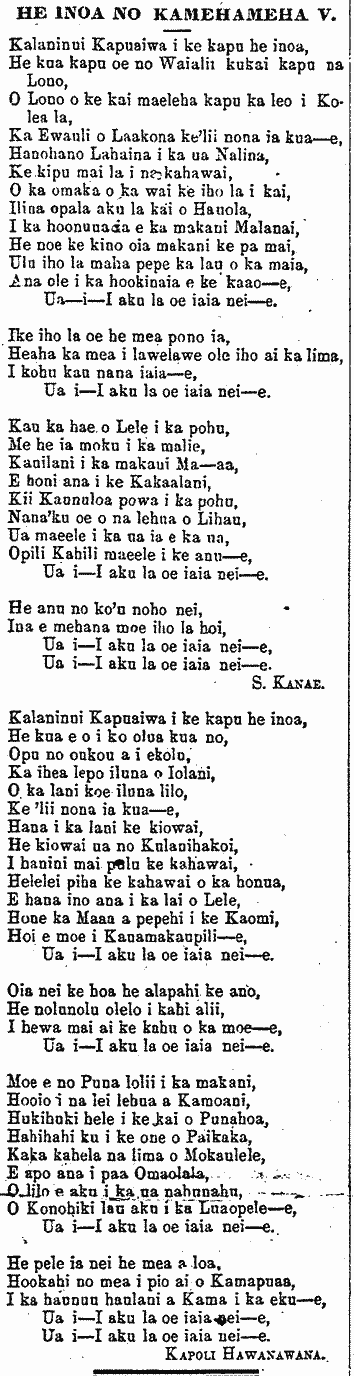
HE INOA NO KAMEHAMEHA V.

Kalaninui Kapuaiwa i ke kapu he inoa,
He kua kapu oe no Waialii kukai kapu na Lono,
O Lono o ke kai maeleha kapu ka leo i Kolea la,
Ka Ewauli o Laakona ke’lii nona ia kua—e,
Hanohano Lahaina i ka ua Nalina,
Ke kipu mai la i na kahawai,
O ka omaka o ka wai ke iho la i kai,
Ilina opala aku la kai o Hauola,
I ka hoonuua ia e ka makani Malanai,
He noe ke kino oia makani ke pa mai,
Ulu iho la maha pepe ka lau o ka maia,
Ana ole i ka hookinaia e ke kaao—e,
Ua—i—I aku la oe iaia nei—e.

Ike iho la oe he mea pono ia,
Heaha ka mea i lawelawe ole iho ai ka lima,
I koho kau nana iaia—e,
Ua i—I aku la oe iaia nei—e.

Kau ka hae o Lele i ka pohu,
Me he ia moku i ka malie,
Kauilani i ka makani Ma—aa,
E honi ana i ke Kakaalani,
Kii Kaunuloa powa i ka pohu,
Nana’ku oe o na lehua o Lihau,
Ua maeele i ka ua ia e ka ua,
Opili Kahili maeele i ke anu—e,
Ua i—I aku la oe iaia nei—e.

He anu no ko’u noho nei,
Ina e mehana moe iho la hoi,
Ua i—I aku la oe iaia nei—e,
Ua i—I aku la oe iaia nei—e.

S. KANAE.

Kalaninui Kapuaiwa i ke kapu he inoa,
Ke kua e o i ko olua kua no,
Opu no oukou a i ekolu,
Ka ihea lepo iluna o Iolani,
O ka lani koe iluna lilo,
Ke ‘lii nona ia kua—e,
Hana i ka lani ke kiowai,
He kiowai ua no Kulanihakoi,
I hanini mai pulu ke kahawai,
Helelei piha ke kahawai o ka honua,
E hana ino ana i ka lai o Lele,
Hone ka Maaa a pepehi i ke Kaomi,
Hoi e moe i Kauamakaupili—e,
Ua i—I aku la oe iaia nei—e.

Oia nei ke hoa he alapahi ke ano,
He nolunolu olelo i kahi alii,
I hewa mai ai ke kahu o ka moe—e,
Ua i—I aku la oe iaia nei—e.

Moe e no Puna lolii i ka makani,
Hooio i na lei lehua a Kamoani,
Hukihuki hele i ke kai o Punahoa,
Hahihahi ku i ke one o Paikaka,
Kaka kahela na lima o Mokaulele,
E apo ana i paa Omaolala,
O lilo e aku i ka ua nahunahu,
O Konohiki lau aku i ka Luaopele—e,
Ua i—I aku la oe iaia nei—e.

He pele ia nei he mea a loa,
Hookahi no mea i pio ai o Kamapuaa,
I ka haunuu haulani a Kama i ka eku—e,
Ua i—I aku la oe iaia nei—e,
Ua i—I aku la oe iaia nei—e.

KAPOLI HAWANAWANA.

[There is one oki of this mele found in the 5/28/1868 issue of Au Okoa by Kekuanaoa, one in the 6/18/1868 issue without an attribution, one in the 7/23/1868 issue by Kamehameha III; three in the 7/30/1868 issue, one by Kalama, one by Kaomi, and the other by Liliha. There are also many issues that are missing for this newspaper, and who knows what treasures might be found once copies of those issues are found!]

(Au Okoa, 9/24/1868, p. 1)

HE INOA NO KAMEHAMEHA V.

Ke Au Okoa, Buke IV, Helu 23, Aoao 1. Sepatemaba 24, 1868.

The latest from Kohala, 1879.

News of the Apaapaa Winds.

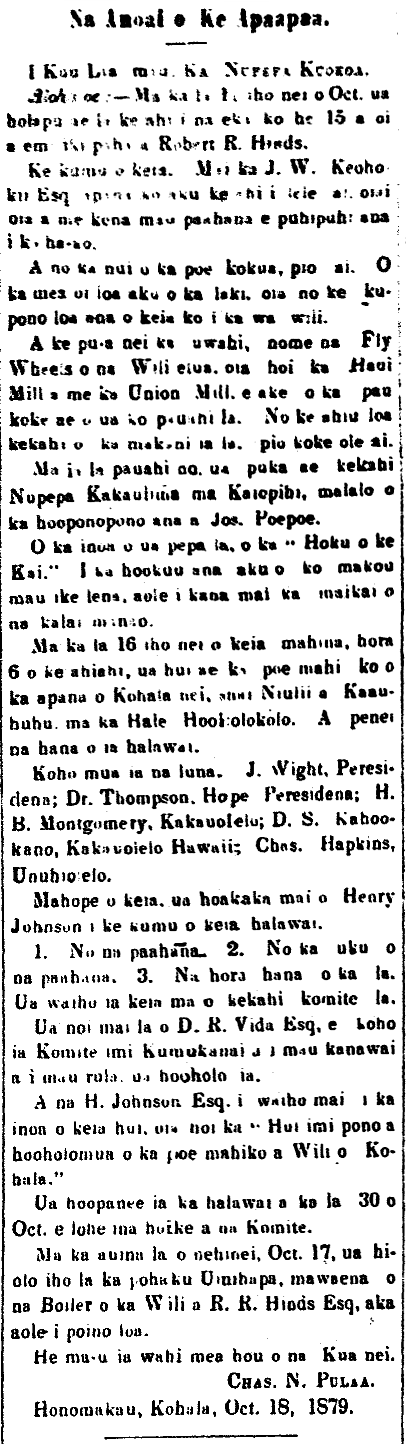
To My Constant Desire, Ka Nupepa Kuokoa.

Aloha oe:—On this past 11th of Oct., fire engulfed more or less 15 acres of Robert R. Hind’s.

This is the cause. The fire jumped from the property of J. W. Keohokii, Esq., while he and his workers were burning the leaves of the sugarcane.

And it was extinguished because of all of those assisting. The luckiest thing was that the cane was all ready to be milled.

While the smoke was billowing, the Fly Wheels of the two Mills spun, that being Haui Mill [Hawi Mill] and Union Mill,  hoping to quickly take care of that burning cane. Because of the terribly wild winds that day, it was not put out quickly.

On that very day of the fire, a Handwritten Newspaper at Kaiopihi under the editing of Joseph Poepoe was issued.

The name of that paper is “Hoku o ke Kai.” When we examined it, the discussions were outstanding.

On the past 16th of this month, at 6 o’clock in the evening, the sugar plantation people of the district of Kohala, from Niulii to Kaauhuhu, met at the Court House. And this is what happened at that meeting.

The officers were chosen first. J. Wight, President; Dr. Thompson, Vice President; H. B. Montgomery, Secretary; D. S. Kahookano, Hawaiian Secretary; Charles Hapkins [Charles Hopkins], Translator.

After this, Henry Johnson explained the purpose of this meeting.

1. Pertaining to the laborers. 2. Pertaining to the wages of the laborers. 3. The work hours per day. This was left to a committee.

D. R. Vida, Esq., asked that a Committee be selected to  form a constitution, laws, and rules; the motion was passed.

H. Johnson, Esq. put forth the name of this organization, that being “Hui imi pono a hooholomua o ka poe mahiko a Wili o Kohala” [Association seeking rights and progress for the workers of the plantations and Mills of Kohala].

The meeting was adjourned until the 30th of Oct. to hear the report of the Committee.

Yesterday afternoon, Oct. 17, a brick fell between the Boilers of the Mill of R. R. Hind, Esq., but there were no serious injuries.

Those were a few news items from here in the Back areas.

Charlse N. Pulaa.

Honomakua, Kohala, Oct. 18, 1879.

(Kuokoa, 10/25/1879, p. 3)

Na Anoai o Ke Apaapaa.

Ka Nupepa Kuokoa, Buke XVIII, Helu 43, Aoao 3. Okatoba 25, 1879.

A Song for Duke Kahanamoku, 1912.

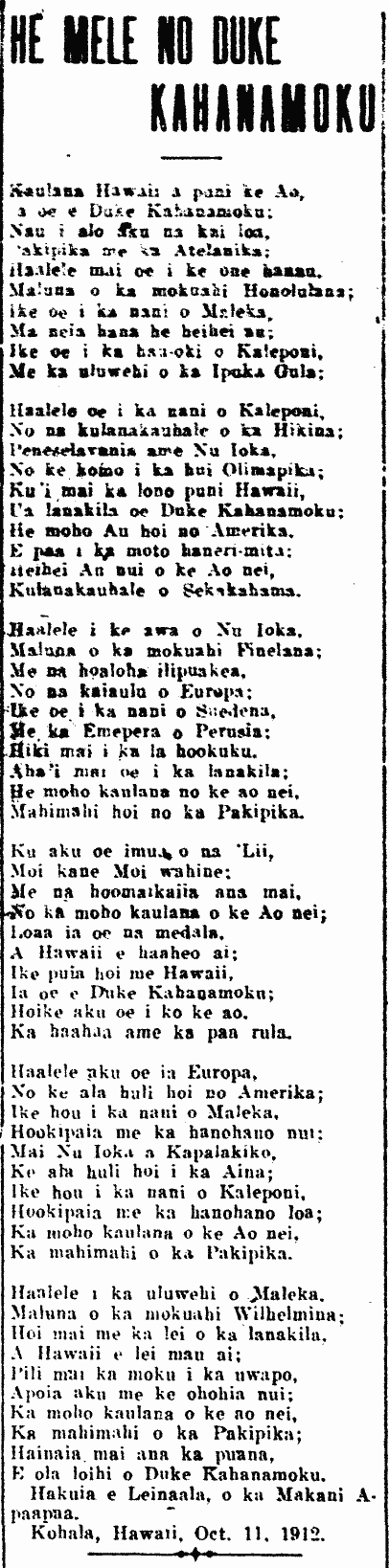
HE MELE NO DUKE KAHANAMOKU

Kaulana Hawaii a puni ke Ao,
Ia oe e Duke Kahanamoku;
Nau i alo aku na kai loa,
Pakipika me ka Atelanika;
Haalele mai oe i ke one hanau,
Maluna o ka mokuahi Honolulana;
Ike oe i ka nani o Maleka,
Ma neia hana he heihei au;
Ike oe i ka hau-oki o Kaleponi,
Me ka uluwehi o ka Ipuka Gula;

Haalele oe i ka nani o Kaleponi,
No na kulanakauhale o ka Hikina;
Peneselavania ame Nu Ioka,
No ke komo i ka hui Olimapika;
Ku’i mai ka lono puni Hawaii,
Ua lanakila oe Duke Kahanamoku;
He moho Au hoi no Ameria,
E paa i ka moto haneri-mita;
Heihei Au nui o ke Ao nei,
Kulanakauhale o Sekokahama.

Haalele i ke awa o Nu Ioka,
Maluna o ka mokuahi Finelana;
Me na hoaloha ilipuakea,
No na kaiaulu o Europa;
Ike oe i ka nani o Suedena,
Me ka Emepera o Perusia;
HIki mai i ka la hookuku,
Aha’i mai oe i ka lanakila;
He mohokaulana no ke ao nei,
Mahimahi hoi no ka Pakipika.

Ku aku oe imua o na ‘Lii,
Moi kane Moi wahine;
Me na hoomaikaiia ana mai,
No ka moho kaulana o ke Ao nei;
Loaa ia oe na medala,
A Hawaii e haaheo ai;
Ike puia hoi me Hawaii,
Ia oe e Duke Kahanamoku;
Hoike akuu oe i ko ke ao,
Ka haahaa ame ka paa rula.

Haalele aku oe ia Europa,
No ke ala huli hoi no Amerika;
Ike hou i ka nani o Maleka,
Hookipaia me ka hanohano nui;
Mai Nu Ioka a Kapalakiko,
Ke ala huli hoi i ka Aina;
Ike hou i ka nani o Kaleponi,
Hookipaia me ka hanohano loa;
Ka moho kaulana o ke Ao nei,
Ka mahimahi o ka Pakipika.

Haalele i ka uluwehi o Maleka,
Maluna o ka mokuahi Wilhelmina;
Hoi mai me ka lei o ka lanakila,
A Hawaii e lei mau ai;
Pili mai ka moku i ka uwapo,
Apoia aku me ke ohohia nui;
Ka moho kaulana o ke ao nei,
Ka mahimahi o ka Pakipika;
Hainaia mai ana ka puana,
E ola loihi o Duke Kahanamoku.

Hakuia e Leinaala, o ka Makani Apaapaa.

Kohala, Hawaii, Oct. 11, 1912.

[A SONG FOR DUKE KAHANAMOKU

Hawaii is renowned world around,
For you, O Duke Kahanamoku,
You faced the great seas,
The Pacific and the Atlantic,
You left your birth sands,
Aboard the steamer Honolulan,
You witnessed the beauty of America,
In this pursuit of swimming competitions,
You saw the icy cold of California,
And the verdure of the Golden Gate.

You left behind the beauty of California,
For the cities in the east,
Pennsylvania and New York,
To join the Olympic team,
The news reached all over Hawaii,
That you were victorious, O Duke Kahanamoku,
You are on the American Swimming team,
You hold the 100-meter record,
In the great Swimming Contest of the World,
In the City of Stockholm.

You left New York Harbor,
Aboard the steamer Finland,
With your fair-skinned friends,
For the cities of Europe,
You witnessed the beauty of Sweden,
And the Emperor of Persia,
The day of the contest arrived,
You took the victory,
The famed champion of the world,
Mahimahi* of the Pacific.

You stood before the Monarchs,
King and Queen,
While being congratulated,
For the famed champion of the World,
You received medals,
For which Hawaii is proud,
Recognized along with Hawaii,
You, O Duke Kahanamoku,
You show the people of the world,
Humility and decorum.

You left Europe,
On the return trip to America,
To see again the beauty of Maleka,
You were welcomed with great pomp,
From New York to San Francisco,
On the road back home,
You witnessed once more the beauty of California,
You were welcomed with much honor,
The famed champion of the World,
Mahimahi of the Pacific.

Leaving behind the verdure of America,
Aboard the steamship Wilhelmina,
Returning with the lei of victory,
Of which Hawaii will forever wear,
The ship touches the dock,
You were embraced with such enthusiasm,
The famed champion of the world,
Mahimahi of the Pacific,
Let the story be told,
Long live Duke Kahanamoku.

Composed by Leinaala, of the Apaapaa Wind.

Kohala, Hawaii, Oct. 11, 1912.

*A mahimahi is a fish that is a fierce swimmer.

[The Duke Paoa Kahanamoku exhibit at the Bishop Museum begins in a week (August 9 to November 30)! I hear there will be a lot of cool things to see and experience…]

(Kuokoa, 10/18/1912, p. 5)
HE MELE NO DUKE KAHANAMOKU

Ka Nupepa Kuokoa, Buke XLVIII, Helu 42, Aoao 5. Okatoba 18, 1912.

David Hauola Makekau and “Leahi,” 1919.

[From: “KUU KAMAAINA I KA UA KUKALAHALE.”]

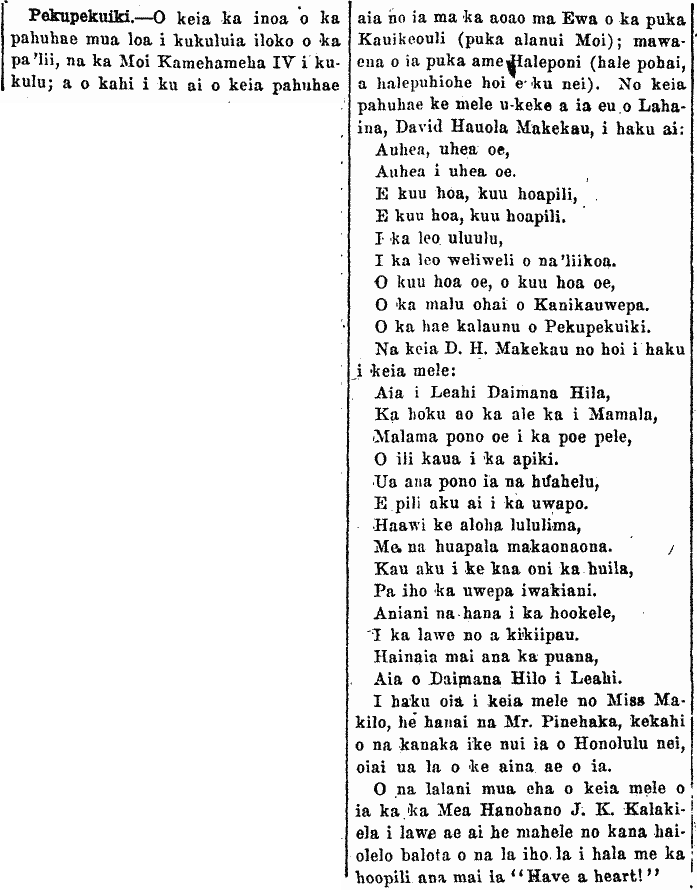
Pekupekuiki.—This is the name of the first flagpole put up in the palace grounds; it was erected by King Kamehameha IV; and this flagpole stood on the Ewa side of the Kauikeaouli gate (the King Street gate); between the gate and Haleponi, “the Coronation Building” (the gazebo and bandstand that stands now). For this flagpole is the u-keke song composed by that spry one of Lahaina, David Hauola Makekau:

Auhea, uhea oe,
Auhea i uhea oe.
E kuu hoa, kuu hoapili,
E kuu hoa, kuu hoapili.
I ka leo uluulu,
I ka leo weliweli o na ʻliikoa.
O kuu hoa oe, o kuu hoa oe,
O ka malu ohai o Kanikauwepa.
O ka hae kalaunu o Pekupekuiki.

It was this D. H. Makekau who indeed composed this mele:

Aia i Leahi Daimana Hila,
Ka hoku ao ka ale ka i Mamala,
Malama pono oe i ka poe pele,
O ili kaua i ka apiki.
Ua ana pono ia na huahelu,
E pili aku ai i ka uwapo.
Haawi ke aloha lululima,
Me na huapala makaonaona.
Kau aku i ke kaa oni ka huila,
Pa iho ka uwepa iwakiani.
Aniani na hana i ka hookele,
I ka lawe no a kikiipau.
Hainaia mai ana ka puana,
Aia o Daimana Hila i Leahi.

He composed this song for Miss Makilo, a hanai child of Mr. Pinehaka [? William Pinehasa Wood], one of the well-known men of Honolulu nei, in those days he lived there [? oiai ua la o ke aina ae o ia].

The first four lines of the mele are what the Honorable J. K. Kalakiela recently took to as part of his election speech adding, “Have a heart!”

[The awesome things you find while watching Merrie Monarch! This description is found in an awesome treatise on place names of Honolulu, “My Familiarity with the Land of the Kukalahale Rain,” which runs in the Kuokoa from 12/20/1918 to 1/24/1919 (although it indicates there is to be more to come), describing famous places of Honolulu in days gone by, written by the Anela o Mekiko, Gabriel K. Keawehaku.

Mahalo to the boys of Na Kamalei o Lililehua for their lively hula inspiring me to do a little searching.

For more on the gates of Iolani Palace, click here for Nanea Armstrong Wassel’s post!

For more on the Hale Poni, again click here for Nanea Armstrong Wassel’s post!!]

(Kuokoa, 1/24/1919, p. 3)

Pekupekuiki.

Ka Nupepa Kuokoa, Buke LVII, Helu 4, Aoao 3. Ianuari 24, 1919.