A cure for leprosy in Hawaii? 1865.

[For the Kuokoa]

Leprosy [“Chinese Disease”]

An Answer.

To you Doctor Gulick [Kauka Kulika]; Aloha oe:—

In the Mar. 30th issue of the Kuokoa, on page 2, there is a statement, “I have been told that Doctor Baldwin [Kauka Baluina] has cured some patients of this type. Is this true? If this is true, he should tell us.” It is to this question that I am responding to. It is indeed true, some people were cured with the medicine I am administering to those with the “Chinese disease.” Five are the number of those who ingested the medicine here in Lahaina. Three of them were totally cured; two, did not follow the instructions for the medicine and followed after this medicine and that medicine Hawaiians are taking for the “mai Pake.” Therefore, I’ve given up on that medicine [for those two]. I’ve given the medicine to a woman in Koolau, Oahu and I’ve heard that her “mai Pake” is somewhat better.

I did not consider prescribing this medicine to a great number of patients from the beginning; but instead to wait, and to see the affects of the medicine and if it was effective or not. Therefore, I watched carefully the people I cared after here in Lahaina; and I am hopeful that all the leprosy patients will be cured with this medicine. Let us not boast, for medicine like this has been given in other countries, and it is said that some have been cured while the illness of other has been persistent. The “Chinese disease” is referred to amongst enlightened Doctors [Kahuna lapaau] as leprosy [lepera]; leprosy is its name; however this is not the exact same thing as the leprosy of the Israelites. Some Doctors from Europe say that if this is a new leprosy, it is curable; if it is an ancient leprosy, it cannot be cured. A skilled Doctor from France, he says, all of the leprosy patients he has seen, both the new and ancient types, are curable only with this medicine.

If we are talking about ancient leprosy, I will mention one of these maii Pake cured in Lahaina. It is a man who is over fifty years of age; he was afflicted with mai Pake for fourteen years; his eyes were swollen, and his ears were knobby, lumpy, swollen, shiny, and thick; his feet and fingers were swollen, and he could do no work. He was treated by the Doctors of Lahaina; I gave him a lot of medicine, without his illness lessening. And I came upon this medicine I am working with, and gave him a pill in the morning and one at night. That is how he took this medicine every day, and three months and a half went by. He was careful in what he ate. His illness lessened; and after those months were over, his disease was entirely cured. This is now a year that he’s been cured, and the disease has not reappeared.

This is ancient leprosy.

I will not say what the name of this medicine is, for it is a poison if an unskilled one uses it. It would not be good if a Hawaiian prescribed this medicine. It is only for educated Doctors and just for them.

I am not the only one with this medicine for leprosy. All of the Haole Doctors in Hawaii have it, and they know well how to prescribe it for leprosy patients. This medicine is made into a liquid sometimes; it is the same medicine. The doctors of Honolulu have prescribed this medicine and other medicines to some leprosy patients, and they were cured. The medicine Book speaks of this medicine as good for leprosy. Dr. Good of London, a haole that is brilliant in doctoring says, “There is no other medicine that is as powerful and good for curing leprosy in all lands.” I spoke with the doctors of Honolulu about this illness, and Dr. Judd made some medicine for me. Doctor Smith [Mika] of Koloa prescribed this drug, and told me that it is a good medicine. Doctor Wetmore [Wetemore] of Hilo assisted me greatly in this effort, and said, “Try this medicine for the leprosy patients in Lahaina.”

If this is how prepared the Haole Doctors are for this disease, where does the problem lie with leprosy amongst us? Here is the problem; most of the leprosy patients are terribly simpleminded. They want to get cured quickly and follow after this or that foolishness called a medicine that works. There are many Hawaiians, uneducated people, who are treating leprosy, prescribing this medicine and that, haole medicine as well as Hawaiian medicine. One person says, “You will be cured with awa.” There are many who are fond of pain killers [penikila]; some cut their flesh with a piece of glass; and some here in Lahaina persist in eating cat, because some Chinese said, if they eat cat meat, they will be cured. In the year 1863, there were 50 leprosy patients in Lahaina—ten of them died that year. The illness of some of them was not that severe, but they died. In my opinion, they died because of bad medical treatment. These days, some of us who have this disease, they are strong and fine; they have an appetite, and go around here and there, but while they are strong, they die all of a sudden. What is tha about? His doctor is blind. It would be good to punish them for murder.

This land will be blessed by the good law for the leprosy patients that was passed this year. Those people must be segregated, or the land will be full of that horrible thing. I do not believe that it is right to put the patients on a ship and send them to another island, or the islands will become infested. It would be better that there be some small buildings where they are to live—two on Hawaii, two on Maui, and one on Oahu, and so forth. If it is done correctly, and if it is the Haole Doctor that does the treating, I am hopeful that in less than five years’ time, leprosy will be gone from the land.

With aloha,

D. Baldwin.

[Read this article, and then read the following post…]

(Kuokoa, 4/13/1865, p. 1)
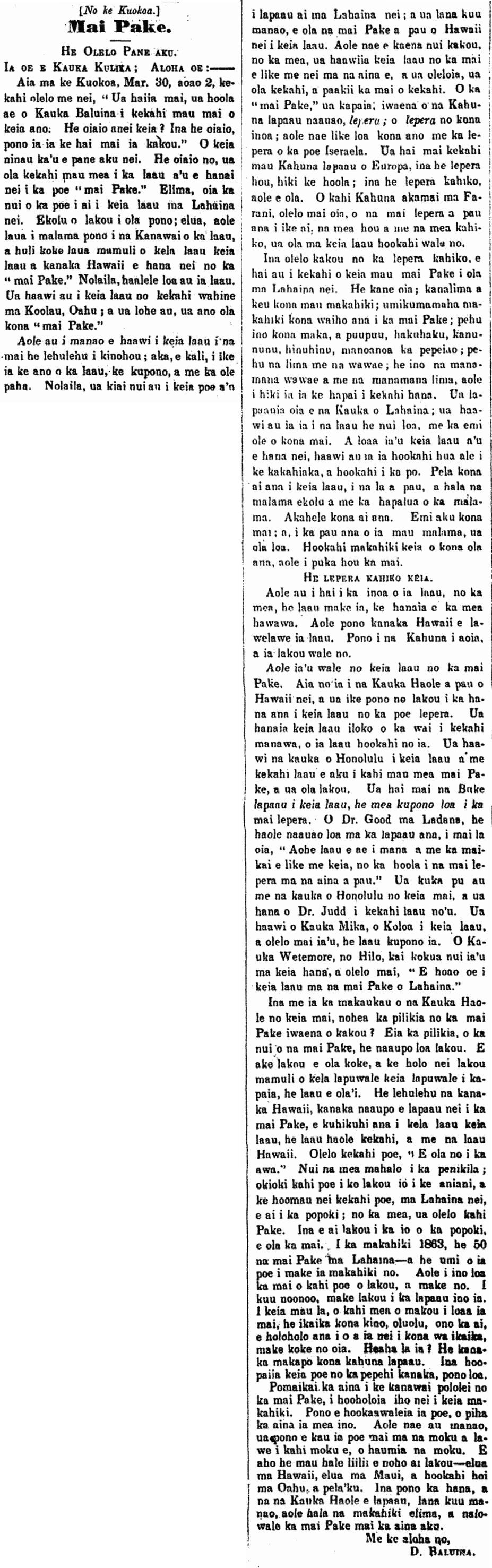
Mai Pake.

Ka Nupepa Kuokoa, Buke IV, Helu 15, Aoao 1. Aperila 13, 1865.

Member districts, parties, and committees of the legislature, 1913.

Members of the Senate by Island

Hawaii—

R. H. Makekau, R. [Republican]
D. E. Metzger, D. [Democrat]
D. Baker, D.
G. C. Hewitt, R.

Maui—

H. B. Penhallow, R.
H. Pali, R.
H. Baldwin, R.

Oahu—

A. Judd, R.
C. Brown, R.
Chillingworth, R.
C. P. Iaukea, D.
Wirtz, D.
Coke, D.

Kauai—

Charles A. Rice, R.
E. A. Knudsen, R.

Standing Committees of the Senate.

Committee on Ways and Means [Komite o na loaa ame hoolilo]—Rice, Chairman; C. Brown, Iaukea, Metzger, Baldwin.
Committee on Judiciary [Hookolokolo]—A. Judd, Chairman; Brown, Makekau.
Committee on Public Lands and Internal Improvements [Na Aina Aupuni ame na Hana Hou Kuloko]—Baldwin, Chairman; Metzger and Hewitt.
Committee on Education [Komite Hoonaauao]—Penhallow, Chairman; Rice, Makekau.
Committee on Enrollment, Revision and Printing [Komite Pai]—Pali, Chairman; Iaukea, Judd.
Committee on Accounts [Komite Papahelu]—Brown, Chairman; Wirtz, Hewitt.
Committee on Military [Komite Oihana Koa]—Chillingworth, Chairman; Coke, Penhallow.
Committee on Public Health [Komite Ola]—Chillingworth, Chairman; Judd, Wirtz.
Committee on Manufactures, Forestry and Promotion [Komite Ululaau ame hooholomua]—Hewitt, Chairman; Baker, Penhallow.
Committee on Rules [Komite o na Rula]—Rice, Chairman; Pali, Baker.

Standing Committees of the House.

Finance [Waiwai]—Watkins, George P. Cooke, Spalding, Lyman, C. H. Cooke, Kaaua, Paele.
Judiciary [Hookolokolo]—Sheldon, Coney, Tavares, Poepoe, Paele.
Public Lands and Internal Improvements [Aina Aupuni ame Hana Hou kuloko]—Huddy, Lota, Kaupiko, Silva, Goodness, Robertson, Kalakiela.
Agriculture [Mahiai]—George P. Cooke, Silva, Goodness, Irwin, Paxson.
Health and Police [Ola ame Makai]—Coney, Makekau, Kawewehi, Irwin, Asch.
Education [Hoonaauao]—C. H. Cooke, Huddy, Spalding, Kinslea, Paxson.
Miscellaneous [Huikau]—Lyman, Waiaholo, Kaaua, Asch, Kaniho.
Accounts and Public Expenditures [Papahelu]—Tavares, Watkins, Wilcox, Kupihea, McCandless.
Printing, Revisions and Enrollment [Pa’i]—Waiaholo, Lota, Kaupiko, Robertson.
Military [Koa]—Kawewehi, Makekau, Wilcox, McCandless, Kaniho.
Rules [Rula]—Holstein, Sheldon, Poepoe, Kalakiela, Kupihea.

MEMBERS OF THE HOUSE OF REPRESENTATIVES.

EAST HAWAII.

G. H. Huddy, R.
A. Irwin, D.

WEST HAWAII.

H. L. Holstein, R.
E. K. Kaaua, R.
D. K. Kaupiko, R.
H. L. Kawewehi, H. R. [Home Rule]

MAUI.

G. P. Cooke, R.
P. J. Goodness, R.
C. K. Makekau, R.
A. F. Tavares, R.
E. Waiaholo, R.
John Wilcox, R.

OAHU.

C. H. Cooke, R.
Norman Watkins, R.
J. W. Asch, D
W. R. Kinslea, D.
A. S. Paxson, D.
A. Robertson, D.
J. S. Kalakiela, D.
H. M. Kaniho, D.
D. Kupihea, D.
E. J. McCandless, D.
J. K. Paele, D.
J. M. Poepoe, D.

KAUAI.

J. H. Coney, R.
J. K. Lota, R.
W. J. Sheldon, R.
R. P. Spalding, R.

(Kuokoa, 2/21/1913, p. 1)

Na Hoa o ke Senate ma na Mokupuni.

Ka Nupepa Kuokoa, Buke L, Helu 8, Aoao 1. Feberuari 21, 1913.

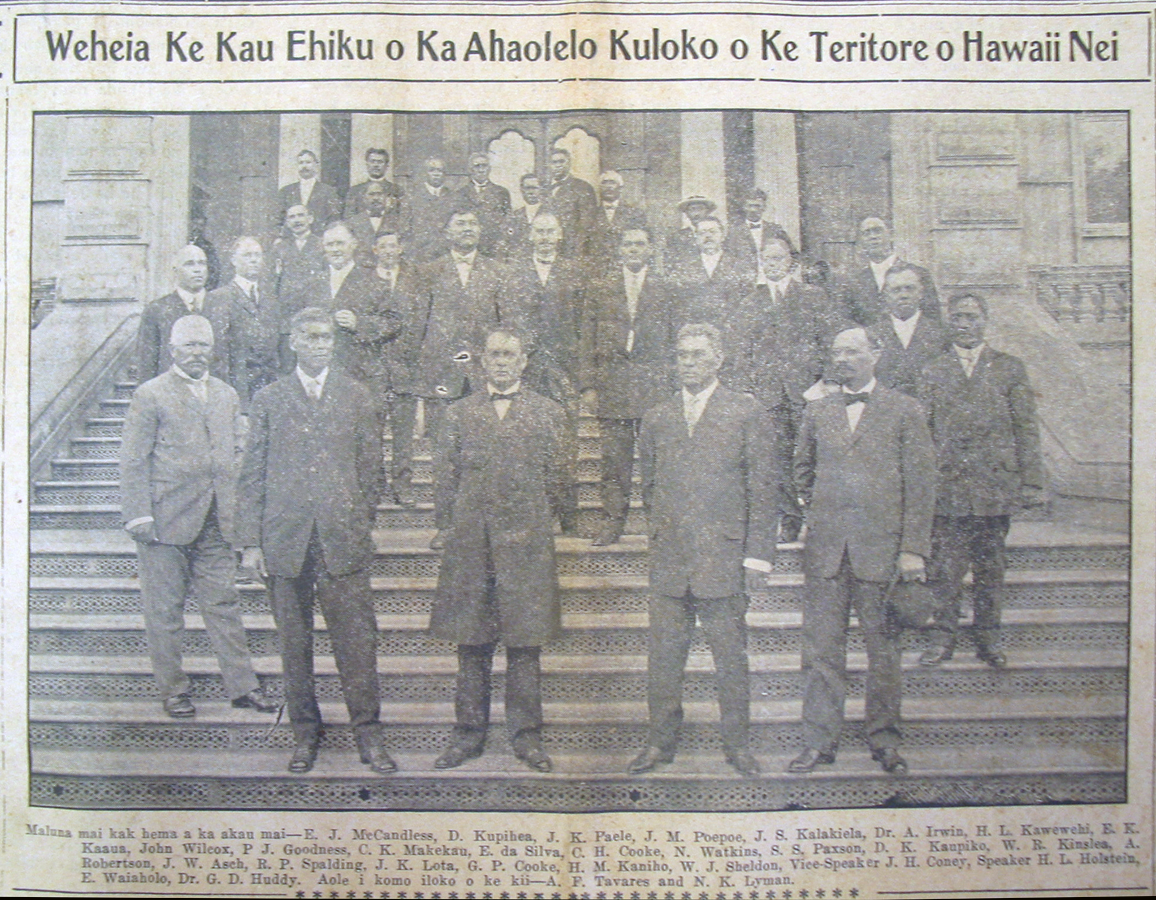
Opening of the legislature a hundred years ago, 1913.

The Seventh Local Legislature of the Territory of Hawaii Opens.

Top from the left to right—E. J. McCandless, D. Kupihea, J. K. Paele, J. M. Poepoe, J. S. Kalakiela, Dr. A. Irwin, H. L. Kawewehi, E. K. Kaaua, John Wilcox, P. J. Goodness, C. K. Makekau, E. da Silva, C. H. Cooke, N. Watkins, S. S. Paxson, D. K. Kaupiko, W. R. Kinalea, A. Robertson, J. W. Asch, R. P. Spalding, J. K. Lota, G. P. Cooke, H. M. Kaniho, W. J. Sheldon, Vice-Speaker J. H. Coney, Speaker H. L. Holstein, E. Waiaholo, Dr. G. D. Huddy. Not included in this picture—A. F. Tavares and N. K. Lyman.

[Kuokoa 1913 should be “Buke XLIX” but the Volume number in this issue is mislabeled as “Buke L” and later issues are mislabeled as “Buke VL” and “Buke LI”. Eventually the rest of this year is labeled “Buke LI” and the following 1914 as a result is called “Buke LII”.

Hopefully one day soon the Hawaiian-Language Newspapers will be rescanned so we can see clearer images of pictures like these from its pages!]

(Kuokoa, 2/21/1913, p. 1)

Weheia Ke Kau Ehiku o Ka Ahaolelo Kuloko o Ke Teritore o Hawaii Nei

Ka Nupepa Kuokoa, Buke XLIX, Helu 8, Aoao 1. Feberuari 21, 1913.

Painting dated using the Hawaiian-Language Newspapers? 1906.

BEATIFUL VIEW OF THE FAMOUS HILL OF KAIMANA HILA [DIAMOND HEAD], PAINTED BY ALEXANDER SCOTT [ALEKANEKELO SCOTT].

[This seems to be the painting, “Diamond Head from Tantalus,” currently dated c. 1906–1908. But being that it appears here already in 1906, this would mean that it was definitely painted in 1906 (if Scott arrived in Hawaii that same year).]

(Kuokoa, 3/23/1906, p. 3)

KEKAHI NANAINA NANI...

Ka Nupepa Kukoa, Buke XLIV, Helu 12, Aoao 3. Maraki 23, 1906.

More on Kaheleiki trial: “Something not to be forgotten.” 1863.

Voyage of the Hawaiian Chiefs to San Francisco.

This past Wednesday morning [4/15/1863], the Honorable C. Gordon Hopkins [Hapakini], John Ii [Ioane Ii], Kaisara Kapaakea [Caesar Kapaakea], and J. Koii Unauna, along with the one who is involved in the dispute for whom they went to testify for, namely Harry Kaheleiki, came to shore riding aboard the ship, Yankee; and we are pleased to report the public that they are in good health.

During the trial of Harry Kaheleiki in San Francisco, there were many witnesses strongly against him; however, with the arrival of the alii mentioned above, there was true testimony in favor of the accused, and the error of those who testified against him was clear. The newspapers of San Francisco were filled with thoughts of appreciation for this Nation sending witnesses at much expense to have one of its citizens wrongly charged in a foreign land set free; according to one of the papers, this is a benevolent act not done by the enlightened Nations of the world, and so the Hawaiian Nation has taken the lead in this fine action. This is truly an act of aloha, and it is something not to be forgotten for all times.

The reason it was heard that a Hawaiian was being imprisoned in San Francisco was because of Doctor Gulick [Gulika], the one who was previously living in the islands of Micronesia, and due to weakening health, arrived in California. While he was in San Francisco several months ago, he heard that there was a Hawaiian man being held in one of the Jails there on the charge of murder; he therefore went quickly to meet with the man, and when he got there, he spoke with the aforementioned Kaheleiki, and though this conversation, it was clear in Doctor Gulick’s mind that the accused was innocent. And because Kaheleiki asked him if they could wait until witnesses were sent for from Hawaii for him, there would be many who would testify that he was innocent of the charges against him. So Doctor Gulick immediately went to the office of the Hawaiian Consul, Mr. Hitchcock [Kanikela Hawaii o Mr. Hikikoki], and told him about the circumstances of Kaheleiki and how he was certain that Kaheleiki was innocent of the charges. When the Hawaiian Consul heard of this, he went at once to meet with the accused, and upon seeing his demeanor and what he had to say, he knew for himself that Kaheleiki was innocent. He then went quickly to see the Judge to ask that the trial of Kaheleiki be postponed until he heard from here; for he had witnesses here for him. And that is how time was given to send his witnesses, and that is how he was freed. And when he sent for witnesses here, along with a letter from Doctor Gulick, and when His Highness L. Kamehameha heard of this, he along with Sheriff W. C. Parke put great effort into finding appropriate witnesses to testify for Kaheleiki, the one who was falsely charged. We are filled with appreciation for the Royal One, His Highness, and the Sheriff.

We must thank Doctor Gulick, and we are truly thankful for him in the name of all who desire that the innocent who are persecuted be freed, and in the name of all who strive to find ways to free the innocent from the hands of those who oppose them, while they live in foreign lands. God shall free the righteous.

[There are countless stories like this in the Hawaiian-Language Newspapers that should be relearned and retold and retold again, so they are not forgotten!]

(Kuokoa, 4/18/1863, p. 3)

Ka Huakai a na 'Lii Hawaii i Kapalakiko.

Ka Nupepa Kuokoa, Buke II, Helu 16, Aoao 3. Aperila 18, 1863.

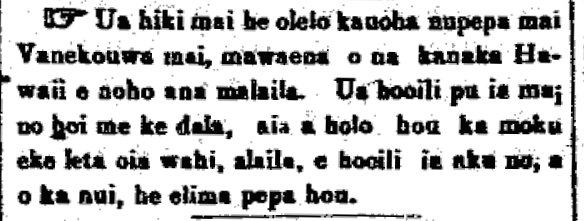
Hawaiian-Language Newspapers for Vancouver, 1863.

Orders for newspaper subscriptions came from Vancouver from amongst the Hawaiians living there. It was sent along with the money, and when the mail ship for that area leaves again, it will be sent; the number is five more papers.

(Hoku o ka Pakipika, 2/26/1863, p. 3)

Ua hiki mai he olelo kauoha nupepa...

Ka Hoku o ka Pakipika, Buke 2, Helu 20, Aoao 3. Feberuari 26, 1863.

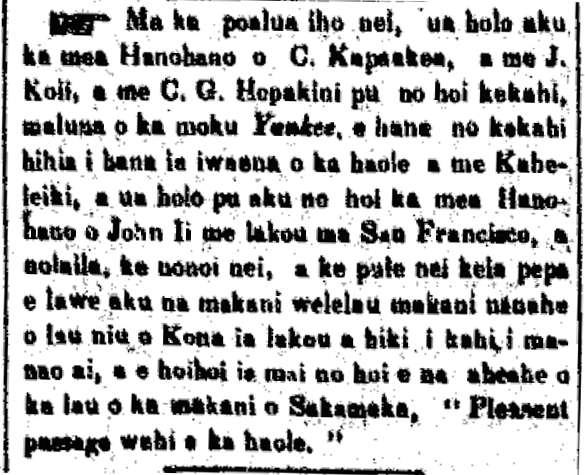
More on the Kaheleiki trial, 1863.

This past Tuesday [2/17/1863], the Honorable C. Kapaakea, and  J. Koii, and C. G. Hopkins also went aboard the ship Yankee, to appear in a case raised between the haole and Kaheleiki; the Honorable John Ii also accompanied them to San Francisco, and this paper hopes and prays that the fringes of the winds; the gentle winds of the coconut fronds of Kona take them to their destination, and that they are brought back by the soft puffs of the wind of Sakameka [? Sacramento]; “Pleasant passage,” according to the haole.

(Hoku o ka Pakipika, 2/19/1863, p. 2)

Ma ka poalua iho nei...

Ka Hoku o ka Pakipika, Buke 2, Helu 19, Aoao 2. Feberuari 19, 1863.

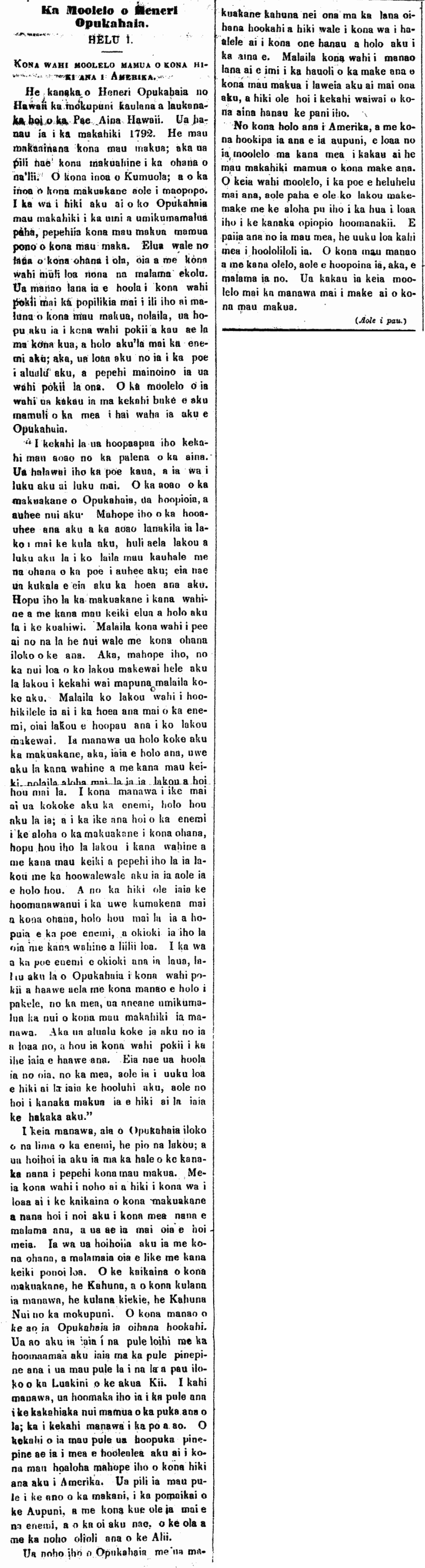
Biography of Henry Opukahaia, 1865–1866.

Here is one of a number of times where the Hawaiian-Language Newspapers run the biography of Heneri Opukahaia. This is a translation of the book, “MEMOIR OF HENRY OBOOKIAH, A NATIVE OF THE SANDWICH ISLANDS, WHO DIED AT CORNWALL, CONNECTICUT, FEBRUARY 17, 1818, AGED 26.” by Rev. E. W. Dwight. The story runs in the Kuokoa from 9/9/1865 until 3/24/1866.

This is not the same text as the book published later in Hawaiian in 1867 in New York: “KA MOOLELO O HENERI OPUKAHAIA, UA HANAUIA MA HAWAII, M. H. 1787, A UA MAKE MA AMERIKA, FEBERUARI 17, 1818. OIA KA HUA MUA O HAWAII NEI.” The published book is based on the same English story, but is edited for errors, and includes further information gathered by Rev. S. W. Papaula in Kealakekua. That being said, most books in Hawaiian were first printed as a serial in the newspapers first, and then published as a book.

It opens this way:

The Story of Henry
Opukahaia

NUMBER 1.

HIS STORY PRIOR TO HIS
ARRIVAL IN AMERICA.

Heneri Opukahaia is from Hawaii, the famous and densely populated island of the Hawaiian Archipelago. He was born in the year 1792. His parents were makaainana, however, his mother was connected to chiefly circles. Her name was Kumuola, and the name of his father is not known. When Opukahaia reached the age of perhaps ten or twelve, his parents were killed before his eyes. There were but two in his family that survived, he and his youngest sibling who was three months old. He hoped to save his young sibling from the tragedy which befell upon his parents, so he grabbed his little sibling and placed it upon his back and ran from the enemy; however, he was found by those chasing after them, and the younger sibling was cruelly killed. That telling of that account is written in another book according to what was told by Opukahaia…

[If you are in or around Hilo this Monday, consider checking out the talk by Deborah Liʻikapeka Lee on Opukahaia at the Lyman Museum. For more information see the Lyman Museum page.]

(Kuokoa, 9/9/1865, p. 2)

Ka Moolelo o Heneri Opukahaia.

Ka Nupepa Kuokoa, Buke IV, Helu 36, Aoao 2. Sepatemaba 9, 1865.

Mahalo to MAB for pointing to this article on the Kaheleiki trial, 1863.

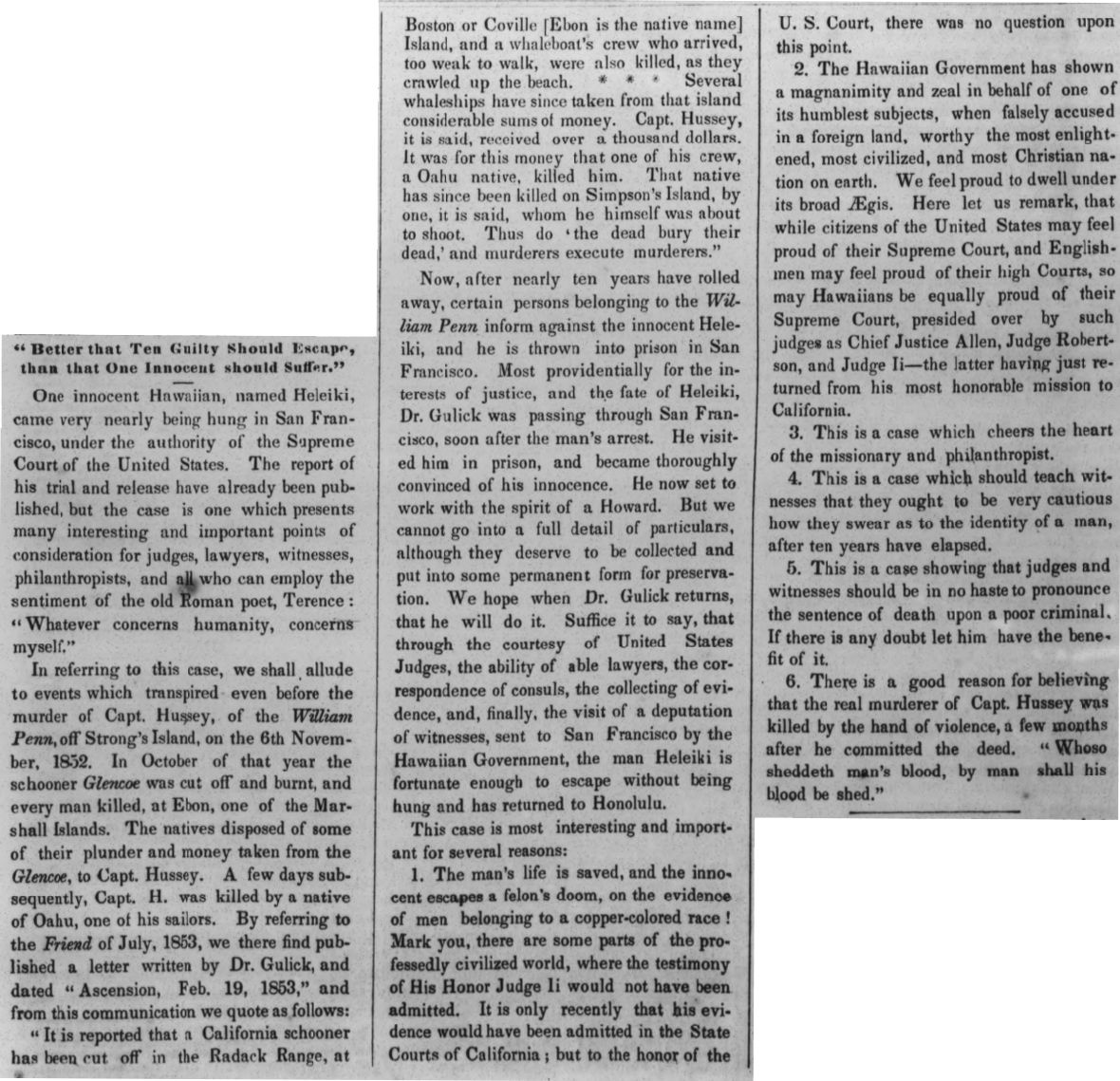
“Better that Ten Guilty Should Escape, than that One Innocent should Suffer.”

One innocent Hawaiian, named Heleiki, came very nearly being hung in San Francisco, under the authority of the Supreme Court of the United States. The report of his trial and release have already been published, but the case is one which presents many interesting and important points of consideration for judges, lawyers, witnesses, philanthropists, and all who can employ the sentiment of the old Roman poet, Terence: “Whatever concerns humanity, concerns myself.”

In referring to this case, we shall allude to events which transpired even before the murder of Capt. Hussey, of the William Penn, off Strong’s Island, on the 6th of November, 1852. In October of that year the schooner Glencoe was cut off and burnt, and every man killed, at Ebon, one of the Marshall Islands. The natives disposed of some of their plunder and money taken from the Glencoe, to Capt. Hussey. A few days subsequently, Capt. H. was killed by a native of Oahu, one of his sailors. By referring to the Friend of July, 1853, we there find published a letter written by Dr. Gulick, and dated “Ascension, Feb. 19, 1853,” and from this communication we quote as follows:

“It is reported that a California schooner has been cut off in the Radack Range, at Boston or Coville (Ebon is the native name) Island, and a whaleboat’s crew who arrived, too weak to walk, were also killed, as they crawled up the beach. * * * Several whaleships have since taken from that island considerable sums of money. Capt. Hussey, it is said, received over a thousand dollars. It was for this money that one of his crew, a Oahu native, killed him. That native has since been killed on Simpson’s Island, by one, it is said, whom he himself was about to shoot. Thus do ‘the dead bury their dead,’ and murderers execute murderers.”

Now, after nearly ten years have rolled away, certain persons belonging to the William Penn inform against the innocent Heleiki, and he is thrown into prison in San Francisco. Most providentially for the interests of justice, and the fate of Heleiki, Dr. Gulick was passing through San Francisco, soon after the man’s arrest. He visited him in prison, and became throughly convinced of his innocence. He now set to work with the spirit of a Howard. But we cannot go into a full detail of particulars, although they deserve to be collected and put into some permanent form for preservation. We hope when Dr. Gulick returns, that he will do it. Suffice it to say, that through the courtesy of United States Judges, the ability of able lawyers, the correspondence of consuls, the collecting of evidence, and, finally, the visit of a deputation of witnesses, sent to San Francisco by the Hawaiian Government, the man Heleiki is fortunate enough to escape without being hung and has returned to Honolulu.

This case is most interesting and important for several reasons:

1. The man’s life is saved, and the innocent escapes a felon’s doom, on the evidence of men belonging to a copper-colored race! Mark you, there are some parts of the professedly civilized world, where the testimony of His Honor Judge Ii would not have been admitted. It is only recently that his evidence would have been admitted in the State Courts of California; but to the honor of the U. S. Court, there was no question upon this point.

2. The Hawaiian Government has shown a magnanimity and zeal in behalf of one of its humblest subjects, when falsely accused in a foreign land, worthy the most enlightened, most civilized, and most Christian nation on earth. We feel proud to dwell under its broad Ægis. Here let us remark, that while citizens of the United States may feel proud of their Supreme Court, and Englishmen may feel proud of their high Courts, so may Hawaiians be equally proud of their Supreme Court, presided over by such judges as Chief Justice Allen, Judge Roberson, and Judge Ii—the latter having just returned from his most honorable mission to California.

3. This is a case which cheers the heart of the missionary and philanthropist.

4. This is a case which should teach witnesses that they ought to be very cautious how they swear as to the identity of a man, after ten years have elapsed.

[See earlier article: Government officials to go to California to defend a Hawaiian citizen. 1863.]

(Friend, 5/1/1863, p. 33)

"Better that Ten Guilty Should Escape, than that One Innocent should Suffer."

The Friend, New Series, Volume 12, Number 5, Page 33. May 1, 1863.