More on John K. Waiamau and others, 1893.

PERSONAL.

President Dole’s illness has been caused by an ulcerated tooth. He is now on the mend.

John K. Waiamau, the accomplished young architect is going to Chicago at the expense of his employer, C. B. Ripley to study architectural drawing.

Ornithologist Palmer returned on the Pele last evening from Makaweli, where he has been collecting birds for the British Museum.

(Hawaiian Star, 8/18/1893, p. 2)

PERSONAL.

The Hawaiian Star, Volume I, Number 122, Page 2. August 18, 1893.

John K. Waiamau, the artist, 1904.

11th of June

Sports in Kalaupapa

KRG

The Butts

Bull’s Eye.

The Losers.

Scorer.

Bicycle Race.

Horse Race.

DRAWN BY JOHN K. WAIAMAU.

(Hawaiian Gazette, 6/17/1904, p. 5)

11th of June

Hawaiian Gazette, Volume XXXIX, Number 49, Page 5. June 17, 1904.

Primo across the sea, 1912.

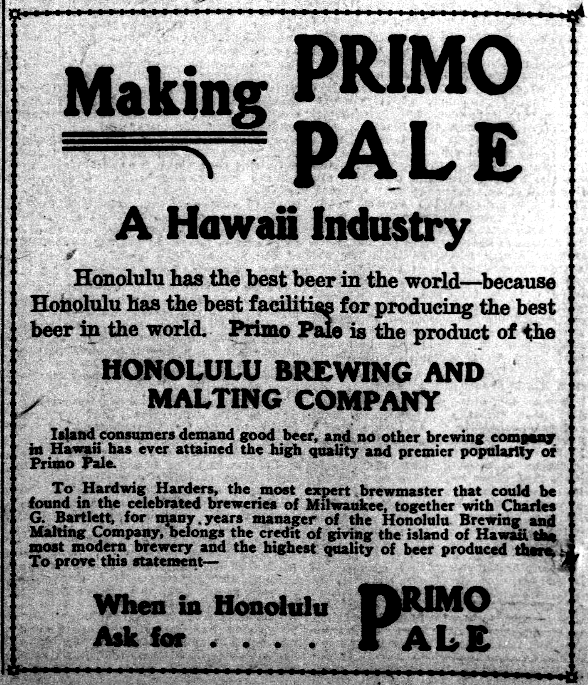
Making PRIMO PALE

A Hawaii Industry

Honolulu has the best beer in the world—because Honolulu has the best facilities for producing the best beer in the world. Primo Pale is the product of the

HONOLULU BREWING AND
MALTING COMPANY

Island consumers demand good beer, and no other brewing company found in the celebrated breweries of Milwaukee, together with Charles G. Bartlett, for many years manager of the Honolulu Brewing and Malting Company, belongs the credit of giving the island of Hawaii this most modern brewery and the highest quality of beer produced there. To prove this statement—

When in Honolulu Aks for… PRIMO PALE

[The issue of the SF Call that this advertisement appears in is the Hawaiian Publicity Edition, sixteen pages of articles and pictures dealing with Hawaii nei.]

(San Francisco Call, 8/14/1912, p. 6)

Making PRIMO PALE

The San Francisco Call, Volume CXII, Number 75, Page 6. August 14, 1912.

Sanford B. Dole, the Congregationalists, and Annexation, 1902.

THE HAWAIIAN SITUATION.

On Monday evening, April 28 last, Governor Dole was the guest of the Congregational Club of Boston. Elsewhere in this issue will be found a sketch made by Dole of the Hawaiian situation. It is characteristic of the man. Having the full support of the Administration behind him he is not afraid to say in public what he has been thinking in private for many long years. Let us see and take up his points one by one.

Point No. 1.—”The monarchy was overthrown and annexation was accomplished for the sake of good government for the islands; that is, for their benefit.”—It is true! Annexation was accomplished, by a handful of Congregationalists because the reciprocity treaty between the United States and Hawaii was in imminent danger of being abrogated. The monarchy was overthrown, so as to save the $40 per ton duty on sugar. It was then as it is now for the Congregationalists:—Money before principle.

Point No. 2:—”We have given you everything we have by being annexed.”—That is, Sanford B. Dole, and his Congregationalist friends have given to the United States that which did not belong to them. With the help of an American cruiser, American marines and an American Minister, they have robbed the native Hawaiians of their country so as to enable a few Congregationalist planters to keep up receiving big dividends from their sugar stocks which would have been materially cut down had a $40 duty been imposed upon each ton of sugar. The Springfield Republican adds the following comment to Point No. 2: “But the second point that they have given us all they have is not at all consistent with his first point that they sought Annexation for the benefit of the Islands, and it shows that they are still trying to work the United States for the benefit of the Hawaiians.” Continue reading

Republican candidates for Maui, 1904.

REPUBLICAN TICKET ON MAUI ISLE

HON. PHILIP PALI OF LAHAINA.

MOSES K. NAKUINA OF MOLOKAI.

W. J. COELHO OF WAILUKU.

GEORGE COPP.

A. N. HAYSELDEN, NOMINEE FOR SENATOR.

HON. W. P. HAIA OF HANA.

JOHN KALINO OF HAMAKUAPOKO.

(Hawaiian Gazette, 9/23/1904, p. 5)

REPUBLICAN TICKET ON MAUI ISLE

Hawaiian Gazette, Volume XXXIX, Number 77, Page 5. September 23, 1904.

James Keauiluna Kaulia and David Kalauokalani, 1897.

HAWAIIANS EMPHATICALLY OPPOSED TO ANNEXATION.

As president of the Hawaiian Patriotic League of the Hawaiian Islands, I honestly assert from an intimate knowledge of the Hawaiian people that they, men and women, as a race and nation, are emphatically opposed to the annexation of Hawaii to the United States of America or to any other nation.
We love our independence too dearly.
JAMES KEAUILUNA KAULIA.
I, as president of the Hawaiian Political Association of the Hawaiian Islands; affirm and indorse the statement of the Hawaiian Patriotic League.
DAVID KALAUOKALANI.

[Check out the latest in the four-part series by the Hawaiian Patriots Project.

James Keauiluna Kaulia.

And previously:

George Helm and Alice Kamokila Campbell.

And coming up in the near future on the 16 of September, Piilani (the wahine of Kaluaikoolau).]

(San Francisco Call, 9/24/1897, p. 2)

HAWAIIANS EMPHATICALLY OPPOSED TO ANNEXATION.

The San Francisco Call, Volume LXXXII, Number 116, Page 2. September 24, 1897.

Snow… up in the Waianae mountains? 1862.

The Weather.

This unfailing topic of general conversation has suffered no diminution of late. Thunder, lighting, rain and hail, and even snow, according to some, have prevailed in quantities and duration beyond the memory of the “oldest inhabitant.” On Friday night, the 14th inst., hail fell in Koolauloa on this island, and we are told, in quantities to be scooped up by the hands, and people crossing the Waianae mountains that night report that snow fell thick on the mountain peaks. On Saturday morning the thermometer in Honolulu stood at 53°, and credible people aver that the saw snow flakes in the air, though they melted by or before touching the ground. Wednesday morning, this week, a thunderstorm passed over this town from the Southwest which, for sharpness of lightning and loudness of thunder, was the severest of many years. The lightning apparently played over the town in every direction, yet, we are happy to say, without any damage, excepting that a Chinaman was knocked down in the street and remained for some time perfectly paralysed before coming to, and a man, hoisting the colors on a flagstaff, felt a blow over the wrist which benumbed the hand for upwards of an hour before it passed off. In the afternoon of the same day the weather cleared up a little, but during the night, between 11½ and 3 o’clock, the thunderstorm raged again in all imaginable fury, accompanied with showers of rain so severe that it seemed almost impossible for any roofing to withstand the force of the fall or the weight of the falling water. The Waikiki plains were at one time almost literally a sheet of water, and partial freshets occurred in several directions, though the main river of the Nuuanu Valley was not filled so as to endanger the bridge leading over it. How many inches, or rather feet, of rain fell that night we have not learned, but the amount must have been enormous.

[This was a very strange year. Hualalai was cloaked in snow as well!]

(Polynesian, 2/22/1862, p. 2)
The Weather.

The Polynesian, Volume XVIII, Number 43, Page 2. February 22, 1862.

Mafia? 1893.

AN AMERICAN MAFIA.

“The Queen never will be restored to the throne, for she will be shot within 24 hours, and every man who takes office under her will be shot also—we have men secretly sworn to do it.”

Such was the remark made to the writer by a brainless young sprig of the “citizens reserve,” such is the tenor of numerous open threats of the canaille composing the annexation club, the citizens reserve and the American league organizations that pretending to be patriotically American are in fact veritable nests of socialism, fenianism and mafia.

To their shame be it said that these mafias are organized under men calling themselves Americans, men who heretofore have been regarded as respectable and intelligent citizens: Hatch, Castle, Wilder, Jones, Smith, McGrew, Emerson, and so on, whose names will pass into history as knavish pirates in a plot to steal a nation and compel America to receive the stolen goods.

A recent article in the Holomua warned that a wave of insanity had struck Honolulu in accordance with a well known theory of cycles. The malady appears to be growing worse, for certain it is, that all the men and women concerned in the overthrow of the Queen, the terrorism and misgovernment of a P. G. military despotism, and the present display of hostilities against the United States, all act like people demented. Continue reading

Original “Guava Season” ad, 1922.

Preserving time

and a cool kitchen

Make canning time a real pleasure this year by using a good oil cook-stove. It concentrates a steady, controlled heat directly under the utensil. Your task is shortened and your kitchen is kept cool, clean and comfortable.

To insure best results, use only Pearl Oil—the clean-burning, uniform kerosene—refined and re-refined by a special process.

Sold by dealers everywhere. Order by name—Pearl Oil.

STANDARD OIL COMPANY

(California)

PEARL OIL

(KEROSENE)

HEAT AND LIGHT

STANDARD OIL COMPANY

(California)

[It is interesting how pear? peach? lemon? preserving turned into guava jelly making here! And also, notice how in America it seems the product advertised here was “Pearl Oil,” but here in Hawaii nei, it was “Star Oil.”]

(Lynden Tribune, 6/1/1922, p. 8)

Preserving time

The Lynden Tribune, Volume XIV, Number 50, Page 8. June 1, 1922.

Vote for William J. Sheldon, 1914.

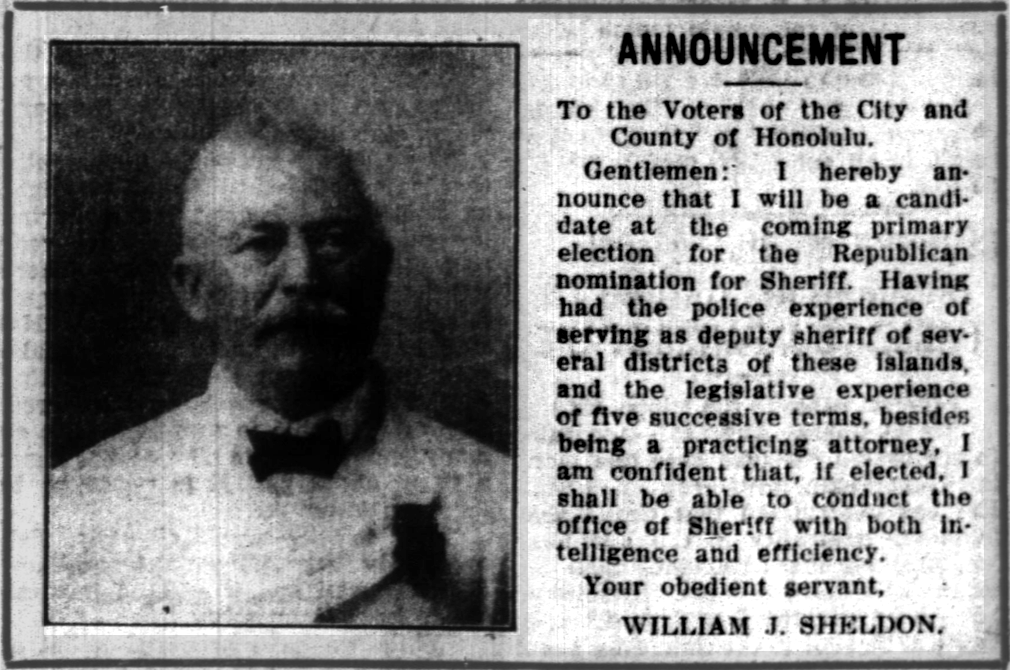
ANNOUNCEMENT

To the Voters of the City and County of Honolulu.

Gentlemen: I hereby announce that I will be a candidate at the coming primary election for the Republican nomination for Sheriff. Having had the police experience of serving as deputy sheriff of several districts of these islands, and the legislative experience of five successive terms, besides being a practicing attorney, I am confident that, if elected, I shall be able to conduct the office of Sheriff with both intelligence and efficiency.

Your obedient servant,

WILLIAM J. SHELDON.

(Honolulu Star-Bulletin, 8/16/1914, p. 4)

ANNOUCEMENT

Honolulu Star-Bulletin, Volume XXII, Number 6973, Page 4. August 16, 1914.