English-Language Newspaper articles less important than Hawaiian-Language articles? 2012

Here is something to consider…

There are many who believe that English-Language articles are somehow less important than Hawaiian-Language ones. We should not turn our noses up at any history passed down by those who lived it—in any language. Although it is important to take into account who wrote the information and under what circumstances, any information is better than no information!

Here for instance is the coverage the first Kamehameha Girls School graduation received in The Hawaiian Gazette of July 6, 1897, p. 2, “CLOSING EXERCISES”.

Compare this to what we saw earlier from the Kuokoa of July 2, 1897, p. 2, “KA HOIKE O KE KULA KAIKAMAHINE O KAMEHAMEHA”.

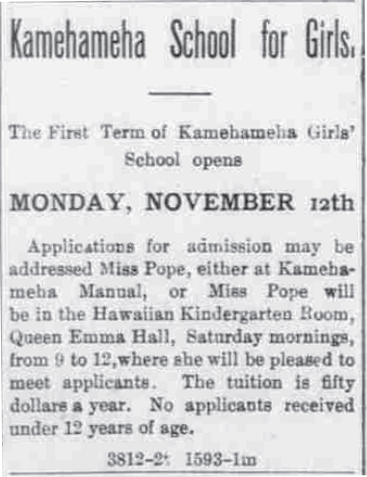
Kamehameha School for Girls advertisement, 1894.

Kamehameha School for Girls.

The First Term of Kamehameha Girls’ School opens

MONDAY, NOVEMBER 12th

Applications for admission may be addressed Miss Pope, either at Kamehameha Manual, or Miss Pope will be in the Hawaiian Kindergarten Room, Queen Emma Hall, Saturday mornings, from 9 to 12, where she will be pleased to meet applicants. The tuition is fifty dollars a year. No applicants received under 12 years of age.

[How things have changed!]

(Hawaiian Gazette, 10/23/1894, p. 6)

Kamehameha School for Girls.

The Hawaiian Gazette, Volume XXIX, Number 84, Page 6. October 23, 1894.

Wow, this sounds like a pretty awesome opportunity for the young people! There is a lot of priceless information available in the English Newspapers as well, much of it dealing with Hawaii nei!

uodigcol's avatarOregon Digital Newspaper Program

As part of the National Digital Newspaper Program (NDNP) and provider of historic Oregon newspaper content for the Chronicling America historic American newspapers website (hosted by the Library of Congress and the National Endowment for the Humanities), the Oregon Digital Newspaper Program (ODNP) is pleased to spread the word about a new opportunity for recognition of middle and high school students with a passion for history.

The following press release was published today on the National Endowment for the Humanities website at http://www.neh.gov/news/press-release/2012-06-14:

WASHINGTON (June 14, 2012) —  The National Endowment for the Humanities (NEH) today announced a new contest to encourage middle and high school students to use Chronicling America, the NEH and Library of Congress-supported digital archive of historic newspapers, in their projects for National History Day.

At the closing ceremonies of National History Day, held on the University of Maryland campus in College Park, Maryland…

View original post 502 more words

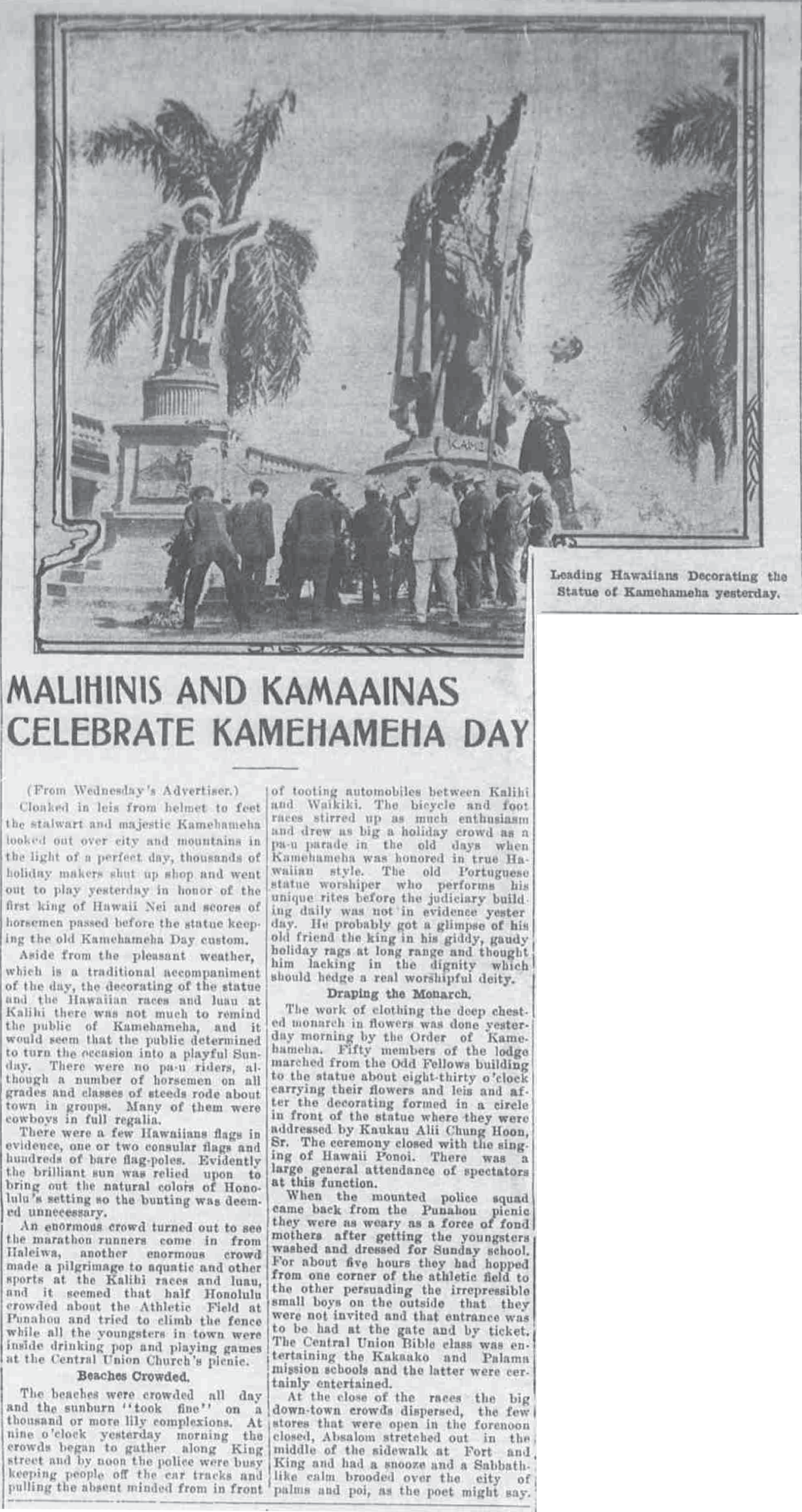
More Decorating the Kamehameha Statue, 1912.

MALIHINIS AND KAMAAINAS CELEBRATE KAMEHAMEHA DAY

Leading Hawaiians Decorating the Statue of Kamehameha yesterday.

(From Wednesday’s Advertiser.)

Cloaked in leis from helmet to feet the stalwart and majestic Kamehameha looked out over city and mountains in the light of a perfect day, thousands of holiday makers shut up shop and went out to play yesterday in honor of the first king of Hawaii Nei and scores of horsemen passed before the statue keeping the old Kamehameha Day custom.

Aside from the pleasant weather, which is a traditional accompaniment of the day, the decorating of the statue and the Hawaiian races and luau at Kalihi there was not much to remind the public of Kamehameha, and it would seem that the public determined to turn the occasion into a playful Sunday. There were no pa-u riders, although a number of horsemen on all grades and classes of steeds rode about town in groups. Many of them were cowboys in full regalia.

There were a few Hawaiian flags in evidence, one or two consular flags and hundreds of bare flag-poles. Evidently the brilliant sun was relied upon to bring out the natural colors of Honolulu’s setting so the bunting was deemed unnecessary.

An enormous crowd turned out to see the marathon runners come in from Haleiwa, another enormous crowd made a pilgrimage to aquatic and other sports at the Kalihi races and luau, and it seemed that half of Honolulu crowded about the Athletic Field at Punahou and tried to climb the fence while all the youngsters in town were inside drinking pop and playing games at the Central Union Church’s picnic.

Beaches Crowded.

The beaches were crowded all day and the sunburn “took fine” on a thousand or more lily complexions. At nine o’clock yesterday morning the crowds began to gather along King street and by noon the police were busy keeping people off the car tracks and pulling the absent minded from in front of tooting automobiles between Kalihi and Waikiki. The bicycle and foot races stirred up as much enthusiasm and drew as big a holiday crowd as a pa-u parade in the old days when Kamehameha was honored in true Hawaiian style. The old Portuguese statue worshiper who performs his unique rites before the judiciary building daily was not in evidence yesterday. He probably got a glimpse of his old friend the king in his giddy, gaudy holiday rags at long range and thought him lacking in the dignity which should hedge a real worshipful deity.

Draping the Monarch.

The work of clothing the deep chested monarch in flowers was done yesterday morning by the Order of Kamehameha. Fifty members of the lodge marched from the Odd Fellows building to the statue about eight-thirty o’clock carrying their flowers and leis and after the decorating formed in a circle in front of the statue where they were addressed by Kaukau Alii Chung Hoon, Sr. The ceremony closed with the singing of Hawaii Ponoi. There was a large general attendance of spectators at this function.

When the mounted police squad came back from the Punahou picnic they were as weary as a force of fond mothers after getting the youngsters washed and dressed for Sunday school. For about five hours they had hopped from one corner of the athletic field to the other persuading the irrepressible small boys on the outside that they were not invited and that entrance was to be had at the gate and by ticket. The Central Union Bible class was entertaining the Kakaako and Palama mission schools and the latter were certainly entertained.

At the close of the races the big down-town crowds dispersed, the few stores that were open in the forenoon closed, Absalom stretched out in the middle of the sidewalk at Fort and King and had a snooze and a Sabbath-like calm brooded over the city of palms and poi, as the poet might say.

[Found on Chronicling America!]

(Hawaiian Gazette, 6/14/1912, p. 2)

MALIHINIS AND KAMAAINAS CELEBRATE KAMEHAMEHA DAY

The Hawaiian Gazette, Volume LV, Number 39, Page 2. June 14, 1912.

News of the Titanic reaches Hawaii. 1912.

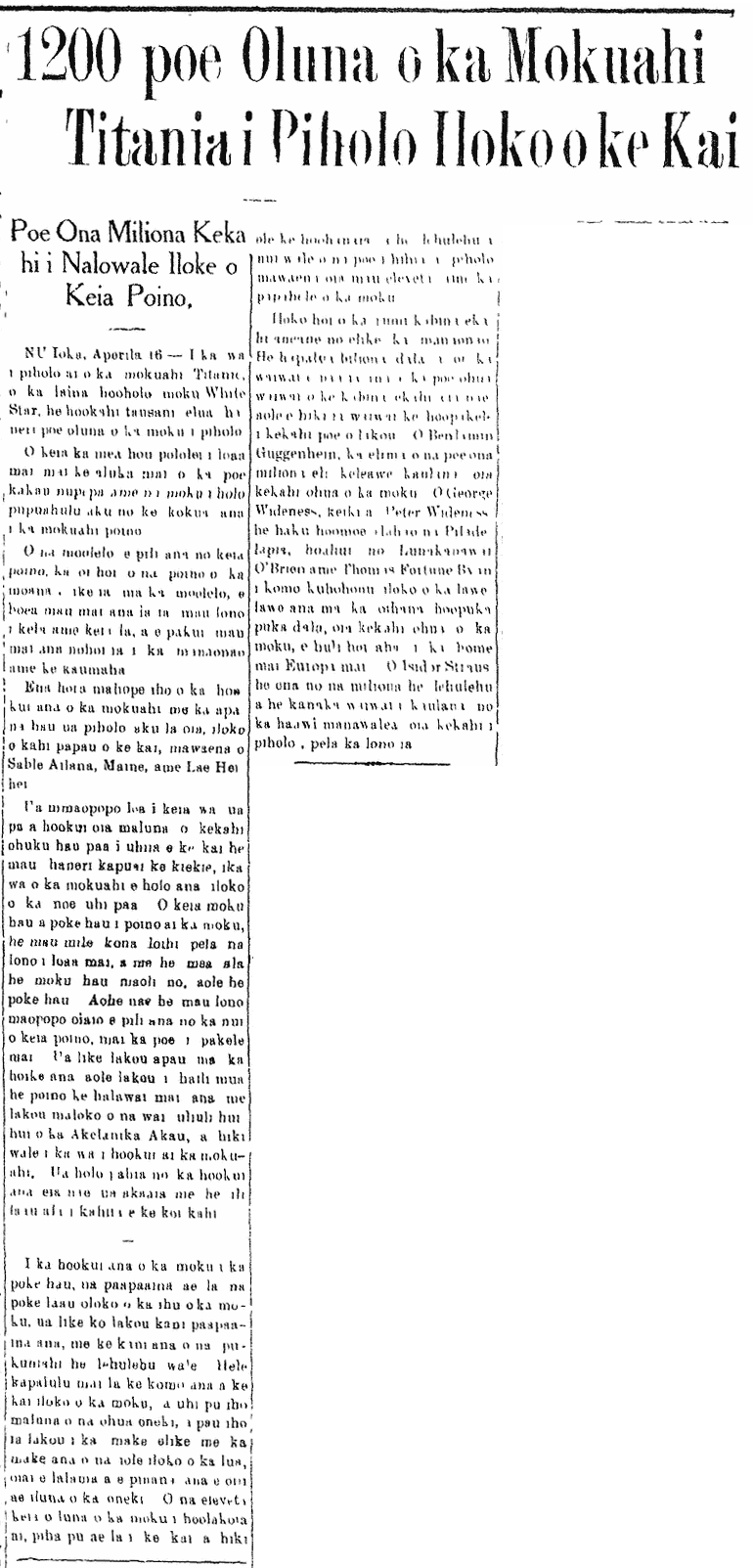
1200 People Aboard the Steamship Titanic Drown in the Sea

Amongst the Missing of This Tragedy are Millionaires

New York, April 16—When the steamship Titanic of the White Star Line went down in the sea, there were a thousand and two hundred people on board who drowned.

This is the true account from the crowd of newspaper writers as well as those on the ships what scurried to assist the vessel.

The story of this tragedy is the worse of all maritime disasters know in history; news keeps arriving daily adding to the horror and sadness.

Two hours after the ship collided with the piece of ice, it sank in a shallow part of the ocean between Sable Island and Cape Race.

It is now known that it ran on top of a solid mass of ice that was blanketed by the sea, and some hundreds of feet tall, while the steamship was travelling through dense fog. This chunk of ice which damaged the ship was a mile across, according to reports received, and it was like an island made of ice, and not a chunk of ice. There was no definitive word on the massiveness of this calamity from the people who were rescued. They all stated that they had no clue that they’d meet with tragedy in the dark, frigid waters of the North Atlantic, until the steamship collided. The hit was at an angle, but it was peeled off like the bark of a tree is shaved off by a plane.

When the ship ran in to the mass of ice, the boards in the bow of the ship snapped, and this snapping sounded like many cannons going off. The sea water rushed into the ship and washed over the deck passengers, who were all done for like rats dying in their holes, while they reached about and climbed to get to the top of the deck. The elevators that the ship was equipped with were filled with water and were not functional; and there were many who were trapped and drowned in them between floors of the ship.

In the first-class cabins, the horror was almost the same. The first-class passengers had a half billion dollars or more between them, and yet that wealth could not save any one of them. Benjamin Guggenheim, the fifth of the famous copper millionaires was on the ship. George Wideness [Widener], the son of Peter Wideness [Widener], the head of railroad track laying in Philadelphia, and partner of O’Brien and Thomas Fortune Ryan, deep in their money making schemes, was a passenger on the ship, and was headed home from Europe. Isidor Straus, a multimillionaire and a wealthy man famous for his philanthropy is one of the drowned; that is what is heard.

[This article appears to have been taken from the first page story of the Hawaiian Gazette on April 16, 1912. All three Hawaiian-Language Newspapers of the time were covering this tragic story.]

(Kuokoa Home Rula, 4/19/1912, p. 1)
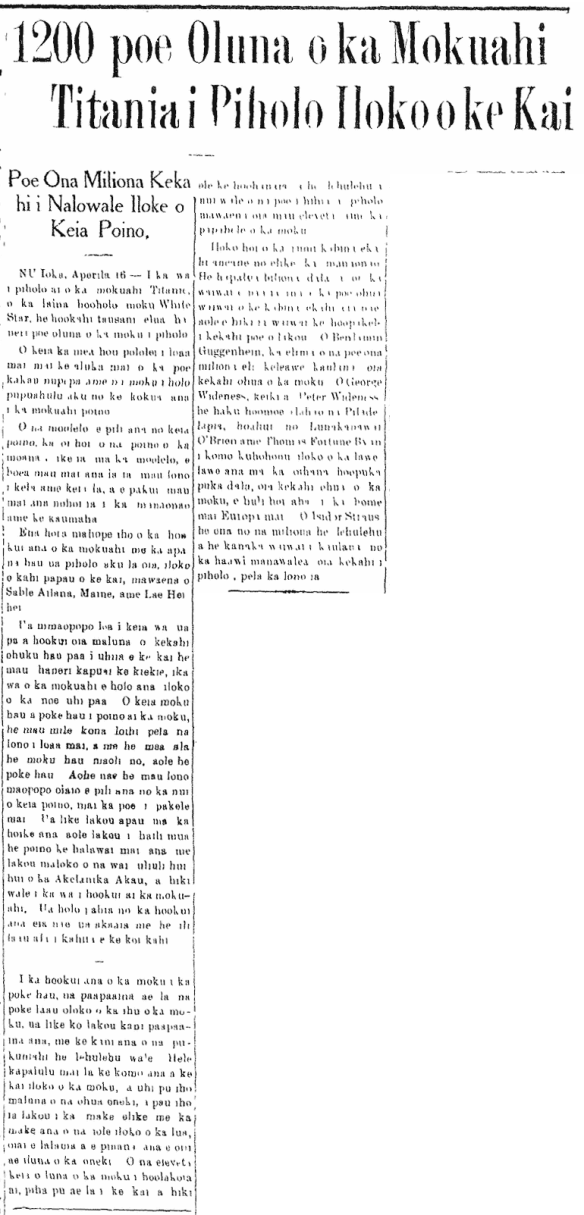
1200 poe Oluna o ka Mokuahi Titania i Piholo iloko o ke Kai

Kuokoa Home Rula, Buke X, Helu 16, Aoao 1. Aperila 19, 1912.

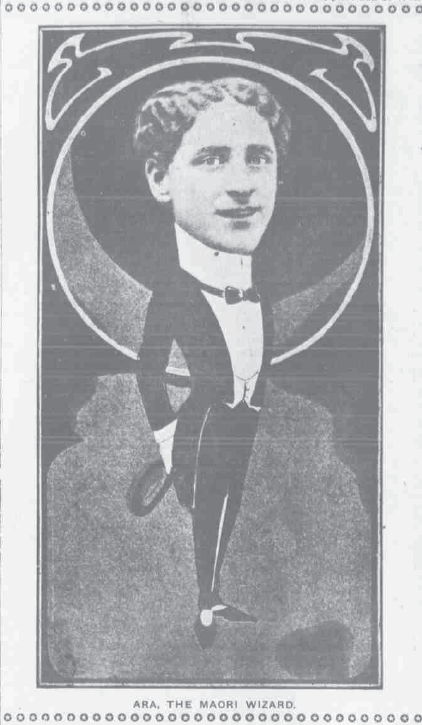
Ara, the Maori Wizard, 1912.

ARA, THE MAORI WIZARD

[Here is an image of Ara, mentioned in the previous post. See the rest of the article here: A Trip Around the World.

Also see more English-language coverage in Chronicling America!]

(Hawaiian Star, 2/10/1912, p. 12)

ARA, THE MAORI WIZARD

The Hawaiian Star, Volume XIX, Number 6198, Page 12. February 10, 1912.

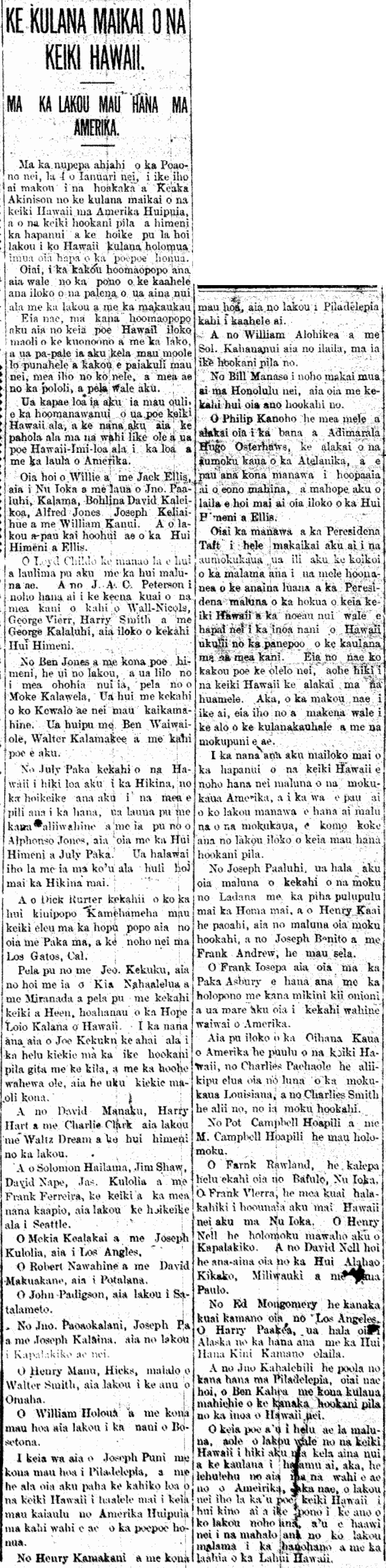
Hawaiians all over America! 1913.

THE GOOD STANDING OF THE HAWAIIAN YOUTHS.

IN THEIR EMPLOYMENT IN AMERICA.

[The issue of this Aloha Aina is misprinted as 1/11/1912, but it should be 1/11/1913! This sort of thing happens once in a while, and if you are not careful, it can lead to wild goose chases. Case in point: i don’t know how long i spent looking for the English article that this was taken from because i was looking in 1912… This article originates from the Honolulu Star-Bulletin (1/4/1913).

See the Star-Bulletin article here.]

(Aloha Aina, 1/11/1912 [1913], p. 1)

KE KULANA MAIKAI O NA KEIKI HAWAII.

Ke Aloha Aina, Buke XVII, Helu 2, Aoao 1. Ianuari 11, 1912* (1913).

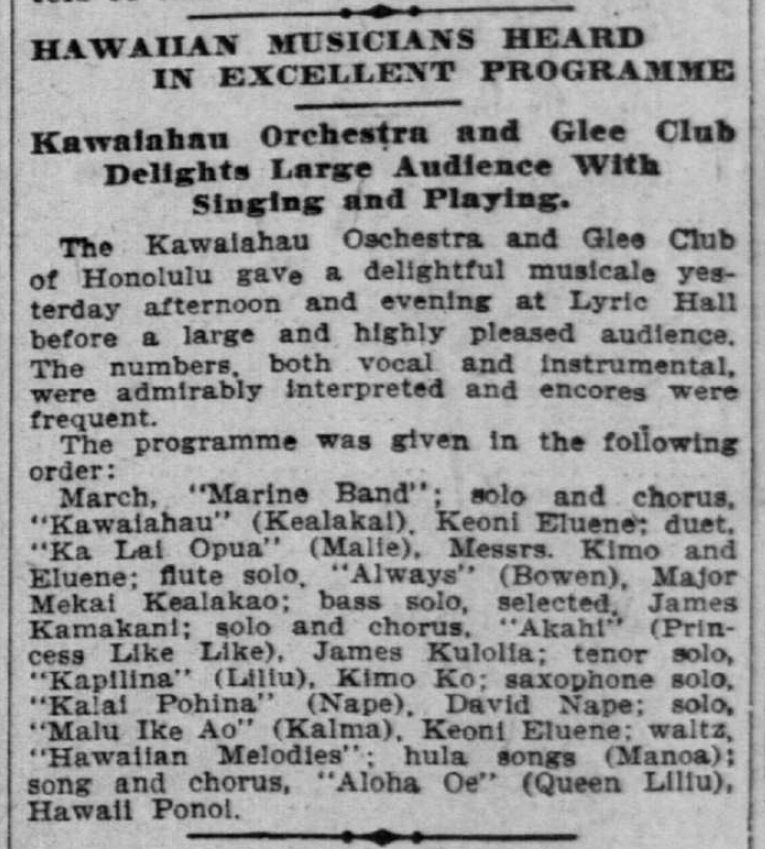
Kawaihau Orchestra and Glee Club in SF. 1905.

HAWAIIAN MUSICIANS HEARD IN EXCELLENT PROGRAMME

Kawaiahau Orchestra and Glee Club Delights Large Audience With Singing and Playing.

The Kawaiahau Orchestra and Glee Club of Honolulu gave a delightful musicale yesterday afternoon and eveing at Lyric Hall before a large and highly pleased audience. The numbers, both vocal and instrumental, were admirably interpreted and encores were frequent.

The programme was given in the following order:

March, “Marine Band”; solo and chorus, “Kawaiahau” (Kealakai), Keoni Eluene; duet, “Ka Lai Opua” (Malie), Messrs. Kimo and Eluene; flute and solo, “Always” (Bowen), Major Mekia Kealakao [Kealakai]; bass solo, selected, James Kamakani; solo and chorus, “Akahi” (Princess Like Like [Likelike]), James Kulolia; tenor solo, “Kapilina” (Liliu), Kimo Ko; saxophone solo, “Kalai Pohina” (Nape), David Nape; solo, “Malu Ike Ao” (Kalima), Keoni Eluene; waltz, “Hawaiian Melodies” ; hula songs (Manoa); song and chorus, “Aloha Oe” (Queen Liliu), Hawaii Ponoi.

[Because of its location, The San Francisco Call had much Hawaii coverage.]

(San Francisco Call, 10/7/1905, p. 16)

HAWAIIAN MUSICIANS HEARD IN EXCELLENT PROGRAMME

The San Francisco Call, Volume XCVIII, Number 129, Page 16. October 7, 1905.

If you think we’ve been having strange weather lately… Snow on Molokai? 1912.

SNOW FELL ON MOLOKAI.

THE FIRST TIME THIS REMARKABLE THING WAS WITNESSED.

On her way home from Molokai, Mrs. Emma Nakuina brought proof of snow [hau sano] falling on Molokai, and you can clearly see the whitening of the mountain tops behind Pukoo with snow. In the history of the inhabitation of Molokai, there has never been seen this amazing thing on that island from the beginning, and this is the first time that snow has been seen falling on Molokai. According to Mrs. Nakuina.

H. D. Bowen stated that snow fell in great quantities on the mountain behind Pukoo, so that you could see clearly the patches of snow in many places on the ridges as well as down in the valleys.

You can see the snow all the way from the harbor of Pukoo and the shore, according to Mr. Bowen. He has some land next to [illegible because of fold] and while he was there, he saw the snow.

I believe this is the first time that man remembers that snow fell on Molokai, said Mrs. Nakuina.

So it is perhaps because of the cold we’ve had these past days that snow fell on Molokai. According to the scientists, the time is coming where the tropic zone will become arctic, and will be covered in snow. Could this be the beginning of this?

[See the article from which this was translated [?] and more in The Hawaiian Star, 3/11/1912, pp. 1 & 5.]

(Aloha Aina, 3/16/1912, p. 1)

HAULE KA HAU SANO MA MOLOKAI.

Ke Aloha Aina, Buke XI, Helu 11, Aoao 1. Maraki 16, 1912.

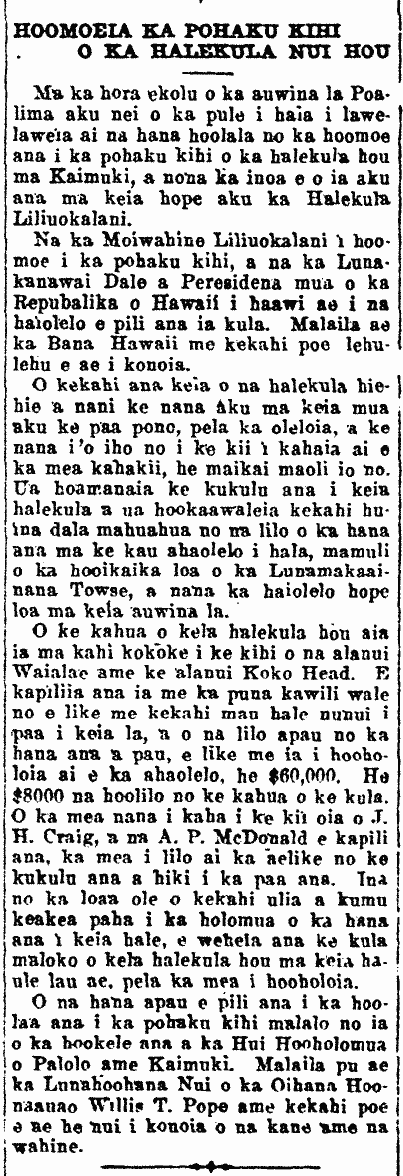
Laying of the cornerstone of Liliuokalani School, 1912.

The Cornerstone of the New Great School is Laid.

At three o’clock on the afternoon of last Friday (4/12/1912), a ceremony was conducted to lay the cornerstone of the new school house in Kaimuki, that will be called hereafter, Liliuokalani School.

Queen Liliuokalani laid the cornerstone, and Legislator Dole, and former President of the Republic of Hawaii gave a speech about the school. The Hawaiian Band was there along with many invited guests.

When it is completed, this will be one of the most distinguished and beautiful schools, according to what is being said. And when you look at the artist’s rendering, it is indeed splendid. Authorization for building and funds were set aside in the previous session of the Legislature, through the efforts of Legislator Towse, and it was he that gave the final speech that afternoon.

The grounds of this school is near the corner of Waialae and Koko Head. It is being constructed of cement, like many of the great buildings being built these days. And the entire costs will be, as decided by the legislature, $60,000. $8000 was spent to purchase the land. The artist who drew the rendering was J. H. Craig. A. P. McDonald is the one doing the constructing; he received the contract to build the school to completion. Should there be no accidents or hinderances to the progress, the school will be unveiled this coming fall, as per what was decided.

Everything concerning the dedication of the cornerstone fell under the Improvement Club of Palolo and Kaimuki. Present also the head of the DOE, Willis T. Pope, as well as many men and women invited to attend.

[Although sadly this school has been closed, I hear there will be a 100th year celebration of the laying of the cornerstone to be held on the Queen Liliuokalani School grounds, on the 12th of April, with gates opening at 3:00 p. m.

See also from Chronicling America these related articles in English:

Evening Bulletin, 4/13/1912, p. 11,

Hawaiian Gazette, 4/16/1912, p. 7.

And about the actual opening of the school:

Hawaiian Gazette, 10/15/1912, p. 7.]

(Kuokoa, 4/19/1912, p. 6)

HOOMOEIA KA POHAKU KIHI O KA HALEKULA NUI HOU.

Ka Nupepa Kuokoa, Buke XLVIII, Helu 16, Aoao 6. Aperila 19, 1912.