John Papa Ii speaks of his aunty, Kaneiakama, 1869.

[Found under: “HUNAHUNA MOOLELO HAWAII.”]

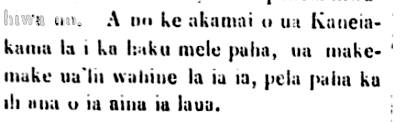
And perhaps because of the skill of Kaneiakama at composing mele, that the chiefess [Kaahumanu] had a liking for her, and maybe that is why that land [Waianae] went to the two of them [Kaneiakama and her husband, Paakonia].

[John Papa Ii’s columns on the history of Hawaii ran in the Kuokoa from 1866 through 1870. For more on Kaneiakama see more from this date, and in English, see “Fragments of Hawaiian History,” translated by Mary Kawena Pukui, and published by Bishop Museum Press.]

(Kuokoa, 7/17/1869, p. 1)

Kuokoa_7_17_1869_1.png

Ka Nupepa Kuokoa, Buke VIII, Helu 29, Aoao 1. Iulai 17, 1869.


150 years ago, people were reading about the arrival of Catholicism, in S. M. Kamakau’s great history, 1869.

THE HISTORY OF HAWAII.

By S. M. Kamakau.

NUMBER 97.

Pertaining to the Reign of Kauikeaouli over the Nation, he being called Kamehameha III.

Pertaining to the arrival of Catholicism, in the year 1827 [1837].

In the month of September, in the year 1836. A Catholic priest [kahuna katolika Roma] arrived, the Rev. Aresaniao R. Walsh [Rev. Arsenius Robert Walsh], from Britain. He were not expelled, but was forbidden by the Chiefs, that he should not proselytize amongst the Hawaiians. But he went and argued with some Protestant priests [Kahuna Hoole Pope]. He indeed converted Hawaiians and secretly Baptized some people. Continue reading

On Kalaipahoa, 1931.

POISON GOD BURNED

Hilo, Hawaii, July 6, 1931.

Editor, The Star-Bulletin.

Sir: In your issue of July 4, 1931, there appears a picture of an old Hawaiian wooden idol  under which it was stated that it was believed to be the poison-god Kalaipahoa. Continue reading

On kake and Kauikeaouli and Kalama and Kaahumanu, 1896.

[Found under: “NA WAHI PANA A KAULANA O HONOLULU, OAHU NEI, I UHIIA I KA LEPO A NALOWALE LOA HOI I KEIA AU HOU.”]

KAHALEULUHE

5.—Kahaleuluhe was where the Anglican Church stands today, and its stature is hard to picture today. This was a Royal residence during the time of Kamehameha III, the kindhearted Alii who was shown affection through words of kake, because of the fear Kalama had lest she be killed by Kaahumanu and Kinau, Continue reading

Passing of Victoria Kahoa Kaahumanu Tolman, 1893.

AN OLD LANDMARK GONE.

Death of an Adopted Daughter of Queen Kaahumanu.

Mrs. Victoria Kahoa Kaahumanu Tolman died at the residence of Hon. F. S. Pratt, Punchbowl street, of heart failure, at 9:30 o’clock yesterday evening, at the ripe age of 78, Kahoa Virginia is a twin sister to Teresa Oana [Aana], both being born in Kailua, Kona, in August, 1815. Shortly after their birth, in fact the same night, both were adopted by Queen Kaahumanu, and taken from their home. Their mother was Holau, a true descendant of Lonoikamakahiki and Keikilani, King and Queen of Puna, of whom there are many stories in Hawaiian history. The father was the late Jean Jassin Rives [Reeves], commonly known as Father John, of the Catholic Mission, who went to England with Kamehameha II. Continue reading

Death of Simeon Kaiu, 1835.

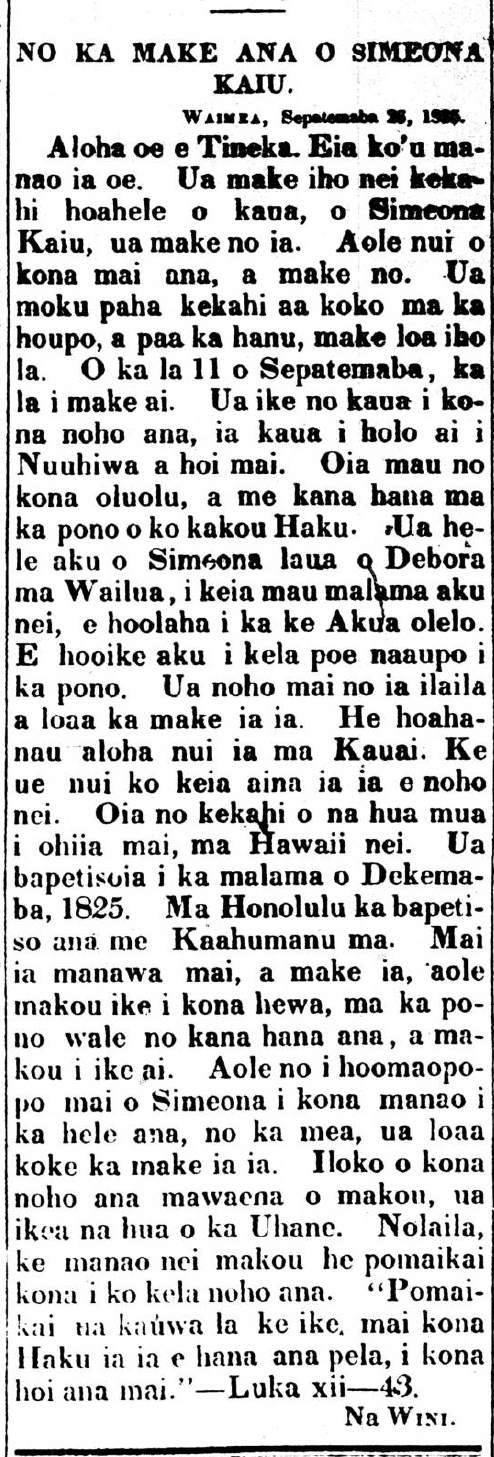
PERTAINING TO THE DEATH OF SIMEONA KAIU.

Waimea, September 26, 1835.

Aloha to you, O Tinker. This is my thought for you. One of our fellow travellers has recently died, Simeon Kaiu, he has died. He was not terribly sick, and he died. Perhaps one of his blood vessels severed in his chest, and he could not breathe, and he died. September 11 was the day he died. We know how he lived, when we travelled to Nuuhiwa and came back. His was as kindly as ever, as he did the work of the Lord. Simeon and Deborah [Debora] were in Wailua a few months ago spreading the word of God. They showed those ignorant ones of enlightenment. He lived there, where he died. He was a greatly beloved brethren on Kauai. He is much mourned for in this land. He is one of the first fruit picked here in Hawaii. He was baptized in the month of December, 1825. The baptism took place in Honolulu with Kaahumanu. From that time until he died, we know not of any wrong he committed, from what we saw he only did good. Simeona did not make clear what his thoughts were upon his leaving, for he died quickly. When he lived amongst us, we witnessed the fruit of the Spirit. Therefore we believe that he is doing well in that life. “Blessed is that servant, whom his lord when he cometh shall find so doing.”—Luke xii—43.

By Whitney.

[According to S. M. Kamakau, on December 4, 1825, baptized were: E. Kaahumanu, Kalanimoku, A. Keliiahonui, Lidia Namahana, Kekuaipiia, Gikeona Laanui, Simeona Kaiu, Debora Kapule Haakulou, and R. Kalaaiaulu.]

(Kumu Hawaii, 10/14/1835, p. 165)

KumuHawaii_10_14_1835_165.png

Ke Kumu Hawaii, Buke 1, Pepa 21, Aoao 165. Okatoba 14, 1835.

Multi-day Restoration Day celebration! 1844.

The 31st of July.

The Festivities of the 31st and the three following days—the Anniversary of the Restoration of the Hawaiian Flag by Admiral Thomas.

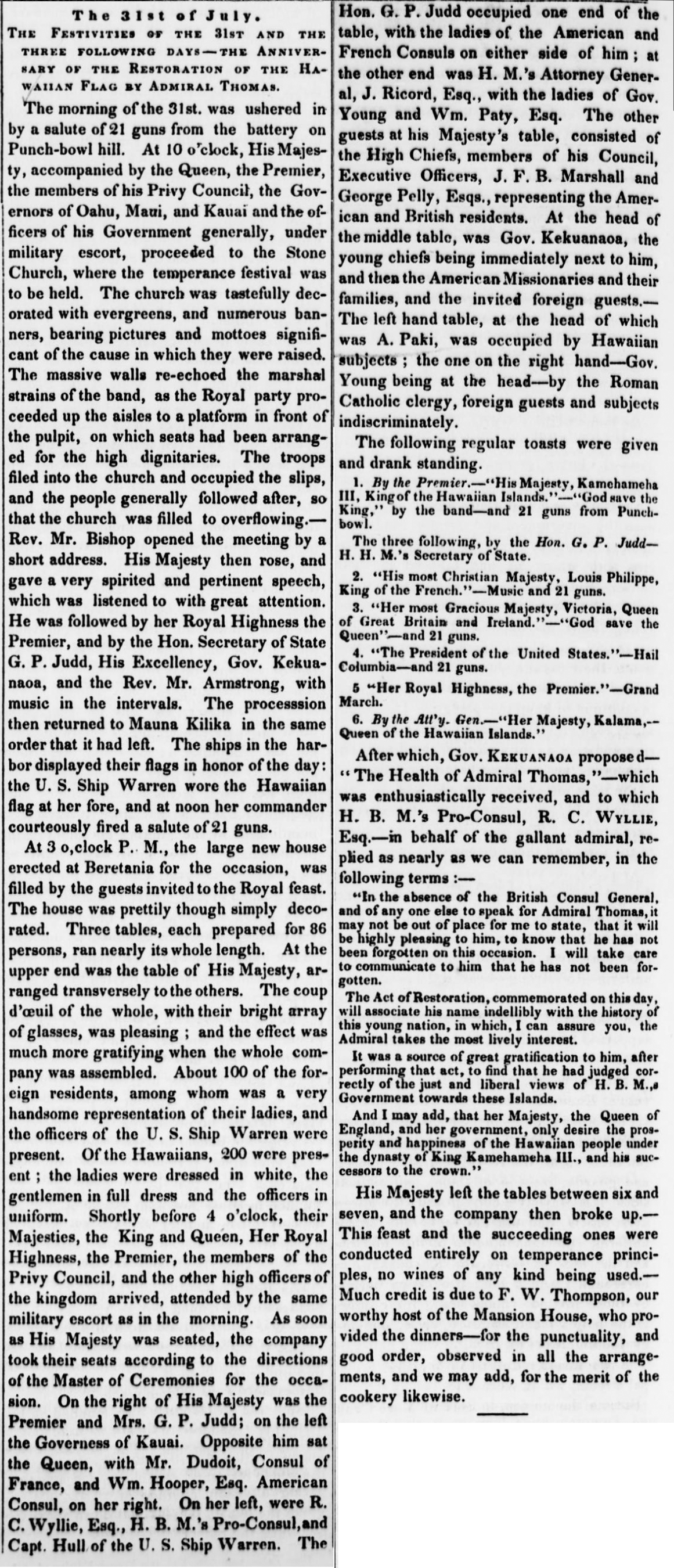
The morning of the 31st, was ushered in by a salute of 21 guns from the battery on Punch-bowl hill. At 10 o’clock, His Majesty, accompanied by the Queen, the Premier, the members of his Privy Council, the Governors of Oahu, Maui, and Kauai and the officers of his Government generally, under military escort, proceeded to the Stone Church [Kawaiahao Church], where the temperance festival was to be held. The church was tastefully decorated with evergreens, and numerous banners, bearing pictures and mottoes significant of the cause in which they were raised. The massive walls re-echoed the marshal strains of the band, as the Royal party proceeded up the aisles to a platform in front of the pulpit, on which seats had been arranged for the high dignitaries. The troops filed into the church and occupied the slips, and the people generally followed after, so that the church was filled to overflowing.—Rev. Mr. Bishop opened the meeting by a short address. His Majesty then rose, and gave a very spirited and pertinent speech, which was listened to with great attention. He was followed by her Royal Highness the Premier, and by the Hon. Secretary of State G. P. Judd, His Excellency, Gov. Kekuanaoa, and the Rev. Mr. Armstrong, with music in the intervals. The procession then returned to Mauna Kilika in the same order that it had left. The ships in the harbor displayed their flags in honor of the day: the U. S. Ship Warren wore the Hawaiian flag at her fore, and at noon her commander courteously fired a salute of 21 guns.

At 3 o’clock P. M., the large new house erected at Beretania for the occasion, was filled by the guests invited to the Royal feast. The house was prettily though simply decorated. Three tables, each prepared for 86 persons, ran nearly its whole length. At the upper end of the table of His Majesty, arranged transversely to the others. The coup d’œuil of the whole, with their bright array of glasses, was pleasing; and the effect was much more gratifying when the whole company was assembled. About 100 of the foreign residents, among whom was a very handsome representation of their ladies, and the officers of the U. S. Ship Warren were present. Of the Hawaiians, 200 were present; the ladies were dressed in white, the gentlemen in full dress and the officers in uniform. Shortly before 4 o’clock, their Majesties, the King and Queen, Her Royal Highness, the Premier, the members of the Privy Council, and the other high officers of the kingdom arrived, attended by the same military escort as in the morning. As soon as His Majesty was seated, the company took their seats according to the directions of the Master of Ceremonies for the occasion. On the right of His Majesty was the Premier and Mrs. G. P. Judd; on the left the Governess of Kauai. Opposite him sat the Queen, with Mr. Dudoit, Consul of France, and William Hooper, Esq. American Consul, on her right. On her left, were R. C. Wyllie, Esq., H. B. M.’s Pro-Consul, and Capt. Hull of the U. S. Ship Warren. The Hon. G. P. Judd occupied one end of the table, with the ladies of the American and French Consuls on either side of him; at the other end was H. M.’s Attorney General, J. Ricord, Esq., with the ladies of Gov. Young and William Paty, Esq. The other guests at his Majesty’s table, consisted of the High Chiefs, members of his Council, Executive Officers, J. F. B. Marshall and George Pelly, Esqs., representing the American and British residents. At the head of the middle table, was Gov. Kekuanaoa, the young chiefs being immediately next to him, and then the American Missionaries and their families, and the invited foreign guest.—The left hand table, at the head of which was A. Paki, was occupied by Hawaiian subjects; the one on the right hand—Gov. Young being at the head—by the Roman Catholic clergy, foreign guests and subjects indiscriminately.

The following regular toasts were given and drank standing.

1. By the Premier.—”His Majesty, Kamehameha III, King of the Hawaiian Islands.”—”God save the King,” by the band—and 21 guns from Punchbowl.

The three following, by the Hon. G. P. Judd—H. H. M.’s Secretary of State.

2. “His most Christian Majesty, Louis Philippe, King of the French.”—Music and 21 guns.

3. “Her most Gracious Majesty, Victoria, Queen of Great Britain and Ireland.”—”God save the Queen”—and 21 guns.

4. “The President of the United States.”—Hail Columbia—and 21 guns.

5. “Her Royal Highness, the Premier.”—Grand March.

6. By the Att’y. Gen.—”Her Majesty, Kalama,—Queen of the Hawaiian Islands.”

After which, Gov. Kekuanaoa proposed—”The Health of Admiral Thomas,”—which was enthusiastically received, and to which H. B. M.’s Pro-Consul, R. C. Wyllie, Esq.—in behalf of the gallant admiral, replied as nearly as we can remember, in the following terms:—

“In the absence of the British Consul General, and of any one else to speak for Admiral Thomas, it may not be out of place for me to state, that i will be pleasing to him, to know that he has not been forgotten on this occasion. I will take care to communicate to him that he has not been forgotten.

The Act of Restoration, commemorated on this day, will associate his name indellibly with the history of this young nation, in which, I can assure you, the Admiral takes the most lively interest.

It was a source of great gratification to him, after performing that act, to find that he had judged correctly of the just and liberal views of H. B. M.’s Government towards these Islands.

And I may add, that her Majesty, the Queen of England, and her government, only desire the prosperity and happiness of the Hawaiian people under the dynasty of King Kamehameha III., and his successors to the crown.”

His Majesty left the tables between six and seven, and the company then broke up.—This feast and the succeeding ones were conducted entirely on temperance principles, no wines of any kind being used.—Much credit is due to F. W. Thompson, our worthy host of the Mansion House, who provided the dinners—for the punctuality, and good order, observed in all the arrangements, and we may add, for the merit of the cookery likewise.

(Polynesian, 8/10/1844, p. 46.)
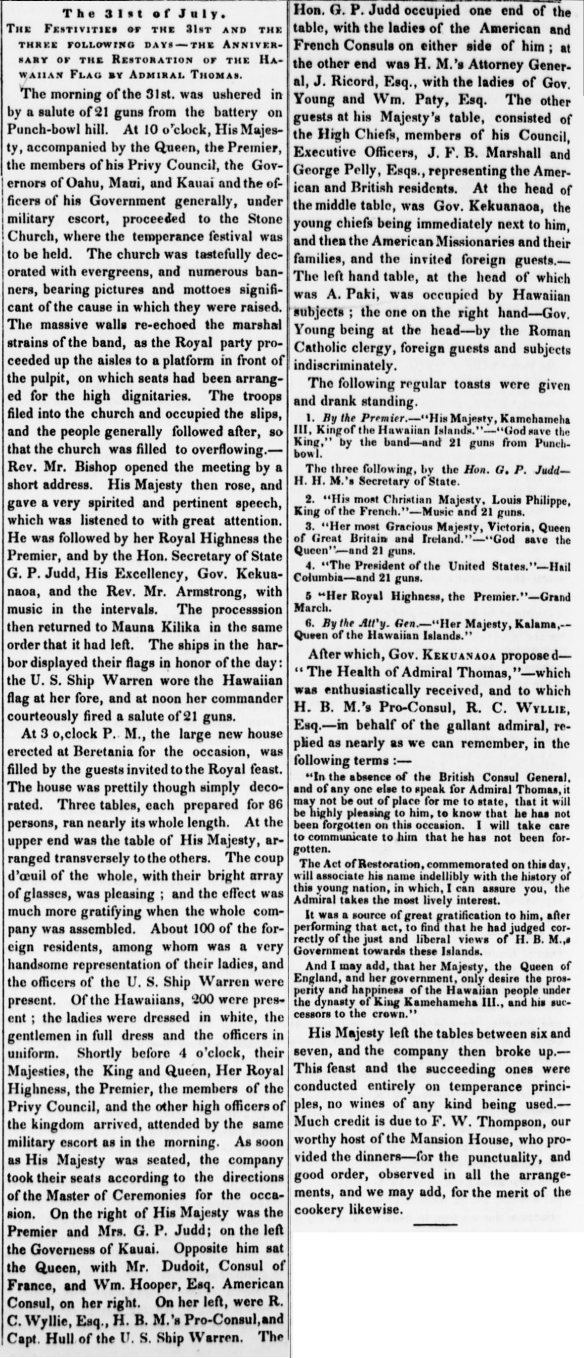
The 31st of July.

The Polynesian, New Series, Volume 1, Number 12, Page 46. August 10, 1844.

David Malo and a prediction, 1894.

The prediction of David Malo.

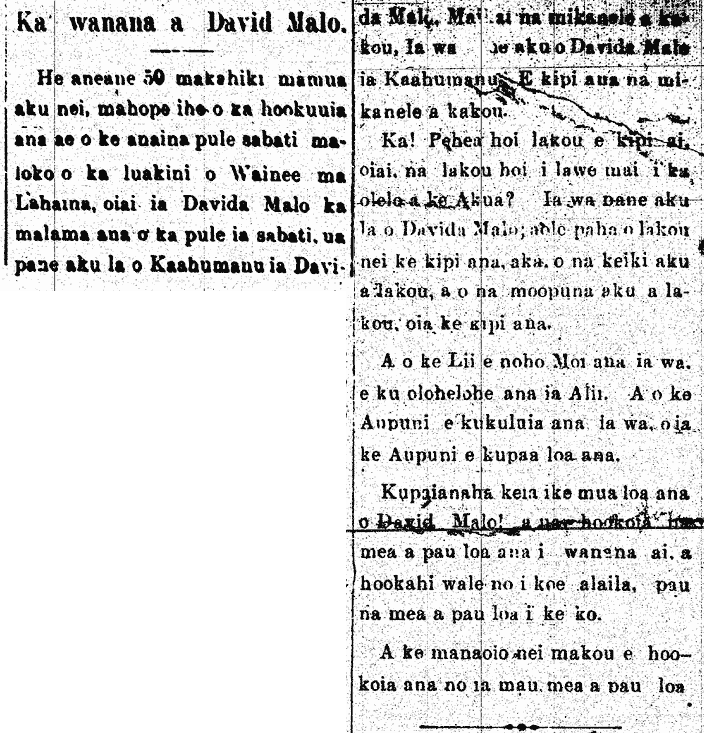
Nearly 50 years ago, after the sunday service was let out from the Wainee Church in Lahaina, while it was Davida Malo who gave the prayer that sunday, Kaahumanu said to Davida Malo, “Our missionaries are good.” Davida Malo then replied to Kaahumanu, “The missionaries of ours will conspire against us [kipi].

“Tsa! How will they revolt, being that it was they who brought the word of God?” To which Davida Malo answered, “Perhaps they will not revolt, but the children after them, and the grandchildren after them; they will be the rebels.

“And the Alii who is ruling as Monarch at the time, that Alii will stand bare. And the Nation built then, that is the Nation that will stand securely.”

How astonishing is this great foresight of David Malo! and everything he predicted [wanana] has come true, except one remains, and then everything will have come true.

And we believe that all of this will come true.

(Leo o ka Lahui, 9/7/1894, p. 2)

Ka wanana a David Malo.

Ka Leo o ka Lahui, Buke II, Helu 1022, Aoao 2. Sepatemaba 7, 1894.

Joseph Emerson interrupts meeting at the Kapuukolo Church, 1893.

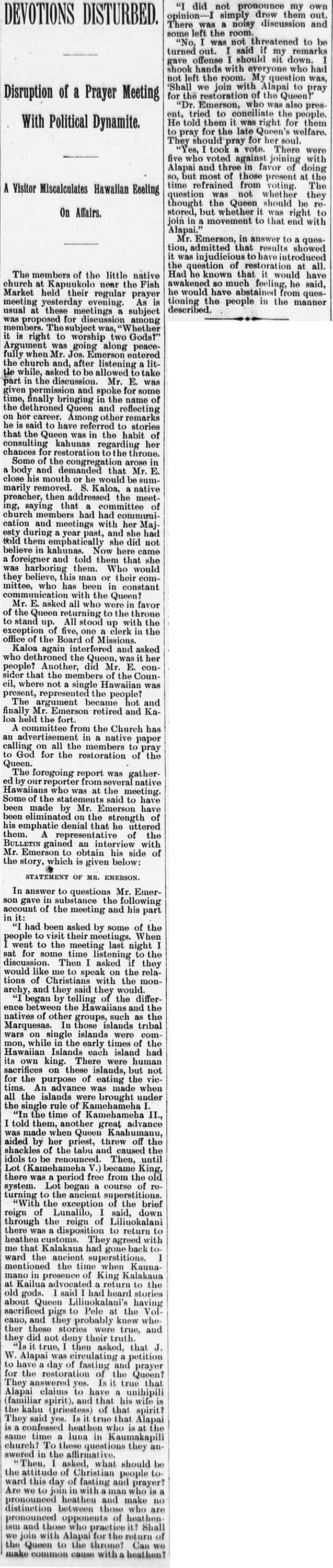
DEVOTIONS DISTURBED.

Disruption of a Prayer Meeting With Political Dynamite.

A Visitor Miscalculates Hawaiian Feeling On Affairs.

The members of the little native church at Kapuukolo near the Fish Market held their regular prayer meeting yesterday evening. As is usual at these meetings a subject was proposed for discussion among members. The subject was, “Whether it is right to worship two Gods?” Argument was going along peacefully when Mr. Jos. Emerson entered the church and, after listening a little while, asked to be allowed to take part in the discussion. Mr. E. was given permission and spoke for some time, finally bringing in the name of the dethroned Queen and reflecting on her career. Among other remarks he is said to have referred to stories that the Queen was in the habit of consulting kahunas regarding her chances for restoration to the throne.

 Some of the congregation arose in a body and demanded that Mr. E. close his mouth or he would be summarily removed. S. Kaloa, a native preacher, then addressed the meeting, saying that a committee of church members had had communication and meetings with her Majesty during a year past, and she had told them emphatically she did not believe in kahunas. Now here came a foreigner and told them that she was harboring them. Who would they believe, this man or their committee, who has been in constant communication with the Queen?

Mr. E. asked all who were in favor of the Queen returning to the throne to stand up. All stood up with the exception of five, one a clerk in the office of the Board of Missions.

Kaloa again interfered and asked who dethroned the Queen, was it her people? Another, did Mr. E. consider that the members of the Council, where not a single Hawaiian was present, represented the people?

The argument became hot and finally Mr. Emerson retired and Kaloa held the fort.

A committee from the Church has an advertisement in a native paper calling on all the members to pray to God for the restoration of the Queen.

The foregoing report was gathered by our reporter from several native Hawaiians who was at the meeting. Some of the statements said to have been made by Mr. Emerson have been eliminated on the strength of his emphatic denial that he uttered them. A representative of the Bulletin gained an interview with Mr. Emerson to obtain his side of the story, which is given below:

STATEMENT OF MR. EMERSON.

In answer to questions Mr. Emerson gave in substance the following account of the meeting and his part in it:

 “I had been asked by some of the people to visit their meetings. When I went to the meeting last night I sat for some time listening to the discussion. Then I asked if they would like me to speak on the relations of Christianity with the monarchy, and they said they would.

“I began by telling of the difference between the Hawaiians and the natives of other groups, such as the Marquesas. In those islands tribal wars on single islands were common, while in the early times of the Hawaiian Islands each island had its own king. There were human sacrifices on these islands, but not for the purpose of eating the victims. An advance was made when all the islands were brought under the single rule of Kamehameha I.

“In the time of Kamehameha II., I told them, another great advance was made when Queen Kaahumanu, aided by her priest, threw off the shackles of the tabu and caused the idols to be renounced. Then, until Lot (Kamehameha V.) became King, there was a period free from the old system. Lot began a course of returning to the ancient superstitions.

“With the exception of the brief reign of Lunalilo, I said, down through the reign of Liliuokalani there was a disposition to return to heathen customs. They agreed with me that Kalakaua had gone back toward the ancient superstitions. I mentioned the time when Kaunamano in the presence of King Kalakaua at Kailua advocated a return to the old gods. I said I had heard stories about Queen Liliuokalani’s having sacrificed pigs to Pele at the Volcano, and they probably knew whether these stories were true, and they did not deny their truth.

“Is it true, I then asked, that J. W. Alapai was circulating a petition to have a day of fasting and prayer for the restoration of the Queen? They answered yes. Is it true that Alapai claims to have a unihipili (familiar spirit), and that his wife is the kahu (priestess) of that spirit? They said yes. Is it tre that Alapai is a confessed heathen who is at the same time a luna in Kaumakapili church? To these questions they answered in the affirmative.

“Then, I asked, what should be the attitude of Christian people toward this day of fasting and prayer? Are we to join in with a man who is a pronounced heathen and make no distinction between those who are pronounced opponents of heathenism and those who practice it? Shall we join with Alapai for the return of the Queen to the throne? Can we make common cause with a heathen?

“I did not pronounce my own opinion—I simply drew them out. There was a noisy discussion and some left the room.

“No, I was not threatened to be turned out. I said if my remarks gave offense I should sit down. I shook hands with everyone who had not left the room. My question was, ‘Shall we join with Alapai to pray for the restoration of the Queen?’

“Dr. Emerson, who was also present, tried to conciliate the people. He told them it was right for them to pray for the late Queen’s welfare. They should pray for her soul.

“Yes, I took a vote. There were five who voted against joining with Alapai and three in favor of doing so, but most of those present at the time refrained from voting. The question was not whether they thought the Queen should be restored, but whether it was right to join in a movement to that end with Alapai.”

Mr. Emerson, in answer to a question, admitted that results showed it was injudicious to have introduced the question of restoration at all. Had he known that it would have awakened so much feeling, he said, he would have abstained from questioning the people in the manner described.

[This article was translated in Leo o ka Lahui, 2/9/1893, p. 2. It is interesting that there is a note appended to the end of the translated article that they did not have time to translate Emerson’s response.]

(Daily Bulletin, 2/7/1893, p. 3)

DEVOTIONS DISTURBED.

The Daily Bulletin, Volume V, Number 644, Page 3. February 7, 1893.