Here is the amendment to the marriage law passed in 1888.

MOKUNA LXIX.

HE KANAWAI

E hoololi ai i ka Pauku 2 o ka Mokuna LVI o ke Kanawai Hoopai Karaima, a e hoopau loa ai i na Pauku 3, 4 a me 5 o ia Mokuna, me na hoololi a pau i ua Mokuna nei.

E hooholoia e ka Moi a me ka Ahaolelo o ko Hawaii Paeaina.

Pauku 1. E hoololi ia a ma keia ke hoololi ia nei ka Pauku 2 o ka Mokuna LVI o ke Kanawai Hoopai Karaima, a penei e heluhelu ia ai:

“Pauku 2. E ninaninau ia, e hoolohe ia, a e hooholo ia e ka Lunakanawai no ia hihia, a ina he mea hiki e hoopau ia ka noho kue ana o laua; aka, ina aole hiki e hoopau ia ko laua kue ana, e hoopau wale ia no ka hoopii. Ina e hoopau wale ia kekahi hoopii, e hooholo ka Lunakanawai e hookaa ia na koina e like me ka mea ana i manao ai oia ka pono.”

Pauku 2. Ma keia ke hoopau loa ia nei na Pauku 3, 4 a me 5 o ka Mokuna i olelo ia  a me kekahi a me na hoololi o ia Mokuna i olelo ia.

Apono ia i keia la 10 o Sepatemaba, M. H. 1888.

KALAKAUA REX.

Na ka Moi:

L. A. Thurston,

Kuhina Kalaiaina.

(NA KANAWAI O KA MOI KALAKAUA I, Ke Alii o Ko Hawaii Paeaina, i Kau ia e ka Hale Ahaolelo Kau Kanawai, i ke Kau o 1888, p. 171.)

CHAPTER LXIX.

AN ACT

To amend Section 2 of Chapter LVI. of the Penal Code and Repeal Sections 3, 4 and 5 of said Chapter with all Amendments thereto.

Be it Enacted by the Kind and the Legislature of the Hawaiian Kingdom:

Section 1. That Section 2 of Chapter LVI. of the Penal Code be and is hereby amended so as to read as follows:

“Section 2. Said Justice shall examine into, hear and determine the complaint and shall secure if practicable, a reconciliation between the parties; but if no reconciliation can be effected, the complaint shall be dismissed. In case of such dismissal the Justice shall adjudge the costs to be paid as in his opinion justice shall demand.”

Section 2. Sections 3, 4 and 5 of said Chapter and any and all amendments thereof be and are hereby repealed.

Approved this tenth day of September, A. S. 1888.

KALAKAUA REX.

By the King:

L. A. Thurston.

Minister of the Interior.

(Laws of His Majesty Kalakaua, King of the Hawaiian Islands: Passed by the Legislative Assembly at its Session 1888, pp. 157–158.)

King Kalakaua gifts some 200 kii¹ to the National Academy of Sciences. 1887.

A Gift from the King.

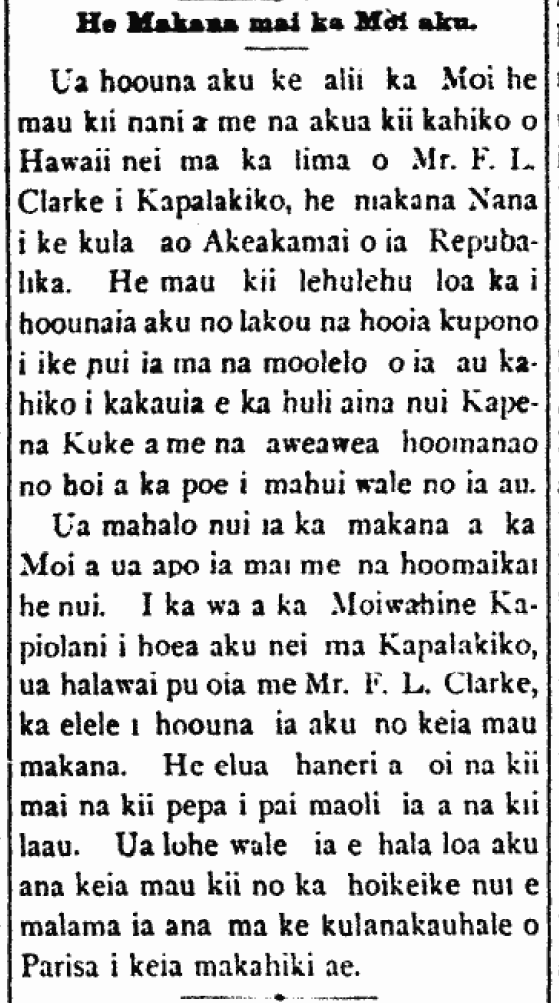
The alii, the King, sent a number of beautiful pictures [kii] and old godly images [akua kii] of Hawaii to the hands of Mr. F. L. Clarke² in San Francisco, a gift from Him to the National Academy of Sciences [? ke kula ao Akeakamai o ia Repubalika]. There were a great many images sent which are well attested to as seen in the old accounts written by the great explorer Captain Cook and the faint recollections of those who have slight knowledge of that era.

The gift of the King was greatly appreciated and it was accepted with much thanks. When Queen Kapiolani arrived in San Francisco, she met with Mr. F. L. Clarke, the representative sent for this gift. There were two hundred or more images, from images that were printed on paper, to wooden idols. It’s been heard that they will go all the way to the city of Paris for the great exposition to be held next year.³

¹”Kii” refers to any image or representation of something, whether it be printed on paper, painted on canvas, carved out of wood, or cast in metal.

²See Clarke’s short history of Hawaii, “Hawaii’s Real Story,” which appeared in The Forum, July 1900, pp. 555–565.

³Exposition Universelle, 1889. See “Catalogue of the Hawaiian Exhibits at the Exposition Universelle, Paris, 1889.” by John A. Hassinger, Department of the Interior.

[Does anyone know of what happens to all of this?]

(Kuokoa, 5/14/1887, p. 2)

He Makana mai ka Moi aku.

Ka Nupepa Kuokoa, Buke XXVI, Helu 20, Aoao 2. Mei 14, 1887.

King Kalakaua’s Arrival in Japan, 1881.

His Majesty the King of Hawaii arrived here yesterday (Friday) morning at 8 a. m. in the Oceanic. As the steamer moved up to her anchorage, the men-of-war in harbour dressed ship and manned yards, the crews of the Russian and Japanese vessels also cheering heartily as the Oceanic passed them. His Majesty was visited on board by Mr. Hachisuka, ex-Daimiyo of Awa, Admiral Nakamura, Mr. Ishibashi, Secretary of the Foreign Office and others, as well as by the Russian Admiral and Staff. He subsequently embarked in the Emperor’s State barge and proceeded to the Port Admiral’s Office, where he was received by Mr. Daté, Ex-Daimiyo of Uwajima, Mr. Hijikata, Vice Minister of the Household Department, Mr. Sannomiya, Mr. Nagasaki and several Naval and Military officers, Mr. R. Irwin, Consul for Hawaii in Japan, and Mr. Stevens, secretary of the U. S. Legation also waited on his Majesty. From the Port Admiral’s Office His Majesty proceeded in a state carriage to the Summer Palace at Iséyama, which has been paled at his disposal by the Emperor. He was there visited by H. I. H. Prince Fushimi, Mr. Uyeno, Vice Minister of Foreign Affairs, and many other officials of high rank. To-day (Saturday) he proceeded to Tokiyo by the 12 o’clock train and was met at Shimbashi terminus by four Imperial Princes, who accompanied him first to an audience with His Majesty the Emperor and afterwards to their own houses, whence he ultimately proceeded to the Yenriyokwan, which has been prepared for his reception during the period of his sojourn here. The King’s name is Kalakauwa, which may be translated, “The day of battle.” His Majesty is nearly fifty years old, having been born in 1831. In personal appearance he is about the middle height, thickset, but of really handsome personal appearance. His complexion is not darker than that of an ordinary Japanese. When but a child he was received into the boarding school, kept for many years by Mr. and Mrs. Cook of the American Board’s Mission, for the exclusive reception of all the young chiefs of the highest blood. Here he received a good education, and being at the time he was first sent there one of the youngest received into this family of some dozen or more pupils, he had acquired, at the conclusion of his scholastic career, not only a through knowledge of English, but also an accurate pronunciation of that language. Previous to his election, in 1874, to fill the throne rendered vacant by the death of King William Lunalilo, he served as Post-Master General, and in other Government positions.

[This is an article appearing in one of Japan’s English-language newspapers of the time, The Japan Weekly Mail, which started in 1879.]

(Japan Weekly Mail, 3/5/1881, p. 1)

His Majesty the King of Hawaii arrived...

The Japan Weekly Mail, Volume V, Number 9, Page 1. March 5, 1881.

In response to gas illumination at the opening of Iolani Palace, 1913.

Palace Never Had Gas–First Electric Light

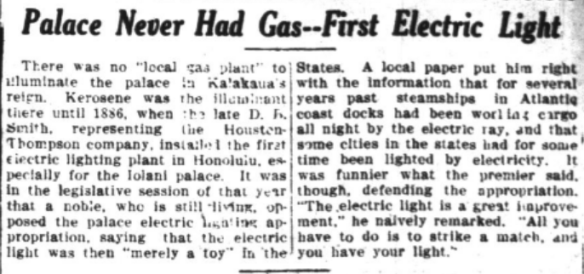
There was no “local gas plant” to illuminate the palace in Kalakaua’s reign. Kerosene was the illuminant there until 1886, when the late D. P. Smith, representing the Houston-Thompson company, installed the first electric lighting plant in Honolulu, especially for the Iolani palace. It was in the legislative session of that year that a noble, who is still living, opposed the palace electric lighting appropriation, saying that the electric light was then “merely a toy” in the States. A local paper put him right with the information that for several years past steamships in Atlantic coast docks had been working cargo all night by the electric ray, and that some cities in the states had for some time been lighted by electricity. It was funnier what the premier said, though, defending the appropriation. “The electric light is a great improvement,” he naively remarked. “All you have to do is to strike a match, and you have your light.”

(Honolulu Star-Bulletin, 1/11/1913, p. 8)

Palace Never Had Gas--First Electric Light

Honolulu Star-Bulletin, Volume XX, Number 6482, Page 8. January 11, 1913.

More on the Palace mirrors, 1913.

THOSE KALAKAUA MIRRORS.

Editor Honolulu Star-Bulletin,

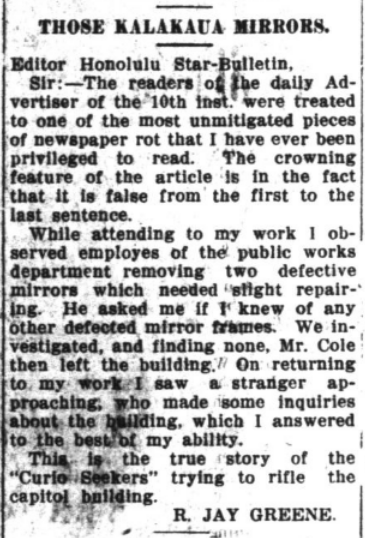
Sir:—The readers of the daily Advertiser of the 10th inst. were treated to one of the most unmitigated pieces of newspaper rot that I have ever been privileged to read. The crowning feature of the article is in the fact that it is false from the first to the last sentence.

While attending to my work I observed employees of the public works department removing two defective mirrors which needed slight repairing. He asked me if I knew of any other defected mirror frames. We investigated, and finding none, Mr. Cole then left the building. On returning to my work I saw a stranger approaching, who made some inquiries about the building, which I answered to the best of my ability.

This is the true story of the “Curio Seekers” trying to rifle the capitol building.

R. JAY GREENE.

[Here is an interesting response from the “Roland Green” of the previous articles.]

(Honolulu Star-Bulletin, 1/11/1913, p. 4)

THOSE KALAKAUA MIRRORS.

Honolulu Star-Bulletin, Volume XX, Number 6482, Page 4. January 11, 1913.

Mahalo to Zita Cup Choy for pointing out this related article in the Pacific Commercial Advertiser, 1913.

CURIO SEEKERS TRY TO RIFLE CAPITOL

King Kalakaua’s Mirrors the Pet Object of Souvenir Hunters—Kamehameha Knocked.

Daring souvenir collectors, willing to run the risk of a term in prison to gratify their desires, made a bold attempt to carry off a number of mirrors and bronze frames from the Capitol Building some time Wednesday night. It is believed that the collectors were frightened while at work and for that reason did not accomplish their purpose.

Roland Green, keeper of the Capitol, yesterday morning discovered the work of the would-be souvenir owners on the first terrace of the Ewa side of the building. They had succeeded in partially breaking two of the mirrors from their fastenings on the wall. A board holding one of the glasses in place was broken in two in tearing it from its lodgment. Green had the glasses and bronze frames removed to the basement of the Capitol where they will be repaired, resilvered and returned to their positions on the Capitol wall.

During the past few years several of these mirrors have been torn from their fastenings and carried away. Though malihinis, sightseeing and treasure hunting on the island, have been accused of the depredations it is said that kamaainas have had knowledge of at least one or two of them.

Kamehameha’s statue has not escaped the destructive onslaughts of the vandals. Several heads of the little bronze images at the base of the statue have been knocked off and carried away by the curio-seekers.

The mirrors, however, seem to have the most attraction. These mirrors are set in elaborate circular bronze frames surmounted by the coat of arms of King Kalakaua, bearing the initials of that monarch supported by two perfectly carved cherubs. It is stated that these frames originally cost $250 each and many were installed around the terraces of each floor of the palace. The idea of putting them in place is said to have originated with the King and were designed for the purpose of aiding in illuminating the palace grounds.

This was in 1883. Gas was then the modern method of illumination in Honolulu as well as on the mainland. Gas fixtures were arranged in front of each of the glasses. When these were lighted the mirrors were intended to cast the reflection to the surrounding grounds. It is said that this innovation cost the monarchy about $20,000.

For a year after the completion of the new palace it is said that King Kalakaua had one of the best illuminated palaces in the world, though practically the full capacity of the local gas plant was required to accomplish this purpose. By that time the good King learned that, after all, his bright mirrors were not the success they should be. Soon afterward the electric lights came and the gas fixtures were removed. Since then the mirrors have not only been sought after by curio hunters but have been the object of much speculation on the part of tourists.

Many of these strangers have figured that the mirrors were installed on the palace walls by the King with a view of aweing visiting native subjects, many of whom, according to fiction, had never gazed into a looking-glass.

It remained for Keeper Green to give the true version of their cause of their installation.

“It is strange how some people look upon this Capitol Building as a curio pile,” said a territorial official yesterday. “The fact that the former palace of the King is being used as the seat of a democratic government seems to appeal to them strongly and but for the vigilance used by the watchman and others the entire building would be carried off by souvenir hunters within a few years.”

[This is most likely the basis of the Hawaiian-Language article in the Kuokoa, 1/17/1913, p. 6.]

(Pacific Commercial Advertiser, 1/10/1913, p. 6)

CURIO SEEKERS TRY TO RIFLE CAPITOL

Pacific Commercial Advertiser, Volume LVII, Number 9494, Page 6. January 10, 1913.

Attempted theft from Iolani Palace, 1913.

SOME MIRRORS REMOVED FROM THE PALACE.

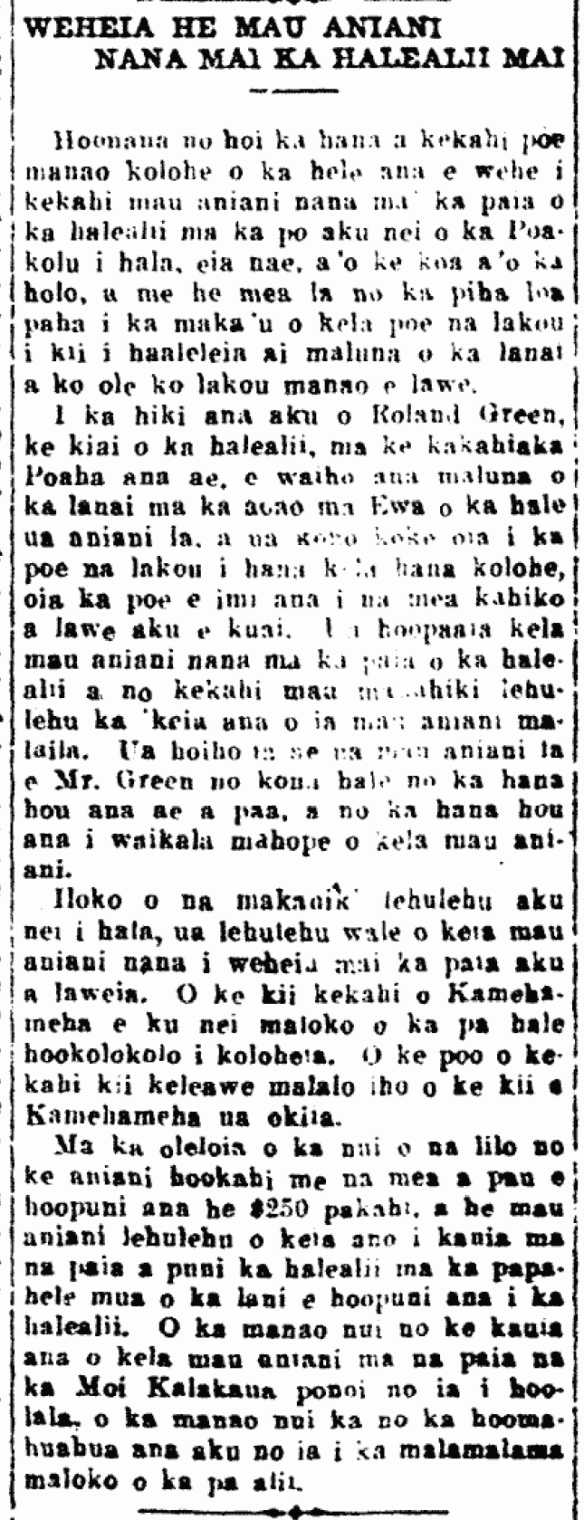
Flagrant was the actions of some vandals who went and removed some mirrors from the wall of the palace the other night of this past Wednesday; however, [as the saying goes,] “Learn to be a warrior; learn also to run away.” And perhaps it was as if due to their being full of fear, that the ones who went to take the mirrors, left them on the lanai without them succeeding in taking them.

When Roland Green, the palace guard, arrived the next Thursday morning, the mirrors were left on the Ewa-side lanai, and he immediately surmised that the people who carried out the vandalism were people who sought out antiquities to sell them.  These mirrors were hung on the wall of the palace and they were there for many years. They were taken by Mr. Green to his place to fix, and to reapply the mercury behind the mirrors.

In many years past, there were numerous mirrors removed from the walls and taken. The statue of Kamehameha standing on the grounds of the court house was also vandalized. One of the heads of a brass image below Kamehameha was severed.

According to what is said, the cost of one of the mirrors and related expenses is $250 each; and there are many of those mirrors that are hung around the first floor walls of the lanai surrounding the palace. The idea for the hanging of these mirrors on the walls was devised by King Kalakaua himself; the intent it is said was to brighten the grounds of the palace.

(Kuokoa, 1/17/1913, p. 6)

WEHEIA HE MAU ANIANI NANA MAI KA HALEALII MAI

Ka Nupepa Kuokoa, Buke XLIX, Helu 3, Aoao 6. Ianuari 17, 1913.

On taxation and leprosy patients, 1875.

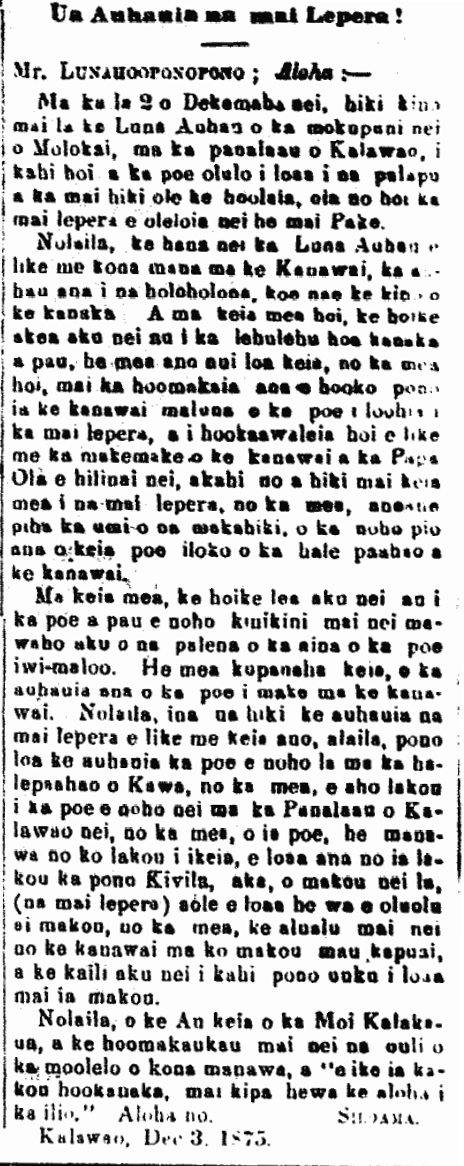
The Leprosy Patients are Taxed!

Mr. Editor; Aloha:—

On the 2nd of this December, the Tax Assessor [Luna Auhau] of this island of Molokai came in person to the colony of Kalawao, the place of the castaways who are afflicted with wounds of an incurable sickness, that being leprosy [mai lepera], which is called he Chinese sickness [mai Pake].

Therefore, the Tax Assessor is acting as per his power under the Law; the taxing of animals, all except the body of man. And as such, I am announcing before all of our fellow people, that this is a major thing, because from the beginning of the enforcement of this law upon people afflicted with leprosy and who are set apart as based on the intent of the edict of the Board of Health; this is the first time this sort of thing has come before the patience, as it has almost been ten years that these people have been living as prisoners in the penitentiary of the law.

Through this, I am announcing clearly to all the people living all over outside of the boundaries of the land of the skeletons. This is astonishing that those dead to the law are being taxed. So if leprosy patients are taxable in this way, then those imprisoned in Kawa [the government prison] should be taxed, for they are better off than those living here in the Colony of Kalawao; those people, there is a given time when they will once again receive their Civil rights, but we here (the leprosy patience), we will not have a time when we are relieved, because the law follows after our steps, and takes from us even the tiniest of rights that we have.

This is the Era of King Kalakaua, and the character of the history of his reign is being prepared; so “Recognize your fellow man, and don’t waste your aloha on dogs.” Aloha no. SILOAMA.¹

Kalawao, Dec. 3, 1875

¹Siloama is probably a pen name; it is the Protestant church in Kalawao.

(Kuokoa, 12/11/1875, p. 4)

Ua Auhauia na mai Lepera!

Ka Nupepa Kuokoa, Buke XIV, Helu 50, Aoao 4. Dekemaba 11, 1875.

Hugo Kawelo, sent to Glasgow to study, returns, 1886.

HAWAIIAN YOUTH RETURNS.

On the ship that brought the Portuguese laborers, Mr. Hugo Kawelo, one of the youths sent to Scotland [Sekotia] to seek education by working [unclear word] in an iron works factory. Because of sickness, he returned, but when he arrived back, he was the epitome of a robust and vigorous man. It was as if the air of the open ocean brought him back to health. He wishes to return to complete his education in the iron [unclear word] industry, should his health be good.

[Hugo Kawelo is one of the select Hawaiians sent abroad by Kalakaua to study and to bring back this knowledge to move Hawaii forward. For more on this program, see for instance: Agnes Quigg’s “Kalakaua’s Hawaiian Studies Abroad Program” from the Hawaiian Journal of History.

Here is one another example of a badly imaged newspaper. I guessed the meaning of some of the passage.

One of our readers, Lynda Fitzgerald, asked who can be contacted to get the original Hawaiian-Language Newspapers reshot clearly. I don’t have a specific name, but the more people that know how important this is, the more likely it will be done. So talk to your friends and coworkers and heads of boards and kumu hula and civic club officers and the aunty down the street. Why do you think seeing all of this information clearly is important…]

(Nupepa Elele, 3/6/1886, p. 2)

HAWAII OPIO UA HOI MAI.

Ka Nupepa Elele, Buke VII, Helu 36, Aoao 2. Maraki 6, 1886.

Princess Kaiulani born, 1875.

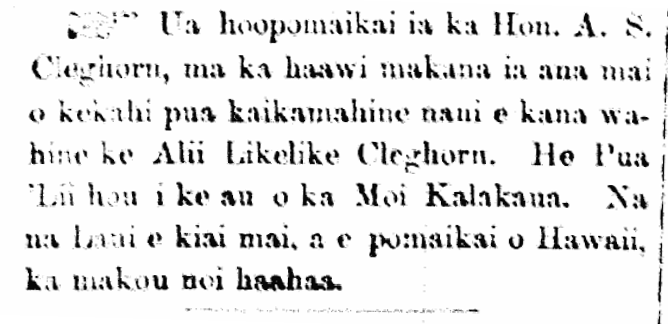
The Hon. A. S. Cleghorn was blessed with being gifted with a beautiful baby girl by his wife, the Alii Likelike Cleghorn. This is a new Royal Offspring in the era of King Kalakaua. That the Heavens watch over and bless Hawaii is our humble plea.

(Lahui Hawaii, 10/23/1875, p. 3)

Ua hoopomaikai ia ka Hon. A. S. Cleghorn...

Ka Lahui Hawaii, Buke I, helu 43, Aoao 3. Okatoba 23, 1875.