Alsoberry Kaumu Hanchett, Kauai boy, becomes a doctor, 1914.

ANOTHER KAUAI BOY MAKES GOOD

A. H. Hanchett who is a Lihue boy, born in a house on the site of the present bowling alley, will graduate from the medical department of Harvard at the end of this month and will, on July 1, enter upon his duties as interne of a great hospital at Providence, R. I. He stood an examination, with 56 others, for that place and came out first best.

Young Hanchett’s father still lives on Kauai, at Waimea; and he is a half brother of W. O. Crowell, of Waimea. Prior to leaving the Islands, he graduated from both Kamehameha school and Oahu College. He next took a four-years course in Harvard, graduating A. B.; after which he took up the medical course, which he is now about to complete.

It is Dr. Hanchett’s hope and present intention to return to the Islands as soon as his two-year term with the Providence hospital is completed.

(Garden Island, 6/9/1914, p. 2)

ANOTHER KAUAI BOY MAKES GOOD

The Garden Island, Volume 10, Number 22, Page 2. June 9, 1914.

A. Kaumu Hanchett studying at Harvard, 1914.

HAWAII IS PROUD OF THIS NATIVE HAWAIIAN

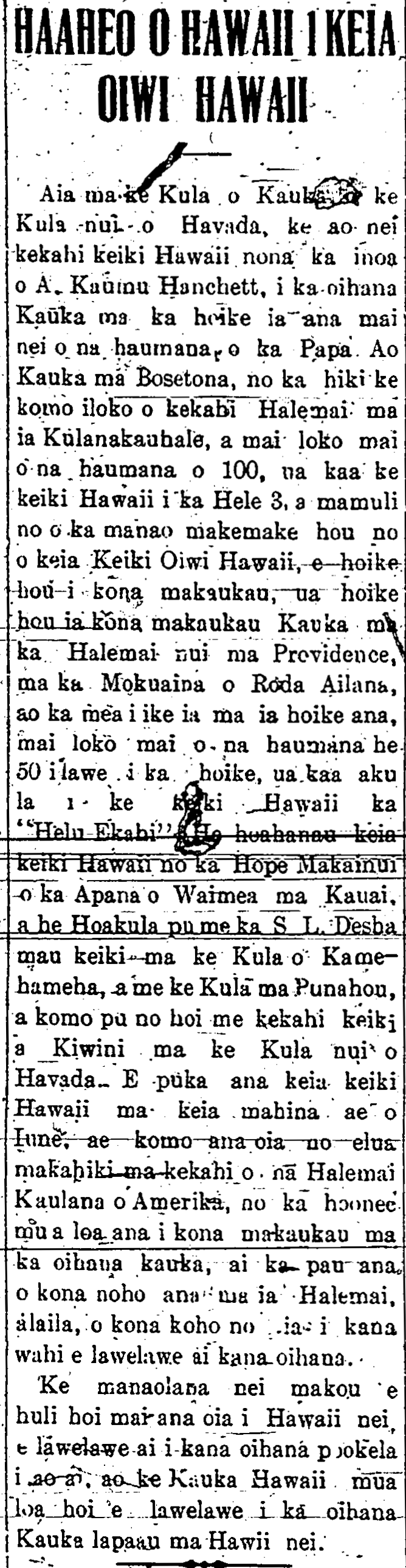
At the Medical School of Harvard University, a Hawaiian named A. Kaumu Hanchett is learning Medicine; in an examination of the medical students in Boston, in order to enter one of the Hospitals of the City, and from amongst a 100 students, the Hawaiian boy ranked 3rd, and because this Hawaiian Boy wanted to once again test his competence, his Medical abilities were tested once again at a big Hospital in Providence in the State of Rhode Island, and what was revealed in that examination was that amongst 50  students who took the test, to the Hawaii boy went “Number One.” He is a brother [hoahanau] of the Deputy Sheriff [Crowell] of the District of Waimea on Kauai, and he was a Classmate of the children of S. L. Desha at Kamehameha School and Punahou School, and he entered Harvard University with a son of Desha’s. This Hawaiian boy will graduate in this coming June, and will intern for two years at one of the Famous Hospitals of America to advance his abilities in the medical field, and at the completion of his stay at the  Hospital, then he will select where he will practice his calling.

We hope that he will come back to Hawaii nei to practice this greatest of occupations in which he trained, and be the first Hawaiian to practice medicine in here in Hawaii.

[On page 295 of the Harvard Alumni Directory for 1910, you will find Alsoberry Kaumu Hanchett [c 1907–10, A.B. 1911(10).] Waimea, Kauai, Hawaii.]

(Hoku o Hawaii, 5/21/1914, p. 2)

HAAHEO O HAWAII I KEIA OIWI HAWAII

Ka Hoku o Hawaii, Buke 8, Helu 50, Aoao 2. Mei 21, 1914.

Winona Kapuailohia Desha Beamer, 1943.

[Found under: “News From Boys, Girls Kamehameha Schools”]

By Pilialoha Hopkins

Miss Winona Kapuailohia Desha Beamer, a graduate of the Kamehameha Schools for Girls, class of ’41, returned from Barnard college, New York.

While she was there Winona was studying in the fields of ethnology and anthropology.

Because of health condition Miss Beamer will remain in the islands for some time. She hopes to continue her study after the war.

While a student at Kamehameha, Winona was engaged in various activities some being, class president, a member of Hui Kumolipo [Kumulipo], a piano and organ pupil, a member of the choir, silver and gold pin student, and was awarded upon graduation a scholarship to Colorado Women’s college. While in school she also won the Clarke-English award and was interested a great deal in relationship and study of the early Hawaiians and Polynesians.

Winona is the daughter of Mr. and Mrs. Francis Pono Beamer of Waikiki, Oahu. She is the granddaughter of Mr. and Mrs. Peter Carl Beamer of Hilo, Hawaii.

At present, Winona has two brothers Francis and Cleighton and a sister Flora attending Kamehameha. Also at Kam she has four cousins, Milton, Edwin, and Helen Beamer, and Helen Walker.

[This was a regular column on the happenings at Kamehameha Schools in the Hoku o Hawaii, and the articles were composed by the students, sometimes in English, and sometimes in Hawaiian.]

(Hoku o Hawaii, 4/14/1943, p. 2)

By Pilialoha Hopkins

Ka Hoku o Hawaii, Volume XXXVII, Number 51, Aoao 2. Apelila 14, 1943.

Monument to Kauikeaouli on his 100th birthday, 1914.

UNVEILING OF THE DONATED TABLET

The Populace Gathers in Kawaiahao on the Evening of this Past Tuesday.

It was a scene from the sacred times when the Islands were ruled under monarchs, that was before a great crowd of people which arrived at Kawaiahao Church in the afternoon of this past Tuesday, when a memorial service for the hundredth birthday of King Kauikeaouli, Kamehameha III was held, and unveiled was the stone tablet dedicated to him that will be stood at the place of his birth at Keauhou, North Kona, Hawaii.

Before the hour set aside for that remembrance, at four o’clock in the afternoon, the crowd entered the church: from the members of the organizations of this town, the students of the Kamehameha Schools, the heads of the government, to the general public, filled up the church, with some people standing.

Outside of the church grounds was the Royal Hawaiian Band entertaining the people, with a majority of the people there, because they could not get a seat in the church.

Before the pulpit stood a painting of King Kauikeaouli, Kamehameha III, and right below the painting was the tablet with clear lettering that said: “Kauikeaouli, Kamehameha III, ke keiki a Kamehameha III ame Keopuolani. Hanauia i Maraki 17,1814. Ka Moi lokomaikai.”

Continue reading

The Steamship Australia, 1900.

A DAY OF CELEBRATION FOR THE STEAMSHIP AUSTRALIA IN HONOLULU.

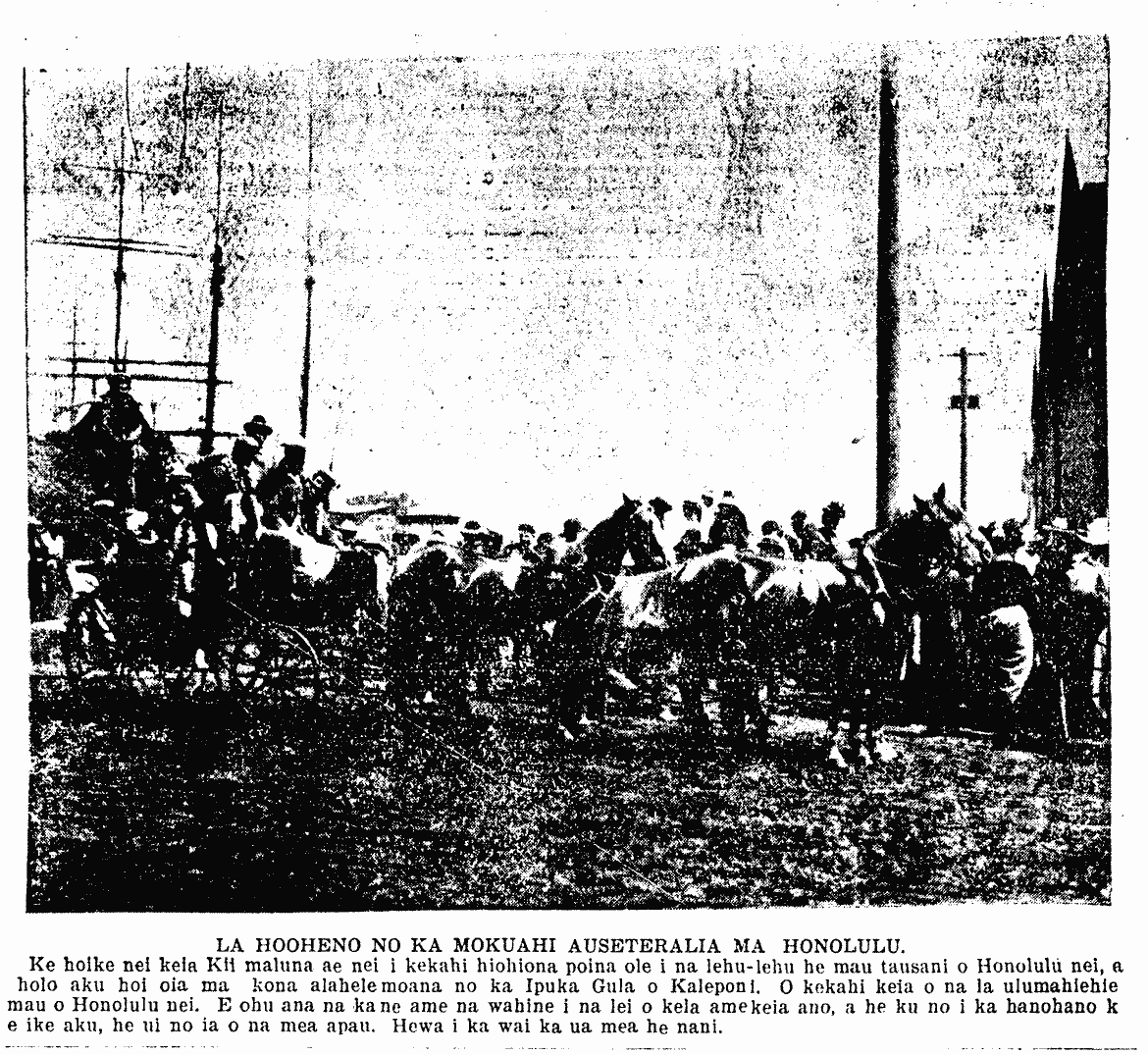
The picture above illustrates the scene that cannot be forgotten by the crowd of thousands of Honolulu nei, as it goes on its ocean path to the Golden Gate of San Francisco. This is a regular festivity here in Honolulu. The men and women are decorated with lei of this and that variety, and it is glorious to see, the beauty of everyone. It is so very beautiful.

[The Australia was one of the many ships that took Hawaiians to and from this Archipelago. One of her famous passengers was Sweet Emalia, Emalia Kaihumua, the composer of “He Aloha Moku o Keawe,” which is a song composed in far away San Francisco during a time of great turbulence, where the writer yearns for her homeland.

Don’t forget to tune in tonight to the 94th annual Kamehameha Schools’ Song Contest! Its theme this year is Songs of World Travel!!]

(Kuokoa, 3/23/1900, p. 1)

LA HOOHENO NO KA MOKUAHI AUSETERALIA

Ka Nupepa Kuokoa, Buke XXXVIII, Helu 12, Aoao 1. Maraki 23, 1900.

Kamehameha Schools Song Contest, yesterday and today, 1944 / 2014.

[Found under: “News From Boys, Girls Kamehameha School”]

By HARRIETTE HURLEY

People who enjoy Hawaiian music have expressed the desire to know the meanings of the Hawaiian songs. Translations of the two prize songs to be used in the Kamehameha School for Girls’ song contest to be held on February 13, appear below.

Mrs Mary Kawena Pukui, translator at the Bishop Museum and director of Hawaiian activities at the Kamehameha Preparatory School, has translated the songs.

The junior division prize song is Pa’au’au Waltz. Selected for the senior division prize song is Lei Awapuhi.

Translation of Lei Awapuhi

I hear the voice of a loved one say
Let me pluck and wear the flower
To string a lei for my leaf bud to wear
My love was strongly attracted
To the choicest flower that ever bloomed
Let me, darling, string it into a lei,
O let your ginger lei be mine. Continue reading

John Kaina, Kamehameha senior classman, 1941.

KAMEHAMEHA SCHOOLS NEWS

(Written by Louis Agard)

JOHN KAINA

The Bishop Museum [hale hoahu o na mea kahiko o Bihopa] published picture postcards [pepa kii haleleka] showing Hawaiian pictures. Amongst the cards printed is a picture of John Kaina, a senior classman at Kamehameha. John Kaina’s picture is printed in this group of postcards. The first group is made up of twelve eleven cards. Continue reading

Words of praise for C. R. Bishop on today, his birthday, 1896.

MEMORIALS.

….¹

There are many kinds of memorials [kia hoomanao] to remember people by. A person is remembered for his deeds, in memorials built as pillars and monuments, in reminiscences, and preserved in the hearts of the many. Famous deeds of people are remembered with aloha for the good, and with scorn for the bad.

Queen Liliuokalani’s beloved efforts stand today as the Hui Hoonaauao i na Opio [Liliuokalani Educational Society].

The epitome of great deeds of these past days was done by a haole who lived here as a malihini and married one of the Princesses amongst the royal youth. Charles R. Bishop built the Kamehameha Schools, the memorial for his wife, the Alii Pauahi Bishop; and by this act of commemoration, a memorial now stands for all of the Kamehamehas, and it is impossible to forget their name.

 In the days when this haole friend was living here in Hawaii, he was often criticized for his stinginess and defiance by Hawaiian and haole alike, but he paid no care to this criticism. He continued with his work, ate healthily, [illegible digital image], until he was a rich man; but in all the criticism for him, there is no way that it could be said that he was a scoundrel or that he cheated someone; and this says a lot for his uprighteousness.

Likewise with his charity work, he acted with maturity and kindness without end in his steadfast support for the benefit of this lahui. In giving, he was not frivolous in his giving, but gave wisely. He donated hundreds of thousands of dollars to the Punahou College and to the Kamehameha Schools, from his own estate and from that of his wife’s; and from his own, also benefited were the Boarding School for  Boys and Girls. How wondrous is God in his passing down the great entire wealth of the Kamehamehas from one to another until it all came down to Keelikolani and then to Pauahi, the grandchildren of the first born of Kamehameha Nai Aupuni; and it was the last of the two, the one most knowledgeable of them all, as measured by their final deeds, which she created with her husband as a memorial for all of the Kamehamehas. This man was of a great mind in his carrying out meticulously this work which he and his wife discussed between themselves, without misappropriating a single parcel of land included in the estate of his wife, but instead he was conscientious and included his own estate. When put together with all the other beloved deeds by everyone in Hawaii nei, this is measured as the most wise of them all, the height and breadth of its foundation will go on and bear forth much benefits for this lahui. There is but yet one thing to complete and to perfect the building of this memorial to the Kamehamehas, that being the righteousness of God’s words, the basis upon which the good and the blessings of the lahui will continue.

But Bishop’s help for our people is not done in his continued assistance to the memorial to the Kamehamehas and their foster children [keiki hookama] in the covenant of marriage of Charles R. Bishop.

¹The first paragraph was left out because it was somewhat irrelevant to this particular post, and was commentary on J. Kekipi and the Christian Science [Hoomana Karistiano Naauao] faith.

(Oiaio, 2/21/1896, p. 2)
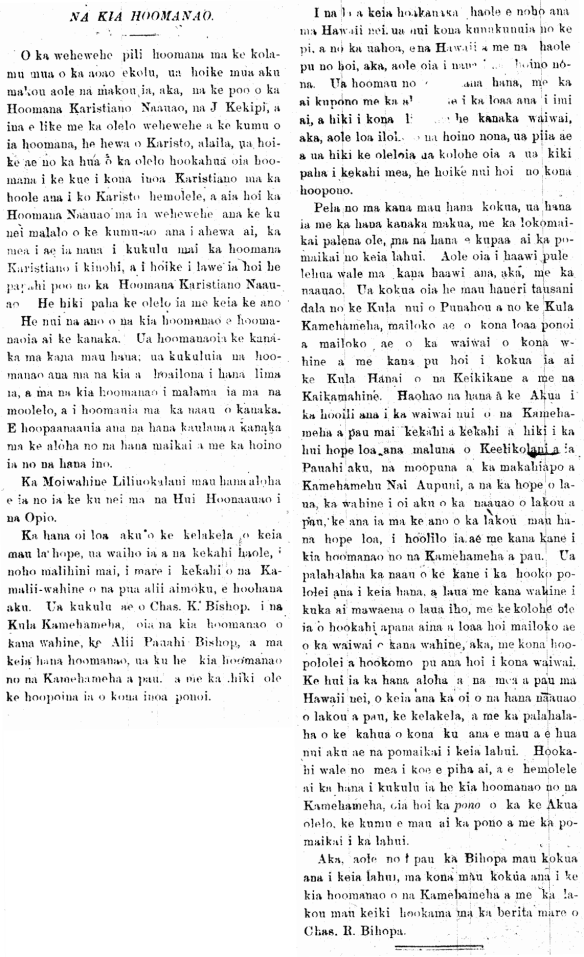
NA KIA HOOMANAO.

Ka Oiaio Puka La, Buke I, Helu 37, Aoao 2. Feberuari 21, 1896.

Beginnings of the Bishop Museum, 1888.

[Found under: “This and That.”]

The Portuguese are hewing a-la stone in the uplands of Waipilopilo for the new structure that the Hon. C. R. Bishop is considering building for the benefit of the young children of the school and a place to house the antiques of the royal women Pauahi and Kaleleonalani.

(Kuokoa, 6/2/1888, p. 3)

Na ka poe Pukiki...

Ka Nupepa Kuokoa, Buke XXVII, Helu 22, Aoao 3. Iune 2, 1888.