Newspapers, translation, and a mele for the Merrie Monarch, 1913 / Timeless.

You can find various translations for the beautiful song, “Kaipoleimanu” in the archives of the Bernice Pauahi Bishop Museum, online, and on liner notes. None however seems to acknowledge that Kaipoleimanu itself was a wahi pana, along with its neighboring hau of Maihi, ulu of Weli [also seen as Wehi], and hala of Mapuana.

There is a priceless church meeting report/travelogue appearing in the Kuokoa from 12/5/1913 to 2/6/1914: Ka Ike Hou ana o ke Kamahele i ka Mokupuni o Kauai [The Traveler Sees Once More the Island of Kauai], signed, Kamahele. Amongst all the fascinating information found in this report is a description of the places hearkened to in the mele Kaipoleimanu, to which the traveller is taken by his guide, the Deputy Sheriff of Hanalei, William Werner. He says: Continue reading

Stopping by at Washington, D. C. on the way to see the Queen, 1887.

KING KALAKAUA’S WIFE.

QUEEN KAPIOLANI ARRIVES AT OUR NATIONAL CAPITAL.

Arrangements Made for the Queen to Call on the President and Mrs. Cleveland—A Benevolent Creature on Her Way to Visit Victoria—Queen Emma.

QUEEN KAPIOLANI.

Washington, May 4.—Queen Kapiolani, of the Hawaiian Islands, who arrived in San Francisco on April 20, arrived in Washington to-day and immediately went to the Arlington Hotel. Arrangements have been made for the queen to call on the president and Mrs. Cleveland at noon on Wednesday. The queen and suite will arrive here early Tuesday evening and go at once to the Arlington. A time will be appointed by the queen during her stay here for the diplomatic corps to call on her, and she will also probably receive calls from the naval officers who have been stationed at Honolulu, all of whom have met her majesty, and many of whom have danced with her.

After spending a few days here sight-seeing she will go to New York. From there she goes to England to be present at the Queen’s jubilee. She has never been out of her own country before, and is quite anxious to see the “greatest woman on the face of the earth,” as she calls Queen Victoria. Queen Kapiolani is not of what is known as royal blood in Honolulu. Strictly speaking neither is King Kalakaua of royal blood, as he was elected to the throne and did not inherit it. Continue reading

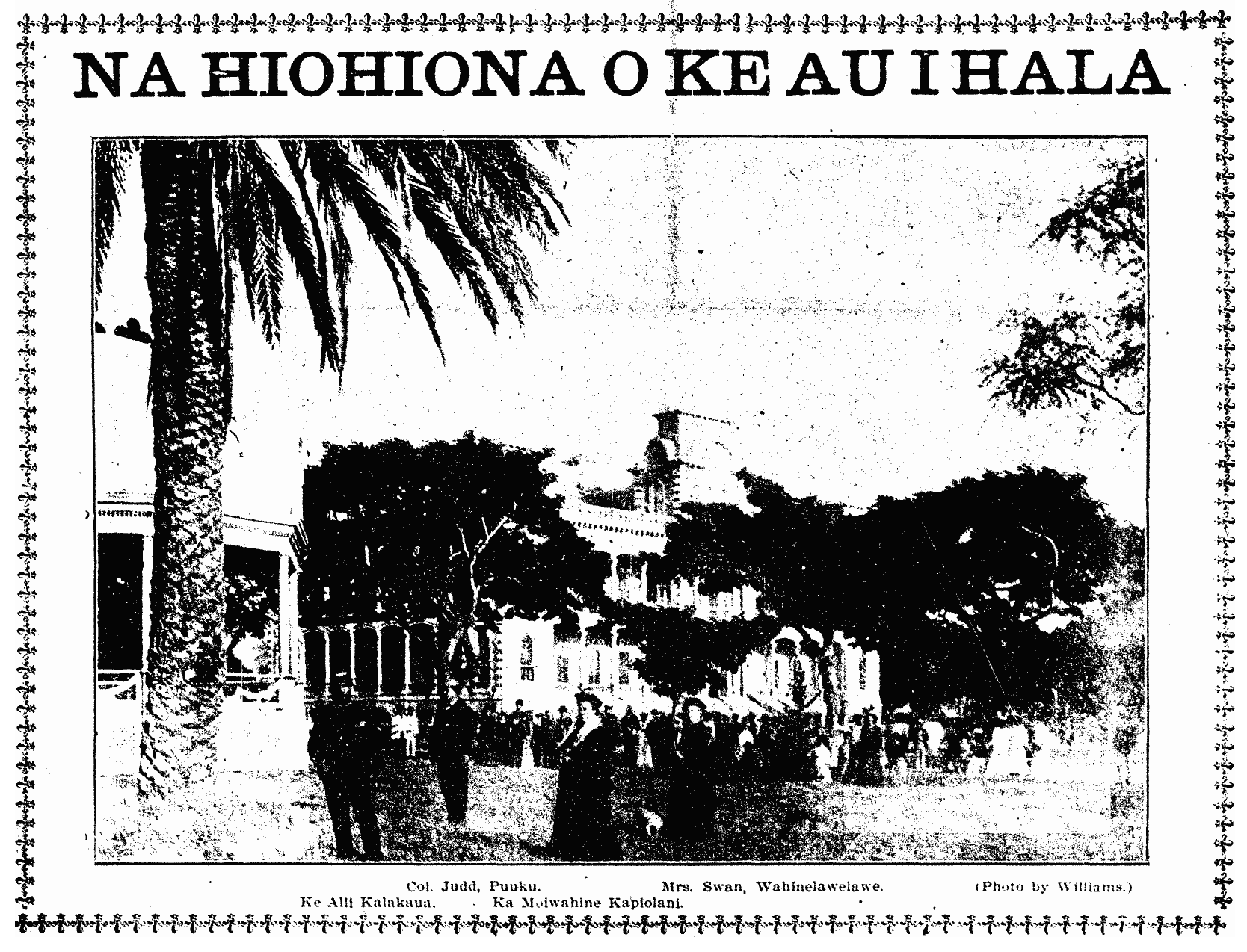
King Kalakaua and Queen Kapiolani and Iolani Palace, 1903.

IMAGES FROM DAYS GONE BY

Col. Judd, Chamberlain [Puuku]         Mrs. Swan, Chambermaid [Wahinelawelawe.]         (Photo by Williams.)

King Kalakaua                                Queen Kapiolani

(Kuokoa, 4/17/1903, p. 1)

NA HIOHIONA O KE AU I HALA

Ka Nupepa Kuokoa, Buke XLI, Helu 16, Aoao 1. Aperila 17, 1903.

Kaipoleimanu, okolehao, place names, and such, 1895 / 2014.

KAIPOLEIMANU.

This Tuesday, Captain Kalei of the Schooner Rob Roy, which is a schooner travelling between Honolulu nei and Molokai, was arrested for having an Okolehao jug containing liquor; there were a great many officers sent to the seaside to arrest the Captain of the schooner.

There was much found in a dark room: four gin jugs, two Whiskey jugs, but the majority found were bottles that were empty with no whiff of Okolehao.

One of the sailors of this ship, distanced himself with a dismal look on his face, and another scratched his head while looking pale.

When it was clear to an officer that he saw alcohol was brought into Honolulu town to be sold, and because of orders received by the officers, should there be a person or persons that were confirmed to have alcohol, they were to be taken to Jail [Halewai], that indeed is what happened as per what was ordered; and the officers and some others went along to the Jailhouse while bringing in a Demijohn [“basketry filled with a bottle”] containing some Okolehao; there was the stench of Ipoleimanu, and this made us recall these lines of mele.

He manao he aloha,
No Kaipoleimanu,
He manu ku’u hoa,
Noho mai ka nahele,
Iiwi a o uka,
Polena i kaua,
Ua ao Hanalei,
Anu au maeele,
[Ua anu hoi au
I ka ua noe anu
Na hau o Maihi
Au ana i ke kai
Na ulu o Weli
Punohu mai ana
E mapu mai ana
Ke ala o ka Hala
Hala o Mapuana
Honi ana i ka ihu
Ke ala pua rose
Hooheno i kuu poli
Naue kuu kino
Ko hiki ana mai
Haina ia ka puana
No ka ipo leimanu.]

¹Kaipoleimanu was during this time a slang for okolehao.

[I took a step back from “Hawaii’s Story,” but not too far. This mele by Queen Kapiolani for her King Kalakaua, Kaipoleimanu, is still widely sung today. But who today still knows that along with Hanalei, Maihi, Weli, and Mapuana, that Kaipoleimanu is a place on Kauai. In a Hawaii where we are so used to places called Diamond Head, Pearl City, Bowls, Sunset, Yokohama, and the like, is there value in re-membering more traditional names?

On that note, before i take some time away from these posts, i thought i would try a little survey. If you have the time, please think about the question rationally, then choose an answer or add one of your own. And as always, do feel free to leave comments in the box all the way at the bottom.]

(Oiaio, 8/23/1894, p. 3)

KAIPOLEIMANU.

Nupepa Ka Oiaio, Buke VII, Helu 25, Aoao 3. Augate 23, 1895.

Birthday of Queen Kapiolani, 1876.

Queen Kapiolani.

Yesterday, December 31, was the birthday of the Alii, Queen Kapiolani, the royal daughter of Kuhio (m) and Kinoiki (f), and this made her forty-first year, for she was born on this day in the year 1834. Yesterday at 12 noon, she saw in Iolani Palace all those who came to see her and to give her joy on this proud day of a person’s life, and the cannons were shot off in salute for her birthday. Just as with the happiness and the congratulations of those who went to see her, so too are we who are outside, with prayers for blessings from the heavens that her life may be extended until extreme old age.

Here is the genealogy of birth of Queen Kapiolani:

Keawe dwelt with Lonomaikanaka; Kauhiokeka (f) dwelt with Keawe (m); Kekaulike (f) dwelt with Kepoomahoe (m); Kalanikauleleiaiwi 3 [?] (f) dwelt with Kanekoa (m); Pomaikaulani (f) dwelt with Elelule (m); Kuhio (m) dwelt with Kinoiki (f); born was Kapiolani (f), Kapooloku (f), and Kekaulike (f).

Long live the Queen, Kapiolani.

[Here is another article probably submitted by Robert William Wilcox (Wilikoki) dealing with Queen Kapiolani’s genealogy. Kuokoa, 7/21/1899, p. 2. “KA MOOKUAUHAU ALII O KA MOIWAHINE KAPIOLANI.”]

(Kuokoa, 1/1/1876, p. 2)

Ka Moiwahine Kapiolani.

Ka Nupepa Kuokoa, Buke XV, Helu 1, Aoao 2. Ianuari 1, 1876.

“Ka Ipo Lei Manu,” 1891.

KALANI KAULILUA.

He manao he aloha
Na ka ipo lei manu
Ua manu kuu hoa
Noho mai ka nahele
Iiwi o uka
Polena i ka ua
Elua maua
I ka po ua nui
Ua o Hanalei
Anu au maeele
Ua anu hoi au
I ka ua noe anu
Na hau o Maihi
Au ana i ke kai
Na ulu o Weli
Ponuhu mai ana
Mapu mai ana
Ke ala o ka Hala
Hala o Mopuena [Mapuana]
Onaona i ka ihu
Ke ala pua Loke
Hone na ka manao
Naue kuu kino
Ko hiki ana mai
Haina ia ka puana
O ka Lani Kaulilua.

[A song attributed to Queen Kapiolani for her King that travelled afar; it is still widely sung today and more commonly known by the title “Ka Ipo Lei Manu”. This is perhaps the first time it appears in the Hawaiian-Language Newspapers. It was published in the issue immediately following the issue announcing the death of King Kalakaua.]

(Leo o ka Lahui, 2/2/1891, p. 2)

KALANI KAULILUA.

Ka Leo o ka Lahui, Buke II, Helu 120, Aoao 2. Feberuari 2, 1891.

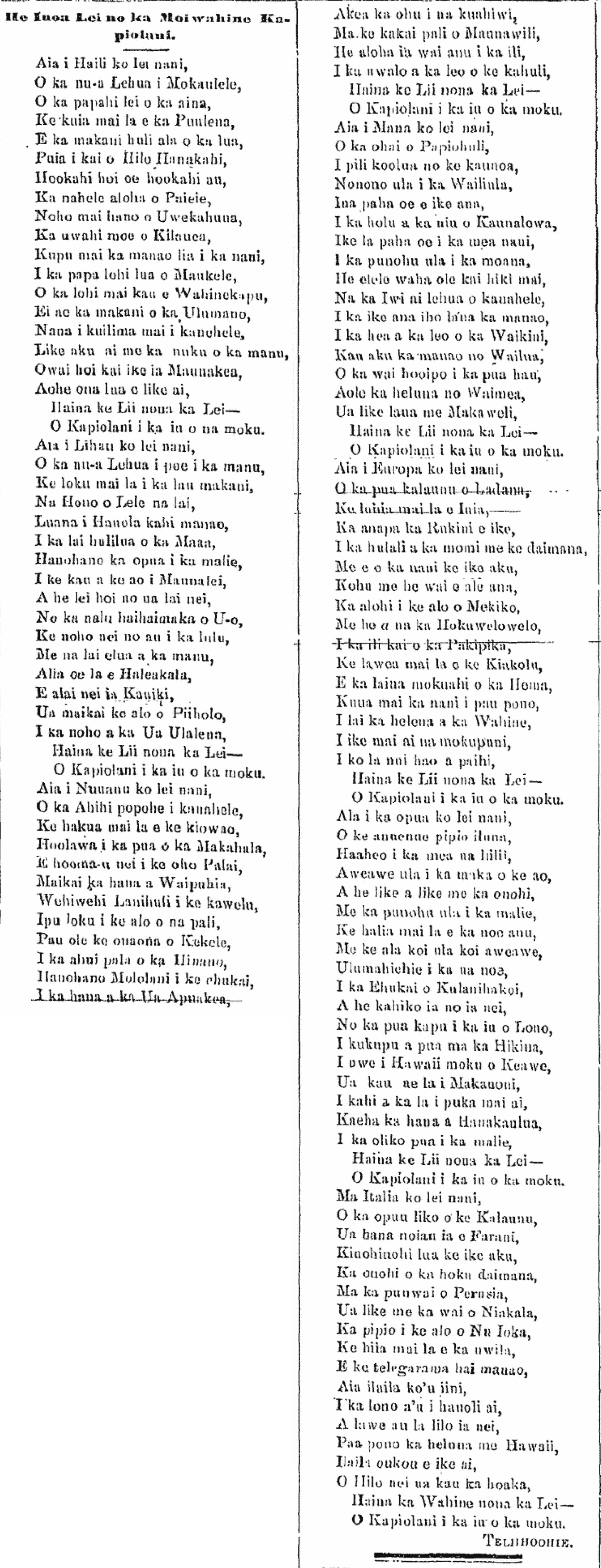
Queen Kapiolani, Mele, Maunakea, and a new site to check out, 1878/2013.

He Inoa Lei no ka Moiwahine Kapiolani.

Aia i Haili ko lei nani,
O ka nu-a Lehua i Mokaulele,
O ka papahi lei o ka aina,
Ke kuia mai la e ka Puulena,
E ka makani huli ala o ka lua,
Puia i kai o Hilo Hanakahi,
Hookahi hoi oe hookahi au,
Ka nahele aloha o Paieie,
Noho mai hano o Uwekahuna,
Ka uwahi moe o Kilauea,
Kupu mai ka manao lia i ka nani,
I ka papa lohi lua o Maukele,
O ka lohi mai kau e Wahinekapu,
Ei ae ka makani o ka Ulumano,
Nana i kuilima mai i kanehele,
Like aku ai me ka nuku o ka manu,
Owai hoi kai ike ia Maunakea,
Aohe ona lua e like ai,
Haina ke Lii nona ka Lei—
O Kapiolani i ka iu o na moku.

Aia i Lihau ko lei nani,
O ka nu-a Lehua i poe i ka manu,
Ke loku mai la i ka lau makani,
Na hono o Lele na lai,
Luana i Hauola kahi manao,
I ka lai hulilua o ka Maaa,
Hanohano ka opua i ka malie,
I ke kau a ke ao i Maunalei,
A he lei hoi no ua lai nei,
No ka nalu haihaimaka o U-o
Ke noho nei no au i ka lulu,
Me na lai elua a ka manu,
Alia oe la e Haleakala,
E alai nei ia Kauiki,
Ua maikai ke alo o Piiholo,
I ka noho a ka Ua Ulalena,
Haina ke Lii nona ka Lei—
O Kapiolani i ka iu o ka moku.

Aia i Nuuanu ko lei nani,
O ka Ahihi popohe i kanahele,
Ke hakua mai la e ke kiowao,
Hoolawa i ka pua o ka Makahala,
E hooma-u nei i ke oho Palai,
Maikai ka hana a Waipuhia,
Wehiwehi Lanihuli i ke kawelu,
Ipu loku i ke alo o na pali,
Pau ole ke onaona o Kekele,
I ka ahui pola o ka Hinano,
Hanohano Mololani i ke ehukai,
I ka hana a ka Ua Apuakea,
Akea ka ohu i na kuahiwi,
Ma ke kakai pali o Maunawili,
He aloha ia wai anu i ka ili,
I ka uwalo a ka leo o ke kahuli,
Haina ke Lii nona ka Lei—
O Kapiolani i ka iu o ka moku.

Aia i Mana ko lei nani,
O ka ohai o Papiohuli,
I pili koolua no ke kaunoa,
Nonono ula i ka Wailiula,
Ina paha oe e ike ana,
I ka holu a ka ulu o Kaunalewa,
Ike la paha oe i ka mea nani,
I ka punohu ula i ka moana,
He elele waha ole kai hiki mai,
Na ka Iwi ai lehua o kanahele,
I ka ike ana iho lana ka manao,
I ka hea a ka leo o ka Waikini,
Kau aku ka manao no Wailua,
O ka wai hooipo i ka pua hau,
Aole ka heluna no Waimea,
Ua like laua me Makaweli,
Haina ke Lii nona ka Lei—
O Kapiolani i ka iu o ka moku.

Aia i Europa ko lei nani,
O ka pua kalaunu o Ladana,
Ke luhia mai la e Inia,
Ka anapa ka Rukini e ike,
I ka hulali a ka momi me ke daimana,
Me e o ka nani ke ike aku,
Kohu me he wai e ale ana,
Ka alohi i ke alo o Mekiko,
Me he a na ka Hokuwelowelo,
I ka ili kai o ka Pakipika,
Ke lawea mai la e ke Kiakolu,
E ka laina mokuahi o ka Hema,
Kuua mai ka nai i pau pono,
I lai ka helena a ka Wahine,
I ike mai ai na mokupuni,
I ko la nui hao a paihi,
Haina ke Lii nona ka Lei—
O Kapiolani i ka iu o ka moku.

Ala i ka opua ko lei nani,
O ke anuenue pipio iluna,
Haaheo i ka mea na liilii,
Aweawe ula i ka maka o ke ao,
A he like a like me ka onohi,
Me ka punohu ula i ka malie,
Ke halia mai la e ka noe anu,
Me ke ala koi ula koi aweawe,
Ulumahiehie i ka ua noe,
I ka Ehukai o Kulanihakoi,
A he kahiko ia no ia nei,
No ka pua kapu i ka iu o Lono,
I kukupu a pua ma ka Hikina,
I uwe i Hawaii moku o Keawe,
Ua kau ae la i Makanoni,
I kahi a ka la i puka mai ai,
Kaeha ka hana a Hanakaulua,
I ka oliko pua i ka malie,
Haina ke Lii nona ka Lei—
O Kapiolani i ka iu o ka moku.

Ma Italia ko lei nani,
O ka opuu liko o ke Kalaunu,
Ua hana noiau ia e Farani,
Kinohinohi lua ke ike aku,
Ka onohi o ka hoku daimana,
Ma ka puuwai o Perusia,
Ua like me ka wai o Niakala,
Ka pipio i ke alo o Nu Ioka,
Ke hiia mai la e ka uwila,
E ke telegarama hai manao,
Aia ilaila ko’u iini,
I ka lono a’u i hauoli ai,
A lawe au la lilo ia nei,
Paa pono ka helua me Hawaii,
Ilaila oukou e ike ai,
O Hilo nei ua kau ka hoaka,
Haina ka Wahine nona ka Lei—
O Kapiolani i ka iu o ka moku.

Teliihoohie.

[I was reminded of this set of lei chants for Queen Kapiolani by a post on a relatively new site with information about Hawaii past and present. Check out the recent post on Maunakea and much more by Nanea Armstrong Wassel, right here:

http://instagram.com/naneaarmstrongwassel

This mele is also printed in the very next issue of Ko Hawaii Pae Aina, 10/12/1878, p. 4, with some variation.]

(Ko Hawaii Pae Aina, 10/5/1878, p. 4)
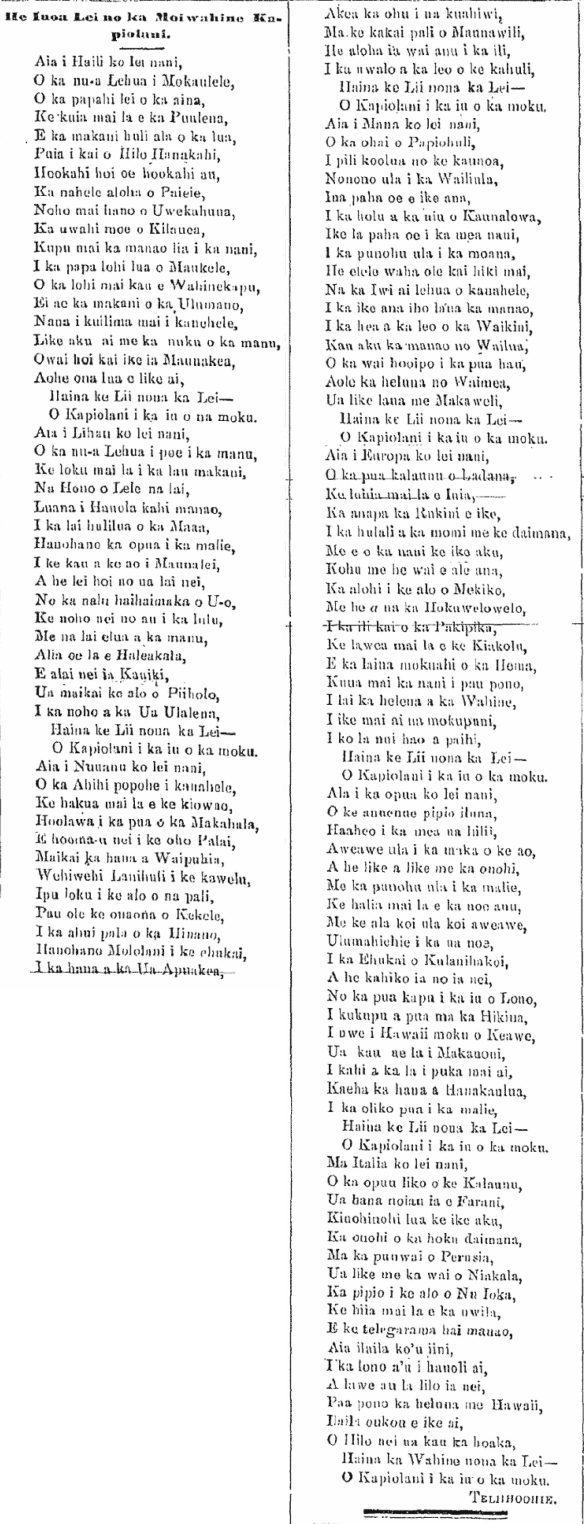
He Inoa Lei no ka Moiwahine Kapiolani.

Ko Hawaii Pae Aina, Buke I, Helu 40, Aoao 4. Okatoba 5, 1878.

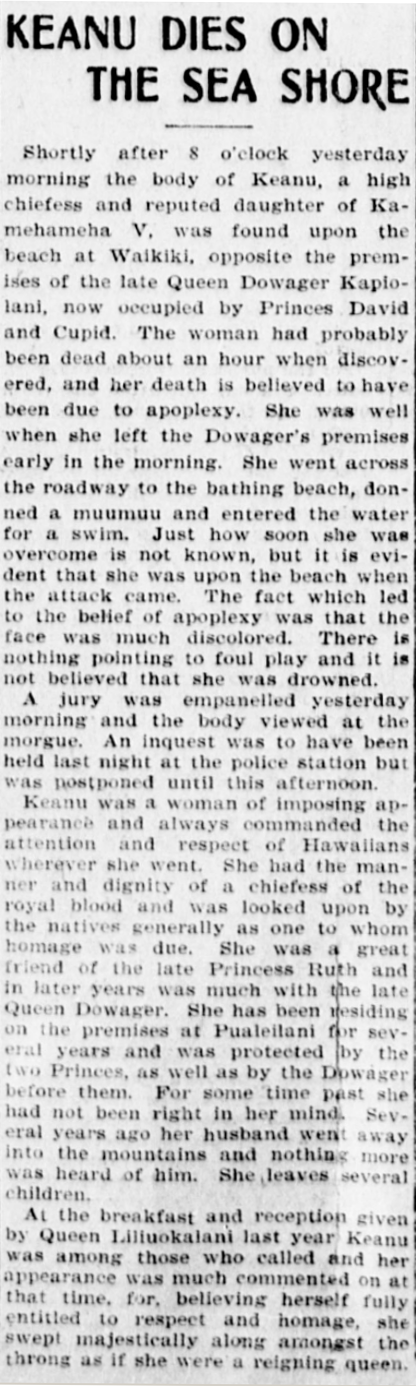
More on the death of Keanu, 1902.

KEANU DIES ON THE SEA SHORE

Shortly after 8 o’clock yesterday morning the body of Keanu, a high chiefess and reputed daughter of Kamehameha V, was found upon the beach at Waikiki, opposite the premises of the late Queen Dowager Kapiolani, now occupied by Princes David and Cupid. The woman had probably been dead about an hour when discovered, and her death is believed to have been due to apoplexy. She was well when she left the Dowager’s premises early in the morning. She wen across the roadway to the bathing beach, donned a muumuu and entered the water for a swim. Just how soon she was overcome is not known, but it is evident that she was upon the beach when the attack came. The fact which led to the belief of apoplexy was that the face was much discolored. There is nothing pointing to foul play and it is not believed that she was drowned.

A jury was empanelled yesterday morning and the body viewed at the morgue. An inquest was to have been held last night at the police station but was postponed until this afternoon.

Keanu was a woman of imposing appearance and always commanded the attention and respect of Hawaiians wherever she went. She had the manner and dignity of a chiefess of the royal blood and was looked upon by the natives generally as one to whom homage was due. She was a great friend of the late Princess Ruth and in later years was much with the late Queen Dowager. She has been residing on the premises at Pualeilani for several years and was protected by the two Princes, as well as by the Dowager before them. For some time past she had not been right in her mind. Several years ago her husband went away into the mountains and nothing more was heard of him. She leaves several children.

At the breakfast and reception given by Queen Liliuokalani last year Keanu was among those who called and her appearance was much commented on at that time, for, believing herself fully entitled to respect and homage, she swept majestically along amongst the throng as if she were a reigning queen.

(Hawaiian Gazette, 7/1/1902, p. 4)

KEANU DIES ON SEA SHORE

Hawaiian Gazette, Volume XXXVII, Number 50, Page 4. July 1, 1902.

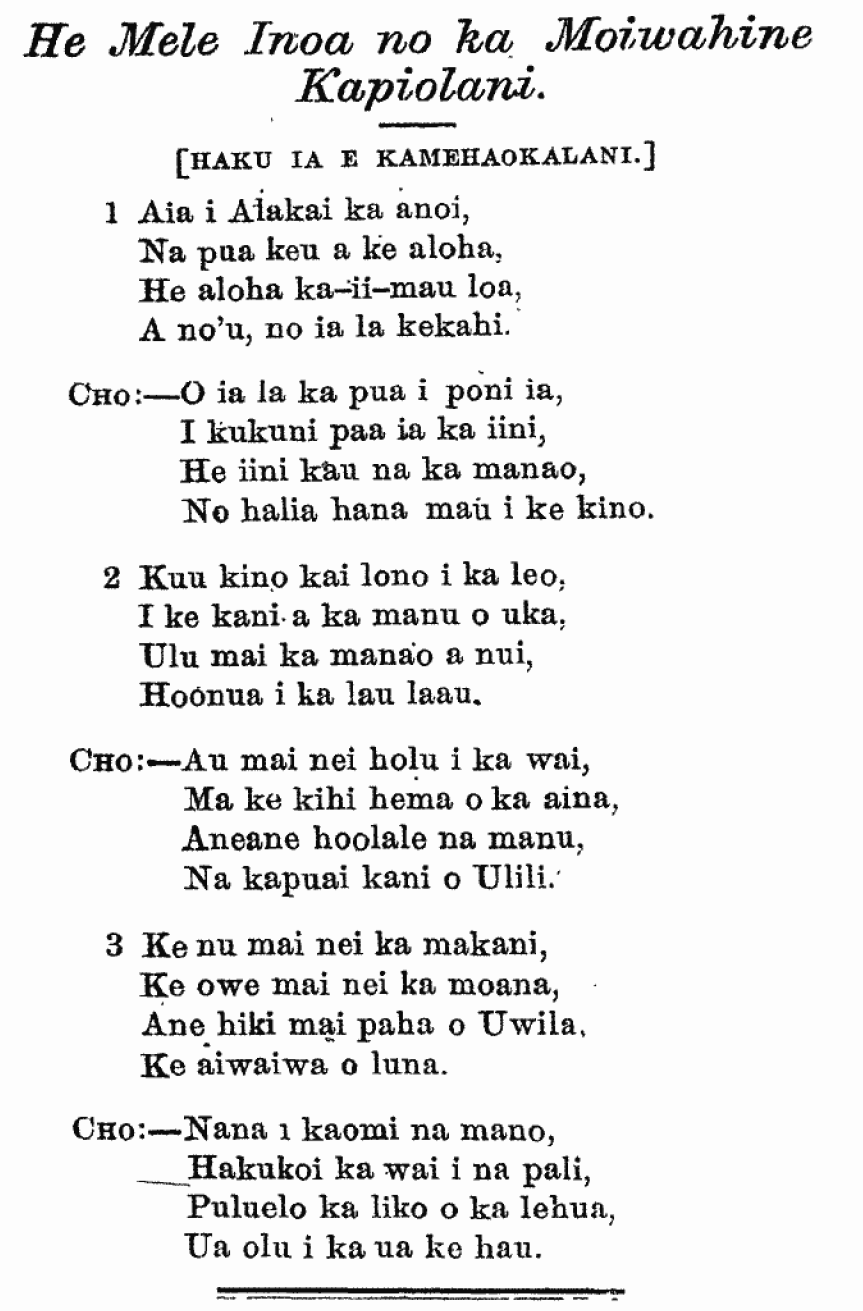
Another beautiful name song for Queen Kapiolani, still sung today, 1883.

He Mele Inoa no ka Moiwahine Kapiolani.

[HAKU IA E KAMEHAOKALANI.]

1 Aia i Alakai ka anoi,
Na pua keu a ke aloha,
He aloha ka—ii—mau loa,
A no’u, no ia la kekahi.

Cho:—O ia la ka pua i poni ia,
I kukuni paa ia ka iini,
He iini kau na ka manao,
No halia hana mau i ke kino.

2 Kuu kino kai lono i ka leo,
I ke kani a ka manu o uka,
Ulu mai ka manao a nui,
Hoonua i ka lau laau.

Cho:—Au mai nei holu i ka wai,
Ma ke kihi hema o ka aina,
Aneane hoolale na manu,
Na kapuai kani o Ulili.

3 Ke nu mai nei ka makani,
Ke owe mai nei ka moana,
Ane hiki mai paha o Uwila,
Ke aiwaiwa o luna.

Cho:—Nana i kaomi na mano,
Hakukoi ka wai i na pali,
Puluelo ka liko o ka lehua,
Ua olu i ka ua ke hau.

[The mele in the newspapers need to be studied. Here, this one is credited to Kamehaokalani. Later on in 1897, in Edward C. Holstein’s “Ka Buke Mele o na Himeni Hawaii,” it is credited to Kamealoha. This book is available as a reprint from the Bernice Pauahi Bishop Museum.]

(Koo o Hawaii, 8/29/1883, p. 8)

He Mele Inoa no ka Moiwahine Kapiolani.

Ke Koo o Hawaii, Buke 1, Helu 2, Aoao 8. Augate 29, 1883.

Queen Kapiolani’s visit to the leprosy colony, 1884.

While the entire report should be read because it is all so telling, I think many will find “Report of Her Majesty Queen Kapiolani’s visit to Molokai, by H. R. H. Princess Liliuokalani, July, 1884.” found in the Appendix to the Report on Leprosy of the President of the Board of Health to the Legislative Assembly of 1886, pp. iii–xvii, very interesting for many reasons.