New organ being assembled at Kawaiahao Church, 1901.

Organ of Kawaiahao.

The new Organ of the Church has arrived, and if you go inside, you will see all sorts of small parts of this organ strewn here and there of the church. It is being assembled as quickly as possible by those working on it. There are hundreds of small parts to be put together until the large organ is complete. Because the church is being taken up by this activity, the church activities will take place in the room below.

[This is just one of a number of new organs that Kawaiahao received throughout the years!]

(Kuokoa, 7/12/1901, p. 4)

Ka Ogana o Kawaiahao.

Ka Nupepa Kuokoa, Buke XXXIX, Helu 28, Aoao 4. Iulai 12, 1901.

Restoration celebration at Kaniakapupu, 1847.

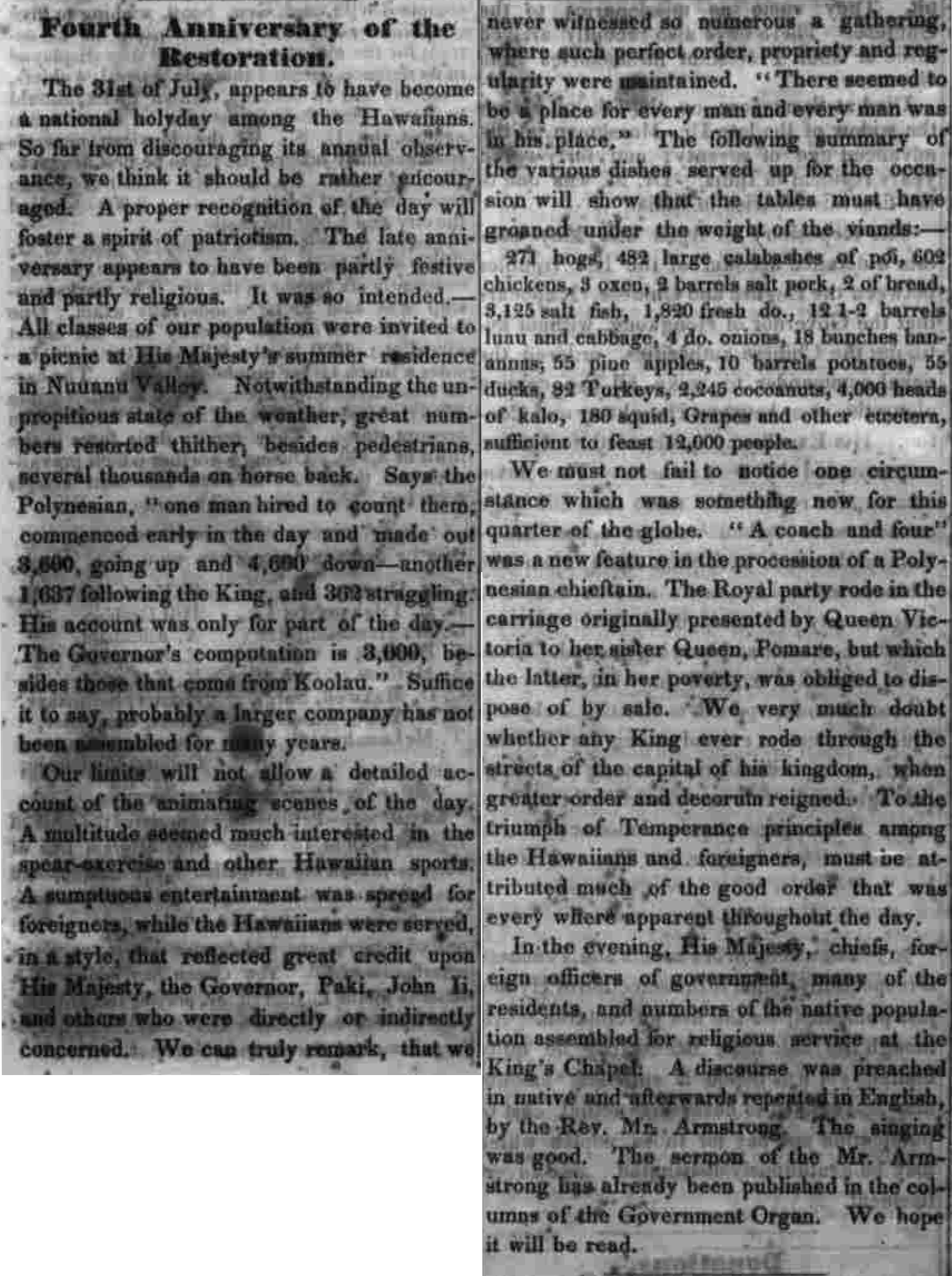
Fourth Anniversary of the Restoration.

The 31st of July, appears to have become a national holyday among the Hawaiians. So far from discouraging its annual observance, we think it should be rather encouraged. A proper recognition of the day will foster a spirit of patriotism. The late anniversary appears to have been partly festive and partly religious. It was so intended.—All classes of our population were invited to a picnic at His Majesty’s summer residence in Nuuanu Valley. Notwithstanding the unpropitious state of the weather, great numbers resorted thither; besides pedestrians, several thousands on horse back. Says the Polynesian, “one man hired to count them, commenced early in the day and made out 3,600, going up and 4,600 down—another 1,637 following the King, and 362 straggling. His account was only for part of the day.—The Governor’s computation is 3,000, besides those that come from Koolau.” Suffice it to say, probably a larger company has not been assembled for many years.

Our limits will not allow a detailed account of the animating scenes of the day. A multitude seemed much interested in the spear-exercise and other Hawaiian sports. A sumptuous entertainment was spread for foreigners, while the Hawaiians were served, in a style, that reflected great credit upon His Majesty, the Governor, Paki, John Ii, and others who were directly or indirectly concerned. We can truly remark, that we never witnessed so numerous a gathering, where such perfect order, propriety and regularity were maintained. “There seemed to be a place for every man and every man was in his place.” The following summary of the various dishes served up for the occasion will show that the tables must have groaned under the weight of the viands:—

271 hogs, 482 large calabashes of poi, 602 chickens, 3 oxen, 2 barrels salt pork, 2 of bread, 3,125 salt fish, 1,820 fresh do., 12 1-2 barrels luau and cabbage, 4 do. onions, 18 bunches bananas, 55 pine apples, 10 barrels potatoes, 55 ducks, 82 Turkeys, 2,245 cocoanuts, 4,000 heads of kalo, 180 squid, Grapes and other etcetera, sufficient to feast 12,000 people.

We must not fail to notice one circumstance which was something new for this quarter of the globe. “A coach and four” was a new feature in the procession of a Polynesian chieftain. The Royal party rose in the carriage originally presented by Queen Victoria to her sister Queen, Pomare, but which the latter, in her poverty, was obliged to dispose of by sale. We very much doubt whether any King ever rode through the streets of the capital of his kingdom, when greater order and decorum reigned. To the triumph of Temperance principles among the Hawaiians and foreigners, must be attributed much of the good order that was every where apparent throughout the day.

In the evening, His Majesty, chiefs, foreign officers of government, many of the residents, and numbers of the native population assembled for religious service at the King’s Chapel. A discourse was preached in native and afterwards repeated in English, by the Rev. Mr. Armstrong. The singing was good. The sermon of the Mr. Armstrong has already been published in the columns of the Government Organ. We hops it will be read.

[This and the rest of The Friend can be found here at the click of a mouse on the Mission Children Society page!

This celebration is also described in Thrum’s Annual for 1930!]

(Friend, 8/12/1847, p. 117.)

Fourth Anniversary of the Restoration.

The Friend, Volume V, Number XV, Page 117. August 12, 1847.

La Hoihoi Ea, 1843.

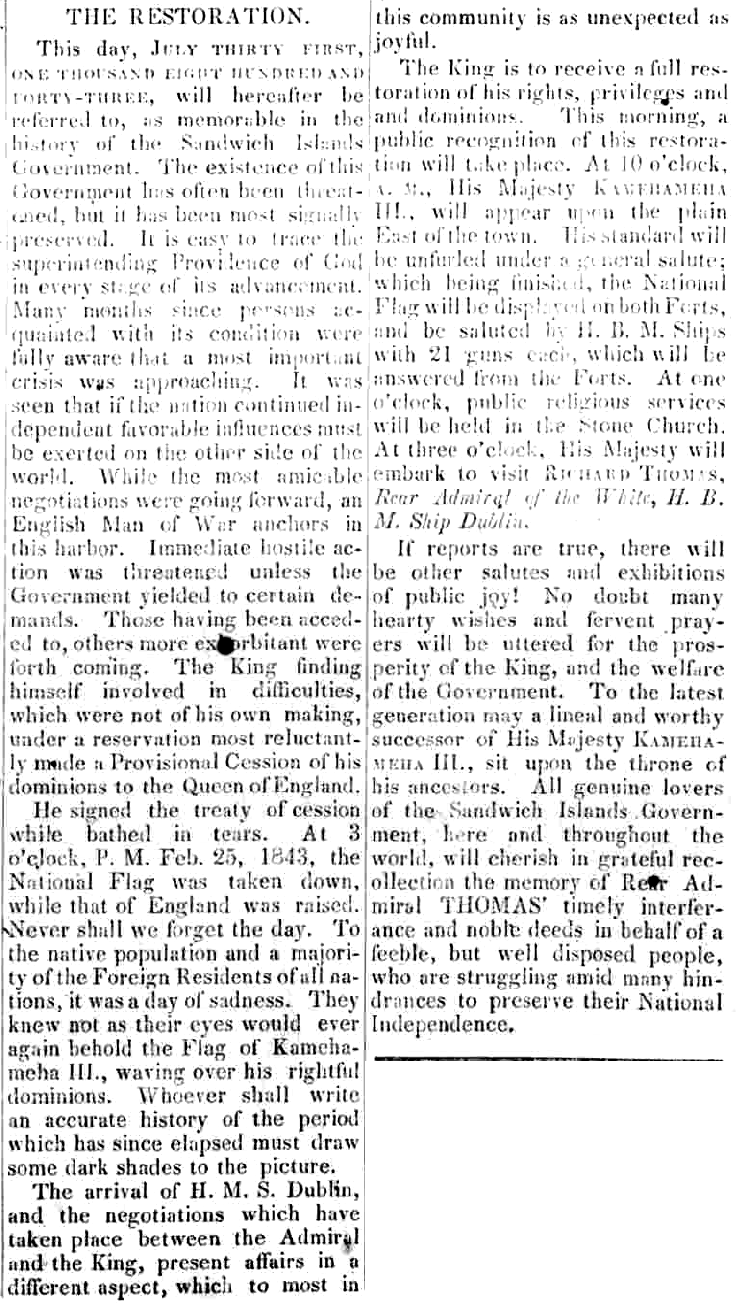
THE RESTORATION.

This day, July thirty first, one thousand eight hundred and forty-three, will hereafter be referred to, as memorable in the history of the Sandwich Islands Government. The existence of the Government has often been threatened, but it has been most signally preserved. It is easy to trace the superintending Providence of God in every stage of its advancement. Many months since persons acquainted with its condition were fully aware that a most important crisis was approaching. It was seen that if the nation continued independent favorable influences must be exerted on the other side of the world. While the most amicable negotiations were going forward, an English Man of War anchors in this harbor. Immediate hostile action was threatened unless the Government yielded to certain demands. Those having been acceded to, others more exhorbitant were forth coming. The King finding himself involved in difficulties, which were not of his own making, under a reservation most reluctantly made a Provisional Cession of his dominions to the Queen of England.

He signed the treaty of cession while bathed in tears. At 3 oʻclock, P. M. Feb. 25, 1843, the National Flag was taken down, while that of England was raised. Never shall we forget the day. To the native population and a majority of the Foreign Residents of all nations, it was a day of sadness. They knew not as their eyes would ever again behold the Flag of Kamehameha III., waving over his rightful dominions. Whoever shall write an accurate history of the period which has since elpased must draw some dark shades to the picture.

The arrival of H. M. S. Dublin, and the negotiations which have taken place between the Admiral and the King, present affairs in a different aspect, which to most in this community is as unexpected as joyful.

The King is to receive a full restoration of his rights, privileges and and dominions. This morning, a public recognition of this restoration will take place. At 10 oʻclock, A. M., His Majesty Kamehameha III., will appear upon the plain East of the town. His standard will be unfurled under a general salute; which being finished, the National Flag will be displayed on both Forts, and be saluted by H. B. M. Ships with 21 guns each, which will be answered from the Forts. At one oʻclock, public religious services will be held in the Stone Church. At three oʻclock, His Majesty will embark to visit Richard Thomas, Rear Admiral of the White, H. B. M. Ship Dublin.

If reports are true, there will be other salutes and exhibitions of public joy! No doubt many hearty wishes and fervent prayers will be uttered for the prosperity of the King, and the welfare of the Government. To the latest generation may a lineal and worthy successor of His Majesty Kamehameha III., sit upon the throne of his ancestors. All genuine lovers of the Sandwich Islands Government, here and throughout the world, will cherish in grateful recollection the memory of Rear Admiral THOMASʻ timely interferance and noble deeds in behalf of a feeble, but well disposed people, who are struggling amid many hindrances to preserve their National Independence.

[This is from a special edition of the Advocate and Friend published on the very day of the restoration. The rest of the coverage can be seen here on the Mission Houses Museum page! Mahalo to Dwight Baldwin (descendant of the Temperance Advocate, and Seamenʻs Friend editor Samuel C. Damon) via Nathan Napoka for reminding me that there are indeed Hawaii newspapers other than Hawaiian-Language Newspapers.]

(Advocate and Friend, 7/31/1843, p. 38)

THE RESTORATION.

Advocate and Friend. (Extra). July 31, 1843, p. 38.

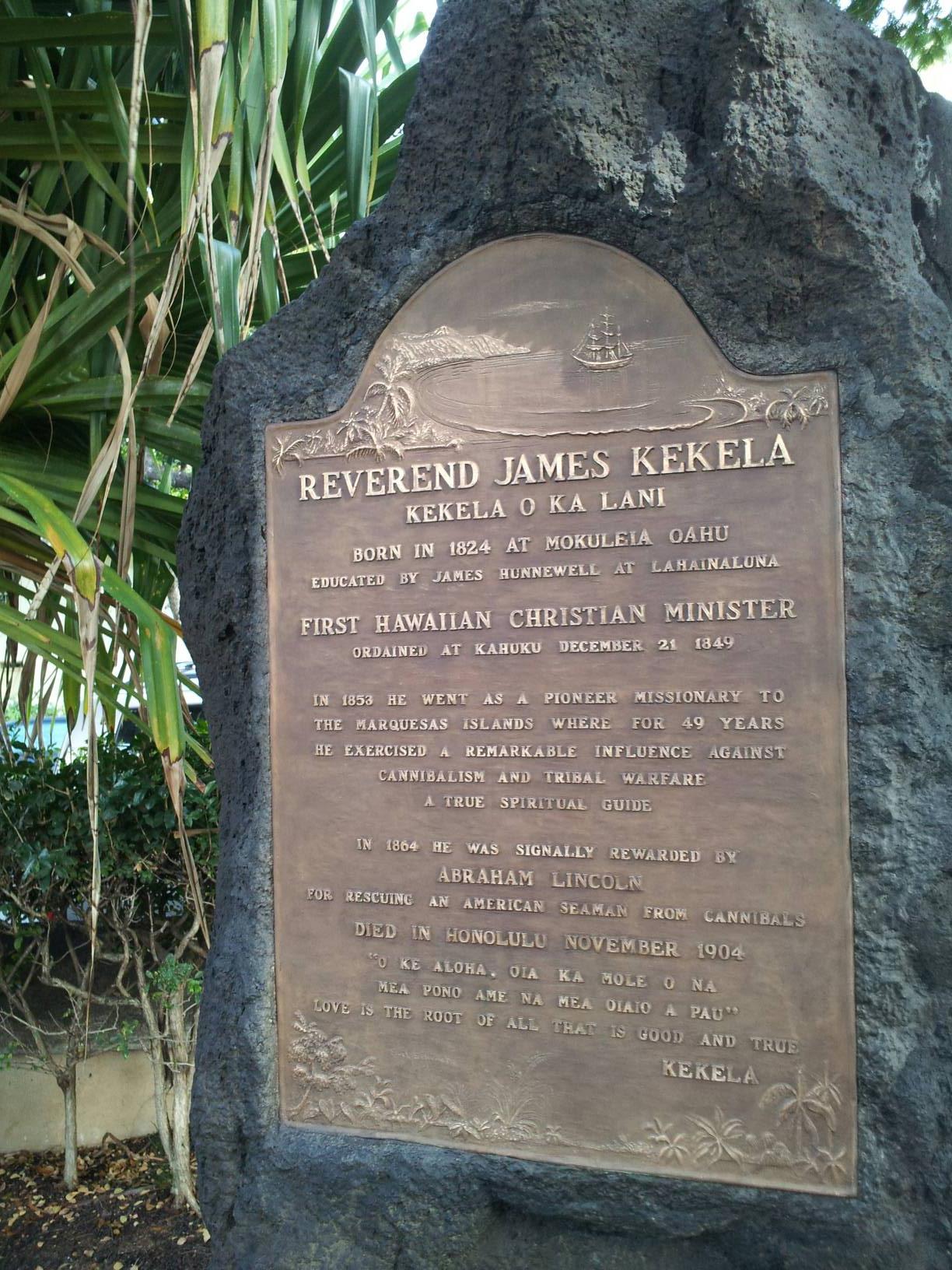
Reverend James Kekela plaque at Kawaiahao Church, 2013.

REVEREND JAMES KEKELA

KEKELA O KA LANI

BORN IN 1824 AT MOKULEIA OAHU

EDUCATED BY JAMES HUNNEWELL AT LAHAINALUNA

FIRST HAWAIIAN CHRISTIAN MINISTER

ORDAINED AT KAHUKU DECEMBER 21 1849

IN 1853 HE WENT AS A PIONEER MISSIONARY TO THE MARQUESAS ISLANDS WHERE FOR 49 YEARS HE EXERCISED A REMARKABLE INFLUENCE AGAINST CANNIBALISM AND TRIBAL WARFARE

A TRUE SPIRITUAL GUIDE

IN 1864 HE WAS SIGNALLY REWARDED BY

ABRAHAM LINCOLN

FOR RESCUING AN AMERICAN SEAMAN FROM CANNIBALS

DIED IN HONOLULU NOVEMBER 1904

“O KE ALOHA, OIA KA MOLE O NA MEA PONO A ME NA MEA OIAIO A PAU”

LOVE IS THE ROOT OF ALL THAT IS GOOD AND TRUE

KEKELA

[Kekela is buried in the cemetery of Kawaiahao Church in front of his daughter Maria. His wife Naomi however is buried at the Waianae Church.]

(Kawaiahao Church)

Kawaiahao Church

Rev. James Kekela Plaque, Kawaiahao Church

Mere Karikimaka, 1901.

CHRISTMAS TREE AT KAWAIAHAO

Nearly 1,200 People Went to See.

Nearly 12 hundred People Went to See.

On Friday night last week, the Sunday School students of Kawaiahao were made happy because of the docking of the ship Alameida [Alameda] that evening with a kind, big old man named “Santa Claus.”

Before the time announced that the old man would be arriving, the great room of that church was packed with the Sunday School children and their parents, and in that crowd, the elders were seen:—Mr. and Mrs. Henry Waterhouse, Mother Castle, Rev. H. H. Parker, Mrs. Haalelea, Rev. S. L. Desha, and our other white friends.

Right before the pulpit, an arch [pio] was erected decorated with pine branches, and amongst these branches the light of electric lights could be seen, in the colors of the American flag: white, red and blue. In the middle of the arch was placed a large star made to be like the Star of Bethlehem which guided the wise men of the East to where the Messiah was born. In the Star was placed a picture of Maria with Christ in her loving bosom. It is truly lovely and beautiful for the heart of man to say.—”It is true, a Messiah was indeed born.”

Under this arch lay a table laden with presents that were made ready to give to the students.

Before the arrival of Santa Claus, hymns were sung and short speeches were given by the girls of the Kawaiahao Boarding School [Kula Hanai o Kawaiahao] and the Youth Class [? Papa Pokii] of Mrs. May Wilcox. Their performance was truly beautiful and sincere, and if the One for whom these celebrations were being held was present in His Actual Body, they would not be without His clapping. The Head of the Sunday School of Kawaiahao, Hon. Henry Waterhouse, gave some praising remarks, as did Pastor Parker [Paleka] and the Pastor of Haili, Rev. S. L. Desha, and the people gathered to hear their voices were joyous.

Being that the one much awaited for was a very kind old man, after the singing of some songs called in English, “Christmas Carols,” there was heard the sound of a conch, at which time was seen Santa Claus entering with his Presents, and he circled about the room giving presents to the children.

Here is some of what he said.—”I am happy to be with all of you. This is one of the most amazing lands for me. Where I live, there are many feet of snow now. When I landed with the steamer Almeida this evening, I was shocked that there was no snow here, so I did not bring my sleigh nor my deer, being that you all have street cars [kaa uwila].

The gifts prepared were handed out. Everyone was thrilled.

(Kuokoa, 12/27/1901, p. 5)

KUMULAAU KARIKIMAKA MA KAWAIAHAO

Ka Nupepa Kuokoa, Buke XXXIX, Helu 26, Aoao 5. Dekemaba 27, 1901.

Collage of Royal Order of Kamehameha officers, 1918.

THESE ARE THE OFFICERS OF THE AHAHUI KAMEHAMEHA, THE ORGANIZATION HEADED BY PRINCE KALANIANAOLE, AND AS USUAL THIS HAWAIIAN ORGANIZATION HELD A PRAYER SERVICE OF REMEMBRANCE FOR KA NA’I AUPUNI KAMEHAMEHA IN KAWAIAHAO CHURCH THIS PAST SUNDAY, WITH OTHER HAWAIIAN GROUPS IN ATTENDANCE AT THAT GATHERING OF COMMEMORATION. THE NAMES OF THE OFFICERS ARE SEEN BELOW THEIR PICTURES.

William Kawohionalani Cano, Reuben Kinney, Solomon Meheula, William Chung Hoon, Jr., Edward K. Wongham.

Samuel K. Kamaiopili, Samuel Pinao, Benjamin N. Kahalepuna, George H. Miranda, James L. Holt.

Prince J. K. Kalanianaole, John K. Lane, Joseph K. Kanepuu.

(Kuokoa, 6/14/1918, p. 1)

O NA LUNA NUI KEIA...

Ka Nupepa Kuokoa, Buke LVI, Helu 24, Aoao 1. Iune 14, 1918.

Decorating the Kamehameha Statue, 1912.

[Found under: “Local News”]

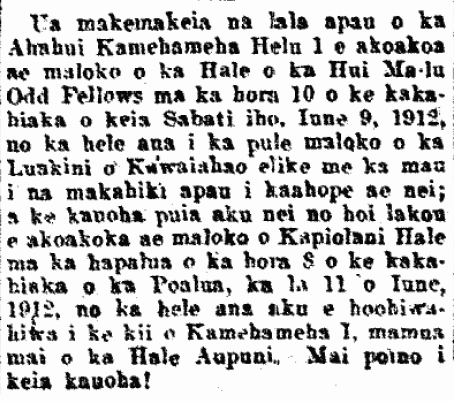
All members of the Ahahui Kamehameha Division 1 are requested to assemble in the Building of the Secret Society, Odd Fellows, at 10 in the morning of this coming Sunday, June 9, 1912, to go on to pray in Kawaiahao Church, as is done in all past years; and they are also ordered to assemble within Kapiolani Hale at half past 8 on the morning of Tuesday, the 11th of June, 1912, to go and decorate the statue of Kamehameha I in front of the Government Building. Do not forget this order!

(Kuokoa, 6/7/1912, p. 8)

Ua makemakeia na lala apau...

Ka Nupepa Kuokoa, Buke XLVIII, Helu 23, Aoao 8. Iune 7, 1912.

Pauli K. Hosea Iwiula, 1912.

My Beloved Husband Has Gone, Undoing Our Bond

PAULI K. HOSEA IWIULA.

O Kuokoa Newspaper, Aloha to you:—Please extend your patience and allow me space in one of your columns for my parcel of my parent in my youth, and perhaps many of our friends will see it, and our companions in the Lord living from where the sun rises at Kumukahi all the way to where it shimmers into the sea of Lehua.

Pauli Kaoleiokukaiakauilani Hosea Iwiula was born in Kamoiliili¹, Oahu, on the 26th of June, 1862, from the loins of Iwiula (m) and Kapolei (f); according to the history of Iwiula, he was a descendant of the chiefly family of Kamalalawalu of Maui, and of kaukau alii rank in the court of the fathers of kings [Makualii, Makua Alii], Kekuanaoa and Kanaina, and the monarchs of the time; and the line related to Pauahi Kaoleioku Hosea Iwiula’s mother, that being Kapolei, she was closely related to the chiefly blood of Kekaulike Nui of Molokai, and being that Molokai is where Kapolei (f) was born, it is believed by the locals here in Kamoiliili that Hosea Iwiula is a chief for whom this eulogy is for.

While Kapolei was young, following the death of Kahuloa, her first husband, she married the aforementioned Iwiula. At that time, Kapolei’s was regularly a singing teacher for the young chiefly women of those days. And Kamoiliili’s handsome prince and gentleman of the time was Pauli Kaoleioku, the first born of the alii Haumea of the serene lands of Ehu, the land where water lies in the face of the cloud banks [epithets for Kona, Hawaii]. And as what happens when people grow up, there is a craving for the great fish that passes before one’s eyes, and that is perhaps why Kapolei and Pauli Kaoleioku were mixed up together, and Hosea was conceived, a son from the loins of Kapolei, and thus Hosea Iwiula was said to be a child of Pauli, and an alii.

During the days when we lived as man and wife, he became a parent to me, and so also me for him. My dear husband was very skilled in singing, and it was he who always lead the Sunday School classes of Kamoiliili for almost thirty or more years, and he was the elder [luna kahiko] of the Kamoiliili Church for almost twenty-four years and also is a long-time member of the Kawaiahao Church, then he left that position in the hands of Hiram Kaaha who is still there now. Hosea was a member of the leaders of Kawaiahao Church from his branch church of Kamoiliili. During the days when he was the leader of the Sunday School for Kaawili, he assisted his Sunday School students immensely, by clothing them with their uniforms, shoes and hats; he helped the children a lot.

I was joined with him on the 16th of January, 1882, at Kamoiliili, and we had ten children, and six of them are still living: one daughter and five sons; and four of them have gone before and he has gone in search to be with them.

On Tuesday, the 25th of January, he went to Kauai for the building of the home of Sam Kaeo, the Kauai county attorney, which he would be painting; and in the last week of December, the 29th, he returned to Kamoiliili, and joined in to lead the Sunday School class of Kamoiliili at the last quarterly congregational convention of 1911, and on January 25, he went back to Nawiliwili where his job was, and there after a few weeks began a sickness in his body, and it progressed until he passed from me in that unfamiliar land, on April 29, 1912, and he and I travelled over the great Kaieie Channel for here in Honolulu aboard the Malulani on the 30th of April, and my beloved lei, my husband was left at the funeral home of M. E. Silva, and on the following Thursday, he was carried to Kamoiliili, and within this church where the two of us along with the friends of this place would always gather to worship God, his funeral service was held and he was returned to the place of all men, and the saying was fulfilled: “Man goes to his eternal home, and the spirit returns to its maker.” For “He gave and He hath taken away, blessed be the name of Jehovah.”

O Lililehua Rain of Palolo, you shall no more buffet the cheeks of my beloved; and you as well, O Kuahine Rain which treads upon the fringes of the lehua of Manoa, you will no more soak him and his lashes; O Royal Capitol of Honolulu, he shall not see your fairness; and O Shores which I was with my beloved, your rocky banks will never again be glided over by his loving feet, and O Seas of Kaalawai and Keauau where me and my loving husband were as one, you will not see him again passing by with me.

Alas, there is only love for my husband of my youth, my parent of my uneducated days. I am yours, O My Beloved, that did [lueuele?], wandering the streets in tears.

Me with sorrow,

MRS. RAHELA [Rachael] HOSEA.

Kamoiliili, May 11, 1912.

¹Kamoiliili is known today generally as Moiliili.

[I have found no other usages of the word “lueuele”. Unless the newspapers are accurately typescripted, we won’t know if lueuele is a typo, or if it is indeed a word. The more examples of usages and context found, the clearer the meaning of the word will be. Does the acceptance of inaccurate typing indicate that these words are not important?]

(Kuokoa, 5/17/1912, p. 4)

KUU ALOHA HE KANE UA HALA, UA WEHE MAI I KA MAUA PILI

Ka Nupepa Kuokoa, Buke XLVIII, Helu 20, Aoao 4. Mei 17, 1912.
Death announcement found outside of the Vital Statistics column, 1898.

THAT HAWAIIAN MOTHER HAS GONE.

It was a painful thing for our hearts to hear that the uncompassionate hand of death reached out and took the precious breath of life from the body of Mrs. Evalaina Willison [Wilson], the wife of Mr. C. B. Willison [Wilson], in the early morning of this Saturday, after she began to waste away of sickness for just a few short days.

She was a well-known woman here in town, and elsewhere on the island, and she was the attendant of Queen Liliuokalani while she was on the throne until her overthrow. There were many, many friends who visited to see her for the last time, and then dust returned to dust, for that is where it came from.

She leaves behind a husband, child and family who grieve for her from this side of the grave.

In the afternoon of this Sunday, the last services over the body were held at Kawaiahao Church by Rev. H. H. Parker, and from there the body was taken to its home in the ground at the cemetery of Kawaiahao, accompanied by the family and numerous friends, and next to her family who passed before she was put to rest for all times.

Ke Aloha Aina joins in the mourning with the family of the one who left on that road of no return, while asking the Almighty to lessen our grief.

(Aloha Aina, 5/28/1898, p. 5)

HALA IA MAKUAHINE HAWAII.

Ke Aloha Aina, Buke IV, Helu 22, Aoao 5. Mei 28, 1898.

Lunalilo’s Crypt overgrown by weeds? 1894.

It is painful to see the cemetery of King Lunalilo at Kawaiahao, showing that it is not remembered, for it is overgrown by weeds. In its wealth, the crypt where his body is laid to rest was left to waste by his Trustees, along with Wile Kamika [William Owen Smith] who feasts off of his pay from the trust. This is proof of the missionary descendents’ [welo mikanele] contempt for the Alii of Hawaii, the people who made them wealthy and also their parents and grandparents.

(Makaainana, 3/19/1894, p. 4)

Ehaeha no hoi na maka...

Ka Makaainana, Buke I----Ano Hou, Helu 12, Aoao 4. Maraki 19, 1894.