Mele by Liliuonamoku Club, 1877.

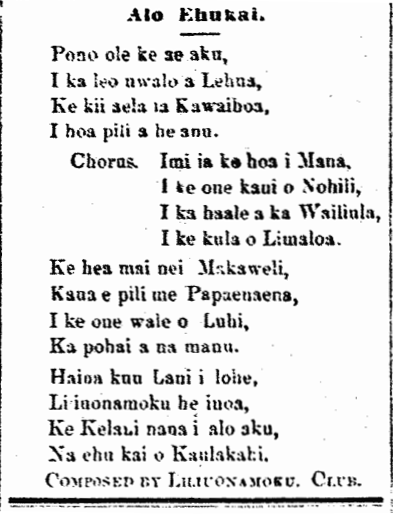
Alo Ehukai.

Pono ole ke ae aku,
I ka leo uwalo a Lehua,
Ke kii aela ia Kawaihoa,
I hoa pili a he anu.

Chorus. Imi ia ke hoa i Mana,
I ke one kani o Nohili,
I ka haale a ka Wailiula,
I ke kula o Limaloa.

Ke hea mai nei Makaweli,
Kaua e pili me Papaenaena,
I ke one wale o Luhi,
Ka pohai a na manu.

Haina kuu Lani i lohe,
Liliuonamoku he inoa,
Ke Kalani nana i alo aku,
Na ehu kai o Kaulakahi.

Composed by Liliuonamoku Club.

(Kuokoa, 11/24/1877, p. 4)

Alo Ehukai.

Ka Nupepa Kuokoa, Buke, XVI, Helu 47, Aoao 4. Novemaba 24, 1877.

Mele by Liliuonamoku Club, 1877.

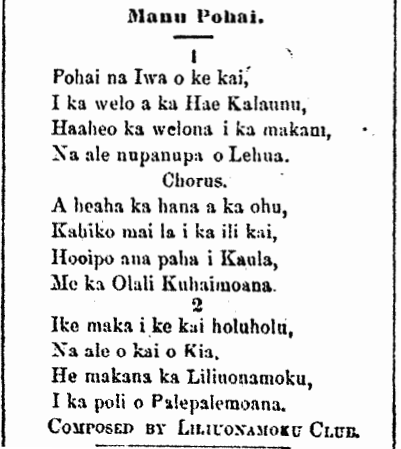
Manu Pohai.

1

Pohai na Iwa o ke kai,
I ka welo a ka Hae Kalaunu,
Haaheo ka welona i ka makani,
Na ale nupanupa o Lehua.

Chorus.

A heaha ka hana a ka ohu,
Kahiko mai la i ka ili kai,
Hooipo ana paha i Kaula,
Me ka Olali Kuhaimoana.

2

Ike maka i ke kai holuholu,
Na ale o kai o Kia,
He makana ka Liliuonamoku,
I ka poli o Palepalemoana.

Composed by Liliuonamoku Club.

(Kuokoa, 11/24/1877, p. 4)

Manu Pohai.

Ka Nupepa Kuokoa, Buke XVI, Helu 47, Aoao 4. Novemaba 24, 1877.

Newly pardoned, 1891.

[Found under: “By Authority.”]

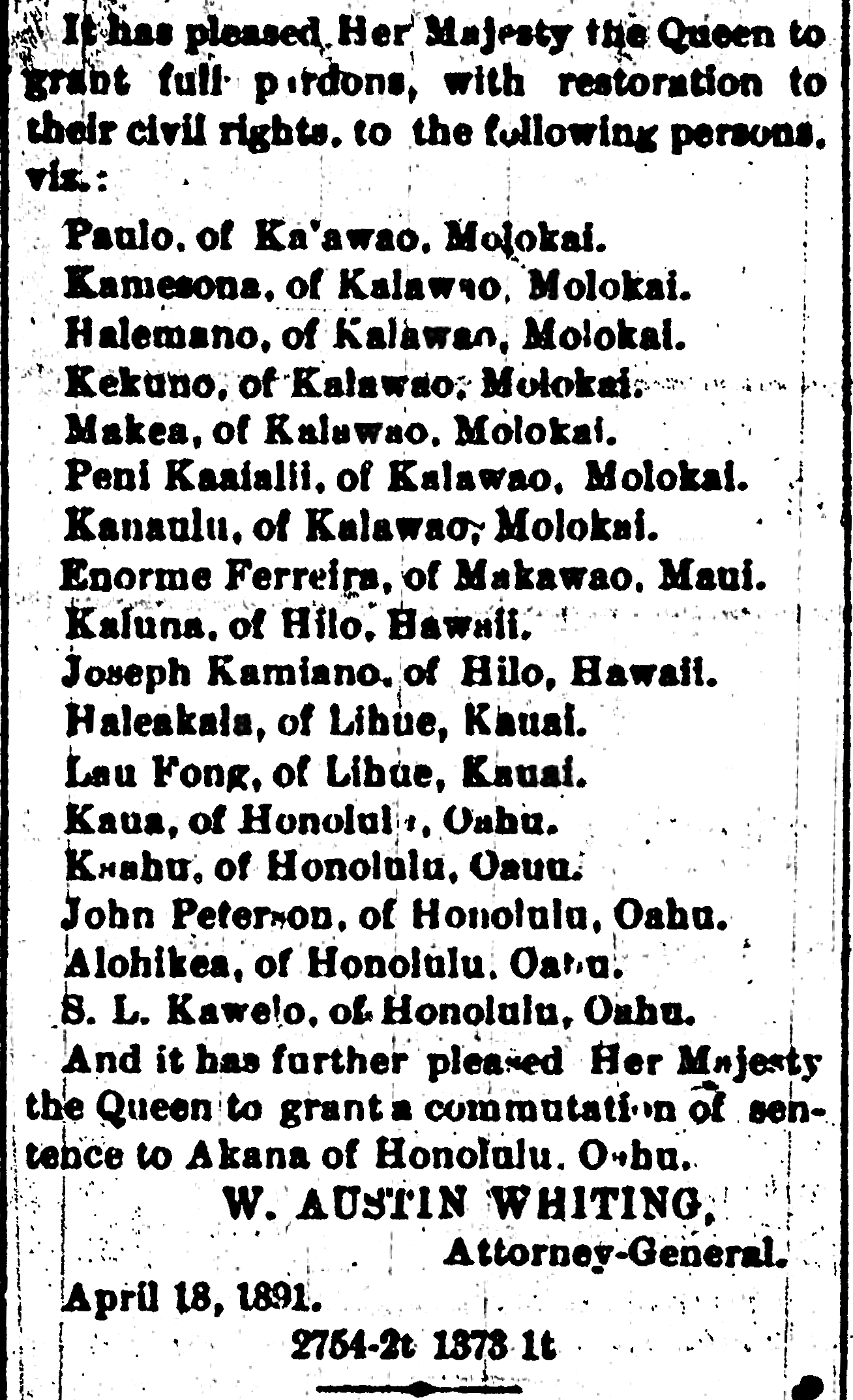
It has pleased Her Majesty the Queen to grand full pardons, with restoration to their civil rights, to the following persons, viz:

Paulo, of Kalawao, Molokai.
Kamesona, of Kalawao, Molokai.
Halemano, of Kalawao, Molokai.
Kekuno, of Kalawao, Molokai.
Makea, of Kalawao, Molokai.
Peni Kaaialii, of Kalawao, Molokai.
Kanaulu, of Kalawao, Molokai.
Enorme Ferreira, of Makawao, Maui.
Kaluna, of Hilo, Hawaii.
Joseph Kamiano, of Hilo, Hawaii.
Haleakala, of Lihue, Kauai.
Lau Fong, of Lihue, Kauai.
Kaua, of Honolulu, Oahu.
Kaahu, of Honolulu, Oahu.
John Peterson, of Honolulu, Oahu.
Alohikea, of Honolulu, Oahu.
S. L. Kawelo, of Honolulu, Oahu.

And it has further pleased Her Majesty the Queen to grant a commutation of sentence to Akana of Honolulu, Oahu.

W. AUSTIN WHITING,
Attorney-General.

April 18, 1891.

(Hawaiian Gazette, 5/5/1891, p. 4)

It has pleased Her Majesty the Queen...

Hawaiian Gazette, Volume XXVI, Number 18, Page 4. May 5, 1891.

Queen Liliuokalani travels to Kalawao, 1891.

Journey of the Alii, Queen Liliuokalani, to the Colony of Kalawao.

To the Editor of the “Daily Ko Hawaii Pae Aina,”

J. U. Kawainui,

Aloha oe:

At 10 at night on this past Sunday, April 26, 1891, the steamship Likelike left the wharf of Ainahou, taking upon her deck beloved Hawaii’s favorite, to see the group of the lahui who are in pain and great suffering. There were three hundred or so people on this tour. Here are the  dignitaries who went:

Queen Liliuokalani, Prince Keliianaole [Kalanianaole], Prime Minister Sam Parker, President D. Dayton, Agent of the Board of Health, Lalana, Hon. J. Nawahi, Hon. L. W. P. Kanealii, Hon. D. W. Pua, Hon. J. K. Hookano, E. Lilikalani, Hon. J. G. Hoapili, French Commissioner, Portuguese Commissioner, Mr. and Mrs. C. Clarke, Joseph Heleluhe, Mrs. Limaheihei, Mrs. Pamahoa Kalauli, Mr. and Mrs. S. M. Kaaukai, Mrs. L. Keohokalole, A. Mahaulu, Bishop Wills, Father Leolono, J. N. K. Keola, G. W. Kualaku, Tamara Meekapu, Mr. and Mrs. Auld and daughters, Mr. and Mrs. Ailau, Band Master Berger and 31 band members, two haole women, Mrs. Makanoe and father, Mrs. Kuihelani, Mahoe, Malaea Kaaipeelua, Lula Kahelemauna, Mrs. Akau and the many others for whom I have don’t have their names.

The ocean was fine, there wasn’t much wind, but there was enough wind to carry the favorite one, landing before her makaainana who suffer in pain. The light of the queen of the night shown down beautifully; the wheel of the princess, the younger sister, Likelike [referring to the ship], pushed against the sea of Kaiwi, the beloved sea, like a child carried before the friends in misfortune; eyes searching the tips of the waves for land, with sorrowful tears for their birth land. At 6 in the morning, on Monday, April 27, 1891 they landed at the harbor of Kalaupapa.

The mast in the aft of the Likelike flew the crown flag, announcing here I am with a heavy heart for all of you. The town of Kalaupapa was spread out before us, from the seaside to the uplands, with cliffs surrounding, lined up on the west side of the town.

The land was astir with people at the harbor wanting to embrace with tears the Queen and her people; and likewise the alii, the Queen, and her people wanted to do the same. Continue reading

Report of Kalakaua’s death from the “San Francisco Chronicle,” 1891.

KALAKAUA DEAD

Last Hours of the Hawaiian Monarch.

Solemn Scenes at the Royal Bedside.

The Succession and the Political Situation.

Sketches of the Dead Sovereign and of the Heirs to the Throne.

Kalakaua I., King of the Hawaiian Islands, is dead. He expired at 2:33 o’clock yesterday afternoon in his room at the Palace Hotel, where for three days he had lain unconscious on his bed. Surrounding him at the moment of his death were Col. Macfarlane, the King’s Chamberlain; Col. Hoapili Baker, His Majesty’s Equerry-in-waiting; Hawaiian Consul McKinley, Admiral Brown, U. S. N. Rev. J. Sanders Reed, Rev. F. H. Church and a number of personal friends of the King. Immediately after the death, Admiral Brown notified the Secretary of the Navy of that fact, Mayor Sanderson was also notified, and he called a meeting of the Supervisors for 9 o’clock this morning to consider proper action in the matter. The remains were embalmed and this afternoon they will be removed to the mortuary chapel of Trinity Church, where they will be guarded by a detail of United States soldiers.

At the Deathbed.

The Scenes in the Chamber of the Dying Monarch.

It was a pitiful and most impressive scene. The dying monarch lay gasping upon his bed, his emaciated body heaving convulsively with each of his labored respirations. At the bedside stood two ministers of the Gospel, physicians of the body had given way when they had come to the sad conclusion that Kalakaua was beyond mortal aid. Seated at the head of the bed, clasping the left hand of his King was Col. Baker, Kalakaua’s Aid-de-camp, whose strong frame was bent with sorrow, and who with great difficulty kept back the flood of tears which trembled in his eyes. Bending over from the right side was Col. Macfarlane, Chamberlain of the King. The suspense of the last few days had almost prostrated him, and his face bore traces of weeping. Crouched upon the floor against the wall near the bedside were the King’s valet Kahikina, an Hawaiian youth, and Kalua, a young girl from the Gilbert islands, who had been a most devoted servant to Kalakaua. They formed part of his suite on his arrival here.

Only a light coverlet of rich brown design covered the body of the King. In his struggles to throw off the firm reaper who was gradually pressing more heavily upon him, Kalakaua had thrust his arms out upon the bed. During the forenoon his faithful servant Kalua, in an endeavor to make the King as comfortable as possible, had placed beneath his chin a wide soft scarf of blue silk. There it remained until the death, seeming as it rose and fell upon the bright red undershirt to be symbolical of the wavering between this and the great beyond of the spirit of the stricken King.

Kalakaua was possessed of great vitality, and to the last he resisted the destroyer with a persistence which excited the wonder of the medical men, who knew that the King’s time had come. Though for three days past he had been unconscious and life had apparently been kept in him merely by the stimulants applied internally through natural channels or hypodermically, his constitution seemed determined to keep the spirit with the trembling body. Even after the physicians had relinquished all hope and, knowing that he must die, had ceased to apply stimulants, he continued to struggle on.

During the morning Drs. Woods, Watts, Sanger and Taylor were in attendance.

They consulted and announced that in their opinion the King would not live more than a few hours. He had then been unconscious for nearly forty hours, with the exception of one brief moment in the early morning, when he recognized Admiral Brown and spoke to Colonel Baker saying:

“Well, I am a very sick man.” Continue reading

Aloha Aina, 2015.

Expressing aloha ʻāina on the anniversary of the overthrow

“And so it happened that on the 16th day of January, 1893, between four and five o’clock in the afternoon, a detachment of marines from the United States Steamer Boston, with two pieces of artillery, landed at Honolulu. The men, upwards of 160 in all, were supplied with double cartridge belts filled with ammunition and with haversacks and canteens, and were accompanied by a hospital corps with stretchers and medical supplies. This military demonstration upon the soil of Honolulu was of itself an act of war. . .”

By nightfall of the next day, the Kingdom of Hawaiʻi had been illegally overthrown.

Hawaiʻi’s people today live in the resulting repercussions of that infamous day. For some, reflection on those historical events still conjures up the ʻeha (pain, hurt) of being wronged.

There may never be an adequate outlet to express the ʻeha, nevertheless, this story commemorates the 122nd anniversary of the illegal overthrow and honors some of the great expressions of aloha ʻāina (patriotism) coming from Hawaiʻi’s aliʻi (monarchs) and lāhui (people).→Continue reading.

Queen Liliʻuokalani, Hawaiʻi’s last reigning monarch, was imprisoned after her kingdom was illegally overthrown on January 17, 1893.

Who was threatening whom? 1893.

THE TROOPS OF THE AMERICAN WARSHIP.

Here on land are the troops from the warship, as they go around town with their guns and their ammunition belts. They came ashore this past Monday. Let them be to enjoy themselves upon the blessed soil of Hawaii and look to the day when they will see that Hawaii is on the side of peace.

QUEEN LILIUOKALANI.

(Hawaii Holomua, 1/18/1893, p. 2)

[This set of newspapers is not available online yet, so I will try to make a copy of the original article from a microfilm as soon as I can.]

Rev. Robert Stewart McArthur rails on the monarchy, 1895.

M’ARTHUR ON HAWAII.

Kalakaua and Liliuokalani Responsible for Heathenism.

CONVERTS AMONG THE NATIVES.

Great Hopes for the Hawaiians Now that They Are in the Enjoyment of a Pure and Free Government—Officers of State are Especially Praised.

NEW YORK, Dec. 2.—The Rev. Robert Stewart McArthur delivered a sermon in the Calvary Baptist church last night on “The Responsibility of Kalakaua and Liliuokalani.”

After referring to the characteristics of the Hawaiians he quoted figures to show the falling off in the number of Christian converts among the natives since the reign of Kamehameha V, who removed all restraint from the Hula masters and Kahuna influence and thereby sided the spread of idolatry. Continue reading

Hale Naua, 1895.

[Found under: “TOPICS OF THE DAY.”]

The reverend McArthur who was a devoted friend and follower of Chief Justice Judd, abuses Queen Liliuokalani because the so-called Hale Naua Society, existed during the reign of her brother. We are told that the Hale Naua Society was a heathen institution and that it was decidedly opposed to good morals and good government. We do not know how Mr. McArthur has gained his information as he was never initiated into its ranks. We desire to say that the Hale Naua Society was similar to the foreign secret societies of which King Kalakaua was a leading member. The Hale Naua had its rites and indulged in the usual mummery of the lodges which are tolerated and even celebrated here. The man who says that the society in question practiced immoral rules or undesirable rites is a liar. The aid-de-camp to the President of Hawaii, Major C. P. Iaukea, was a prominent member of the society. The “missionary” interpreter at the Supreme Court, Mr. Luther Wilcox, was the only “white” member of the society. Mr. John Ena, a prominent virtuous Councillor of State, knows all about the society in question. Chief Justice Judd would have been only too willing to become a member of the lodge, but would of course have been blackballed; and under such circumstances Hawaii is against being abused by the “Echo” of Mr. Judd, the very Reverend Mr. McArthur. Don’t the paid hirelings of our missionaries do more harm than even the filibusters and the Sheridans and Underwoods?

(Independent, 12/12/1895, p. 3)

The reverend McArthur who was a devoted friend...

The Independent, Volume I, Number 145, Page 3. December 12, 1895.

On Hoolulu Park, the recycling of pictures, the Kohala-Hilo R.R. Co., and the 4th of July, 1903.

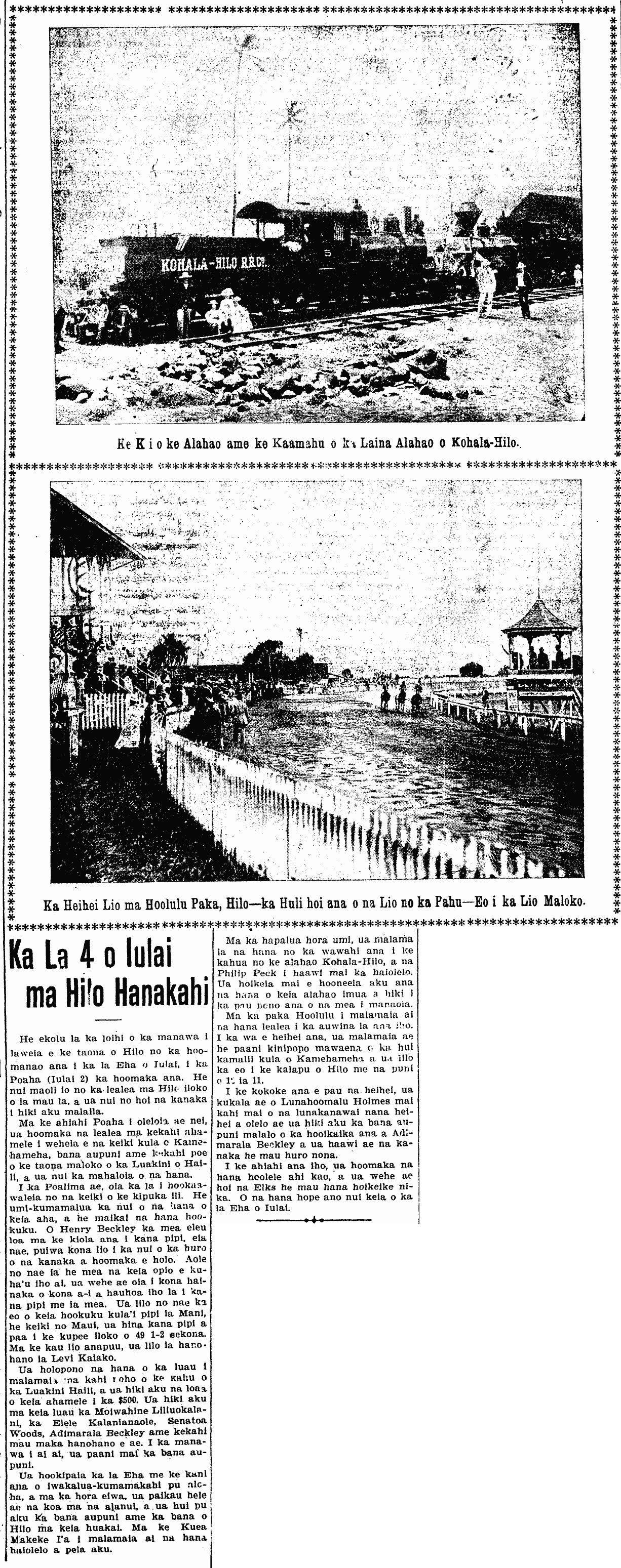
A Picture of the Railroad [Alahao] and Steam Engine [Kaamahu] of the Kohala-Hilo Railway Line.

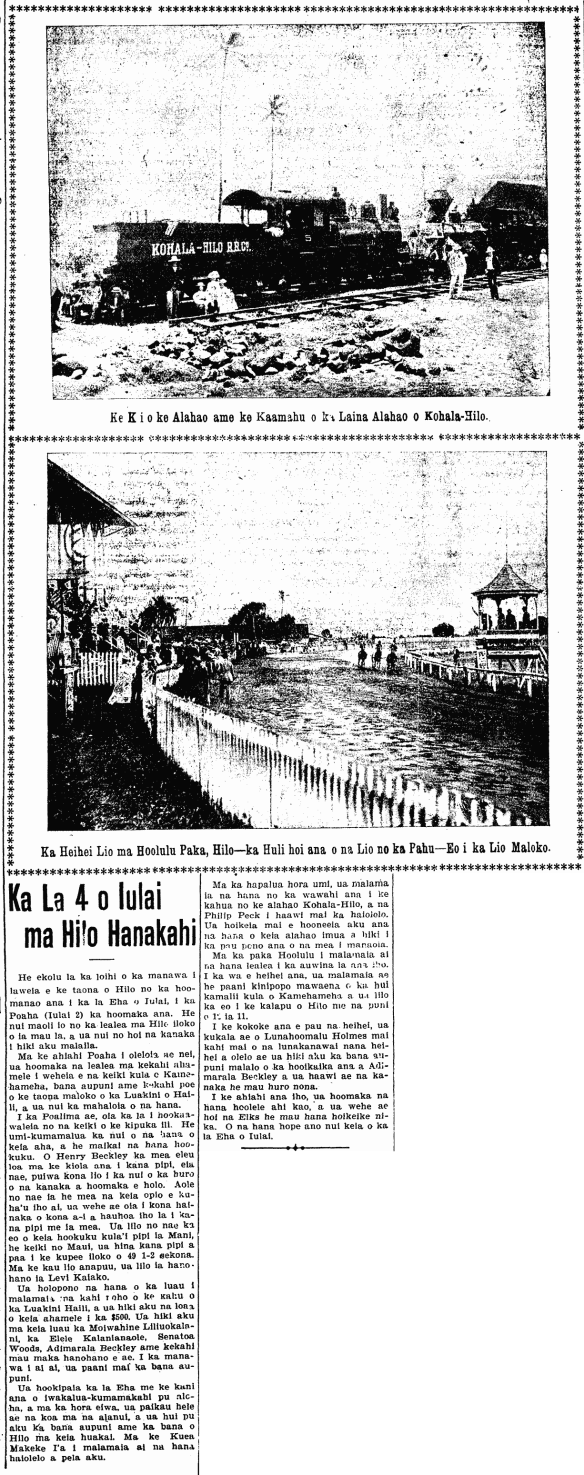
Horse Race at Hoolulu Park, Hilo—The Turning of the Horses for the Goal—The Horse on the Inside Wins.

The 4th of July in Hilo Hanakahi

The town of Hilo celebrated the Fourth of July for three days, beginning on Thursday (July 2). There truly was great joy in Hilo during those days, and there were many people who came.

In the evening of the said Thursday, the festivities began with a concert put on by the students of Kamehameha School, the government band, and some people of the town, in Haili Church, and it was greatly appreciated.

On the following Friday, that is the day set aside for the lassoing boys. There were twelve events of this meet, and there was good competition. Henry Beckley was the liveliest one at throwing his bull, however, his horse was alarmed at all of the cheering of the people, and began to run. But this was not something that made this youth falter; he removed his handkerchief from his neck and tied his bull with it. The victory for the contest to throw down the steer went to Mani, a Maui boy, and his steer was thrown down and tied in 49 1-2 seconds. For bronc riding, that honor went to Levi Kalako.

The luau went well, held at the residence of the kahu of Haili Church, and the proceeds of this concert came to $500. Appearing at this luau were Queen Liliuokalani, Representative Kalanianaole, Senator Woods, Admiral Beckley, and other distinguished people. When the eating began, the government band played.

The Fourth was greeted with the salute of twenty-one guns, and at nine o’clock, the soldiers marched on the streets, and the government band and the Hilo Band joined in this parade. At the Fish Market Square [Kuea Makeke I’a], speeches were held, and so forth.

At half after ten o’clock, the breaking ground for the Kohala-Hilo Railroad was held, and Philip Peck gave the speech. It was said that the work of this railroad will move forward until what was planned is completed.

At Hoolulu Park was held the festivities of that afternoon. When the races were going on, a ballgame went on with the school boys of Kamehameha, and the victory went to the Hilo club with the score of 12 to 11.

When the races were almost done, Chairman Holmes announced from the area of the race judges that the government band had arrived by the efforts of Admiral Beckley, and the people gave him a cheer.

Later that evening, fireworks were shot off, and the Elks put on a “nigger show [hoikeike nika].”¹ These were the last major events of this Fourth of July.

[This is the same picture of Hoolulu Park found later in the Kuokoa three years later, on 12/7/1906. This kind of recycling of pictures happened back in the day, just as we see it happening today, therefore sometimes it is difficult to date a picture that appears in the newspapers.]

¹This type of entertainment here can be seen spoken of in the Hawaiian newspapers from the mid-1800s to the early 1900s.

(Kuokoa, 7/10/1903, p. 1)
Ka La 4 o Iulai ma Hilo Hanakahi

Ka Nupepa Kuokoa, Buke XLI, Helu 28, Aoao 1. Iulai 10, 1903.