Lorenzo Lyons, translator of “The Raven”! 1871.

I posted the awesome translation of Poe’s “The Raven” back in 2013, but back then I did not realize that “Hawaii” was Lorenzo Lyons! Wow.

Ma ke aumoe pouliuli, ia’u i nalu a luluhi
Ma na mea kahiko loa, ane nalo aku no,
Kimo au la, ane moe, hikilele i ka lohe
I ka mea me he kikoni i koni ma ka puka o’u,
He malihini wahi au, i koni ma ka puka o’u,
Oia wale iho no….

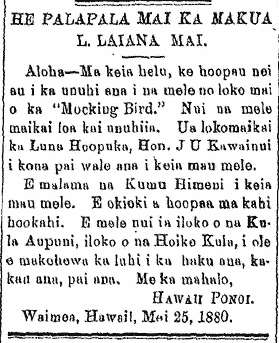
Lorenzo Lyons was also “Hawaii Ponoi”! 1880

A LETTER FROM FATHER L. LAIANA.

Aloha—In this issue, I am concluding my translation of the mele from the “Mocking Bird.” Many very fine songs have been translated. The Publisher [Luna Hoopuka], Hon. J. U. Kawainui, has been kind to print these mele.

The Song Teachers should keep these mele. They should cut them out and assemble them in once place. Sing them widely in the Public Schools, at the School Presentations, so that the work spent composing, writing, and printing these mele will not go to waste. With appreciation,

Hawaii Ponoi.

Waimea, Hawaii, May 25, 1880.

[It is good to know that Lorenzo Lyons went by the pen name “Hawaii Ponoi” as well as “Hawaii”.]

(Ko Hawaii Pae Aina, 6/5/1880, p. 4)

KHPA_6_5_1880_4

Ko Hawaii Pae Aina, Buke III, Helu 23, Aoao 4. Iune 5, 1880.

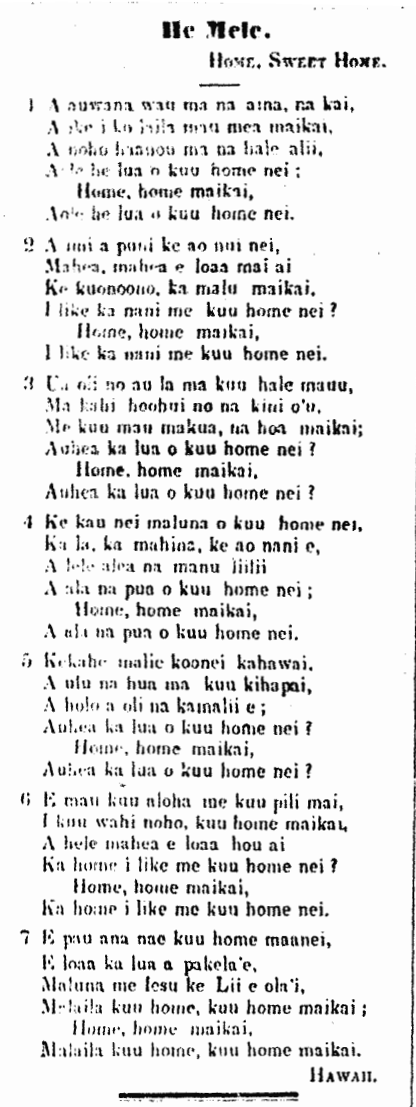
A song by “Hawaii”, 1866.

He Mele.

Home, Sweet Home.

1 A auwana wau ma na aina, na kai,
A ike i ko laila mau mea maikai,
A noho haanou ma na hale alii,
Aole he lua o kuu home nei;
Home, home maikai,
Aohe he lua o kuu home nei.

2 A imi a puni ke ao nui nei,
Mahea, mahea e loaa mai ai,
Ke kuonoono, ka malu maikai,
I like ka nani me kuu home nei?
Home, home maikai,
I like ka nani me kuu home nei.

3 Ua  oli no au la ma kuu hale mauu.
Ma kahi hoohui no na kini o’u,
Me kuu mau makua, na hoa maikai,
Auhea ka lua o kuu home nei?
Home, home maikai,
Auhea ka lua o kuu home nei?

4 Ke kau nei maluna o kuu home nei,
Ka la, ka mahina, ke ao nani e,
A lele alea na manu liilii,
A ala na pua o kuu home nei;
Home, home maikai,
A  ala na pua o kuu home nei.

5 Kekahe malie koonei kahawai,
A ulu na hua ma kuu kihapai,
A holo a oli na kamalii e;
Auhea ka lua o kuu home nei?
Home, home maikai,
Auhea ka lua o kuu home nei?

6 E mau kuu aloha me kuu pili mai,
I kuu wahi noho, kuu home maikai,
A hele mahea e loaa hou ai,
Ka home i like me kuu home nei?
Home, home maikai,
Ka home i like me kuu home nei.

7 E pau ana nae kuu home maanei,
E loaa ka lua a pakela’e,
Maluna me Iesu ke Lii e ola’i,
Malaila kuu home, kuu home maikai,
Home, home maikai,
Malaila kuu home, kuu home maikai.

Hawaii.

[Now that I know that “Hawaii” is Lorenzo Lyons, it makes sense that he was very prolific in the newspapers with his many poetic compositions.]

(Kuokoa, 1/27/1866, p. 4)

Kuokoa_1_27_1866_4

Ka Nupepa Kuokoa, Buke V, Helu 4, Aoao 4. Ianuari 27, 1866.

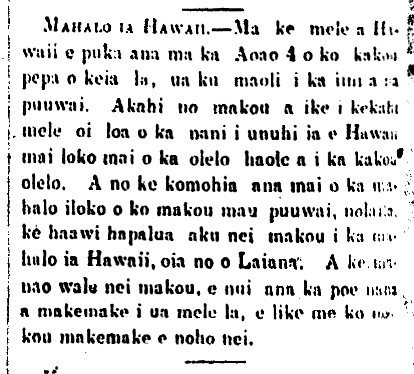
The translator of mele who calls himself “Hawaii” is Lorenzo Lyons! 1866.

[Found under: “HUNAHUNA MEA HOU O HAWAII NEI.”]

Appreciation for Hawaii.—The song published on Page 4 of our paper today, is something truly that our hearts desire. This is the first time that we have seen a song that is exceptionally beautiful translated by Hawaii from English to our language. And being that we feel admiration in our hearts, we give a portion of thanks [??? ke haawi hapalua aku nei makou i ka mahalo] to Hawaii, that is to Lyons [Laiana]. And we believe that there will be many who will see it and like the mele, just as we do.

[I have been searching for the identity of this person Hawaii for many years. Finding the identity of pen names used in Hawaiian newspapers is always an exciting thing.]

(Kuokoa, 1/27/1866, p. 2)

Kuokoa_1_27_1866_2

Ka Nupepa Kuokoa, Buke V, Helu 4, Aoao 2. Ianuari 27, 1866.

Mele, translations, and pen names, 1915.

[Found under: “Big Island News”]

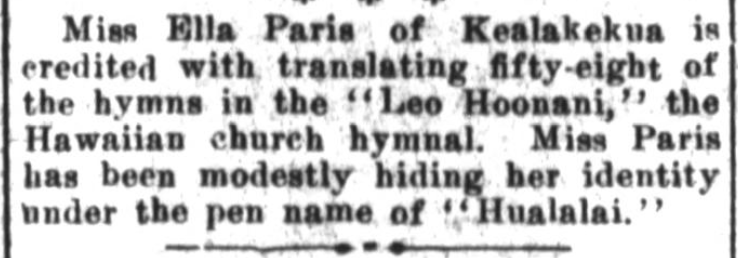
Miss Ella Paris of Kealakekua is credited with translating fifty-eight of the hymns in the “Leo Hoonani,” the Hawaiian church hymnal. Miss Paris has been modestly hiding her identity under the pen name of “Hualalai.”

[Although this pen name seems to be widely known, it is often difficult to ascertain the identities of people who use pen names. Every so often there are articles like this in the newspapers (and elsewhere)!]

(Hawaiian Gazette, 7/16/1915, p. 8)

Miss Ella Paris...

Hawaiian Gazette. Volume VIII, Number 57, Page 8. July 16, 1915.

Aloha Aina, 1871 / 2014.

“Ka Hae Nani o Hawaii,
E mau kona welo ana.”

[“The Beautiful Flag of Hawaii
Let her wave for all times.”]

(Black & Auld Printers, Honolulu, H. I.)

E ola ka Moi i ke Akua.

Composed by His Highness, W. C. Lunalilo.

1. Ke Akua mana mau,
Hoomaikai, pomaikai
I ka Moi!
Kou lima mana mau,
Malama, kiai mai
Ko makou nei Moi,
E ola e!

2. Ka inoa kamahao
Lei nani o makou,
E ola e!
Kou eheu uhi mai,
Pale na ino e,
Ka makou pule nou,
E ola e!

3. Imua ou makou,
Ke ‘Lii o na Alii,
E aloha mai;
E mau ke ea e
O ke aupuni nei,
E ola mau makou,
Me ka Moi.

God Save the King.

Translated by Rev. L. Lyons.

1. Eternal, might God,
Bless, from they bright abode,
Our Sovereign King;
May thy all-powerful arm
Ward from our Sire all harm,
Let no vile foe alarm,
Long may he reign!

2. Royal, distinguished name,
Our beauteous diadem,
Long life be thine;
Thy wing spread o’er our land,
From every wrong defend,
For thee our prayers ascend,
Long live our King!

3. Before thee, King of Kings,
Of whom all nature sings,
Our prayer we bring;
Oh, let our Kingdom live,
Life, peace and union give,
Let all they care receive;
Bless thou our King!

[The Hawaiian flag in the original newspaper is printed in color.]

(Kuokoa, 1/7/1871, p. 1)

"Ka Hae Nani o Hawaii...

Ka Nupepa Kuokoa, Buke X, Helu 1, Aoao 1. Ianuari 7, 1871.

On the passing Gabriel K. Keawehaku, Ka Anela o Mekiko, 1921.

GABRIEL K. KEAWEHAKU PASSES AWAY.

Gabriel K. Keawehaku.

After being ill for the past many months, Gabriel K. Keawehaku left this life at 9 a. m. on the 4th of this month, just outside of his home in Kaimuki, and in the afternoon of the following 5th, his remains were put to rest at the Kaimuki cemetery.

He was given birth to by his parents, Keawehaku (m) and Olaola (f), on the 31st of the month of May, 1867, here in Honolulu, and when he grew weary of this life, he was 54 years old, plus 7 months and 4 days.

He was educated in Honolulu nei during his childhood; he was a kamaaina of this town, performing many jobs, and it was the illness that came upon him that made him give up his different jobs.

He first was employed in his youth in the Metropolitan Meat Market of Waller [Wala] and company. During the monarchy, he lived with King Kalakaua, in the king’s private guards for six years. He served as the customs inspector when the government was transferred under America, being sent to Hilo, and he was customs inspector there for five years. Continue reading

Kuu Aina Hanau E. 1871.

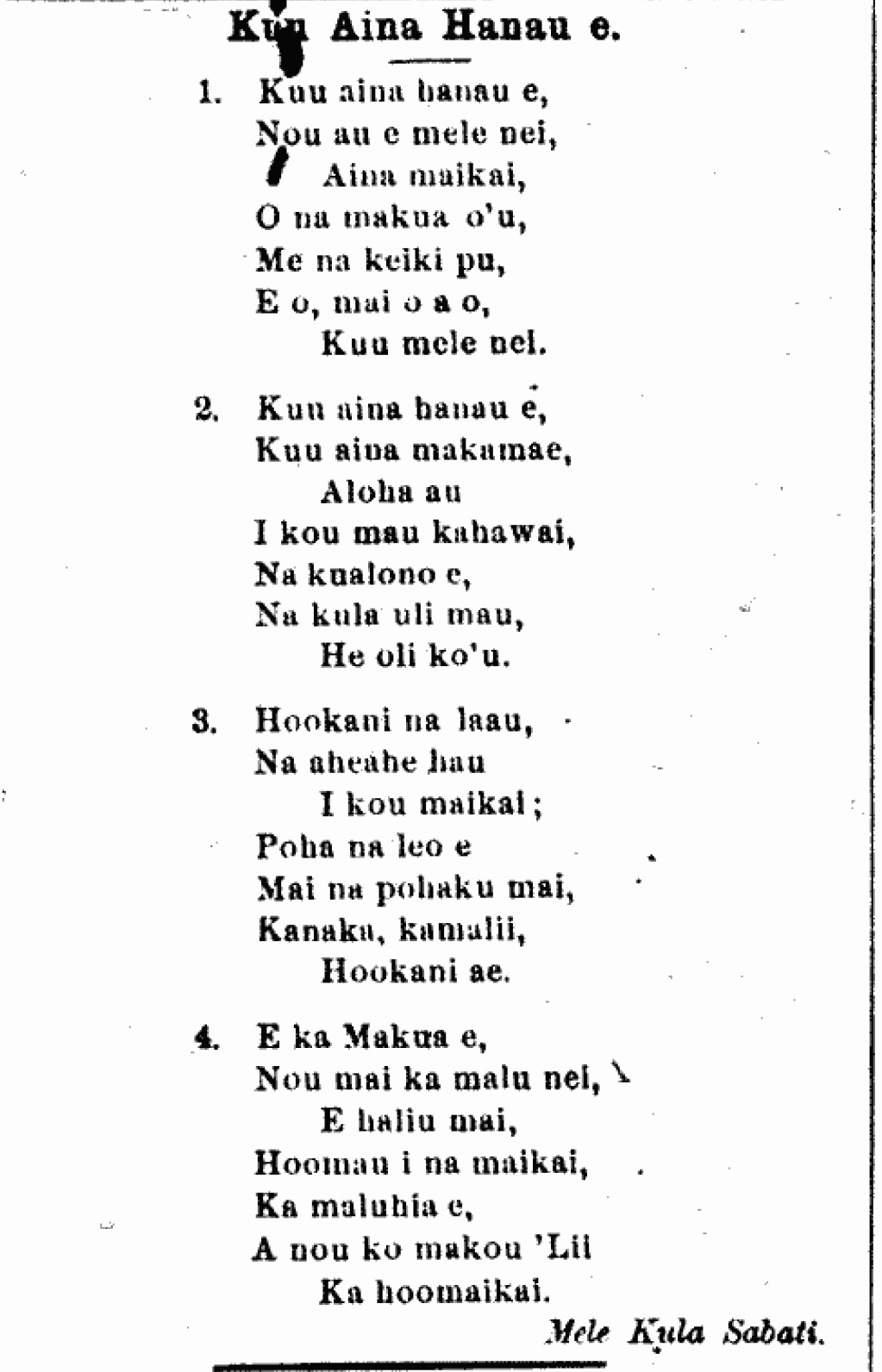
Kuu Aina Hanau e.

1. Kuu aina hanau e,
Nou au e mele nei,
Aina maikai,
O na makua o’u,
Me na keiki pu,
E o, mai o a o,
Kuu mele nei.

2. Kuu aina hanau e,
Kuu aina makamae,
Aloha au
I kou mau kahawai,
Na kualono e,
Na kula uli mau,
He oli ko’u.

3. Hookani na laau,
Na aheahe hau
I kou maikai;
Poha na leo e
Mai na pohaku mai,
Kanaka, kamalii,
Hookani ae.

4. E ka Makua e,
Nou mai ka malu nei,
E haliu mai,
Hoomau i na maikai,
Ka maluhia e,
A nou ko makou ‘Lii
Ka hoomaikai.

Mele Kula Sabati.

My Dear Land of Birth.

1. My dear land of birth,
For thee I sing,
Beautiful land,
Of my parents,
And my children,
Respond from far and wide
To my song.

2. My dear land of birth,
My cherished land,
I love
Your rivers,
The mountain ridges,
The ever-green plains,
I am jubilant.

3. The trees sound forth,
The gentle cool breezes
Of your splendor;
The voices boom
From the rocks,
Men, children,
Sounding forth.

4. O Father,
From whom comes our protection,
Look down upon us,
Let the goodness continue,
The peace,
And for you, our King
Is the praise.

Sunday School Song.

[This is the song sung at the opening of the first meeting of the Kona chapter of the Kaahumanu Society held on  March 30, 1913. It is one of the many compositions of Lorenzo Lyons. The song was sung to the tune of “My Country ‘Tis of Thee,” and it seems some of the sentiment was taken from its lyrics as well.]

(Lau Oliva, 2/1871, p. 1)

Kuu Aina Hanau e.

Ka Lau Oliva, Buke I, Helu 2, Aoao 1. Feberuari, 1871.

More on the Hawaiian National Hymn, 1874.

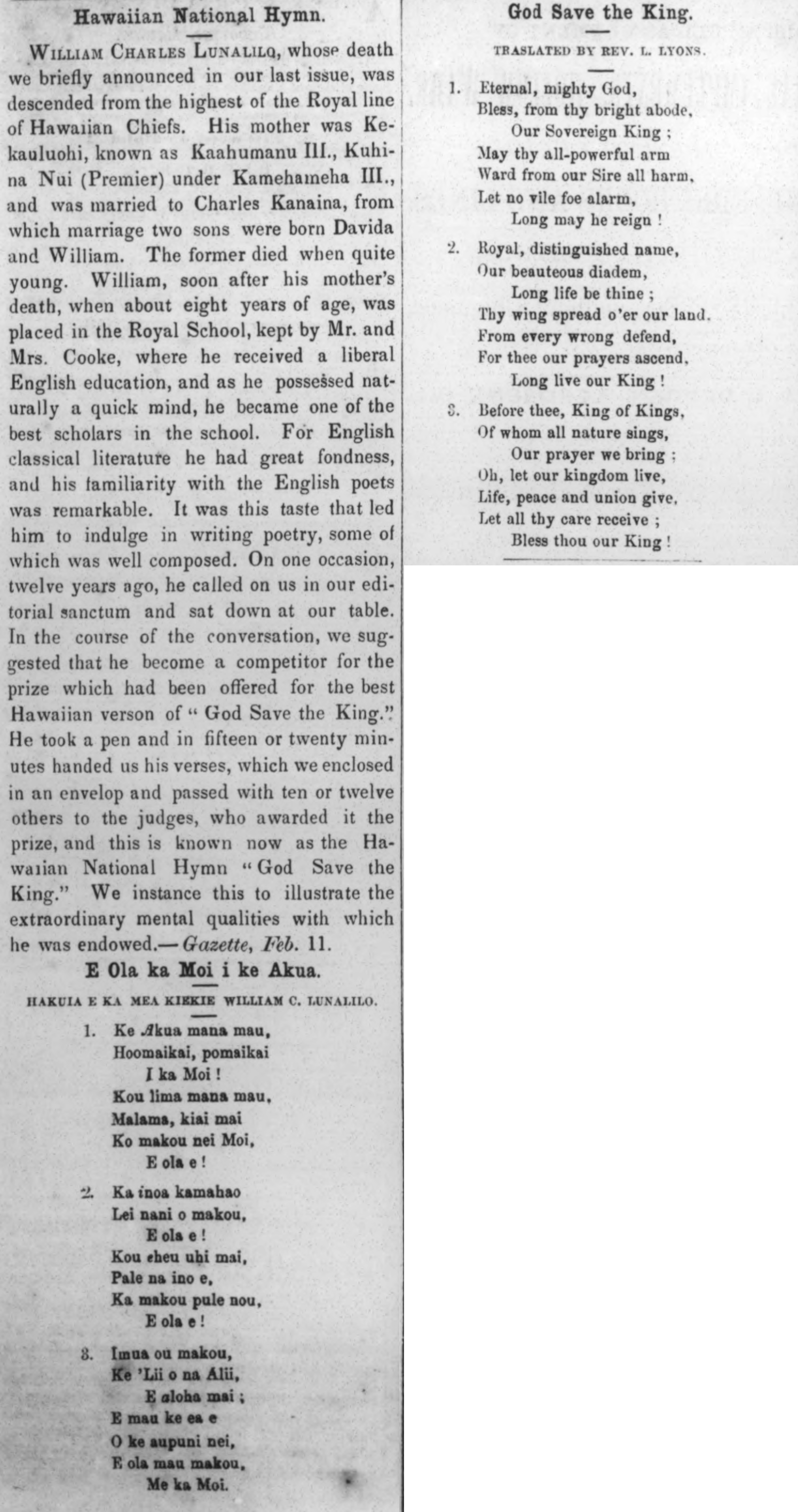
Hawaiian National Hymn.

William Charles Lunalilo, whose death we briefly announced in our last issue, was descended from the highest of the Royal line of Hawaiian Chiefs. His mother was Kekauluohi, known as Kaahumanu III., Kuhina Nui (Premier) under Kamehameha III., and was married to Charles Kanaina, from which marriage two sons were born Davida and William. The former died when quite young. William, soon after his mother’s death, when about eight years of age, was placed in the Royal School, kept by Mr. and Mrs. Cooke, where he received a liberal English education, and as he possessed naturally, a quick mind, he became one of the best scholars in the school. For English classical literature he had great fondness, and his familiarity with the English poets was remarkable. It was this taste that led him to indulge in writing poetry, some of which was well composed. On one occasion, twelve years ago, he called on us in our editorial sanctum and sat down at our table. In the course of the conversation, we suggested that he become a competitor for the best prize which had been offered for the best Hawaiian version of “God Save the King.” He took a pen and in fifteen or twenty minutes handed us his verses, which we enclosed in an envelope and passed with ten or twelve others to the judges, who awarded it the prize, and this is known now as the Hawaiian National Hymn “God Save the King.” We instance this to illustrate the extraordinary mental qualities with which he was endowed.—Gazette, Feb. 11.

E Ola ka Moi i ke Akua.

HAKUIA E KA MEA KIEKIE WILLIAM C. LUNALILO.

1. Ke Akua mana mau,
Hoomaikai, pomaikai
I ka Moi!
Kou lima mana mau,
Malama, kiai mai
Ko makou nei Moi,
E ola e!

2. Ka inoa kamahao
Lei nani o makou,
E ola e!
Kou eheu uhi mai,
Pale na ino e,
Ka makou pule nou,
E ola e!

3. Imua ou makou,
Ke ‘Lii o na Alii,
E aloha mai;
E mau ke ea e
O ke aupuni nei,
E ola mau makou,
Me ka Moi.

God Save the King.

TRANSLATED BY REV. L. LYONS.

1. Eternal, mighty God,
Bless, from thy bright abode,
Our Sovereign King;
May thy all-powerful arm
Ward from our Sire all harm,
Let no vile foe alarm,
Long may he reign!

2. Royal, distinguished name,
Our beauteous diadem,
Long life be thine;
Thy wing spread o’er our land.
From every wrong defend,
For thee our prayers ascend,
Long live our King!

3. Before thee, King of Kings,
Of whom all nature sings,
Our prayer we bring;
Oh, let our kingdom live,
Life, peace and union give,
Let all thy care receive;
Bless thou our King!

(Friend, 3/2/1874, p. 24)

Hawaiian National Hymn.

The Friend, New Series, Volume 23, Number 3, Page 24. March 2, 1874.

A Kanikau for Mrs. Fidelia Church Coan, done in Hawaiian and English! 1872.

[Translation.]

A Dirge for Mrs. Coan,

Composed by request for the Church and friends at Hilo.

Tune, A Mother’s Kiss,—Golden Robin.

1.

What hand is this stretched from above,
From where kind Spirits blend?
It is a hand let down in love
To bear away a friend.
A stranger friend she came to us
From homes beyond the seas,
And moved by love she staid with us
To teach us words of peace.

2.

Long she abode in our domain,
And domiciled with us;
A Mother teacher she became,
A kind and tender nurse;
A mother dear and much beloved,
A guide both safe and sure
O’er verdant fields with flowers perfumed,
By waters still and pure.

3.

Look upward, lo! what sight is this?
A shining cloud appears,
It floats, and thence an angel’s voice
Falls on our listening ears;
O friend beloved, there’s waiting nigh
An angel carr for thee;
Take passage, and ascend on high,
To the world though long’st to see.

4.

Hark! hark! what notes are these we hear?
they are deep sorrow’s wails;
They roll, and swell, and fill the air,
And echo o’er the hills—
The angel choir has borne away
From children weeping here
A mother whom they loved to obey,
A mother teacher dear.

5.

Our mournful tears are flowing fast,
And falling here and there,
For thee, our mother in days past,
Our leader kind and dear.
We bend in sorrow o’er one loved,
Our grief for thee is great—
Thou came’st, and we together moved;
But now we separate.

6.

Hark! hark! what bell is tolling thus?
It is a mournful bell:—
Gather together in God’s house—
It is the funeral knell.
We listen and together come,
Dear friends the summons heed;
And draped mourning, to the tomb
We march with sorrow’s tread.

7.

Mournful we move, and all are hush!
Angels are looking on,
And Jesus comes to walk with us,
And comfort those who mourn.
The hills and vales, and streams that flow,
Together with us mourn.
The loved one’s form is lower’d, and lo!
The clouds are dak’ning round!

8.

But look again, the clouds have flown,
And light breaks thro’ the gloom;
A voice exhorts with gentle tone,
O cease, ye friends, to mourn.
The dear and much beloved one
Lies not in this drear tomb,
She’s risen and to heaven has gone,
With Jesus she’s at home.

Hawaii.

[Unuhiia.]

He Kanikau no Mrs. Koana,

I hakuia ma ke noiia mai no ka ekalesia a me na makamaka o Hilo.

Leo, A Mother’s Kiss,—Golden Robin.

1.

He lima aha e o nei
Mai luna mai ke ao?
He lima kii e lawe ae
Kekahi hoahanau.
He hoa malihini nei
Mai kahi loa mai no,
Aloha nae a noho mai
I kumu no kakou.

2.

Ua noho a loihi no,
A kamaaina pu,
A lilo i makua ao,
A hanai ia kakou;
Makuwahine makamae,
A alakai maikai
Ma kahi kula uli e,
A ma na wai maemae.

3.

E nana, e, heaha nei?
He ao olino e,
Ke kau la, a noloko mai
He leo hea mai;
Ke hoa aloha, ke ku nei
He kaa anela nou;
E ee maluna, a pii ae,
Pii i ke ao ma o.

4.

Hamau! he lohe aha nei?
He olo pihe no;
O olo ae, a kupinai
Maluna o na puu—
Ua kai na anela aulii,
Mai na keiki ae,
I ka makua aloha e,
Makua ao maikai.

5.

Ke kahe nei a helelei
Na u waimaka e
Nou, ka makua aloha e,
Ko makou alakai—
Ke haalou nei, a hu ka uwe,
Pau mako e makou!
Hoea a noho pu maanei,
Kaawale nae ano.

6.

Hamau! he bele aha nei?
He bele kanikau—
E hui ma ka halawai
Hoolewa kupapau.
Ke hui nei na hoahanau,
Na hoaaloha pu;
Paa i ka lole kanikau,
A nauwe u kakou.

7.

Ke nauwe kanikau hamau—
Nana na anela,
Me Iesu hoi ke hele pu,
A, nana e hoona.
Na puu, na awawa a kahawai
Ke kanikau pu no.
Ka mea aloha ua nalo ae,
Pouli mai na ao!

8.

E nana hou, ua hee na ao,
Poha he lama e;
He leo paipai olu no,
E pau, e pau ka uwe—
Ka mea aloha makamae,
Aole ia maanei.
Ua lele i ke ao maikai
Me Iesu e maha’i.

Hawaii.

[I thought to post this piece because it is one of the few examples where the author/composer did both the Hawaiian and English version. It is interesting to look at the two compositions side by side. This is a kanikau written for Fidelia Church Coan who arrived in Hawaii along with her husband, Titus Coan, on June 6, 1835. They were stationed in Hilo, and she ran a boarding school there for girls.

The composer who calls himself “Hawaii,” is a prolific translator of English hymns into Hawaiian in the Kuokoa newspaper. Could this possibly be Lorenzo Lyons? Would anyone have any information on this?]

(Kuokoa, 11/2/1872, p. 7)

[Translation.] A Dirge for Mrs. Coan...

Ka Nupepa Kuokoa, Buke XI, Helu 44, Aoao 7. Novemaba 2, 1872.