The First Governor, G. R. Carter has passed away, at 66 years and some months of life. He was a local boy.
(Hoku o Hawaii, 2/14/1933, p. 2)

Ka Hoku o Hawaii, Buke XXVI, Helu 37, Aoao 2. Feberuari 14, 1933.

The First Governor, G. R. Carter has passed away, at 66 years and some months of life. He was a local boy.
(Hoku o Hawaii, 2/14/1933, p. 2)
Ka Hoku o Hawaii, Buke XXVI, Helu 37, Aoao 2. Feberuari 14, 1933.
James N. K. Keola of the Homesteads of Waiakea [Home hookuonoono o Waiakea] left this life after being sick for some time. He left behind his wife, child, and family, who are mourning after him.
(Hoku o Hawaii, 2/14/1933, p. 2)

Ka Hoku o Hawaii, Buke XXVI, Helu 37, Aoao 2. Feberuari 14, 1933.
In the same issue as yesterday’s post on the marriage of Edith Kanaele to Luke Kanakaole, there are six more articles on Marriages, Births, and Deaths along with one about a birthday celebration and one on the health of an individual. Although the Hoku o Hawaii did not have a specific Vital Statistics column, it did print individual articles dealing with those events. If just this one issue of the newspaper held this much genealogical information, just imagine what a year holds.
See the following posts for the eight other articles from Hoku o Hawaii, 2/14/1933.
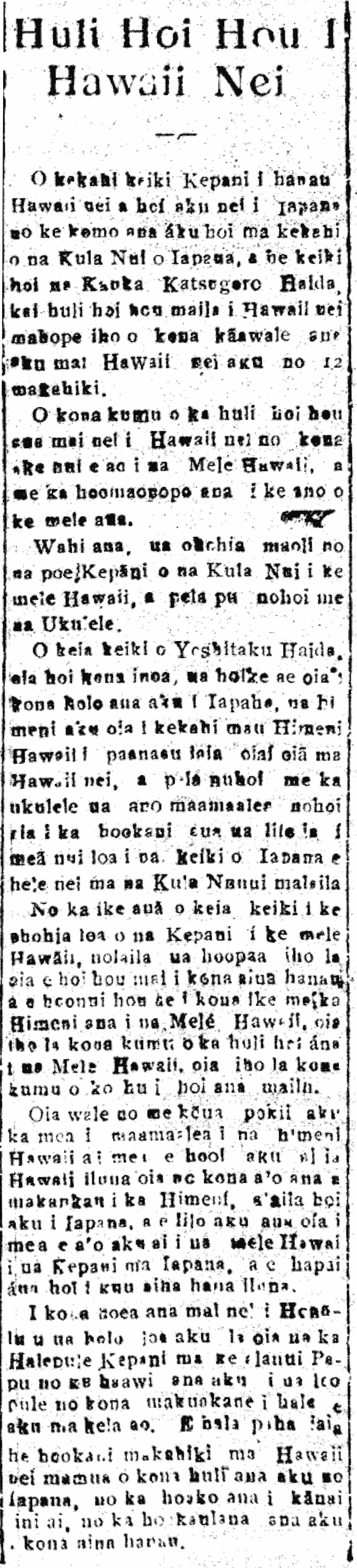
A Japanese boy born here in Hawaii and who went back to Japan to enter into a College in Japan, and who is a child of Dr. Katsugoro Haida, came back to Hawaii after being away from Hawaii for 12 years.
The reason for his return to Hawaii was because of his desire to learn Hawaiian Mele and to learn how to sing them.
According to him, the Japanese of the Universities are enthralled by Hawaiian songs, and so too of the Ukulele.
That boy, Yoshitaku Haida [Yoshikatsu Haida, aka Haruhiko Haida, aka Yukihiko Haida] is his name, said that when he went to Japan, he sang some Hawaiian Songs that he had memorized while in Hawaii nei; so also with the ukulele, he was quite skillful in playing it; and it became something big with the Japanese youth going to that University [Keio University].
Because this boy saw the great interest the Japanese had for Hawaiian music, he decided to return to the land of his birth and increase his knowledge in Singing Hawaiian Music, and that was the reason for his coming back.
It is just he and his younger brother [Katsuhiko Haida] who are skilled at Hawaiian songs, to raise up Hawaii, and that is why he is learning Singing until he is proficient, at which point he will return to Japan where he will become a teacher of Hawaiian mele to the Japanese in Japan, and raise up the land of my [his] birth.
Upon arriving in Honolulu, he went to the Japanese Church on Fort Street to say a prayer for his father who has passed to the other world. He may be here in Hawaii for perhaps a year before turning back for Japan, to fulfill his desire to bring fame to his birth land.
(Hoku o Hawaii, 2/14/1933, p. 3)
Ka Hoku o Hawaii, Buke XXVI, Helu 37, Aoao 3. Feberuari 14, 1933.
ʻŌiwi TV February 12, 2013
E nā hoa kākoʻo mau i kēia kiʻina hoʻōla ʻōlelo a moʻomeheu Hawaiʻi ma o ka pāpaho “Na Ka Hawaiʻi, No Ka Hawaiʻi”, e alu mai i ka hāpai i kēia i mua ma ka hoʻouna i manaʻo kākoʻo i ka pila SB1235.
To all those who continue to support our efforts to use the power of the media for the benefit of our ʻōlelo and moʻomeheu Hawaiʻi, please join us in supporting SB1235.
Draft Testimony Template: SB1235.Support.Leka
Submit Testimony via e-mail: CPNtestimony@capitol.hawaii.gov
Submit Testimony Online: http://www.capitol.hawaii.gov/submittestimony.aspx?billtype=SB&billnumber=1235
Submitting testimony online is as simple as entering your name, email, and clicking “support”
Measure Status Page: http://www.capitol.hawaii.gov/measure_indiv.aspx?billtype=SB&billnumber=1235&year=2013
S.B. 1235: http://www.capitol.hawaii.gov/session2013/bills/SB1235_.pdf
The goal is to acquire long-term, cyclical, and diversified funding for the production and distribution of Hawaiian language video content to support an independent Native Hawaiian television service that is a prime vehicle in the mass revitalization of Hawaiian language and culture.
The purpose of this bill is to require the Department of Commerce and Consumer Affairs to allocate revenues derived from any collected franchise fees to specific entities for specific purposes. One of the new designees for allocation of funds would be Makauila, Inc., a non-profit educational organization with the purpose of revitalizing Hawaiian language and culture via media.
The Constitution of the State of Hawaii, Article XV, Section 4 states “English and Hawaiian shall be the official languages of Hawaii,[…]” If the Hawaiian language is to reach an equal status with that of the English language in everyday use, the production and distribution of Hawaiian language broadcast media must be supported. Language revitalization research supports this assertion (Fishman).
The cable franchise fee is a 4.6% fee assessed to cable television customers in Hawaiʻi and these funds are currently allocated to support initiatives such as public, education, and government television but with no specific requirements to support the Hawaiian language. We believe that an independent Native Hawaiian television service focusing on the revitalization of language is a worthy recipient of these funds proven by the viewership and demand for this programming by Makauila and its distribution partners ʻŌiwi TV and Hawaiʻi News Now. For more information on the cable franchise fees: http://hawaii.gov/dcca/catv/peg_plan_information/catv_final_peg_plan.pdf
Makauila, in partnership with a collective of other Hawaiian-serving organizations and funding sources, has built the foundation for a Native Hawaiian television industry through Hawaiian-focused content production, workforce training programs, and equipment investments. Partners include ʻŌiwi TV, ʻAha Pūnana Leo, the Kamehameha Schools, the Office of Hawaiian Affairs, and Oceanic Time Warner Cable. This collective has pursued a long-term strategy to effectively and systematically scale up the capacity to leverage diversified funding sources as content production and viewership increases.
Highlights of the collective since 2008:
| Launched ʻŌiwiTV, Oceanic 326 and http://www.oiwi.tv. First Hawaiian language and cultural television station | Produced ʻĀhaʻi ʻŌlelo Ola, the first native language news program on network television (KGMB/HNN) |
| 1,200 video segments totaling 165 hours of Hawaiian-focused content, including 85 hours of all Hawaiian language content | Produced the Hawaiian language greetings at Hawaiʻi airports |
| 8.7 million views locally on KGMB/HNN, ʻŌiwi TV and web | Produced the Hawaiian language video greeting for in-bound flights to Hawaiʻi |
| Developed and operationalized the Native Hawaiian Broadcast Media Training Program, providing 12 full-time jobs to graduates | Acquired over $3million in funding from Federal, State, and private grants and contracts |
Makauila, Inc. formed in April 2010 from a need for on-going funding for ʻĀhaʻi ʻŌlelo Ola, the pioneering Hawaiian language news show produced by the ʻAha Pūnana Leo for air on KGMB/Hawaii News Now and ʻŌiwi TV. Looking beyond a news segment, the core group of Native Hawaiian media professionals and their partners saw the need for this new nonprofit to acquire funding to produce high quality digital multimedia content that would expand the presence of a Hawaiian perspective in television and contemporary society.
The mission of Makauila is to utilize digital media as the means to enrich the educational and cultural experiences for Native Hawaiians in the modern context.
The purpose of Makauila is to develop and produce educational multimedia content through Hawaiian language, culture and perspective for television and digital distribution. Advances in digital technology have opened new avenues of interactive communication that offer tremendous opportunity to educate from a Native Hawaiian perspective. Makauila formed to take advantage of these opportunities and to serve as the catalyst for community building through education and language revitalization.
The long-term goal of Makauila is to leverage collective experience, relationships and knowledge to be the pre-eminent producer and distributor of relevant multimedia content from the Hawaiian perspective to support an independent Native Hawaiian television service.
As part of this strategy, Makauila partnered with ʻŌiwi TV as its primary distribution venue because of the clear alignment in vision and commitment to a high standard for ʻōlelo and moʻomeheu Hawaiʻi. Since 2010, Makauila and ʻŌiwi TV have collaborated on numerous content production projects that are providing the Hawaiian community with high-quality Hawaiian language, cultural, and educational television programming. The content and subject matter of the programming being produced through this collaboration includes news and other timely information that makes it relevant and meaningful to the audience, adding more value to the experience audience. This programming is also filling a long-underserved need by allowing Hawaiian language speakers and learners the opportunity to use their language in their homes and outside of a classroom environment. This opportunity to expand the areas in which Hawaiian language is commonplace is an important step in the revitalization of the Hawaiian language. Furthermore, using digital distribution through television and the Internet allows for Hawaiian language content to be delivered to and consumed by its audience through a modern and forward-thinking strategy.
Luke Kanakaole was joined together in the sacred bond of marriage with Miss Edith Kanaele, of Keaukaha. Marriage is a splendid thing.
[After attending the awesome symposium this past week, Words in the World: Literatures, Oratures, and New Meeting Grounds, it was serendipity that I just came across this marriage announcement for the famous chanter and hula practitioner, as well as mother of one of the esteemed mele panel presenters, Pualani Kanakaole Kanahele!
There is so much available in the Hawaiian-Language Newspapers, if only we bothered to look. Although it wouldn’t hurt if there were clear images online and they were accurately word searchable.]
(Hoku o Hawaii, 2/14/1933, p. 3)

Ka Hoku o Hawaii, Buke XXVI, Helu 37, Aoao 3. Feberuari 14, 1933.
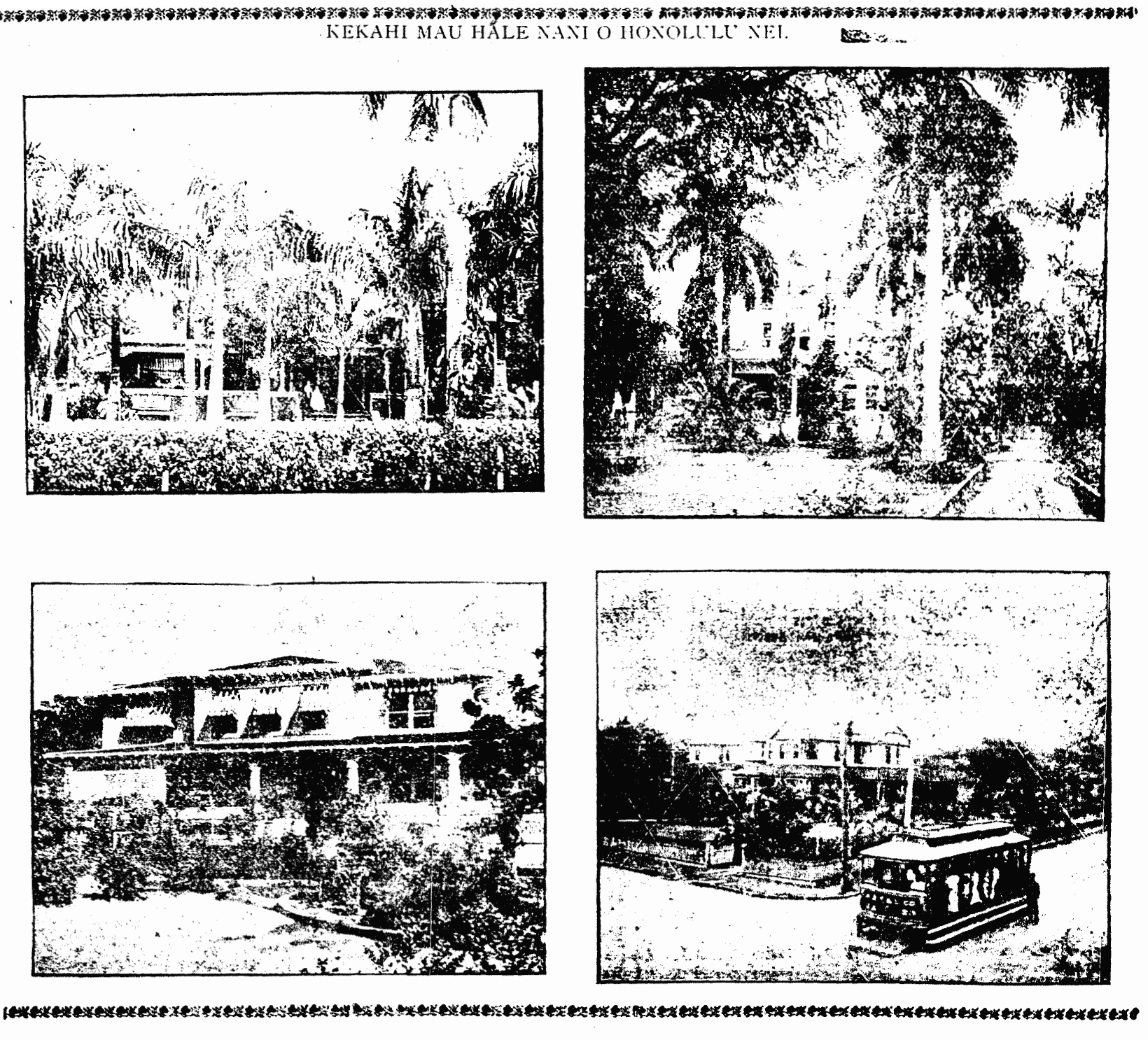
[The digital images currently available are as i have previously lamented over not terribly clear. Even if images scanned from the originals would not be “photo quality,” it would still give us much more of a connection than with what we have here.
Would anyone know where these four houses stood, who they belonged to, and if they are still standing today?]
(Kuokoa, 10/26/1906, p. 2)
Ka Nupepa Kuokoa, Buke XLV, Helu 43, Aoao 2. Okatoba 26, 1906.
CHAPTER I.
HIS FIRST DAY AT SCHOOL.
One fine day, when the hills and vales were covered with the light of the morning, this little child came out of a log cabin. Log cabins were the houses of the poor country people of this area, and this is how they are built….
[This is the opening of one of several biographies of Abraham Lincoln published throughout the years in the Hawaiian-Language Newspapers. This particular one runs in the Kuokoa from 7/27/1906 to 1/18/1907. Linekona was followed closely through life and death and beyond in the Hawaiian-Language Newspapers. Perhaps of any president of the United States, he is the one most written about and most respected for his stance and for the actions he took to promote these beliefs.
There is an article announcing the beginning of this story appearing in the previous issue of the Kuokoa, 7/20/1906, p. 4: “PERESIDENA LINEKONA, KE KEIKI KUAAINA”.]
(Kuokoa, 7/27/1906, p. 6)

Ka Nupepa Kuokoa, Buke XLV, Helu 30, Aoao 6. Iulai 27, 1906.
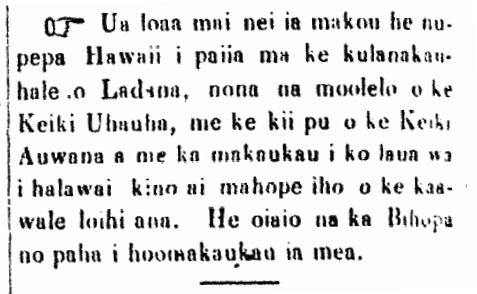
We have come into possession of a Hawaiian newspaper printed in the city of London, in which was the story of the Wasteful Child [Keiki Uhauha], along with an illustration of the Wayward Child [Keiki Auwana], in preparation for their meeting each other in person after a long separation. It is true that it is probably the Bishop that put it together.
[There is no indication whether this paper is in the Hawaiian-Language or whether it is in English. Might anyone know what this refers to? There seems to have been a chapbook or pamphlet that was available in the 1860s called “Ka hoi ana mai o ke Keiki Uhauha”.]
(Kuokoa, 1/27/1872, p. 2)
Ka Nupepa Kuokoa, Buke XI, Helu 4, Aoao 2. Ianuari 27, 1872.
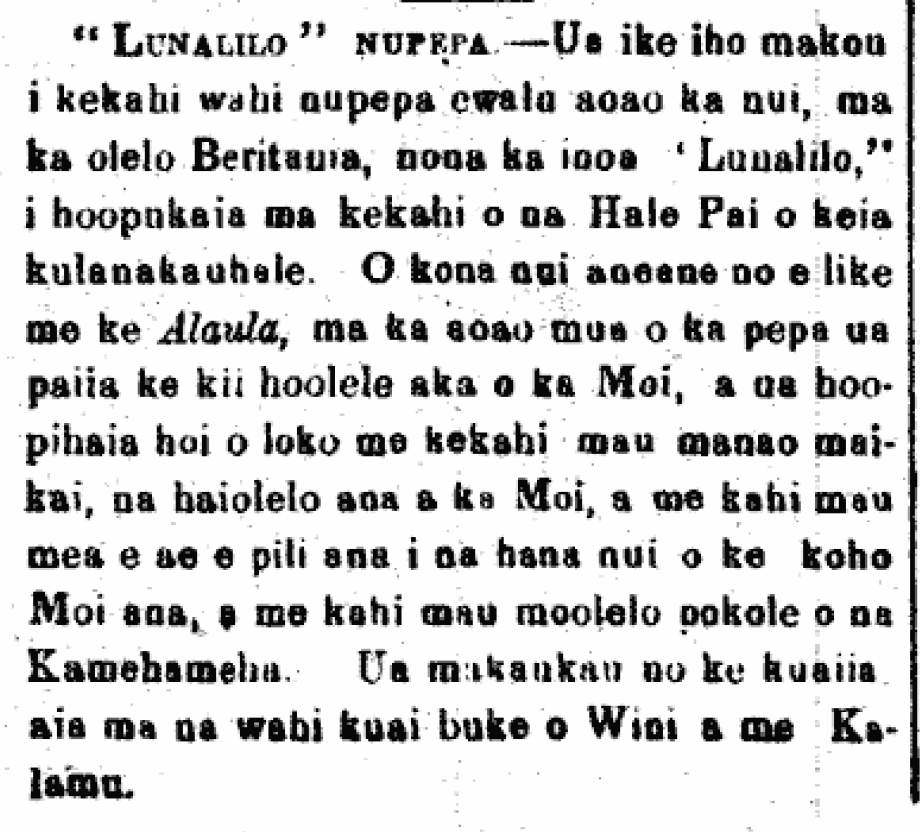
“Lunalilo” Newspaper.—We have seen a newspaper of eight sides, in the English language, with the name, “Lunalilo,” which was printed at one of the Printing Houses of this town. Its size is about the size of the Alaula, and on the first page of the paper is printed with a silhouette [kii hoolele aka] of the King, and the inside is filled with good ideas, the speeches of the King, and some other things pertaining to the election of the King, as well as some short stories about the various Kamehameha. It is ready for sale at the bookstores of Whitney [Wini] and Kalamu [Thrum].
[This is documented in the great four-volume Hawaiian bibliography by David Forbes, “Hawaiian National Bibliography, 1780-1900”]
(Au Okoa, 1/30/1873, p. 3)
Ke Au Okoa, Buke VIII, Helu 42, Aoao 3. Ianuari 30, 1873.
 nupepa