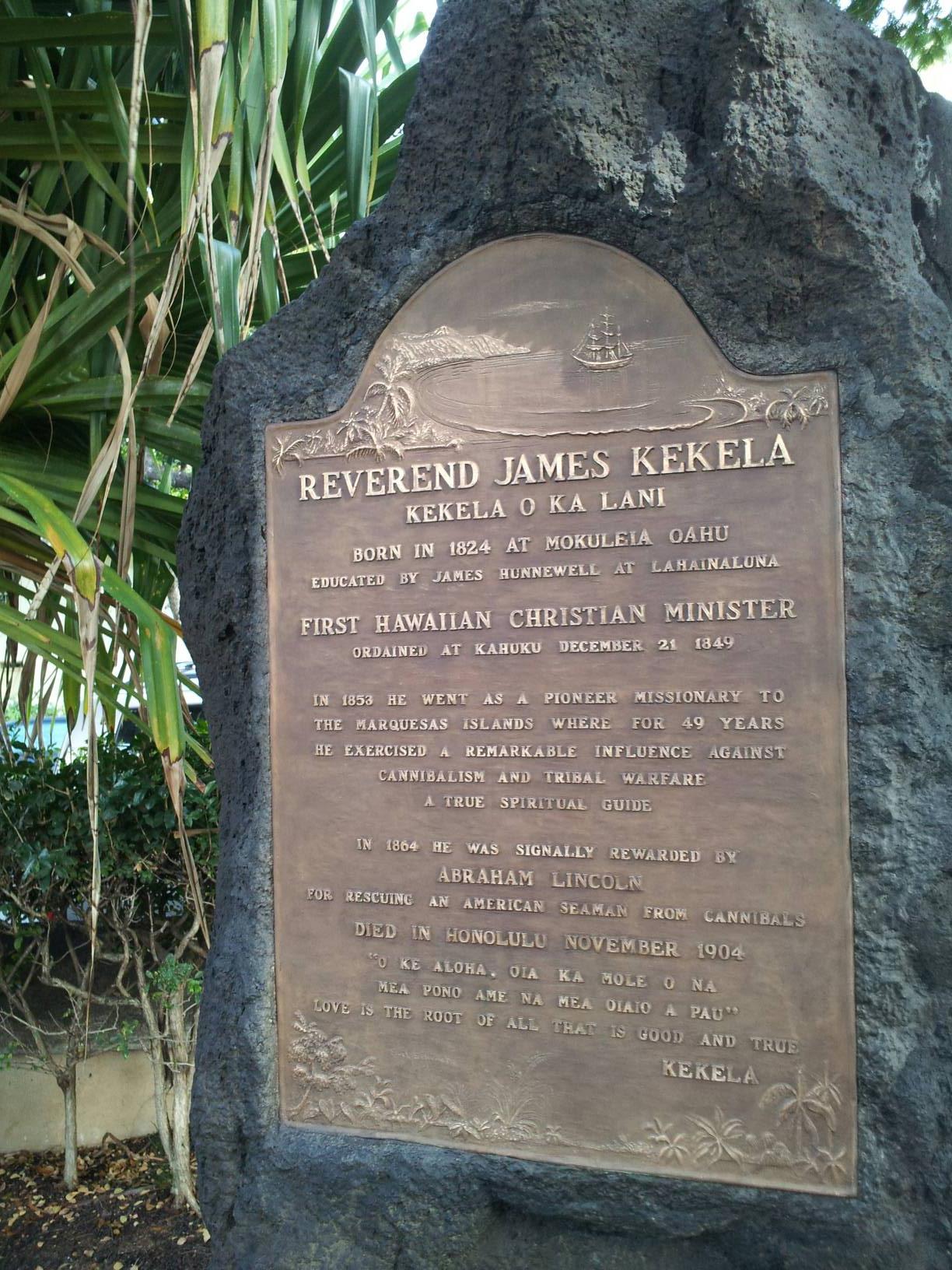
Reverend James Kekela plaque at Kawaiahao Church, 2013.

REVEREND JAMES KEKELA

KEKELA O KA LANI

BORN IN 1824 AT MOKULEIA OAHU

EDUCATED BY JAMES HUNNEWELL AT LAHAINALUNA

FIRST HAWAIIAN CHRISTIAN MINISTER

ORDAINED AT KAHUKU DECEMBER 21 1849

IN 1853 HE WENT AS A PIONEER MISSIONARY TO THE MARQUESAS ISLANDS WHERE FOR 49 YEARS HE EXERCISED A REMARKABLE INFLUENCE AGAINST CANNIBALISM AND TRIBAL WARFARE

A TRUE SPIRITUAL GUIDE

IN 1864 HE WAS SIGNALLY REWARDED BY

ABRAHAM LINCOLN

FOR RESCUING AN AMERICAN SEAMAN FROM CANNIBALS

DIED IN HONOLULU NOVEMBER 1904

“O KE ALOHA, OIA KA MOLE O NA MEA PONO A ME NA MEA OIAIO A PAU”

LOVE IS THE ROOT OF ALL THAT IS GOOD AND TRUE

KEKELA

[Kekela is buried in the cemetery of Kawaiahao Church in front of his daughter Maria. His wife Naomi however is buried at the Waianae Church.]

(Kawaiahao Church)

Kawaiahao Church

Rev. James Kekela Plaque, Kawaiahao Church

Introduction to the reminiscences of Hawaiian missionary James Kekela, 1901.

THE LIGHT IN MICRONESIA.¹

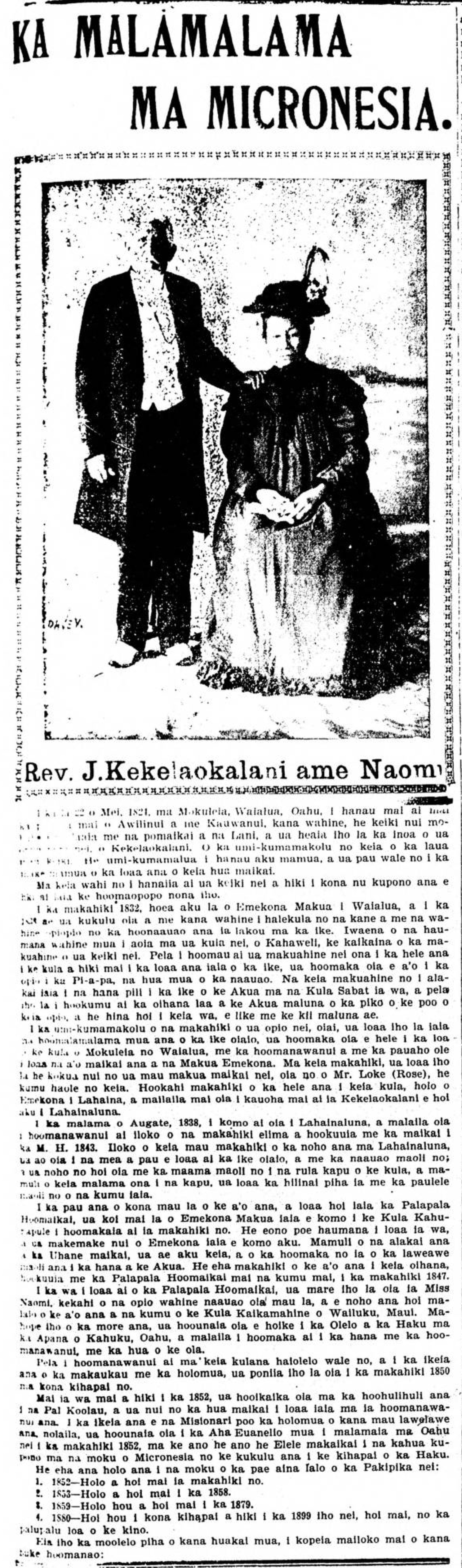
Rev. J. Kekelaokalani and Naomi

On the 22nd of May, 1821, at Mokuleia, Waialua Oahu, born of Awilinui and Kauwanui, his wife, was a big well filled-out baby with the blessings of the Heavens, and child was called by the name Kekelaokalani. This was the thirteenth of their children. Twelve were born prior, and with the [unclear phrase] of that fine offspring.

It was here that that child was raised until he was capable of understanding things for himself.

In the year 1832, Emerson, Sr. [Emekona Makua] arrived in Waialua, and in the following 1833 [unclear] he built a schoolhouse with his wife for the young men and women to enlighten them with knowledge. From among the first women to be taught there at that school was Kahaweli, the younger sister of the mother of that child. And following her, his mother as well attended the school until she was educated; and she began teaching the children the alphabet [Pi-a-pa], the beginnings of knowledge. It was this mother who guided him at that time in the knowledge about God and Sunday School, and it was thus that the sacred work of God was instilled a top the fontanel of the head [piko o ke poo] of this child, which is silver now, as in the picture above.

When that child was thirteen years old, being that he had received the beginnings of the light of true knowledge, he began to travel the width of the plain of Mokuleia for Waialua, with patience and without exhaustion, to receive the good teachings of the elder Emersons. In this year, those fine elders got great help in the form of Mr. Rose (Loke), a haole teacher. After one year of attending this school, Emerson went to Lahaina, and from there he told Kekelaokalani to come to Lahainaluna.

In August 1838, he entered Lahainaluna, and there he patiently remained for five years and he graduated in the year 1843. During those years at Lahainaluna, he learned everything about the true knowledge, as well as actual knowledge; and he remained, following the rules of the school, and as a result of his following the rules, he gained the full trust and total faith of the teachers.

After his days of learning were over, and he received his Diploma [Palapala Hoomaikai], Emerson, Sr. encouraged him to join the school for the clergy [Kula Kahunapule] that was started that very year. There were six students at the time, and Emerson wanted greatly for him to join. And because of the guidance of the righteous Spirit, he agreed, and so began his actual performing of the work of God. He spent four years at this work, and graduated with a Diploma from the teachers, in the year 1847.

When he received his Diploma, he married Miss Naomi, one of the educated young women of the time, and was living under the instruction of the teachers of the Girls’ School of Wailuku, Maui. After they were wed, he was sent to teach the Word of the Lord in the District of Kahuku, Oahu, and there he began his work with patience, with the word of life.

And he thus patiently continued as but a preacher; and when his readiness and progress was seen, he was ordained at his own parish.

From then until 1852, he strove to convert the Koolau Cliffs, and the fruits of his patience were many. When the head Missionaries saw his progress of his work, he was sent by the first Evangelical Convention held here on Oahu in the year 1852 as a Representative to travel to the places suitable to build parishes of the Lord in the Micronesian Islands.

He went to the islands of the South Pacific four times:

1. 1852—Went and returned that same year.

2. 1853—Went and returned in 1858.

3. 1859—Went again and returned in 1879.

4. 1880—Returned to his parish until this past year 1899, and came back, in feeble health.

Here is the entire story of his first excursion, copied from his journal:

[A long account follows. Perhaps i will post it here one of these days…]

¹Kekela was based in the Marquesas Islands, and not the Micronesian Islands.

(Kuokoa, 1/18/1901, p. 5)
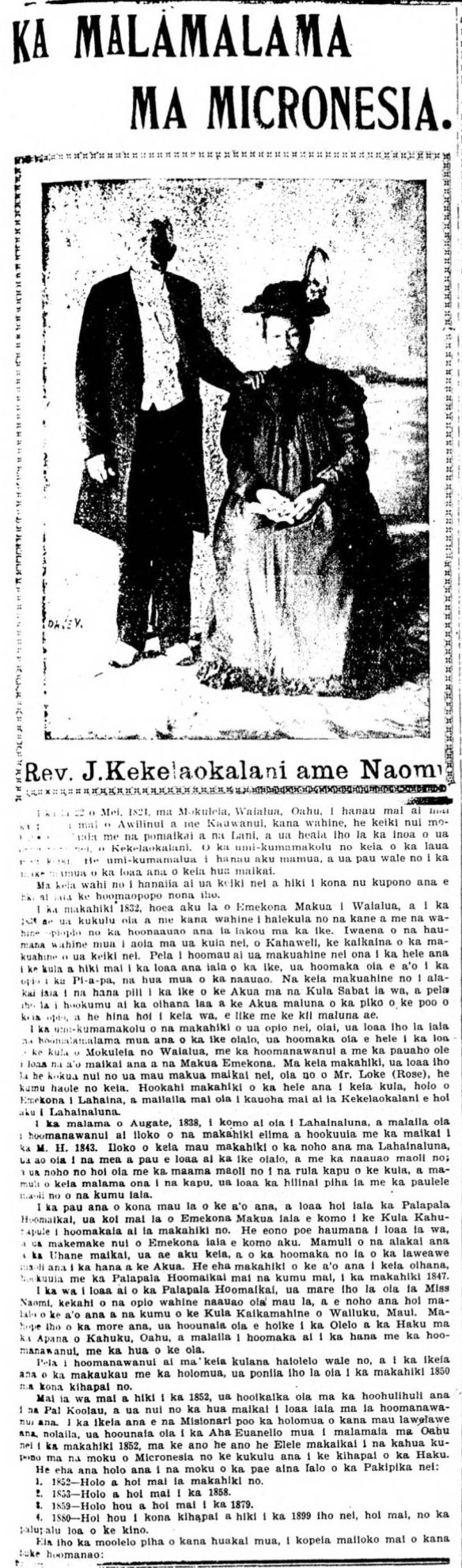
KA MALAMALAMA MA MICRONESIA.

Ka Nupepa Kuokoa, Buke XXXIX, Helu 3, Aoao 5. Ianuari 18, 1901.

Here is the amendment to the marriage law passed in 1888.

MOKUNA LXIX.

HE KANAWAI

E hoololi ai i ka Pauku 2 o ka Mokuna LVI o ke Kanawai Hoopai Karaima, a e hoopau loa ai i na Pauku 3, 4 a me 5 o ia Mokuna, me na hoololi a pau i ua Mokuna nei.

E hooholoia e ka Moi a me ka Ahaolelo o ko Hawaii Paeaina.

Pauku 1. E hoololi ia a ma keia ke hoololi ia nei ka Pauku 2 o ka Mokuna LVI o ke Kanawai Hoopai Karaima, a penei e heluhelu ia ai:

“Pauku 2. E ninaninau ia, e hoolohe ia, a e hooholo ia e ka Lunakanawai no ia hihia, a ina he mea hiki e hoopau ia ka noho kue ana o laua; aka, ina aole hiki e hoopau ia ko laua kue ana, e hoopau wale ia no ka hoopii. Ina e hoopau wale ia kekahi hoopii, e hooholo ka Lunakanawai e hookaa ia na koina e like me ka mea ana i manao ai oia ka pono.”

Pauku 2. Ma keia ke hoopau loa ia nei na Pauku 3, 4 a me 5 o ka Mokuna i olelo ia  a me kekahi a me na hoololi o ia Mokuna i olelo ia.

Apono ia i keia la 10 o Sepatemaba, M. H. 1888.

KALAKAUA REX.

Na ka Moi:

L. A. Thurston,

Kuhina Kalaiaina.

(NA KANAWAI O KA MOI KALAKAUA I, Ke Alii o Ko Hawaii Paeaina, i Kau ia e ka Hale Ahaolelo Kau Kanawai, i ke Kau o 1888, p. 171.)

CHAPTER LXIX.

AN ACT

To amend Section 2 of Chapter LVI. of the Penal Code and Repeal Sections 3, 4 and 5 of said Chapter with all Amendments thereto.

Be it Enacted by the Kind and the Legislature of the Hawaiian Kingdom:

Section 1. That Section 2 of Chapter LVI. of the Penal Code be and is hereby amended so as to read as follows:

“Section 2. Said Justice shall examine into, hear and determine the complaint and shall secure if practicable, a reconciliation between the parties; but if no reconciliation can be effected, the complaint shall be dismissed. In case of such dismissal the Justice shall adjudge the costs to be paid as in his opinion justice shall demand.”

Section 2. Sections 3, 4 and 5 of said Chapter and any and all amendments thereof be and are hereby repealed.

Approved this tenth day of September, A. S. 1888.

KALAKAUA REX.

By the King:

L. A. Thurston.

Minister of the Interior.

(Laws of His Majesty Kalakaua, King of the Hawaiian Islands: Passed by the Legislative Assembly at its Session 1888, pp. 157–158.)

Pilipo Kamai, Representative in the Legislature, takes a stand. 1890.

OBJECTIVES OF REPRESENTATIVE P. KAMAI.

On the 30th of March, between the hours of 1 and 6 in the afternoon, the representative Pilipo Kamai of here in Hana held a meeting of the makaainana in the old school house adjacent to his residence at Puuomaiai, Kaupo. There were fifty-four Hawaiians, one Portuguese, and one American that showed up. Rev. Mr. Kailioha of Huelo called for the light from the Heavens to shine down. The meeting began peacefully, and our representative revealed his path for the upcoming Legislative session, and the number of his objectives is twenty-three. And here they are, without my clarifications; the 3rd objective is the one he is passionate about.

And this is how he began, “When my feet are firmly planted amongst my fellow law makers, your humble servant will strive to fulfill these objectives:

1. To maintain our nation’s independence.

2. To pay off our nation’s debt.

3. To restore all power of the King.

4. To lessen the wages of all the nation’s officials, from the first to the last.

5. To have the government lands sold at low cost only to Hawaiians who have no land.

6. To block the entrance of the Chinese, Japanese, and Portuguese.

7. To continue the Treaty with the United States of America.

8. To repeal for good the desertion of marriage law passed during the last Legislative Session.

9. To make Arbor Day (La kanu laau) into a day that is recognized.

10. To have voting for the Monarch done by all.

11. To have the Cabinet of Ministers be made up of two Hawaiians and two haole.

12. To lessen taxes.

13. To pay only $25.00 to representatives who win and not to those who lose.

14. To have juries for Hawaiians be Hawaiian, and juries for haole be haole.

15. To bring an end to pensions [uku hoomau].

16. To have clergy teach School children about religion everyday, during school hours.

17. To have makaainana petition to their Representatives of their problems by way of Committee of thirteen selected members, it being signed by fifty names.

18. To get funding for the jail in Kipahulu.

19. To have children under 17 years not be taxed.

20. To get Hana two Judges.

21. To  get Hana two Representatives.

22. To have street taxes levied in each town remain with each respective town, and not be turned over to the Street Funds of the district.

23. These objectives above will be considered carefully before the representatives brings them to motion in the Legislature.

A Committee was selected, and here is who were chosen: Paele, Chairman; Kala, Secretary; Anakalea; Kamoau; Kanamu; Helio; Naehu; Karolo; Nehemia; Haleauki; Anton Paiko; and Kalima. The committee will meet this coming week, on April 12, to think on the problems here in Kaupo, and the entire district.

Before the meeting was adjourned, a letter was read from Ulupalakua asking our representative to go there for a grand party given to honor Mister Wilcox [Wilikoki]. The meeting was adjourned.

Kahupo.

Kaupo, March 31.

(Ko Hawaii Pae Aina, 4/19/1890, p. 1)

NA KUMUHANA A LUNAMAKAAINANA P. KAMAI.

Ko Hawaii Pae Aina, Buke XIII, Helu 16, Aoao 1. Aperila 19, 1890.

Pilipo Kamai passes away, 1901.

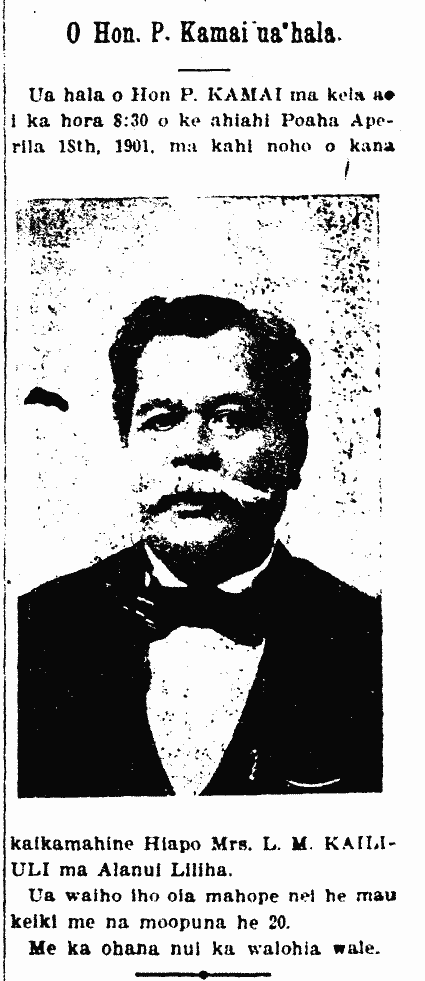
Hon. P. Kamai passes.

The Hon. P. KAMAI passed from this world at 8:30 in the evening of Thursday, April 18th, 1901, at the residence of his First child, a daughter, Mrs. L. M. KAILIULI on Liliha Street.

He leaves behind a number of children and grandchildren numbering 20.

Much sympathy to his whole family.

(Kuokoa, 5/3/1901, p. 2)

O Hon. P. Kamai ua hala.

Ka Nupepa Kuokoa, Buke XXXIX, Helu XVIII, Aoao 2. Mei 3, 1901.

James Kekela retires, 1899.

A HAWAIIAN MISSIONARY.

After fifty years of the Rev. James Kekela and his wife carrying out missionary work, and after forty-six years of them telling the Gospel of Christ [Euanelio o Karisto] in the Marquesas [Makuisa], here they are returning to spend the rest of their days here in their homeland.

They are being accompanied by their children and grandchildren totalling 14. According to the last word heard, they will be carried by a schooner of 50 tons, chartered to return them home. This month they will leave the Marquesas, and in March they will arrive here. According to what the newspaper the Friend published about Kekela and his fellow missionaries:

Their good works which they have done have spread wide. Kekela was honored by Lincoln when he tried to save the life of an American officer [Jonathan Whalon].

Kekela, Kauwealoha, and Hapuku civilized the ignorant of the Marquesas, and their fame has spread to Tahiti and the colonies of France in the South and East Pacific.

Kauwealoha has no children, and will live there until he dies; but for Kekela, he has a big family, and according to his friends, he is bringing back a part of his family to the land of his birth.

[There are many many letters in the Hawaiian-Language Newspapers throughout the years from the Marquesas Islands written by these Hawaiian missionaries: James Kekela, Zachariah Hapuku, and Samuel Kauwealoha.]

(Aloha Aina, 2/18/1899, p. 5)

HE MISIONARI HAWAII.

Ke Aloha Aina, Buke V, Helu 7, Aoao 5. Feberuari 18, 1899.

James Kaulia injured, 1899.

James Kaulia Injured

BY HENRY VIDA AND JACK GIBSON.

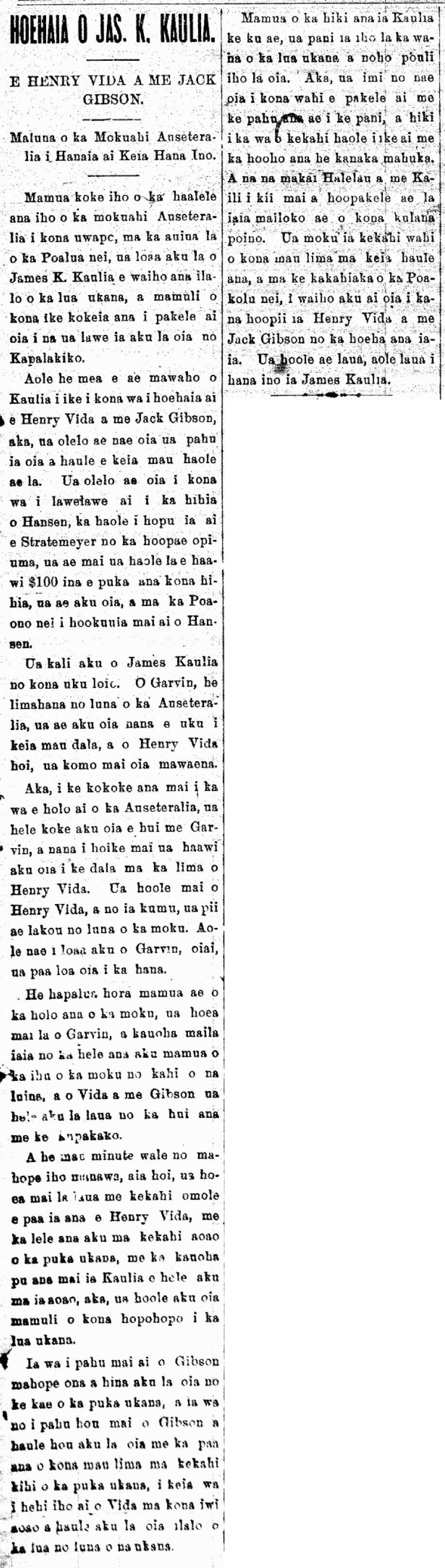
Aboard the Steamer Australia is Where This Evil Act Was Done.

Right before the Steamship Australia [Auseteralia] left its mooring, on the evening of this Tuesday, James K. Kaulia was found left below in the storage hold, and because he was found quickly that he was saved, lest he have been taken to San Francisco.

There was no one else other than Kaulia who witnessed him being hurt by Henry Vida and Jack Gibson, but he stated that he was shoved by these haole men and fell. He says that when he took the case of Hansen, the haole that was arrested by Stratemeyer for importing opium, that haole agreed to pay $100 if his charges were overturned, he [Kaulia] agreed, and this Saturday, Hansen was set free.

James Kaulia waited for his lawyer fees. Garvin, a worker aboard the Australia agreed that he’d pay the money, and Henry Vida stood as an intermediary.

But when it grew near to the time when the Australia was to leave, he went to go see Garvin, who told him that he gave the money in the hands of Henry Vida. Henry Vida denied this, and for this reason they all went aboard the ship. Garvin however was not found, for he was busy working.

Half and hour prior to the ship’s departure, Garvin appeared, and he told him [Kaulia] to go up front to the prow, where the sailors were; and as for Vida and Gibson, they went to meet with the purser.

And just a few minutes after that, the two of them suddenly showed with a jug being held by Henry Vida; and they jumped to one side of the opening of the storage, while telling Kaulia to come over to that side, but he refused because he was hesitant about the storage hold.

That was when Gibson pushed him from behind and he fell on the side of the door to the storage, at which point Gibson shoved him again and he fell once more, his hands grabbing on to a corner of the door; then Vida stomped on his ribs and he fell into the room on top of the baggage.

Before Kaulia was able to stand, the entrance to the storage was shut, and he sat there in the dark. However, he sought a way for him to get out, pounding at the door until he was found by a haole who exclaimed that there was a runaway. And officers Halelau and Kaili came to rescue him from his precarious situation. Some parts of his arms were broken when he fell, and in the morning of this Wednesday, he filed a suit against Henry Vida and Jack Gibson for injuring him. The two of them deny harming James Kaulia.

(Aloha Aina, 2/25/1899, p. 2)

HOEHAIA O JAS. K. KAULIA.

Ke Aloha Aina, Buke V, Helu 8, Aoao 3. Feberuari 25, 1899.

Vital Statistics, 1913.

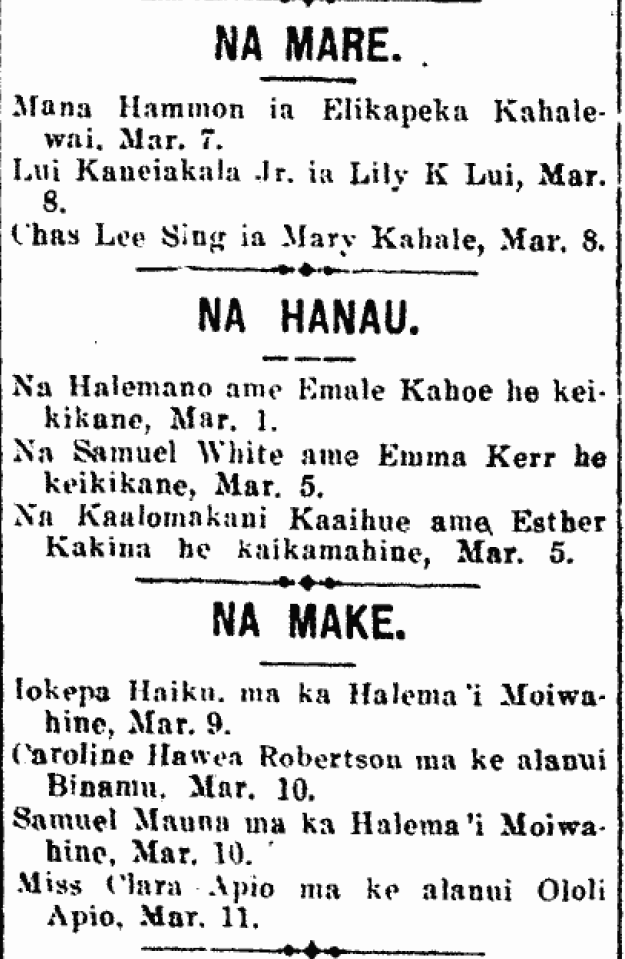
MARRIAGES.

Mana Hammon to Elikapeka Kahalewai, Mar. 7.
Lui Kaneiakala, Jr. to Lily K. Lui, Mar. 8.
Charles Lee Sing to Mary Kahale, Mar. 8.

BIRTHS.

To Halemano and Emale Kahoe, a son, Mar. 1.
To Samuel White and Emma Kerr, a son, Mar. 5.
To Kaalomakani Kaaihue and Esther Kakina, a daughter, Mar. 5.

DEATHS.

Iokepa Haiku, at Queenʻs Hospital, Mar. 9.
Caroline Hawea Robertson, on Bingham Street, Mar. 19.
Samuel Mauna, at Queenʻs Hospital, Mar. 10.
Miss Clara Apio, on Apio Lane, Mar. 11.

(Kuokoa, 3/14/1913, p. 8)

NA MARE. / NA HANAU. / NA MAKE.

Ka Nupepa Kuokoa, Buke LI, Helu 11, Aoao 8. Maraki 14, 1913.

Nice follow up on Louis [Lui] Thompson Keouli.

In response to an earlier post “More Hawaiians playing music afar, 1908,” from March 1, 2012.

https://nupepa-hawaii.com/2012/03/01/more-hawaiians-playing-music-afar-1908/#comment-2266

Keith James says:

I wrote a Wikipedia article on Lu Thompson Keouli (aka as Louis Keouli Thompson), who was my great-grandfather. He graduated from Kamehameha, class of 1900. (http://en.wikipedia.org/wiki/Louis_Keouli_Thompson)

Huge hail on Maui, 1898/1868.

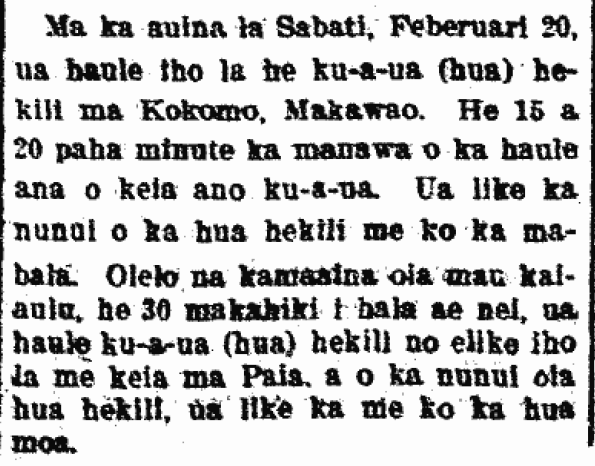
On the afternoon of Sunday, February 20, a hail storm fell at Kokomo, Makawao. This kind of storm went on for about maybe 15 or 20 minutes. The size of the hail [hua hekili] was like marbles. The locals of that area said, 30 years ago, a hail storm like this fell at Paia, and the size of the hail was like that of chicken eggs.

(Kuokoa, 3/4/1898, p. 2)

Ma ka auina la Sabati...

Ka Nupepa Kuokoa, Buke XXXVII, Helu 9, Aoao 2. Maraki 4, 1898.