English and education, 1903.

The Problem Of Language

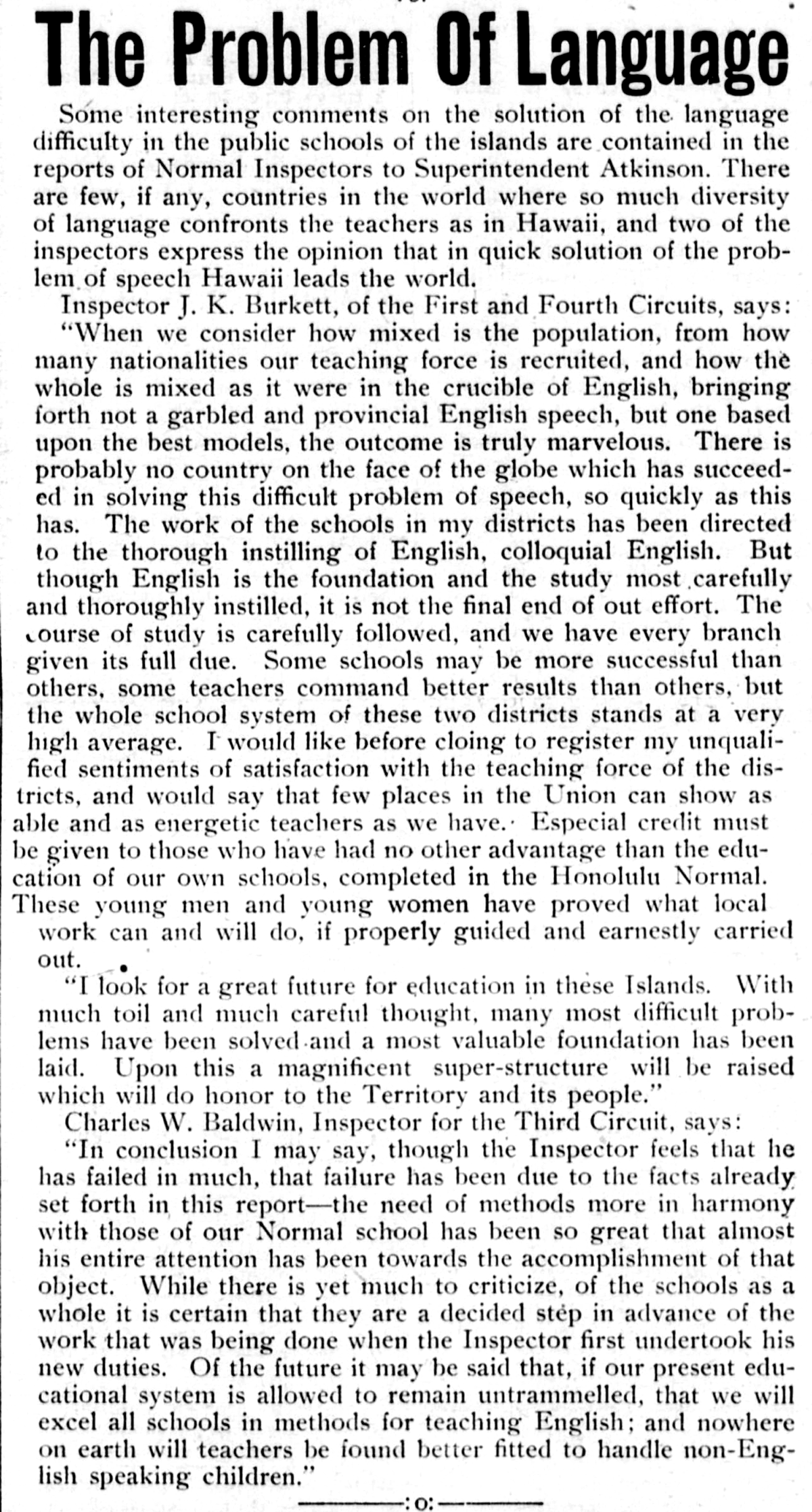
Some interesting comments of the solution of the language difficulty in the public schools of the islands are contained in the reports of Normal Inspectors to Superintendent Atkinson. There are few, if any, countries in the world where so much diversity of language confronts the teachers as in Hawaii, and two of the inspectors express the opinion that in quick solution of the problem of speech Hawaii leads the world.

Inspector J. K. Burkett, of the First and Fourth Circuits, says:

“When we  consider how mixed is the population, from how many nationalities our teaching force is recruited, and how the whole is mixed as it were in the crucible of English, bringing forth not a garbled and provincial English speech, but one based upon  the best models, the outcome is truly marvelous. There is probably no country on the face of the globe which has succeeded in solving this difficult problem of speech, so quickly as this has. The work of the schools in my districts has been directed to the thorough instilling of English, colloquial English. But though English is the foundation and the study most carefully and thoroughly instilled, it is not the final end of our effort. The course of study is carefully followed, and we have every branch given its full due. Some schools may be more successful than others, some teachers command better results than others, but the whole school system of these two districts stands at a very high average. I would like before closing to register my unqualified sentiments of satisfaction with the teaching force of the districts, and would say that few places in the Union can show as able and as energetic teachers as we have. Especial credit must be given to those who have had no other advantage than the education of our own schools, completed in the Honolulu Normal. These young men and young women have proved what local work can and will do, if properly guided and earnestly carried out.

“I look for a great future for education in these Islands. With much toil and much careful thought, many most difficult problems have been solved and a most valuable foundation has been laid. Upon this a magnificent super-structure will be raised which will do honor to the Territory and its people.”

Charles W. Baldwin, Inspector for the Third Circuit says:

“In conclusion I may say, though the Inspector feels that he has failed in much, that failure has been due to the facts already set forth in this report—the need of methods more in harmony with those of our Normal school has been so great that almost his entire attention has been towards the accomplishment of that object. While there is yet much to criticize, of the schools as a whole it is certain that they are a decided step in advance of the work that was being done when the Inspector first undertook his new duties. Of the future it may be said that, if our present educational system is allowed to remain untrammelled, that we will excel all schools in methods for teaching English; and nowhere on earth will teachers be found better fitted to handle non-English speaking children.”

(Hawaiian Star, 3/5/1903, p. 7)
The Problem Of Language

The Hawaiian Star, Volume X, Number 3419, Page 7. March 5, 1903.
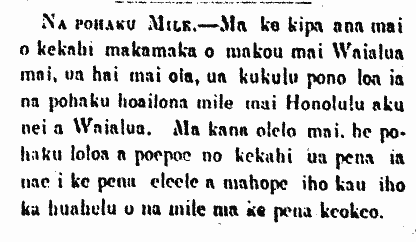
Old school mile markers! 1866.

Mile stones.—When one of our friends from Waialua came visiting, he told us, the stone mile markers from Honolulu to Waialua have been set up. From what he said, they are tall and rounded rocks that have been painted black, and afterwards the numerals of the miles will be painted on in white.

(Kuokoa, 11/24/1866, p. 2)

Na Pohaku Mile.

Ka Nupepa Kuokoa, Buke V, Helu 47, Aoao 2. Novemaba 24, 1866.

Hawaiian language in an English paper, 1884.

$25 REWARD.

FOR the Conviction of the person or persons that entered my premises on the 9th of Jan. 1884, and robbed the house, and destroyed several bags of feed.

———

NO KA HOPU ANA i ka mea a mau mea paha i hele ai ma ku’u aina ma ka la 9 o Ianuari, 1884, a komo iloko o ka hale a hoopoinoia he lehulehu o na Eke Ai (a ka holoholona).

R. GERKE.

Jan. 15th, 1884.

(Daily Bulletin, 2/5/1884, p. 4)

$25 REWARD.

The Daily Bulletin, Volume III, Number 628, Page 4. February 5, 1884.

The death of Prince Albert Kunuiakea, 1903.

PRINCE ALBERT KUNUIAKEA’S BODY BORNE IN STATE TO THE CAPITOL

Kamehameha III.  Prince Albert.  Queen Kalama.

PRINCE ALBERT AS AN INFANT.

From a picture hanging on the walls of the home of the late Prince Albert Kunuiakea. Made about 1853.

The Program of the Ceremonies Today.

In the old throne room of the Capitol Building, where royalty once held sway, the remains of Prince Albert Kunuiakea were laid in state yesterday afternoon. At 6 o’clock to the accompaniment of muffled drums and the solemn tread of soldiery the casket containing the body of the last heir presumptive of the Kamehamehas was brought from his late residence in Palama to the old royal estate where the Prince as a boy had been raised in the family of Kamehameha III. The procession from the residence was headed by a drum corps followed by four companies of the First Regiment of the National Guard of Hawaii. Behind the troops came the hearse bearing the royal casket, flanked by young Hawaiian chiefs bearing large and small feather kahilis. These were novel in the startling array of beautiful colored feathers and in the adaptation of ancient funeral customs. Behind the hearse came the mourners, the chiefs and chiefesses according to rank as recognized among the Hawaiians. When the military filed into the Capitol grounds they divided on each side of the driveway allowing the hearse to pass between serried lines of soldiers standing at present arms. Col. Soper and Capt. Hawes of the Governor’s staff, in full uniform, met the remains at the front entrance of the Capitol.

The casket was carried into the throne room and deposited upon a bier overspread with a beautiful pall of heavy black velvet faced with yellow silk. At the head was a magnificent feather kahili of black and yellow and candelabra authorized by the Roman Catholic church. Four huge kahilis, the tabu marks of the royal presence, designated the sacred enclosure and within this, six chiefs, three on each side of the bier, were placed upon watch, waving small kahilis in unison over the casket. From the old throne of the Kalakauas the crown flag of Hawaii was suspended and over the entrances the Hawaiian colors were draped. A beautiful array of palms upon the dais, together with the picturesque old throne room chairs, formed a pleasing picture. When the beautiful crystal candelabra were illuminated the scene beneath was spectacular.

The main staircase from the hallway was lined with palms. The waving of the kahilis, and the chanting of the genealogy of the Prince were continued through the night and will be a part of the weird ceremony until the casket is borne from the palace.

The committee on decorations was as follows: Mrs. Carrie Robinson, Mrs. Helen Holt, Mrs. Mary Beckley, Mrs. Ena, Mrs. A. P. Taylor, Mrs. Emmeline Magoon, Mrs. Alice Hutchinson, Miss Hilda Burgess, Miss May Low, Harry Davison, J. McGuire.

From 11 a. m. to 1 p. m. today the body will lie in state in the old throne room of the Capitol. From 1 to 1:20 p. m. the Roman Catholic service will be said, Pro Vicar Libert officiating. A detail of the National Guard was assigned as a guard of honor yesterday afternoon and will remain under arms until the procession moves this afternoon.

The order of procession today appears elsewhere in a By Authority notice.

[Might anyone know where this portrait is today?]

(Pacific Commercial Advertiser, 3/15/1903, p. 1)

PRINCE ALBERT KUNUIAKEA'S BODY BORNE IN STATE TO THE CAPITOL

Sunday Advertiser, Volume I, Number 11, Page 1. March 15, 1903.

Henry Wilfred Waiau weds Isabela Kaheapuulani Akiona, 1911.

THOSE HAWAIIAN YOUTHS MARRIED.

Mr. Solomon Hanohano, Editor, Aloha oe: Please allow me some space of the pride of the people, so that everyone from Hawaii, island of Keawe, all the way to the sun-snatching island of Manokalanipo (Kauai), knows of the marriage of Henry Wilfred Waiau of the calm seas of Kona, where you had affection in the days of your youth, distinguished by the passing of the cloud banks and the hinano flowers in the calm, with the type-setting girl of the garden island of Manokalanipo.

After Henry Wilfred Waiau spent a year or more on Kauai, Miss Isabela Kaheapuulani Akiona of the island of Manokalanipo, the island that snatches the shining rays of the sun from the tip of Kumukahi and setting at the base of Lehua, proudly took him (H. W. Waiau) and placed him in the sacred stage of the covenant of matrimony at 8 oʻclock in the evening of last Wednesday, and the two of them were joined by Rev. W. Kamau of the church of Lihue, Kauai.
Continue reading

Hail nearly the size of chicken eggs in Keaukaha, 1920.

There was heavy lighting and thunder in the evening of this past Monday, and hail [hua hekili] fell in some places of Keaukaha. Some of the hailstones that the children of a haole family staying there that evening picked up were almost the size of chicken eggs. Hail broke through the shingles of a house there.

(Hoku o Hawaii, 4/1/1920, p. 2)

Ikaika ka uwila...

Ka Hoku o Hawaii, Buke XIII, Helu 44, Aoao 2. Aperila 1, 1920.

Amazing story about the capes given by Kalaniopuu to Cook, 1908.

The Ahuula Garments of Kalaniopuu!

Given by the Chief to Captain Cook!

It is understood in Hawaii’s ancient history, before Captain Cook [Kapena Kuke] left Hawaii, on the 3rd of February, 1779, King Kalaniopuu gave a gift to Captain Cook some Ahuula and Ahu Mamo and feather mahiole headgear of Hawaii. After the ships of Captain Cook left Hawaii Island shortly after the death of that British Captain, the ships went and landed at Kamchatka, on the eastern shores of Siberia.
Continue reading

Strive for the summit! 1899.

PERTAINING TO THE CASKET OF QUEEN KAPIOLANI.

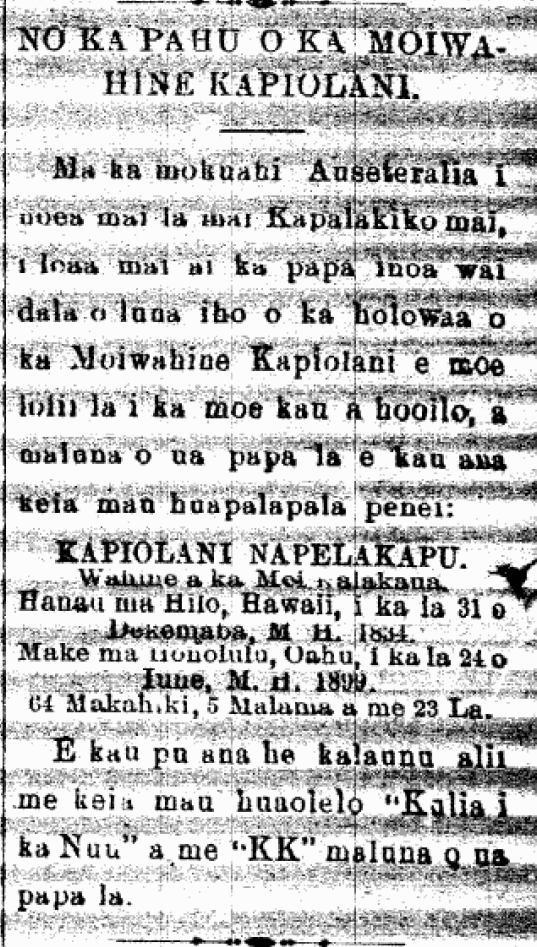
Aboard the Australia which arrived from San Francisco was received the silver [wai dala] name plate for the top of the casket of Queen Kapiolani who sleeps at ease the eternal sleep, and on that plate are these words thus:

KAPIOLANI NAPELAKAPU

Wife of King Kalakaua

Born in Hilo, Hawaii, on the 31st of December, 1834.

Died at Honolulu, Oahu on the 24th of June, 1899.

64 Years, 5 Months, and 23 Days.

Also put on that plate will be the royal crown, the words “Kulia i ka Nuu” and “KK”.

(Aloha Aina, 11/4/1899, p. 4)

NO KA PAHU O KA MOIWAHINE KAPIOLANI.

Ke Aloha Aina, Buke V, Helu 44, Aoao 4. Novemaba 4, 1899.

Martha Hatchie passes on, 1920.

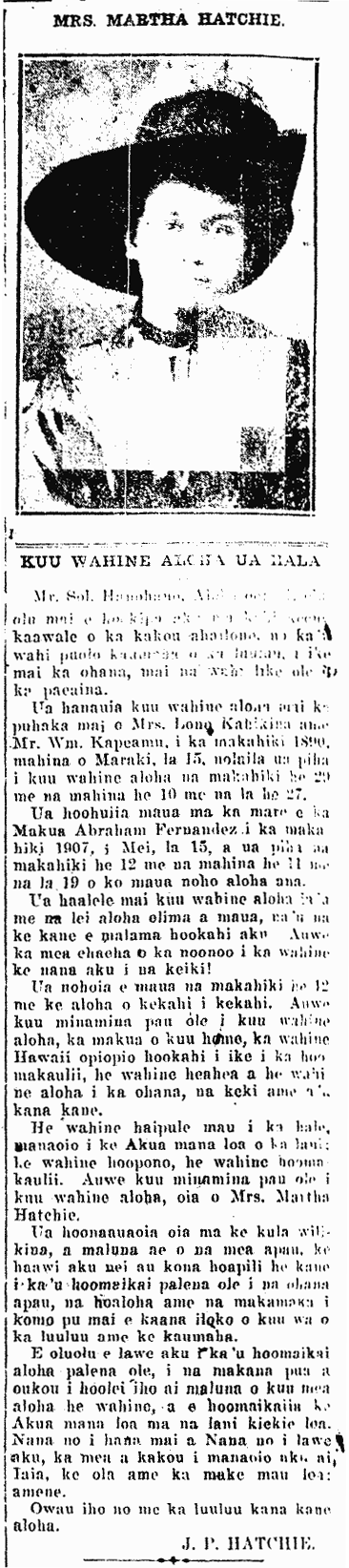
MRS. MARTHA HATCHIE.

MY BELOVED WIFE HAS PASSED ON

Mr. Sol. Hanohano, Aloha oe: please welcome in some empty room in our messenger for this sad parcel that is placed above so that the family sees in all parts of this archipelago.

My beloved wife was born from the loins of Mrs. Lono Kahikina and Mr. William Kapeamu, in the year 1890, in the month of March, on the 15th day, therefore, my wife was 29 years and 10 months and 27 days old.

We were joined in marriage by the Father Abraham Fernandez in the year 1907, on May 15th, and we lived in aloha for 12 full years, 11 months, and 19 days.

My beloved wife left me and our five beloved lei for me, her husband to singly care for. Auwe, how painful to think of my wife when looking at the children!

We lived together for 12 years with love for each other. Auwe, my endless regret for my loving wife, the adult of our home, the one young Hawaiian woman who knew thrift; she was a welcoming woman, and a woman who loved her family, the children, and me, her husband.

My wife was always devout in the home, she had faith in the almighty God of the heavens, she was a respectable woman, and she was thrifty. Auwe, my endless sorrow for my beloved wife, Mrs. Martha Hatchie.

She was educated at the school of the nuns [?? St. Andrew’s Priory]; and above all, I, her companion, her husband, give my boundless thanks to all the family, companions, and friends who came and shared in our time of grief and sadness.

Please take my endless appreciation for the gifts of flowers that you strew upon my beloved, my wife, and blessed be the almighty god in the highest heavens. It is He who giveth and He who taketh away, the one in whom we trust; of Him is eternal life and death; amen.

Me, in sadness, her loving husband.

J. P. HATCHIE.

(Kuokoa, 1/23/1920, p. 2)

MRS. MARTHA HATCHIE.

Ka Nupepa Kuokoa, Buke LVIII, Helu 4, Aoao 2. Ianuari 23, 1920.