Unknown's avatar

About nupepa

Just another place that posts random articles from the Hawaiian Newspapers! It would be awesome if this should become a space where open discussions happen on all topics written about in those papers!! And please note that these are definitely not polished translations, but are just drafts!!! [This blog is not affiliated with any organization and receives no funding. Statements made here should in now way be seen as a reflection on other organizations or people. All errors in interpretation are my own.]

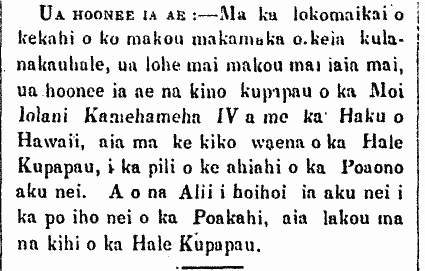
Kamehameha IV and Ka Haku o Hawaii moved, 1865.

[Found under: “HUNAHUNA MEA HOU O HAWAII NEI.”]

Transferred:—Through the kindness of one of our friends in this town, we heard from him/her that the bodies of the King Iolani Kamehameha IV and Ka Haku o Hawaii were moved when evening came last Saturday [11/28/1865]; they are in the center of the Crypt. And the alii who were moved this past Monday [11/30/1865], they are at the corners of the Crypt.

[See more at Nanea Armstrong-Wassel’s instagram page here. And also another article in appearing in the same column of the Kuokoa here.]

(Kuokoa, 11/4/1865, p. 2)

Ua Hoonee ia ae...

Ka Nupepa Kuokoa, Buke IV, Helu 44, Aoao 2. Novemaba 4, 1865.

Alohaalii Campbell baptized, 1894.

BAPTIZED.

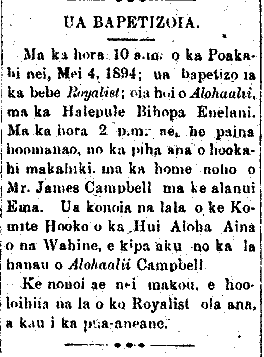
At 10 o’clock in the morning of this past Monday, May 4, 1894, the baby Royalist, that being Alohaalii, was baptized at the Anglican Church. Later at 2 o’clock p. m., there was a party to celebrating the first birthday, at the residence of Mr. James Campbell on Emma Street. All of the members of the Executive Committee [Komite Hooko] of the Women’s Patriotic League [Hui Aloha Aina o na Wahine] were invited to visit for the birthday of Alohaalii Campbell.

We ask that the days of Royalist’s life be long, and that he she live until old age.

[Unfortunately it seems that Royalist Campbell, child of James and Alice Kamokila Campbell Abigail Kuaihelani Maipinepine, lives only a little more than a year more…]

(Oiaio, 5/18/1894, p. 3)

UA BAPETIZOIA.

Nupepa Ka Oiaio, Buke VI, Helu 20, Aoao 3. Mei 18, 1894.

Belina Elizabeth, Sacred Hearts teacher passes on, 1894.

A Catholic Nun Dies.

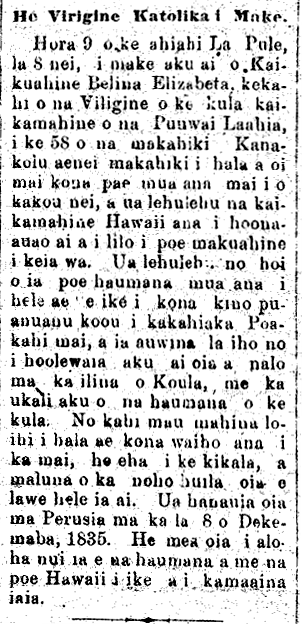
At 9 o’clock in the evening on this past Sunday, the 8th, Sister Belina Elizabeth, one of the Nuns [Viligine] at Sacred Hearts girls’ school, at 58 years old. It was thirty or more years ago that she first landed here amongst us, and there have been numerous Hawaiian girls who were taught by her and who have become mothers today. And many of those early students of hers came to see her cold, clammy [i am sure there is a much better image for “koou”!] remains in the morning of the following Monday, and that evening, her funeral was held, and at the Koula Cemetery she was no more to be seen, accompanied by the students of the school. For many months she was ill with pains in her hip, and she was taken around on a wheelchair [noho huila]. She was born in Persia [Perusia] on the 8th of December, 1835. She was greatly beloved by the students, and by the Hawaiians who knew her and were close to her.

(Makaainana, 4/16/1894, p. 1)

He Virigine Katolika i Make.

Ka Makaainana, Buke I—-Ano Hou, Helu 16, Aoao 1. Aperila 16, 1894.


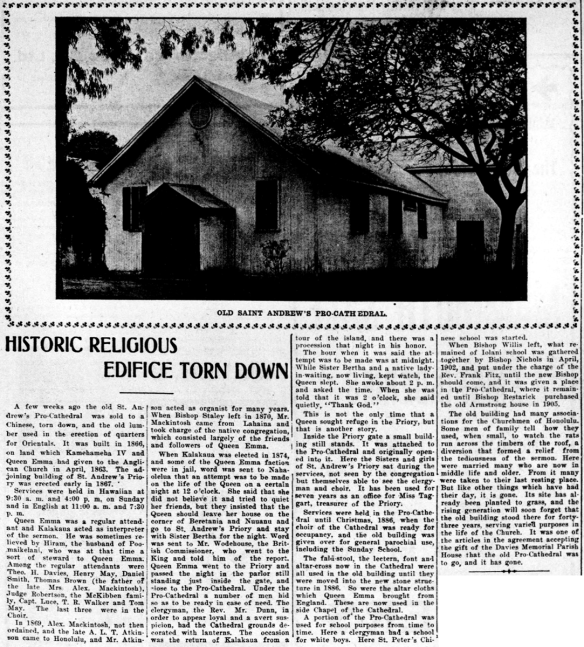
St. Andrew’s, the early days, 1909.

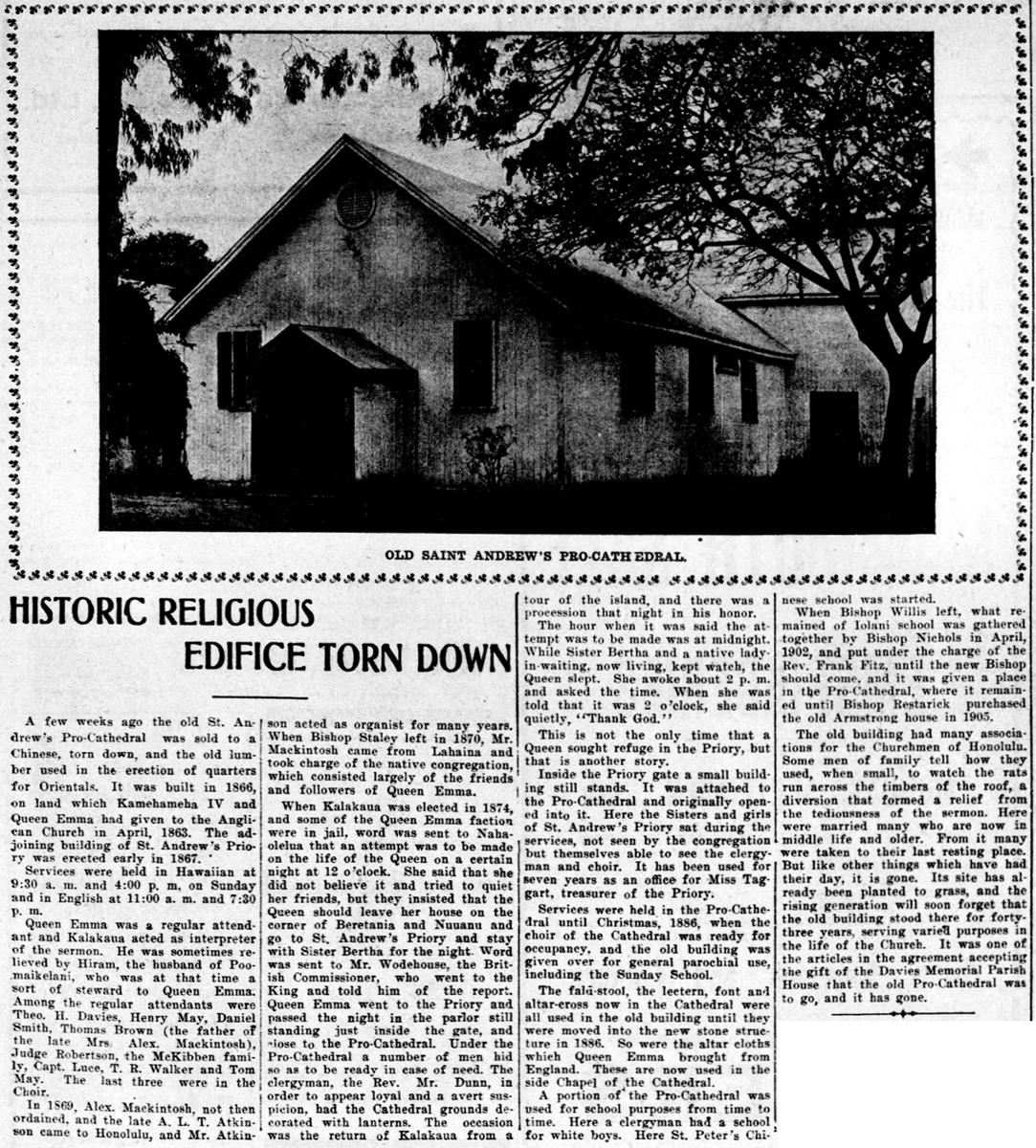
OLD SAINT ANDREW’S PRO-CATHEDRAL.

RELIGIOUS EDIFICE TORN DOWN

A few weeks ago the old St. Andrew’s Pro-Cathedral was sold to a Chinese, torn down, and the old lumber used in the erection of quarters for Orientals. It was built in 1866, on land which Kamehameha IV and Queen Emma had given to the Anglican Church in April 1863. The adjoining building of St. Andrew’s Priory was erected in 1867.

Services were held in Hawaiian at 9:30 a. m. and 4:00 p. m. on Sunday and in English at 11:00 a. m. and 7:30 p. m.

Queen Emma was a regular attendant and Kalakaua acted as interpreter of the sermon. He was sometimes relieved by Hiram, the husband of Poomaikelani, who was at that time a sort of steward to Queen Emma. Among the regular attendants were Theo. H. Davies, Henry May, Daniel Smith, Thomas Brown (the father of the late Mrs. Alex. McKintosh), Judge Robertson, the McKibben family, Capt. Luce, T. R. Walker and Tom May. The last three were in the Choir.

In 1869, Alex. Mackintosh, not then ordained, and the late A. L. T. Atkinson came to Honolulu, and Mr. Atkinson acted as organist for many years. When Bishop Staley left in 1870, Mr. Mackintosh came from Lahaina and took charge of the native congregation, which consisted largely of the friends and followers of Queen Emma.

When Kalakaua was elected in 1874, and some of the Queen Emma faction were in jail, word was sent to Nahaolelua that an attempt was to be made on the life of the Queen on a certain night at 12 o’clock. She said that she did not believe it and tried to quiet her friends, but they insisted that the Queen should leave her house on the corner of Beretania and Nuuanu and go to St. Andrew’s Priory and stay with Sister Bertha for the night. Word was sent to Mr. Wodehouse, the British Commissioner, who went to the King and told him of the report. Queen Emma went to the Priory and passed the night in the parlor still standing just inside the gate, and close to the Pro-Cathedral. Under the Pro-Cathedral a number of men hid so as to be ready in case of need. The clergyman, the Rev. Mr. Dunn, in order to appear loyal and a avert suspicion, had the Cathedral grounds decorated with lanterns. The occasion was the return of Kalakaua from a tour of the island, and there was a procession that night in his honor.

The hour when it was said the attempt was to be made was at midnight. While Sister Bertha and a native lady-in-waiting, now living, kept watch, the Queen slept. She awoke about 2 p. m. and asked the time. When she was told that it was 2 o’clock, she said quietly, “Thank God.”

This is not the only time that a Queen sought refuge in the Priory, but that is another story.

Inside the Priory gate a small building still stands. It was attached to the Pro-Cathedral and originally opened into it. Here the Sisters and girls of St. Andrew’s Priory sat during the services, not seen by the congregation but themselves able to see the clergyman and choir. It has been used for seven years as an office for Miss Taggart, treasurer of the Priory.

Services were held in the Pro-Cathedral until Christmas, 1886, when the choir of the Cathedral was ready for occupancy, and the old building was given over for general parochial use, including the Sunday School.

The fald-stool, the lectern, font and altar-cross now in the Cathedral were all used in the old building until they were moved into the new stone structure in 1886. So were the altar cloths which Queen Emma brought from England. These are now used in the side Chapel of the Cathedral.

A portion of the Pro-Cathedral was used for school purposes from time to time. Here a clergyman had a school for white boys. Here St. Peter’s Chinese school was started.

When Bishop Willis left, what remained of Iolani school was gathered together by Bishop Nichols in April, 1902, and put under the charge of the Rev. Frank Fitz, until the new Bishop should come, and it was given a place in the Pro-Cathedral, where it remained until Bishop Restarick purchased the old Armstrong house in 1905.

The old building had many associations for the Churchmen of Honolulu. Some men of family tell how they used, when small, to watch the rats run across the timbers of the roof, a diversion that formed a relief from the tediousness of the sermon. Here were married many who are now in middle life and older. From it many were taken to their last resting place. But like other things which have had their day, it is gone. Its site has already been planted to grass, and the rising generation will soon forget that the old building stood there for forty-three years, serving varied purposes in the life of the Church. It was one of the articles in the agreement accepting the gift of the Davies Memorial Parish House that the old Pro-Cathedral was to go, and it has gone.

(Pacific Commercial Advertiser, 9/18/1909, p. 3)
HISTORIC RELIGIOUS EDIFICE TORN DOWN

The Pacific Commercial Advertiser, Volume L, Number 8459, Page 3. September 18, 1909.

Our Stories Are Sacred, On Knowing Who We Are 

Owning History is Powerful! Something to think about.

hehiale's avatarKE KAUPU HEHI ALE

A flying peacock at the Nehru Memorial Museum and Library, Delhi, courtesy of the author


Our Stories Are Sacred, On Knowing Who We Are

by Anjoli Roy

     “Of course people ask me about India.” Chhaya Pishi makes a face reserved for stupid people. “Eating with my hands. Arranged marriage. Whatever. This is New York, though, thank God. Not some backward place without Indians.” She passes a long shelf of brittle pasta.
     Chandrani considers that at least her aunt knows what to say when people do ask. She’s usually guessing. Or trying to make things up so she didn’t sound so dumb. And white.
     When Chandrani’s third-grade teacher asked her which tribe she came from, she blurted out Cherokee. Her teacher looked relieved, like she’d finally dug out something sharp from her skin. She told Chandrani what strong people she came from. At dinner that night, when Chandrani told her father…

View original post 1,624 more words

Memorial of the Hawaiian People, 1893.

PETITION

—OF THE—

Hawaiian Natives.

A Committee of 5 members was chosen to take the Petition [Memoriala] of the Hawaiian People which was unanimously passed by the Delegates sent by all of the Districts from all over the Archipelago to the Convention of Delegates, before the Honorable James H. Blount, by the Hawaiian Patriotic League [Hui Hawaii Aloha Aina]; and it was divided thusly, with one member from each Island, like this.

COMMITTEE.

John Richardson     Island of Maui.

S. H. K. Ne     ″ Hawaii.

J. K. Kaiheopulani     ″ Molokai.

Ben Naukana     ″ Oahu.

J. A. Akina     ″ Kauai.

John Richardson was the Chairman [Lunahoomalu] of the Committee. It was exactly at 3 o’clock when it was first announced that the Committee arrived; they were cordially welcomed and the petition of the Lahui was read and it was left with the Honorable James H. Blount. The Commissioner conversed briefly with the Representatives, and at their leave, they expressed their appreciation for their treatment; and that the conversation between the commissioner and the committee was congenial.

Memorial of the Hawaiian People to the American People.

Whereas his Excellency [ka Mea Mahaloia] Grover Cleveland, President of the United States of America, has honored the Hawaiian Nation by sending to us the Hon. James H. Blount as a Special Commissioner [Komisina Wae], to find out the true wishes of the Hawaiian People as to the proposed annexation of their country to their great friend the United States, therefore;

We, the people of the Hawaiian Islands, through the delegates of the branches of the Hawaiian Patriotic League [Hui Hawaii Aloha Aina] of all the districts throughout the kingdom, in convention assembled, take this mode of submitting our appeal and expression of our unanimous wishes to the people of our great and good friend, the Republic of the United States of America, with whom we always entertained the most cordial relations, whom we have learned to look upon as our patrons and most reliable protectors, and whose honor, integrity, and sense of justice and equity we have ever confidently relied for investigation into the grievous wrongs that have been committed against us as a people, against the person of our sovereign, and the independence of our land.

And While we are anxious to promote the closest and most intimate political and commercial relations with the United States, we do not believe that the time has yet come for us to be deprived of our nationality and of our sovereign by annexation to any foreign power.

And Therefore we do hereby earnestly and sincerely pray that the great wrongs committed against us may be righted by the restoration of the independent autonomy and constitutional government of our Kingdom under our beloved Queen Liliuokalani, in whom we have the utmost confidence as a conscientious and popular ruler.¹

SIGNED BY THE REPRESENTATIVES FROM ACROSS THE ARCHIPELAGO

North Hilo—D. Hoakimoa

Central Hilo—K. M. Koahou

Hilo Town—Henry West

Puna—S. T. Piihonua

North Kona ————

″     ″—W. E. N. Kanealii

South Kona—C. G. Naope

North Kohala—S. H. K. Ne

Hamakua—J. H. Halawale

Maui.

Lahaina—R. H. Makekau

Waihee—J. K. Kealoalii

South Wailuku—W. B. Keanu

North Wailuku—Thomas Clark

″     ″—T. B. Lyons

″     ″—D. Kanuha

″     ″—J. Richardson

Makawao—J. Kaluna

″    —J. Kamakele

Honuaula—S. D. Kapono jr.

Hana—S. W. Kaai

Molokai.

Kaunakakai—J. N. Uahinui

Pelekunu—D. Himeni

Wailau—Kekoowai

Ualapue—J. K. Kaiheopulani

Kalaupapa—S. K. Kahalehulu

Halawa—A. P. Kapaehaole

Kainalu—S. K. Piiapoo

Oahu.

District One—F. S. Keiki

″ Two—Charles Keawe

″ Three—J. K. Prendergast

″ Four—E. Johnson

″ Five—S. K. Pua

Ewa—J. K. Kauku

″     —D. W. Keliiokamoku

Waianae—S. W. Kailieha

Waialua—Bejamin Naukana

Waimanalo—J. Kimo

Kauai.

Hanalei—Charles Kahee

Kilauea—George W. Mahikoa

Hanapepe—D. W. Kamaliikane

Waimea—J. A. Akina

Wainiha—S. K. Kaleikini

Waioli—J. Molokai

Joseph Nawahi,

President.

J. K. Kaulia

Secretary.

[See also mention of a picture taken of the committee that took the Memoriala to Blount from an earlier post here.]

¹Taken from p. 504 of the Blount Report.

(Leo o ka Lahui, 5/3/1893, p. 2)

MEMORIALA A KA Lahui Hawaii.

Ka Leo o ka Lahui, Buke II, Helu 697, Aoao 2. Mei 3, 1893.

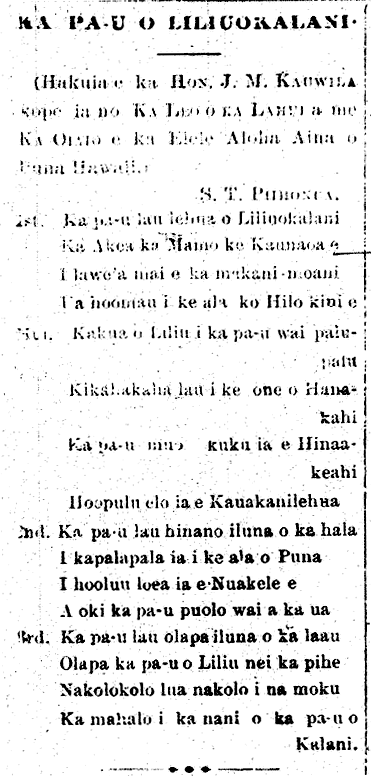
A mele for the pāʻū of the Queen, 1893.

THE PA-U OF LILIUOKALANI

(Composed by the Hon. J. M. Kauwila, and copied for Ka Leo o ka Lahui and Ka Oiaio by the Aloha Aina Representative of Puna, Hawaii.)

S. T. Piihonua.

1st.  Ka pa-u lau lehua o Liliuokalani
Ka Akea [? Akoa] ka Mamo ke Kaunaoa e
I lawe’a mai e ka makani moani
Ua hoomau i ke ala ko Hilo kini e

Hui.  Kakua o Liliu i ka pa-u wai palupalu
Kikahakaha lau i ke one o Hanakahi
Ka pa-u muo kuku ia e Hinaakeahi
Hoopulu elo ia e Kauakanilehua

2nd.  Ka pa-u lau hinano iluna o ka hala
I kapalapala ia e ke ala o Puna
I hoolulu loea ia e Nuakele e
A oki ka pa-u puolo wai a ka ua

3rd.  Ka pa-u lau olapa iluna o ka laau
Olapa ka pa-u o Liliu nei ka pihe
Nakolokolo lua nakolo i na moku
Ka mahalo i ka nani o ka pa-u o Kalani.

(Leo o ka Lahui, 5/8/1893, p. 3)

KA PA-U O LILIUOKALANI

Ka Leo o ka Lahui, Buke II, Helu 700, Aoao 3. Mei 8, 1893.

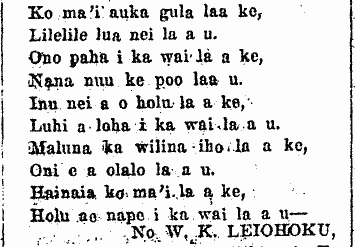
Prince Leleiohoku’s glittering gold bar, 1922.

[Found under: “Makalei, ka Laau Pii Ona a ka I’a o Moaula-Nui-Akea i Kaulana”]

Ko ma’i auka gula laa ke,
Lilelile lua nei la a u.
Ono paha i ka wai la a ke,
Nana nuu ke poo laa u.
Inu nei a e holu la a ke,
Luhi a loha i ka wai la a u.
Maluna ka wilina iho la a ke,
Oni e a olalo la a u.
Hainaia ko ma’i la a ke,
Holu ae nape i ka wai la a u—

No W. K. LEIOHOKU [W. P. LELEIOHOKU]

[Many times mele are used to enhance stories, and there is no telling where you might find a mele, old or new. This procreation chant for William Pitt Leleiohoku for instance is included in this story to add to the mood following a description of the deeds of the “kalohe”.]

(Kuokoa, 2/17/1922, sec. 2, p. 2)

Ko ma'i auka gula laa ke...

Ka Nupepa Kuokoa, Buke LXI, Helu 7, Mahele Elua, Aoao 2. Feberuari 17, 1922.

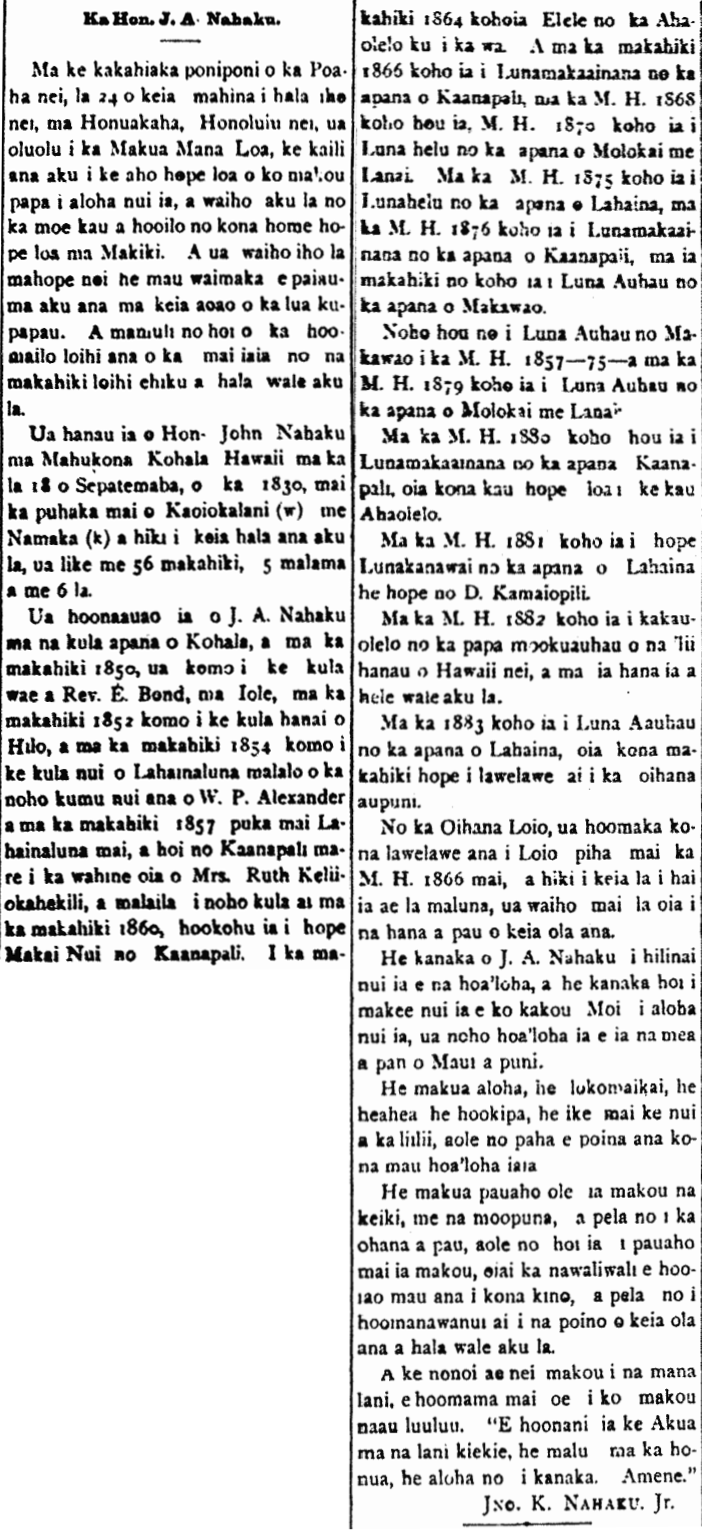
The Hon. J. A. Nahaku passes on, 1887.

The Hon. J. A. Nahaku.

In the deep purple morning of this past Thursday, the 24th of this past month, at Honuakaha, here in Honolulu, the Almighty Father was pleased to take the last breath of our dearly beloved father, and leave him behind to sleep the eternal sleep at his last home in Makiki. And left behind were tears of grief on this side of the grave. And he passed after being troubled with sickness for the long period of seven years.

The Hon. John Nahaku was born at Mahukona, Kohala, Hawaii, on the 18th of September, 1830, from the loins of Kaoiokalani (f) and Namaka (m) and until  his recent passing, he was aged 56 years, 5 months, and 6 days.

J. A. Nahaku was educated at the district school of Kohala, and in the year 1850, he entered into the school of Rev. E. Bond, at Iole, and in 1852, he entered into the Hilo Boarding School, and in 1854, he entered into Lahainaluna College under the tutelage of W. P. Alexander, and in 1857, he graduated from Lahainaluna and returned to Kaanapali where he married his wife, Mrs. Ruth Keliiokahekili, and there he resided and in 1860 he was appointed Sheriff of Kaanapali. In 1864, he was elected as a Delegate to the Constitutional Convention. And in 1866, he was elected as the Representative for the district of Kaanapali, and in 1868, he was reelected, and in 1870 he was appointed as census taker [Luna helu] for the district of Molokai and Lanai. In 1875, he was appointed as Census taker for the district of Lahaina, and in 1876 he was elected as Representative for the district of Kaanapali, and in the same year he was chosen as Tax Assessor for the district of Makawao.

He served again as Tax Assessor for Makawao in 1857—75—and in 1879, he was chosen as Tax Assessor for the districts of Molokai and Lanai.

In 1880, he was reelected as Representative for the district of Kaanapali, and that was his last term in the Legislature.

In 1881, he was selected as assistant Judge [hope Lunakanawai] for the district of Lahaina, as an assistant to D. Kamaiopili.

In 1882, he was chosen as secretary for the Board of Genealogy of Hawaiian Chiefs [Papa Mookuauhau o na Alii Hanau o Hawaii nei], and it while serving at this post that he passed on.

In 1883, he was chosen as Tax Assessor for the district of Lahaina, and this was the last year which he filled a government post.

As a Lawyer, he began serving as a full Attorney in the year 1866, until that day mentioned above, when he left behind all the work of this life.

J. A. Nahaku was a greatly trusted man by his friends, and he was highly prized by our greatly loved King, and he was a friend to everyone all around Maui.

He was a loving father, he was kind, welcoming, he recognized the great and the small, and his friends most likely shall not forget him.

He was a tireless father to us children, and his grandchildren, and so too to all of his family; he never grew weary of us, even if weakness constantly attacked [?? hooiao ?? hoohao] his body, and thus he persevered the hardships of this life until he passed on.

We ask the powers of heaven to lighten our heavy hearts. “Glory to God in the highest, and on earth peace, good will toward men. Amen. [E hoonani ia ke Akua ma na lani kiekie, he malu ma ka honua, he aloha no i kanaka. Amene.]”

John K. Nahaku, Jr.

(Kuokoa, 3/5/1887, p. 3)

Ka Hon. J. A. Nahaku.

Ka Nupepa Kuokoa, Buke XXVI, Helu 10, Aoao 3. Maraki 5, 1887.

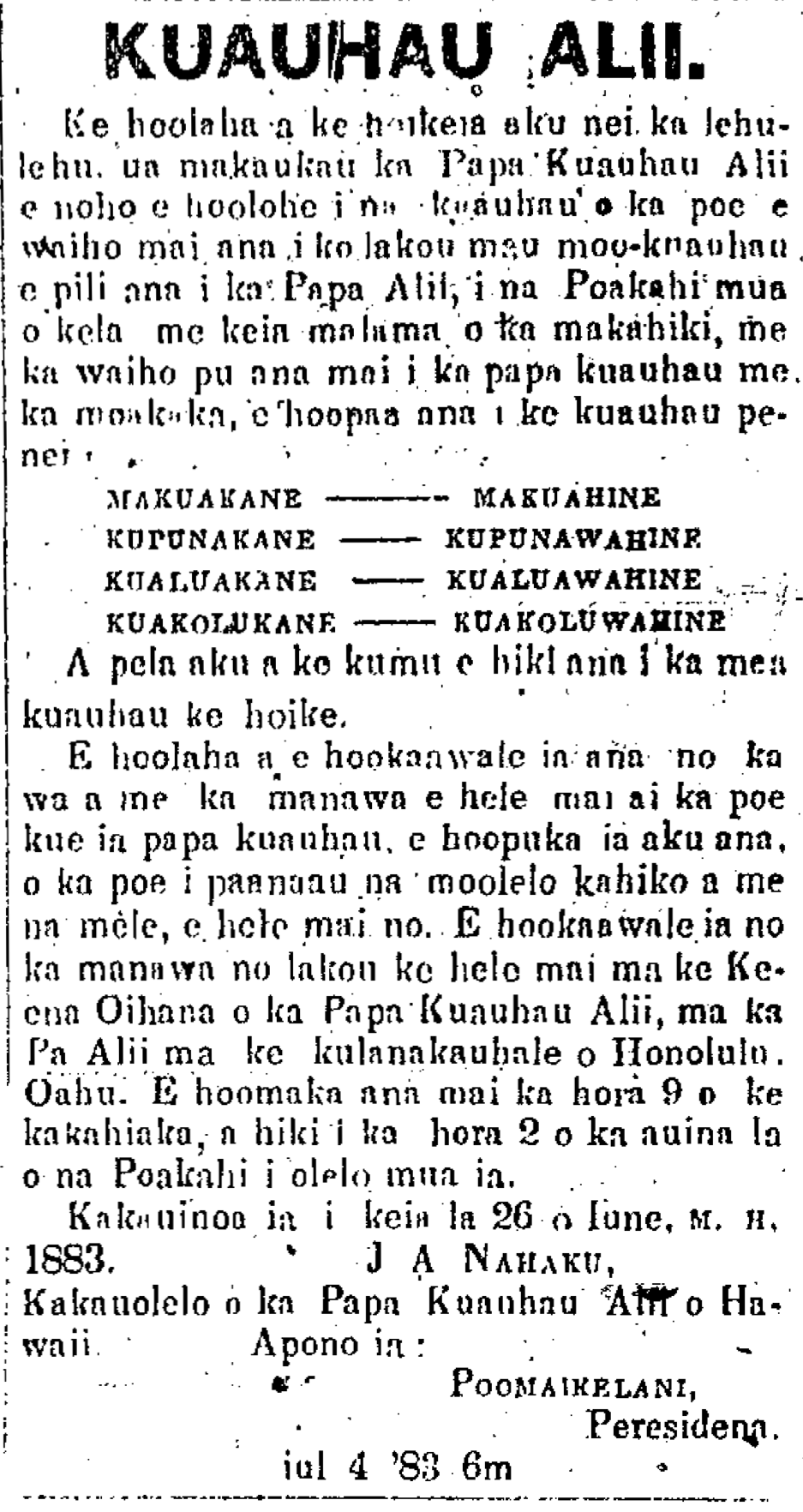
Poomaikelani’s search for alii genealogies, 1883.

ROYAL GENEALOGIES.

It is being advertised and shown to the public that the Board of Genealogy of Hawaiian Chiefs [Papa Kuauhau Alii] is prepared to hear the genealogies of those who put forward their pedigree as related to the Chiefly Class, every first Monday of the months of the year, where they put before us the clear genealogy written down in this fashion:

FATHER [makuakane]——— MOTHER [makuahine]

GRANDFATHER [kupunakane] ——— GRANDMOTHER [kupunawahine]

GREAT GRANDFATHER [kualuakane] ——— GREAT GRANDMOTHER [kualuawahine]

GREAT GREAT GRANDFATHER [kuakolukane]———— GREAT GREAT GRANDMOTHER [kuakoluwahine]

And so forth until the earliest that the genealogist can show.

A notice will be given and time will be set aside for those who object to the genealogies that will be published, for those who know the old stories and mele, you come as well. Time will be set aside for them to come to the Business Office of the Papa Kuauhau Alii, on the Palace Grounds in the town of Honolulu, Oahu. Commencing at 9 o’clock in the morning, until 2 o’clock in the afternoon on the Mondays mentioned previously.

Signed on this day the 26th of June, 1883.  J. A. Nahaku,

Secretary of the Papa Kuauhau Alii.  Approved by:

Poomaikelani,

President.

(Elele Poakolu, 8/1/1883, p. 4)

KUAUHAU ALII.

Ka Elele Poakolu, Buke IV, Helu 31, Aoao 4. Augate 1, 1883.