Unknown's avatar

About nupepa

Just another place that posts random articles from the Hawaiian Newspapers! It would be awesome if this should become a space where open discussions happen on all topics written about in those papers!! And please note that these are definitely not polished translations, but are just drafts!!! [This blog is not affiliated with any organization and receives no funding. Statements made here should in now way be seen as a reflection on other organizations or people. All errors in interpretation are my own.]

St. Louis School, 1880.

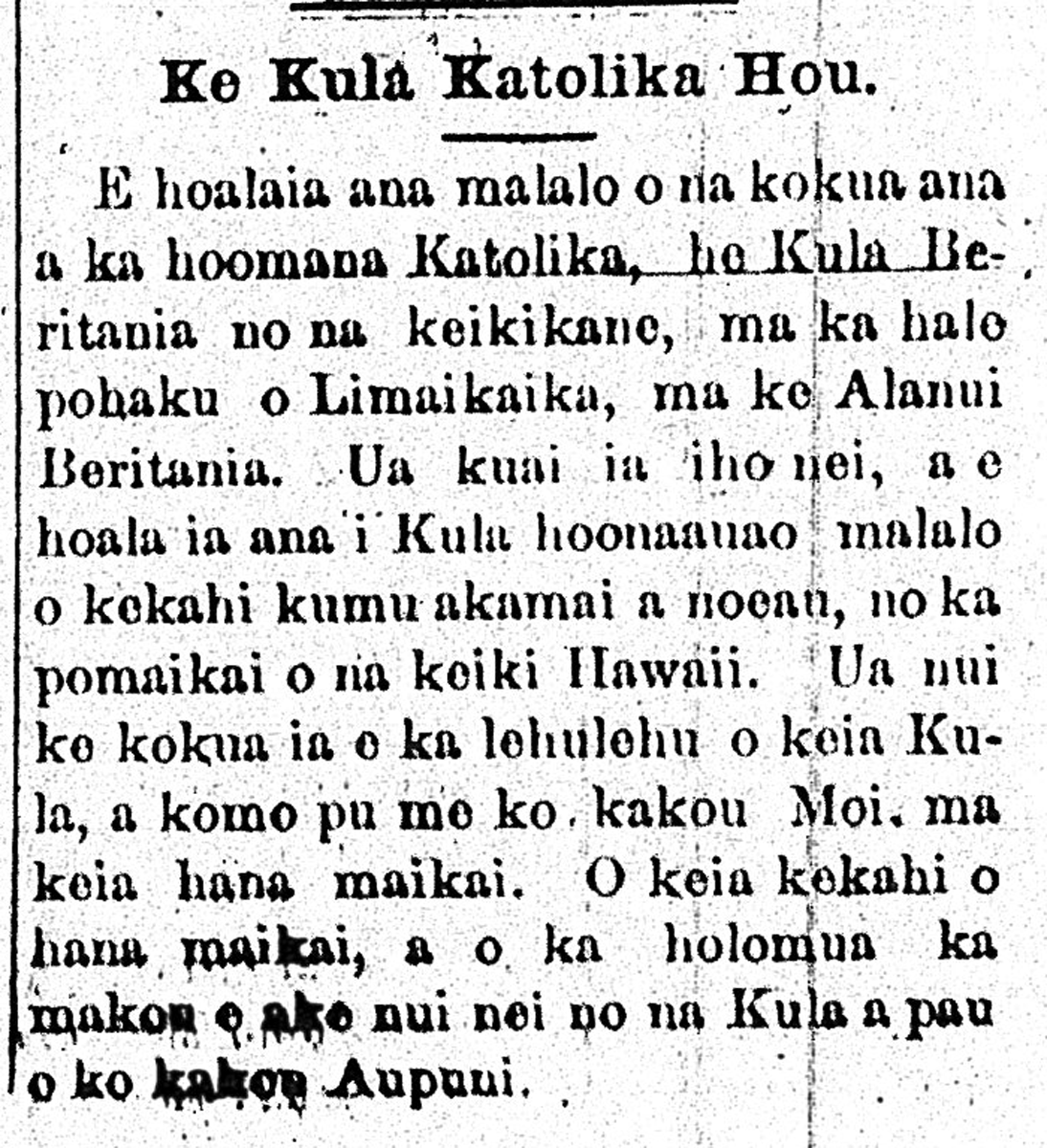
The New Catholic School.

There will be established under the Catholic Faith, an English school for boys, at the stone building of Armstrong [Limaikaika], on Beritania Street. It was recently purchased, and a school of learning will be set up for the benefit of Hawaiian boys. This school is greatly supported by the public, along with our King, at this fine endeavor. This is one of the fine works, and is progress that we greatly desire for all of the Schools of our Nation.

(Elele Poakolu, 9/22/1880, p. 1)

Ke Kula Katolika Hou.

Ka Elele Poakolu, Buke I, Helu 3, Aoao 1. Sepatemaba 22, 1880.

Story of Kamehameha by Walter Murray Gibson, 1880.

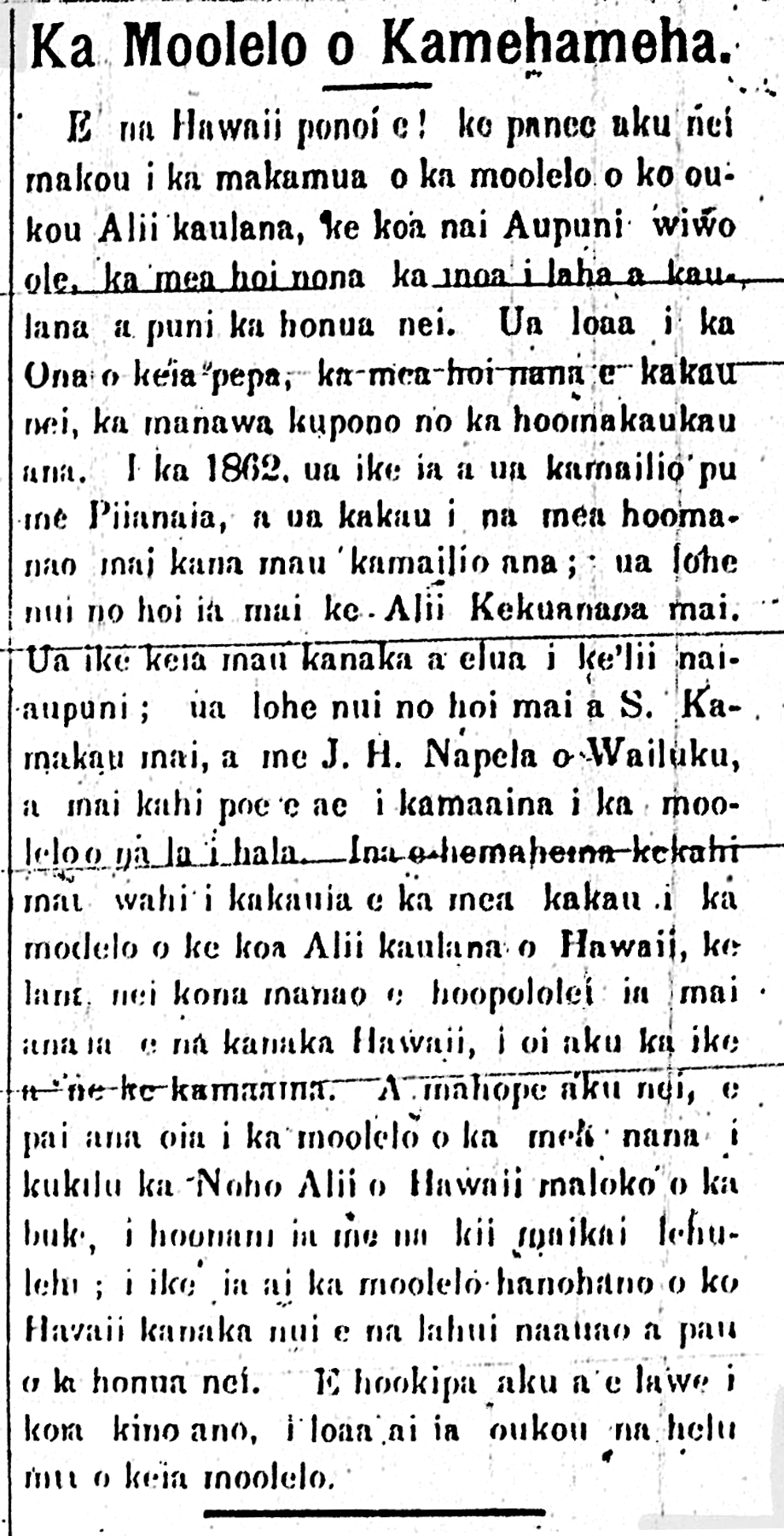
The Story of Kamehameha.

O Hawaii’s own! we are putting forth the beginning of the story of your famous Alii, the fearless conqueror of the Kingdom, the one whose name is spread and is famous all around the world. The Owner of this paper, the one who is writing, has had ample time to prepare. In 1862, Piianaia was met with and spoken with, and his recollections were written down; much was heard from Chief Kekuanaoa. These two men knew the nation conquering chief; much was heard from S Kamakau, and from J. H. Napela of Wailuku, and from some other who were familiar with the stories of those times gone by. Should there be any problems with what is written by the writer of the story of the famous  warrior Chief of Hawaii, he hopes that he will be corrected by Hawaiians who know more and are more familiar. And thereafter he will publish the story of of the one who established the Monarchy of Hawaii as a book, embellished with many fine illustrations so that the proud story of Hawaii’s great man is known by all of the children of the world. Welcome it and subscribe to it at once, so that you get all of the many columns of this story.

[This is an announcement for the story of Kamehameha called, “Kamehameha! Ka Na_i Aupuni!” which runs in the Elele Poakolu from 10/6/1880 to perhaps 11/24/1880 (without a conclusion). Unfortunately, this newspaper is not available online as of this date.]

(Elele Poakolu, 10/6/1880, p. 4)

Ka Moolelo o Kamehameha.

Ka Elele Poakolu, Buke I, Helu 5, Aoao 4. Okatoba 6, 1880.

Mele inoa for Queen Kapiolani, 1881.

A Name Song.

For Queen Kapiolani Napelakapu; from Holoholoku comes this mele for the wife of Aikanaka, the King of Kauai; Hinaaikamala [Hinaaikamalama] was the wife of Aikanaka; which was recorded by S. Hinau. A small portion was copied here below.

Nani kuu hilahila e noho nei-e
Hele wale ka manene a ka lima-e
A ka laulau hoi mai-e
Hohoi maua me kuu nele-e
Me ka hilahila pau pu no-e
Ahi loloko wewela i ka makemake-e
I ka hu-honua a ka waimaka-e
O kuu maka kai ike i ka eha-e
Halanalana no e hanini-e
Kahanu kolopaa oia hanu-e
Ka lapalapa huila o ke kanaka-e
Ka hinu holo ia a ke aloha-e
Nana i kuikui nawali au-e
Nakunaku ka pua hau i ka wai e-e
Napanapa ka lau ke ike ku-e
He ukiuki keia i ka lono-e
Lono wau ua pa kanaka oe-e.

[This can also be seen in the mele “Nani Kuu Maka e Au Wale Nei-e,” found on pages 264–267, of Na Mele Aimoku, Na Mele Kupuna, a me Na Mele Ponoi o ka Moi Kalakaua I. It is credited to Niau. There is also an appended note that the top of this mele has been lost.

It is also unfortunate that this newspaper, Ka Elele Poakolu, is still not available online in any form.]

(Elele Poakolu, 5/11/1881, p. 2)

He Mele Inoa.

Ka Elele Poakolu, Buke II, Helu 10, Aoao 2. Mei 11, 1881.

Hawaiian-Language Newspapers, 1862.

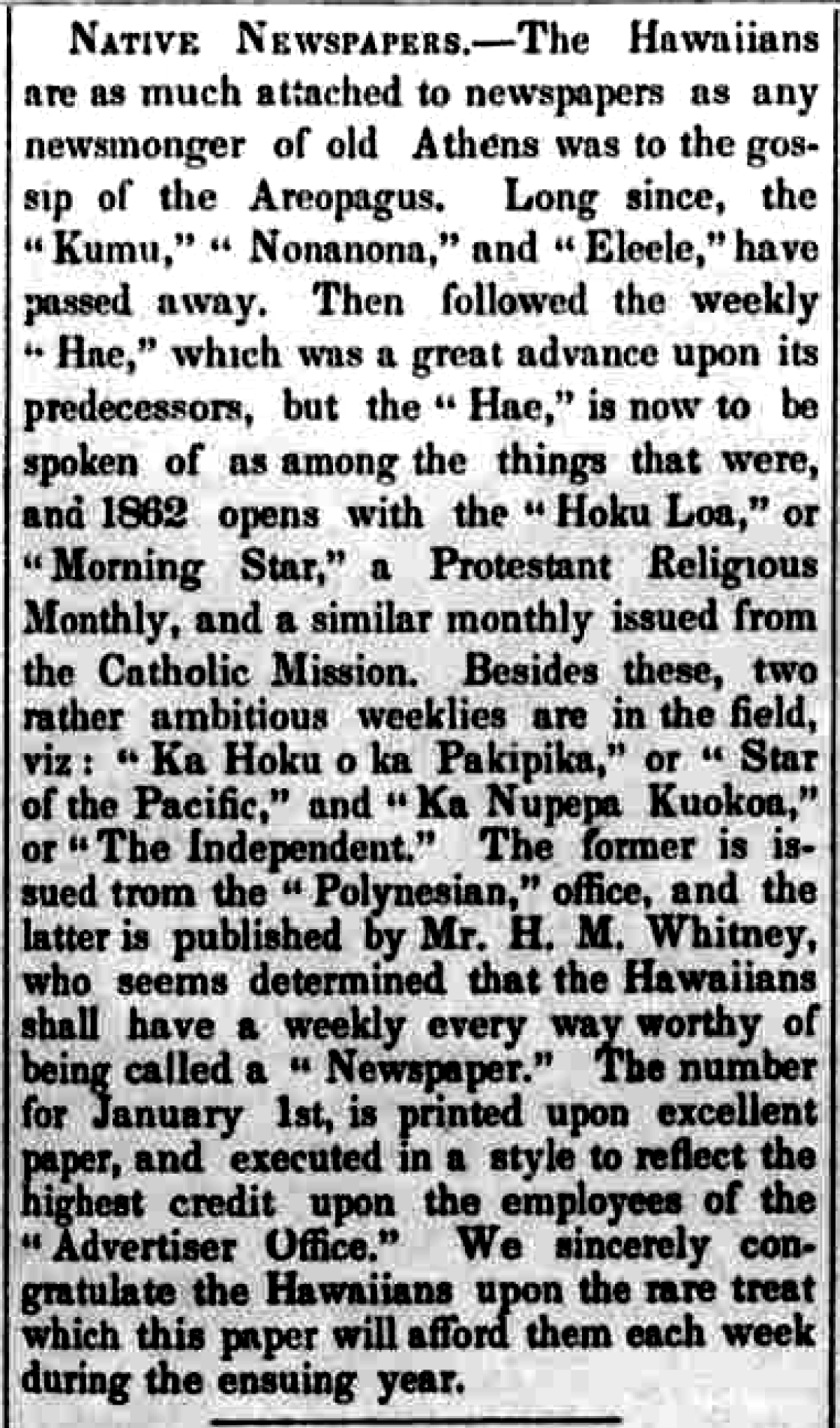
Native Newspapers.—The Hawaiians are as much attached to newspapers as any newsmonger of old Athens was to the gossip of the Areopagus. Long since, the “Kumu,” “Nonanona,” and “Eleele” [Elele], have passed away. Then followed the weekly “Hae,” which was a great advance upon its predecessors, but the “Hae,” is now to be spoken of as among the things that were, and 1862 opens with the “Hoku Loa,” or “Morning Star,” a Protestant Religious Monthly, and a similar monthly issued from the Catholic Mission [“Ka Hae Kiritiano”]. Besides these, two rather ambitious weeklies are in the field, viz: “Ka Hoku o ka Pakipika,” or “Star of the Pacific,” and “Ka Nupepa Kuokoa,” or “The Independent.” The former is issued from the “Polynesian,” office, and the latter is published by Mr. H. M. Whitney, who seems determined that the Hawaiians shall have a weekly every way worthy of being called a “Newspaper.” The number for January 1st, is printed upon excellent paper, and executed in a style to reflect the highest credit upon the employees of the “Advertiser Office.” We sincerely congratulate the Hawaiians upon the rare treat which this paper will afford them each week during the ensuing year.

[I am posting this after coming across it because of a post last week by Nanea Armstrong-Wassel, seen here. It is interesting to note that the Friend was obviously not supporting the Hoku o ka Pakipika…]

(Friend, 1/1/1862, p. 1)

Native Newspapers.

The Friend, New Series, Volume II, Number 1, Page 1. January 1, 1862.

Mother’s Day observed in Hawaii nei, 1914.

MOTHER’S DAY OBSERVED.

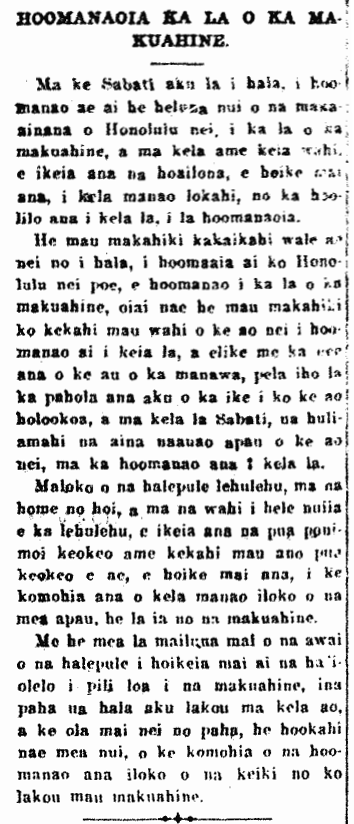
This past Sunday a great number of makaainana of Honolulu nei observed the day for mothers, and everywhere was seen the symbol showing their united mind to make this a day of commemoration.

Just a few years ago, Honolulu’s people became accustomed to celebrating mother’s day, whereas it was for years that some places in the world commemorated this day, and along with the flow of time, it has become known all over the world, and on that Sunday, all the enlightened lands of the world join together in celebrating the day.

Within a great many churches, homes, and places frequented by crowds, white carnations [ponimoi] were seen, along with other white blossoms, showing the joint idea of everyone that this is a day for mothers.

It was as if it was upon pulpits of churches that were given sermons about mothers; and whether they passed on to the next world, or they are still living, there is one important thing, that their children all remember their mothers.

(Kuokoa, 5/15/1914, p. 2)

HOOMANAOIA KA LA O KA MAKUAHINE.

Ka Nupepa Kuokoa, Buke LII, Helu 20, Aoao 2. Mei 15, 1914.

Mother’s Day at Honokaa Union Church, 1942.

[Found under: “Meahou O Na Kohala Ame Hamakua.”]

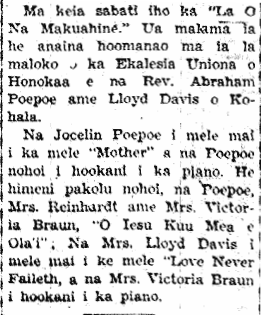
This past Sunday was the “Day of Mothers.” A commemoration was held at the Union Church of Honokaa by the Rev. Abraham Poepoe and Lloyd Davis of Kohala.

Jocelin Poepoe sang the song “Mother” and Poepoe [? Abraham] played the piano. There was a trio with Poepoe, Mrs. Reinhardt and Mrs. Victoria Braun, singing “O Iesu Kuu Mea e Ola’i,” and Mrs. Lloyd Davis sang “Love Never Faileth,” and Mrs. Victoria Braun played the piano.

[This was found in the regular column written by Hattie Linohaupuaokekoolau Saffery Reinhardt on news from North and South Kohala and Hamakua.]

(Hoku o Hawaii, 5/13/1942, p. 1)

Ma keia sabati iho ka "La o Na Makuahine."...

Ka Hoku o Hawaii, Volume XXXVII, Number 3, Aoao 1. Mei 13, 1942.

Let everyday be Mother’s Day, but… 1941.

[Found under: “Na Hunahuna Mea Hou o Maui.”]

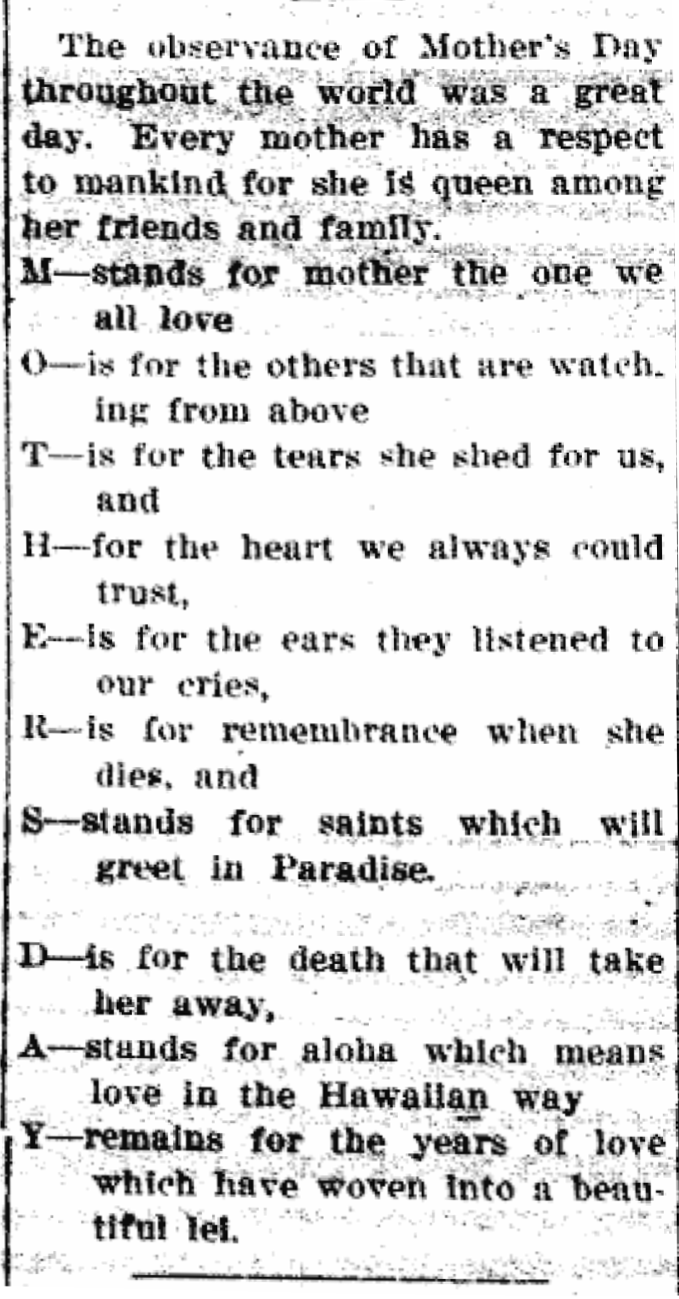
The observance of Mother’s Day throughout the world was a great day. Every mother has a respect to mankind for she is queen among her friends and family.

M—stands for mother the one we all love

O—is for the others that are watching from above

T—is for the tears she shed for us, and

H—for the heart we always could trust,

E—is for the ears they listened to our cries,

R—is for remembrance when she dies, and

S—stands for saints which will greet in Paradise.

D—is for the death that will take her away,

A—stands for aloha which means love in the Hawaiian way

Y—remains for the years of love which have woven into a beautiful lei.

[This appears in Mrs. Banham’s regular column on news items from Maui. Acrostics also appear in Hawaiian-Language Newspapers in the Hawaiian Language from very early on.]

(Hoku o Hawaii, 5/14/1941, p. 1)

The observance of Mother's Day...

Ka Hoku o Hawaii, Volume XXXVI, Number 3, Aoao 1. Mei 14, 1941.

Just because something appears in a newspaper doesn’t necessarily make it true, 1865.

[Found under: “NOTES OF THE WEEK.”]

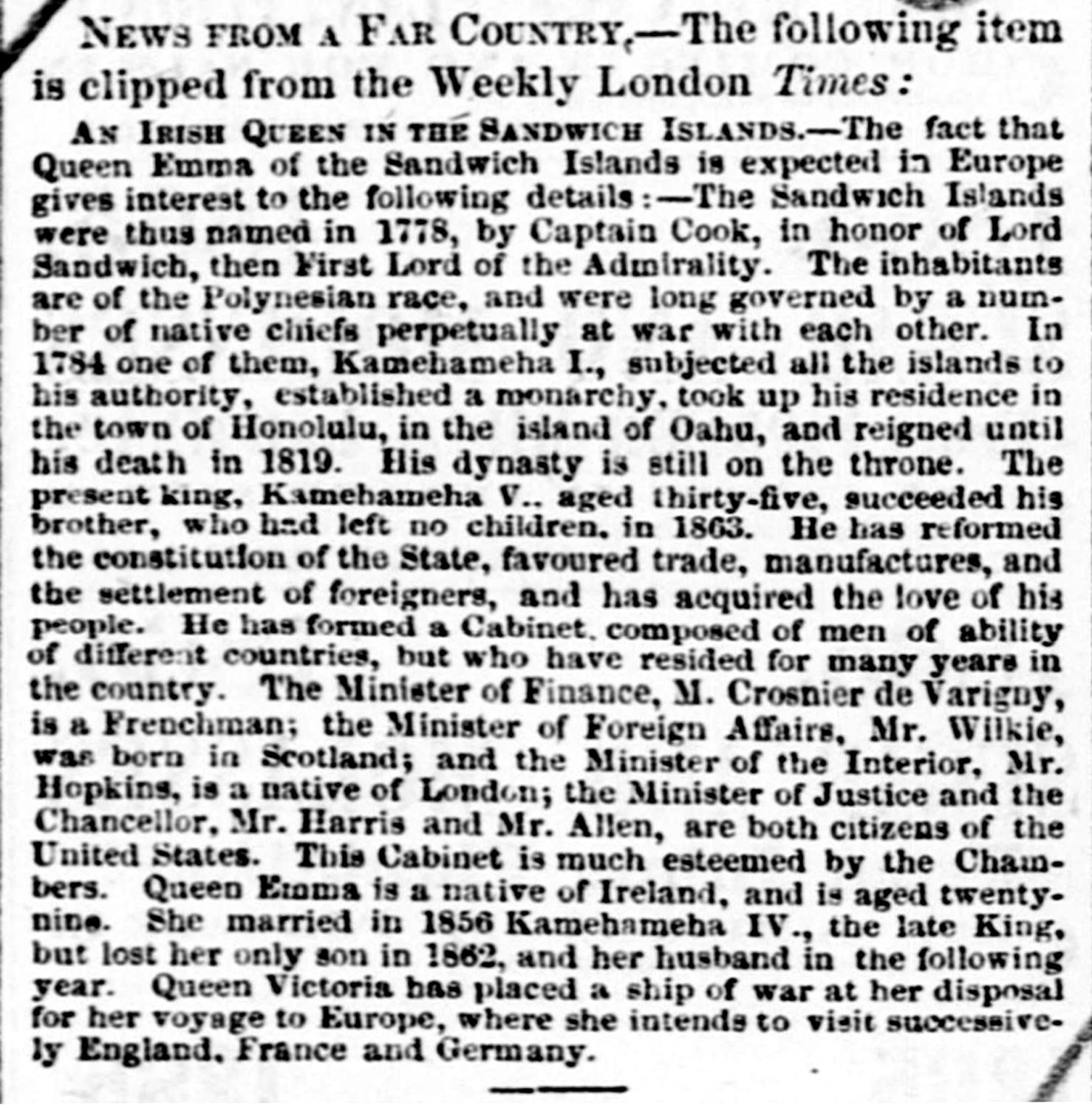
News from a Far Country.—The following item is clipped from the Weekly London Times:

An Irish Queen in the Sandwich Islands.—The fact that Queen Emma of the Sandwich Islands is expected in Europe gives interest to the following details:—The Sandwich Islands were thus named in 1778, by Captain Cook, in honor of Lord Sandwich, then First Lord of the Admirality. The inhabitants are of the Polynesian race, and were long governed by a number of native chiefs perpetually at war with each other. In 1784 one of them, Kamehameha I., subjected all the islands to his authority, established a monarchy, took up his residence in the town of Honolulu, in the island of Oahu, and reigned until his death in 1819. His dynasty is still on the throne. The present King, Kamehameha V., aged thirty-five, succeeded his brother, who had left no children, in 1863. He has reformed the constitution of the State, favoured trade, manufactures, and the settlement of foreigners, and has acquired the love of his people. The Minister of Finance, M. Crosnier de Varigny, is a Frenchman; the Minister of Foreign Affairs, Mr. Wilkie, was born in Scotland; and the Minister of Interior, Mr. Hopkins, is a native of London; the Minister of Justice and the Chancellor, Mr. Harris and Mr. Allen, are both citizens of the United States. This Cabinet is much esteemed by the Chambers. Queen Emma is a native of Ireland, and is aged twenty-nine. She married in 1856 Kamehameha IV., the late King, but lost her only son in 1862, and her husband in the following year. Queen Victoria has placed a ship of war at her disposal for her voyages to Europe, where she intends to visit successively England, France and Germany.

(Pacific Commercial Advertiser, 9/30/1865, p. 2)
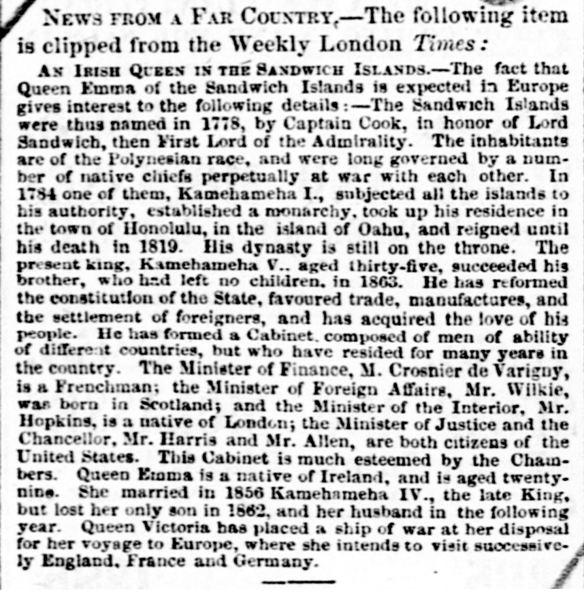
News from a Far Country...

The Pacific Commercial Advertiser, Volume X, Number 13, Page 2. September 30, 1865.

Foreign birds set free by the Honorable Lilia Kamakaeha, 1870.

[Found under: “NU HOU KULOKO: Oahu.”]

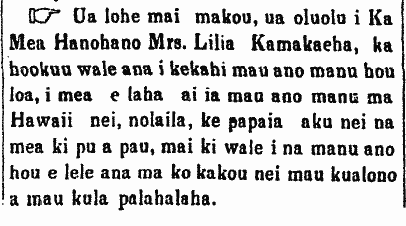
We hear that the Honorable Mrs. Lilia Kamakaeha was pleased at the releasing of some new kinds of birds so that they spread here in Hawaii nei. Therefore, all hunters are prohibited from shooting these new birds flying in our mountainsides and plains.

(Kuokoa, 10/1/1870, p. 2)

Ua lohe mai makou...

Ka Nupepa Kuokoa, Buke IX, Helu 40, Aoao 2. Okatoba 1, 1870.