The Story of Piilani
At the recent meeting of the Kauai Historical Society, Judge C. B. Hofgaard, of Waimea, read the following article on the above subject:
Mrs. Piilani Kaluaikoolau died at Waimea, Kauai, on Sept. 1, 1914, after a lingering sickness and was buried the next day.
Only a few of the kamaainas among the haoles knew that she was with us and none of the younger generation of foreigners knew who she was. Piilani was the wife of Kaluaikoolau, generally called Koolau, the leper. She was with Koolau when he shot L. H. Stolz, Deputy Sheriff of Waimea, she was with him, when he stood off successfully the soldiers of the Hawaiian army, that were sent to catch him dead or alive, and she was with him when he defended his hiding-place in the pali of Kalalau; she stayed with him after the army had left and was with him constantly till his death, dug singlehanded his grave and singlehanded buried him. Her only child sickened and died in her arms while she was living in the wilderness and she and her husband buried the child.
Piilani was born at Kekaha in the year 1864. Her parents were Hoona, a man from Papaikou, Hawaii, and her mother was Kepola, a woman from Kekaha. In her childhood, she lived with her parents at Kekaha and her house was on the Mana side of the church of Kekaha. She grew up a tall, straight girl resembling her father, who is still straight for a man between seventy and eighty. She was a very goodlooking woman in her younger days and had in a great measure the litheness of the young people of her race, and she kept youthful in appearance and actions till a few years before her death. She was sick a great part of the time during the last two years of her life.
She was married to Koolau in 1881, by Father Rowell, and she and her husband always lived happily together. They had only one child, a boy by the name of Kaleimanu, who was born in 1883 and contracted his father’s dreaded disease and died while they were living as a outlaw, in the mountains of Kalalau.
Her husband, Koolau, was born in Kekaha in 1862, his parents were Kaleimanu and Kukui. He went to school with Father Rowell in Waimea from 1868 and when he came out of school he worked first with Francis Gay and later for V. Knudsen. In 1891 and 1892 there was a great activity by the authorities to get all the lepers and send them to the leper settlement at Molokai. In the fall of 1889 and possibly before, we had noticed that my friend Koolau began to show signs of the dreaded disease on his cheeks. I said “my friend” Koolau, and the reason is, that he was often my companion on hunting trips in the Puukapele region. Koolau was a splendid hunter, a fine marksman and an excellent man with the lasso; besides this he was a pleasant companion. He knew all the country west of Waimea canyon and all the haunts of the wild cattle, and when we had Koolau in the party, we were sure to find game. In a couple of years the disease developed quite noticeably, and in 1891 and 1892 when the gathering of the lepers started, he was in a bad state, and Mr. Stolz, the deputy sheriff, told him to go to Doctor Campbell and be examined. He was pronounced a leper and Stolz told him to get ready to go to Molokai. Koolau did not object and asked Stolz to leave him a few days to settle his affairs and Stolz acquiesced, as he had confidence in Koolau’s good faith.
Some of the lepers in the Waimea and Makaweli valleys had armed themselves and showed some resistance to the authorities and others had escaped to Kalalau valley.
The horror of going to Molokai and be separated from his wife and child must have preyed on Koolau’s mind and succumbing to the entreaties not to leave his wife, Koolau consented to break his word with Stolz and run away to the valley of Kalalau, where the several lepers were living in the hope that the authorities would leave them there alone, like what had been done on the island of Niihau, where they had a small colony of lepers at Kawaihoa on the western end of the island, which colony had been left alone for a number of years.
One dark night Piilani, her husband Koolau, their son Kaleimanu, Piilani’s mother Kepola and her sister Kinoulu’s daughter, Ida, started from Kekaha over the mountain to Kalalau. Kua Papiohuli went along to take back all the horses. I think no other man would have undertaken to go across the Kilohana of Kalalau in the middle of a dark night but Koolau. I found it a difficult place to find your way in in the day-time, as the place is practically flat and there were cattle-trails in all directions. The party struck the top of Kalalau valley just before daylight. They had some breakfast and Kua Papiohuli started back to Waimea with the horses. It was a cold damp day. Piilani and the others started down the trail, Koolau carrying the child in a sling that he made from his shirt. To go up or down the old trail from Kilohana into Kalalau was a task of endurance for any mountain-climber and it speaks well for the endurance of Piilani and her mother to get down to the bottom unassisted. The old trail is impassible now. In Kalalau Koolau and family first stayed with some friends and he worked in their taro-patches as payment for the food he got for himself and his family.
Shortly after coming to Kalalau, Piilani’s boy, Kaleimanu began to show signs of leprosy.
They stayed quietly in Kalalau till one day in 1883, when Piilani was startled by meeting Louis Stolz followed by Penikila, one of the police constables of Waimea. They had come down the pali to where Koolau and family lived at Nohoeiki’s house in Kalalau. She greeted them and had a long talk with them. After a while Stolz asked her where her husband was and she told them that Koolau had gone to work in the taro-patch. He then asked at what time she expected him back, to which Piilani answered that sometimes Koolau come home at noon and sometimes in the evening. Stolz told her that he was going makai and that he wanted to see Koolau and requested her to tell Koolau to come makai and see him.
Piilani had sad forebodings and began to cry and her son Kaleimanu asked her, why she cried. She lifted up the child and covered its face with kisses and could not answer the child’s question in regard to the reason for her weeping. Just then Koolau came and saw her crying with the child in her arms. He thought something had happened to the child. She said nothing had happened to the child, but threw her arms around Koolau’s neck and told him about Stolz’s visit, and Koolau tried to comfort her.
On the second day after her meeting with Mr. Stolz, the word was passed around that all the lepers were ordered by him to come makai and all the lepers and their friends went there, and they all agreed to go to the leper settlement, except Koolau, who stood up before Mr. Stolz and said: “I ask you, if you agree to let my wife go with me. I will not leave her, as we are as one, and I shall not leave her, till death does us part.”
Mr. Stolz said: “No, your wife cannot go with you, only the lepers shall go and nobody else.”
Koolau said: “Then I refuse to go to that strange place and leave the wife that I have vowed to stay with. My wife and I have sworn to be as one, when we married. I will not go alone.
Koolau was angry and deadly honest and maintained that the government had no right to separate a man from his wife and put him in a place like a prison.
Two days later, Mr. Stolz and party returned to Waimea, and all the lepers with exception of Koolau prepared to go to the leper settlement. Koolau and Piilani returned mauka and they had often visitors, and Koolau told them all to get ready, but for himself, he had decided to stay with his wife and child
(Concluded in next issue.)
[This account as told by C. B. Hofgaard continues in the 12/26/1916 issue and concludes in the 1/2/1917 issue.]
(Garden Island, 12/19/1916, p. 6)
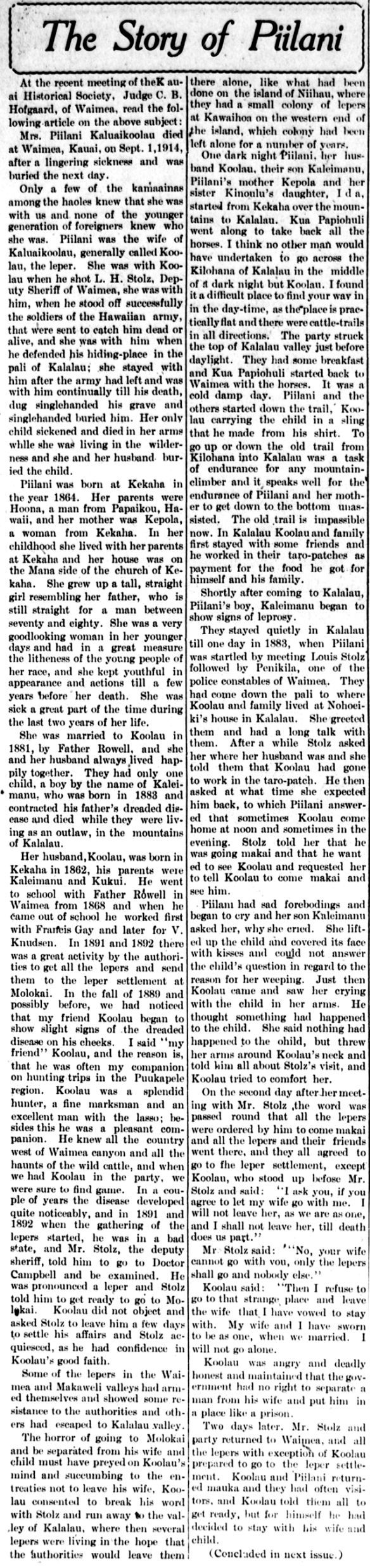
The Garden Island, Volume 12, Number 51, Page 6. December 19, 1916.