Unknown's avatar

About nupepa

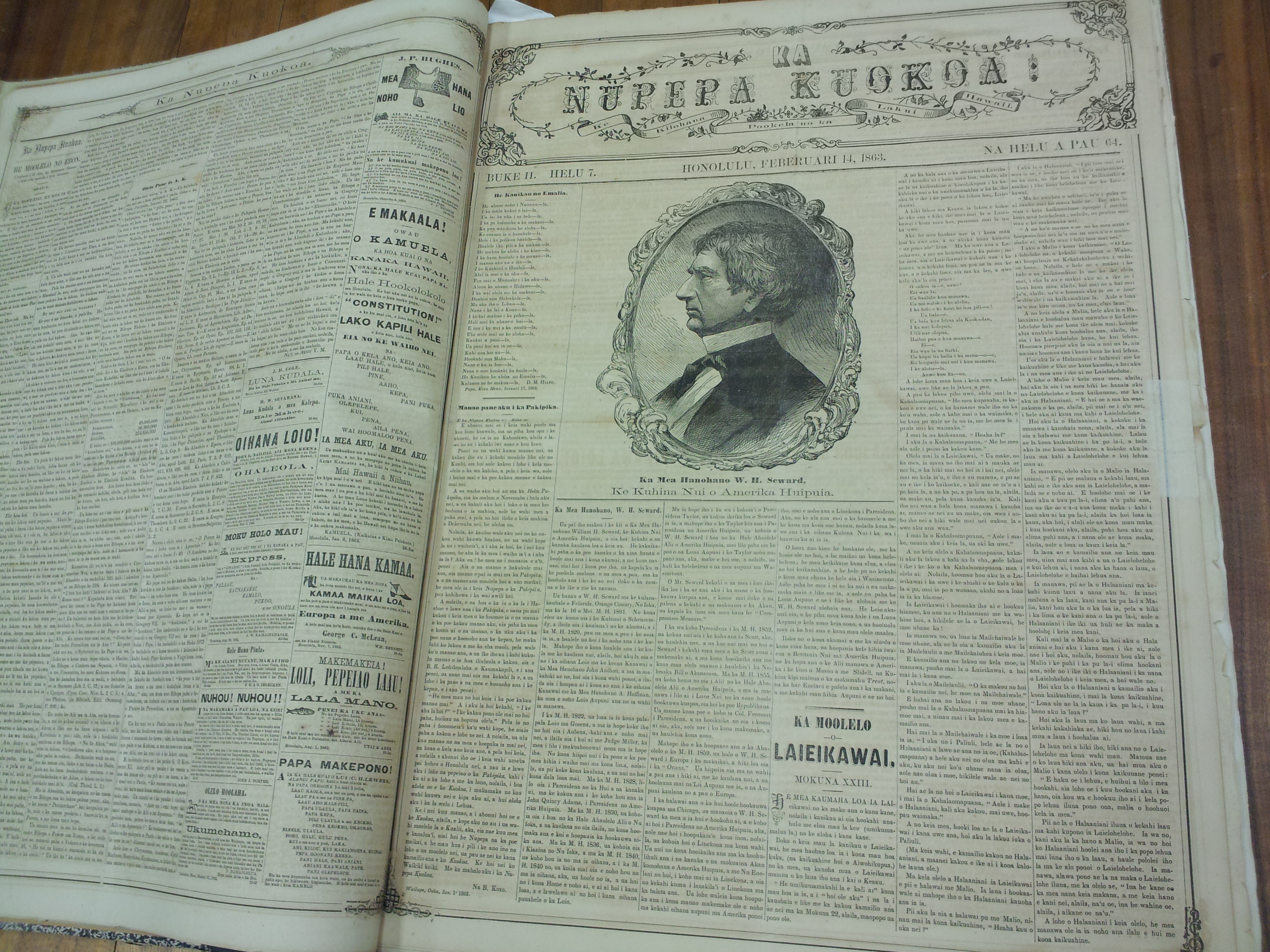
Just another place that posts random articles from the Hawaiian Newspapers! It would be awesome if this should become a space where open discussions happen on all topics written about in those papers!! And please note that these are definitely not polished translations, but are just drafts!!! [This blog is not affiliated with any organization and receives no funding. Statements made here should in now way be seen as a reflection on other organizations or people. All errors in interpretation are my own.]

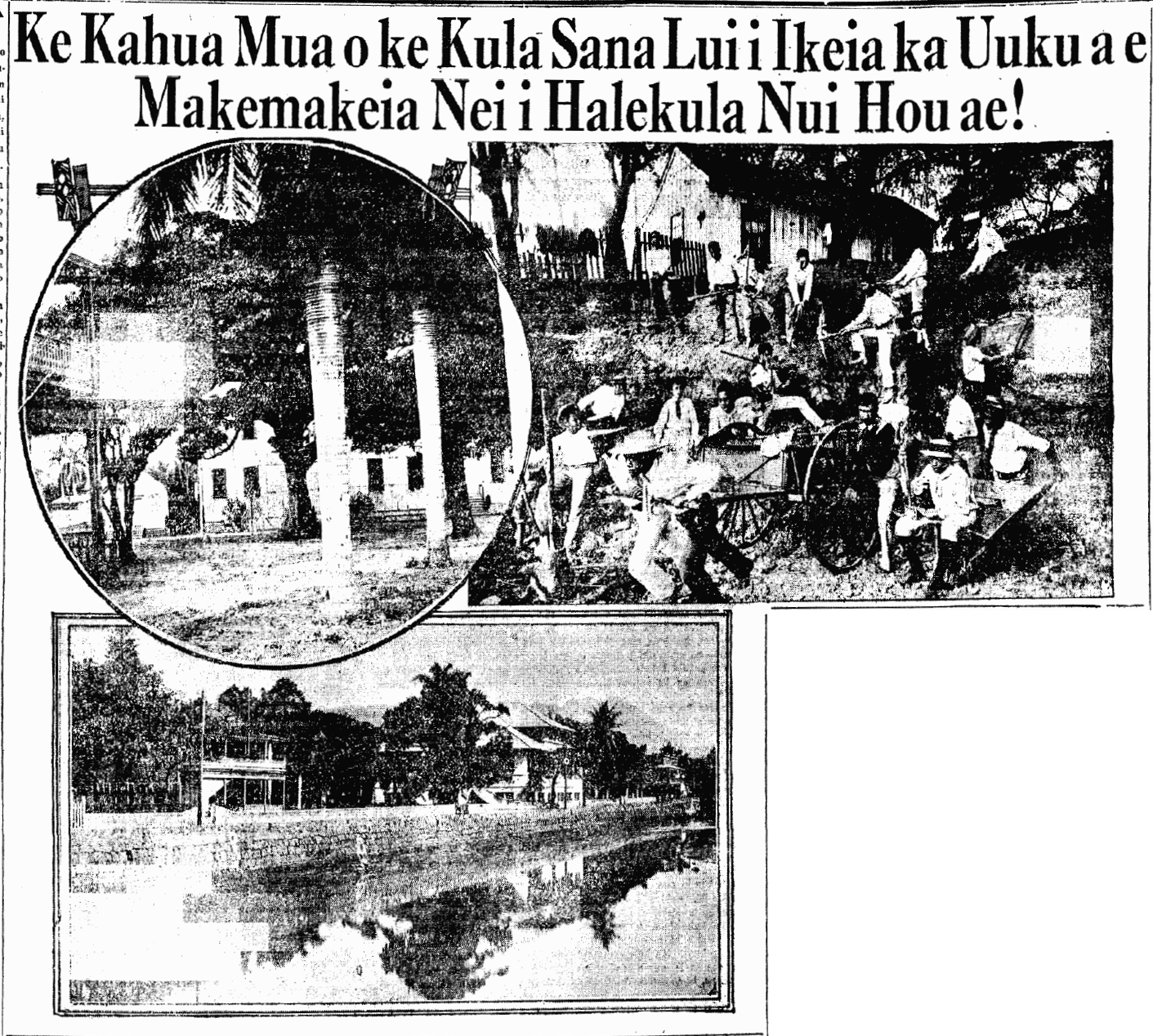
The new and improved St. Louis College, 1881.

THE COLLEGE
OF SAINT LOUIS
—and the—
COMMERCIAL AND BUSINESS ACADEMY
HONOLULU, OAHU, H. I.

This institution being remote from city allurements, is an acknowledged safeguard for morals—for salubrity of climate, is unrivalled. The buildings are large and commodious, while the grounds afford the pupils opportunities for healthful exercises.

Unremitting attention will be given to the intellectual and moral culture of the pupils. Non-Catholic pupils will be free to attend the religious exercises or not, according as their parents or guardians may desire.

Pupils are received at any time during the year. No reduction will be made from regular charges, except for absence caused by protracted illness.

No leave of absence during the scholastic year, except at the College vacations or by special permission.

Each pupil must on entering obtain one suit of uniform, which with all other necessary clothing, &c., &c., will be furnished at moderate cost by the College; but none of these will be provided by the College unless by special arrangement.

Payments are to be made quarterly, and invariably in advance.

The course of study is Classical, Scientific and Commercial; Latin, Greek, French, Spanish, German and Italian are taught.

Particular attention will be paid to the English Language in all its branches. Literature, Pure and Mixed Mathematics, History, Geography, Chemistry and Natural Philosophy, &c.

TERMS:

For Board, Lodging, Tuition and Washing, per Scholastic Year…$200.00

Entrance fee…10.00

Vacation at College…40.00

Music, vocal and instrumental, Drawing and Modern Languages—extras.

DAY PUPILS—Senior Class…$60.00

Junior Class…40.00

The Scholastic Year consists of two Sessions, each comprising a period of five months. The first session commences on the 20th of August; the second on the 20th of January.

For all further particulars, apply to

REV. W. J. LARKIN, President.

No. 73 Beretania St.

Evening School Department of St. Louis College.

The President has decided to include this branch in the curriculum of the College.

Its object is to afford all classes of the community the means of acquiring a theoretical and practical knowledge of all commercial and business transactions in daily use; and also to give an insight into the workings and applications of the different Trades, which it is so essential to do in these Islands.

The Theoretical Branch will be under the supervision of the President and Professors of the College. The Practical and most important Branch will be specially attended to by volunteers from the various master artizans among us, who have kindly and generously promised their services to this useful and valuable enterprise.

They will, alternately, devote half and hour each evening to the task of imparting knowledge to the students. All the implements necessary to each trade, and to Agriculture, will be furnished by the College.

Each master-artizan, while connected with the College, will be entitled to name one Free-Life-Scholarship to the privileges of this Evening School Department.

TERMS—Each student per week, 50 cts. The Evening School will open at 7 o’clock p. m.

(Elele Poakolu, 2/2/1881, p. 5)

KE KULA NUI O SANA LUI

Ka Elele Poakolu, Buke I, Helu 22, Aoao 5. Feberuari 2, 1881.

[This is an advertisement for the recently moved Saint Louis College, back in 1881. The English is taken from the English advertisement appearing on page 5 of the Hawaiian Gazette, 2/9/1881.

This Hawaiian ad appears in the newspaper Ka Elele Poakolu, which for some reason is not available online as of yet, even if it has been available on microfilm for years…]

Replanting of native plants, 1901!

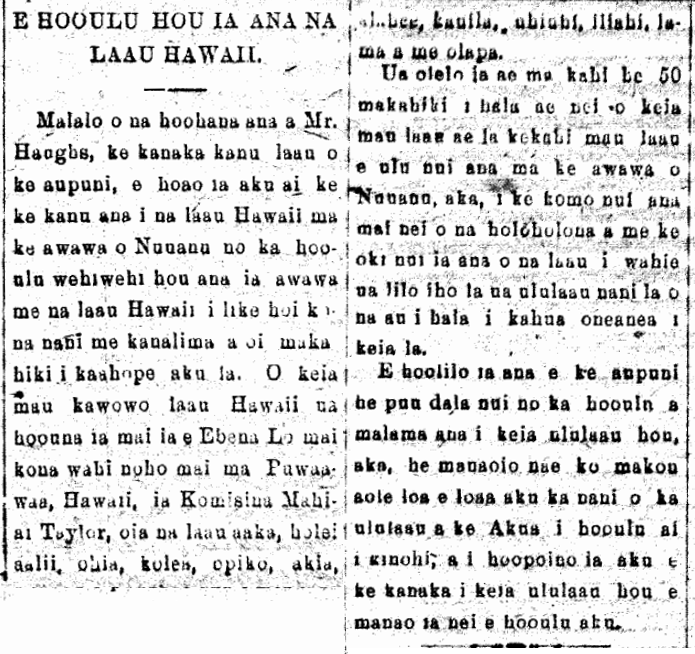
HAWAIIAN PLANTS WILL BE GROWN AGAIN.

Under the direction of Mr. Haughs, the nurseryman of the government, the planting of Hawaiian plants in the valley of Nuuanu will be attempted, to make that valley verdant once again with native plants, so that it will be just as beautiful as it was fifty or more years ago. These seedlings were sent by Ebena Lo [Eben Low] from his residence at Puuwaawaa, Hawaii, to Commissioner Taylor, those being aaka, holei, aalii, ohia, kolea, opiko, akia, alahee, kauila, uhiuhi, iliahi, lama, and olapa.

It is said that it has been about 50 years that these plants were growing in abundance in Nuuanu Valley, for with the influx of animals and the mass cutting of trees for firewood, the beautiful forest of times gone by became a barren field.

The government will spend a sum of money to grow and foster this new forest, however, we believe that there is no way that the beauty of the forest which God grew originally and which was damaged by man will be attained by this new forest which is intended to be grown.

(Aloha Aina, 12/7/1901, p. 4)

E HOOULU HOU IA ANA NA LAAU HAWAII.

Ke Aloha Aina, Buke VII, Helu 49, Aoao 4. Dekemaba 7, 1901.

Harper’s New Monthly Magazine and Kekuanaoa, 1871.

Here is the short piece described in the last post:

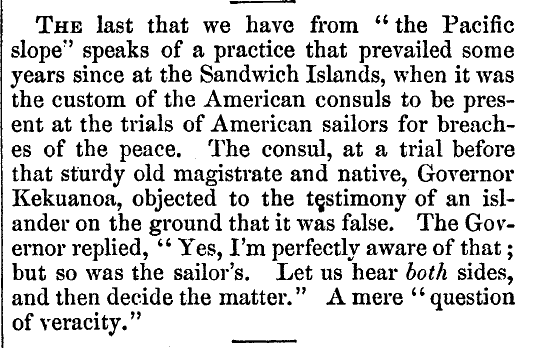
The last that we have from “the Pacific slope” speaks of a practice that prevailed some years since at the Sandwich Islands, when it was the custom of the American consuls to be present at the trials of American sailors for breaches of the peace. The consul, at a trial before the sturdy old magistrate and native Governor Kekuanoa [Kekuanaoa], objected to the testimony of an islander on the grounds that it was false. The Governor replied, “Yes, I’m perfectly aware of that; but so was the sailor’s. Let us hear both sides, and then decide the matter.” A mere “question of veracity.”

(Harper’s New Monthly, 4/1871, p. 797)

The last that we have from...

Harper’s New Monthly Magazine, Volume 42, Issue 251, Page 797. April 1871.

In praise of Mataio Kekuanaoa, 1871.

The different Father of Chiefs.

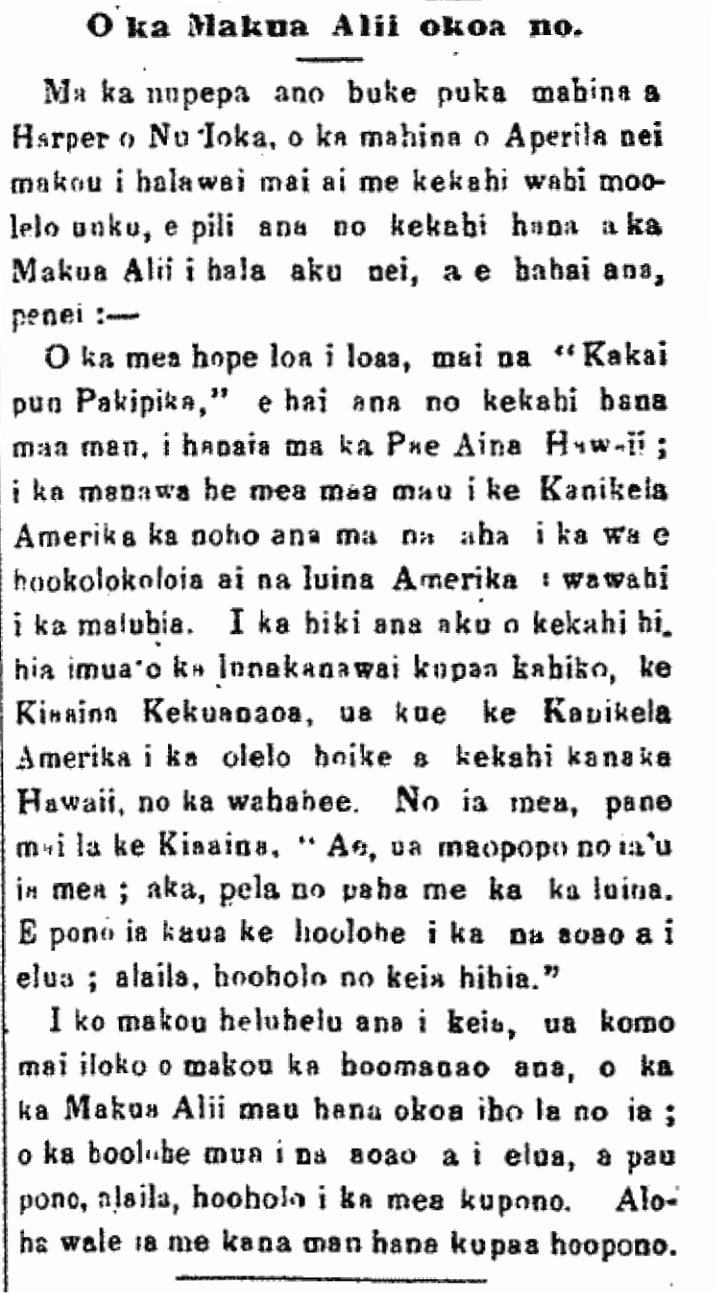
In the monthly magazine, Harper’s of New York, we came across in the April edition, a short story about something done by the Alii Father [Makua Alii] who has passed, and it reports:—

The latest received from the “Pacific String of Hills” speaks of a regular practice carried out in the Hawaiian Islands; during the times when it was a regular thing for the American Consul to sit at court when an American sailor was on trial for disturbing the peace. When a case came before the traditional judge, the Governor Kekuanaoa, the American Consul objected to the testimony of a Hawaiian on the grounds of perjury. At which the Governor replied, “Yes, I am aware of this; but the same may be true of the sailor. The two of us must hear both sides and then rule on this matter.”

When we read this, we recalled that is the different way the Father of Chiefs did things; he listened to both sides first, and when that was finished, he would decide what was proper. Aloha to him and his deeds of steadfast righteousness.

(Au Okoa, 4/13/1871, p. 1)

O ka Makua Alii okoa no.

Ke Au Okoa, Buke VI, Helu 52, Aoao 1. Aperila 13, 1871.

Bound years of the Kuokoa for sale, 1865.

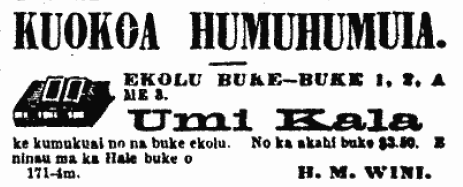
BOUND KUOKOA.

THREE BOOKS—VOLUMES 1, 2 AND 3.

Ten Dollars

is the price for the three books. For one book is $3.50. Inquire at the Book store of H. M. WHITNEY [H. M. WINI].

[For a fee, you could take your year of newspapers to be bound at the end of the year, or they would be sold bound like these Kuokoa. Thanks the this binding, we are left with many full sets of newspapers! However, when they microfilmed the bound newspapers years ago, many were so tightly sewn that the bound side of the pages are illegible because they fall in a shadow. Hopefully funding can be found to have these newspapers unbound by an expert so the pages can be photographed clearly!]

(Kuokoa, 3/16/1865, p. 3)

KUOKOA HUMUHUMUIA.

Ka Nupepa Kuokoa, Buke IV, Helu 11, Aoao 3. Maraki 16, 1865.

Hawaii’s Story by Hawaii’s Queen, in the Hawaiian Language, 1898.

WE WILL SATISFY.

Because we are constantly asked by our readers to print the story which our Queen wrote in Washington and that was just published in Boston, therefore, we are spreading the news to our readership that we will translate and print the story in the columns of the newspapers the daily and weekly Ke Aloha Aina, on the first week of this coming month for the benefit of our readers. Therefore, do take up Ke Aloha Aina so that you can see the one story written by Queen Liliuokalani and published in foreign lands, with statements full of sentiment and aloha dealing with Her overthrow. Aloha for Her.

(Aloha Aina, 3/19/1898, p. 5)

E HOOKO AKU ANA MAKOU.

Ke Aloha Aina, Buke IV, Helu 12, Aoao 5. Maraki 19, 1898.

Here, by the way, is what the heading of that running column looked like:

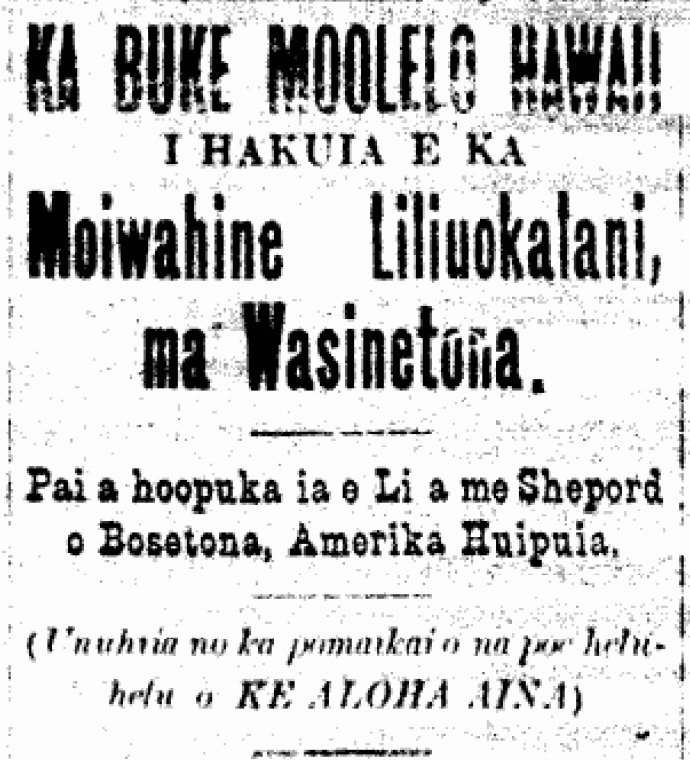
HAWAIIAN HISTORY

WRITTEN BY

Queen Liliuokalani,

in Washington.

Published by Lee and Shepard

of Boston, United States of America.

(Translated for the benefit of the

readers of KE ALOHA AINA)

(Aloha Aina, 4/2/1898, p. 6)

KA BUKE MOOLELO HAWAII

Ke Aloha Aina, Buke IV, Helu 14, Aoao 6. Aperila 2, 1898.

On Liliuokalani’s composition of “Mele Lahui Hawaii,” 1898.

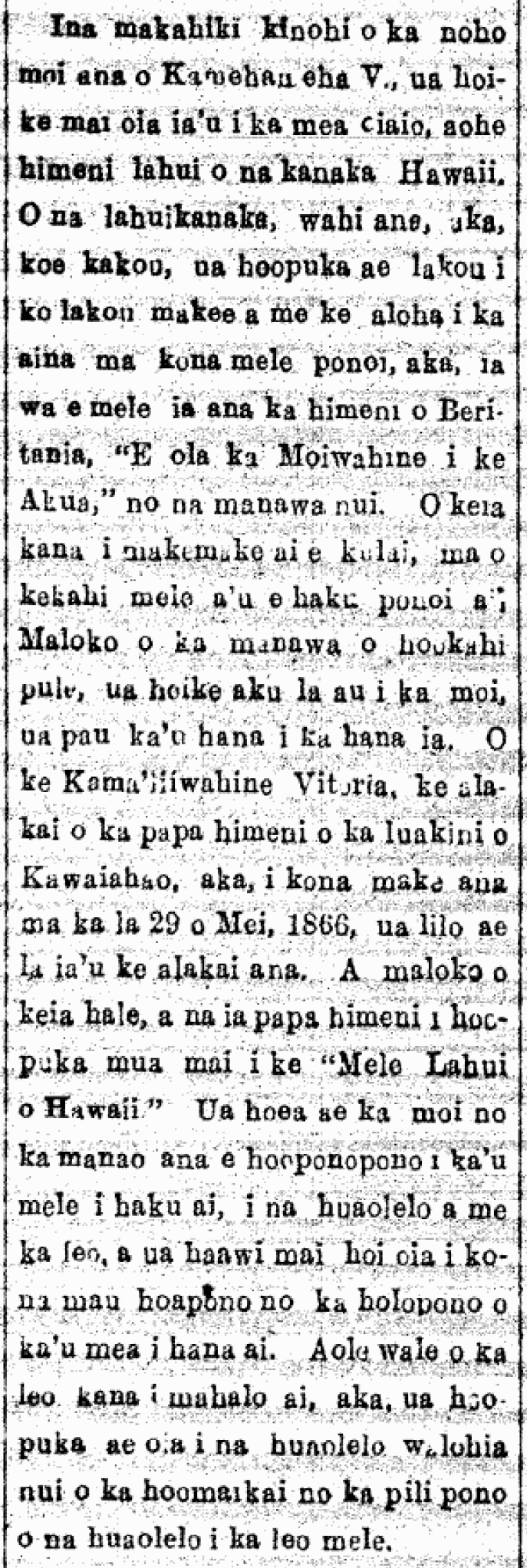
“In the early years of the reign of Kamehameha V, he brought to my notice the fact that the Hawaiian people had no national air. Each nation, he said, but ours had its expression of patriotism and love of country in its own music; but we were using for the purpose on state occasions the time-honored British anthem, “God save the Queen.” This he desired me to supplant by one of my own composition. In one week’s time I notified the king that I had completed my task. The Princess Victoria had been the leader of the choir of the Kawaiahao church; but upon her death, May 29, 1866, I assumed the leadership. It was in this building and by that choir that I first introduced the “Hawaiian National Anthem.” The king was present for the purpose of criticising my new composition of both words and music, and was liberal in his commendations to me on my success. He admired not only the beauty of the music, but spoke enthusiastically of the appropriate words, so well adapted to the air and to the purpose of which they were written.”

(from Hawaii’s Story by Hawaii’s Queen, pp. 31–32.)

“Ina makahiki kinohi o ka noho moi ana o Kamehameha V., ua hoike mai oia ia’u i ka mea oiaio, aohe himeni lahui o na kanaka Hawaii. O na lahuikanaka, wahi ana, aka, koe kakou, ua hoopuka ae lakou i ko lakou makee a me ke aloha i ka aina ma kona mele ponoi, aka, ia wa e mele ia ana ka himeni o Beritania, “E ola ka Moiwahine i ke Akua,” no na manawa nui. O keia kana i makemake ai e kulai, ma o kekahi mele a’u e haku ponoi ai. Maloko o ka manawa o hookahi pule, ua hoike aku la au i ka moi, ua pau ka’u hana i ka hana ia. O ke Kama’liiwahine Vitoria, ke alakai o ka papa himeni o ka luakini o Kawaiahao, aka, i kona make ana ma ka la 29 o Mei, 1866, ua lilo ae la ia’u ke alakai ana. A maloko o keia hale, a na ia papa himeni i hoopuka mua mai i ke “Mele Lahui o Hawaii.” Ua hoea ae ka moi no ka manao ana e hooponopono i ka’u mele i haku ai, i na huaolelo a me ka leo, a ua haawi mai hoi oia i kona mau hoapono no ka holopono o ka’u mea i hana ai. Aole wale o ka leo kana i mahalo ai, aka, ua hoopuka ae oia i na huaolelo walohia nui o ka hoomaikai no ka pili pono o na huaolelo i ka leo mele.”

(Aloha Aina, 5/14/1898, p. 7)

KA BUKE MOOLELO HAWAII I HAKUIA E KA Moiwahine Liliuokalani...

Ke Aloha Aina, Buke IV, Helu 20, Aoao 7. Mei 14, 1898.

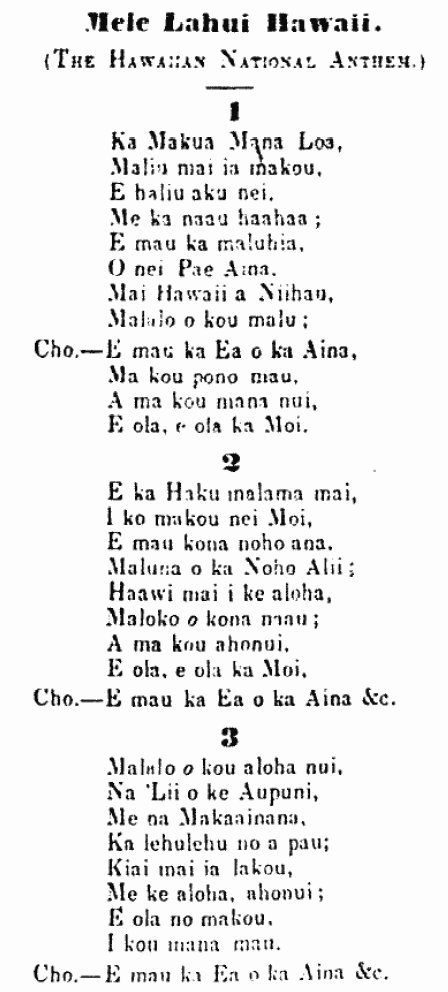
Hawaiian National Anthem, 1866.

Mele Lahui Hawaii.
(The Hawaiian National Anthem.)

1

Ka Makua Mana Loa,
Maliu mai ia makou,
E haliu aku nei,
Me ka naau haahaa;
E mau ka maluhia,
O nei Pae Aina,
Mai Hawaii a Niihau,
Malalo o kou malu.

Cho.—E mau ka Ea o ka Aina,
Ma kou pono mau,
A ma kou mana nui,
E ola, e ola ka Moi.

2

E ka Haku malama mai,
I ko makou nei Moi,
E mau kona noho ana,
Maluna o ka Noho Alii;
Haawi mai i ke aloha,
Maloko o kona naau;
A ma kou ahonui,
E ola, e ola ka Moi.

Cho.—E mau ka Ea o ka Aina, &c.

3

Malalo o kou aloha nui,
Na ‘Lii o ke Aupuni,
Me na Makaainana,
Ka lehulehu no a pau;
Kiai mai ia lakou,
Me ke aloha, ahonui;
E ola no makou,
I kou mana mau.

Cho.—E mau ka Ea o ka Aina, &c.

The Hawaiian National Anthem.

1

Almighty Father,
Heed us,
Who turn to you,
With humble hearts;
Let there forever be peace,
In these Islands,
From Hawaii to Niihau,
Under your protection;

Cho.—Let the Sovereignty of this Land be for always,
By your never ending righteousness,
And by your great power,
Long live, long live the King.

2

O Lord, protect,
Our King,
Let his rule continue,
Upon the Throne;
Bestow him aloha,
Within his heart;
And by your grace
Long live, long live the King.

Cho.—Let the Sovereignty of this Land be for always, &c.

3

Under your great love,
Are the Alii of the Nation,
And the Makaainana,
All the people;
Do watch over them,
With aloha and magnanimity,
Let us live,
By your eternal power.

Cho.—Let the Sovereignty of this Land be for always, &c.

(Kuokoa, 11/24/1866, p. 2)

Mele Lahui Hawaii.

Ka Nupepa Kuokoa, Buke V, Helu 47, Aoao 2. Novemaba 24, 1866.