Unknown's avatar

About nupepa

Just another place that posts random articles from the Hawaiian Newspapers! It would be awesome if this should become a space where open discussions happen on all topics written about in those papers!! And please note that these are definitely not polished translations, but are just drafts!!! [This blog is not affiliated with any organization and receives no funding. Statements made here should in now way be seen as a reflection on other organizations or people. All errors in interpretation are my own.]

Population of Niihau and more, 1864.

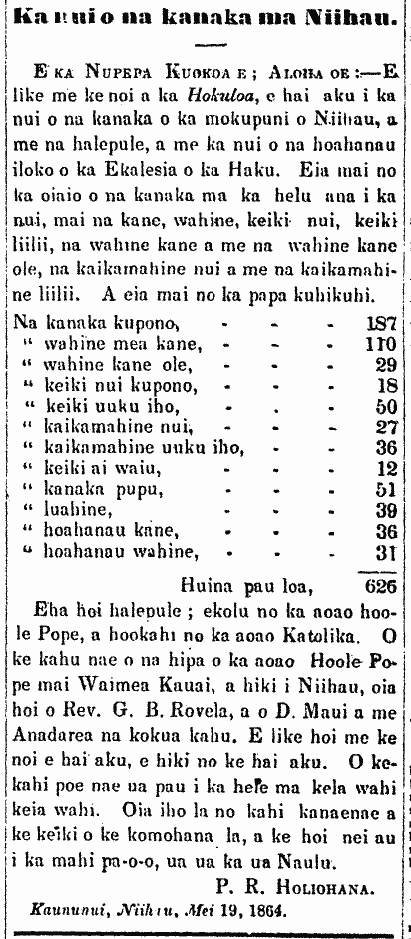
The Population of Niihau.

O Kuokoa Newspaper; Aloha oe:—In response to the request by the Hoku Loa [newspaper], to tell the population of Niihau, and the number of houses of worship and members of the Lord’s church. Here is the actual figures of the population, from the men, women, older boys, younger boys, married women, and single women, the older girls and younger girls. Here is the chart.

Good-standing men, 187

Married women, 110

Single women, 29

Older boys [that can work?], 18

Younger boys, 50

Older girls, 27

Younger girls, 36

Breast-feeding children, 12

Old men, 51

Old women, 39

Male church members, 36

Female church members, 31

Total, 626

There are four houses of worship; three for the Protestants, and one for the Catholics. The shepherd of the sheep of the Protestants from Waimea, Kauai to Niihau, is Rev. G. B. Rovela [Rowell], and D. Maui and Anadarea are the assistant kahu. As per the requests for answers, will be responses. But there are some people who have gone here or there. This is the supplication of the boy from the west, and I am returning to my gardening of sweet potato scraps, as the Naulu rain came down.

P. R. Holiohana.

Kaununui, Niihau, May 19, 1864.

(Kuokoa, 6/11/1864, p. 4)

Ka nui o na kanaka ma Niihau.

Ka Nupepa Kuokoa, Buke III, Helu 24, Aoao 4. Iune 11, 1864.

Niihau purchased for $10,800. 1864.

The Haole are Really Working Niihau.

O Kuokoa Newspaper; Aloha to you:—I met up with the newspaper article under News of Hawaii, in Issue 15 of the 9th of April, about the selling of Niihau to Mr. James Francis Sinclair, for $10,800, along with the lands of Kuakanu, which are the konohiki lands of Halewela and Kahuku, which the Government sold to the one named above, along with the konohiki lands, and this whole island has gone to the haole; perhaps you all and those others as well have heard that Niihau was sold, along with those penny-pinching folks who don’t get the shining beacon of Hawai nei through the Kuokoa Newspaper. And it is we who know of the great, who know of the small, and who know of the wide, that knows of the selling from Kii to Kawaihoa, from the Makahuena Point to Pueo Point; everything upon the land is bought and there is nothing left for us, the Hawaiians, under the haole owners.

Their Way of Living: They are pleasant and good, and speak nicely with the people, but they are not very proficient in the Hawaiian language. The haole say, “mahope aku kumaki” [?] There are ten Hawaiians, caretakers [hoaaina] of the land, chosen from amongst the locals, but two are from elsewhere, they are newcomers, one from Hawaii and the other from Maui, and including them there are ten caretakers. Here are each of their names which the haole selected: A. Puko, D. Kauki, Hetesia, J. H. Kanakaiki, P. R. Holiohana, H. Haokaku, Mose Kanohai, Ioela, Kapahee and Pouli; Kanakaiki is from Napoopoo, Hawaii, and Holiohana is from Hana, Maui, and are locals from there. Those caretakers are in charge of the three work days every month just like the konohiki of the chiefs, should there be work by haole owner to be done.

Their Number: Mr. James Francis Sinclair them total twelve in number; two brothers, three sisters, five children, one mother, and one in-law, which totals twelve; they live in Kununui; they are religious, with one God, but their religion is very different; their houses were constructed in Britain and brought to Niihau: three houses, one currently stands, and two more to follow; we appreciate how nice and beautiful it is to see.

Dealing with the Animals: There are two horses per man and woman, and should there be three, it is killed, and so forth; as for dogs, there are none left, they were all killed, from the big ones to the small ones because sheep were being killed, and so the government is without money from the dog tax, also the goats were all killed. You Kauai people who own horses and sheep, get them quick, don’t dawdle, or they will be taken by the haole.

Things Grown by the People.

The Hawaiians consume what they produce, and they also assist with the land owners in the watering of the sweet potato, ke pola akaakai [?], and chickens, as long as they were pleasant, or else that was that.

On the Number of Sheep

Set loose on Niihau are the sheep which you have perhaps seen in our Newspaper; as for the count, you probably have not heard; this is the truth as to the abundance or dearth: the number of sheep is 3,400, with 1,400 belonging to the Hon. W. Webster and 2,000 belonging to the King; there is no end to their desire for sheep.

Sugar Cane Cultivation.

Niihau will be planted with sugar cane if the test on one acre goes well; and if the cane grows nicely, then planting will commence, but if it doesn’t grow, that’s it, because it is an arid land.

This is an undesirable land for those foreigners seeking to make money because it is dry and scorched by the sun, and crops die; but here are people who are after wealth, and they tell us, the locals, that this is very valuable land for sheep and cane; our good friend, H. M. Whitney, the local of Waimea and Niihau, along with his parents, are familiar with this island and its extreme heat in the Makalii months [summer]. I will stop writing as the Naulu rain of Niihau is falling. With aloha.

P. R. Holiohana.

Kihalaui, Niihau, May 2, 1864.

[This P. R. Holiohana (later it seems he goes by the name P. R. Holi) writes in to the newspapers often from Niihau on a number of subjects.]

(Kuokoa, 6/4/1864, p. 1)

Hana io ka Haole ia Niihau.

Ka Nupepa Kuokoa, Buke III, Helu 23, Aoao 1. Iune 4, 1864.

Bishop Alfred Willis Leaves for Tonga, 1902.

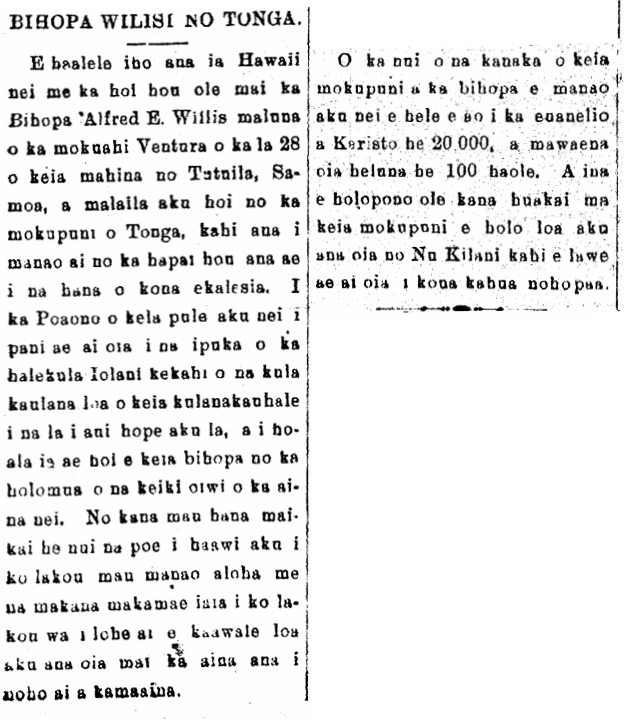
BISHOP WILLIS TO TONGA.

Bishop Alfred E. Willis is leaving Hawaii, and not returning, aboard the steamship Ventura on the 28th of this month for Tutuila, Samoa, and from there for the island of Tonga, where he intends to take up the work of his church. Last Saturday he closed the doors of Iolani School, one of the very well known schools of this town in days gone by,  and it was established by this bishop for the advancement of the native children of this land. For his good works, there were many people gave their expressions of aloha and precious gifts to him when they heard that he will forever leave this land that he became a local to.

The population of the people of this island on which the bishop is intending to go teach the word of Christ to is 20,000; and with this number, 100 are haole. And should this trek to this island does not go well, he will continue on to New Zealand where he will put down roots.

(Aloha Aina, 5/24/1902, p. 4)

BIHOPA WILISI NO TONGA.

Ke Aloha Aina, Buke VIII, Helu 21, Aoao 4. Mei 24, 1902.

M. E. Silva’s Funeral Home, 1912.

NEW UNDERTAKING COMPANY.

On April 14th, Manuel Feli [Felip?] Aguan passed.

Mr. Loo [Lee?] Chong left this life on the 21st of April.

Mrs. Kanehailua left for the eternal world on the 3rd of November at Hamakua, Hawaii.

Therefore, bring in your donations of ten cents for the members of your Organizations who left this life, to my Business Office on Chaplain Lane, right behind Queen Emma Hall, between Nuuanu Avenue and Fort Street.

M. E. SILVA.

[This is the undertaking establishment of M. E. Silva mentioned in the previous post. See more on the interesting story of Manuel Enos Silva in “Men of Hawaii” (1917).

(Aloha Aina, 5/16/1912, p. 3)

HUI HOOLEWA HOU

Ke Aloha Aina, Buke XVI, Helu 20, Aoao 3. Mei 18, 1912.

Pauli K. Hosea Iwiula, 1912.

My Beloved Husband Has Gone, Undoing Our Bond

PAULI K. HOSEA IWIULA.

O Kuokoa Newspaper, Aloha to you:—Please extend your patience and allow me space in one of your columns for my parcel of my parent in my youth, and perhaps many of our friends will see it, and our companions in the Lord living from where the sun rises at Kumukahi all the way to where it shimmers into the sea of Lehua.

Pauli Kaoleiokukaiakauilani Hosea Iwiula was born in Kamoiliili¹, Oahu, on the 26th of June, 1862, from the loins of Iwiula (m) and Kapolei (f); according to the history of Iwiula, he was a descendant of the chiefly family of Kamalalawalu of Maui, and of kaukau alii rank in the court of the fathers of kings [Makualii, Makua Alii], Kekuanaoa and Kanaina, and the monarchs of the time; and the line related to Pauahi Kaoleioku Hosea Iwiula’s mother, that being Kapolei, she was closely related to the chiefly blood of Kekaulike Nui of Molokai, and being that Molokai is where Kapolei (f) was born, it is believed by the locals here in Kamoiliili that Hosea Iwiula is a chief for whom this eulogy is for.

While Kapolei was young, following the death of Kahuloa, her first husband, she married the aforementioned Iwiula. At that time, Kapolei’s was regularly a singing teacher for the young chiefly women of those days. And Kamoiliili’s handsome prince and gentleman of the time was Pauli Kaoleioku, the first born of the alii Haumea of the serene lands of Ehu, the land where water lies in the face of the cloud banks [epithets for Kona, Hawaii]. And as what happens when people grow up, there is a craving for the great fish that passes before one’s eyes, and that is perhaps why Kapolei and Pauli Kaoleioku were mixed up together, and Hosea was conceived, a son from the loins of Kapolei, and thus Hosea Iwiula was said to be a child of Pauli, and an alii.

During the days when we lived as man and wife, he became a parent to me, and so also me for him. My dear husband was very skilled in singing, and it was he who always lead the Sunday School classes of Kamoiliili for almost thirty or more years, and he was the elder [luna kahiko] of the Kamoiliili Church for almost twenty-four years and also is a long-time member of the Kawaiahao Church, then he left that position in the hands of Hiram Kaaha who is still there now. Hosea was a member of the leaders of Kawaiahao Church from his branch church of Kamoiliili. During the days when he was the leader of the Sunday School for Kaawili, he assisted his Sunday School students immensely, by clothing them with their uniforms, shoes and hats; he helped the children a lot.

I was joined with him on the 16th of January, 1882, at Kamoiliili, and we had ten children, and six of them are still living: one daughter and five sons; and four of them have gone before and he has gone in search to be with them.

On Tuesday, the 25th of January, he went to Kauai for the building of the home of Sam Kaeo, the Kauai county attorney, which he would be painting; and in the last week of December, the 29th, he returned to Kamoiliili, and joined in to lead the Sunday School class of Kamoiliili at the last quarterly congregational convention of 1911, and on January 25, he went back to Nawiliwili where his job was, and there after a few weeks began a sickness in his body, and it progressed until he passed from me in that unfamiliar land, on April 29, 1912, and he and I travelled over the great Kaieie Channel for here in Honolulu aboard the Malulani on the 30th of April, and my beloved lei, my husband was left at the funeral home of M. E. Silva, and on the following Thursday, he was carried to Kamoiliili, and within this church where the two of us along with the friends of this place would always gather to worship God, his funeral service was held and he was returned to the place of all men, and the saying was fulfilled: “Man goes to his eternal home, and the spirit returns to its maker.” For “He gave and He hath taken away, blessed be the name of Jehovah.”

O Lililehua Rain of Palolo, you shall no more buffet the cheeks of my beloved; and you as well, O Kuahine Rain which treads upon the fringes of the lehua of Manoa, you will no more soak him and his lashes; O Royal Capitol of Honolulu, he shall not see your fairness; and O Shores which I was with my beloved, your rocky banks will never again be glided over by his loving feet, and O Seas of Kaalawai and Keauau where me and my loving husband were as one, you will not see him again passing by with me.

Alas, there is only love for my husband of my youth, my parent of my uneducated days. I am yours, O My Beloved, that did [lueuele?], wandering the streets in tears.

Me with sorrow,

MRS. RAHELA [Rachael] HOSEA.

Kamoiliili, May 11, 1912.

¹Kamoiliili is known today generally as Moiliili.

[I have found no other usages of the word “lueuele”. Unless the newspapers are accurately typescripted, we won’t know if lueuele is a typo, or if it is indeed a word. The more examples of usages and context found, the clearer the meaning of the word will be. Does the acceptance of inaccurate typing indicate that these words are not important?]

(Kuokoa, 5/17/1912, p. 4)

KUU ALOHA HE KANE UA HALA, UA WEHE MAI I KA MAUA PILI

Ka Nupepa Kuokoa, Buke XLVIII, Helu 20, Aoao 4. Mei 17, 1912.

Shark attack, 1914.

GRUESOME DEATH BY A SHARK

This Sunday, Mar. 1—A Japanese and his son went to pick opihi [kui opihi] on the sea cliffs of Honomu, and while they were enjoying the opihi picking, the boy slipped and fell into the ocean, and before the father could do something for the child, the boy was taken by a huge black shark.

The body of that Japanese boy was held upwards in view of the father, and when it went back down into the ocean, the waist was severed, and with the second bite of that man-eating shark, the body of that unfortunate boy was completely gone. The actions done by that niuhi to that pitiful child is truly frightening.

(Hoku o Hawaii, 3/5/1914, p. 2)

MAKE MAINOINO I KA MANO
Ka Hoku o Hawaii, Buke 8, Helu 39, Aoao 2. Maraki 5, 1914.

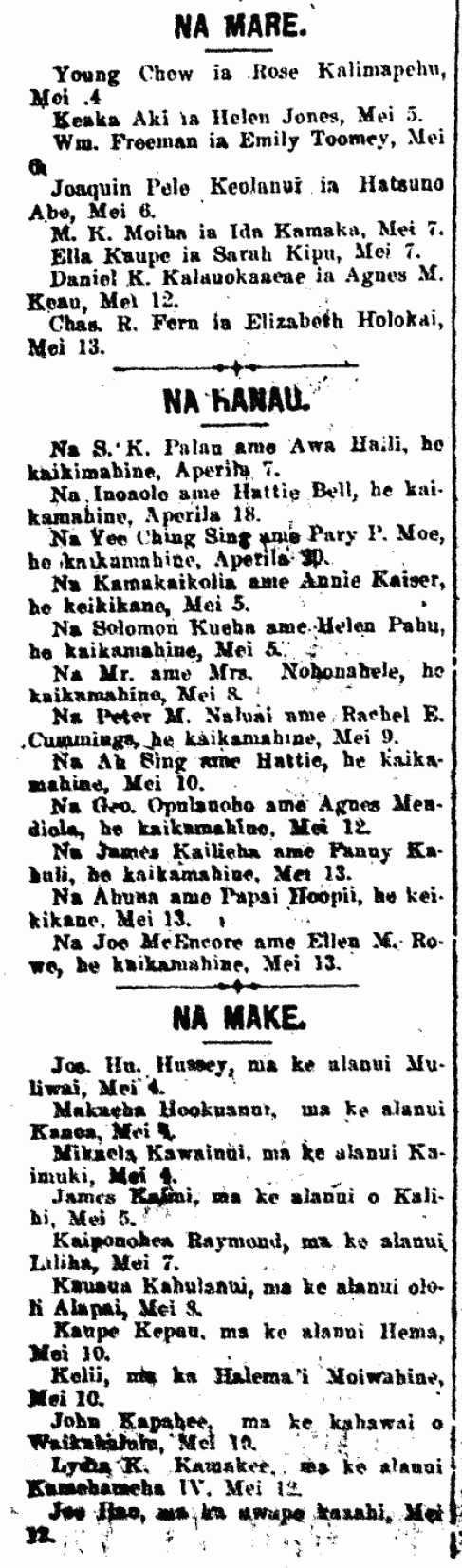
Vital Statistics, 1912.

MARRIAGES.

Young Chow to Rose Kalimapehu, May 4.
Keaka [Jack] Aki to Helen Jones, May 5.
William Freeman to Emily Toomey, May 6.
Joaquin Pele Keolanui to Hatsuno Abe, May 6.
M. K. Moiha to Ida Kamaka, May 7.
Elia Kaupe to Sarah Kipu, May 7.
Daniel K. Kalauokaaeae to Agnes M. Keau, May 12.
Charles R. Fern to Elizabeth Holokai, May 13.

BIRTHS.

To S. K. Palau and Awa Haili, a daughter, April 7.
To Inoaole [Nameless] and Hattie Bell, a daughter, April 18.
To Yee Ching Sing and Pary P. Moe, a daughter, April 30.
To Kamakaikolia and Annie Kaiser, a son, May 5.
To Solomon Kueha and Helen Pahu, a daughter, May 5.
To Mr. and Mrs. Nohonahele, a daughter, May 8.
To Peter M. Naluai and Rachel E. Cummings, a daughter, May 9.
To Ah Sing and Hattie, a daughter, May 10.
To George Opulauoho and Agnes Mendiola, a daughter, May 12.
To James Kailieha and Fanny Kahuli, a daughter, May 13.
To Ahuna and Papai Hoopii, a son, May 13.
To Joe McEncore and Ellen M. Rowe, a daughter, May 13.

DEATHS.

Joseph Hu Hussey, on Muliwai Street, May 4.
Makaeha Hookuanui, on Kanoa Street, May 4.
Mikaela Kawainui, on Kaimuki Avenue, May 4.
James Kaimi, on Kalihi Street, May 5.
Kaiponohea Raymond, on Liliha Street, May 7.
Kauaua Kahulanui, on Alapai Lane, May 8.
Kaupe Kepau, on South Street, May 10.
Kelii, at Queen’s Hospital, May 10.
John Kapahee, at the stream of Waikahalulu, May 10.
Lydia K. Kamakee, on Kamehameha IV Road, May 12.
Joseph Hao, at the train depot, May 12.

(Kuokoa, 5/17/1912, p. 8)

MARE. / HANAU. / MAKE.

Ka Nupepa Kuokoa, Buke XLVIII, Helu 20, Aoao 8. Mei 17, 1912.