Land Commissioners, 1846.

PAY HEED!

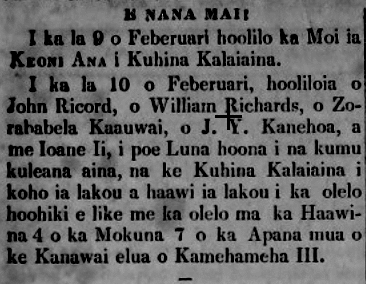
On the 9th of February, the King appointed Keoni Ana as Minister of the Interior [Kuhina Kalaiaina].

On the 10th of February, John Ricord, William Richards, Zorababela Kaauwai, J. Y. Kanehoa, and Ioane Ii were appointed Commissioners to settle land claims [Luna hoona i na kumu kuleana aina]; the Minister of Interior selected them and gave them an oath as per what is prescribed in Article 4 of Chapter 7 of Part One of the Second Act of Kamehameha III.

[O ka hoohiki, oia no:

Ke hoohiki nei kela mea keia mea o makou, e imi pono me ka paewaewa old i na kumu kuleana aina a na kanaka i hoopii mai nei no ke Aupuni o ko Hawaii pae aina, a e hooholo makou i ka olelo pono no ua kuleana la, ke kumu kuleana, ka loihi o ke kuleana, a me ka nui o ka aina, e like hoi me ka olelo iloko o ka Haawina eha o ka Mokuna ehiku o ka Apana m ua o ke Kanawai i kapaia, ‘He Kanawai hoonohonoho i na hana i haawiia i na Kuhina o ko Hawaii Pae Aina,’ i hooholoia ma Honolulu i keia la _____ o _____, 18_____.

Imua o’u _____ _____, ke Kuhina Kalaiaina.

The oath reads:

We and each of us do solemnly swear that we will carefully and impartially investigate all claims to land submitted to us by private parties against the government of the Hawaiian Islands; and that we will equitably adjudge upon the title, tenure, duration and quantity thereof, according to the terms of article fourth of the seventh chapter of the first part of an act entitled “An act to organize the executive departments of the Hawaiian Islands,” passed at Honolulu, _____ day of _____, 18____.

Subscribed and sworn to, this _____ day of _____, 18_____.

Before me, _____ _____,

Minister of the Interior.]

(Elele Hawaii, 3/3/1846, p. 184)

EleleHawaii_3_3_1846_184.png

Ka Elele Hawaii, Buke I, Pepa 24, Aoao 184. Maraki 3, 1846.

Princess Liliuokalani to make circuit of the Islands, 1881.

[Found under: “NOTES.”]

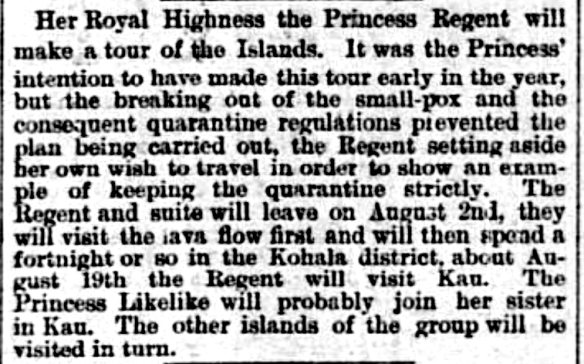
Her Royal Highness the Princess Regent will make a tour of the Islands. It was the Princess’ intention to have made this tour early in this year, but the breaking out of the small-pox and the consequent quarantine regulations prevented the plan being carried out, the Regent setting aside her own wish to travel in order to show an example of keeping the quarantine strictly. The Regent and suite will leave on August 2nd, they will visit the lava flow first and will then spend a fortnight or so in the Kohala district, about August 19th the Regent will visit Kau. The Princess Likelike will probably join her sister in Kau. The other islands of the group will be visited in turn.

(Hawaiian Gazette, 7/27/1881, p. 2)

HawaiianGazette_7_27_1881_2.png

The Hawaiian Gazette, Volume XVII, Number 30, Page 2. July 27, 1881.

Unheeded words of Talmage to the United States of America, 1894.

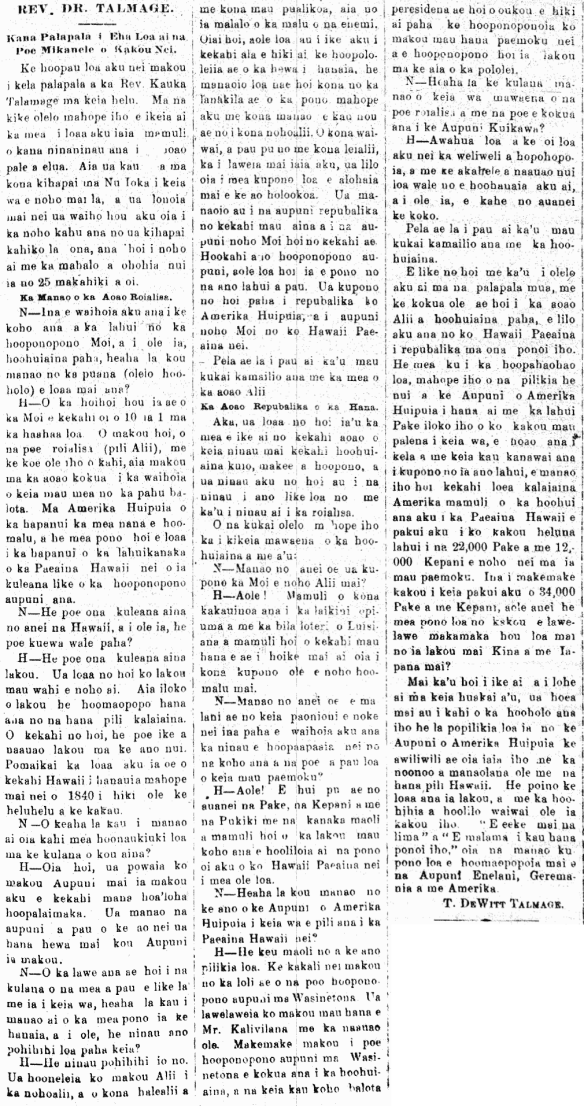
REV. DR. TALMAGE.

His Article Which Greatly Hurt the Missionaries Amongst Us.

The article below written by the Rev. Doctor Talmage of New York and published in a newspaper there was translated and published in the newspaper “Aloha Aina;” however,  because of the difference between our understanding of the translation and theirs, we took it and translated it once more and am putting it before our readers. Here is our translation of the said article:

Honolulu, June 18, 1894.

The chamberlain came to invite the two of us to go to the residence of the former Monarch, and had suggested 11 o’clock that morning as the best hour for our visit…

[This is what sent me looking for the article I posted earlier today. Unfortunately, the previous translation is not found online. It must have been printed in the paper, “Nupepa Aloha Aina” which ran from 1/6/1894 to 1/5/1895. The entire run is in the holdings of the Mission Children’s Society Library. This is a paper that is well worth digitizing and OCRing. I am excited to see what the translation differences could be!]

Makaainana_11_12_1894_1.png

Ka Makaainana, Buke II—Ano Hou, Helu 20, Aoao 1. Novemaba 12, 1894.

Makaainana_11_26_1894_1.png

Ka Makaainana, Buke II—Ano Hou, Helu 22, Aoao 1. Novemaba 26, 1894.

Did Lunalilo have a thing for acrostic poems? 1862.

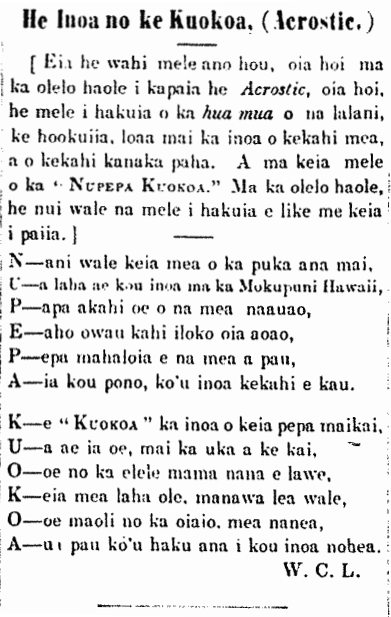
He Inoa no ke Kuokoa, (Acrostic.)

[Eia he wahi mele ano hou, oia hoi ma ka olelo haole i kapaia he Acrostic, oia hoi, he mele i hakuia o ka hua mua o na lalani, ke hookuiia, loaa mai ka inoa o kekahi mea, a o kekahi kanaka paha. A ma keia mele o ka “Nupepa Kuokoa.” Ma ka olelo haole, he nui wale na mele i hakuia e like me keia i paiia.]

N—ani wale keia mea o ka puka ana mai,
U—a laha ae kou inoa ma ka Mokupuni Hawaii,
P—apa akahi oe o na mea naauao,
E—aho owau kahi iloko oia aoao,
P—epa mahaloia e na mea a pau,
A—ia kou pono, ko’u inoa kekahi e kau.

K—e “Kuokoa” ka inoa o keia pepa maikai,
U—a ae ia oe, mai ka uka a ke kai,
O—oe no ka elele mama nana e lawe,
K—eia mea laha ole, manawa lea wale,
O—oe maoli no ka oiaio, mea nanea,
A—ua pau ko’u haku ana i kou inoa nohea.

W. C. L.

[A Name Song for the Kuokoa, (Acrostic.)

This is a new type of mele, that being what is called in English an Acrostic; that is a mele that is composed where the first letter of the lines put together make up the name of a thing or a person perhaps. And in this mele it is the “Kuokoa Newspaper.” In English, there are a lot of poems that are composed like this one that is printed.

How great is this publication,
Your name is spread across the Islands of Hawaii,
You are the first class of educational material,
It is a good thing for me to be amongst that group,
A paper that is appreciated by all,
For your well-being, I will subscribe.

The “Kuokoa” is the name of this fine paper,
You are accepted, from uplands to the sea,
You are the swift messenger who carries,
This rare thing, a thing of benevolence,
You are indeed the truth, a thing of fascination,
And I am done composing your lovely name song.]

(Kuokoa, 8/16/1862, p. 3)
Kuokoa_8_16_1862_3.png

Ka Nupepa Kuokoa, Buke I, Helu 38, Aoao 3. Augate 16, 1862.

Acrostic Poem for King Lunalilo, 1873.

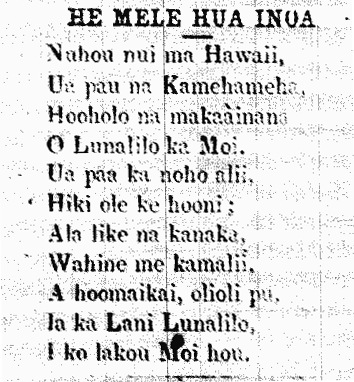
HE MELE HUA INOA

Nuhou nui ma Hawaii,
Ua pau na Kamehameha,
Hooholo na makaainana,
O Lunalilo ka Moi.
Ua paa ka noho alii,
Hiki ole ke hooni;
Ala like na kanaka,
Wahine me kamalii,
A hoomaikai, olioli pu,
Ia ka Lani Lunalilo,
I ko lakou Moi hou.

[ACROSTIC POEM

There is great news in Hawaii,
The Kamehamehas are over,
The citizens decided,
Lunalilo is the King.
The throne is secure,
It cannot be swayed;
Risen together are the men,
Women and children,
Praising and rejoicing together,
For the King Lunalilo,
Their new Monarch.]

[The first letter of each line spells out “Hawaiian News” which is the name of the newspaper it appears in as well.]

(Nuhou, 10/14/1873, p. 1)

Nuhou_10_14_1873_1

Nuhou, Volume 2, Number 23, Page 1. October 14, 1873.

A song for the birthday of King Lunalilo, 1873.

A SONG FOR LUNALILO.

[The mele below was composed and sung by some of Hawaii’s own, on Kauai, on the past 31st of January.]

Leo Mele Hail Columbia.

1. He aloha la he aloha,
No ka Moi Lunalilo,
Lei Nani o kakou,
Hiwahiwa o ke Aupuni;
E hauoli pu kakou,
Na Makaainana a pau.

Leo Hui—E hauoli pu kakou,
E na puuwai Hawaii,
No ka la i hanau ai
O ko kakou Lani hou,
Mai Hawaii a Niihau,
E hookani oli hou,
No ka Moi Lunalilo,
A kakou i koho ai.

2. Eia kakou a pau maanei,
Na nui na opio,
E hauoli no Lunalilo,
Ko kakou Moi hou,
E noho mai la ma ka noho alii,
O ke Aupuni Hawaii.

Leo Hui—E hauoli pu kakou, &c. Continue reading

The National Anthem by William Charles Lunalilo, 1862.

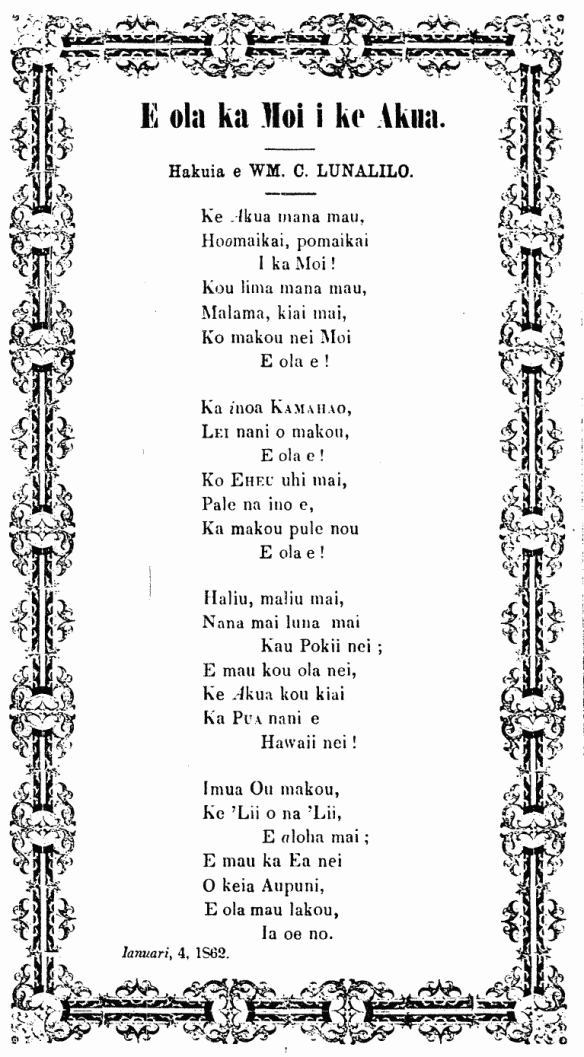
E ola ka Moi i ke Akua.

Hakuia e WM. C. LUNALILO.

Ke Akua mana mau,
Hoomaikai, pomaikai
I ka Moi!
Kou lima mana mau,
Malama, kiai mai,
Ko makou nei Moi
E ola e!

Ka inoa Kamahao,
Lei nani o makou,
E ola e!
Ko Eheu uhi mai,
Pale na ino e,
Ka makou pule nou
E ola e!

Haliu, maliu mai,
Nana mai luna mai
Kau Pokii nei;
E mau kou ola nei,
Ke Akua kou kiai
Ka Pua nani e
Hawaii e!

Imua Ou makou,
Ke ‘Lii o na ‘Lii,
E aloha mai;
E mau ke Ea nei
O keia Aupuni,
E ola mau lakou,
Ia oe no.

Ianuari 4, 1862.

[The winning lyrics by Lunalilo to a contest open to native Hawaiians to compose a song praising Kamehameha IV, Queen Emma, and Ka Haku o Hawaii, sung to the tune of “God Save the King”.]

(Kuokoa, 2/8/1862, p. 1)

Kuokoa_2_8_1862_1

Ka Nupepa Kuokoa, Buke I, Helu 11, Aoao 1. Feberuari 8, 1862.

Birthday of William Charles Lunalilo, 1933.

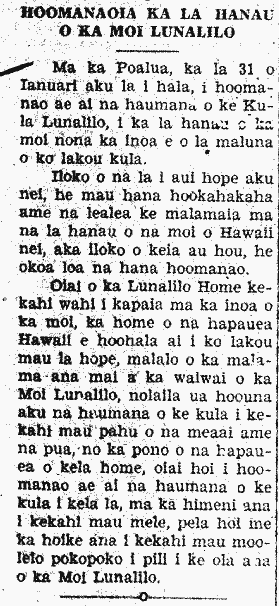
THE BIRTHDAY OF KING LUNALILO IS COMMEMORATED

On Tuesday, the past 31st of January, the students of Lunalilo School celebrated the birthday of the king for whose name their school is called.

In days past, there were parades and gaiety held on the birthdays of the monarchs of Hawaii nei, but in this new age, the commemorations are very different.

Being that Lunalilo Home is a place named after the king, the home where aged Hawaiians live their last days under the care of the estate of King Lunalilo, therefore the students of the school sent several boxes of food and flowers for the benefit of the oldsters of that home, while the students of the school celebrated that day with the singing of some songs, and presenting short stories pertaining to the life of King Lunalilo.

(Alakai o Hawaii, 2/16/1933, p. 3)

AlakaioHawaii_2_16_1933_3

Ke Alakai o Hawaii, Buke 5, Helu 42, Aoao 3. Feberuari 16, 1933.

Kinau, Kaahumanu II, dies, 1839.

DIED.

KAAHUMANU II.

In Honolulu, on the 4th of April.

She became sick from the 30th of March, early in the morning; it was a paralysis. She was numb in her left hand and leg, and on the 31st, she fell into a sleep: This was a sleep where the paralysis on  her left side subsided, but her slumbering grew, until the 2nd of April when her fellow brethren could not wake her.

On the fourth, Kamehameha III, the King, arrived although he was sick, enduring this for his love for his “mother” [makuahine]. The King landed early in the morning, and at miday, at half past 12, that is when she died, without seeing the King.

Everyone is in mourning, and cry with aloha, because their alii has died, the one that was greatly loved. But on the fifth, the crying was ceased because of the illness of the King; talking loudly is not good.

(Kumu Hawaii, 4/10/1839, p. 92)

MAKE.

Ke Kumu Hawaii, Buke 4, Pepa 23, Aoao 92. Aperila 10, 1839.

Hypocrites? 1893.

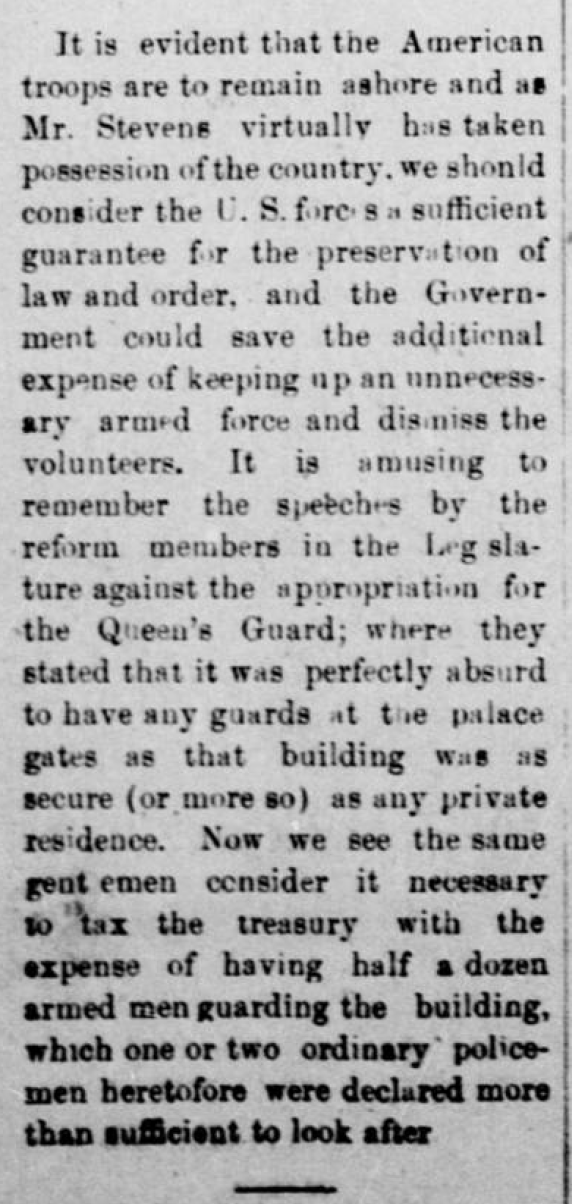
It is evident that the American troops are to remain ashore and as Mr. Stevens virtually has taken possession of the country, we should consider the U. S. forces a sufficient guarantee for the preservation of law and order, and the Government could save the additional expense of keeping up an unnecessary armed force and dismiss the volunteers. It is amusing to remember the speeches by the reform members in the Legislature against the appropriation for the Queen’s Guard; where they stated that it was perfectly absurd to have any guards at the palace gates as that building was as secure (or more so) as any private residence. Now we see the same gentlemen consider it necessary to tax the treasury with the expense of having half a dozen armed men guarding the building, which one or two ordinary policemen heretofore were declared more than sufficient to look after.

(Hawaii Holomua, 1/20/1893, p. 4)

HawaiiHolomua_1_20_1893_4

Hawaii Holomua, Buke III, Helu 143, Aoao 4. Ianuari 20, 1893.