The First Kamehameha Day, 1872.

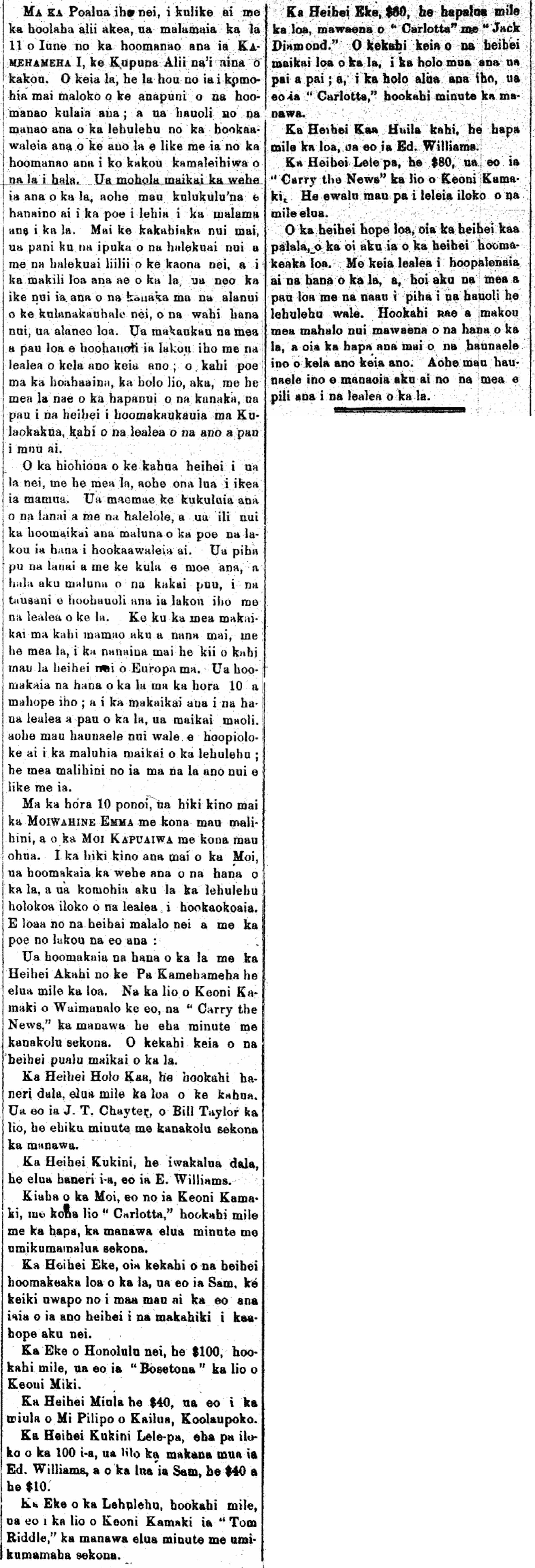
This past Tuesday, as per the Royal Proclamation, the 11th of June was observed as the day to commemorate Kamehameha I, our Royal Ancestor who conquered the land. This is a new day included in the realm of holidays; and the people were joyous at the designating of a day like this for the remembering of our precious beloved one of days gone by. The day opened beautifully, without any drops to bother the people who were well adept to celebrate the day. From early morning, the doors of the large and small shops of town were closed shut, and when the sun came out, nonexistent the sight of many people on the streets of this town, and the places of work were deserted. Everyone was ready to entertain themselves with pleasures of all sorts; some people with feasts or horse riding, but it seemed as if most of the people were at the races set up at Kulaokahua, where enjoyments of all sorts took place [? i muu ai].

The sight of the race track on that day, was as if like no other before. The lanai and tents were nicely built, and congratulations go to those responsible for that distinguished job. The lanai and grounds were filled all the way atop the hills with thousands enjoying themselves with the festivities of the day. Should a visitor stand far away and look forth, it was as if it was a scene from great racing days in Europe. The events of the day began at 10 o’clock or thereafter; and to take in all of the many fun activities of the day was great; there were no big uproars to disturb the peace; that is something unusual for big days like this.

At 10 o’clock sharp, Queen Emma made an appearance with her guests, and King Kapuaiwa with his suite. At the arrival of the King, the activities of the day were opened, and all the people joined in the festivities set aside. There are the races below as well as those who won.

The activities of the day began with the First Race for the Kamehameha Plate, which was two miles long. John A. Cummins [Keoni Kamaki] of Waimanalo won, with “Carry the News,” with a time of four minutes and thirty seconds. This was one of the fine open races [heihei pualu] of the day.

Trotting Race [Heihei Holo Kaa], for one hundred dollars, two mile long course. J. T. Chayter won with the horse Bill Taylor, with a time of seven minutes and thirty seconds.

Foot Race [Heihei Kukini], for twenty dollars, two hundred yards, won by E. Williams [Edward Williams].

King’s Cup, won by John A. Cummins [Keoni Kamaki], with his horse, “Carlotta,” one mile and  a half, with a time of two minutes and twelve seconds.

Sack Race [Heihei Eke], was one of the most humorous races of the day, won by Sam, the harbor boy who is used to winning that type of race in past years.

Honolulu Purse [Eke Honolulu nei], of $100, one mile, won by “Bosetona,” the horse of Keoni Miki [John Meek].

Mule Race [Heihei Miula], $40, won by the mule of Mr. Pilipo of Kailua, Koolaupoko.

Foot Hurdle Race [Heihei Kukini Lele-pa], four hurdles in a hundred yards; the first place went to Ed. Williams, and the second to Sam; $40 and $10.

Public Purse [Eke o ka Lehulehu], one mile, the horse of John A. Cummins [Keoni Kamaki], “Tom Riddle,” won, with a time of two minutes and fourteen seconds.

$60 Purse [Heihei Eke $60], half a mile long, between “Carlotta” and “Jack Diamond.” This was one of the best races of the day, in the first running, they were head to head; but on the second race, “Carlotta” won with a time of one minute.

Velocipede Race [Heihei Kaa Huila kahi], half a mile long, won by Edward Williams.

Hurdle Race [Heihei Lele pa], for $80, won by “Carry the News,” the horse of John A. Cummins [Keoni Kamaki]. Eight hurdles were jumped over in two miles.

The final race was the wheelbarrow race [heihei kaa palala], which was the most comical. With this race, the activities of the day came to a close, and everyone went home with hearts filled with much joy. There is one thing amongst all the activities which we appreciate greatly, that is the fraction of various sorts of commotions. There were no disturbances believed to have resulted from the gaiety of the day.

[This is quite a different type of celebration compared to today. Whatever you may have planned for today, let there be remembering of the one who unified the islands, Kamehameha Paiea.]

(Au Okoa, 6/13/1872, p. 2)
Ma ka Poalua iho nei...

Ke Au Okoa, Buke VIII, Helu 9, Aoao 2. Iune 13, 1872.
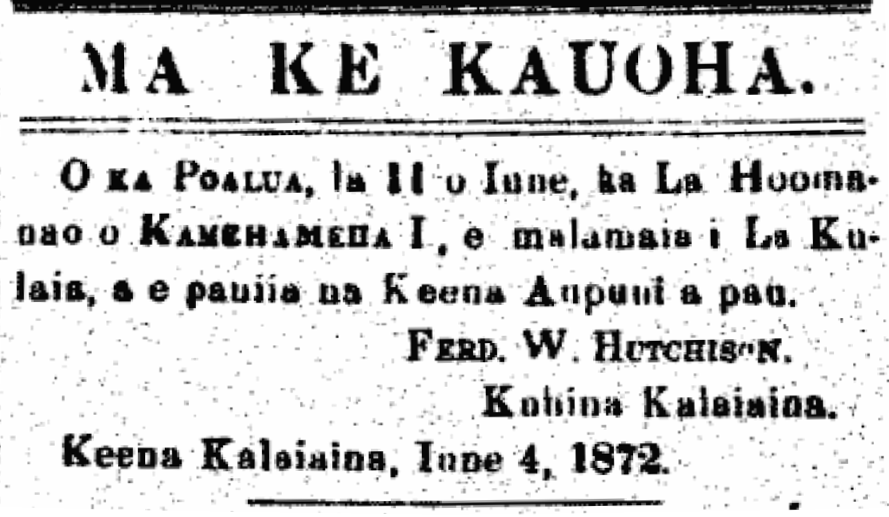
Announcing the first Kamehameha Day, 1872.

BY AUTHORITY.

Tuesday, the 11th of June, the Day of Commemoration of Kamehameha I, will be observed as a Holiday, and all Government Offices will be closed.

Ferd. W. Hutchison.

Minister of the Interior [Kuhina Kalaiaina].

Office of the Interior [Keena Kalaiaina], June 4, 1872.

(Au Okoa, 6/6/1872, p. 2)

MA KE KAUOHA.

Ke Au Okoa, Buke VIII, Helu 8, Aoao 2. Iune 6, 1872.

As it was then it is now. 1893 / 2013.

HE LEI NO KA POE ALOHA AINA.

Kaulana na pua a Hawaii
Kupaa mahope o ka Aina
Hiki mai ka Elele a ka lokoino
Palapala anunu me ka pakaha
Pane mai Hawaii Nui a Keawe
Kokua na Hono a Piilani
Kakoo mai Kauai o Mao
Pau pu me ke one o Kakuhihewa
Aole e kau kuu pulima
Maluna o ka pepa a ka Enemi
Aole makou e minamina
I ka puu kala a ke Aupuni
Ua ola makou i ka pohaku
I ka ai kamahao a ka Aina
Hoohui Aina kuai hewa
I ka pono Kiwila a o ke kanaka
Mahope makou o Liliulani
A kau hou ia i ke Kalaunu
Haina ia mai ana ka puana
No ka poe i Aloha i ka Aina.

A LEI FOR THE PATRIOTS.

Famous are the blossoms of Hawaii
Who stand steadfast behind the Land
When the evil-hearted Messengers arrives
With their documents of greed and plunder
Great Hawaii of the Chief Kakuhihewa answers
The Bays of the Chief Piilani assists
Kauai of the Chief Manokalanipo gives support
Along with the sands of the Chief Kakuhihewa
I will not affix my signature
Upon the paper of the Enemy¹
We will not feel longing
For the sums of money from the Government
We live on the rocks
On the amazing food of the Land
[Annexing and selling wrongfully
The Civil rights of the people]
We stand behind Liliulani
Her Crown shall be placed back upon her
Let the refrain be told
Of the people who Love the Land.

Miss Kekoaohiwaikalani,
Puahaulani Hale,
Honolulu, Feb. 10, 1893.

As a result of the many requests we received to reprint the mele of the Patriots, we are fulfilling your desire; and this is a totally accurate copy of this Mele gotten from the Lady who composed this mele.

[This mele was indeed printed many times in the Hawaiian-Language Newspapers, attesting to its importance. It is just as important today, 120 years since, if not more so!]

¹It appears that the bracketed lines were misplaced and should follow here. …or perhaps not, as it appears in basically this same form three years later: Aloha Aina, Buke III, Helu 24, Aoao 4. Iune 13, 1896. “E Nana Mai i ke Mele.”

(Leo o ka Lahui, 5/16/1893, p. 3)

HE LEI NO KA POE ALOHA AINA.

Ka Leo o ka Lahui, Buke II, Helu 706, Aoao 3. Mei 16, 1893.

Cotton grown in Hawaii, 1863.

[Found under: “NEWS OF HAWAII NEI.”]

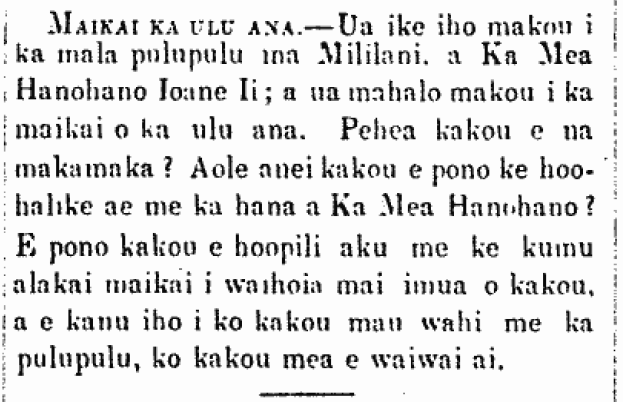
Growing well.—We have seen the cotton plantation at Mililani, of the Honorable John Ii [Ioane Ii]; and we are in admiration at how well it is growing. What about us, O Friends? Shouldn’t we emulate the efforts of the Honorable One? We must follow the good example put before us and plant our land with cotton, that thing which will make us rich.

(Kuokoa, 8/22/1863, p. 2)

Maikai ka ulu ana.

Ka Nupepa Kuokoa, Buke II, Helu 34, Aoao 2. Augate 22, 1863.

Fund raiser for the building of St. Augustine in Waikiki, 1901.

FAIR AND LUAU.

A fair and grand luau was held by the Catholic brethren in the armory [hale paikau] outside, this Saturday afternoon. There were many people who showed up to this fair, and we hear that they made a lot of money through the items sold and the luau. Amongst the dignitaries who appeared at the fair was Queen Liliuokalani. The Royal Hawaiian Band [bana aupuni] was there, entertaining the visitors that came, and with the coming of night there was held a dance in the armory. All the proceeds from this fair will be given to the church of St. Augustine being built outside of Waikiki.

(Aloha Aina, 7/20/1901, p. 5)

AHA FEA ME LUAU.

Ke Aloha Aina, Buke VII, Helu 29, Aoao 5. Iulai 20, 1901.

Population of Hawaii, 1838.

POPULATION OF HAWAII NEI.

This is something translated from a haole document.

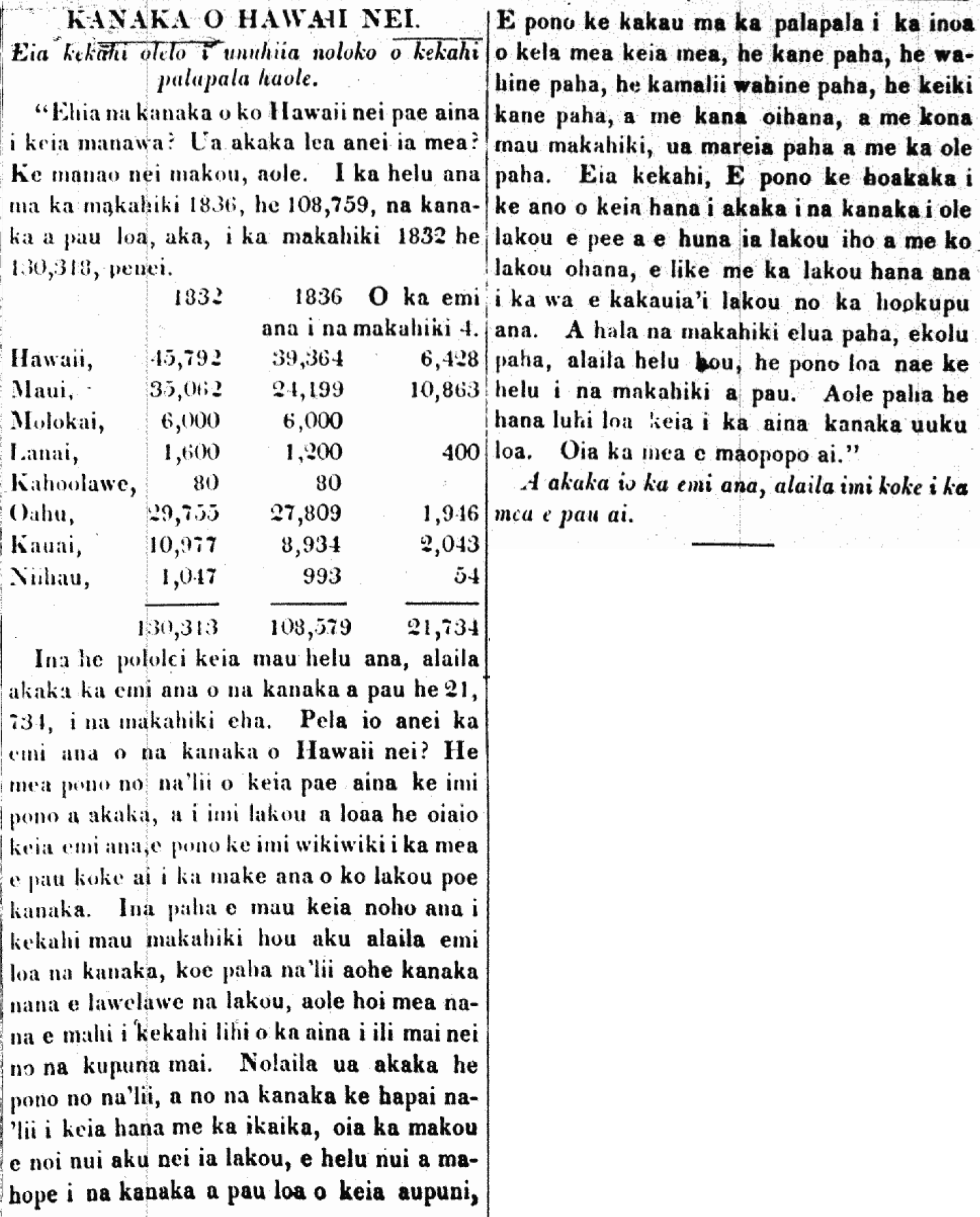
“How many people are there currently in the Hawaiian Archipelago? Is that something that is clear? We believe, it is not. In the census in 1836, there were 108,759 people total, however in 1832, there were 130,318, like this:

1832 1836 Decrease over 4 years
Hawaii 45,792 38,364 6,428
Maui 35,062 24,199 10,863
Molokai 6,000 6,000
Lanai 1,600 1,200 400
Kahoolawe 80 80
Oahu 29,755 27,809 1,946
Kauai 10,977 8,934 2,043
Niihau 1,047 993 54
130,313 108,579 21,734

If these figures are true, then it is clear that there has been a decrease of 21,734 people in the total population over four years. Is that truly the decrease in the population of Hawaii nei? It is imperative that the alii of this archipelago investigate and make it clear, and should they check and if this is indeed the decrease, they must quickly find a way to stop the deaths of their people. If this way of life goes on for another few years, then the population will be miniscule and perhaps only the alii will survive and they will not have people to care for them; there will be no one to farm a bit of land passed down from the ancestors. Therefore it is imperative for the sake of the alii and the people that the alii put great effort into this, and this is what we strongly ask of them to do a great count of all of the people of this nation. It is important to document the names of everyone, whether they are men, or women, or girls or boys, and their occupation, their age, and whether they are married or not. Also, it is important that this effort be explained so that people understand to prevent them from hiding themselves and their family, like they do when they are being tallied for taxation [hookupu ana]. And after two years or three pass, there should be another count, although it really is important to do it every year. This shouldn’t be very hard to do in a land of very few people. This is what should be understood.”

If there is an clear decrease, there should immediately be something done to curtail it.

(Kumu Hawaii, 12/5/1838, p. 55)

KANAKA O HAWAII NEI.

Ke Kumu Hawaii, Buke 4, Pepa 14, Aoao 55. Dekemaba 5, 1838.

Mele and King Lunalilo, 1883.

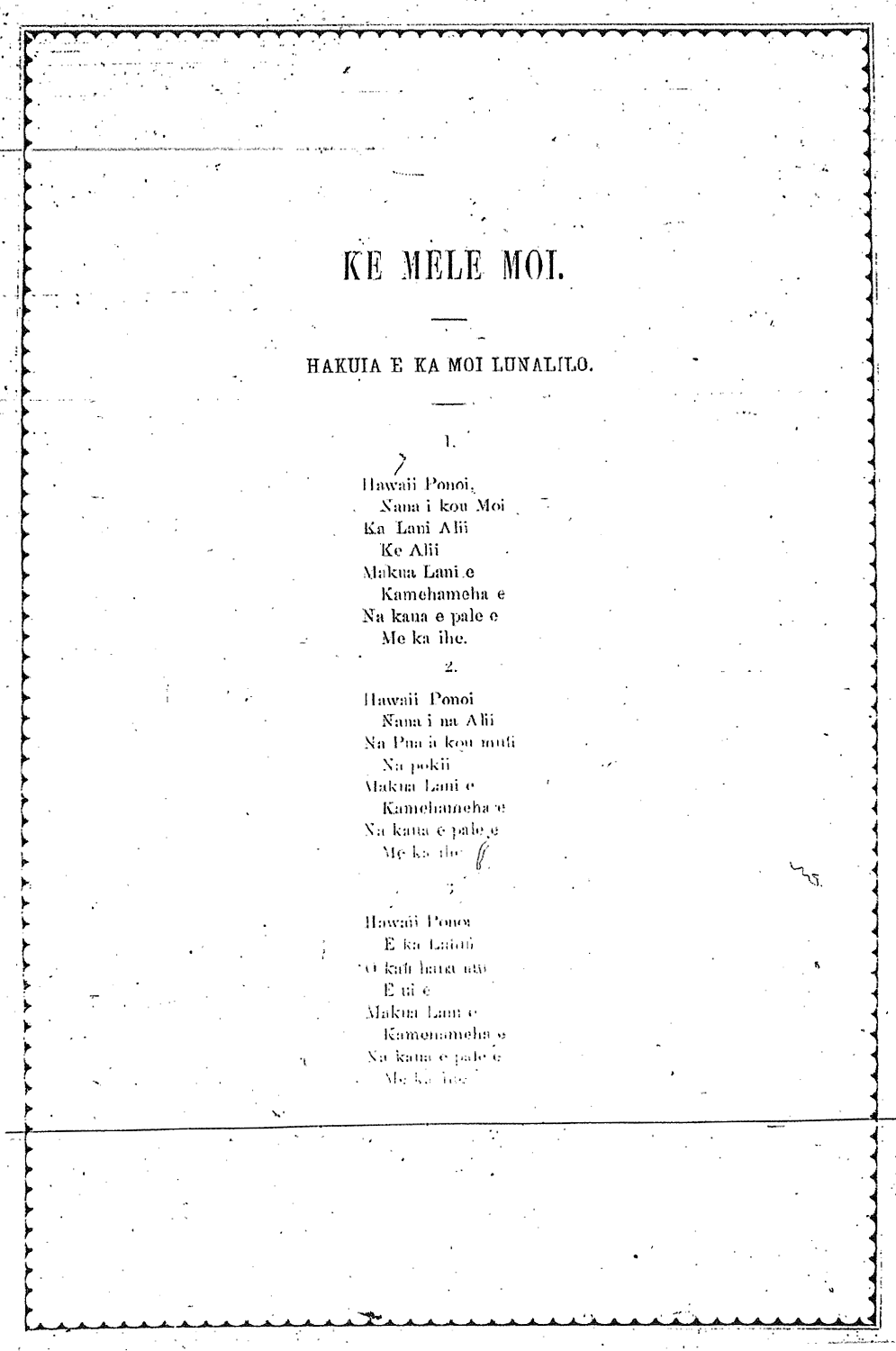
ROYAL MELE.

COMPOSED BY KING LUNALILO.

1

Hawaii Ponoi,
Nana i kou Moi
Ka Lani Alii
Ke Alii
Makua Lani e
Kamehameha e
Na kaua e pale e
Me ka ihe.

2.

Hawaii Ponoi
Nana i na Alii
Na Pua a kou muli
Na pokii
Makua Lani e
Kamehameha e
Na kaua e pale e
Me ka ihe.

3.

Hawaii Ponoi
E ka Lahui
O kau hana nui
E ui e
Makua Lani e
Kamehameha e
Na kaua e pale e
Me ka ihe.

[It is interesting to note that i could not find any article in any paper protesting the attribution of this song. In the same issue is the National Anthem by Princess Liliuokalani.]

(Koo o Hawaii, 8/15/1883, p. 2)

KE MELE MOI.

Ke Koo o Hawaii, Buke 1, Helu 1, Aoao 2. Augate 15, 1883.

Follow up to Hawaiian National Hymn, 1862.

[Found under: “NEWS OF HAWAII NEI.”]

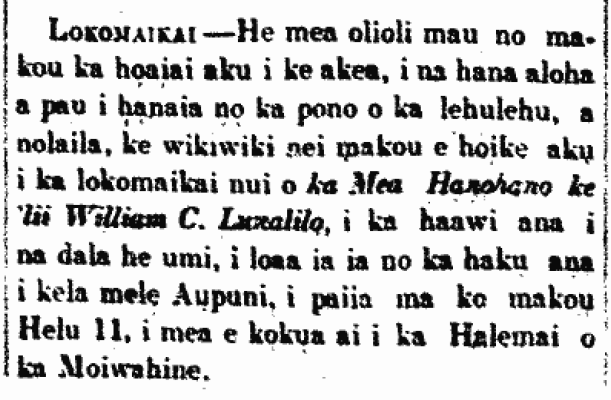
Good Will.—We are always delighted to release to the public all kind deeds done for the benefit of the people, and therefore, we are showing at once the great kindness of the Honorable, Chief William C. Lunalilo, in his donating the ten dollars he received for composing the National song that was published in our Issue 11, to aid the Queen’s Hospital.

(Kuokoa, 2/15/1862, p. 2)

Lokomaikai.

Ka Nupepa Kuokoa, Buke I, Helu 12, Aoao 2. Feberuari 15, 1862.

More on the Hawaiian National Hymn, 1874.

Hawaiian National Hymn.

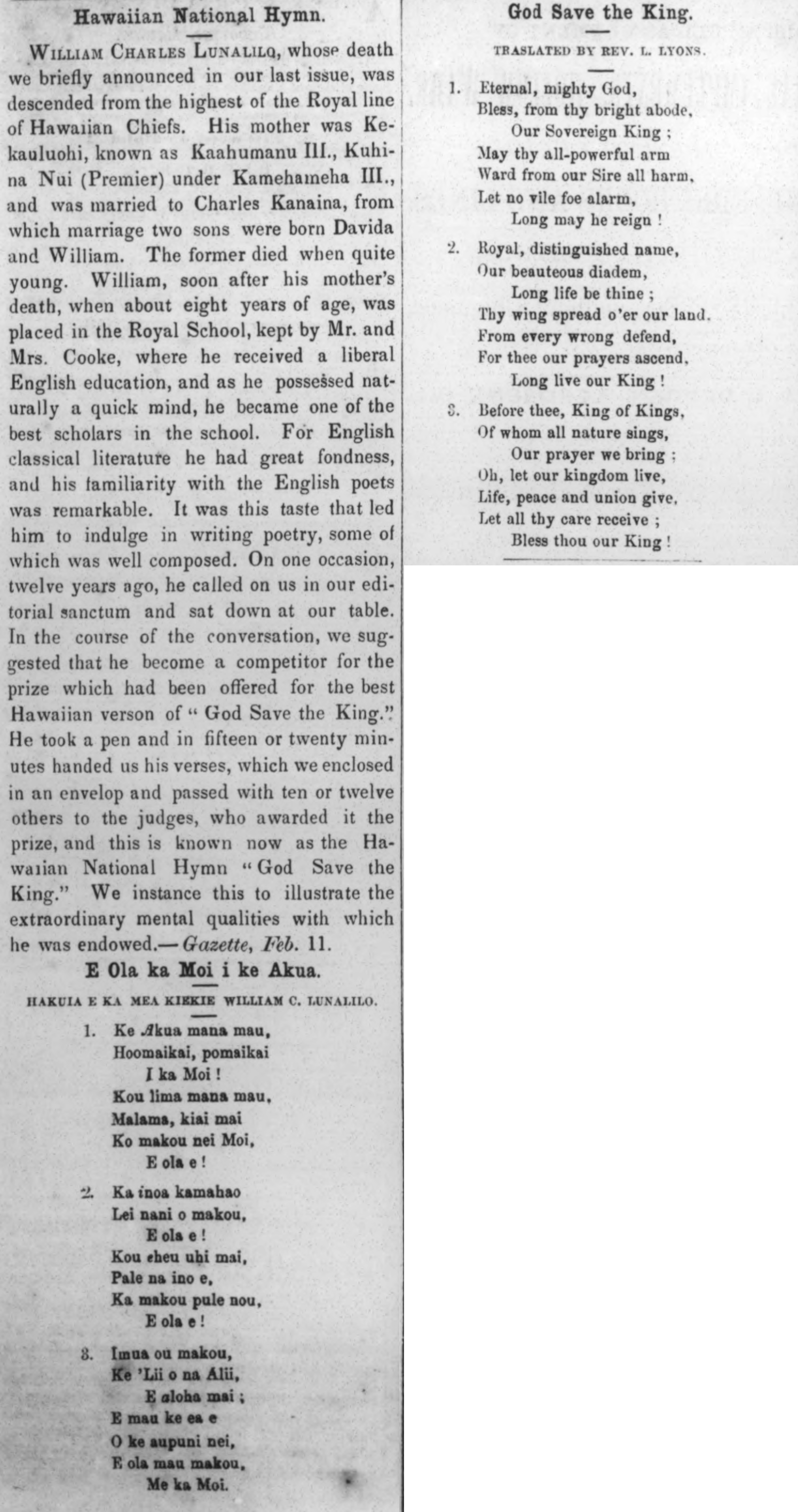
William Charles Lunalilo, whose death we briefly announced in our last issue, was descended from the highest of the Royal line of Hawaiian Chiefs. His mother was Kekauluohi, known as Kaahumanu III., Kuhina Nui (Premier) under Kamehameha III., and was married to Charles Kanaina, from which marriage two sons were born Davida and William. The former died when quite young. William, soon after his mother’s death, when about eight years of age, was placed in the Royal School, kept by Mr. and Mrs. Cooke, where he received a liberal English education, and as he possessed naturally, a quick mind, he became one of the best scholars in the school. For English classical literature he had great fondness, and his familiarity with the English poets was remarkable. It was this taste that led him to indulge in writing poetry, some of which was well composed. On one occasion, twelve years ago, he called on us in our editorial sanctum and sat down at our table. In the course of the conversation, we suggested that he become a competitor for the best prize which had been offered for the best Hawaiian version of “God Save the King.” He took a pen and in fifteen or twenty minutes handed us his verses, which we enclosed in an envelope and passed with ten or twelve others to the judges, who awarded it the prize, and this is known now as the Hawaiian National Hymn “God Save the King.” We instance this to illustrate the extraordinary mental qualities with which he was endowed.—Gazette, Feb. 11.

E Ola ka Moi i ke Akua.

HAKUIA E KA MEA KIEKIE WILLIAM C. LUNALILO.

1. Ke Akua mana mau,
Hoomaikai, pomaikai
I ka Moi!
Kou lima mana mau,
Malama, kiai mai
Ko makou nei Moi,
E ola e!

2. Ka inoa kamahao
Lei nani o makou,
E ola e!
Kou eheu uhi mai,
Pale na ino e,
Ka makou pule nou,
E ola e!

3. Imua ou makou,
Ke ‘Lii o na Alii,
E aloha mai;
E mau ke ea e
O ke aupuni nei,
E ola mau makou,
Me ka Moi.

God Save the King.

TRANSLATED BY REV. L. LYONS.

1. Eternal, mighty God,
Bless, from thy bright abode,
Our Sovereign King;
May thy all-powerful arm
Ward from our Sire all harm,
Let no vile foe alarm,
Long may he reign!

2. Royal, distinguished name,
Our beauteous diadem,
Long life be thine;
Thy wing spread o’er our land.
From every wrong defend,
For thee our prayers ascend,
Long live our King!

3. Before thee, King of Kings,
Of whom all nature sings,
Our prayer we bring;
Oh, let our kingdom live,
Life, peace and union give,
Let all thy care receive;
Bless thou our King!

(Friend, 3/2/1874, p. 24)

Hawaiian National Hymn.

The Friend, New Series, Volume 23, Number 3, Page 24. March 2, 1874.