“You are not permitted to use your own judgement but are blandly told that you don’t know what you are talking about when you venture to express an opinion that is contrary to what is said to be an established fact,” Clarence E. Edwords, 1896.

The Hawaiian Situation.

They protest too much.

This is the conclusion that is reached by the careful observer who talks with the adherents of the present Government [the Provisional Government] of the Hawaiian Islands.

They seem too anxious to impress upon you the fact that it is a most serene and peaceful atmosphere. You are not permitted to use your own judgement but are blandly told that you don’t know what you are talking about when you venture to express an opinion that is contrary to what is said to be an established fact. Of course no fault can be found with such procedure. It is a part of politics. They want certain conditions to obtain and the desire is so great that by long effort to fool others the “P. G.’s” eventually fool themselves. It may seem presumptuous for one who spent but a month in the island republic to give an opinion as to the real political status of the island, but there is so much evidence obtainable that such opinion can easily be formed, even if it does happen to be against the desire of those who now hold the reins of Government.

The stranger who visits Honolulu almost immediately feels that he is surrounded by an air of uneasiness. Things evidently are not as they seem. There is an indefinable something in the atmosphere that makes one feel as if he should be watching over his shoulder. Where the impression comes from it is difficult to say, but if you will talk politics for five minutes with any resident you cannot help but notice the lowered tone of voice, the careful watch of passers-by or the graurded manner, as if there were a constant fear of spies. Nor is this noticeable alone when talking with royalists. The adherents of the Republic are just as guarded and just as careful.

It looks as if they feared a change of Government and as if their expressions might be treasured up against them.

Yet the Republicans and the papers are persistent in their declarations that the islands were never more peaceful than at present.

Perhaps this is true, but if the the present Government is not sitting over a smouldering political volcano, then the signs are wrong, and this same Government has not failed to realize this fact. Nor has it failed to prepare a soft place to light after the explosion.

What is this soft place?

When a man who had been a resident of the islands but ten months made the public announcement of a new Government, that announcement was successful because of the American Minister, who backed up the revolutionists with the force of an American warship and the naval support of the United States. Liliuokalani was dethroned and the Re-…

(Independent, 7/11/1896, p. 1)

The Hawaiian Situation.

The Independent, Volume III, Number 323, Page 1. July 11, 1896.

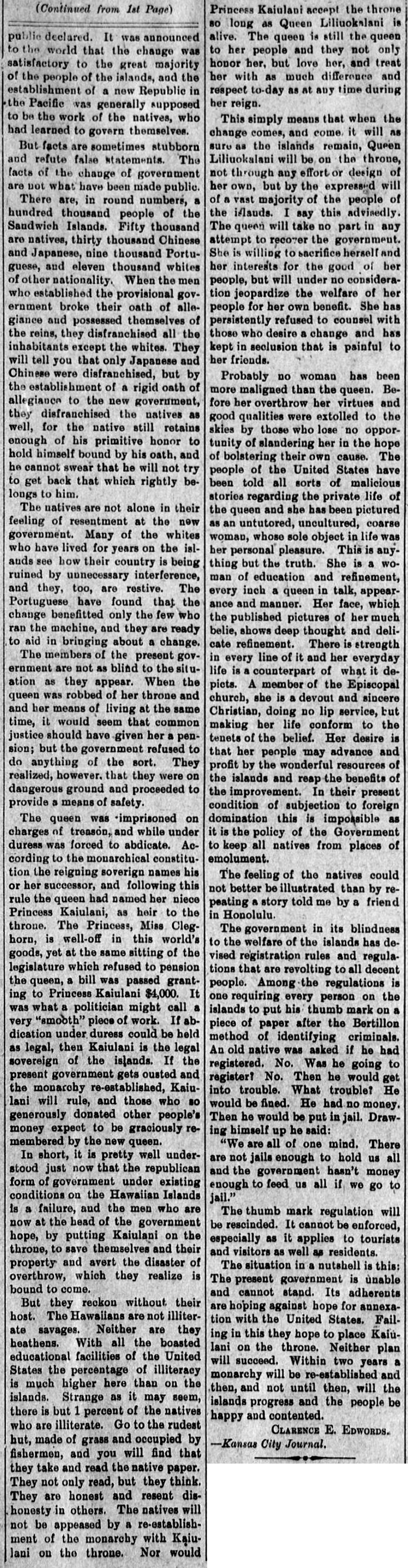
…public declared. It was announced to the world that the change was satisfactory to the great majority of the people of the islands, and the establishment of a new Republic in the Pacific was generally supposed to be the work of the natives, who had learned to govern themselves.

But facts are sometimes stubborn and refute false statements. The facts of the change of government are not what have been made public.

There are, in round numbers, a hundred thousand people of the Sandwich Islands. Fifty thousand are natives, thirty thousand Chinese and Japanese, nine thousand Portuguese, and eleven thousand whites of other nationality. When the men who established the provisional government broke their oath of allegiance and possessed themselves of the reins, they disfranchised all the inhabitants except the whites. They will tell you that only Japanese and Chinese were disfranchised, but by the establishment of a rigid oath of allegiance to the new government, they disfranchised the natives as well, for the native still retains enough of his primitive honor to hold himself bound by his oath, and he cannot swear that he will not try to get back that which rightly belongs to him.

The natives are not alone in their feeling of resentment at the new government. Many of the whites who have who have lived for years on the islands see how their country is being ruined by unnecessary interference, and they, too, are restive. The Portuguese have found that the change benefitted only the few who ran the machine, and they are ready to aid in bringing about a change.

The members of the present government are not as blind to the situation as they appear. When the queen was robbed of her throne and and her means of living at the same time, it would seem that common justice should have given her a pension; but the government refused to do anything of the sort. They realized, however, that they were on dangerous ground and proceeded to provide a means of safety.

The queen was imprisoned on charges of treason, and while under duress was forced to abdicate. According to the monarchical constitution the reigning soverign names his or her successor, and following this rule the queen had named her niece Princess Kaiulani, as heir to the throne. The Princess, Miss Cleghorn, is well-off in this world’s goods, yet at the same sitting of the legislature which refused to pension the queen, a bill was passed granting to the Princess Kaiulani $4,000. It was what a politician might call a very “smooth” piece of work. If abdication under duress could be held as legal, then Kaiulani is the legal sovereign of the islands. If the present government gets ousted and the monarchy re-established, Kaiulani will rule, and those who so generously donated other people’s money expect to be graciously remembered by the new queen.

In short, it is pretty well understood just now that the republican form of government under existing conditions on the Hawaiian Islands is a failure, and the men who are now at the head of the government hope, by putting Kaiulani on the throne, to save themselves and their property and avert the disaster of overthrow, which they realize is bound to come.

But they reckon without their host. The Hawaiians are not illiterate savages. Neither are they heathens. With all the boasted educational facilities of the United States the percentage of illiteracy is much higher here than on the islands. Strange as it may seem, there is but 1 percent of the natives who are illiterate. Go to the rudest hut, made of grass and occupied by fisherman, and you will find that they take and read the native paper. They not only read, but they think. They are honest and resent dishonesty in others. The natives will not be appeased by a re-establishment of the monarchy with Kaiulani on the throne. Nor would Princess Kaiulani accept the throne so long as Queen Liliuokalani is alive. The queen is still the queen to her people and they not only honor her, but love her, and treat her with as much difference and respect to-day as at any time during her reign.

 This simply means that when the change comes, and come it will as sure as the islands remain, Queen Liliuokalani will be on the throne, not through any effort of design of her own, but by the expressed will of a vast majority of the people of the islands. I say this advisedly. The queen will take no part in any attempt to recover the government. She is willing to sacrifice herself and her interests for the good of her people, but will under no consideration jeopardize the welfare of her people for her own benefit. She has persistently refused to  counsel with those who desire a change and has kept in seclusion that is painful to her friends.

Probably no woman has been more maligned than the queen. Before her overthrow her virtues and good qualities were extolled to the skies by those who lose no opportunity of slandering her in the hope of bolstering their own cause. The people of the United States have been told all sorts of malicious stories regarding the private life of the queen and she has been pictured as an untutored, uncultured, coarse woman, whose sole object in life was her personal pleasure. This is anything but the truth. She is a woman of education and refinement, every inch a queen in talk, appearance and manner. Her face, which the published pictures of her much belie, shows deep thought and delicate refinement. There is strength in every line of it and her everyday life is a counterpart of what it depicts. A member of the Episcopal church, she is a devout and sincere Christian, doing no lip service, but making her life conform to the tenets of the belief. her desire is that her people may advance and profit by the wonderful resources of the islands and reap the benefits of the improvement. In their present condition of subjection to foreign domination this is impossible as it is the policy of the Government to keep all natives from places of emolument.

The feeling of the natives could not better be illustrated than by repeating a story told me by a friend in Honolulu.

The government in its blindness to the welfare of the islands has devised registration rules and regulations that are revolting to all decent people. Among the regulations is one requiring every person on the islands to put his thumb mark on a piece of paper after the Bertillon method of identifying criminals. An old native was asked if he had registered. No. Was he going to register? No. Then he would get into trouble. What trouble? He would be fined. He had no money. Then he would be put in jail. Drawing himself up he said:

“We are all of one mind. There are not jails enough to hold us all and the government hasn’t money enough to feed us all if we go to jail.”

The thumb mark regulation will be rescinded. It cannot be enforced, especially as it applies to tourists and visitors as well as residents.

The situation in a nutshell is this: The present government is unable and cannot stand. Its adherents are hoping against hope for annexation with the United States. Failing in this they hope to place Kaiulani on the throne. Neither plan will succeed. Within two years a monarchy will be re-established and then, and not until then, will the islands progress and the people be happy and contented.

Clarence E. Edwords.
—Kansas City Journal.

(Independent, 7/11/1896, p. 4)
...public declared...

The Independent, Volume III, Number 323, Page 4. July 11, 1896.
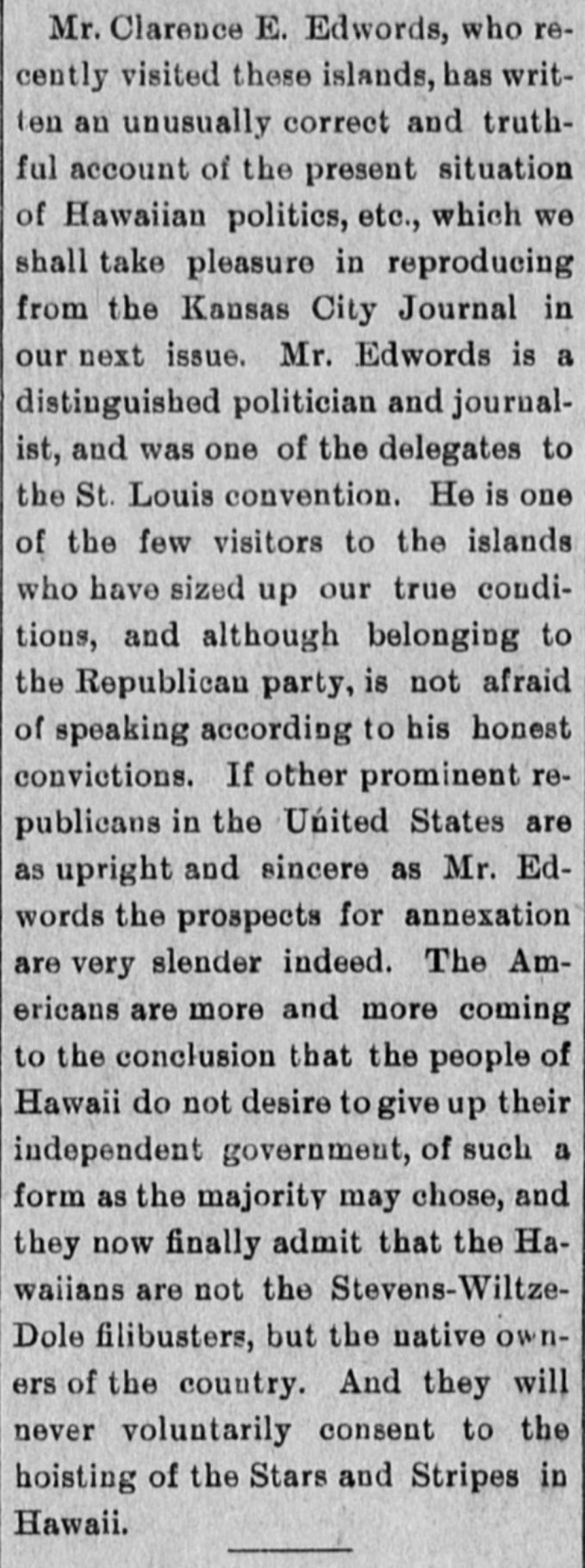
Clarence E. Edwords and the political situation in Hawaii, 1896.

Mr. Clarence E. Edwords, who recently visited these islands, has written an unusually correct and truthful account of the present situation of Hawaiian politics, etc. which we shall take pleasure in reproducing from the Kansas City Journal in our next issue. Mr. Edwords is a distinguished politician and journalist, and was one of the delegates to the St. Louis convention. He is one of the few visitors to the islands who have sized up our true conditions, and although belonging to the Republican party, is not afraid of speaking according to his honest convictions. If other prominent republicans in the United States are as upright and sincere as Mr. Edwords the prospects for annexation are very slender indeed. The Americans are more and more coming to the conclusion that the people of Hawaii do not desire to give up their independent government, of such a form as the majority may chose, and they now finally admit that the Hawaiians are not the Stevens-Wiltze-Dole filibusters, but the native owners of the country. And they will never voluntarily consent to the hoisting of the Stars and Stripes in Hawaii.

[I will try to put up the entire Clarence E. Edwords text tomorrow!]

(Independent, 7/10/1896, p. 2)

Mr. Clarence E. Edwords...

The Independent, Volume III, Number 322, Page 2. July 10, 1896.

More on Clarence E. Edwords, 1896.

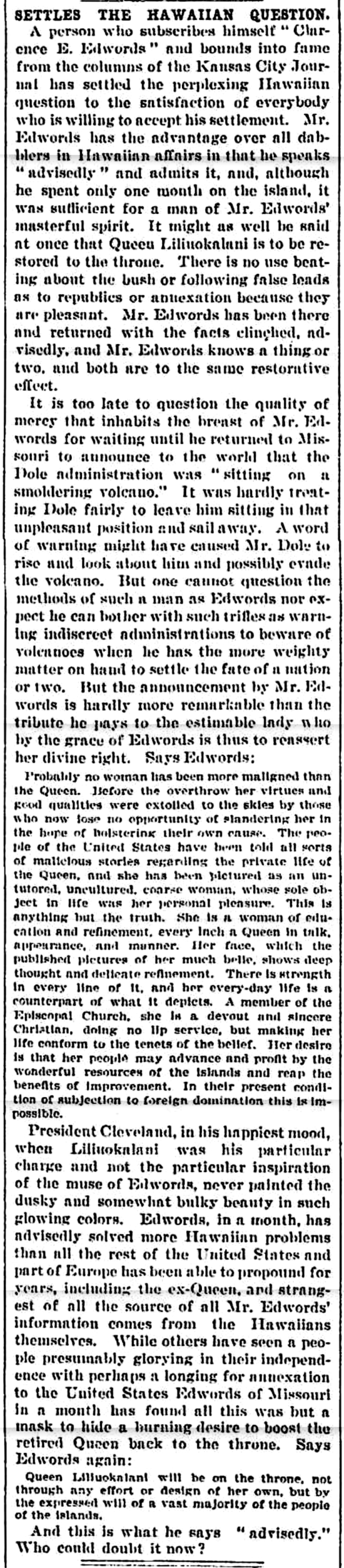
SETTLES THE HAWAIIAN QUESTION.

A person who subscribes himself “Clarence E. Edwords” and bounds into fame from the columns of the Kansas City Journal has settled the perplexing Hawaiian question to the satisfaction of everybody who is willing to accept his settlement. Mr. Edwords has the advantage over all dabblers in Hawaiian affairs in that he speaks “advisedly” and admits it, and, although he spent only one month on the island, it was sufficient for a man of Mr. Edwords’ masterful spirit. It might as well be said at once that Queen Liliuokalani is to be restored to the throne. There is no use beating about the bush or following false leads as to republics or annexation because they are pleasant. Mr. Edwords has been there and returned with the facts clinched, advisedly, and Mr. Edwords knows a thing or two, and both are to the same restorative effect.

It is too late to question the quality of mercy that inhabits the breast of Mr. Edwords for waiting until he returned to Missouri to announce to the world that the Dole administration was “sitting on a smoldering volcano.” It was hardly treating Dole fairly to leave him sitting in that unpleasant position and sail away. A word of warning might have caused Mr. Dole to rise and look about him and possibly evade the volcano. But one cannot question the methods of such a man as Edwords nor expect he can bother with such trifles as warning indiscreet administrations to beware of volcanoes when he has the more weighty matter on hand to settle the fate of a nation or two. But the announcement by Mr. Edwords is hardly more remarkable than the tribute he pays to the estimable lady who by the grace of Edwords is thus to reassert her divine right. Says Edwords:

Probably no woman has been more maligned than the Queen. Before the overthrow her virtues and good qualities were extolled to the skies by those who now lose no opportunity to slandering her in the hope of bolstering their own cause. The people of the United States have been told all sorts of malicious stories regarding the private life of the Queen, and she has been pictured as an untutored, uncultured, coarse woman, whose sole object in life was her personal pleasure. This is anything but the truth. She is a woman of education and refinement, every inch a Queen in talk, appearance, and manner. Her face, which the published pictures of her much belie, shows deep thought and delicate refinement. There is strength in every line of it, and her every-day life is a counterpart of what it depicts. A member of the Episcopal Church, she is a devout and sincere Christian, doing no lip service, but making her life conform to the tenets of the belief. Heer desire is that her people may advance and profit by the wonderful resources of the islands and reap the benefits of improvement. In their present condition of subjection to foreign domination this is impossible.

President Cleveland, in his happiest mood, when Liliuokalani was his particular charge and not the particular inspiration of the muse of Edwords, never painted the dusky and somewhat bulky beauty in such glowing colors. Edwords, in a month, has advisedly solved more Hawaiian problems than all the rest of the United States and part of Europe has been able to propound for years, including the ex-Queen, and strangest of all the source of Mr. Edwords’ information comes from the Hawaiians themselves. While others have seen a people presumably glorying in their independence with perhaps a longing for annexation to the United States Edwords of Missouri in a month has found all this was but a mask to hide a burning desire to boost the retired Queen back to the throne. Says Edwords again:

Queen Liliuokalani will be on the throne, not through any effort or design of her own, but by the expressed will of a vast majority of the people of the islands.

And this is what he says “advisedly.” Who could doubt it now?

[Unfortunately, the 1896 Kansas City Journal issues are not available online. Edwords seems to have been the managing editor and owner of that newspaper.]

(Chicago Tribune, 7/7/1896, p. 6)

SETTLES THE HAWAIIAN QUESTION.

The Chicago Tribune, Volume LV, Number 189, Page 6. July 7, 1896.

“Kuu Moi,” a patriotic mele by Clarence E. Edwords, 1896.

Kuu Moi.

Oh Lydia, Heaven born child of the sun!
Liliuokalani, aloha, kuu Moi!
True sovereign of the sun kissed isles of the sea,
Let it not be said that they race is now run.
How shall the intruders for their crimes atone?
For the vile indignities cast upon thee?
Oh, what, indeed, should the fit punishment be
For those who so basely robbed thee of thy throne?
Even now with stones they children are fed;
Aye, but it were better that they should be dead
Than pledged allegiance to the foreign born band,
Or take subsistence from their accursed hand.
Akua mana loa forbid it be said
That thy people deserted their native land.

Clarence E. Edwords.

[Does anyone know the story of Clarence E. Edwords?? There are some nice references to what is happens with the patriots of the Royal Hawaiian Band choosing to eat stones before pledging allegiance to the Provisional Government. Ellen Predergast composes “Mele Ai Pohaku,” and Clarence E. Edwords composes “Kuu Moi.”]

(Makaainana, 7/13/1896, p. 1)

Kuu Moi.

Ka Makaainana, Buke VI—-Ano Hou, Helu 2, Aoao 1. Iulai 13, 1896.

More on the commemorative tablets, but from the pen of Edward Kamakau Lilikalani himself, 1907.

COMMEMORATIVE SERVICE AT KAWAIAHAO

Memorial Tablets to the Alii of the Land are Unveiled.

This past Sunday the Kawaiahao Church was filled to listen to the commemorative program for John Ii, Haalilio, Haalelea, and Ululani; the people whose names are inscribed on the marble tablets placed in the church.

On the wall mauka at the pulpit of the pastor is where the marble tablet of John Ii is placed, and mauka of the central door to enter into the chapel [keena pule] is where the tablet of the last three names.

The Kaahumanu Society came in great numbers on this day, and one side of the church was filled with them, and there were many visitors who came to witness the events held on that day.

It was Rev. H. H. Parker who introduced the two that gave the speeches about the history of those who were being memorialized on that day, they being Rev. S. L. Desha and the Hon. E. K. Lilikalani.

Rev. S. L. Desha’s speech relied heavily upon his introductory words that morning about the woman who anointed the feet of Jesus, and just as the words of the Lord speaks of the actions of that woman becoming something remembered, in that same way Desha presented things about John Ii.

He spoke of the story of this man from his childhood, and he was one of the intelligent ones who gave great assistance in guiding the nation forward.

When the missionary teachers urged the King to educate him, he chose John Ii to be educated along with the younger brother of the King; this showed the King had much trust in this man.

In the administration of the nation, John Ii was the first amongst the Hawaiians who the King chose for an important post. When a commissioner was being chosen to give lands to the people, he was one who was selected, and he rose to the position of judge on the Supreme Court.

When the King received instruction from San Francisco to send someone from Hawaii to sit in the jury of that city pertaining to the crime committed by a Hawaiian [Harry Kaheleiki], it was indeed John Ii who the king chose to send to hear this case, and this man’s abilities and intelligence was seen through his actions.

In his attitude towards religion, he was a man who always stuck to what was right, and he gave sermons at the Church of Ewa. It is said that if it was heard that he was the one to be speaking, the church would be filled, and people stood outside, and on one Sunday when he went to go pray, when he was headed home, he fell from his horse and broke a rib, and that was his ailment which persisted until his death.

It is said in the history of this man, he was a man of strength, and the Alii were of great importance to him. As a result of an accident involving one of the Alii, that being the Alii falling from a horse, he did not wait to find out the cause of this distress to the Alii, but his outrage was focused upon the horse, and in his anger, with but one punch he struck the horse and it died.

After the words about John Ii was done, the Hon. E. K. Lilikalani stood and read the story of the second part of the events of that day, and we are printing what he presented for them, just as he read, and here it is below:

Whereas:—The second portion of the events of this day is the dedication of the commemorative tablet for Ululani and Haalelea which is affixed to the wall in front of this church.

This gift was not on account of just one person, but it is a present from the people. It is the members, intimates, and friends of the Kawaiahao Church showing the family of the ones who died their aloha and their never-ending remembrance of Ululani Haalelea.

The reason and the cause that this endeavor was carried out by the members and it was decided to place it here in this church of Kawaiahao:

Whereas, Ululani did a great deed for this church and its members, over a long period of time, during her lifetime, and she was a brethren of this Church.

With the auspices of the Church, along with this commemorative speech, will be attached the history of her life, her birth, her fine works, and the list of names of the intimates and friends who were involved, and will be gifted to the family of Ululani Haalelea here in Honolulu and in other places.

(See page 8.)

(Kuokoa, 10/18/1907, p. 1)

ANAINA HOOMANAO MA KAWAIAHAO

Ka Nupepa Kuokoa, Buke XLII, Helu 42, Aoao 1. Okatoba 18, 1907.

COMMEMORATIVE SERVICE AT KAWAIAHAO.

(From page 1.)

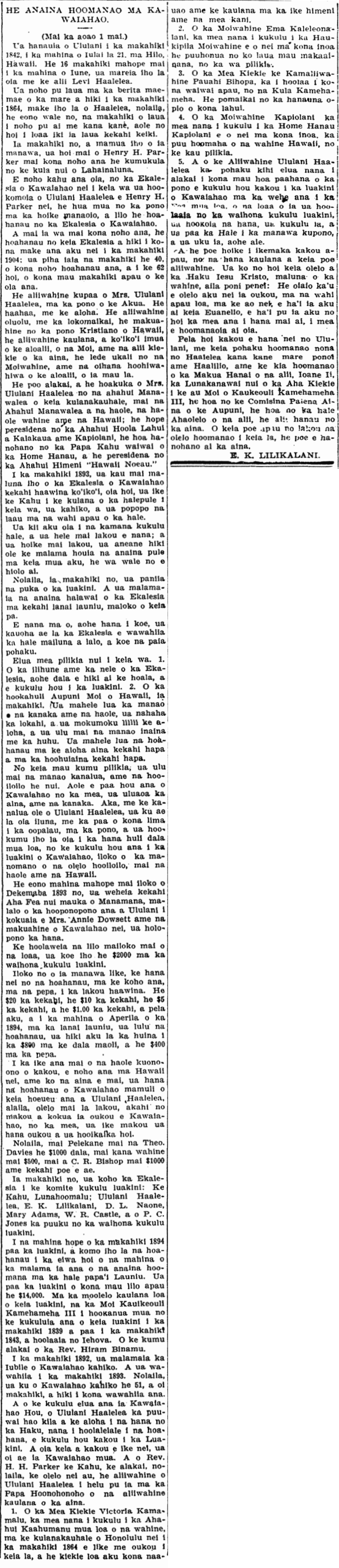
Ululani was born in they year 1842, in the month of July on the 21st, at Hilo, Hawaii. Sixteen years later, in the month of June, she was married to the alii, Levi Haalelea.

They lived in the holy covenant of matrimony until 1864, when Haalelea died; therefore, she only lived with her husband for six years, and they had not children.

In that very year, and a just before that time, Henry H. Parker came from his position as teacher at Lahainaluna College.

He was to serve as kahu of Kawaiahao Church, and it was then Ululani Haalelea was included into the church by this Henry H. Parker; she was the first fruit for righteousness in her confession of faith [hoike manaoio], and she became a member of the Kawaiahao Church.

And from then on she remained a member of the Church until her recent death in 1904; she was a member for 40 years, in her 62 years of life.

Mrs. Ululani Haalelea was a chiefess who was steadfast in the righteousness of God. She was humble with aloha. She was pleasant and benevolent, she was a mother for the Christian good in Hawaii, she was a famous chiefess and prominent among the Courts of the Monarchs, and the high chiefs of the land, she was an attendant of Queens, and held honored positions in the courts of those days.

Mrs. Ululani Haalelea was a leader and an adviser of the Beneficent association of this town, from the Beneficent Associations of the haole, to the haole women and to the Hawaiians; she was the vice president of the Ahahui Hoola Lahui of Kalakaua and Kapiolani, she was a distinguished member of the board of trustees of the Maternity Home, and a president of the Choir “Hawaii Noeau.”

In 1893, a difficult situation fell upon the membership of Kawaiahao, that being the Kahu realized the state of the church at that time; it was old and the wood all over the building was rotting.

He fetched carpenters and they came and looked; they said that shortly services could not be held in the near future; it was just a matter of time before it fell.

Therefore, that very year, the doors of the church were shut. And the meetings of the members were held in a coconut front lanai upon this grounds.

Looking on, there was nothing left to do; the members ordered the building be torn down from top to bottom, leaving only the stone walls.

There were two big problems at the time. 1. The poor and needy state of the Church; there was no money to reestablish and rebuild the church. 2. the overthrowing of the Monarchy of Hawaii that year. The thoughts of the Hawaiians and the haole were cleaved in two, the unity was broken, and aloha was broken into bits, and feelings of rage and anger grew. The church members were split in two with one group being patriots while the other group being for annexation.

Because of these problems, there grew many doubts and predictions of disaster. Kawaiahao would not be built anew for the land and the people were in turmoil. But Ululani Haalelea had no doubt, she stood up and holding a plow in her hand, in righteousness, and she set up the very first money-making event to rebuild Kawaiahao Church, among the many words of doom from the haole and Hawaiians alike.

Six months later, in December 1893, a great Fair [Aha Fea] was held in the uplands of Manamana, under the direction of Ululani assisted by Mrs. Annie Dowsett and the mothers of Kawaiahao, and the effort went smoothly.

Subtracting the expenses from the profits, what was left was $2000 in the funds to build the church.

At the same time, the members took action by figuring out on paper their donations. Some put $20, some $10, some $5, some $1.00, and so forth, and in the month of April of 1894, in the coconut frond lanai, the members gave their donations which totaled to $890 in cash, and $400 on paper.

When the wealthy haole amongst us living in Hawaii nei as well as in foreign lands saw that the members of Kawaiahao were taking action at the urging of Ululani Haalelea, they said, [“]We will now give you aid, O Kawaiahao, for we see that you are working and putting in great effort.[“]

Therefore, from Britain, from Theo. Davies, came $1000; from his wife $500; from C. R. Bishop $1000; and some others.

In that same year, the members chose a committee for the building of the church: The Kahu, Chairman; Ululani Haalelea, E. K. Lilikalani, D. L. Naone, Mary Adams, W. R. Castle, and P. C. Jones was the treasurer for the funds to build the church.

In the closing months of 1894, the church was completed, and the members entered after nine months of holding services in the Coconut frond  hut [hale papa’i Launiu]. The church was complete with the total expenses being $14,000. In the famous history of this church, it was King Kauikeaouli Kamehameha III who first set up the building of this church in the year 1839, and it was complete in 1843 and consecrated to Jehovah. Its head was Rev. Hiram Bingham [Rev. Hiram Binamu].

In 1892, the Jubilee of the old Kawaiahao was held. And it was torn down in 1893. Therefore the old Kawaiahao stood for 51 years before it was razed.

And in the reconstruction of the New Kawaiahao, Ululani Haalelea was the one with a steel heart of aloha in the works for the Lord who inspired the brethren, [“]Let’s rebuild the Church.[“] And this is what we see now, that it is better than the previous Kawaiahao. And Rev. H. H. Parker is the Kahu, the leader; therefore I say that Ululani Haalelea is a Chiefess who is ranked in the List of famous chiefesses of the land.

    1. Her Highness Victoria Kamamalu, was the one to establish the first Kaahumanu Society of women here in the town of Honolulu in 1864, just as you all on this day, and she was extremely intelligent and famous for her knowledge in singing and musical instruments.
    2. Queen Ema Kaleleonalani, was the one who established the Queen’s Hospital which is called by her name, a place of refuge for their [Queen Emma and Kamehameha IV] citizens in times of trouble.
    3. Her Highness, Princess Pauahi Bishop, dedicated all of her wealth for the Kamehameha Schools. A blessing for the generations of youth of her lahui.
    4. Queen Kapiolani was the one who established the Kapiolani Maternity Hospital called by her name, the place of rest for Hawaiian women for their periods of difficulty.
    5. And the Chiefess Ululani Haalelea, the second cornerstone, the one who lead her fellow laborers of good, [“]Let’s rebuild the Kawaiahao Church,[“] by establishing the first Fair [Fea], and the proceeds from it was dedicated to the funds for the construction of the church, and this was carried out, and it was built, and the Building was completed in time and paid off with no debt.

And we all are witnesses who see firsthand the famous works of these chiefesses. Those words of the Lord Jesus Christ about that woman who anointed him in oil were fulfilled: Verily I say unto you, Wheresoever this gospel shall be preached throughout the whole world, this also that she hath done shall be spoken of for a memorial of her.

In that way we are remembering Ululani, with this stone monument for her, for Haalelea, her own husband, and for Haalilio; along with the monument to the Hanai Parent of the chiefs, Ioane Ii, the great Judge of the Supreme Court during the reign of Kauikeaouli Kamehameha III,  a member of the National Boundary Commission, a member of the House of Nobles, and a native born chief. It was for all of them that the speeches of commemoration on this day were given, people who give pride to this land.

E. K. LILIKALANI.

[It is interesting to compare this account by E. K. Lilikalani with the account presented earlier in the PCA on 10/14/1907.]

(Kuokoa, 10/18/1907, p. 8)

HE ANAINA HOOMANAO MA KAWAIAHAO.

Ka Nupepa Kuokoa, Buke XLII, Helu 42, Aoao 8. Okatoba 18, 1907.

Memorial tablets in honor of John Papa Ii, Timoteo Haalilio, Levi Haalelea, and Ululani Haalelea, 1907.

TABLETS TO ALII KAWAIAHAOANS

Dedicatory Services at Old Church Yesterday Morning.

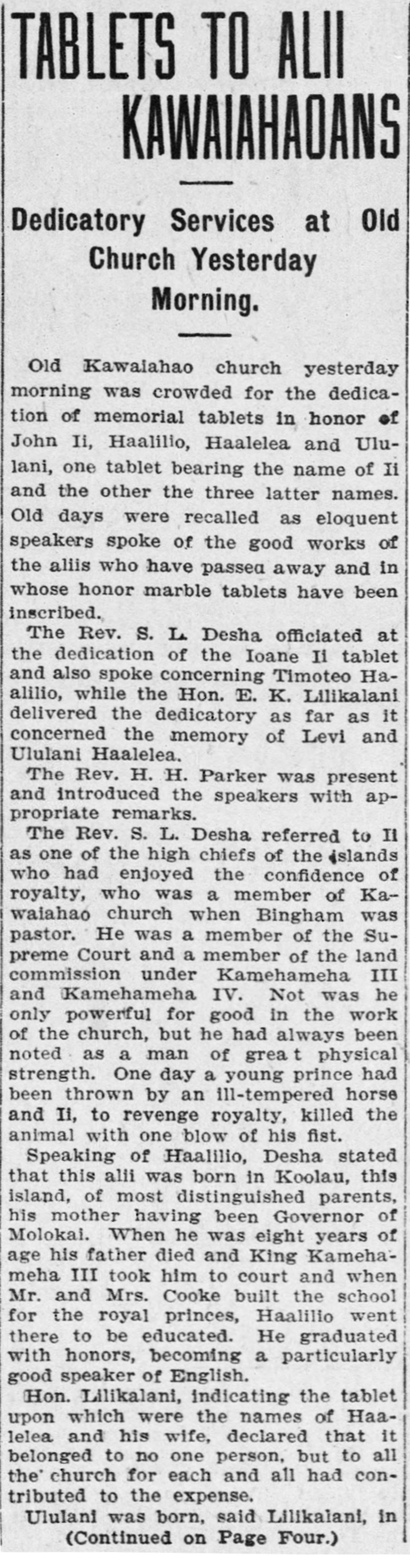
Old Kawaiahao church yesterday morning was crowded for the dedication of memorial tablets in honor of John Ii, Haalilio, Haalelea and Ululani, one tablet bearing the name of Ii and the other the three latter names. Old days were recalled as eloquent speakers spoke of the good works of the aliis who have passed away and in whose honor marble tablets have been inscribed.

The Rev. S. L. Desha officiated at the dedication of the Ioane Ii tablet and also spoke concerning Timoteo Haalilio, while the Hon. E. K. Lilikalani delivered the dedicatory as far as it concerned the memory of Levi and Ululani Haalelea.

The Rev. H. H. Parker was present and introduced the speakers with appropriate remarks.

The Rev. S. L. Desha referred to Ii as one of the high chieffs of the islands who had enjoyed the confidence of royalty, who was a member of Kawaiahao church when Bingham was pastor. He was a member of the Supreme Court and a member of the land commission under Kamehameha III and Kamehameha IV. Not was he only powerful for good in the work of the church, but he had always been noted as a man of great physical strength. One day a young prince had been thrown by an ill-tempered horse and Ii, to revenge royalty, killed the animal with one blow of his fist.

Speaking of Haalilio, Desha stated that this alii was born in Koolau, this island, of most distinguished parents, his mother having been Governor of Molokai. When he was eight years of age his father died and King Kamehameha III took him to court and when Mr. and Mrs. Cooke built the school for the royal princes, Haalilio went there to be educated. He graduated with honors, becoming a particularly good speaker of English.

Hon. Lilikalani, indicating the tablet upon which were the names of Haalelea and his wife, declared that it belonged to no one person, but to all the church for each and all had contributed to the expense.

Ululani was born, said Lilikalani, in…

(Continued on Page Four.)

(Pacific Commercial Advertiser, 10/14/1907, p. 1)

TABLETS TO ALII KAWAIAHAOANS

The Pacific Commercial Advertiser, Volume XLVI, Number 7857, Page 1. October 14, 1907.

TABLETS TO ALII KAWAIAHAOANS

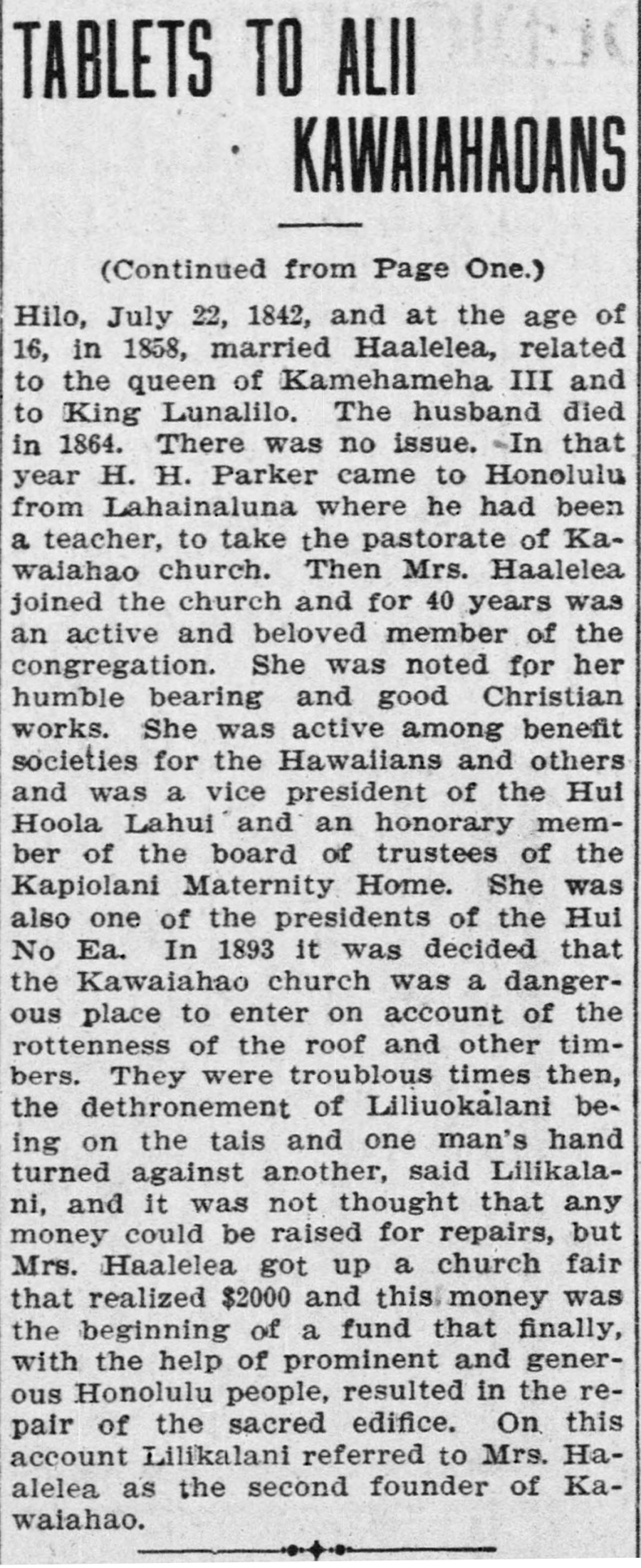
(Continued from Page One.)

Hilo, July 22, 1842, and at the age of 16, in 1858, married Haalelea, related to the queen of Kamehameha III and to King Lunalilo. The husband died in 1864. There was no issue. In that year H. H. Parker came to Honolulu from Lahainaluna where he had been a teacher, to take the pastorate of Kawaiahao church. Then Mrs. Haalelea joined the church and for 40 years was an active and beloved member of the congregation. She was noted for her humble bearing and good Christian works. She was active among benefit societies for the Hawaiians and others and was a vice president of the Hui Hoola Lahui and an honorary member of the board of trustees of the Kapiolani Maternity Home. She was also one of the presidents of the Hui No Ea. In 1893 it was decided that the Kawaiahao church was a dangerous place to enter on account of the rottenness of the roof and other timbers. They were troublous times then, the dethronement of Liliuokalani being the tais and one man’s hand turned against another, said Lilikalani, and it was not thought that any money could be raised for repairs, but Mrs. Haalelea got up a church fair that realized $2000 and this money was the beginning of a fund that finally, with the help of prominent and generous Honolulu people, resulted in the repair of the sacred edifice. On this account Lilikalani referred to Mrs. Haalelea as the second founder of Kawaiahao.

[Check out this article on the same topic found in one of the Hawaiian-Language Newspapers, written by E. K. Lilikalani himself!]

(Pacific Commercial Advertiser, 10/14/1907, p. 4)

TABLETS TO ALII KAWAIAHAOANS

The Pacific Commercial Advertiser, Volume XLVI, Number 7857, Page 4. October 14, 1907.

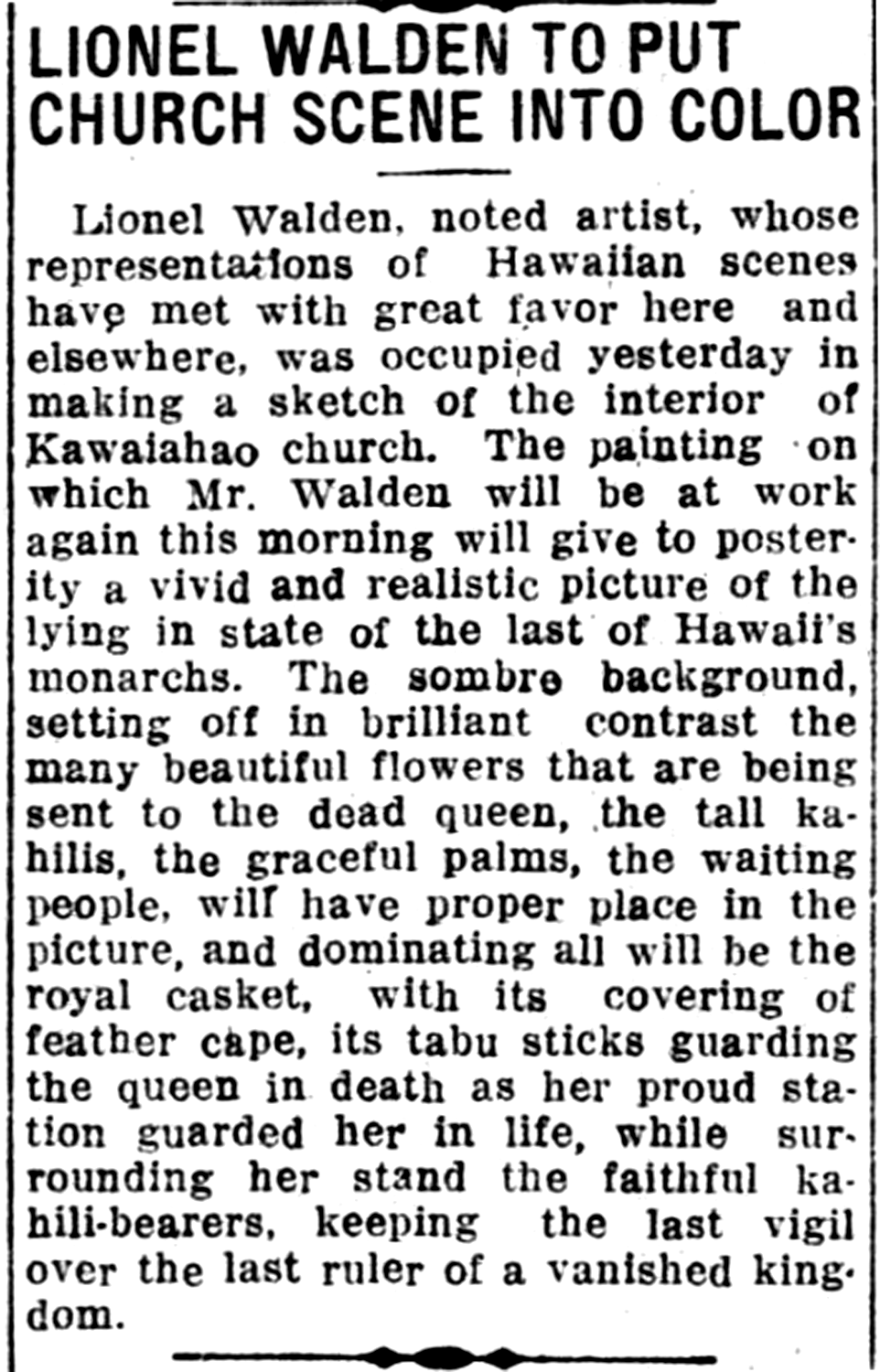
Painting of lying in state of Queen Liliuokalani by Lionel Walden? 1917.

LIONEL WALDEN TO PUT CHURCH SCENE INTO COLOR

Lionel Walden, noted artist, whose representations of Hawaiian scenes met with great favor here and elsewhere, was occupied yesterday in making a sketch of the interior of Kawaiahao church. The painting on which Mr. Walden will be at work again this morning will give to posterity a vivid and realistic picture of the lying in state of the last of Hawaii’s monarchs. The somber background, setting off in brilliant contrast the many beautiful flowers that are being sent to the dead queen, the tall kahilis, the graceful palms, the waiting people, will have proper place in the picture, and dominating all will be the royal casket, with its covering of feather cape, its tabu sticks guarding the queen in death as her proud station guarded her in life, while surrounding her stand the faithful kahili-bearers, keeping the last vigil over the last ruler of a vanished kingdom.

[Wow. Does anyone know if this painting was completed and if so, where it is now?]

(Honolulu Star-Bulletin, 11/15/1917, p. 2)

LIONEL WALDEN TO PUT CHURCH SCENE INTO COLOR

Honolulu Star-Bulletin, Volume XXV, Number 7985, Page 2. November 15, 1917.

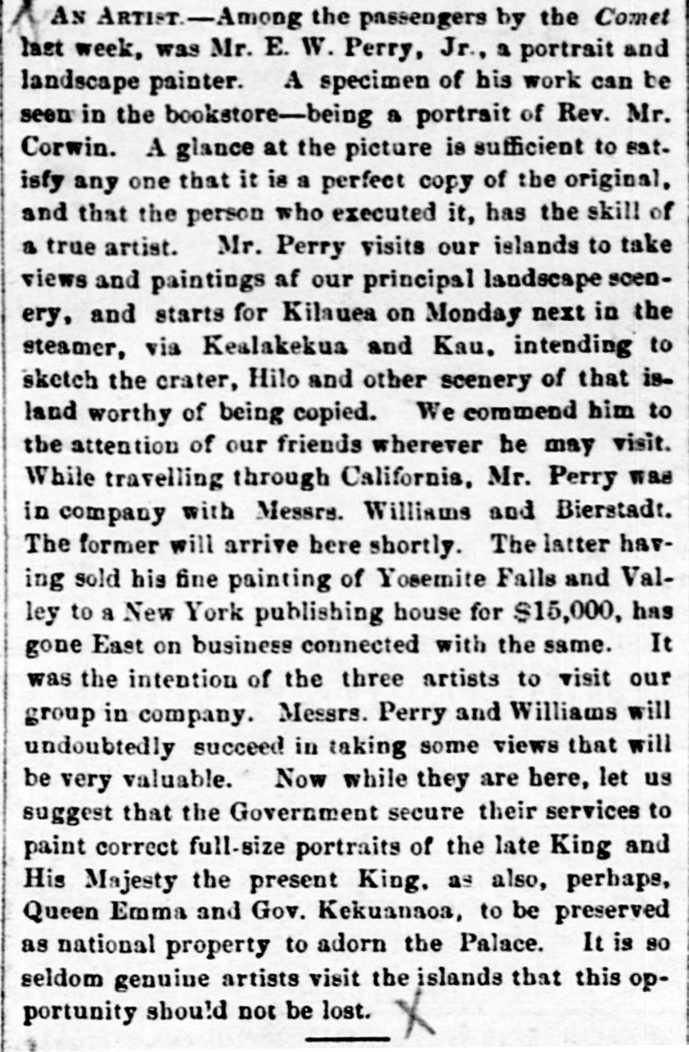
Enoch Wood Perry Jr. arrives, 1864.

An Artist.—Among the passengers by the Comet last week, was Mr. E. W. Perry, Jr., a portrait and landscape painter. A specimen of his work can be seen in the bookstore—being a portrait of Rev. Mr. Corwin. A glance at the picture is sufficient to satisfy any one that it is a perfect copy of the original, and that the person who executed it, has the skill of a true artist. Mr. Perry visits our islands to take views and paintings af our principal landscape scenery, and starts for Kilauea on Monday next in the steamer, via Kealakekua and Kau, intending to sketch the crater, Hilo and other scenery of that island worthy of being copied. We commend him to the attention of our friends wherever he may visit. While travelling through California, Mr. Perry was in company with Messrs. Williams and Bierstadt. The former will arrive here shortly. The latter having sold his fine painting of Yosemite Falls and Valley to a New York publishing house for $15,000, has gone East on business connected with the same. It was the intention of the three artists to visit our group in company. Messrs. Perry and Williams will undoubtedly succeed in taking some views that will be very valuable. Now while they are here, let us suggest that the Government secure their services to paint correct full-size portraits of the late King and His Majesty the present King, as also, perhaps, Queen Emma and Gov. Kekuanaoa, to be preserved as national property to adorn the Palace. It is so seldom genuine artists visit the islands that this opportunity should not be lost.

[Perry is the artist who painted the famous portrait of Ka Haku o Hawaii with his dog. He also seems to have painted a portrait of Levi Haalelea!

I am not sure who the Williams mentioned in the article is, but the other painter is most likely Albert Bierstadt.]

(Pacific Commercial Advertiser, 10/1/1864, p. 2)

An Artist.

The Pacific Commercial Advertiser, Volume IX, Number 14, Page 2. October 1, 1864.

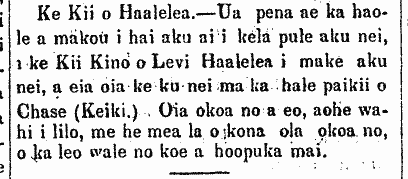
Portrait of Levi Haalelea, 1864.

[Found under: “NA MEA HOU O HAWAII NEI.”]

Portrait of Haalelea.—The haole which we spoke of the other week has painted a Portrait of Levi Haalelea who has passed, and it is now in the photography studio of Chase (Keiki). It remains victorious, and has not lessened at all, as if he is still living, it is just missing his voice coming forth.

[Here is the article mentioning the artist’s name. And here is another found in the Pacific Commercial Advertiser with more data.

Does anyone know the whereabouts of this painting by famous painter Enoch Wood Perry Jr.? I would appreciate it if you all might repost this article wherever you think an answer could be found!]

(Kuokoa, 12/24/1864, p. 2)

Ke Kii o Haalelea

Ka Nupepa Kuokoa, Buke III, Helu 52, Aoao 2. Dekemaba 24, 1864.

Queen Liliuokalani’s gift to the leprosy patients, 1891.

GIFT OF ALOHA TO THE LEPROSY PATIENTS AT KALIHI.

We each all are going without a companion at our side, and no child before us or at our back, it is just our lone bodies going naked to the Colony of Kalawao, and there is no way out of it for us for there is the law of our beloved land upon our shoulders.

These red silk kerchiefs which you see on our necks, and your sums of money in our hands this day, it is a memorial for us during the days of our lives in this dejected world, until the dust of that unfamiliar land is spread upon our bodies, and this decaying body returns to the earth, and the spirit returns to God.

Therefore, may your majesty take our great thanks for you. And that is when the Queen replied:

I take your thanks with me, and you will go and you will see my children, those are your seniors living upon that great flat lands, and perhaps we will all be there, but we do not know.

This was the touching statement, and the close to the conversation with the Queen.

Here are the names of the patients taken and their place of residence.

Miss Helina Kaiwaokalani Maikai, Miss Kaehuokalani, Miss M. Kalama [? Miss M. Kalaina], they are from Honolulu; Napoliona Keawe (m), from Manoa, Oahu; Miss Mapo (f), Kahaku (m), from Waialua, Oahu; Ah Ping from Hanalei, Kauai; Henry Keku, Akoi, from Wailuku; Alualu (f), Ulunui (f) from Waikapu; Maraea Kaluna from Olowalu; Liwai Haalelea from Kukuihaele, Hawaii.

These are the patients left at the receiving station of Kalihi:

W. K. Makakoa, G. K. Kepoikai, from Waiehu, Maui; Josiah Kaina from Lihue, Kauai; William Kalani Kalua from Puako, Waimea, Hawaii.

These are the patients who have not been examined by the Doctors:

Keopuhiwa from Hana; Keoahu (f), and Huliwaa (f), and Lutiana Keliikaapuni (f), from Kaupo, Maui; and Joe, a Portuguese boy from Honolulu.

On the 17th of July, Mrs. Kaikioewa Ulukou gave gifts once again to the patients at Kalihi.

Aloha one and all.

WILLIE KALIKOKALANI.

Kalihi Hospital, July 20, 1891.

[Might anyone know how/if Liwai Haalelea and Levi Haalelea (d. 1864) are related?]

(Leo o ka Lahui, 7/29/1891, p. 2)

HE MAKANA ALOHA I NA MA'I LEPERA MA KALIHI.

Ka Leo o ka Lahui, Buke II, Helu 247, Aoao 2. Iulai 29, 1891.