More awesome patriotic mele by Eleanor Prendergast, 1893.

HE WEHI NO KA LAHUI.

He inoa keia no ka lahui
Na ewe hanau o ka aina
Na pua na mamo na oiwi
A ka I a ka Mahi me ka Palena
E ala e lohe i ka welina
Ka’u kanaenae no Hawaii
Lahui malama i ka maluhia
Kupaa i ka pono o ke Kalaunu
Palekaua ia o ka manaoio
A he kolopa nana e une
Na pali kapu a o Kilauea
Ua paa i ke ahi a ka Wahine
I ke aiwaiwa o ke ao nei
Nana e hooni puni ka honua
Ike ia Hawaii a he moku nui
I ke o-i ana iho paa i ka mole
Keehi kulana i Ainaike
Ike ia kaua he hoa kanaka
Hookahi puuwai o ke aloha
Kakoo i kuu one hanau
Kihapai ia no Edena
Ua piha i ka ono me ke kuhinia
Nawai e ole a e makahehi
Na manu Aiko o ka Hikina mai
I ka ike i ka nani me ka hemolele
Aina o ka meli me ka waiu
E kahe ana ia me ke aliali
Me he wai hau ala no Helemona
Kona mau kuahiwi a he kilakila
He molale i ka maka ke ike aku
Ka makani kupa hoi a he aheahe
Kona mau kapakai a he malie
Na ulu laau a he uliuli
O kona mau pua e popohe ana
A he waianuahea kona aala [A he waianuhea kona aala]
E poina ole ai ke hoomanao
Mukiki ana i ka pua lehua
Ahe nani hiehie kona hiona
He nohea me he manu Nunu ala
Ka opua ua hoi ua haaheo
O ke anuenue e pipio ana
O ka oi no ia i ka’u ike
Aole ona lua e like ai
Kaena ana au me ka haaheo
No kuu aina i hanau ai
He momi i loaa mailuna mai
A he lei kaimana no ka lahui
E ola kakou a pau loa
Ma ka inoa o ka Haku Mana Loa
Haina e ka wehi i kaulana
He mele lahui no Hawaii.

Composed for the patriots

Miss Kekoaohiwaikalani,

Puahaulani Hale.

Honolulu, Feb. 10, 1893.

(Leo o ka Lahui, 2/16/1893, p. 3)

HE WEHI NO KA LAHUI.

Ka Leo o ka Lahui, Buke II, Helu 643, Aoao 3. Feberuari 16, 1893.

More patriotic mele composed by Eleanor Prendergast, 1893.

HE WEHI KAULANA NO KA LAHUI.

Eia Hawaii ua Lanakila,
Aina kaulana i ka hanohano,
Haaheo na Pua me na Mamo
A ka I a ka Mahi me ka Palena.
Lahui pookela o ke ao nei
Hookipa oluolu i ka malihini;
Puuwai hamama me ke aloha
Lokomaikai piha he manawalea.
Kui ai e ka lono puni ka honua
No ka hana kaulana a ka Lahui,
Malama maluhia me ka hoopono,
He manao kupaa me ka wiwoole.
Aohe puni wale i ka Lilelile,
I ka mali leo mai a ke Kolea.
Oiai ua kila ia ua paa
Ke aloha aina i ka puuwai.
Ua ewe, ua mole, ua onipaa.
Ua ku i ka piko kapu o Wakea.
Hookahi mea nui a ka manao
A e ake nei a e hookoia;
O ke Alii Aimoku i ke Aupuni
O ka aina hoi a e maluhia,
O ka Hae Kalaunu e welo ana
Haaheo mai ana i kona nani.
Hoike mai ana i ka Lahui
Ua hoi hou e ka Ea o ka Aina.
Lanakila mau loa aku Hawaii,
Me kona Hae nani oi kelakela.
Haina e ka wehi i kaulana
Na Pua i Aloha i ka Aina.

Miss Keko’aohiwaikalani

Puahaulani Hale.

Kawaiiki, Nov. 8th, 1893.

(Leo o ka Lahui, 11/10/1893, p. 3)

HE WEHI KAULANA NO KA LAHUI.

Ka Leo o ka Lahui, Buke II, Helu 810, Aoao 3. Novemaba 10, 1893.

Another patriotic mele by Eleanor Prendergast, 1893.

KE ALOHA AINA.

1st.  Kahiko ka ohu i Nuuanu
I ka hoku a ka lau Kawelu
Ua lupea ia e ka moani
Hoope aala oia uka.

Hui:  He halia he aloha keia
No kuu aina hanau
A’u e hiipoi mau nei
No ka lanakila o Hawaii.

2nd.  Ua nani ka pua o ka Ilima
I pilia mai me ka Maile
I wehi hoohie no ke kino
Kahiko mau no Hawaii.

3rd.  Kamahao ka ike’na i ka nani
I ka wai Lehua a na manu
Manu inu wai pua Ohelo
Iiwipolena o ke Kuahiwi.

Miss Kekoaohiwaikalani.

Puahaulani Hale.

Honolulu, Mar. 25, 1893.

(Leo o ka Lahui, 4/24/1893, p. 1)

KE ALOHA AINA.

Ka Leo o ka Lahui, Buke II, Helu 690, Aoao 1. Aperila 24, 1893.

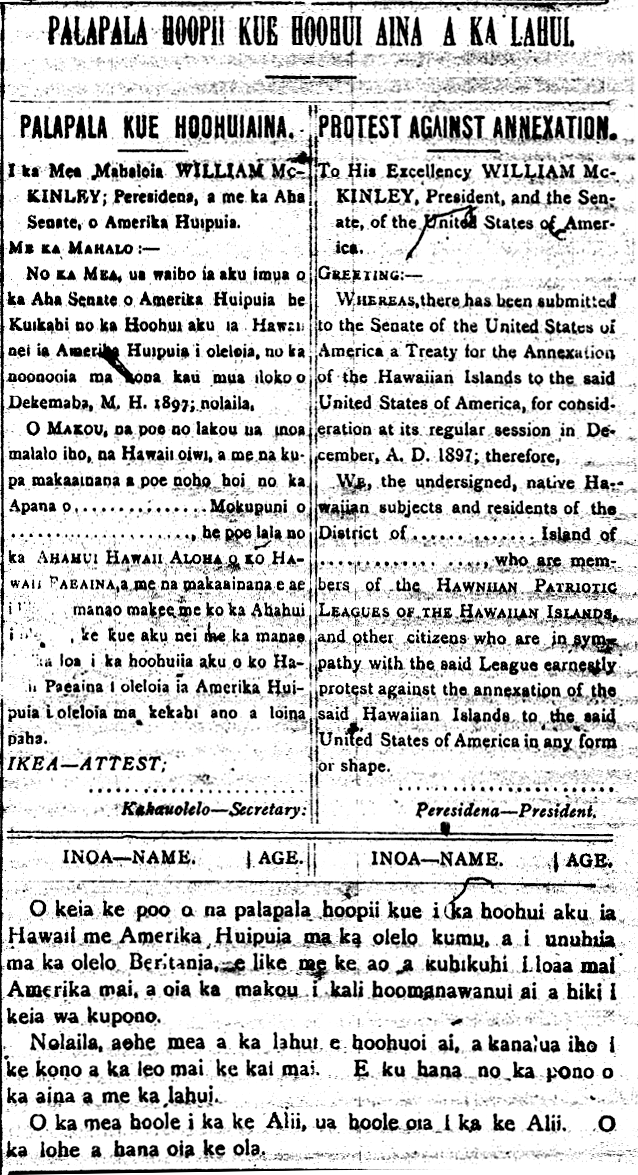
PETITION OF THE PEOPLE PROTESTING AGAINST ANNEXATION, 1897.

PALAPALA HOOPII KUE HOOHUI AINA A KA LAHUI.

PALAPALA KUE HOOHUIAINA.

I ka Mea Mahaloia WILLIAM McKINLEY; Peresidena, a me ka Aha Senate, o Amerika Huipuia.

Me ka Mahalo:—

No ka Mea, ua waiho ia aku imua o ka Aha Senate o Amerika Huipuia he Kuikahi no ka Hoohui aku ia Hawaii nei ia Amerika Huipuia i oleloia, no ka noonoooia ma kona kau mua iloko o Dekemaba, M. H. 1897; nolaila,

O Makou, na poe no lakou na inoa malalo iho, na Hawaii oiwi, a me na kupa makaainana a poe nooho hoi no ka Apana o …………………….Mokupuni o ……………………., he poe lala no ka Ahahui Hawaii Aloha o ko Hawaii Paeaina, a me na makaainana e ae i like ka manao makee me ko ka Ahahui i oleloia, ke kue aku nei me ka manao ikaika loa i ka hoohuiia aku o ko Hawaii Paeaina i oleloia ia Amerika Huipuia i oleloia ma kekahi ano a loina paha.

IKEA—ATTEST:

…………………….

Kakauolelo—Secretary:

INOA—NAME.     Ι AGE.

PROTEST AGAINST ANNEXATION.

To His Excellency WILLIAM McKINLEY, President, and the Senate, of the United States of America.

Greeting:—

Whereas, there has been submitted to the Senate of the United States of America a Treaty for the Annexation of the Hawaiian Islands to the said United States of America, for consideration at its regular session in December, A. D. 1897; therefore,

We, the undersigned, native Hawaiian subjects and residents of the District of …………………… Island of ……………………., who are members of the Hawaiian Patriotic Leagues of the Hawaiian Islands, and other citizens who are in sympathy with the said League earnestly protest against the annexation of the said Hawaiian Islands to the said United States of America in any form or shape.

…………………….

Presidena—President.

INOA—NAME.     Ι  AGE.

This is the heading of the petitions protesting the annexation of Hawaii to the United States of America in the original language, and translated into English, and as per the instruction and direction coming from America, we waited patiently until this proper time.

Therefore, there is nothing for the lahui to be suspicious about, or to be wary when the voice from the sea beckons. Stand up and do what is pono for the land and the people.

The person who denies that of the Alii denies that of the Alii [this is probably a typo that should have read, “O ka mea hoole i ka ke Alii, ua hoole oia i ka ke Akua,” The person who denies that of the Alii denies that of God]. Listening and acting is the way to survival.

[Check here for the images of the anti-annexation petitions put up by the University of Hawaii, Hamilton Library, Hawaiian Collection.]

(Aloha Aina, 9/18/1897, p. 5)

PALAPALA HOOPII KUE HOOHUI AINA A KA LAHUI.

Ke Aloha Aina, Buke III, Helu 38, Aoao 5. Sepatemaba 18, 1897.

Mauna a Kea, Moana a Kea: Hawaii nei is sacred in its entirety, from the sun above to the land and ocean below. 1866 / today and the future.

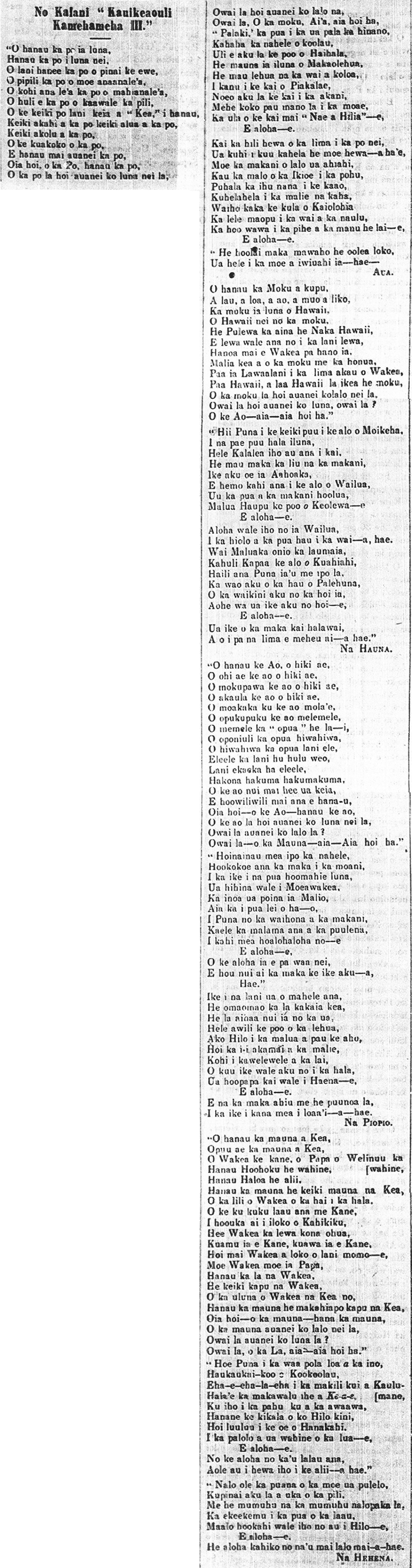
No Kalani “Kauikeaouli Kamehameha III.”

“O hanau ka po ia luna,
Hanau ka po i luna nei,
O lani hanee ka po o pinai ke ewe,
O pipili ka po o moe anaanale’a,
O kohi ana le’a ka po o mahianale’a,
O huli e ka po o kaawale ka pili,
O ke keiki po lani keia a “Kea,” i hanau,
Keiki akahi a ka po keiki alua a ka po,
Keiki akolu a ka po,
O ke kuakoko o ka po,
E hanau mai auanei ka po,
Oia hoi, o ka Po, hanau ka po,
O ka po la hoi auanei ko luna nei la,
Owai la hoi auanei ko lalo na,
Owai la, O ka moku, Ai’a, aia hoi ha,
“Palaki,” ka pua i ka ua pala ka hinano,
Kahaha ka nahele o koolau,
Uli e aku la ke poo o Haihala,
He mauna ia iluna o Makaolehua,
He mau lehua na ka wai a koloa,
I kanu i ke kai o Piakalae,
Noeo aku la ke kai i ka akani,
Mehe koko pau mano la i ka moae,
Ka ula o ke kai mai “Nae a Hilia”—e,
E aloha—e.

Kai ka hili hewa o ka lima i ka po nei,
Ua kuhi i kuu kahela he moe hewa—a ha’e,
Moe ka makani o lalo ua ahiahi,
Kau ka malo o ka Ikioe i ka pohu,
Puhala ka ihu nana i ke kaao,
Kuhelahela i ka malie na kaha,
Waiho kaka ke kula o Kaiolohia,
Ka lele maopu i ka wai a ka naulu,
Ka hoo wawa i ka piha a ka manu he lai—e,
E aloha—e.

[Na] AUA.

O hanau ka Moku a kupu,
A lau, a loa, a ao, a muo a lilo,
Ka moku ia luna o Hawaii,
O Hawaii nei no ka moku,
He Pulewa ka aina he Naka Hawaii,
E lewa wale ana no i ka lani lewa,
Hanoa mai e Wakea pa hano ia,
Malia kea a o ka moku me ka honua,
Paa ia lawaalani i ka lima akau o Wakea,
Paa Hawaii, a laa Hawaii la ikea he moku,
O ka moku la hoi auanei kolalo nei la,
Owai la hoi auanei ko luna, owai la?
O ke Ao—aia—aia hoi ha.”

“Hii Puna i ke keiki puu i ke alo o Moikeha,
I na pae puu hala iluna,
Hele Kalalea iho au ana i kai,
He mau maka ka liu na ka makani,
Ike akuu oe ia Aahoaka,
E hemo kahi ana i ke alo o Wailua,
Uu ka pua a ka makani hoolua,
Malua Haupu ke poo o Keolewa—e
E aloha—e.

Aloha wale iho no ia Wailua,
I ka hiolo a ka pua hau i ka wai—a, hae,
Wai Maluaka onio ka laumania,
Kahuli Kapaa ke alo o Kuahiahi,
Haili ana Puna ia’u me ipo la,
Ka wao aku o ka hau o Palehuna,
O ka waikini aku no ka hoi ia,
Aohe wa ua ike aku no hoi—e,
E aloha—e.
Ua ike o ka maka kai halawai,
A o i pa na lima e meheu ai—a hae.”

Na HAUNA.

“O hanau ke Ao, o hiki ae,
O ohi ae ke ao o hiki ae,
O mokupawa ke ao o hiki ae,
O akaula ke ao o hiki ae,
O moakaka ku ke ao mola’e,
O opukupuku ke ao melemele,
O memele ka “opua” he la—i,
O oponiuli ka opua hiwahiwa,
O hiwahiwa ka opua lani ele,
Eleele ka lani hu hulu weo,
Lani ekaeka ha eleele,
Hakona hakuma hakumakuma,
O ke ao nui mai hee ua keia,
E hoowiliwili mai ana e hana-u,
Oia hoi—o ke Ao—hanau ke ao,
O ke ao la hoi auanei ko luna nei la,
Owai la auanei ko lalo la?
Owai la—o ka Mauna—aia—Aia hoi ha.”

“Hoinainau mea ipo ka nahele,
Hookokoe ana ka maka i ka moani,
I ka ike i na pua hoomahie luna,
Ua hihina wale i Moeawakea,
Ka inoa ua poina ia Malio,
Aia ka i pua lei o ha—o,
I Puna no ka waihona a ka makani,
Kaele ka malama ana a ka puulena,
I kahi mea hoalohaloha no—e,
E aloha—e,
O ke aloha ia e pa waa nei,
E hou nui ai ka maka ke ike aku—a,
Hae.”

Ike i na lani ua o mahele ana,
He omaomao ka la kakaia kea,
He la aihaa nui ia no ka ua,
Hele awili ke poo o ka lehua,
Ako Hilo i ka malua a pau ke aho,
Hoi ka i-i akamai a ka malie,
Kohi i kawelewele a ka lai,
O kuu ike wale aku no i ka hala,
Ua hoopapa kai wale i Haena—e,
E aloha—e.
E na ka maka ahiu me he puunoa la,
I ka ike i kana mea i loaa’i—a—hae.

Na PIOPIO.

“O hanau ka mauna a Kea,
Opuu ae ka mauna a Kea,
O Wakea ke kane, o Papa o Welinuu ka wahine,
Hanau Hoohoku he wahine,
Hanau Haloa he alii,
Hanau ka mauna he keiki mauna na Kea,
O ka lili o Wakea o ka hai i ka hala,
O ke ku kuku laau ana me Kane,
I hoouka ai i iloko o Kahikiku,
Hee Wakea ka lewa kona ohua,
Kuamu ia e Kane, kuawa ia e Kane,
Hoi mai Wakea a loko o lani momo—e,
Moe Wakea moe ia Papa,
Hanau ka la na Wakea,
He keiki kapu na Wakea,
O ka uluna o Wakea na Kea no,
Hanau ka mauna he makahiapo kapu na Kea,
Oia hoi—o ka mauna—hana ka mauna,
O ka mauna auanei ko lalo nei la,
Owai la auanei ko luna la?
Owai la, o ka La, aia—aia hoi ha.”

“Hoe Puna i ka waa pola loa a ka ino,
Haukaukai—koo o Kookoolau,
Eha—e—eha—la—eha i ka makili kui a Kaulumano,
Hala’e ka makawalu ihe a Ko-a-e,
Ku iho i ka pahu ku a ka awaawa,
Hanane ke kikala o ko Hilo kini,
Hoi luuluu i ke oe o Hanakahi,
I ka palolo a ua wahine o ka lua—e,
E aloha—e.
No ke aloha no ka’u lalau ana,
Aole au i hewa iho i ke alii—a hae.”

“Nalo ole ka puana o ka moe ua pulelo,
Kupinai aku la a uka o ka pili,
Me he mumuhu na ka mumuhu nalopaka la,
Ka ekeekemu i ka pua o ka laau,
Maalo hookahi wale iho no au i Hilo—e,
E aloha—e.
He aloha kahiko no na’u mai lalo mai—a—hae.

Na HEHENA.

(Kuokoa, 3/24/1866, p. 4)

No Kalani "Kauikeaouli Kamehameha III."

Ka Nupepa Kuokoa, Buke V, Helu 12, Aoao 4. Maraki 24, 1866.

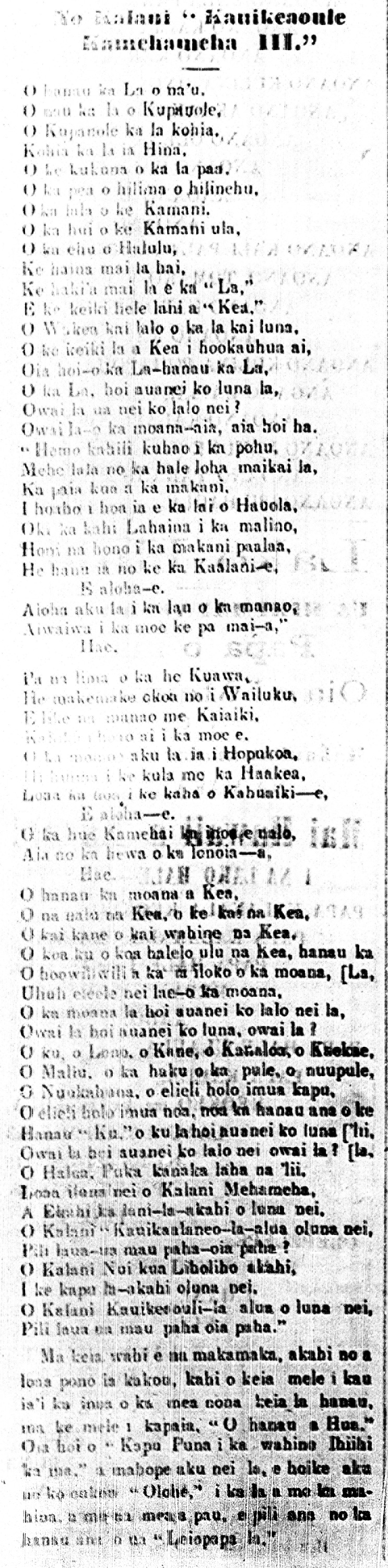
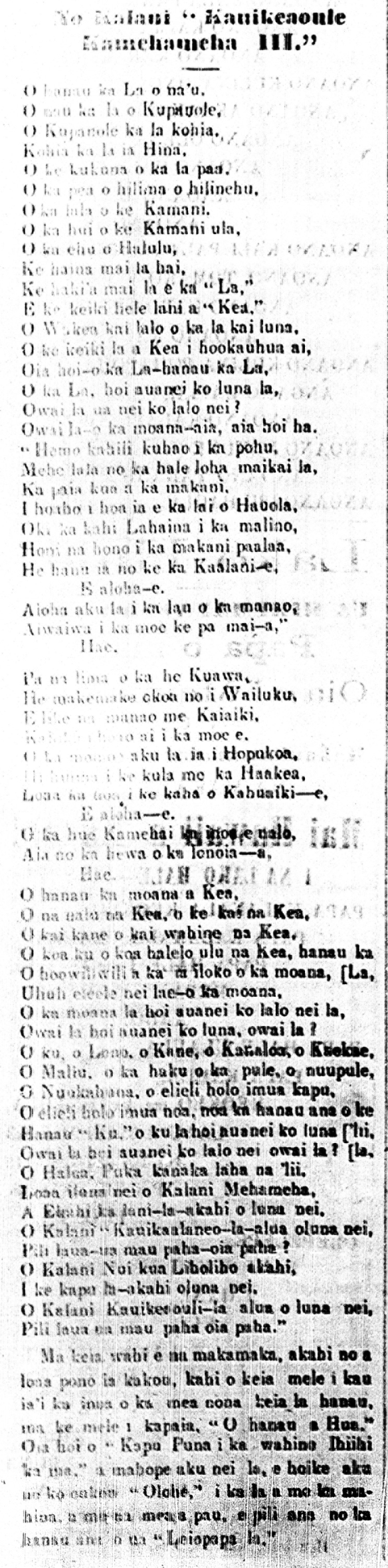
No Kalani “Kauikeaoule Kamehameha III.” [No Kalani “Kauikeaouli Kamehameha III.”]

O hanau ka La o na’u,
O nau ka la o Kupauole,
O Kupauole ka la kohia,
Kohia ka la ia Hina,
O ke kukuna o ka la paa,
O ka pea o hilima o hilinehu,
O ka lala o ke Kamani,
O ka hui o ke Kamani ula,
O ka ehu o Halulu,
Ke haina mai la hai,
Ke haki’a mai la e ka “La,”
E ke keiki hele lani a “Kea,”
O Wakea kai lalo o ka la kai luna,
O ke keiki la a Kea i hookauhua ai,
Oia hoi—o ka La—hanau ka La,
O ka La, hoi auanei ko luna la,
Owai la ua nei ko lalo nei?
Owai la—o ka moana—aia, aia hoi ha,
“Hemo kahili kuhao i ka pohu,
Mehe lala no ka hale loha maikai la,
Ka paia kua a ka makani,
I hoaho i hoa ia e ka lai o Hauola,
Oki ka kahi Lahaina i ka malino,
Honi na hono i ka makani paalaa,
He hanu ia no ke ka Kaalani—e,
E aloha—e.
Aloha aku la i ka lau o ka manao,
Aiwaiwa i ka moe ke pa mai—a,”
Hae.

Pa na lima o ka he Kuawa,
He makemake okoa no i Wailuku,
E like na manao me Kaiaiki,
Kahiko i hoao ai i ka moe e,
O ka momoe aku la ia i Hopukoa,
Hi hininu i ke kula me ka Haakea,
Loaa ka hoa i ke kaha o Kahuaiki—e,
E aloha—e.
O ka hue Kamehai ka inoa e nalo,
Aia no ka hewa o ka lonoia—a,
Hae.

O hanau ka moana a Kea,
O na nalu na Kea, o ke kai na Kea,
O kai kane o kai wahine na Kea,
O koa ku o koa halelo ulu na Kea, hanau ka La,
O hoowiliwili a ka ia iloko o ka moana,
Uliuli eleele nei lae—o ka moana,
O ka moana la hoi auanei ko lalo nei la,
Owai la hoi auanei ko luna, owai la?
O ku, o Lono, o Kane, o Kanalua, o Kaekae,
O Maliu, o ka haku o ka pule, o nuupule,
O Nuukahana, o elieli holo imua kapu,
O elieli holo imua noa, noa ka hanau ana o ke ‘lii,
Hanau “Ku” o ku la hoi auanei ko luna,
Owai la hoi auanei ko lalo nei owai la?
O Haloa, Puka kanaka laha na ‘liii,
Loaa iluna nei o Kalani Mehameha,
A Ekahi ka lani—la—akahi o luna nei,
O Kalani “Kauikaalaneo—la—alua oluna nei,
Pili laua—ua mau paha—oia paha?
O Kalani Nui kua Liholiho akahi,
I ke kapu la—akahi oluna nei,
O Kalani Kauikeaouli—la alua o luna nei,
Pili laua ua mau paha oia paha.”

Here O Friends is the first time we actually have the part of this mele in which is the name of the one whose birthday it is, in the mele called, “O hanau a Hua.” That being “Kapu Puna i ka wahine Ihiihi ka ma,” and after that, I, your “Expert,” will tell you of the day, and the months, and everything pertaining to the birthday of that “Leiopapa.”

[This genealogical mele for Kamehameha III was printed a number of times over the years in various Hawaiian-Language Newspapers. It was important enough back then, and it is just as important for us today, if not more so. The gods gave birth to all above and all below—it is all sacred. Let us treat all our land and ocean with that in mind.

Unfortunately much of the columns in which these appear are not digitized clearly, and are hard to read…]

(Kuokoa, 3/31/1866, p. 4)
No Kalani Kauikeaoule Kamehameha III."

Ka Nupepa Kuokoa, Buke V, Helu 13, Aoao 4. Maraki 31, 1866.


Why are some religions “real” while others are “superstitions,” “myths,” and “legends”? 1905 / today.

WAKEA THE POLYNESIAN

(By Rev. W. D. Westervelt in Paradise of the Pacific.)

The fountain source of the Mississippi has been discovered and re-discovered. The origin of the Polynesian race has been a subject for discovery and re-discovery. The older theory of Malay origin as set forth in the earlier encyclopædias is now recognized as untenable. The Malays followed the Polynesians rather than preceded them. The comparative study of Polynesian legends leads almost irresistibly to the conclusion that Polynesians were Aryans, coming at least from India to Malaysia and possibly coming from Arabia, as Fornander of Hawaii so earnestly argues. It is now accepted that the Polynesians did not originate from Malay parentage, and that they did occupy for an indefinite period the region around the Sunda Straits from Java to the Molucca Islands, and also that the greater portion of the Polynesians was driven out from this region and scattered over the Pacific in the early part of the Christian Era. The legends that cluster around Wakea have greatly aided in making plain some things concerning the disposition of the Polynesians. By sifting the legends of Hawaii-loa, we learn how the great voyager becomes one of the first Vikings of the Pacific. His home at last is found to be Gilolo of the Molucca Islands. From the legends we become acquainted with Wakea (possibly meaning “noonday” or “the white time” and his wife Papa (“earth”), the most widely remembered of all the ancestors of the Polynesian race. Their names are found in the legends of the most prominent island groups, and the highest places are granted them among the chief dieties. Their deeds belong to the most ancient times—the creation or discovery of the various islands of the Pacific world. Those who worshipped Wakea and Papa are found in such widely separated localities that it must be considered impossible for even a demi-god to have had so many homes. Atea or Wakea was one of the highest gods of the Marquesas islands. Here his name means “light.” The Marquesans evidently look back of all their present history and locate Atea in the ancient home land. Va-tea, in the Society Islands, Wakea in Hawaii and New Zealand, Makea-Vakea and Akea are phonetic variations of the one name when written down by the students who made a written form for words repeated from generation to generation by word of mouth alone. Even under the name Wakea this ancient chief is known by most widely separated islands. The only reasonable explanation for this widespread reference to Wakea is that he was an ancestor belonging in common to all the scattered Polynesians. It seems as if there must have been a period when Wakea was king of chief of a united people. He must have been of great ability and probably was the great king of the United Polynesians. If this were the fact it would naturally result that his memory would be carried wherever the dispersed race might go.

In the myths and legends of the Hervey Islands, Vatea is located near the beginning of their national existence.” Then there came upon the ancient world Te Vaerua, “the breath” or “the life.” Then came the god time—Te Manawa roa, “the long ago.” Then their creation legends locate Vari, a woman whose name means “the beginning,” a name curiously similar to the Hebrew word bara, to create, as in Gen. 1:1. Her children were torn out of her breasts and given homes in the ancient mist land, with which without any preparation or introduction, Hawa-iki is confused in a part of the legend. One of the children of Vari dwelt in a “sacred tabu island” and became the god of the fish. Another sought a home “where the red parrots’ feathers were gathered”—the royal feathers for the high chief’s garments. Another became the echo-god and lived in the “hollow grey rocks.” Another as the gods of the winds went far out “on the deep ocean.” Another, a girl, found a home, “the silent land,” with her mother. Wakea, or Vatea, the eldest of this family remained in Avaiki (Hawaii) the ancestral home—”the bright land of Vatea.” Here he married Papa. This Ava-iki was to the Herveyites of later generations the fiery volcanic under-world. When the long sea voyages ceased after some centuries, the islanders realized that Ava-iki was very closely connected with their history. They had but a misty idea of far off lands, and they did know of earthquakes and lava caves and volcanic fires—so they located Ava-iki as the secret world under their islands. This underworld with legendary inconsistency was located on the ocean’s surface, when it became necessary to have their islands discovered by the descendants of Vatea. According to the Hervey legends, Vatea is the father of Lono and Kanaloa, two of the great gods of the Polynesians. They are twins. Lono has three sons, whom he sends away. They sail out through many heavens and from Ava-iki “pull up” out of the deep ocean two of the Hervey islands. The natives of the Hervey group supposed that the horizon around their group inclosed the world. Beyond this world were heaves after heavens. A daring voyager by sailing through the sky line would break out from this world into an unknown world or a heaven bounded by new horizons. Strangers thus “broke through” from heaven to heaven, sometimes making use of the path of the sun. Thus about twenty-five generations ago Raa (possibly Laa, the Hawaiian), broke down the horizon’s bars and established a line of kings in Raiatea. So also when Captain Cook came to the Hervey Islands the natives said: “Whence comes this strange thing? It has climbed up (come up forcibly) from the thin land the home of Wakea.” He had pierced the western heavens from which their ancestors had come. Continue reading

On hope, faith, and love, 1896.

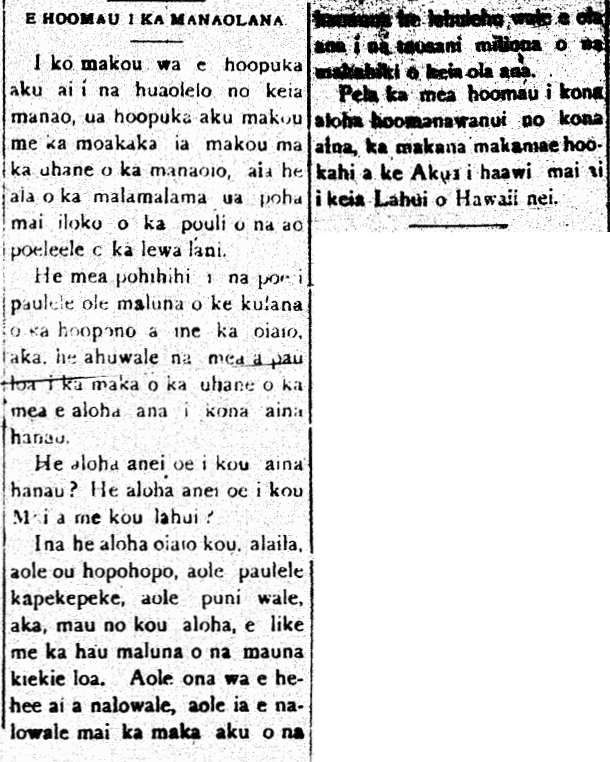
CONTINUE TO HOPE.

While we publish the words of this thought, we print it knowing for certain in the spirit of faith, that there is a path of light that bursts through the darkness of the black clouds in the heavens.

It is unclear to those who do not believe in righteousness and truth, but everything is clearly visible to the eyes of one whose spirit has aloha for his land of birth.

Do you have aloha for your birth land? Do you have aloha for your Monarch and your people?

If you have true aloha, then you have no trepidation, you do not just believe with uncertainty, you do not believe in lies, but your aloha is steadfast like the snow atop very tall mountains. It never melts and disappears, it will never vanish from the eyes of many generations living for thousands of millions of years in this life.

That is the way one who continues to patiently be patriotic for his land is; that is the single precious gift God gave this Lahui of Hawaii nei.

(Aloha Aina, 7/18/1896, p. 4)

E HOOMAU I KA MANAOLANA.

Ke Aloha Aina, Buke II, Helu 29, Aoao 4. Iulai 18, 1896.

Dirge for Abner Kahekili, 1843.

KANIKAU FOR ABENERA KAHEKILI, A CHIEF OF THIS ARCHIPELAGO WHO DIED.

1 O ke ano aloha o Liawahine
O ka maka aloha o Hikuanaka
O ke kino oioio o ka lapu loku
I moe nounounea me Hikuikapua
I luna o ke opu hiwa a Kane
I loko o ke kapa auaiku a Lono oe—
He leo keia e mapu nei
E ano nei i ke kahakai
O ka maka aloha o kuu makuakane
I walea i ka ai kihamu pua niu
Uhane auaukai o Ulakua oe—
Hoakua ka lokoino oia la—la—ia—oe—e—

2 Mehameha ia ka hele a ke aloha
Ka pee’na ku nei nanowale
Hele i Kuahaehae ka hele ana
I paepae leo me Kupinai
Me na hoa hui wale i ka nahele
Halawai ae la me Anowahine
Me ka wahine i ka iukapu o mua oe—
Eia au la i ka lipo
I walea au i ke kui pua
Lililo ai maua i ka nahele
He kamaaina no ka ua waahila
Uhane peepeeua Kukalahale oe—
Oe wale mai ana no ka manao
Aole i hoike mai i ka maka he alo—ha—ia—oe—e— Continue reading

Albert Kunuiakea baptized, 1862.

[Found under: “NA MEA HOU O HAWAII NEI.”]

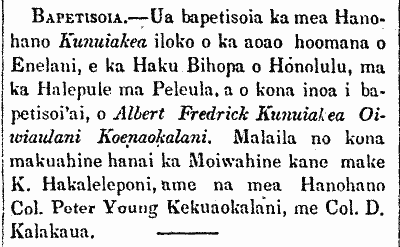
Baptized.—The Honorable Kunuiakea was baptized in the Anglican faith, by the Lord Bishop of Honolulu, at the Church at Peleula, and his name he was baptized with is Albert Fredrick Kunuiakea Oiwiaulani Koenaokalani. Present was his hanai mother, the dowager Queen K. Hakaleleponi, and the Honorable Col. Peter Young Kekuaokalani, and Col. D. Kalakaua.

(Kuokoa, 11/22/1862, p. 2)

Bapetisoia.

Ka Nupepa Kuokoa, Buke I, Helu 52, Aoao 2. Novemaba 22, 1862.