The Ninth Independence Day, 1852.

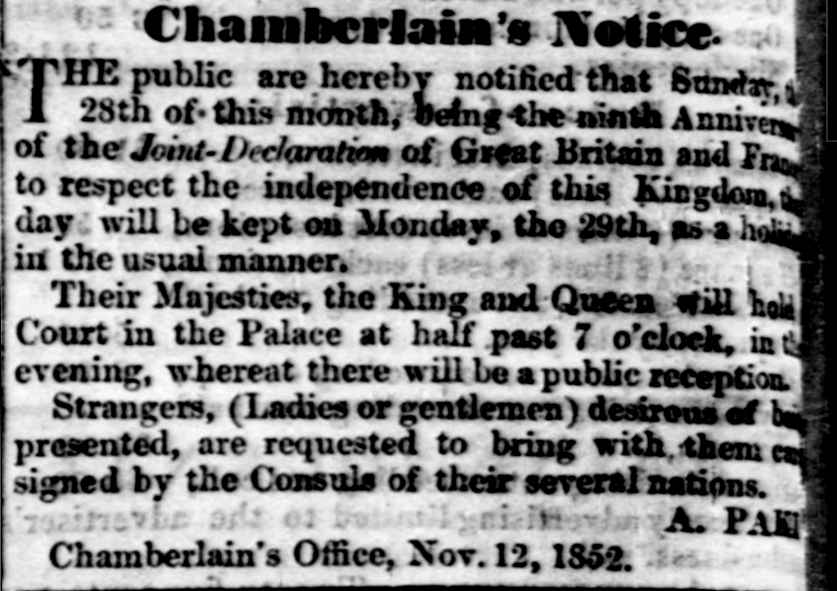
Chamberlain’s Notice.

The public are hereby notified that Sunday, the 28th of this month, being the ninth Anniversary of the Joint-Declaration of Great Britain and France to respect the independence of this Kingdom, the day will be kept on Monday, the 29th, as a holiday in the usual manner.

Their Majesties, the King and Queen will hold Court in the Palace at half past 7 o’clock, in the evening, whereat there will be a public reception.

Strangers, (Ladies or gentlemen) desirous of being presented, are requested to bring with them cards signed by the Consuls of their several nations.

A. PAKI

Chamberlain’s Office, Nov. 12, 1852.

[The 9th anniversary of La Kuokoa was celebrated under the reign of King Kamehameha III, Kauikeaouli and Queen Kapakuhaili.]

(Polynesian, 11/20/1852, p. 110)

Chamberlain's Notice.

The Polynesian, Volume 9, Number 28, Page 110. November 20, 1852.

45th La Kuokoa celebration, 1888.

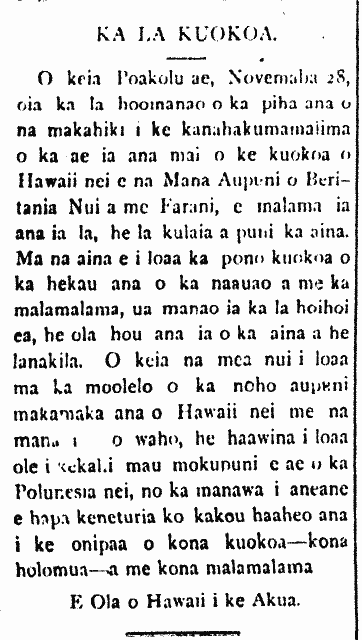
INDEPENDENCE DAY.

This coming Tuesday, November 28th, is the forty-fifth year celebration marking the recognition by the Heads of the Nations of Great Britain and France of Hawaiian independence; this day is set aside as a holiday all across the land. In other lands which enjoy independence through learning and enlightenment, independence day is seen as a day of rebirth for the nation and victory. These are great events found in the history of Hawaii’s friendly international relations; this is a distinction not received by any other island here in Polynesia; it has been nearly half a century that we remain proud of her unwavering  independence—progress—and enlightenment.

Long Live Hawaii Under God.

[On this the 170th anniversary of La Kuokoa, what are you doing to remember the great efforts taken by those like Timoteo Haalilio and William Richards to gain independence for the Nation?]

(Kuokoa, 11/24/1888, p. 2)

KA LA KUOKOA.

Ka Nupepa Kuokoa, Buke XXVII, Helu 47, Aoao 2. Novemaba 24, 1888.

Ellen Kekoahiwaikalani Prendergast’s “Kaulana na Pua”, 1896.

Look Here at This Mele

MELE ALOHA AINA AI-POHAKU
[PATRIOTIC ROCK-EATING SONG]

1. Kaulana na pua o Hawaii
Kupaa mahope o ka aina,
Hiki mai ka elele a ka lokoino
Palapala alunu me ka pakaha

2. Pane mai Hawaii-Nui o Keawe
Kokua na Hono-a-Piilani
Kakoo mai Kauai o Mano
Pau pu me ke one o Kakuhihewa

3. Aole e kau e ka pulima
Maluna o ka pepa a ka enemi
Aole makou a e minamina
I ka puu dala a ke Aupuni

4. Ua lawa makou i ka pohaku
I ka ai kamahao o ka aina
Hoohuiaina kuai hewa
I ka pono kivila o ke kanaka

5. Mahope makou o Liliulani
A kau hou la i ke Kalaunu
Haina ia mai ana ka puana
Na pua i aloha i ka aina

Composed by KEKOAHIWAIKALANI.

[This mele for obvious reasons is published many times throughout time.]

(Aloha Aina, 6/13/1896, p. 4)

MELE ALOHA AINA AI-POHAKU.

Ke Aloha Aina, Buke II, Helu 24, Aoao 4. Iune 13, 1896.

Let the old men go forth and lie upon the roads… 1895.

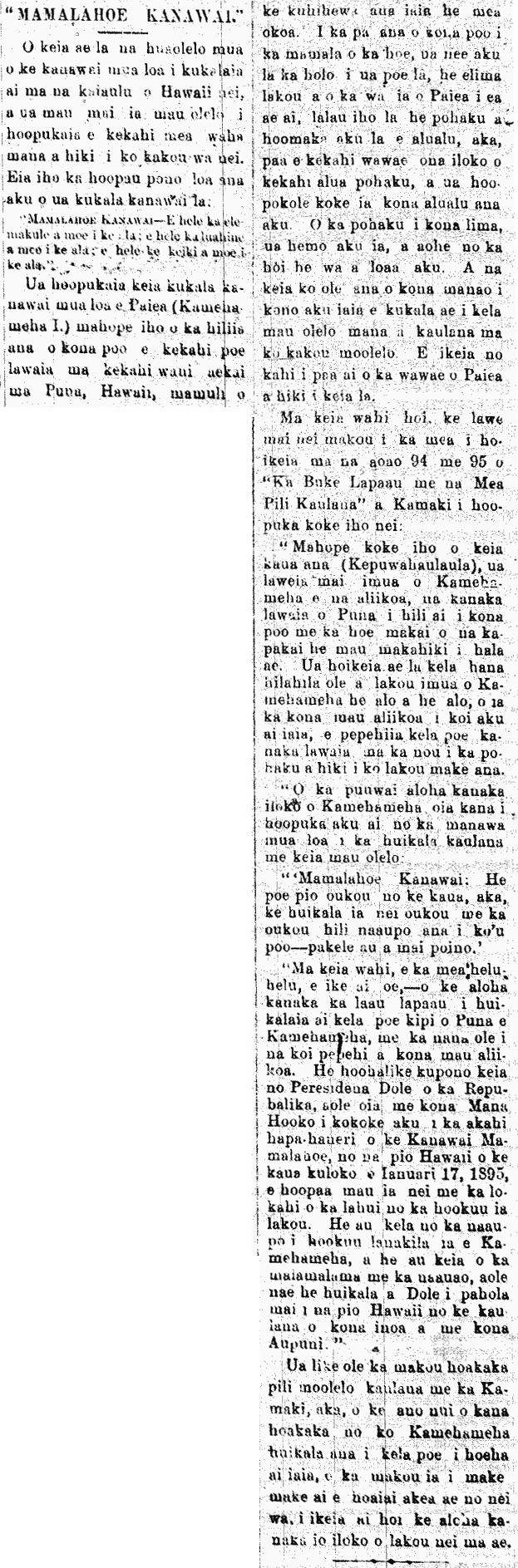
“LAW OF THE PADDLE BLOW.”
[“MAMALAHOE KANAWAI.”]

This above are the initial words of the very first law promulgated in the communities of Hawaii, and those words spoken by one in authority still remain. Here below is the the law in its entirety:

“MAMALAHOE KANAWAI—Let the old men go forth and lie upon the roads; let the old women go forth and lie upon the roads; let the children go forth and lie upon the roads.”

This first law was proclaimed by Paiea (Kamehameha I) after his head was struck by some fishermen at the seashore in Puna, Hawaii, because they mistakenly thought he was someone else. When his head was struck with the blow from a canoe paddle, the men fled, there being five of them; that was when Paiea rose, picked up a rock, and made to chase after them, however, his foot was caught in a rock crevice, and his chase was cut short. The rock in his hand fell, and there was no getting it back. And it was this disappointment which caused him to proclaim these famous and powerful words in our history. The place where Paiea’s foot was caught can be seen to this day.

Here, we take what is shown on pages 94 and 95 of “Ka Buke Lapaau me na Mea Pili Kaulana” which was published by Kamaki [Thomas P. Spencer]:¹

“Soon after this battle (Kepuwahaulaula), the fishermen who years earlier struck the head of Kamehameha with a paddle near the sea were brought before him by his officers. This shameful act of theirs was made known to Kamehameha face to face, for which his officers demanded that they be killed by stoning them to death.

“The aloha Kamehameha had for his fellow man was expressed for the first time in his famous pardon by announcing:

“‘Mamalahoe Kanawai: you are prisoners of war, but you are forgiven for unwittingly striking my head–I escaped, but nearly was in trouble.’

“Here, O Reader, do recognize–love for his fellow man was the cure² for which allowed for the release of these rebels of Puna by Kamehameha, and him not giving regard to the calls by his officers to put them to death. This is a fine comparison to President Dole of the Republic; he with his Executive Powers does not come close to a hundredth of the Kanawai Mamalahoe, in his treatment of the Hawaiian prisoners of the revolution of January 17, 1895 who continue to be imprisoned albeit the lahui are united in wanting them released. That was an uncivilized time when [the men] were triumphantly released by Kamehameha, and this is a knowledge and civilization, and yet Dole has not given clemency to the Hawaiian prisoners for the fame of his name and that of his Nation.”

Our elucidation of this famous story is not like that of Spencer’s, but the basis of his explanation of Kamehameha’s forgiving those who injured him, that is what we want to make clear at this time, so that true love of one’s fellow man is seen by them.

¹This book was republished in 2003 by Bishop Museum Press as: Buke ‘Oihana Lapa’au me na ‘Apu la’au Hawai’i (Book of Medical Practices and Hawaiian Prescriptions). See here for further description.

²”Laau lapaau” [medicinal cure] is the word chosen here because this story appears in a book of traditional medicinal practices.

(Makaainana, 11/25/1895, p. 4)

"MAMALAHOE KANAWAI."

Ka Makaainana, Buke IV—-Ano Hou. Helu 22, Aoao 4. Novemaba 25, 1895.

E Nai Wale No Oukou… 1897.

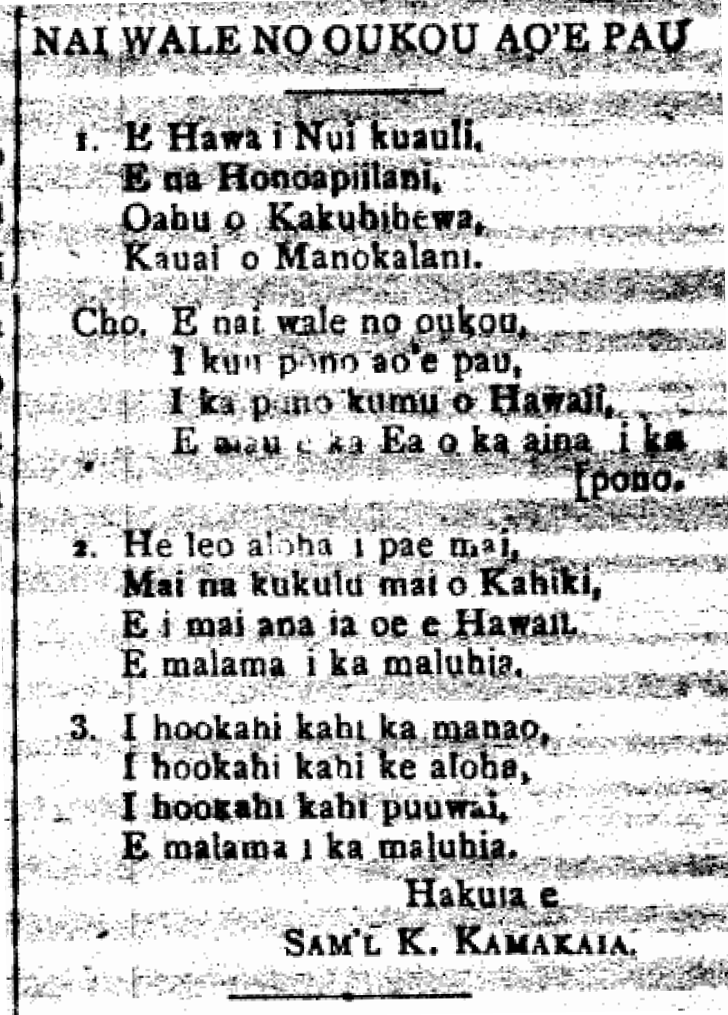
NAI WALE NO OUKOU AO’E PAU

1. E Hawaii Nui kuauli,
E na Honoapiilani,
Oahu o Kakuhihewa,
Kauai o Manokalani.

Cho. E nai wale no oukou,
I kuu pono ao’e pau,
I ka pono kumu o Hawaii,
E mau e ka Ea o ka aina i ka pono.

2. He leo aloha i pae mai,
Mai na kukulu mai o Kahiki,
E i mai ana ia oe e Hawaii,
E malama i ka maluhia.

3. I hookahi kahi ka manao,
I hookahi kahi ke aloha,
I hookahi kahi puuwai,
E malama i ka maluhia.

Composed by
Samuel K. Kamakaia.

[Another well-known mele, with a few noticeable differences from what is sung today. The repeated line “E malama i ka maluhia.” would be “Keep the peace.”]

(Aloha Aina, 8/21/1897, p. 7)

NAI WALE NO OUKOU AO'E PAU

Ke Aloha Aina, Buke III, Helu 34, Aoao 7. Augate 21, 1897.

A mele for the counter revolution, 1895.

KAALAWAI.

Kumaka ka ike’na ia Kaalawai
I ka peki wawae i ke kula loa
Mea ole ka loa a oia kula
Me ke kai hone mai i ka iliili
Me he ‘la a e i mai ana
Imi ia e ka pono o ka aina
Ilaila ohohia kuu manao
I ka ike ana aku i na hoa
Hooho Wilikoki me ka leo nui
Imua kakou a lanakila
Lana mai ka manao Nou e ka Lani
E hoi hou ana i ke Kalaunu
Eia makou ke paa nei
Mamuli o ke aloha i ka aina
O ke kani makawalu a na pu
Pau ka manaolana no ka ohana
Haina ia mai ana ka puana
No ka poe i aloha i ka aina.

Hakuia e
S. Kanehe.
Kawa.

KAALAWAI.
In plain sight was Kaalawai
Treading across its wide plains
The extent of that field is of no consequence
With the sea that whispers atop the pebbles
As if saying
Let pono for this land be sought out
There my mind is elated
To see my comrades
Wilcox cheers with voice aroar
Forward to victory!
Our belief is for You, O Heavenly One
That you will return to the Throne
Here we are, unyielding
Faithfully patriotic
With gunfire ringing out from all directions
No more do we hope to see our families
Let the refrain be told
For the patriotic ones.
Composed by S. Kanehe.
Kawa. [The prison]

[There was a man named Herman K. Kanehe, who was one of many patriots sentenced to 5 years at hard labor and a fine of $5000. But i could not find out information on this S. Kanehe.

It is also interesting to note that this composition is reminiscent of another composition known widely today…]

(Oiaio, 3/22/1895, p. 3)

KAALAWAI.

Ka Oiaio, Buke VII, Helu 3, Aoao 3. Maraki 22, 1895.

Uluhaimalama Ribbons? 1894.

[Found under: “LOCAL NEWS”]

Ribbons stamped in gold: Uluhaimalama, is what these days is the great excitement; it is something of pride to place upon your hat.  We give our much appreciation for the spirited action of the lady who went to print these ribbons.

[There must be a lot of these still around?]

(Leo o ka Lahui, 10/17/1894, p. 2)

O ka lipine i kuniia...

Ka Leo o ka Lahui, Buke II, Helu 1051, Aoao 2. Okatoba 17, 1894.

E o, e Kawohialiiwahine Kiekie Victoria Kewekiu Kaiulani Keahilapalapa Kekauluohi, 1894.

Tuesday last, the 16th, was the birthday of Her Highness, the Princess Kaiulani, the Heir to the Crown of Hawaii nei, and she has made twelve years old. We pray, being that the efforts behind our Nation are not over, that her life is extended until she inhales once again the comforting air of her homeland, and not in a position of ridicule by the shameless hairy-handed [lima huluhulu]¹ usurpers, but as one treasured by her people; and may God Almighty care for her always.

¹Biblical reference to Esau.

(Makaainana, 10/22/1894, p. 4)

Poalua i hala iho la...

Ka Makaainana, Buke II, Helu 17, Aoao 4. Okatoba 22, 1894.

San Francisco Call and the military trials, 1895.

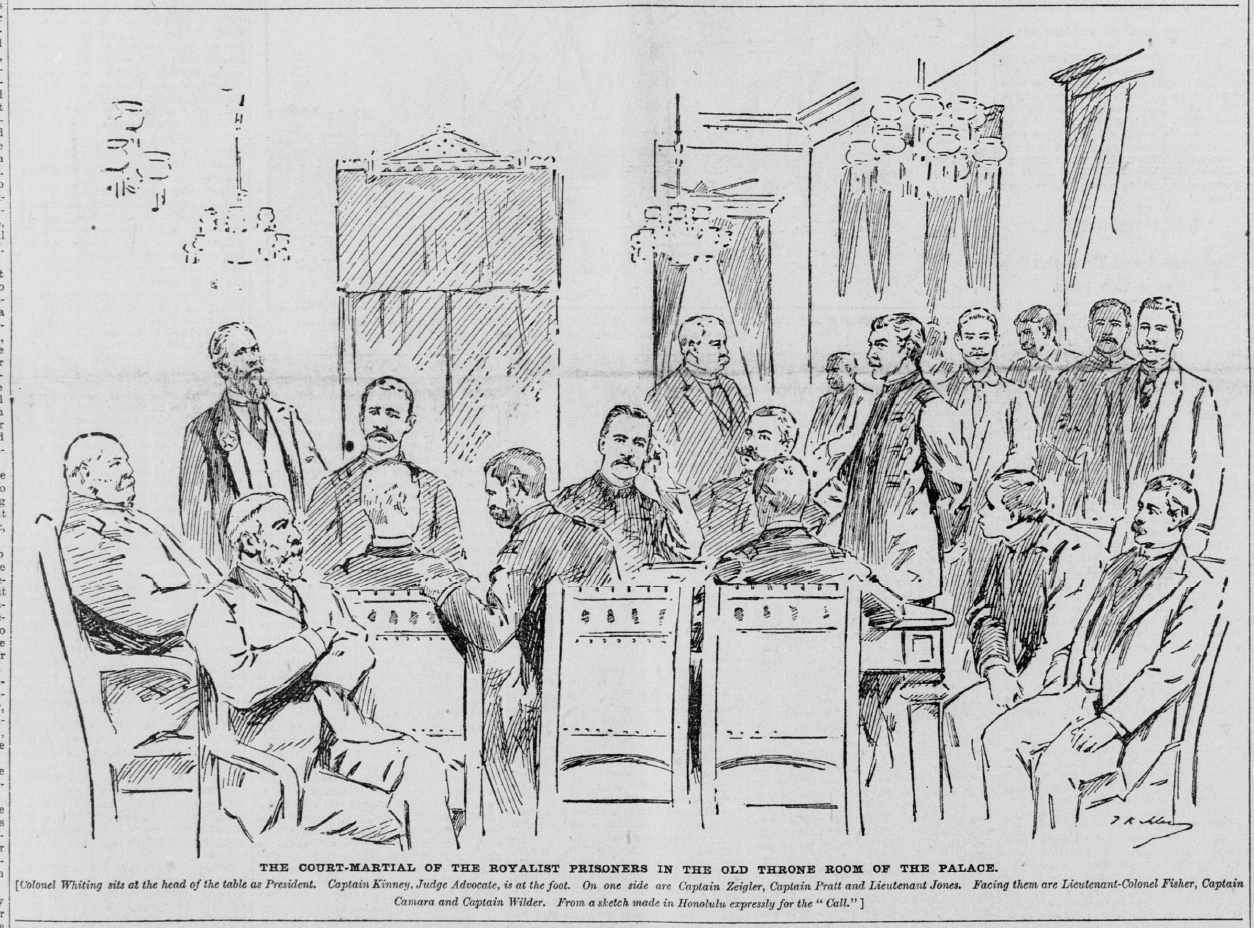
THE COURT-MARTIAL OF THE ROYALIST PRISONERS IN THE OLD THRONE ROOM OF THE PALACE.

{Colonel Whiting sits at the head of the table as President. Captain Kinney, Judge Advocate, is at the foot. On one side are Captain Zeigler, Captain Pratt and Lieutenant Jones. Facing them are Lieutenant-Colonel Fisher, Captain Camara and Captain Wilder. From a sketch made in Honolulu expressly for the “Call.”}

[The San Francisco Call had strong ties with Hawaii, and it is interesting to see the articles printed within its pages and how it saw the situation in Hawaii. See for instance the famous story printed a couple of years later: “Strangling Hands upon a Nation’s Throat,” by Miriam Michelson.

…So many unthinkable things took place in the Throne Room of Iolani Palace.]

(San Francisco Call, 2/7/1895, p. 1)

THE COURT-MARTIAL...

San Francisco Call, Volume LXXVI, Number 52, Page 1. February 7, 1895.

In the Queen’s words, 1895 / 1898.

Proceedings against me, personally, were not modified. Every day thereafter papers were brought to me from the office of President Dole, a legal service, I suppose it is called, being made on me by Major George C. Potter, an aide-de-camp of the president’s staff. In the first of these I found myself charged with the crime of “treason.” After about a week had gone by, the accusation was changed to “misprision of treason.” The substance of my crime was that I knew my people were conspiring to re-establish the constitutional government, to throw off the yoke of the stranger and oppressor; and I had not conveyed this knowledge to the persons I had never recognized except as unlawful usurpers of authority, and had not informed against my own nation and against their friends who were also my long-time friends.

The names of those who had informed, and by whose testimony I was to be convicted, were Captain Samuel Nowlein, Charles H. Clark, W. W. Kaae, Charles Warren, Keahikaauwai, George H. Townsend, and Captain Davies of the steamer Waimanalo.

February 5th was to be the day of my trial. After the summons had been served, Mr. Paul Neumann, in consultation with Mr. Wilson, called to consult with me, as it had been a question whether or not I should personally appear in court, as it would be undignified and humiliating. Humiliation! What had I left? It was the intention of the officers of the government to humiliate me by imprisoning me, but my spirit rose above that. I was a martyr to the cause of my people, and was proud of it. So I told them that I would attend; and on the morning of the 8th, at the hour appointed, Sergeant Kenake appeared, and conducted me, attended by Mrs. Wilson, to the court-room.

(Hawaii’s Story by Hawaii’s Queen, 1898.)