English-Language Newspaper articles less important than Hawaiian-Language articles? 2012

Here is something to consider…

There are many who believe that English-Language articles are somehow less important than Hawaiian-Language ones. We should not turn our noses up at any history passed down by those who lived it—in any language. Although it is important to take into account who wrote the information and under what circumstances, any information is better than no information!

Here for instance is the coverage the first Kamehameha Girls School graduation received in The Hawaiian Gazette of July 6, 1897, p. 2, “CLOSING EXERCISES”.

Compare this to what we saw earlier from the Kuokoa of July 2, 1897, p. 2, “KA HOIKE O KE KULA KAIKAMAHINE O KAMEHAMEHA”.

Hoku o Hawaii begins printing front page in English, 1936.

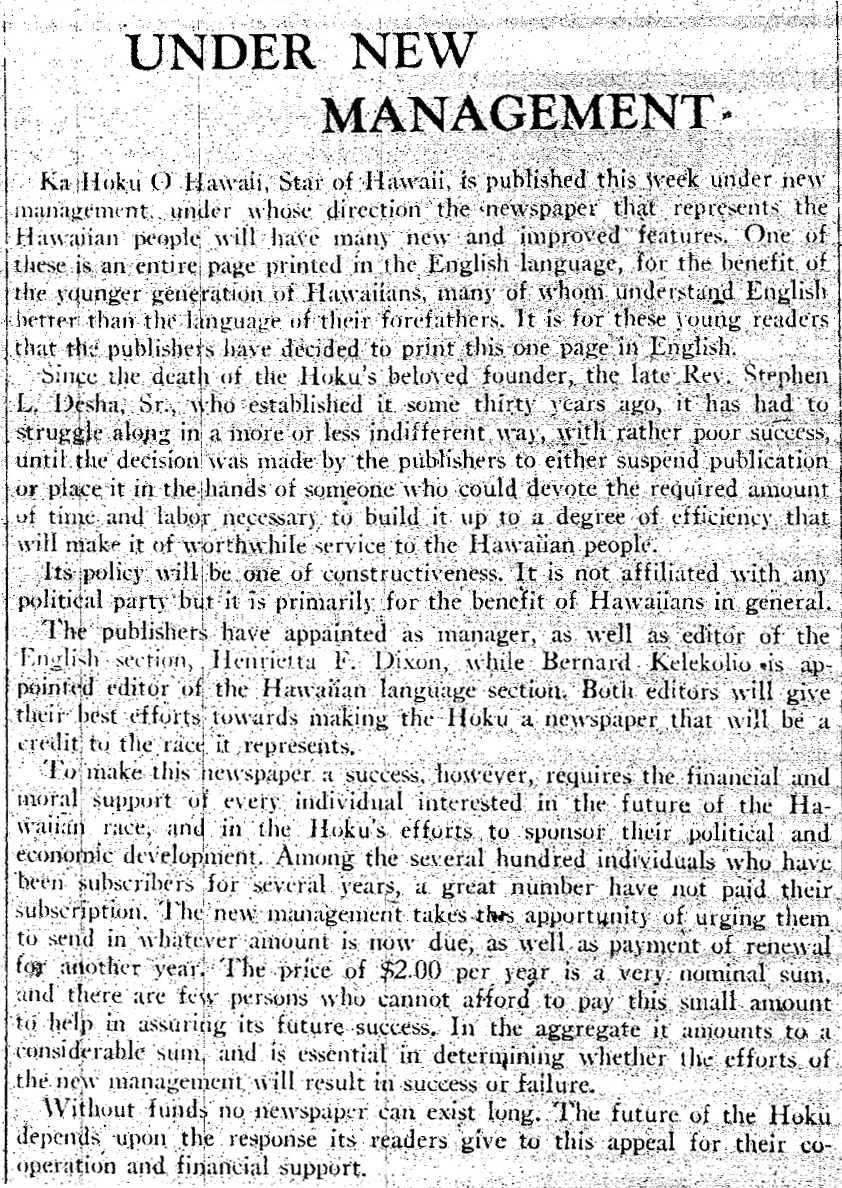
UNDER NEW MANAGEMENT

Ka Hoku o Hawaii, Star of Hawaii, is published this week under new management under whose direction the newspaper that represents the Hawaiian people will have many new and improved features. One of these is an entire page printed in the English language, for the benefit of the younger generation of Hawaiians, many of whom understand English better than the language of their forefathers. It is for these young readers that the publishers have decided to print this one page in English.

Since the death of the Hoku’s beloved founder, the late Rev. Stephen L. Desha, Sr., who established it some thirty years ago, it has had to struggle along in a more o less indifferent way, with rather poor success, until the decision was made by the publishers to either suspend publication or place it in the hands of someone who could devote the required amount of time and labor necessary to build it up to a degree of efficiency that will make it of worthwhile service to the Hawaiian people.

Its policy will be one of constructiveness. It is not affiliated with any political party but it is primarily for the benefit of Hawaiians in general.

The publishers have appainted as manager, as well as editor of the English section, Henrietta F. Dixon, while Bernard Kelekolio is appointed editor of the Hawaiian language section. Both editors will give their best efforts toward making the Hoku a newspaper that will be a credit to the race it represents.

To make this newspaper a success, however, requires the financial and moral support of every individual interested in the future of the Hawaiian race, and in the Hoku’s efforts to sponsor their political and economic development. Among the several hundred individuals who have been subscribers for several years, a great number have not paid their subscription. The new management takes this opportunity of urging them to send in whatever amount is now due, as well as payment of renewal for another year. The price of $2.00 per year is a very nominal sum, and there are few persons who cannot afford to pay this small amount to help in assuring its future success. In the aggregate it amounts to a considerable sum, and is essential in determining whether the efforts of the new management will result in success or failure.

Without funds no newspaper can exist long. The future of the Hoku depends upon the response its readers give to this appeal for their cooperation and financial support.

(Hoku o Hawaii, 2/4/1936, p. 1)

UNDER NEW MANAGEMENT

Ka Hoku o Hawaii, Volume XXVII, Number 31, Page 1. February 4, 1936.

More on the opening of KHBC, 1936.

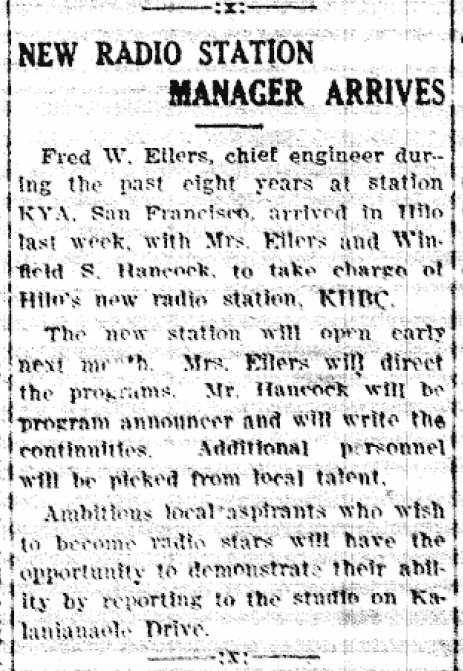
NEW RADIO STATION MANAGER ARRIVES

Fred W. Eilers, chief engineer during the past eight years at station KYA, San Francisco, arrived in Hilo last week, with Mrs. Eilers and Winfield S. Hancock, to take charge of Hilo’s new radio station, KHBC.

The new station will open early next month. Mrs. Eilers will direct the programs. Mr. Hancock will be program announcer and will write the continuities. Additional personnel will be picked from local talent.

Ambitious local aspirants who wish to become radio stars will have the opportunity to demonstrate their ability by reporting to the studio on Kalanianaole Drive.

[Starting on February 4, 1936, the front page of Hoku o Hawaii (published in Hilo), was printed in English, and the following three pages were in Hawaiian.]

(Hoku o Hawaii, 4/15/1936, p. 1)

NEW RADIO STATION MANAGER ARRIVES

Ka Hoku o Hawaii, Volume XXVII, Number 39, Page 1. April 15, 1936.

Two interesting testimonials appearing in the same issue, 1892.

VERIFICATION OF THE TRUTH.

Honolulu, April 4, 1892.

I hereby attest, I am the one whose name appears below; in order to verify the miraculous works of Mr. Marcus W. Lowell, and so that the public knows, he treated my wife in 1886 after she contracted the disease known as the sickness that separates families [ma’i hookaawale ohana]; he treated her and she got much better than with the doctors who treated her. She suffered for ten years from this sickness, and within a month, Mr. Lowell saved her because of his aloha he had for my wife during that time.

To attest to this, I place my name here.

John Kahikina Kelekona.

(Leo o ka Lahui, 4/8/1892, p. 2)

HE HOIKE AKU I KA OIAIO.

Ka Leo o ka Lahui, Buke II, Helu 428, Aoao 2. Aperila 8, 1892.

CURE FOR CANCER.

Honolulu, March 24, 1892.

I, George Campton, carpenter, have been a resident of these Islands for the last 14 years. In the last year 1891 I suffered from cancer in the leg, and through the advice of a friend I had Mr. Lowell to see it. I suffered the most excruciating pain and has confined to my bed for weeks, when Mr. Lowel saw me and told me he thought he could cure it, and to my utter astonishment, in one month from the time Mr. Lowell first saw it it was cured. It is now nearly three months since and has all the appearance of a complete cure. In three weeks from the time Mr. Lowell first saw me I was able to go about my dusiness. Any one desiring further information can call on me at 36 King St.

(Leo o ka Lahui, 4/8/1892, p. 4)

CURE FOR CANCER.

Ka Leo o ka Lahui, Buke II, Helu 428, Aoao 4. Aperila 8, 1892.

History of the Hawaiian Flag. 1862.

“The Beautiful Flag of Hawaii,
Let it forever wave.”

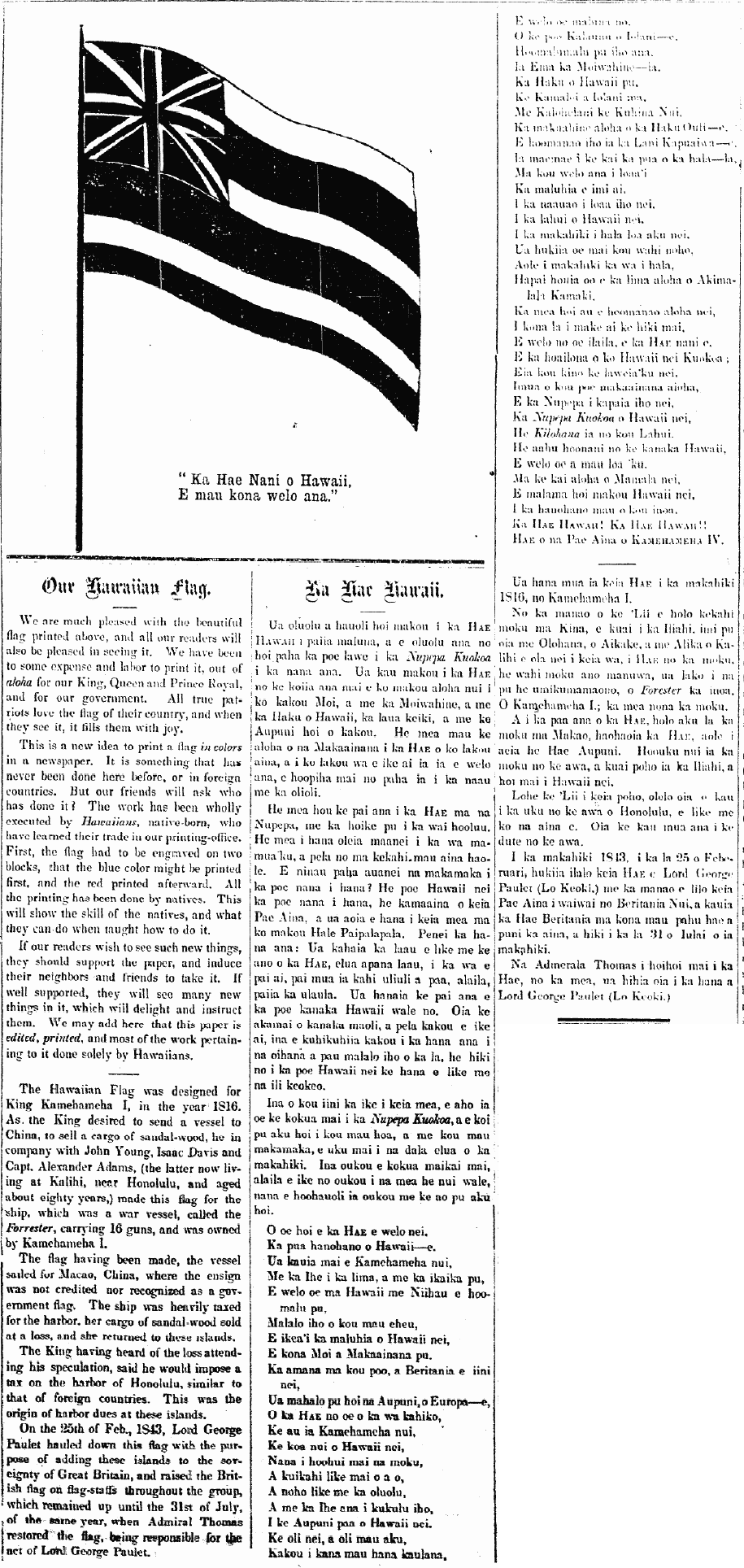
The Hawaiian Flag

We are pleased and happy about the Hawaiian Flag printed above, and the people subscribing to Ka Nupepa Kuokoa will be delighted to see it. We display the Flag, urged to do so by our great aloha for our King, Queen, and Ka Haku o Hawaii, their son, as well as for our Nation. The love by the people for their flag of their country is customary, and when they see her fluttering, it fills their hearts with joy.

The printing of the Flag in a Newspaper is something new, along with the displaying of its colors*. This is something not done previously here, as well as in some foreign countries. Perhaps our friends will inquire as to who did this work. Some Hawaiians did the work, people from this Archipelago, and they were taught to do this in our Printing Office. Here is how it was done: Woodblocks were carved in the fashion of the flag using two blocks. When it was printed, first the blue was printed, allowed to set, then the red was printed. This printing was done solely by Hawaiians. Such is the intelligence of the kanaka maoli, and that is how we recognize it. If we are instructed to do any task under the sun, Hawaiians can do the same as the white-skinned people.

If you should want to see this, you should support Ka Nupepa Kuokoa, and urge your acquaintances and friends to pay the two dollars a year. If you would kindly help, you will see many things that will gladden and instruct you.

You, O fluttering Flag,
The proud blossom of Hawaii.
Established by Kamehameha the great,
With Spear in hand, with strength,
Flutter over Hawaii and Niihau, and give protection.
Beneath your wings,
So that the peace of Hawaii be known,
By her King and the people as well.
The cross on your crest that Britain holds dear,
The Nations of Europe also give acclaim,
You are the Flag of old,
The time of Kamehameha the great,
The bravest warrior of Hawaii,
He who joined the islands,
With unity from end to end,
Living as one in contentment,
Along with the Spear upon which he erected,
The steadfast Nation of Hawaii.
We rejoice, and rejoice for all time,
His famed accomplishments,
You wave there above,
The crown of Iolani, the king
While giving shelter,
To Emma, the Queen.
Along with Ka Haku o Hawaii.
The Royal child of Iolani and Emma,
And Kalohelani, the Regent, Victoria Kamamalu.
The loving aunt of the young lord, Prince Albert,
Do remember his His Highness, Lot Kapuaiwa,
Cleansing the fruit of the pandanus in the sea,
Your fluttering has garnered
The peace that allowed us to seek,
The knowledge that has come,
To the Hawaiian populace.
That year long ago.
You were taken from your proper place.
Not a year passed,
You were raised by the loving hands of Admiral Thomas.
The one you fondly recall,
On the day of his death when it approaches,
You will wave there, O beautiful Flag.
O symbol of Hawaii’s Independence ;
Here is your body, being brought.
Before your beloved people,
By the Newspaper called,
Ka Nupepa Kuokoa of Hawaii,
The Excellence of your Nation.
A garment that adorns the Hawaiian People,
Wave forever.
Over the beloved sea of Mamala,
We, Hawaii, will cherish always,
The eternal glory of thy name.
The Hawaiian Flag! The Hawaiian Flag!!
The Flag of the Islands of Kamehameha IV.

This Flag was first designed in the year 1816 for Kamehameha I.

The King, wanting a ship to sail to China to sell Sandalwood, searched along with John Young, Isaac Davis, and Captain Alexander Adams of Kalihi, who is still living, for a Flag for the ship. It was a man-o-war, called the Forrester, carrying sixteen guns. Kamehameha I owned the ship.

When the Flag was completed, the ship sailed to Macao. The Flag was puzzled over, and was not accepted as a National Flag. The ship was charged exorbitantly for harbor fees, the Sandalwood was sold for a loss, and the ship returned to Hawaii.

The King learned of this loss, and he said that a tax should be placed on the harbor of Honolulu like those of foreign lands. That is when duty was first charged for the harbor.

In 1843, the 25th of February, this Flag was taken down by Lord George Paulet [Lo Keoki], with the intent that this Archipelago be taken as a possession of Great Britain. The British flag was raised on flag poles all around the land, until the 31st of July of that year.

It was Admiral Thomas who restored the Flag, for he disputed the actions of Lord George Paulet.

[Notice the English column to the left, which gives a translation of the Hawaiian. It seems this issue of the Kuokoa was sent to home by many a missionary, to show the progress they were making…

*A word of clarification: This is not the first time color appears in a newspaper. For more on this topic, see Hana Hou Magazine, August/September 2011: “Read All About It!” by Ron Williams.

For more flag articles, just click here!]

(Kuokoa, 1/1/1862, p. 1)
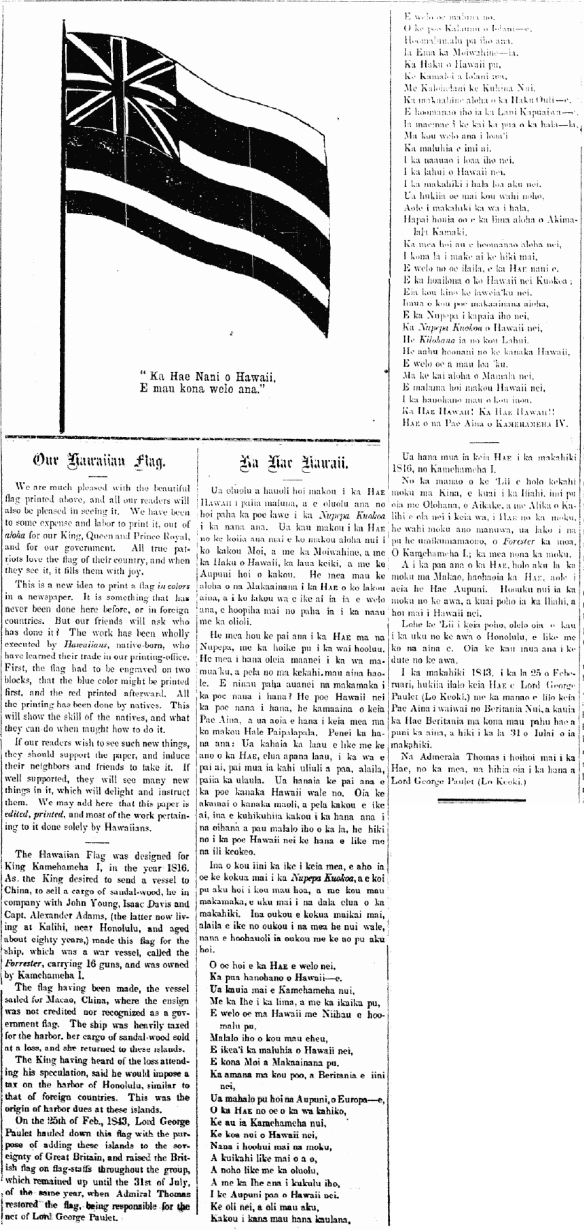
"Ka Hae Nani o Hawaii...

Ka Nupepa Kuokoa, Buke I, Helu 6, Aoao 1. Ianuari 1, 1862.
Poi description in English. 1909.

[Found under: “Our English Items”]

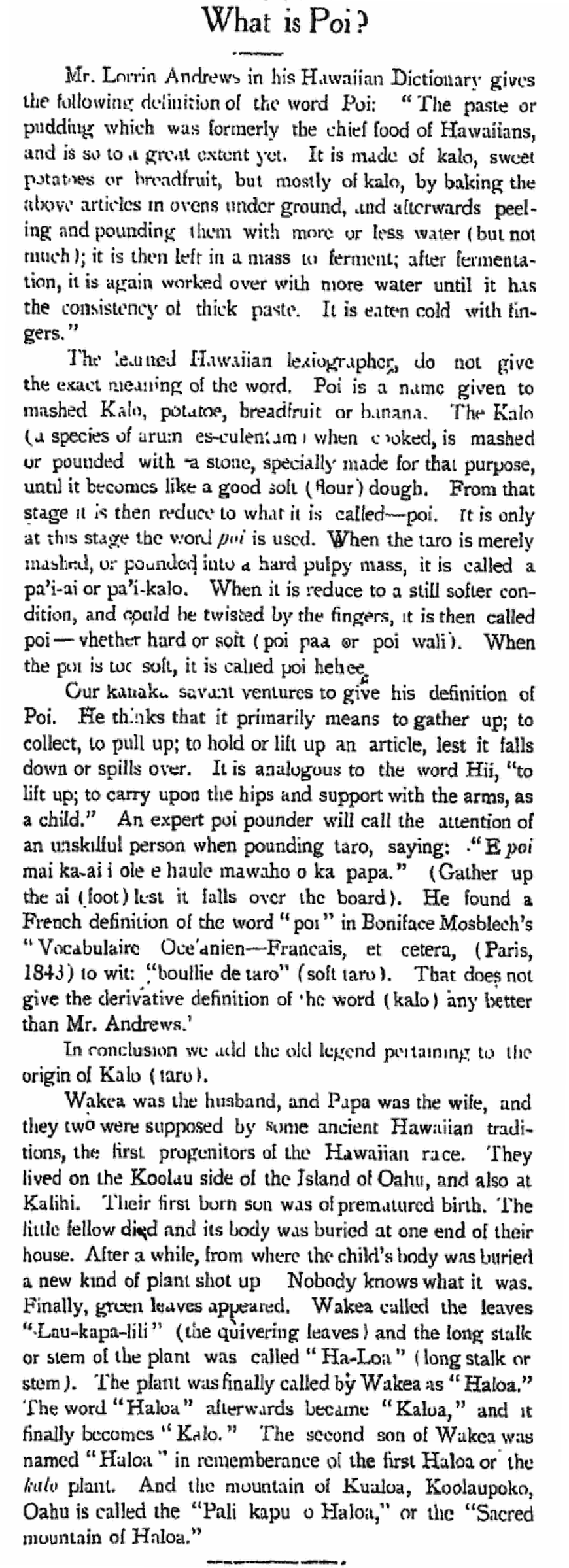
What is Poi?

Mr. Lorrin Andrews in his Hawaiian Dictionary gives the following definition of the word Poi: “The paste or pudding which was formerly the chief food of Hawaiians, and is so to a great extent yet. It is made of kalo, sweet potatoes or breadfruit, but mostly of kalo, by baking the above articles in ovens under ground, and afterwards peeling and pounding them with more or less water (but not much); it is then left in a mass to ferment; after fermentation, it is again worked over with more water until it has the consistency of thick paste. It is eaten cold with fingers.”

The learned Hawaiian lexiographer [lexicographer] do not give the exact meaning of the word. Poi is a name given to mashed Kalo, potatoe, breadfruit or banana. The Kalo (a species of arum ex-culentum [arum esculentum] when cooked, is mashed or pounded with a stone, especially made for that purpose, until it becomes like a good soft (flour) dough. From that stage it is then reduce to what is called—poi. It is only at this stage the word poi is used. When the taro is merely mashed, or pounded into a hard pulpy mass, it is called a pa’i-ai or pa’i-kalo. When it is reduced to a still softer condition, and could be twisted by fingers, it is then called poi—whether hard or soft (poi paa or poi wali). When the poi is too soft, it is called poi hehee.

Our kanaka savant ventures to give his definition of Poi. He thinks that it primarily means to gather up; to collect, to pull up; to hold or lift up an article, lest it falls down or spills over. It is analogous to the word Hii, “to lift up; to carry upon the hips and support with the arms, as a child.” An expert poi pounder will call the attention of an unskillful person when pounding taro, saying: “E poi mai ka ai i ole e haule mawaho o ka papa.” (Gather up the ai (foot [food]) lest it falls over the board). He found a French definition of the word “poi” in Boniface Mosblech’s “Vocabulaire Oce’anien—Francais, et cetera, (Paris, 1843) to wit: “boullie de taro” (soft taro). That does not give the derivative definition of the word (kalo) any better than Mr. Andrews.

In conclusion we add the old legend pertaining to the origin of Kalo (taro).

Wakea was the husband, and Papa was the wife, and they two were supposed by some ancient Hawaiian tradition, the first progenitors of the Hawaiian race. They lived on the Koolau side of the Island of Oahu, and also at Kalihi. Their first born son was of premature birth. The little fellow died and its body was buried at one end of their house. After a while, from where the child’s body was buried a new kind of plant shot up. Nobody knows what it was. Finally, green leaves appeared. Wakea called the leaves “Lau-kapa-lili” (the quivering leaves) and the long stalk or stem of the plant was called “Ha-Loa” (long stalk or stem). The plant was finally called by Wakea as “Haloa.”

(Kuokoa Home Rula, 1/1/1909, p.1)

What is Poi?

Kuokoa Home Rula, Buke VII, Helu 1, Aoao 1. Ianuari 1, 1909.