Anna Berry, daughter of Kentucky congressman, speaks on annexation, 1898.

THE INJUSTICE OF ANNEXATION

As Viewed by an American Woman Miss Anna E Berry of Newport—The Kentucky Congressman’s Daughter Writes Entertainingly of the Native Hawaiians—A Petition to the President.

[Among the ladies who accompanied the congressional party to Hawaii in September was Miss Anna Berry, daughter of Congressman Berry of Kentucky, who has written charmingly of the islands. She brought back many souvenirs of her visit, which are to be seen in her Newport home. The best of all is the Royal Hawaiian standard, the flag which was floating over Queen Liliuokalani when she was deposed. It is to be noted that Miss Berry returned to America with a woman’s sense of the injustice of annexation, from the viewpoint of the native Hawaiian, while the men of the party came back a unit for annexation. The Hawaiian minister to whom Miss Berry refers as a descendant of a Kentucky Governor is Rev. Desha, of Hilo. His grandfather was Governor Desha, of Kentucky, and his father was Isaac B. Desha, who committed a sensational murder at Doggett’s Tavern, a well-known inn of early Kentucky days on the Licking River. The murderer was sentenced to death, and saved by his own father’s pardoning power. The case was one of the most remarkable in American criminal history. He fled to Hawaii where one of his half-native sons is a leading Kanaka minister, and the other is a postal employee.—The Editor of the Kentucky Post.

The recent visit of Senator Morgan and four members of the United States House of Representatives to the Hawaiian Islands aroused among the various peoples of the “Paradise of the Pacific” sentiments and feelings as opposite as the poles. There are indeed various peoples in Hawaii—a very scrapbag of a population—the good with the bad. Here Portuguese and Chinese, Japanese and Germans, Americans and natives jostle one another. Continue reading
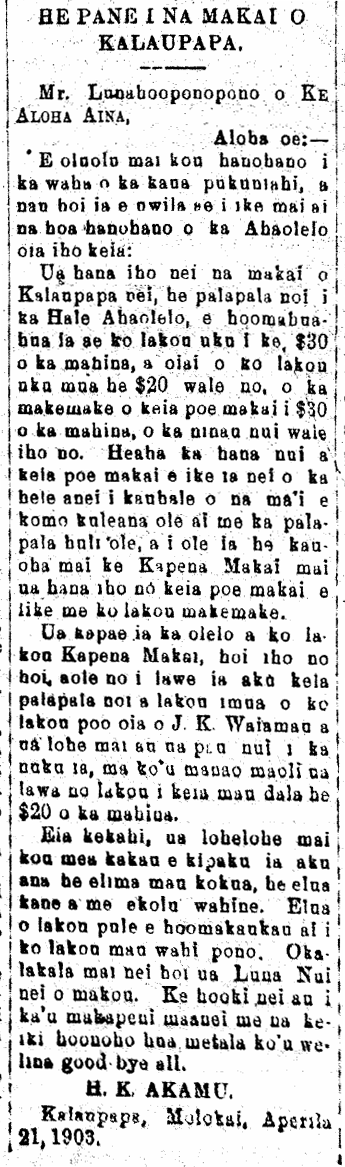
Complaint against police officers in Kalaupapa, 1903.

RESPONSE TO THE POLICE OF KALAUPAPA.

Mr. Editor of Ke Aloha Aina,

Aloha oe:—

May it please your honorable to allow me the mouth of our cannon, and may you flash so that the honored members of the Legislature may see this:

The officers of Kalaupapa nei have made a petition asking the Legislature to increase their salary to $30 per month, being that their current pay is just $20; the asking of the officers for $30 a month is very questionable. What great work do we see them doing; is it going around to the homes of the patients and entering without search warrants, or when the Sheriff gives them orders, these officers do as they please?

They brush aside the orders from their Sheriff and return; they did not put their petition before their head, J. K. Waiamau [Deputy Superintendent], and I hear that they were all admonished; I truly believe that $20 a month is enough for them.

Here is another thing, your writer has heard that five kokua are being sent out, two men and three women. They have only two weeks to ready their belongings. Our Superintendent [McVeigh] is bristling.  I stop my pen here, and to the metal typesetting boys goes my greeting of good-bye all.

H. K. AKAMU.

Kalaupapa, Molokai, April 21, 1903.

(Aloha Aina, 4/25/1903, p. 8)

HE PANE I NA MAKAI O KALAUPAPA.

Ke Aloha Aina, Buke IX, Helu 17, Aoao 8. Aperila 25, 1903.

Sanford B. Dole, the Congregationalists, and Annexation, 1902.

THE HAWAIIAN SITUATION.

On Monday evening, April 28 last, Governor Dole was the guest of the Congregational Club of Boston. Elsewhere in this issue will be found a sketch made by Dole of the Hawaiian situation. It is characteristic of the man. Having the full support of the Administration behind him he is not afraid to say in public what he has been thinking in private for many long years. Let us see and take up his points one by one.

Point No. 1.—”The monarchy was overthrown and annexation was accomplished for the sake of good government for the islands; that is, for their benefit.”—It is true! Annexation was accomplished, by a handful of Congregationalists because the reciprocity treaty between the United States and Hawaii was in imminent danger of being abrogated. The monarchy was overthrown, so as to save the $40 per ton duty on sugar. It was then as it is now for the Congregationalists:—Money before principle.

Point No. 2:—”We have given you everything we have by being annexed.”—That is, Sanford B. Dole, and his Congregationalist friends have given to the United States that which did not belong to them. With the help of an American cruiser, American marines and an American Minister, they have robbed the native Hawaiians of their country so as to enable a few Congregationalist planters to keep up receiving big dividends from their sugar stocks which would have been materially cut down had a $40 duty been imposed upon each ton of sugar. The Springfield Republican adds the following comment to Point No. 2: “But the second point that they have given us all they have is not at all consistent with his first point that they sought Annexation for the benefit of the Islands, and it shows that they are still trying to work the United States for the benefit of the Hawaiians.” Continue reading

Mafia? 1893.

AN AMERICAN MAFIA.

“The Queen never will be restored to the throne, for she will be shot within 24 hours, and every man who takes office under her will be shot also—we have men secretly sworn to do it.”

Such was the remark made to the writer by a brainless young sprig of the “citizens reserve,” such is the tenor of numerous open threats of the canaille composing the annexation club, the citizens reserve and the American league organizations that pretending to be patriotically American are in fact veritable nests of socialism, fenianism and mafia.

To their shame be it said that these mafias are organized under men calling themselves Americans, men who heretofore have been regarded as respectable and intelligent citizens: Hatch, Castle, Wilder, Jones, Smith, McGrew, Emerson, and so on, whose names will pass into history as knavish pirates in a plot to steal a nation and compel America to receive the stolen goods.

A recent article in the Holomua warned that a wave of insanity had struck Honolulu in accordance with a well known theory of cycles. The malady appears to be growing worse, for certain it is, that all the men and women concerned in the overthrow of the Queen, the terrorism and misgovernment of a P. G. military despotism, and the present display of hostilities against the United States, all act like people demented. Continue reading

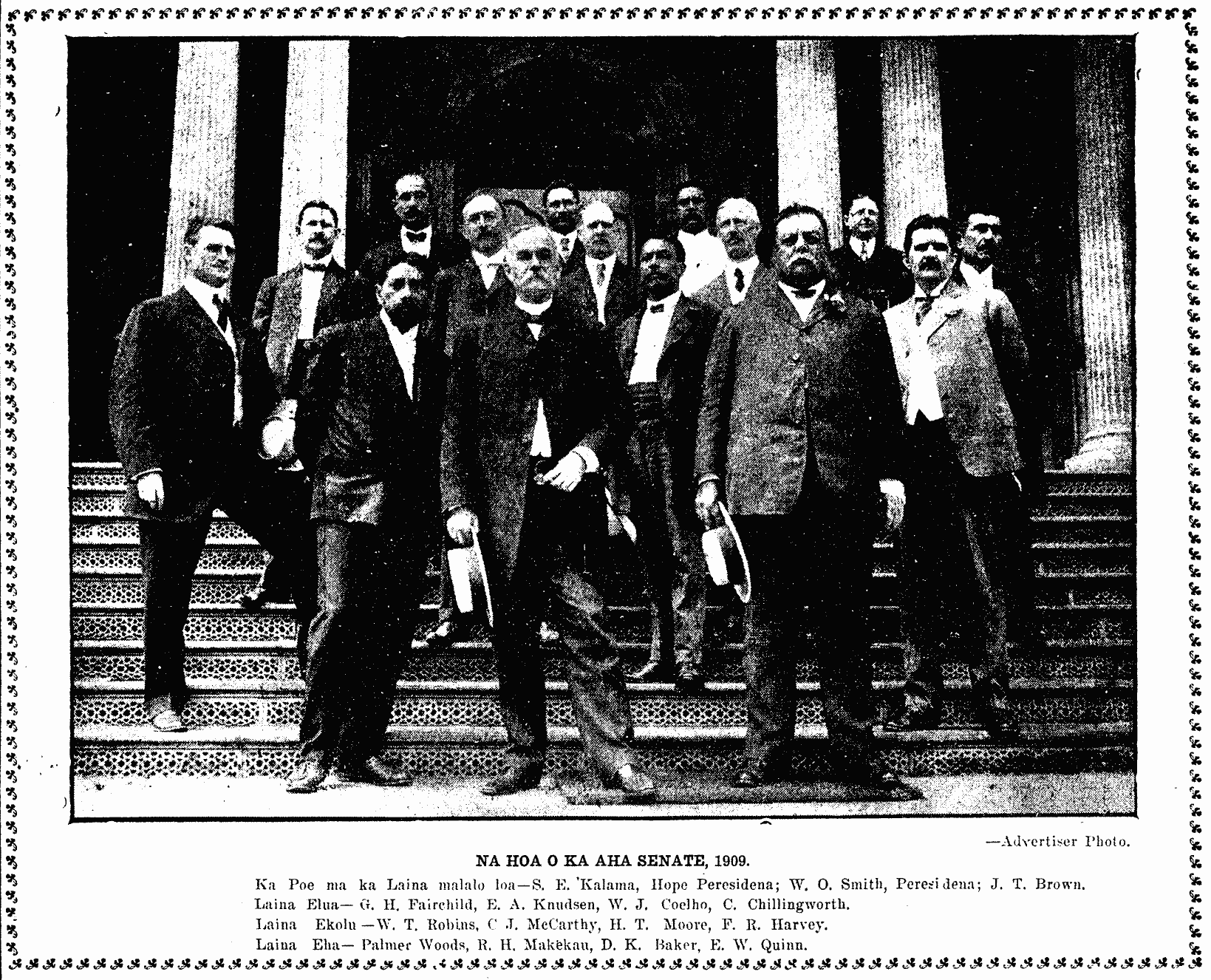
Senators, 1909.

THE MEMBERS OF THE SENATE, 1909.

The people on the bottom row—S. E. Kalama, Vice President; W. O. Smith, President; J. T. Brown.
Second Row—G. H. Fairchild, E. A. Knudsen, W. J. Coelho, C. Chillingworth.
Third Row—W. T. Robins, C. J. McCarthy, H. T. Moore, F. R. Harvey.
Fourth Row—Palmer Woods, R. H. Makekau, D. K. Baker, E. W. Quinn.

—Advertiser Photo

(Kuokoa, 2/19/1909, p. 1)

NA HOA O KA AHA SENATE, 1909.

Ka Nupepa Kuokoa, Buke XLVI, Helu 8, Aoao 1. Feberuari 19, 1909.

House of Representatives, 1923.

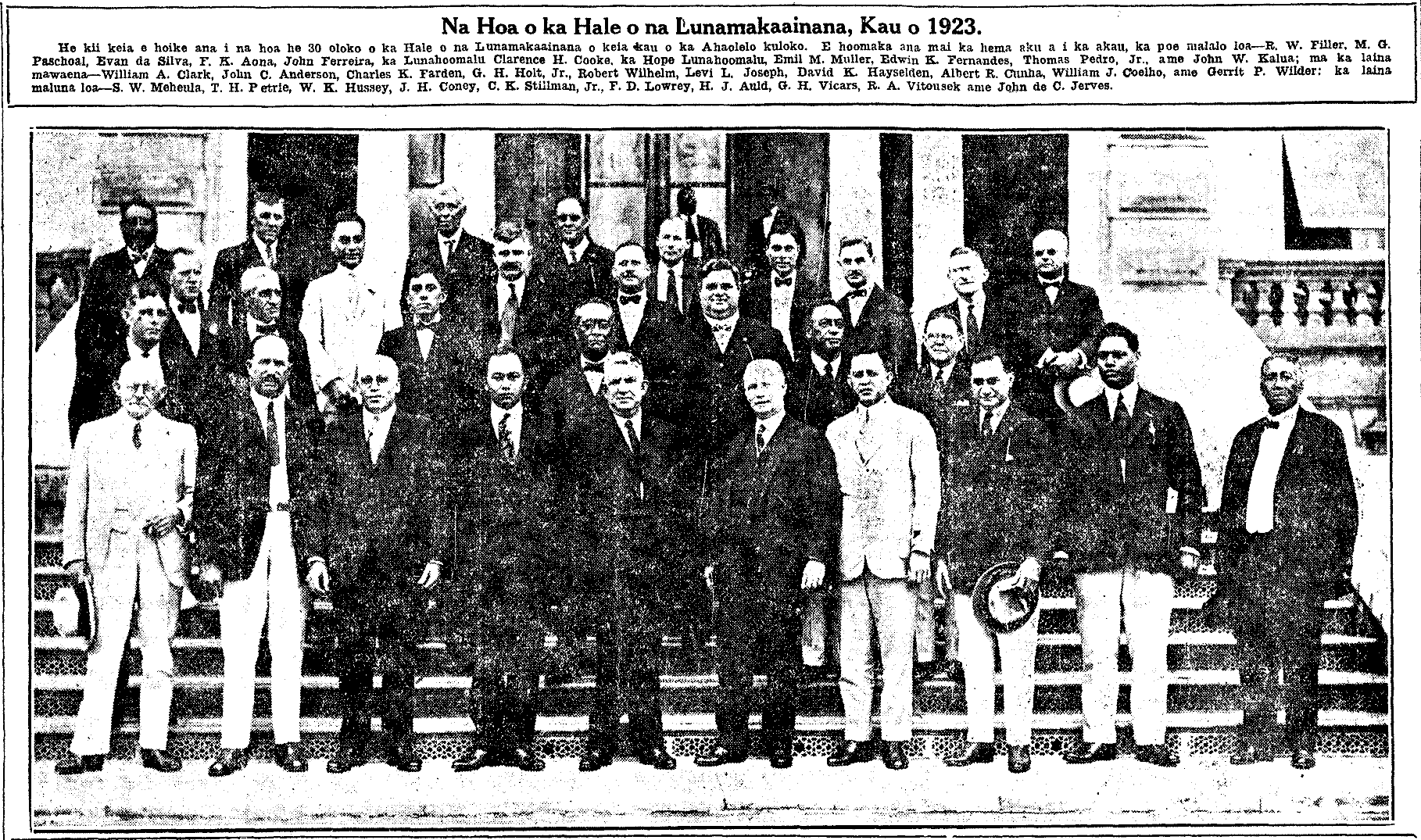
Members of the House of Representatives, 1923 Session.

This is a picture of the 30 members of the House of Representatives of this session of the local Legislature. Beginning from the left to the right, all the way at the bottom—R. W. Filler, M. G. Paschoal, Evan da Silva, F. K. Aona, John Ferreira, the Speaker [Lunahoomalu] Clarence H. Cooke, the Vice Speaker [Hope Lunahoomalu] Emil M. Muller, Edwin K. Fernandes, Thomas Pedro, Jr., and John W. Kalua; in the middle line—William A. Clark, John C. Anderson, Charles K. Farden, G. H. Holt, Jr., Robert Wilhelm, Levi L. Joseph, David K. Hayselden, Albert R. Cunha, William J. Coelho, and Gerrit P. Wilder; the top line—S. W. Meheula, T. H. Petrie, W. K. Hussey, J. H. Coney, C. K. Stillman, Jr., F. D. Lowrey, H. J. Auld, G. H. Vicars, R. A. Vitousek, and John de C. Jerves.

(Kuokoa, 3/1/1923, p. 1)

Na Hoa o ka Hale o na Lunamakaainana, Kau o 1923.

Ka Nupepa Kuokoa, Buke LXII, Helu 9, Aoao 1. Maraki 1, 1923.

Primary election results, 1914.

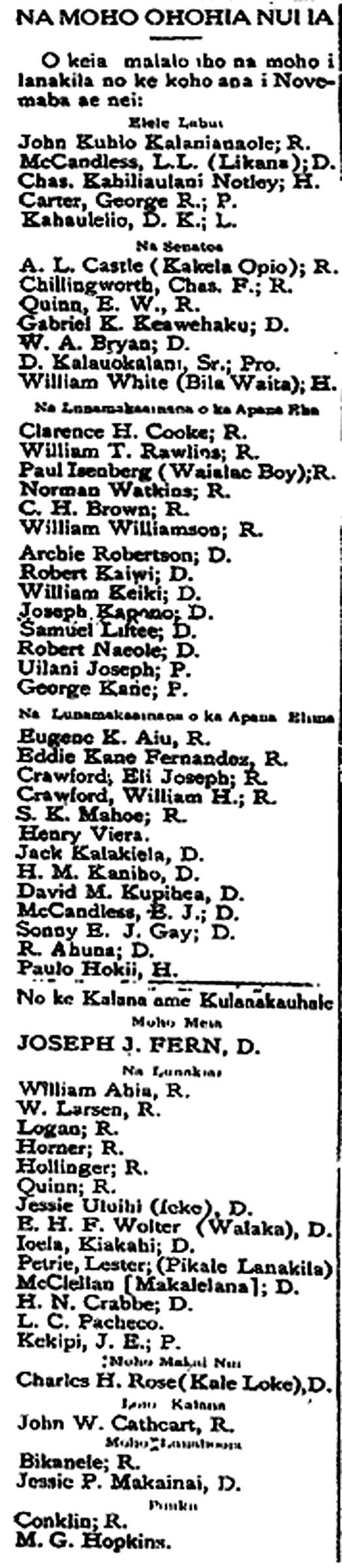
THE CANDIDATES RECEIVING GREAT APPROVAL

These below are the candidates who were victorious for the upcoming elections in November:

Delegate to the U. S. Congress [Elele Lahui]

John Kuhio Kalanianaole; R.
McCandless, L. L. (Likana); D.
Chas. Kahiliaulani Notley; H.
Carter, George R.; P.
Kahaulelio, D. K.; L.

Senators [Na Senatoa]

A. L. Castle (Kakela Opio); R.
Chillingworth, Charles F.; R.
Quinn, E. W.; R.
Gabriel K. Keawehaku; D.
W. A. Bryan; D.
D. Kalauokalani, Sr.; Pro.
William White (Bila Waita); H.

Representatives of the Fourth District [Na Lunamakaainana o ka Apana Eha]

Clarence H. Cooke; R.
William T. Rawlins; R.
Paul Isenberg (Waialae Boy); R.
Norman Watkins; R.
C. H. Brown; R.
William Williamson; R.

Archie Robertson; D.
Robert Kaiwi; D.
William Keiki; D.
Joseph Kapono; D.
Samuel Liftee; D.
Robert Naeole; D.
Uilani Joseph; P.
George Kane; P.

Representatives of the Fifth District [Na Lunamakaainana o ka Apana Elima]

Eugene K. Aiu; R.
Eddie Kane Fernandez; R.
Crawford, Eli Joseph; R.
Crawford, William H.; R.
S. K. Mahoe; R.
Henry Viera;
Jack Kalakiela; D.
H. M. Kaniho; D.
David M. Kupihea; D.
McCandless, E. J.; D.
Sonny E. J. Gay; D.
R. Ahuna; D.
Paulo Hokii, H.

For the City and County

Mayoral Candidate [Moho Meia]

JOSEPH J. FERN; D.

Supervisors [Na Lunakiai]

William Ahia; R.
W. Larsen; R.
Logan; R.
Horner; R.
Hollinger; R.
Quinn; R.
Jessie Uluihi (Ieke); D.
E. H. F. Wolter (Walaka); D.
Ioela, Kiakahi; D.
Petrie, Lester (Pikale Lanakila)
McClellan (Makalelana); D.
H. N. Crabbe; D.
L. C. Pacheco;
Kekipi, J. E.; P.

Candidate for Sheriff [Moho Makai Nui]

Charles H. Rose (Kale Loke); D.

County Attorney [Loio Kalana]

John W. Cathcart; R.

Candidates for Auditor [Moho Lunahooia]

Bikanele; R.
Jessie P. Makainai; D.

Treasurer [Puuku]

Conklin; R.
M. G. Hopkins;

[Political Party abbreviations: D. = Democrat, R. = Republican, H. = Home Rule, P./Pro. = Progressive, L. = Lahui.

Here are more extensive results found in the Honolulu Star-Bulletin, 9/19/1914, p. 11.]

(Holomua, 9/16/1914, p. 1)

NA MOHO OHOHIA NUI IA

Ka Holomua, Buke I, Helu 51, Aoao 1. Sepatemaba 16, 1914.

Voting advice, 1861 / Timeless.

Voting for Representatives.

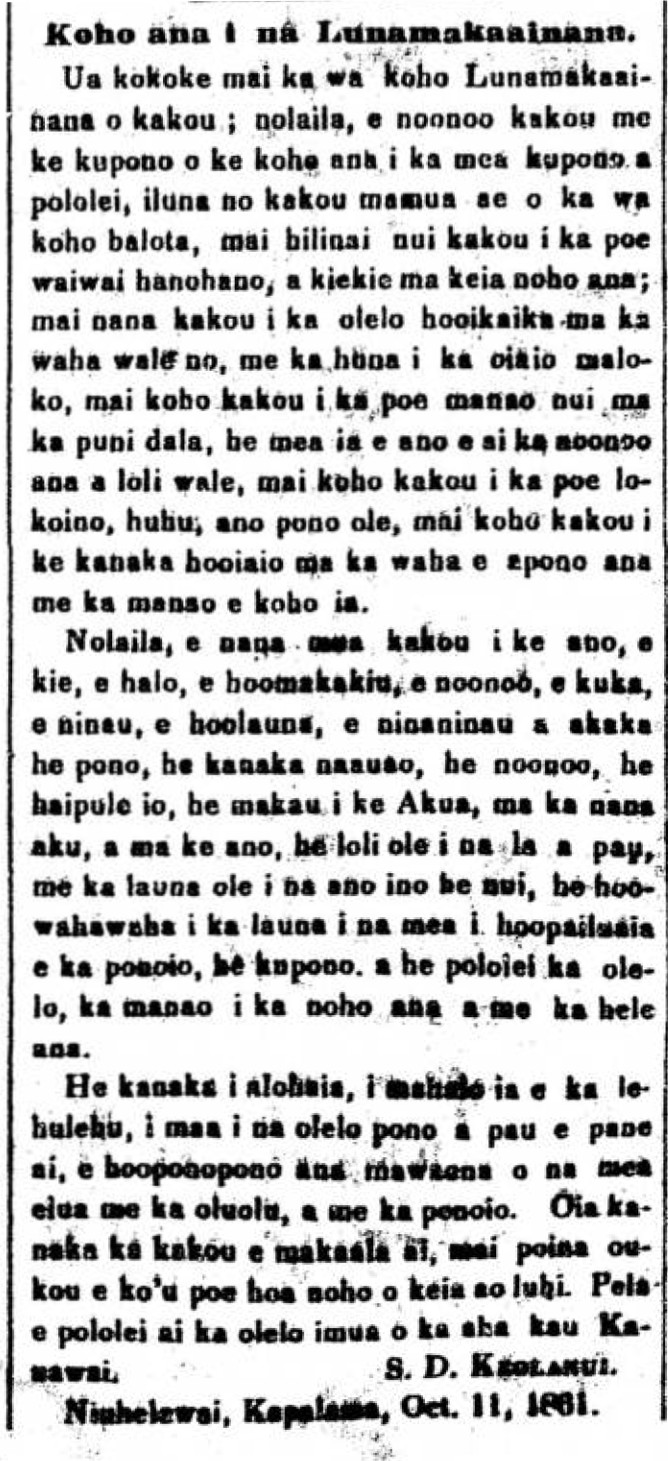
The time for electing our Representatives is approaching; therefore, let us think carefully about voting for the appropriate and right one before it is time to vote; let’s not put great trust behind the famous, wealthy people, and those high up in this world; let us not look solely at great claims made while they hide the truth within, let us not vote for those who are greatly concerned with money for it will alter and easily change their thinking, let us not vote for the heartless, the wrathful, the improper; let us not choose those convincing with the mouth, but vote for those who are chosen with consideration.

Therefore, let us look first at the person’s nature; let us peer, focus on, investigate, consider, discuss, question, associate with, examine; and when it is clear that the person is right, enlightened, thoughtful, devout, fearful of God, in appearance and in character, doesn’t change from day to day, doesn’t associate with the many evils characters, while treating with contempt the associating with those who are sickened by righteousness; upright and straightforward are their words, thoughts, lifestyle and course of action.

A person who is loved and appreciated by the people, who regularly speaks all that is right to mediate between two parties graciously and truthfully. That is the person who we should keep our eyes on; do not forget, my fellow dweller of this wearisome world. In this way, the words before the Legislative session will be truthful.

S. D. Keolanui.

Niuhelewai, Kapalama, Oct. 11, 1861.

[It is interesting to see that much of Keolanui’s advice still rings true over 150 years later.]

(Hoku o ka Pakipika, 10/17/1861, p. 4)

Koho ana i na Lunamakaainana.

Ka Hoku o ka Pakipika, Buke I, Helu 4, Aoao 4. Okatoba 17, 1861.

Restoration Day, 1896.

The Independent recalls the fact that to-day is Restoration day. It reprints on its first page Professor Alexander’s description of the incidents attaching to it. If inaccurate in detail, it is worth reading and is suggestive to thoughtful persons at the present time. The government in control forgets the day, but Hawaiians remember and respect it, and in a few years time will again observe and honor it.

[Tomorrow will be the 171st anniversary of the restoration of the Kingdom.]

(Independent, 7/31/1896, p. 2)


The Independent recalls...

The Independent, Volume III, Number 340, Page 2. July 31, 1896.

Kaulia’s invitation to Morgan, 1897.

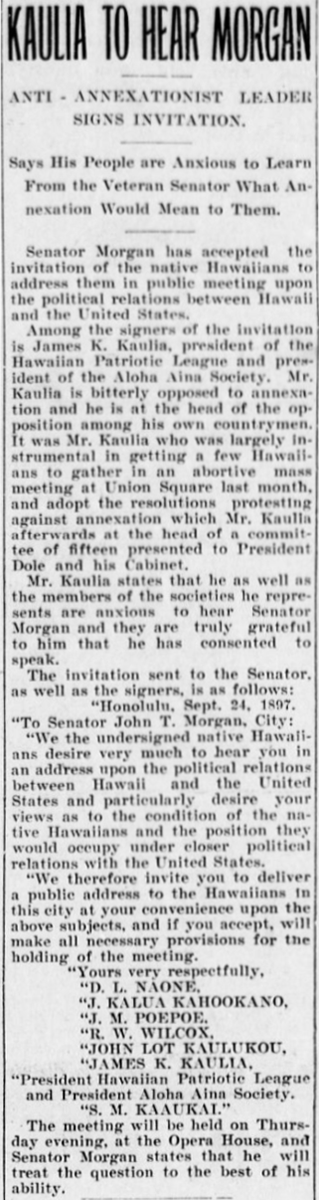
KAULIA TO HEAR MORGAN

ANTI-ANNEXATIONIST LEADER SIGNS INVITATION.

Says His People are Anxious to Learn From the Veteran Senator What Annexation Would Mean to Them.

Senator Morgan has accepted the invitation of the native Hawaiians to address them in public meeting upon the political relations between Hawaii and the United States.

Among the signers of the invitation is James K. Kaulia, president of the Hawaiian Patriotic League and president of the Aloha Aina Society. Mr. Kaulia is bitterly opposed to annexation and he is at the head of the opposition among his own countrymen. It was Mr. Kaulia who was largely instrumental in getting a few Hawaiians to gather in an abortive mass meeting at the Union Square last month, and adopt the resolutions protesting against annexation which Mr. Kaulia afterwards at the head of a committee of fifteen presented to President Dole and his Cabinet.

Mr. Kaulia states that he as well as the members of the societies he represents are anxious to hear Senator Morgan and they are truly grateful to him that he has consented to speak.

The invitation sent to the Senator, as well as the signers, is a follows:

“Honolulu, Sept. 24, 1897.

“To Senator John T. Morgan, City:

“We the undersigned native Hawaiians desire very much to hear you in an address upon the political relations between Hawaii and the United States and particularly desire your views as to the condition of the native Hawaiians and the position they would occupy under closer political relations with the United States.

“We therefore invite you to deliver a public address to the Hawaiians in this city at your convenience upon the above subjects, and if you accept, will make all necessary provisions for the holding of the meeting.

“Yours very respectfully,

“D. L. NAONE,
“J. KALUA KAHOOKANO,
“J. M. POEPOE,
“R. W. WILCOX,
“JOHN LOT KAULUKOU,
“JAMES K. KAULIA,
“President Hawaiian Patriotic League and President Aloha Aina Society.
“S. M. KAAUKAI.”

The meeting will be held on Thursday evening, at the Opera House, and Senator Morgan states that he will treat the question to the best of his ability.

(Hawaiian Star, 9/28/1897, p. 1)

KAULIA TO HEAR MORGAN

The Hawaiian Star, Volume IV, Number 1386, Page 1. September 28, 1897.