Hawaiian Band and the parade for the Knights Templar, 1883.

THE SIR KNIGHTS IN CALIFORNIA.

A Splendid Reception.

San Francisco, 18.—The arrival of the St. Bernard commandery, of Chicago was the event of the day. A delegation from the San Francisco Commandery proceeded as far as Truckee, to welcome them to the Pacific coast. The special honors tendered them are in recognition of the welcome the latter gave to the Pacific coast Knights at the Chicago conclave. On their arrival this morning they were met at the ferry landing by the Knights of the city commanderies, accompanied by Knights from Illinois now here; all in full dress uniform, after the exchange of greetings the knights fell into line, led by the Hawaiian band, and followed by the California commandery mounted. The Presidio band, Golden Gate commandery, St. Bernard band and St. Bernard commandery bringing up the rear. In this order they reached the Baldwin Hotel selected as the headquarters of the Chicago commandery. As an evidence of the marked attention paid them, one detail may be mentioned. Each cigar purchased for their use was provided with a band on which was painted, in colors, the name of their commandery while each box, specially made, was emblazoned with the device, St. Bernard. Mrs. Moulton, wife of the commander, was presented with a flower piece, three fee long and two in breadth, representing every variety of the choicest flowers of California. Including knights from Oregon and Washington Territory, it is estimated that 3,000 persons arrived in this city within the last twenty-four hours.

(Salt Lake Daily Herald, 8/19/1883, p. 1)
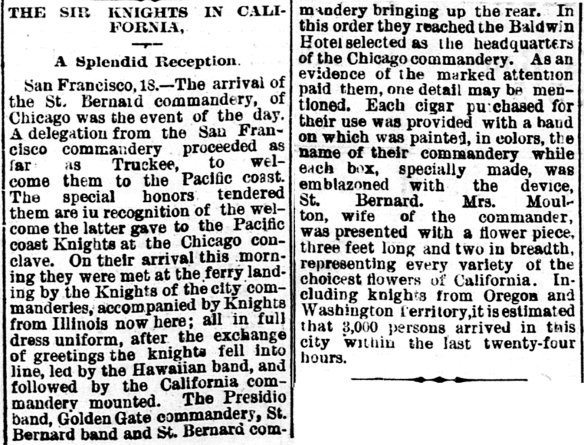
SaltLakeHerald_8_19_1883_1

Salt Lake Daily Herald, Volume XIV, Number 64, Page 1. August 19, 1883.

Aiu, the Kauai boy comes home from war, 1920.

KAUAI BOY SONG.

He mele he inoa no Aiu,
Kuu pua o Kina hapa Hawaii,
He opua hookahi a i kuu alo,
Kuu lei miulana poina ole;
Kau he hiki aku i ka moana,
Na ale nupanupa o ka Pakipika,
Ike oe i ke anu o Kaleponi,
I ohu halii paa ka moana.
Kau aku ka manao nou e Palani,
Ke kahua hoolulu a o na koa,
O ke kikowaena a o ke kaua,
Ua huliamahi na aupuni hui,
Ike pono i ka hana a Kelemania,
Lahui puuwai ole o ke ao nei,
Ilaila hu ae ke aloha a i ka  makua.
Haalele ana i ka puuwai,
Ua paa ko kino i ka aelike,
Me na ‘liikoa Amerika.
Hookahi makahiki i ka aina malihini,
Huli ho i ka home kulaiwi,
Hoomaikaiia ka Makua Lani,
E ole kuu kokua Mana Lani,
Hoi kino mai au me ka lanakila.
Haina ia mai ana ka puana,
Kuu pua o Kina hapa Hawaii.

Owau iho no,

MRS KILA KAILI.

[Might anyone know which Aiu this song is composed for by Mrs. Kila Kaili?]

(Kuokoa, 1/2/1920, p. 2)

Kuokoa_1_2_1920_2.png

Ka Nupepa Kuokoa, Buke LVIII, Helu 1, Aoao 2. Ianuari 2, 1920.

More information sought on Opukahaia and others by the pastor in Cornwall, Connecticut, 1895.

[Found under: “NU HOU HAWAII”]

Who are these people:—The pastor at Cornwall, Conn, where the missionary school was built in 1817, dearly wants to know the personal stories of these students from Hawaii. 1, Opukahaia; 2, Honolii; 3, Kanui; 4, Kaumualii; 5, Hopu; 6, Alohekaa; 7, Kupalii; 8, Haia; 9, Ilipuaa; 10, Kaleiula; 11, Kamahoula [? Kamohoula]; 12, Kapoo; 13, Kapoli; 14, Komo [? Kemo]; 15, Kapali [? Kapuhi]. Those who know, could they please send the stories pertaining to these boys, or perhaps others, to C. M. Hyde, P. O. Box 67 [pahu leta 67], Honolulu.

(Kuokoa, 5/11/1895, p. 3)

Kuokoa_5_11_1895_3.png

Ka Nupepa Kuokoa, Buke XXXIV, Helu 19, Aoao 3. Mei 11, 1895.

Fount of knowledge, H. B. Nalimu, turns 96! 1931.

GOOD NEWS

On the eleventh of November, 1835, Henry Benjamin Nalimu was born, at Papaaloa, North Hilo, Hawaii, the land of birth of his parents.

On November, he became ninety-six years old at “Kamaluokaohai,” at 1536 Alewa Drive, the home of his grandchildren.

Nalimu is a descendant of his ancestor I, who was a famed strategist of Kamehameha ka Na’i Aupuni.

The I, the Mahi, and the Palena, were famous troops of Kamehameha, and leaders of Kamehameha, and I commanded the troops of I.

In 1840, Nalimu left Papaaloa and lived in Pi’opi’o, Hilo, until 1847.

At that time, Kamehameha began to give land to the makaainana.

In 1852, Nalimu entered into the Hilo Boarding School.

D. B. Lyman was the principal at the time, and it was he who built that college on land given by the alii for that school.

In 1857, Nalimu became the assistant kahu of the church of Hilo, under the old Missionary Coan [Koana, Titus Coan].

He accompanied Coan to the cliffs of Hilo, climbing up and going down into the rivers. There were no bridges and no good roads at the time. The walked the trails until Kalapana. The shoes they wore were ti-leaf sandals [kamaa la’i], and pandanus root sandals [kamaa aahala], so that their feet would not be harmed by the rocks. Continue reading

Death of Stephen William Kekuewa, 1920.

THE REV. S. W. KEKUEWA PASSES ON

After being worn away by a debilitating illness for some time, the Rev. Stephen William Kekuewa grew weary of this life, at the home of his daughter, Mrs. John P. Kapua, on School Street, at four o’clock in the afternoon, on Wednesday of this past week; and in the afternoon of this past Sunday, his remains were carried to the Maemae Cemetery.

The Rev. S. W. Kekuewa was born at Luakaha, Nuuanu, on the 25th of February, 1842, therefore when he died he was over seventy-eight years old.

During his youth, he was educated at Lahainaluna School, under his teachers, S. E. Bishop and C. B. Andrews; and for some years he lived on the island of Micronesia on a mission he was sent on by the Hawaiian Evangelical Board [Papa Hawaii].

Because the health of his wife was not good, they returned to Hawaii nei, and he served as the kahu of the chruch at  Iole, Kohala, Hawaii for many years.

Because of the letter of the members of the church of Waianae which called for him to be the kahu of that church, he left the church of Kohala and went to live at Waianae; at that church he lived and worked until he was called by his Lord, and he went to his permanent home beyond. Continue reading

The Rev. John Kauhane passes on, 1907.

FORTY YEARS A NATIVE PASTOR

Something About the Career of Kauhane, Who Died Monday.

Rev. J. Kauhane, the veteran pastor of the native church in Kau, Hawaii, died on Monday at the Queen’s hospital, of enteritis. Kauhane was 79 years old when he died and had for forty years been pastor of the Waiohinu church. His father was a chief of high rank and his mother was the chiefess Alapai, after whom Alapai street was named.

His early education was received at… Continue reading

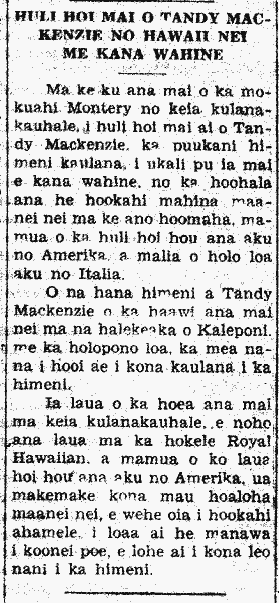
Tandy Kaohu MacKenzie back home, 1932.

TANDY MACKENZIE RETURNS TO HAWAII NEI WITH HIS WIFE

With the landing of the steamship Montery in town, Tandy Mackenzie, the famous singer, came home accompanied by his wife to spend a month on vacation before returning back to America and perhaps going all the way to Italy.

The successful singing performances given by Tandy Mackinzie at theaters in California boosted his singing popularity.

While here in town, they will be staying at the Royal Hawaiian Hotel, and before the couple goes back to America, his friends here want him to put on a concert so that people here have a chance to hear his beautiful singing voice.

[Check out this nice biography found on the Kamehameha Schools Archives page! They have some pretty cool information up about the history of Kamehameha Schools and its graduates if you do some clicking around.]

(Alakai o Hawaii, 12/8/1932, p. 2)

HULI HOI MAI O TANDY MACKENZIE NO HAWAII NEI ME KANA WAHINE

Ke Alakai o Hawaii, Buke 5, Helu 32, Aoao 2. Dekemaba 8, 1932.

Sarai Hiwauli, 1856.

BIOGRAPHY OF S. HIWAULI II.

Sarai Hiwauli was born in Kahaluu, Koolaupoko, after the great plague here on Oahu during the time of Kamehameha I, and she was taken to Hilo, Hawaii to be raised, along with her parents and her kupuna; from Hopuola and Kalimahauna came Hiwauli, from Kahili and Napolo came Hopuola, from Kahiko and Kuanuuanu came Kahili, from Keaweikekino and Iliholo came Kahiko, from Hoou and Kamaiki came Keaweikekino, from Mahiopupelea and Kapaiki came Hoau, from Kanaloauoo and Kapulaiolaa came Kapaihi, from Kahoanokapuokuihewa and Kapahimaiakea came Kapuleiolaa, from Loheakauakeiki and Kalaniheliikauhilonohonua came Kahoanokapuokuihewa, from Kauhealuikawaokalani and LonowahineikahaleIkiopapa came Kalaniheliikauhilonohonua, from Kaholipioku and Moihala came LonowahineikahaleIkiopapa, from Lonoapii and Piilaniwahine came Moihala, and so on. Continue reading

Real gentlemen from a hundred years ago, 1915.

THE WORDS OF A HAWAIIAN

A while ago while some Hawaiian Youths were in Washington and riding an electric car, some haole women boarded the car, and not one of haole men near where those haole women were gave their seat to any of the women. When the Keiki Hawaii saw these Ladies standing, that is when these Hawaiian Youths stood and gave their seats to these white women. The women accepted the kindness of the Hawaiians. These Hawaiian Boys then heard one of the Haole reading a newspaper ridicule them, saying:

“They are probably some foreigners, giving their seats to those women.” It was like he was calling them “country bumpkins.” When S. L. Desha Jr., heard these words of the Haole reading the paper, as he spoke disparagingly of this action by the Hawaiian Boys, that was when he spoke without hesitation to that Haole, perhaps because he was with his fellow Hawaiians. Continue reading

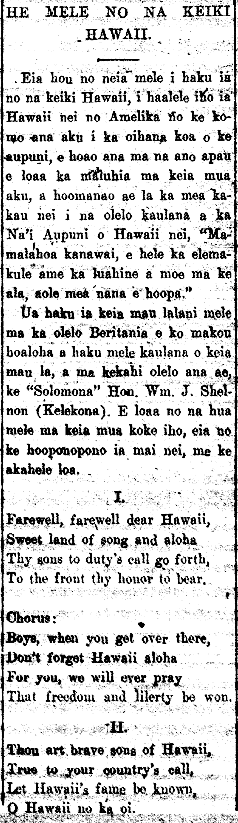
A mele by the “Solomon” of Hawaii, William J. Sheldon, 1918.

A MELE FOR THE HAWAIIAN BOYS.

Here again is this mele which was composed for the Hawaiian boys who just left Hawaii for America to join the armed forces of the nation, to try all means to obtain peace in the future, and the composer recalls the famous words of the Conqueror of the Nation of Hawaii nei, “Law of the Splintered Paddle: let the old men and the old women go and lie by the roads, no one is to disturb them.”

These lines of mele were composed in English by our friend and famous composer of songs of these days, and in other words, the “Solomon,” Hon. William J. Sheldon (Kelekona). The music will be available soon as it is now being edited with great care.

I.

Farewell, farewell dear Hawaii,
Sweet land of song and aloha
Thy sons to duty’s call go forth,
To the front thy honor to bear.

Chorus:

Boys, when you get over there,
Don’t forget Hawaii aloha
For you, we will ever pray
That freedom and liberty be won.

II.

Thou are brave sons of Hawaii,
True to your country’s call,
Let Hawaii’s fame be known,
O Hawaii no ka oi.

(Aloha Aina, 6/21/1918, p. 2)

HE MELE NO NA KEIKI HAWAII.

Ke Aloha Aina, Buke XXIII, Helu 25, Aoao 2. Iune 21, 1918.