King Kalakaua’s Arrival in Japan, 1881.

His Majesty the King of Hawaii arrived here yesterday (Friday) morning at 8 a. m. in the Oceanic. As the steamer moved up to her anchorage, the men-of-war in harbour dressed ship and manned yards, the crews of the Russian and Japanese vessels also cheering heartily as the Oceanic passed them. His Majesty was visited on board by Mr. Hachisuka, ex-Daimiyo of Awa, Admiral Nakamura, Mr. Ishibashi, Secretary of the Foreign Office and others, as well as by the Russian Admiral and Staff. He subsequently embarked in the Emperor’s State barge and proceeded to the Port Admiral’s Office, where he was received by Mr. Daté, Ex-Daimiyo of Uwajima, Mr. Hijikata, Vice Minister of the Household Department, Mr. Sannomiya, Mr. Nagasaki and several Naval and Military officers, Mr. R. Irwin, Consul for Hawaii in Japan, and Mr. Stevens, secretary of the U. S. Legation also waited on his Majesty. From the Port Admiral’s Office His Majesty proceeded in a state carriage to the Summer Palace at Iséyama, which has been paled at his disposal by the Emperor. He was there visited by H. I. H. Prince Fushimi, Mr. Uyeno, Vice Minister of Foreign Affairs, and many other officials of high rank. To-day (Saturday) he proceeded to Tokiyo by the 12 o’clock train and was met at Shimbashi terminus by four Imperial Princes, who accompanied him first to an audience with His Majesty the Emperor and afterwards to their own houses, whence he ultimately proceeded to the Yenriyokwan, which has been prepared for his reception during the period of his sojourn here. The King’s name is Kalakauwa, which may be translated, “The day of battle.” His Majesty is nearly fifty years old, having been born in 1831. In personal appearance he is about the middle height, thickset, but of really handsome personal appearance. His complexion is not darker than that of an ordinary Japanese. When but a child he was received into the boarding school, kept for many years by Mr. and Mrs. Cook of the American Board’s Mission, for the exclusive reception of all the young chiefs of the highest blood. Here he received a good education, and being at the time he was first sent there one of the youngest received into this family of some dozen or more pupils, he had acquired, at the conclusion of his scholastic career, not only a through knowledge of English, but also an accurate pronunciation of that language. Previous to his election, in 1874, to fill the throne rendered vacant by the death of King William Lunalilo, he served as Post-Master General, and in other Government positions.

[This is an article appearing in one of Japan’s English-language newspapers of the time, The Japan Weekly Mail, which started in 1879.]

(Japan Weekly Mail, 3/5/1881, p. 1)

His Majesty the King of Hawaii arrived...

The Japan Weekly Mail, Volume V, Number 9, Page 1. March 5, 1881.
More on Hawaiian Independence Day and Aloha Aina, 1843.

THE ANT [KA NONANONA].

“Go to the ant, thou sluggard; consider her ways, and be wise.” Proverbs [Solomona]

Book 2. HONOLULU, OAHU, JANUARY 17, 1843. Paper 17.

Here are some letters from Haalilio; people will surely be happy to hear from him and Mr. Richards that their travels are going well.

Weletabu [Vera Cruz ?], Mexico, Nov. 2, 1842.

Dr. G. P. Judd,

My dear friend, much aloha to you and your entire household. Here am I, your friend, with feeling aloha for you. The two of us [Haalilio and Richards] arrived here on the 29th of October, and we are awaiting a ship to ride. Hear me, I am doing fine, I have no illness; my health is fine now. However, I do not know how it will be when we get to the cold lands; perhaps it will be alright, and perhaps not. Hear me, we have travelled about this expansive land with peacefully, we were not troubled, we were cared for well by the Lord, until arriving here. But our bodies are spent after the long road. The days were extremely hot and extremely cold; we got drenched by the rain and snow, we passed through mountains, and rivers, and the wilds here in Mexico; we swam the water of rivers running by the face of the mountains, during the day and the night. In the cold and the heat, we endured hunger, riding on the backs of mules all day long. But I was certain that Jesus was with us in this friendless land. And that he blesses us. He takes care of the two of us, and our bodies are not troubled or hurt. He supplies us with all of our needs. He has welcomed us always amongst good friends; and there, we were given comfort and help on our path.

Listen to this, I’ve seen the towns of these lands; they are countless, and I have seen Mexico the great Town of the president [alii]. I’ve also seen the silver mines, and how they work silver; we’ve been to the legislature of the alii and his residence. Those places are grand to see. And today I am with health, giving my aloha to you and your wife and the children; give your [my?] aloha to all the friends there, and to Hana folks and to your people and to my household, and to the land and to the chiefs.

Aloha between us, Let us live through the Lord; until we meet in joy once more.

Timoteo Haalilio.

Mexico, Weletabu [Vera Cruz ?], Nov. 8, 1842.

O D. [G.] P. Judd,

Much Aloha to you; we received your letter on this day, the 8th of Nov., 1842. And we’ve understand all that was within. I have much aloha for you, and for all of you. How sad for all the alii, and how sad for Kapihi! We have been blessed this day in seeing your letter. There is much aloha for us all and our homeland. We are travelling aboard the American warships, Falmouth [Falamaka], to New Orleans [Nuolina]. A steam-powered American warship arrived, a huge vessel, 247 feet long and 2,400 tons. As I watch her sail by steam, it is a fantastic sight; she is so swift, with no comparison; this is the first time I’ve seen a steamer, and I am totally captivated by it.

Much aloha for you; here we are safe, steadfast in our duties we swore to.

Aloha to you.  T. Haalilio.

The two of them are headed to Washington aboard the steamer, a warship named Missouri, and perhaps they will land in Washington in 9 days.

[Does anyone know if Weletabu in Mexico is Vera Cruz, or if it is somewhere else?

Also, who is the Hana and the Kapihi mentioned here?]

(Nonanona, 1/17/1843, p. 81)

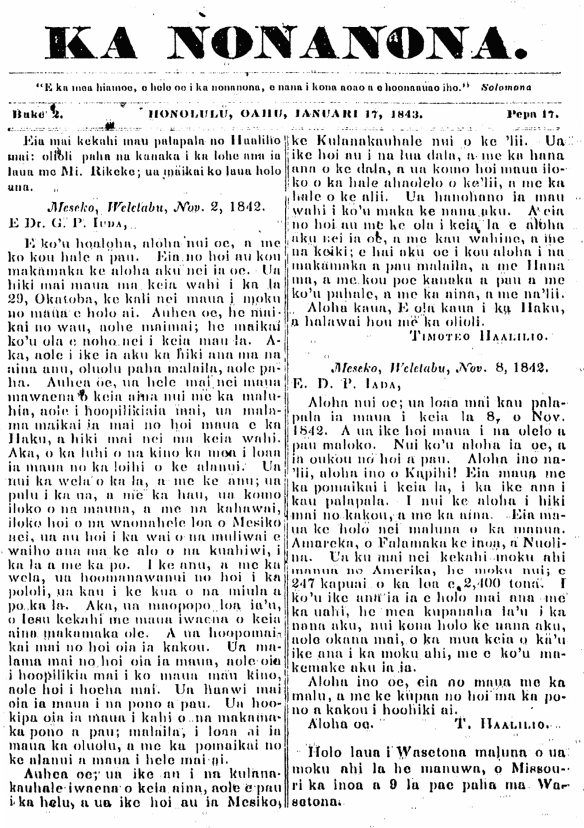
Eia mai kekahi mau palapala no Haalilio mai...

Ka Nonanona, Buke 2, Pepa 17, Aoao 81. Ianuari 17, 1843.

More coverage of Hui Nalu Singing Group, 1912.

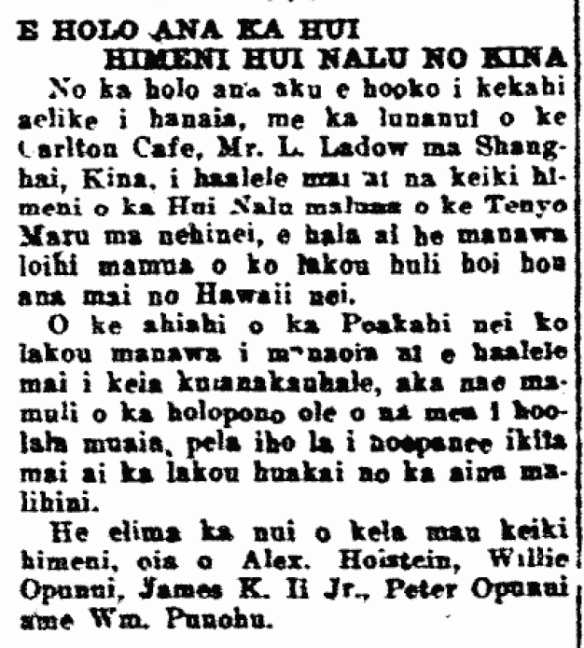
THE HUI HIMENI HUI NALU IS HEADED TO CHINA

To fulfill their contract with the head of the Carlton Cafe, Mr. L. Ladow, in Shanghai, China, the singing boys of the Hui Nalu will leave aboard the Tenyo Maru yesterday, and they will spend a long period of time there before returning to Hawaii nei.

They were supposed to leave this town on Monday, however because what was planned earlier did not go well, their trip to foreign lands has been postponed for a bit.

There are five of these singers, they being: Alex. Holstein, Willie Opunui, James K. Ii, Jr., Peter Opunui, and William Punohu.

(Kuokoa, 12/20/1912, p. 4)

E HOLO ANA KA HUI HIMENI HUI NALU NO KINA

Ka Nupepa Kuokoa, Buke XLVIII, Helu 51, Aoao 4. Dekemaba 20, 1912.

Musicians travel to Japan and China, 1912.

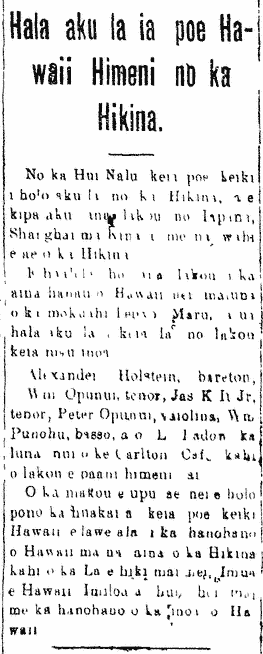
Those Hawaiian Singers Leave for the East.

These youths are from the Hui Nalu [Singing Club] who left for the East; and they will visit Japan and Shanghai in China and other locations in the East.

They will leave the land of their birth aboard the steamship Tenyo Maru [?], and they left this day, their names being:

Alexander Holstein, baritone,

William Opunui, tenor, James K. Ii, Jr., tenor, Peter Opunui, violin, William Punohu, bass, and L. Ladon [Louis Ladow] the head of the Carlton Cafe, where they are to perform.

Our hope is that the journey of these Hawaii boys carrying with them the pride of Hawaii to East, to the land of the rising Sun, goes well. Go forward, go forward O Great-Travelling Hawaiians and return with glory in the name of Hawaii.

(Kuokoa Home Rula, 12/19/1912, p. 1)

Hala aku la ia poe Hawaii Himeni no ka Hikina

Kuokoa Home Rula, Buke X, Helu 51, Aoao 1. Dekemaba 19, 1912.

On the importance of maintaining connections, 1874.

Blessed are the Hawaiians.—In the past months of this year, a certain good woman of this town gathered together all sorts of Hawaiian newspapers and books, and sent them by way of a friend to Oregon for Hawaiians living amongst that unfamiliar people. And just recently in the past few weeks, this good woman of town received a barrel of salmon from the Hawaiians of Oregon with words like this: We are presenting you with this small gift, along with our warm aloha. We are delighted to see the Newspapers and Books you sent by way of _________.

(Lau Oliva, 12/1874, p. 1)

Lokomaikai ka Hawaii Maoli.

Ka Lau Oliva, Buke IV, Helu 12, Aoao 1. Dekemaba 1874.

Hugo Kawelo, sent to Glasgow to study, returns, 1886.

HAWAIIAN YOUTH RETURNS.

On the ship that brought the Portuguese laborers, Mr. Hugo Kawelo, one of the youths sent to Scotland [Sekotia] to seek education by working [unclear word] in an iron works factory. Because of sickness, he returned, but when he arrived back, he was the epitome of a robust and vigorous man. It was as if the air of the open ocean brought him back to health. He wishes to return to complete his education in the iron [unclear word] industry, should his health be good.

[Hugo Kawelo is one of the select Hawaiians sent abroad by Kalakaua to study and to bring back this knowledge to move Hawaii forward. For more on this program, see for instance: Agnes Quigg’s “Kalakaua’s Hawaiian Studies Abroad Program” from the Hawaiian Journal of History.

Here is one another example of a badly imaged newspaper. I guessed the meaning of some of the passage.

One of our readers, Lynda Fitzgerald, asked who can be contacted to get the original Hawaiian-Language Newspapers reshot clearly. I don’t have a specific name, but the more people that know how important this is, the more likely it will be done. So talk to your friends and coworkers and heads of boards and kumu hula and civic club officers and the aunty down the street. Why do you think seeing all of this information clearly is important…]

(Nupepa Elele, 3/6/1886, p. 2)

HAWAII OPIO UA HOI MAI.

Ka Nupepa Elele, Buke VII, Helu 36, Aoao 2. Maraki 6, 1886.

Hawaiian with leprosy sent back from California? 1906.

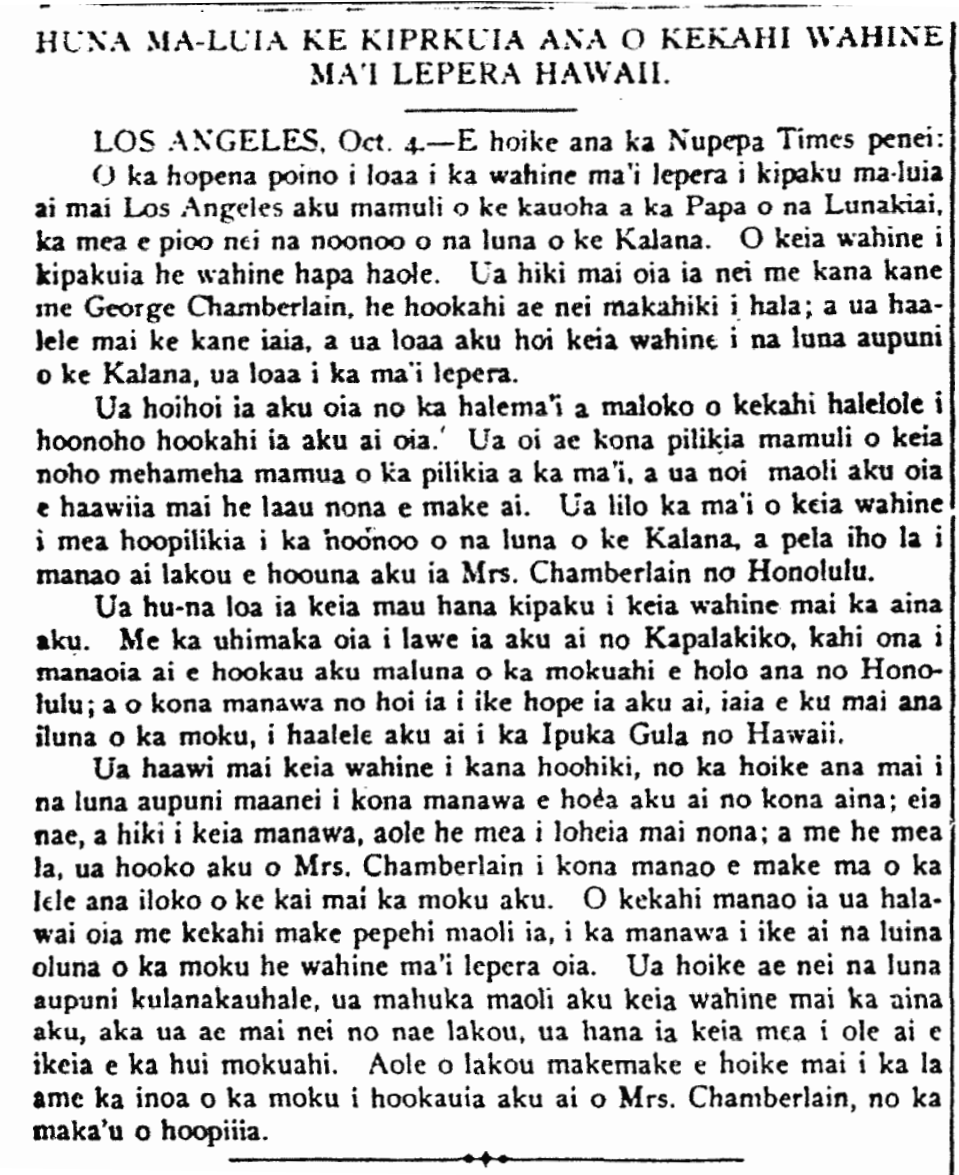
THE DEPORTATION OF A HAWAIIAN WOMAN WITH LEPROSY IS KEPT SECRET.

LOS ANGELES, Oct. 4.—The Times Newspaper reported thus:

The sad fate of a woman with leprosy deported secretly from Los Angeles because of an order by the Board of Supervisors [Papa Lunakiai] is what has gotten the heads of the County perturbed. This woman that was sent away is a hapa haole. She arrived with her husband, George Chamberlain, one year ago; her husband left her, and this woman was found with leprosy by the government officials of the County.

She was sent to the hospital and she was kept alone in a laundry room. She was more troubled by being kept in solitary more than by the disease, and she pleaded them to give her a medicine to kill her. This woman’s ailment was something that was problematic for the heads of the County, and so they decided to send Mrs. Chamberlain to Honolulu.

This deportation from the land was kept a strict secret. She was sent blindfolded to San Francisco, where she was to be put aboard a steamship for Honolulu; and that was the last time she was seen, as she stood atop the ship leaving the Golden Gate for Hawaii.

She gave her word that she would present herself to the government officials here when she arrived in her land; however, until this moment, there has been nothing heard from her; and it would seem that Mrs. Chamberlain carried out her thought to die by jumping off the ship into the sea. One thought is that she was murdered when the sailors aboard the ship found out that she was afflicted by leprosy. The town officials said that she escaped, but however they admit that this was done so that the ship company would not find out. They do not want to say what day and the name of the ship which Mrs. Chamberlain was placed upon, because they are afraid of being sued.

(Kuokoa, 10/26/1906, p. 6)

HUNA MA-LUIA KE KIPRKUIA ANA O KEKAHI WAHINE MA'I LEPERA HAWAII.

Ka Nupepa Kuokoa, Buke XLV, Helu 43, Aoao 6. Okatoba 26, 1906.

Early report on poi palaoa in California, 1859.

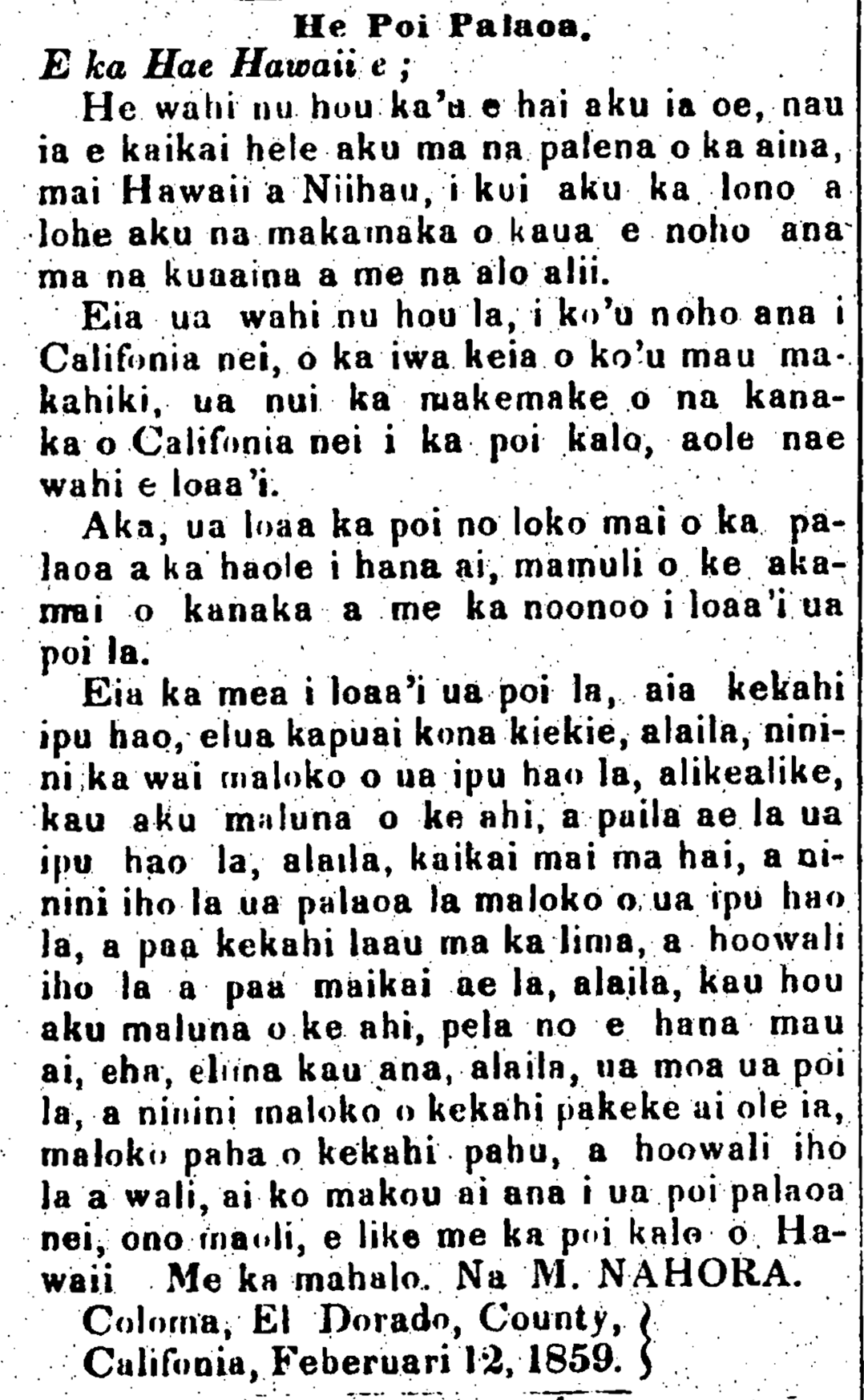
Poi Palaoa.

O Hae Hawaii;

I have some news to report and it will be for you to carry it around to the borders of the land from Hawaii to Niihau, so that the news is heard by our friends living in the countryside [kuaaina] and in the royal court [alo alii].

Here is the news: this is my ninth year of living here in California, and the Hawaiians in California desire poi greatly, but have no way to get it.

But we get poi from the flour that is made by the haole, and through the ingenuity of the Hawaiians who by thinking came up with that poi.

This is how you acquire the poi; get a pot that is two feet high and pour water into it half way and place on top the fire; when it boils, carry it aside and pour in flour into the pot; hold a stick in one hand and stir until firm then put back on the fire; keep doing this, and put back on the fire four or five times at which point the poi is cooked; pour into a bucket or in a barrel perhaps, and mix until smooth; when we eat poi palaoa it is truly delicious like taro poi of Hawaii. With appreciation, By M. NAHORA.

Coloma, El Dorado County,

California, February 12, 1859.

(Hae Hawaii, 3/16/1859, p. 199)

He Poi Palaoa.

Ka Hae Hawaii, Buke 3, Helu 50, Aoao 199. Maraki 16, 1859.

More on E. K. Rose, Prince Lei Lani, 1924.

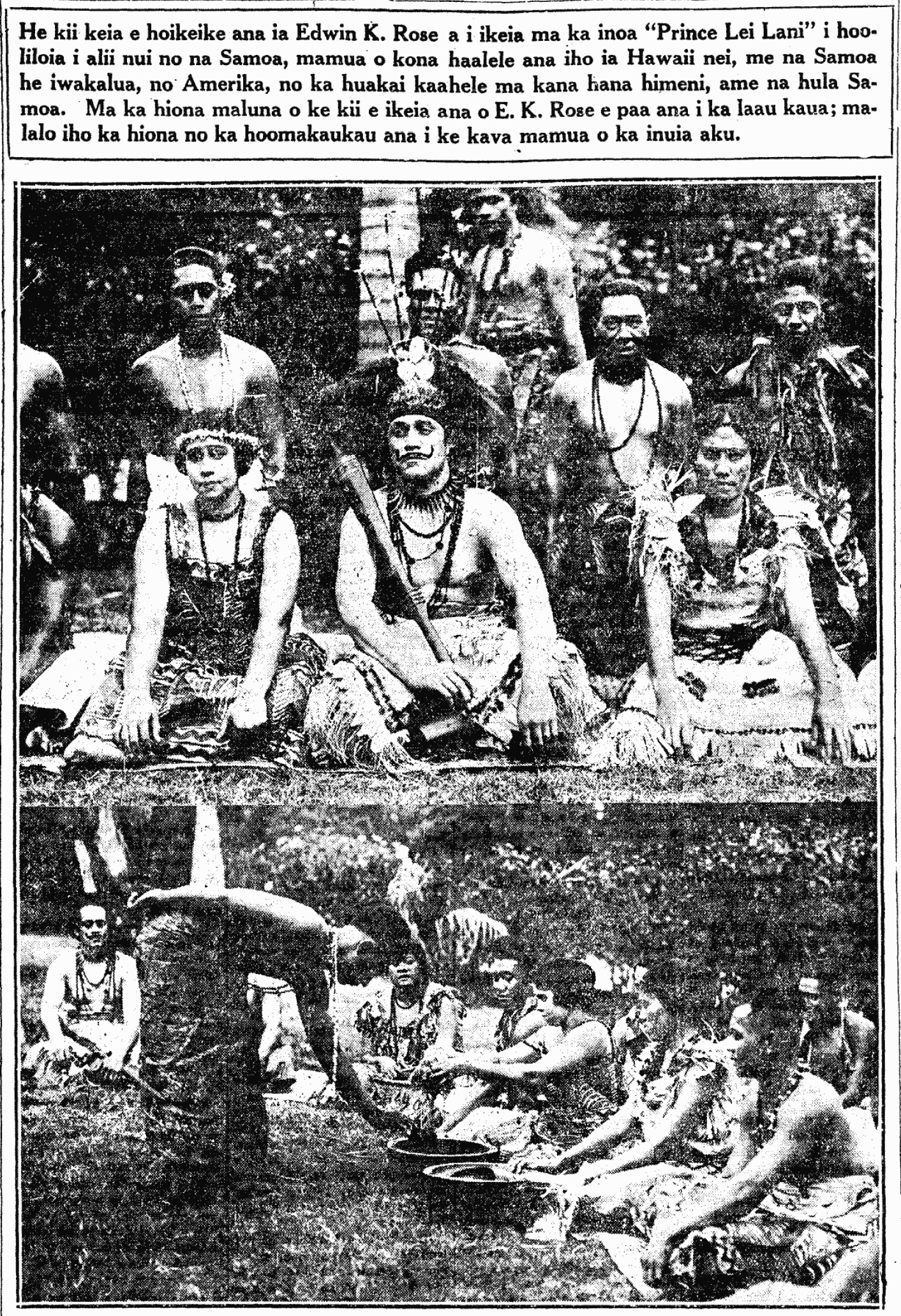
This is a picture showing Edwin K. Rose known by the name “Prince Lei Lani,” who was made a high chief of the Samoans, before he left Hawaii nei with twenty Samoans for America on a singing and Samoan dancing tour. In the scene on the top picture seen is E. K. Rose holding a war club; and below is a scene showing the preparation of kava before it being drunk.

(Kuokoa, 7/24/1924, p. 2)

He kii keia e hoikeike ana ia Edwin K. Rose...

Ka Nupepa Kuokoa, Buke LXIII, Helu 30, Aoao 2. Iulai 24, 1924.

More on “Prince,” 1924.

The Songs of “Prince” Lei Lani Were Just Beautiful

His Falsetto Voice Was Heard at the Concerts He Gave in the Liberty Theater Last Week.

The concerts given by E. K. Rose, known by the stage name “Prince” Lei Lani [Leilani], in the Liberty Theater on the nights of Friday and Saturday, and the afternoon of Saturday of this past week, those were some of the most beautiful concerts, filling all those who attended with delight at hearing in person, the singing voice of this musician of Hawaii nei.

Amongst all of the people who attended to hear his concerts, they said but one thing; that being of their appreciation and desire, not just for all of the different mele sung, but for the loveliness and beauty of his voice, showing that within him are the high talents for which all Hawaiians have pride in him.

For the first time, Honolulu’s people heard singing live along with a phonograph [pahuolelo], auwe, if people weren’t clear about who the singer was on the phonograph, this lack of clarity was put to an end by them hearing the real “Prince” Lei Lani’s voice, being that they were the same in every way.

While the phonograph was playing a song called “Pua Sadinia,” “Prince” Lei Lani sang it in Alto, and it sounded beautiful. “Aloha Oe” was another number played on the phonograph while he sang in alto.

The local singers pale in haole songs, and cannot match the high range of his voice along with the modulation, and yodeling; there is no match, like the voice of a bird.

There was one unfortunate thing in the concert, that was that it was not filled, for there are not many concerts of this sort put on here in Honolulu that are as beautiful.

“Prince” Lei Lani will spend a number of months here in Hawaii nei before turning back to return to America to sing, and while he is here, he will be giving many concerts. He’ll be going to Kauai to perform concerts there, and Kauai’s people are planning a reception for him with excitement.

Other than to sing, he is returning to America, taking with him many photographs of all sorts of places here in Hawaii nei, scenes showing the people of America that Hawaii is a lovely place full of intelligence; not as was shown by some people using ridiculing pictures, saying that Hawaii is in the dark of pagan times.

[I wonder where the pictures ridiculing Hawaii were printed, and who it was that did it.

The internet is pretty amazing. Some ninety years later, we can hear Prince Lei Lani singing “Pua Sadinia” and “Aloha Oe”! Mahalo to cdbpdx for putting it up on youtube!!]

(Kuokoa, 4/10/1924, p. 1)

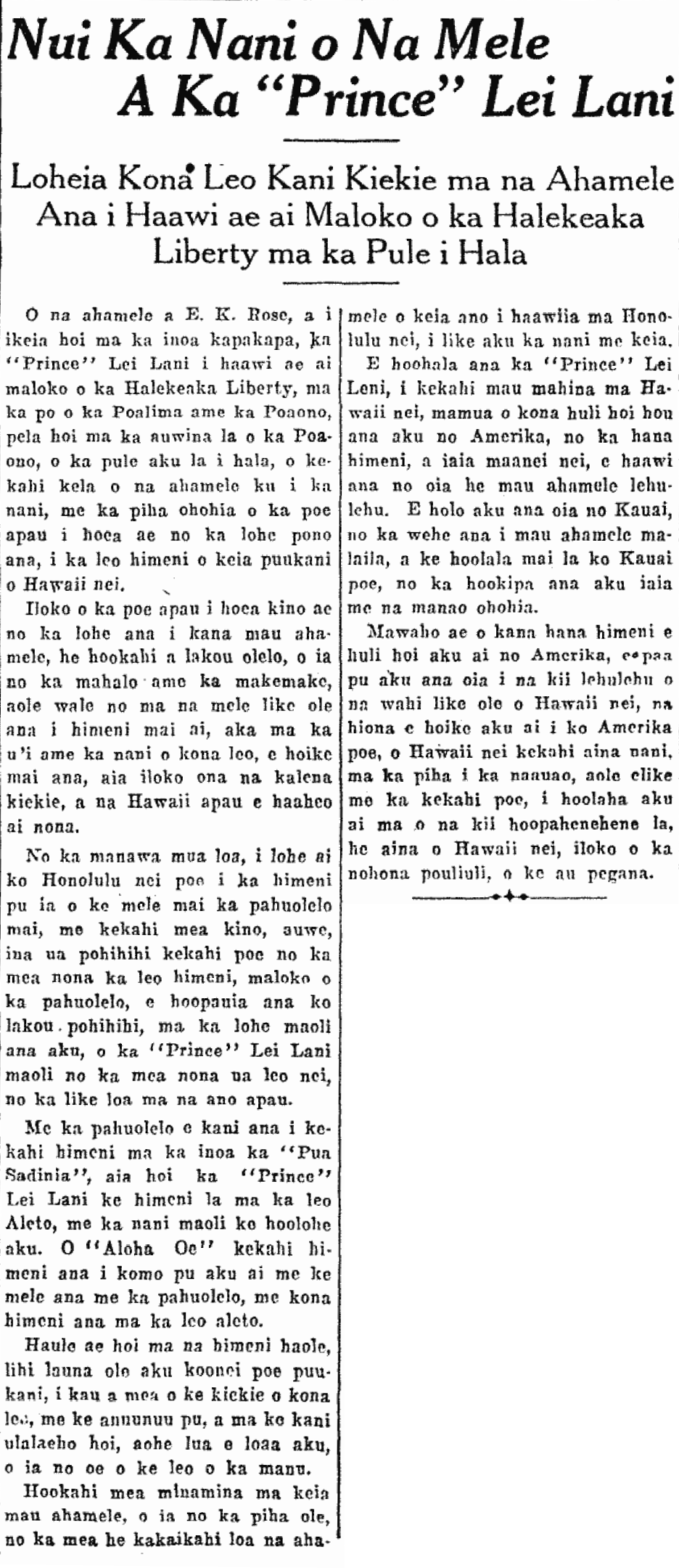
Nui Ka Nani o Na Mele A Ka "Prince" Lei Lani

Ka Nupepa Kuokoa, Buke LXIII, Helu 15, Aoao 1. Aperila 10, 1924.