Response to hula commentary, 1891.

THE HULA AND THE “P. C. ADVERTISER.”

Another example of the “P. C. Advertiser’s” moral attitude appears int the announcement, that a hula given by the Hon. J. A. Cummins at his resident at Waimanalo was a glorious affair.—We have no doubt, that the display was exceptionally fine, since the ex-Premier has a well earned reputation as a connoiseur in that line, and is said to use the collection of females, formerly of boat house fame, second to none in the country.—Still there is something about the hula, that has so far excluded it from the programs of church festivals and school exercises.—It has never been recommended to lure the mind to thoughts of higher and better things or to produce rigid uprightness of morals.

The hula is a graceful and rhythmic representation of certain actions of the human animal. There is no doubt, that from the earliest ages the physiology of reproduction has been the most intrinsically interesting known to man. After the question of food and personal safety, it is the most important consideration in the lives of man, savage and civilized. The Hindoos and Budhists covered their temples and public buildings with indecent pictures, which in some instances took the form of a cross. This was imported to Rome together with the worship of Isis. So every spire on a Christian Church represents a resurrection of the flesh. But civilized society has decided for good reason to cover Isis with a vail and put Osiris in a straight-jacket. It is only those, who believe in the infallibility and prerogatives derived from gold—as some of our friends—who may wish to go back to the first principles and have the hula taught as an accomplishment in our public schools, so that it might prove more attractive in catching a husband and certainly in domesticating him when caught, than the art of piano playing or embroidery. There are great posibilities in the hula! But at present it is prohibited by the law, and we are sorry to see the law violated by those who ought to know better.

(Leo o ka Lahui, 5/14/1891, p. 4)

THE HULA AND THE "P. C. ADVERTISER."

Ka Leo o ka Lahui, Buke II, Helu 193, Aoao 4. Mei 14, 1891.

Luke Kanakaole weds Edith Kanaele, 1933.

Luke Kanakaole was joined together in the sacred bond of marriage with Miss Edith Kanaele, of Keaukaha. Marriage is a splendid thing.

[After attending the awesome symposium this past week, Words in the World: Literatures, Oratures, and New Meeting Grounds, it was serendipity that I just came across this marriage announcement for the famous chanter and hula practitioner, as well as mother of one of the esteemed mele panel presenters, Pualani Kanakaole Kanahele!

There is so much available in the Hawaiian-Language Newspapers, if only we bothered to look. Although it wouldn’t hurt if there were clear images online and they were accurately word searchable.]

(Hoku o Hawaii, 2/14/1933, p. 3)

Ua hoohui ia ae nei o Luke Kanakaole...

Ka Hoku o Hawaii, Buke XXVI, Helu 37, Aoao 3. Feberuari 14, 1933.

Hidden cave, 1897.

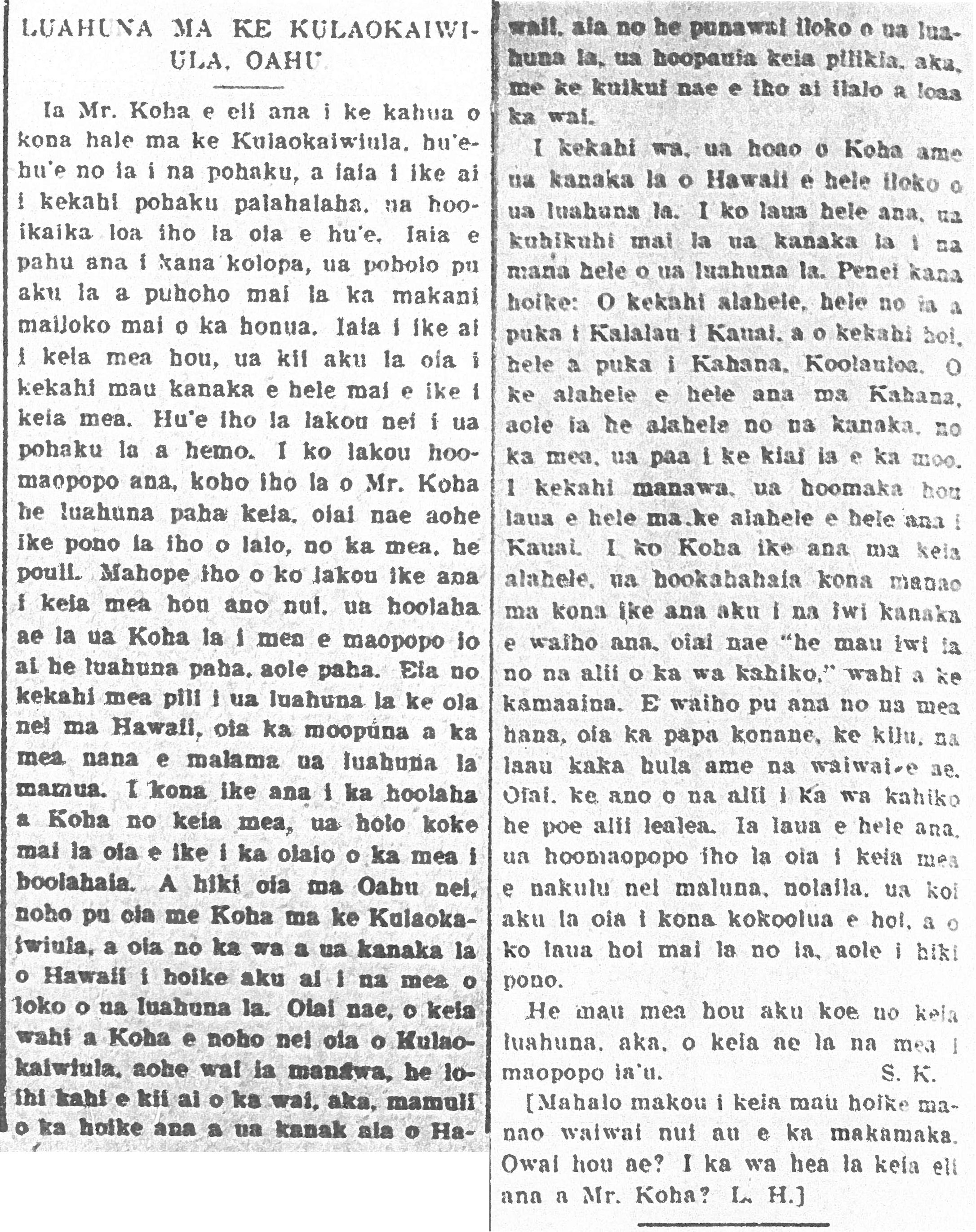
HIDDEN CAVE AT KULAOKAIWIULA, OAHU.

While Mr. Koha was digging the foundation of his house at Kulaokaiwiula [Kekulaokaiwiula], he excavated some rocks, and as he noticed a flat rock he put exerted himself in pulling it up; as he shoved down his crowbar, it slipped in and wind came blowing up from the earth. Discovering this new thing, he fetched some people to come and see it. They pried up the rock. After they saw this, Mr. Koha supposed that it possibly was a hidden cave [luahuna], although the bottom couldn’t be clearly seen because it was dark. After this great discovery, Mr. Koha put out an announcement, so that it would be clear whether it was a hidden cave or not. There was someone who was associated with this hidden cave on Hawaii, the grandchild of the caretaker of the luahuna previously. When he saw Koha’s ad about this thing, he came at once to check if what was advertised was true.  He arrived on Oahu and stayed with Koha at Kulaokaiwiula, and that was when that man from Hawaii told him about what was in that cave. Being that there was no water at this place, Kulaokaiwiula, when Koha was living there, you had to go far to fetch water; however, according to what the man from Hawaii said, there was a spring in the cave, and so that problem was solved, although you had to go down with a light [kuikui] to get the water.

Once, Koha and the man from Hawaii tried to go down in the cave. When the went, the man pointed out the different paths of the cave. This is what he described: On path went and exited at Kalalau, Kauai; and another path went and exited at Kahana, Koolauloa. The path heading to Kahana was not to be travelled by man, for it was guarded by a moo. Another time, they started taking the path which headed towards Kauai. When Koha saw this path, he was astounded to see human bones laid out, being “these were bones of ancient chiefs,” according to the kamaaina. Also here were implements, like a konane board, kilu, hula sticks [laau kaka hula], and other valuable items. The alii of old were fond of entertainment. As they continued on, he noticed there was something dripping down, so he urged his companion to turn back, and so they returned and did not go all the way.

There are more things dealing with the hidden cave, but this is what I know.  S. K.

{O Friend, we are appreciative for this very valuable description. Who else? When did this digging by Mr. Koha happen? Editor}

[The Mr. Koha being spoken of here is very likely G. M. Koha, who is a frequent writer into the newspapers. Hopefully the announcement mentioned in this article can be found sometime soon!]

(Kuokoa, 3/26/1897, p. 2)

LUAHUNA MA KE KULAOKAIWIULA, OAHU.

Ka Nupepa Kuokoa, Buke XXXVI, Helu 13, Aoao 2. Maraki 26, 1897.

Musical Group, The Bohling Sisters, 1940.

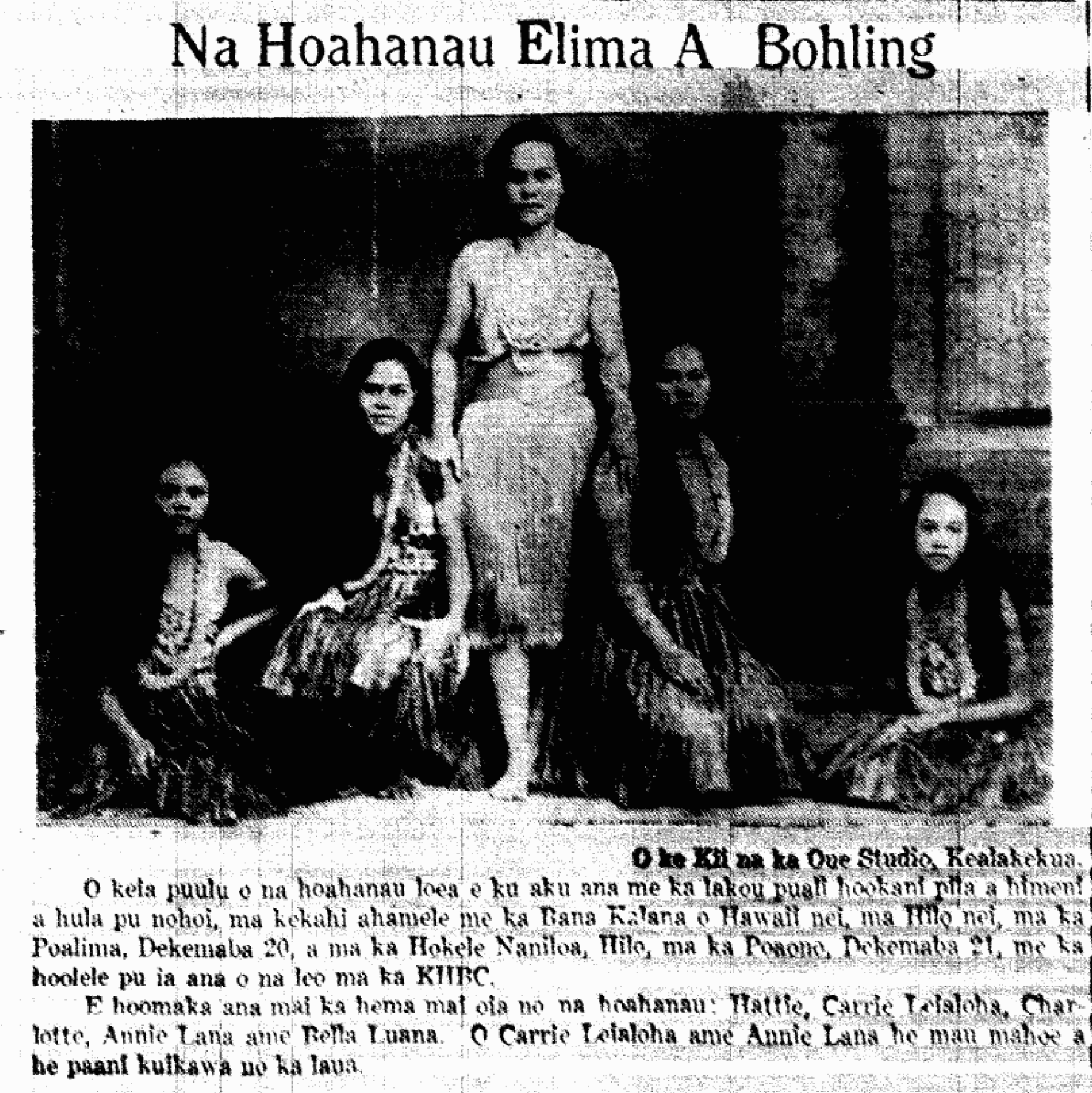
The Five Bohling Sisters

Photograph by Oue Studio, Kealakekua

This group of skilled sisters will appear with their musicians and sing and hula at a concert with the Hawaii County Band [Bana Kalana o Hawaii] on Friday, December 20th, and at the Naniloa Hotel, Hilo, on Saturday, December 21, while being broadcast on KHBC.

Beginning from the left are the sisters: Hattie, Carrie Leialoha, Charlotte, Annie Lana and Bella Luana. Carrie Leialoha and Annie Lana are twins and are playing special.

[Anyone have any information on this musical family? Charlotte Bohling wrote a regular column for the Hoku o Hawaii reporting the news from Kona.]

(Hoku o Hawaii, 12/11/1940, p. 1)

Na Hoahanau Elima A Bohling

Ka Hoku o Hawaii, Volume XXXV, Number 33, Page 1. Dekemaba 11, 1940

John Ioane Ukeke, in his earlier days! 1880

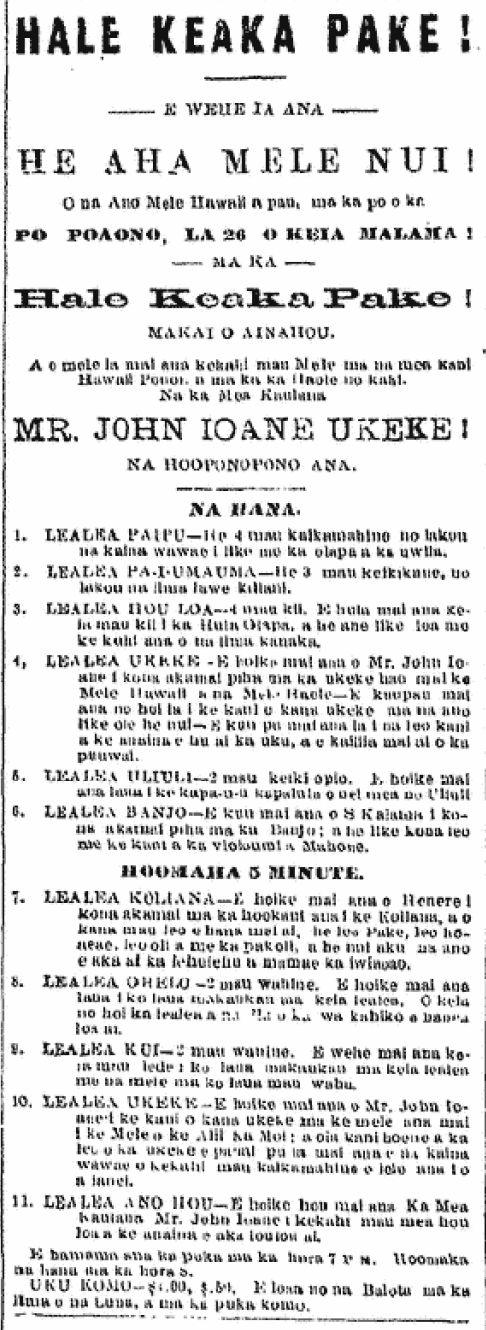
CHINESE THEATER!

OPENING

A GRAND CONCERT!

Of all types of Hawaiian Music, on the night of the

SATURDAY NIGHT, THE 26TH OF THIS MONTH!

AT THE

Chinese Theater!

SEASIDE OF AINAHOU.

There will be some Mele performed with Native Hawaiian instruments, and some with Haole instrments.

By the Famed One

MR. JOHN IOANE UKEKE!

IS THE ORCHESTRATING.

THE PERFORMANCE.

1. IPU PERFORMANCE [LEALEA PAIPU]—4 girls whose steps are like flashes of lightning.

2. CHEST SLAPPING PERFORMANCE [LEALEA PA-I-UMAUMA]—3 boys with swift hand motions.

3. MODERN PERFORMANCE [LEALEA HOU LOA]—4 dolls. The dolls will do a Hula Olapa, and their hand motions will be like those of a human.

4. UKEKE PERFORMANCE [LEALEA UKEKE]—Mr. John Ioane will show his total skill with the metal ukeke (Jew’s harp) with Hawaiian songs and Haole songs—He will exert himself with his ukeke playing in all fashions—[It doesn’t help that the image is not clear, but cannot make out the next line and a half. Anyone?] and your hearts will be captured.

5. ULIULI PERFORMANCE [LEALEA ULIULI]—2young children. They will show the fluttering and rattling of this thing, the Uliuli.

6. BANJO PERFORMANCE [LEALEA BANJO]—S. Kalama will exhibit his full skill at the Banjo; and its sound is like the ten-stringed lyre of Mahone [this is probably a reference to a story running in the Kuokoa: “KA MOOLELO O BERIANA KA WIWO OLE A ME MAHONE KE KOA” (4/26/1879–11/20/1880)]

FIVE MINUTE BREAK.

7. ACCORDIAN PERFORMANCE [LEALEA KOLIANA]—Henere [Henry] will show his skill at playing the Accordian, and the sounds he makes: Chinese, hoaeae, oli and the musical scale [pakoli]; it will make the crowd laugh and your sides will hurt.

8. OHELO PERFORMANCE [LEALEA OHELO]—2 women. They will show their abilities at this amusement. This is the amusement of the alii of the olden days that they greatly enjoyed.

9. KUI PERFORMANCE [LEALEA KUI]—2 women. These two ladies will display their readiness at this amusement while from their mouths come mele.

10. UKEKE PERFORMANCE [LEALEA UKEKE]—Mr. John Ioane will show his playing of the ukeke with Mele of the King; and this sweet voice of the ukeke will be accompanied by the steps of some girls doing lele this way and that.

11. MODERN PERFORMANCE [LEALEA ANO HOU]—The Famous Mr. Ioane will show once again some new things that will have the audience in stitches.

The doors will open at 7 P. M. Performances begin at 8.

ENTRANCE FEE: $1.00, $ .50. Tickets [Balota ?] available from hand of those in charge as well as at the entrance.

(Ko Hawaii Pae Aina, 6/26/1880, p. 2)

HALE KEAKA PAKE!

Ko Hawaii Pae Aina, Buke III, Helu 26, Aoao 2. Iune 26, 1880.

One more on the passing of Ioane Ukeke, 1903.

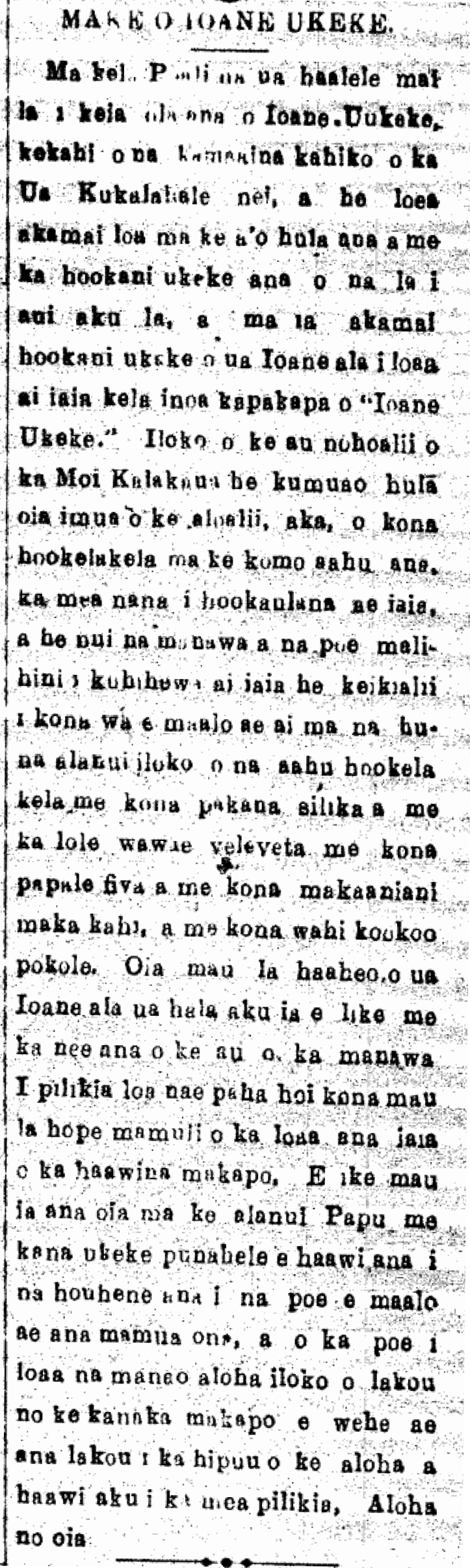
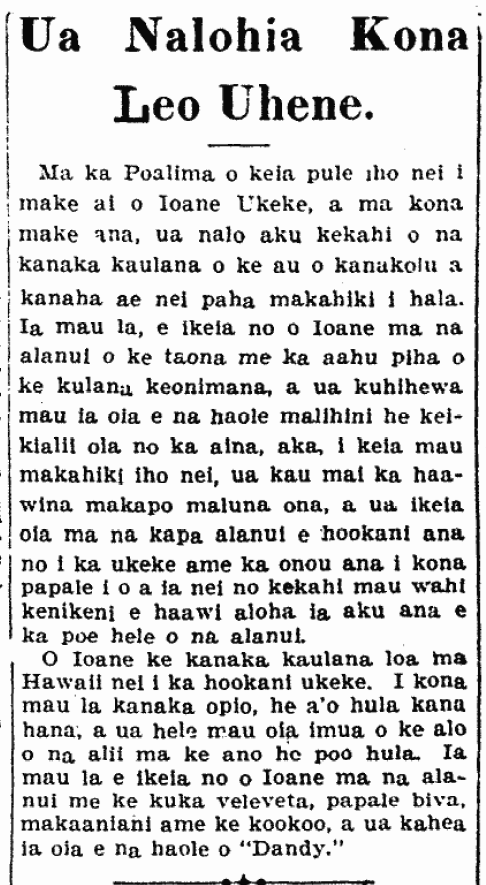
IOANE UKEKE HAS DIED.

Last Friday, Ioane Ukeke left this life, he was one of the old-time kamaaina of the Kukalahale Rain [famous rain of Honolulu], and he was a skilled expert at teaching hula and playing the ukeke in the days gone by, and it is because of Ioane’s skill at playing the ukeke that he received the nickname “Ioane Ukeke.” During the reign of King Kalakaua, he was a hula teacher [kumuao hula] in the royal court, but what made him famous was his showing off in costume, and there was many a time when foreigners mistook him for a prince when he passed by the street corner [huna alanui? huina alanui?] in his stylish attire and his silk waist [pakana ?] and velvet slacks with his beaver hat and monocle, with his short cane. Those proud days of Ioane have gone with the flow of time. He faced difficulties in his latter days, because of blindness. He was always seen on Fort Street with his favorite ukeke serenading those passing by before him, and those who felt aloha for this blind man would undo the tie of aloha and gave a helping hand to the impaired one. Aloha for him.

(Aloha Aina, 5/9/1903, p. 6)

MAKE O IOANE UKEKE.

Ke Aloha Aina, Buke IX, Helu 19, Aoao 6. Mei 9, 1903.

Famed Dandy, Ioane Ukeke, is no more. 1903.

His Joyous Voice is Gone.

On Friday of this past week [5/1/1903], Ioane Ukeke died, and with his death, so too has one of the famous people of thirty or forty years ago left. Those days, Ioane was seen on the streets of town in full attire of a gentleman, and he was often mistaken by the foreign haole, as a prince of the land; but these past years, he went blind, and he was seen on the street sides playing the ukeke and sticking out his hat this way and that for some coins given charitably by the passersby.

Ioane is very famous in Hawaii for his playing of the ukeke. In his youth, he was a hula teacher [a’o hula], and he often went before the court of the alii as a hula leader [poo hula ?]. In those days, Ioane was seen on the streets in a velvet suit, beaver hat, glasses and a cane; he was called “Dandy” by the haole.

(Kuokoa, 5/8/1903, p. 6)

Ua Nalohia Kona Leo Uhene.

Ka Nupepa Kuokoa, Buke XLI, Helu 19, Aoao 6. Mei 8, 1903.

Because February shouldn’t be the only Hawaiian Language month… 1948.

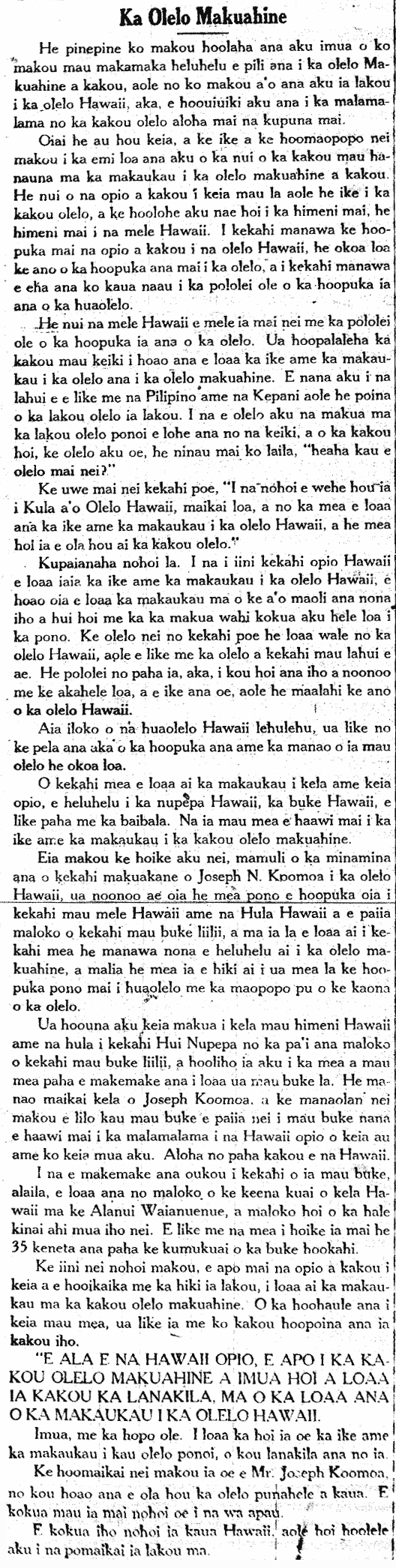
THE MOTHER TONGUE

We frequently speak to our dear readers about our Mother tongue, not about our teaching them the Hawaiian language, but that the light of our beloved language from our forefathers is being extinguished.

Being that this is a new era, and we see and realize that there is a drastic reduction in the number of our generations capable in our mother tongue. There are many of our youths these days who have no knowledge of our language, but when you listen to them singing, they sing Hawaiian songs. Sometimes when our children speak Hawaiian, their production of the language is so strange, and sometimes our naau [gut, heart] aches at their mispronunciation of words.

There are many Hawaiian songs sung with incorrect pronunciation. Our children are neglecting trying to acquire knowledge and proficiency in speaking the mother tongue. Look at the other ethnicities like the Filipinos and the Japanese, they haven’t forgotten their language. If parents spoke in their own language then the children would hear; and when we talk to them, they’ll ask, “he aha kau e olelo mai nei? [what are you saying?]”

Some people bewail, “If only Hawaiian-Language Schools were reopened, that would be a good thing because we’d get knowledge and proficiency in the Hawaiian language and it would revive our language.”

That is astonishing. Should a young Hawaiian have the desire to acquire knowledge and competency in the Hawaiian language, he should try to get this competency by studying diligently by himself and to get together with an adult for help and there would be great progress. Some say that Hawaiian can be gotten just like that, not like the languages of other people. Perhaps it is true, but if you go back and think with great seriousness, you will see that the Hawaiian language is not easy.

Within the many Hawaiian words, spellings might be the same, but the pronunciation and meanings of those words are different.

One thing that will give every youth proficiency is the reading of Hawaiian newspapers and Hawaiian books like perhaps the bible. Those things will give knowledge and competence in our native language.

We point out that because of the great love of a certain father, Joseph N. [Nihiaumoe] Koomoa, for the Hawaiian language, he thought it would be important to publish some Hawaiian songs and Hawaiian Hula and print some booklets, and through that someone could make time to read the Hawaiian language and perhaps that way the person could pronounce the words while understanding the kaona [underlying meanings].

This man sent those Hawaiian songs and hula to a Newspaper company to be printed in booklets, and it will be sold to the person or persons who want those books. This is a good idea of Joseph Koomoa’s, and we hope that your books that are being printed will become books that give knowledge to the Hawaiian youths of this age and of the future. Aloha to us, O Hawaiians.

Should you want one of those books, they will be available at the shop of that Hawaiian on Waianuenue Avenue, and also the former fire station [?] According to what was announced, the books will probably cost 35 cents each.

We want our youngsters to get a hold of this and and improve themselves to the best of their ability so that they can get proficiency in our mother tongue. Letting these go would be like forgetting our own selves.

“RISE YOUNG HAWAIIANS, GRASP OUR MOTHER TONGUE AND GO FORTH AND LET US BE TRIUMPHANT BY BEING PROFICIENT IN THE HAWAIIAN LANGUAGE.

Forge forward with no fear. So that you can get knowledge and proficiency in your own language—that will be your triumph.

We give our congratulations to you, Mr. Joseph Koomoa, for you attempt to revive the prized language of ours. You will be helping for all times [E kokua mau ia mai nohoi oe i na wa apau. ?]

Help ourselves Hawaiians, and don’t let the benefits go to those others [E kokua iho nohoi ia kaua Hawaii, aole hoi hoolele aku i na pomaikai ia lakou ma. ?]

[Anyone know of any copies of these music booklets by Joseph N. Koomoa still in existence???]

(Hoku o Hawaii, 2/11/1948, p. 2)

Ka Olelo Makuahine.

Ka Hoku o Hawaii, Volume XLI, Number 19, Aoao 2. Pepeluali 11, 1948.

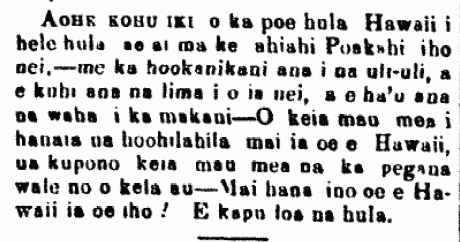
More criticism of hula, 1874.

[Found under: “Local News”]

Not appropriate at all were the Hawaiian dancers who went around doing hula on this Monday evening—rattling their uliuli, their hands pointing this way and that, and their mouths huffing away in the wind—These things that were done shame you, O Hawaii; this kind of thing is appropriate only for the pagan of the past—O Hawaiians, stop hurting yourselves! Hula is strictly banned.

(Kuokoa, 3/21/1874, p. 3)

Aohe kohu iki...

Ka Nupepa Kuokoa, Buke XIII, Helu 12, Aoao 3. Maraki 21, 1874.

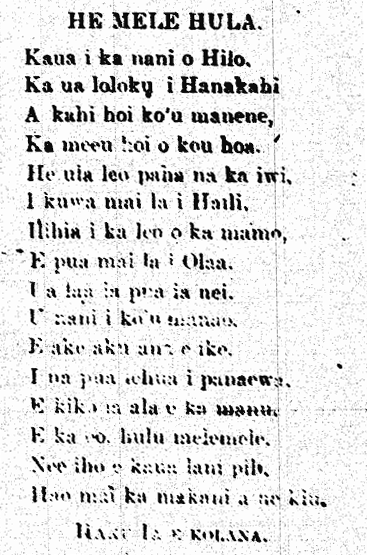
“Kaua i ka Nani o Hilo”. 1892.

A MELE FOR HULA.

Kaua i ka nani o Hilo
Ka ua loloku i Hanakahi
A kahi hoi ko’u manene,
Ka meeu hoi o kou hoa.
He ula leo paha na ka iwi,
I kuwa mai la i Haili,
Ilihia i ka leo o ka mamo,
E pua mai la i Olaa.
Ua laa ia pua ia nei,
U nani i ko’u manao,
E ake aku ana e ike.
I na pua lehua i panaewa,
E kiko ia ala e ka manu
E ka oo, hulu melemele.
Nee iho e kaua lani pili,
Hao mai ka makani a he kiu.

Composed by Kolana.

[Here is another version of “Kaua i ka Nani o Hilo”, and here it is attributed to Kolana.]

(Leo o ka Lahui, 7/18/1892)

HE MELE HULA.

Ka Leo o ka Lahui, Buke II, Helu 501, Aoao 2. Iulai 18, 1892.