Hula fought against by the church, 1917.

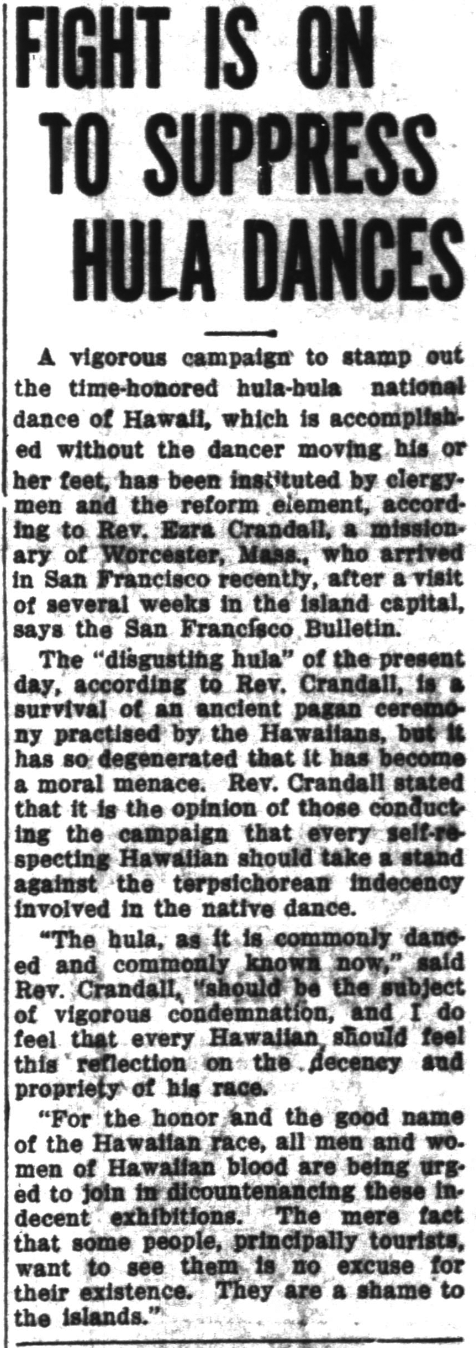
FIGHT IS ON TO SUPPRESS HULA DANCES

A vigorous campaign to stamp out the time-honored hula-hula national dance of Hawaii, which is accomplished without the dancer moving his or her feet, has been instituted by clergymen and the reform element, according to Rev. Ezra Crandall, a missionary of Worcester, Mass., who arrived in San Francisco recently, after a visit of several weeks in the island capital, says the San Francisco Bulletin.

The “disgusting hula” of the present day, according to Rev. Crandall, is a survival of an ancient pagan ceremony practiced by the Hawaiians, but is has so degenerated that it has become a moral menace. Rev. Crandall stated that it is the opinion of those conducting the campaign that every self-respecting Hawaiian should take a stand against the terpsichorean indecency involved in the native dance.

“The hula, as it is commonly danced and commonly know now,” said Rev. Crandall, “should be the subject of vigorous condemnation, and I do feel that every Hawaiian should feel this reflection on the decency and propriety of his race.

“For the honor and the good name of the Hawaiian race, all men and women of Hawaiian blood are being urged to join in discountenancing these indecent exhibitions. The mere fact that some people, principally tourists, want to see them is no excuse for their existence. They are a shame to the islands.”

(Star-Bulletin, 6/15/1917, p. 14)

StarBulletin_6_15_1917_14

Honolulu Star-Bulletin, Volume XXIV, Number 7854, Page 14. June 15, 1917.

Hula thriving in Heeia, 1876.

[Found under: “PALAPALA I KE KUOKOA.”]

Useless activities of adults.

O KUOKOA NEWSPAPER; Aloha oe:—

Please grasp this bundle with your right hand, so that our friends will see from Hilo to Waioli, with Niihau to boot, that being the words above, “useless activities,” that being the hula.

Here in Heeia, Koolaupoko, there is much hula now; at Iolekaa there is 1 hula school with Hopa the male kumu hula; at Heeia Waena, Palau (m) and Naholowaa (f), those two are the kahu hula and Ioane (m) is the kumu; Continue reading

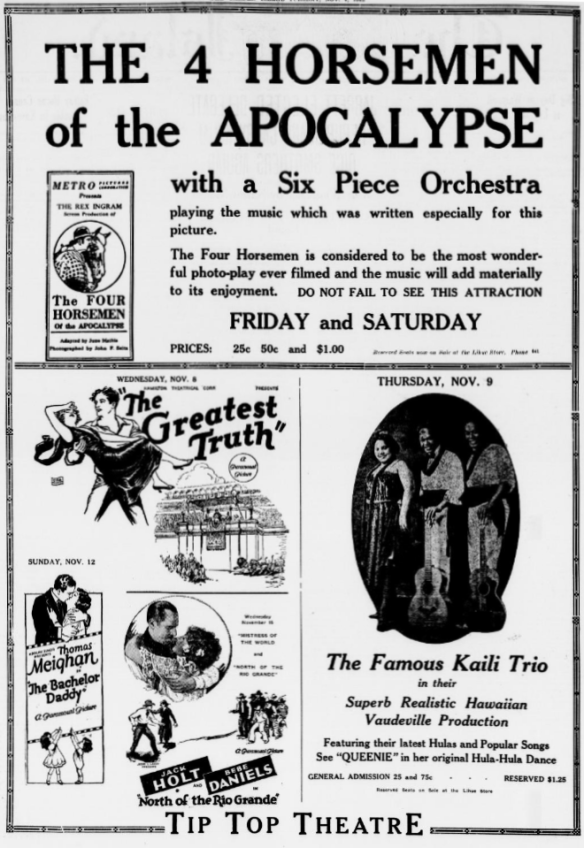
Kaili Trio performing at Kauai’s Tip Top Theatre, 1922.

THE 4 HORSEMEN of the APOCALYPSE

with a Six Piece Orchestra

playing the music which was written especially for this picture.

The Four Horsemen is considered to be the most wonderful photo-play ever filmed and the music will add materially to its enjoyment. DO NOT FAIL TO SEE THIS ATTRACTION

FRIDAY and SATURDAY

PRICES: 25c 50c and $1.00 Reserved Seats now on Sale at the Lihue Store, Phone 641

WEDNESDAY, NOV. 8

HAMILTON THEATRICAL CORP. PRESENTS

“The Greatest Truth”

A Paramount Picture

SUNDAY, NOV. 12

ADOLPH ZUKOR PRESENTS

Thomas Meighan in “The Bachelor Daddy”

A Paramount Picture

Wednesday

November 15

“MISTRESS OF THE WORLD

and

“NORTH OF THE RIO GRANDE”

JACK HOLT AND BEBE DANIELS

in

“North of the Rio Grande”

THURSDAY, NOV. 9

The Famous Kaili Trio

in their

Superb Realistic Hawaiian
Vaudeville Production

Featuring their latest Hulas and Popular Songs
See “QUEENIE” in her original Hula-Hula Dance

GENERAL ADMISSION 25 and 75c – – – RESERVED $1.25

Reserved Seats on Sale at the Lihue Store

TIP TOP THEATRE

(Garden Island, 11/7/1922, p. 2)

GardenIsland_11_7_1922_2.png

The Garden Island, Volume 18, Number 45, Page 2. November 7, 1922.

For all of you hula people, 1865.

[Found under: “Na mea hou o Maui Hikina.”]

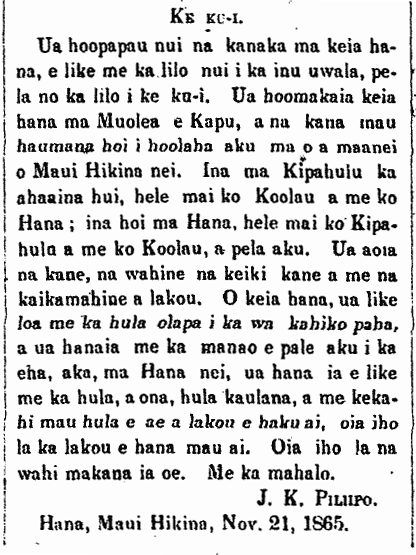
The Ku-i.

All the people are doing it, just as they are totally caught up in drinking [fermented] sweet potato, so too are they engrossed in the ku-i. This activity began at Muolea by Kapu, and it was his students who spread it all over here in East Maui. If there is a party in Kipahulu, the people from Koolau and from Hana come; if it is in Hana, people from Kipahulu and from Koolau come, and so forth. Their husbands, wives, sons and daughters are taught. This is perhaps very similar to the hula olapa in the olden days, and they are done believing it will ward off pain, but here in Hana, it is done like hula, the famous hula as well as some hula that they composed themselves, and that is what they are constantly doing. Those are my gifts to you. [That being the reporting of this story as well as the other stories that preceded it.] With thanks.

J. K. Pilipo.

Hana, East Maui, Nov. 21, 1865.

(Kuokoa, 12/9/1865, p. 3)

Kuokoa_12_9_1865_3

Ka Nupepa Kuokoa, Buke IV, Helu 49, Aoao 3. Dekemaba 9, 1865.

Samuel K. Kekoowai on the Daughters of Hawaii and Hanaiakamalama, 1923.

HANAIAKAMALAMA

This is a building near the end of the route of the electric car, and it stands on a hill.

As a result of the graciousness of one of the members of the Daughters of Hawaii [Ahahui o na Kaikamahine o Hawaii], this writer [Samuel K. Kekoowai] was introduced to Mrs. J. Swanzy, the leader of this association, and by her kindness I was welcomed to see the walls of that house which is filled with beautiful decorations of the monarchy, and their images hanging from the walls, set up almost like the museum of Kamehameha [Bernice Pauahi Bishop Museum].

This group, the Daughters of Hawaii, upholds the name of Queen Emma Kaleleonalani, and her birthday is cherished by them, and the writer observed the commemoration held by the association which holds dear the name placed upon them, the Daughters of Hawaii.

In the story told to me within the house, Kaleleonalani was raised by her hanai guardian [kahu hanai], Dr. Rooke [Kauka Luka], until she married Liholiho Kamehameha 4, however, there is another version that I have been told by another.

On that 20th day of this June, I saw the back room totally filled with those who came, from the members to visitors, and most were whites and there were a few Hawaiians [??? a o-a na Hawaii].

The story of the circuit of Queen Emma Kaleleonalani around Oahu nei was told, beginning at Waimanalo at the place of John Cummins [Keoni Kamaki], and to Kaneohe at the place of Wainui Pii, and then on to Waikane at the place of Kameaaloha; at Kahana there was a Chinese named Apakana, on to Punaluu there was Naili, to Laie at the place of Kupau, to Kahuku at the place of Kaluhi, to Waialua at the place of Kaiaikawaha. Continue reading

Restoration Day celebration, day number 3! 1844.

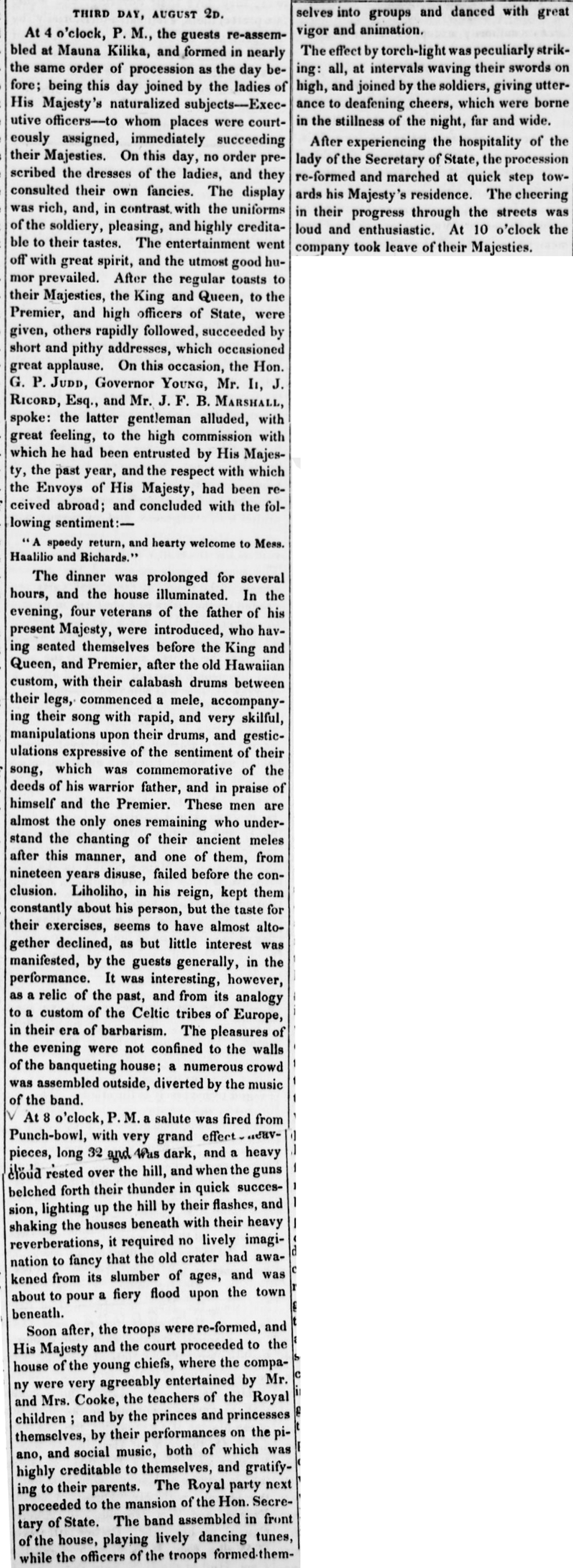
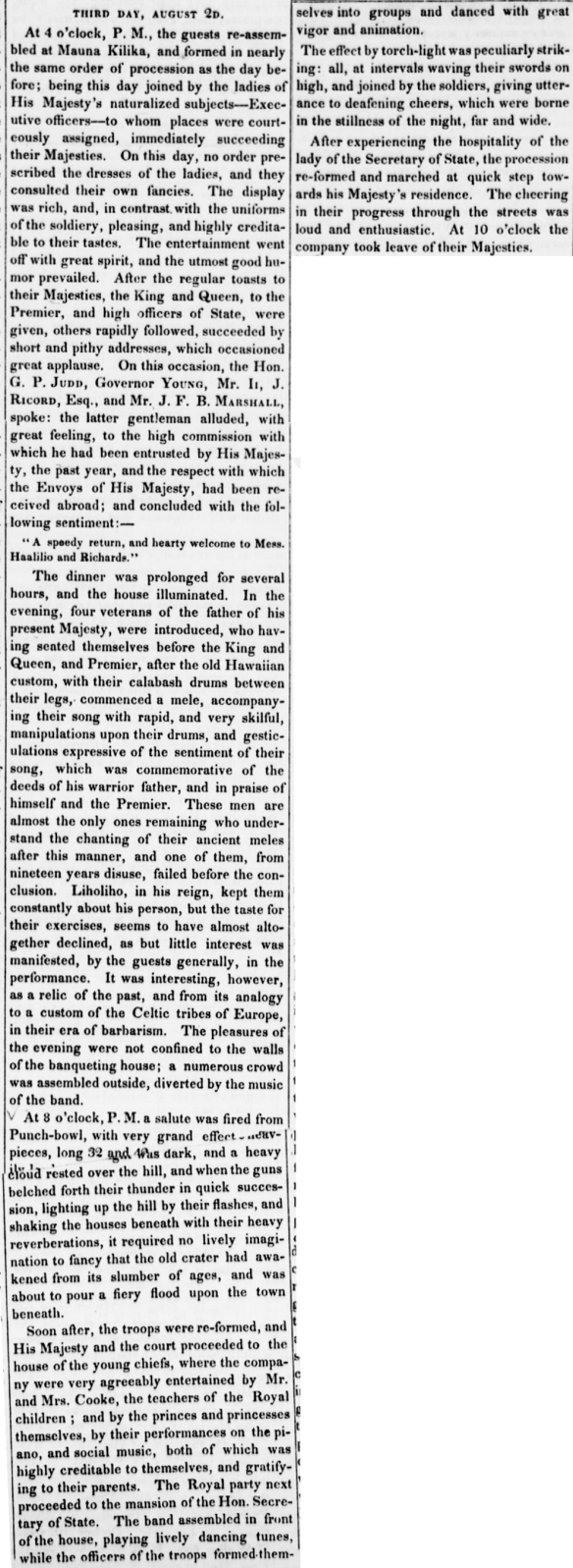
THIRD DAY, AUGUST 2D.

At 4 o’clock, P. M., the guests re-assembled at Mauna Kilika, and formed in nearly the same order of procession as the day before; being this day joined by the ladies of His Majesty’s naturalized subjects—Executive officers—to whom places were courteously assigned, immediately succeeding their Majesties. On this day, no order prescribed the dresses of the ladies, and they consulted their own fanices. The display was rich, and, in contrast with the uniforms of the soldiery, pleasing and highly creditable to their tastes. The entertainment went off with great spirit, and the utmost good humor prevailed. After the regular toasts to their Majesties, the King and Queen, to the Premier, and high officers of State, were given, others rapidly followed, succeeded by short and pithy addresses, which occasioned great applause. On this occasion, the Hon. G. P. Judd, Governor Young, Mr. Ii, J. Ricord, Esq., and Mr. J. F. B. Marshall, spoke: the latter gentleman alluded, with great feeling, to the high commission with which he had been entrusted by His Majesty, the past year, and the respect with which the Envoys of His Majesty, had been received abroad; and concluded with the following sentiment:—

“A speedy return, and hearty welcome to Mess. Haalilio and Richards.”

The dinner was prolonged for several hours, and the house illuminated. In the evening, four veterans of the father of his present Majesty, were introduced, who having seated themselves before the King and Queen, and Premier, after the old Hawaiian custom, with their calabash drums between their legs, commenced a mele, accompanying their song with rapid, and very skillful, manipulations upon their drums, and gesticulations expressive of the sentiment of their song, which was commemorative of the deeds of his warrior father, and in praise of himself and the Premier. These men are almost the only ones remaining who understand the chanting of their ancient meles after this manner, and one of them, from nineteen years disuse, failed before the conclusion. Liholiho, in his reign, kept them constantly about his person, but the taste for their exercises, seems to have almost altogether declined, as but little interest was manifested, by the guests generally, in the performance. It was interesting, however, as a relic of the past, and from its analogy to a custom of the Celtic tribes of Europe, in their era of barbarism. The pleasures of the evening were not confined to the walls of the banqueting house; a numerous crowd was assembled outside, diverted by the music of the band.

At 8 o’clock, P. M. a salute was fired from Punch-bowl, with very grand effect [not legible because of fold in paper] cloud rested over the hill, and when the guns belched forth their thunder in quick succession, lighting up the hill by their flashes, and shaking the houses beneath with their heavy reverberations, it required no lively imagination to fancy that the old crater had awakened from its slumber of ages, and was about to pour a fiery flood upon the town beneath.

Soon after, the troops were re-formed, and His Majesty and the court proceeded to the house of the young chiefs, where the company were very agreeably entertained by Mr. and Mrs. Cooke, the teachers of the Royal children; and by the princes and princesses themselves, by their performances on the piano, and social music, both of which was highly creditable to themselves, and gratifying to their parents. The Royal party next proceeded to the mansion of the Hon. Secretary of State. The band assembled in front of the house, playing lively dancing tunes, while the officers of the troops formed themselves into groups and danced with great vigor and animation.

The effect by torch-light was peculiarly striking: all, at intervals waving their swords on high, and joined by the soldiers, giving utterance to deafening cheers, which were borne in the stillness of the night, far and wide.

After experiencing the hospitality of the lady of the Secretary of State, the procession re-formed and marched at quick step towards his Majesty’s residence. The cheering in their progress through the streets was loud and enthusiastic. At 10 o’clock the company took leave of their Majesties.

(Polynesian, 8/10/1844, p. 47)
THIRD DAY, AUGUST 2D.

The Polynesian, New Series, Volume 1,—Number 12, Page 47. August 10, 1844.

Hawaii Ponoi Society performance, 1907.

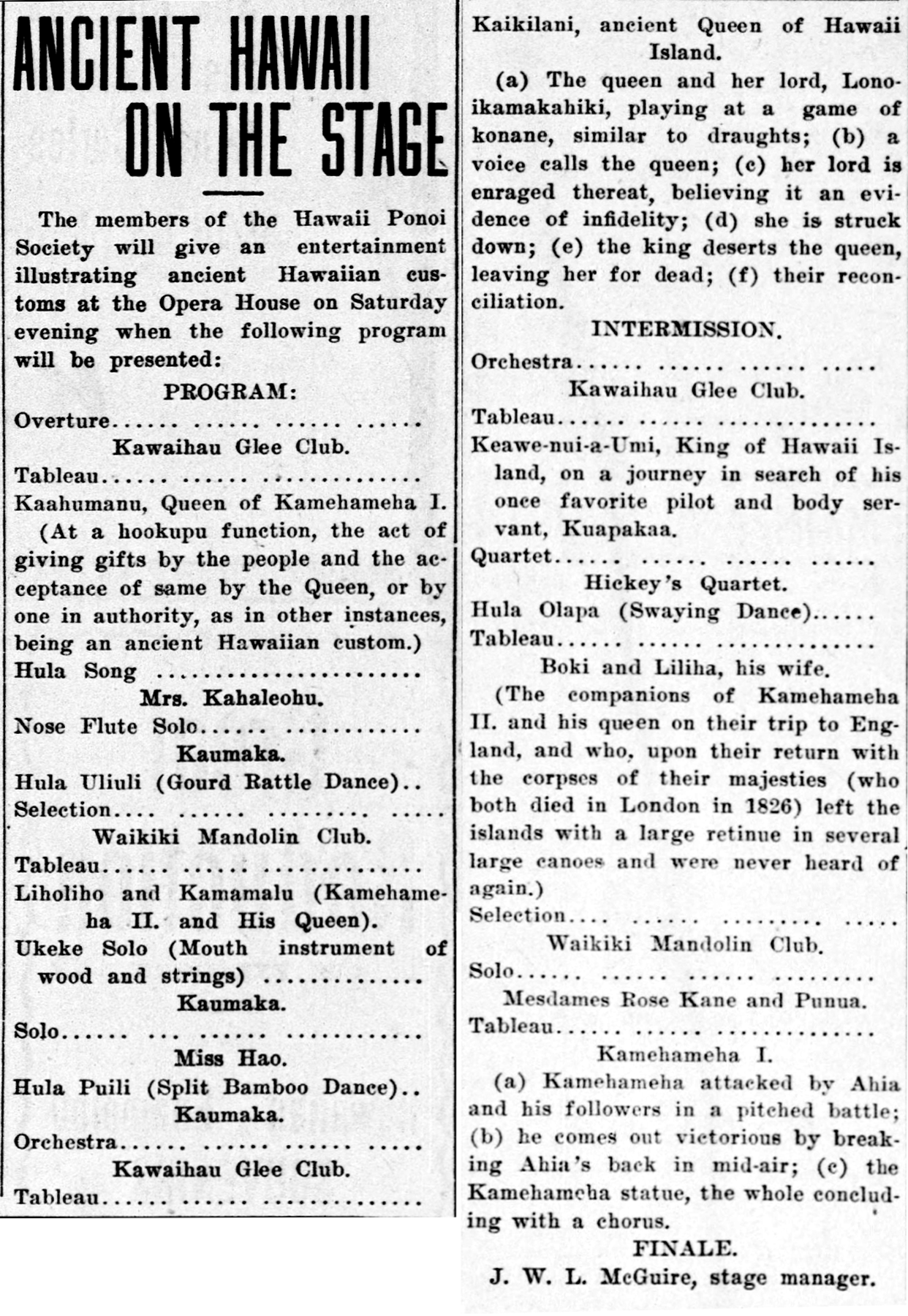
ANCIENT HAWAII ON STAGE

The members of the Hawaii Ponoi Society will give an entertainment illustrating ancient Hawaiian customs at the Opera House on Saturday evening when the following program will be presented:

PROGRAM:

Overture

Kawaihau Glee Club

Tableau

Kaahumanu, Queen of Kamehameha I.

(At a hookupu function, the act of giving gifts by the people and the acceptance of same by the Queen, or by one in authority, as in other instances, being an ancient Hawaiian custom.)

Mrs. Kahaleohu.

Nose Flute Solo

Kaumaka.

Hula Uliuli (Gourd Rattle Dance)

Selection

Waikiki Mandolin Club.

Tableau

Liholiho and Kamamalu (Kamehameha II. and His Queen).

Ukeke Solo (Mouth instrument of wood and strings)

Kaumaka.

Solo

Miss Hao.

Hula Puili (Split Bamboo Dance)

Kaumaka.

Orchestra

Kawaihau Glee Club.

Tableau

Kaikilani, ancient Queen of Hawaii Island.

(a) The queen and her lord, Lonoikamakahiki, playing at a game of konane, similar to draughts; (b) a voice calls the queen; (c) her lord is enraged thereat, believing it an evidence of infidelity; (d) she is struck down; (e) the king deserts the queen, leaving her for dead; (f) their reconciliation.

INTERMISSION.

Orcestra

Kawaihau Glee Club.

Tableau

Keawe-nui-a-Umi, King of Hawaii Island, on a journey in search of his once favorite pilot and body servant, Kuapakaa.

Quartet

Hickey’s Quartet.

Hula Olapa (Swaying Dance)

Tableau

Boki and Liliha, his wife.

(The companions of Kamehameha II. and his queen on their trip to England, and who, upon their return with the corpses of their majesties (who both died in London in 1826) left the islands with a large retinue in several large canoes and were never heard of again.)

Waikiki Mandolin Club.

Solo

Mesdames Rose Kane and Punua.

Tableau

Kamehameha I.

(a) Kamehameha attacked by Ahia and his followers in a pitched battle; (b) he comes out victorious by breaking Ahia’s back in mid-air; (c) the Kamehameha statue, the whole concluding with a chorus.

FINALE.

J. W. L. McGuire, stage manager.

(Pacific Commercial Advertiser, 3/15/1907, p. 6)

ANCIENT HAWAII ON THE STAGE

The Pacific Commercial Advertiser, Volume XLV, Number 7675, Page 6. March 15, 1907.

Grand performance on Maui by the Hawaiian Woman’s Club, 1922.

“A Night in Hawaii” Will Prove a Beautiful Picture

Pageants wherein the characters will be clad in the costumes of the old days in Hawaii, tableaux, meles, singing of Hawaiian songs and melodies, instrumental music by Hawaiian musicians and just an interspersal of hula dancing by little folk to show really graceful and beautiful was the old dancing at its best, these go to make up the program which will be offered at the Territorial Building in Kahului, Saturday in “A Night in Hawaii” as arranged by and for the benefit of the Hawaiian Woman’s Club. The program, which is printed below gives promise of the best entertainment of its king that has been offered on this island.

Almost daily rehearsals have been held of late, especial attention having been given to the drilling of the children’s chorus in their songs and their parts, so much attention was not necessary of the older ones most of whom have participated in affairs of this kind before, but groups have worked here, and other groups there, and finally all of the groups have been brought together and welded into one great company for the coming performance.

Following the rendition of the program there will be a dance.

The Hawaiian Woman’s Club which is conducting the entertainment is a benevolent association of the Hawaiian women of Maui working in the interest of Hawaiians who may be in need of assistance such as the club can give. Something of its activities have been told previously, what it has done of the Kula Sanitarium when first organized, for the education of some of the young Hawaiians and in other directions. One of its latest good works was a generous contribution for a chapel for the home for non-leprous children of lepers at Kalihi, Oahu. In many directions it reaches out to do good and all profits of the entertainment will go in the carrying out of such purposes.

The program for Saturday night follows:

 I. OPENING CHORUS ….. “Eleile”

II. TABLEAU ….. Hawaiian Royalty

1. Queen Liliuokalani—”Makalapua” ….. Mrs. J. W. Kalua

2. Princess Kaiulani—”He Inoa No Kaiulani” ….. Mrs. H. H. Holt

3. Queen Emma—””Na Hala o Naui” ….. Mrs. George Hardy

Hula—Ida Long

4. Princess Pauahi Bishop—”Pauahi Lani” (Blest Type of Womanhood) ….. Mrs. C. C. Conradt

5. Queen Kaahumanu—”Kaahumanu” ….. Mrs. D. Kapohakimohewa

a. Kahili Bearers—Alice Allen, Elizabeth Wailehua.

6. King Kamehameha I.—”He Inoa No Kamehameha” ….. Mr. C. F. N. Rose

a. Attendants—Walter Garcia, Edward Wilson.

b. Hookupu bearers—David Kaumeheiwa, Kaiwi Moikeha.

III. HAWAIIAN MELES — ….. Kumanaiwa

1. A Mele to Kamehameha.

2. Ili.

3. Ukeke.

4. Uliuli.

IV. SONGS—

1. “Pua Mohala”

2. “Old Plantation”

Messrs. Charles Waiwaiole, John Waiwaiole, Kama Apo, George Kauwenaole

3. “No Moku o Hawaii”

Mrs. J. Waiwaiole, Mrs. Huakini Enos, Kama Apo, J. H. Waiwaiole

4. “Kuu Iini”

Mrs. A. Garcia

5. “Maid of Honolulu”

R. Plunkett, N. Opiopio, F. Robinson, J. Brown

V TABLEAU—

1. “Koni Au I Ka Wai”

Elizabeth Wailehua and Chorus

2. “Pulupe Nei Ili I Ke Anu”

Alice Allen and Chorus

3. Hula Olapa

a. Entrance Dance

b. “Emma Lani”

c. “Nani Wale I ka Mahina”

d. “Maia Lau Kapalili”

4. “Na Lei o Hawaii”

Hawaii—Alice Kia

Maui—Blanche Garcia

Oahu—Edna Alo

Kauai—Mary Kaumeheiwa

Molokai—Sophie Waiwaiole

Lanai—Jackie Rosario

Kahoolawe—Florence Kaumeheiwa

Niihau—Dollie Wilson

Molokai—Lei Dunn

5. “Sweet Lei Lehua”

Blanche Garcia and Chorus

6. “Palolo”

Hula by Paddy Bal

7. “Moani Keala”

Sophie Waiwaiole and Chorus

8. “Hawaii Ponoi”

9. “Star Spangled Banner”

“Hawaii”—Lei Dunn

“Uncle Sam”—Paddy Bal

(Maui News, 6/9/1922, p. 5)

"A Night in Hawaii" Will Prove a Beautiful Picture

Semi-Weekly Maui News, 22nd Year, Number 1173, Page 5.June 9, 1922.

Hula at St. Antonio Hall, by Kainana Puahi 1907.

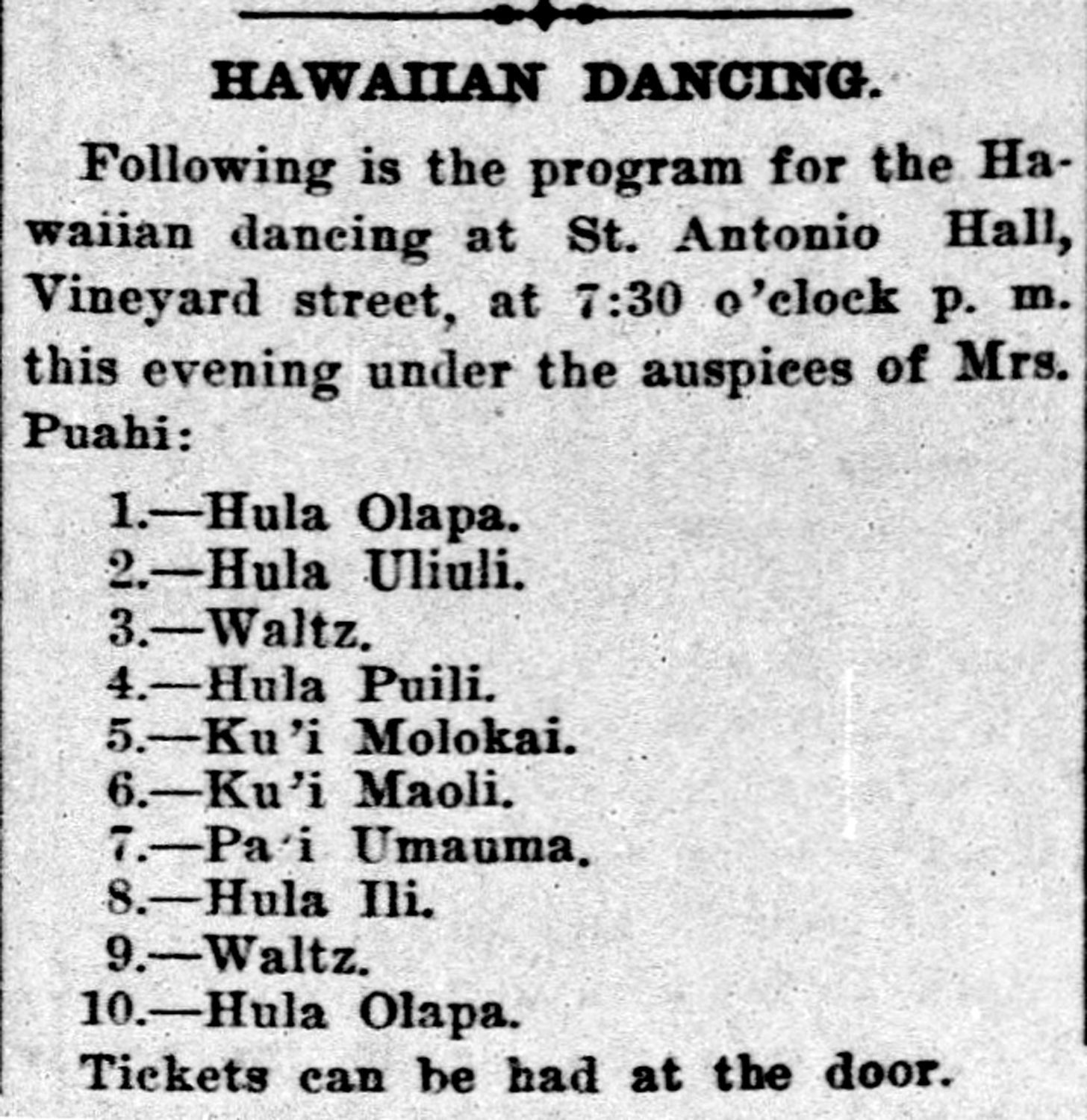
HAWAIIAN DANCING.

Following is the program for the Hawaiian dancing at St. Antonio Hall, Vineyard street, at 7:30 o’clock p. m. this evening under the auspices of Mrs. Puahi:

1.—Hula Olapa.

2.—Hula Ulili.

3.—Waltz.

4.—Hula Puili.

5.—Ku’i Molokai.

6.—Ku’i Maoli.

7.—Pa’i Umauma.

8.—Hula Ili.

9.—Waltz.

10.—Hula Olapa.

Tickets can be had at the door.

(Pacific Commercial Advertiser, 2/22/1907, p. 5)

HAWAIIAN DANCING.

The Pacific Commercial Advertiser, Volume XLV, Number 7657, Page 5. February 22, 1907.

Hula common nuisances? 1859.

[Found under: “HAWAIIAN LEGISLATURE. ADJOURNED SESSION 1858: House of Representatives: Dec. 29, Twenty-First Day.”]

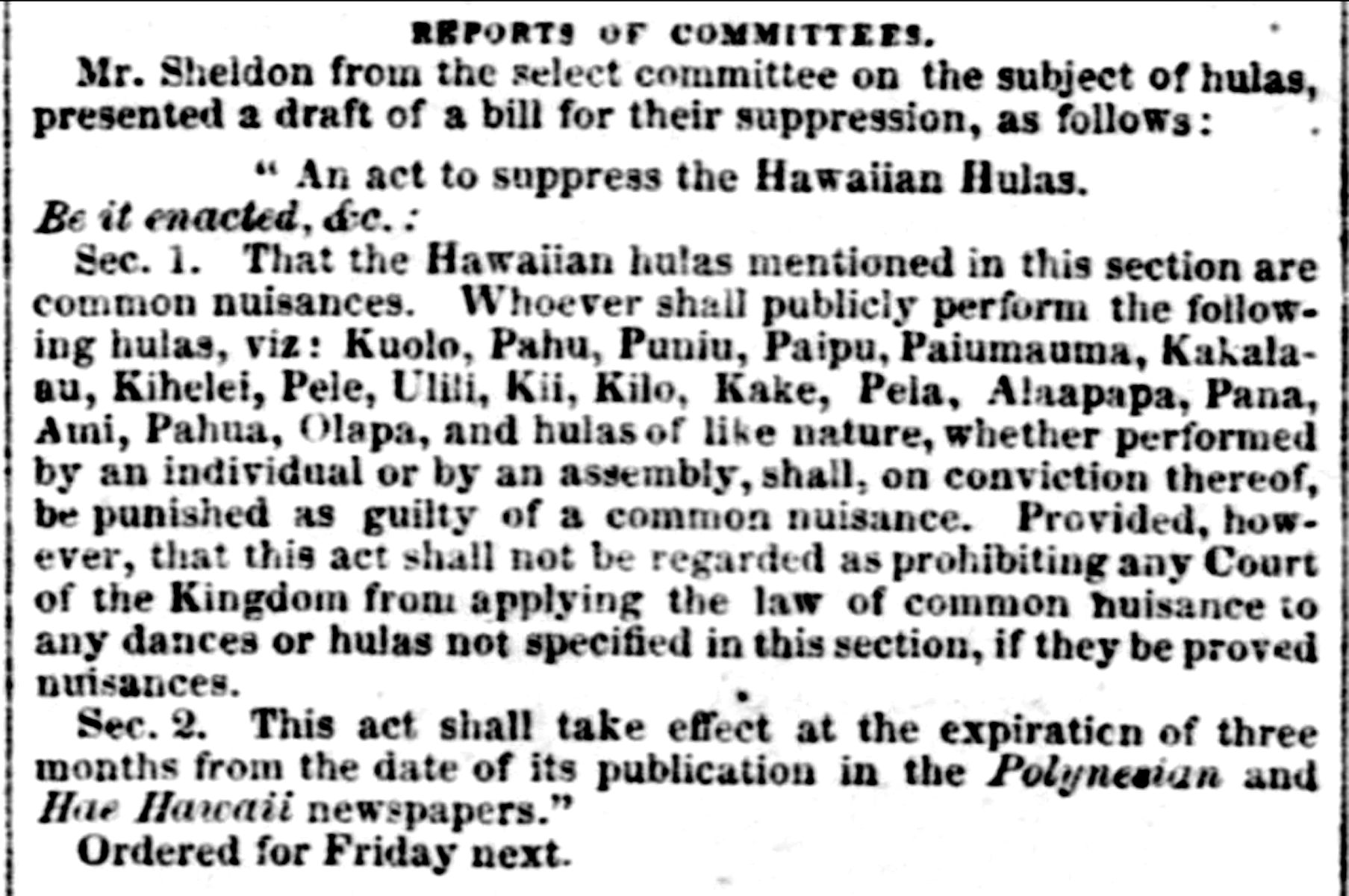
REPORTS OF COMMITTEES.

Mr. Sheldon from the select committee on the subject of hulas, presented a draft of a bill for their suppression, as follows:

“An act to suppress the Hawaiian Hulas.

Be it enacted, &c:

Sec. 1. That the Hawaiian hulas mentioned in this section are common nuisances. Whoever shall publicly perform the following hulas, viz: Kuolo, Pahu, Puniu, Paipu, Paiumauma, Kakalaau, Kihelei, Pele, Ulili, Kii, Kilo, Kake, Pela, Alaapapa, Pana, Ami, Pahua, Olapa, and hulas of like nature, whether performed by an individual or by an assembly, shall, on conviction thereof, be punished as guilty of a common nuisance. Provided, however, that this act shall not be regarded as prohibiting any Court of the Kingdom from applying the law of common nuisance to any dances or hulas not specified in this section, if they be proved nuisances.

Sec. 2. This act shall take effect at the expiration of three months from the date of its publication in the Polynesian and Hae Hawaii newspapers.”

Ordered for Friday next.

[The members of the House there that day were: S. P. Kalama, S. Lainaholo, James I. Dowsett, J. H. Kaakua, J. W. Austin, Paul F. Manini, M. Kapihe, J. S. Low, Ioane Richardson, C. K. Kakani, D. Nuuhiwa, J. H. Kaauwaepaa, R. S. Hollister, E. P. Kamaipelekane, J. E. Chamberlain, Z. P. Kaumaea, M. Kenui, J. W. B. Kiolea, J. W. Kupakee, J. Kahai, J. M. Kalanipoo, D. H. Hitchcock, and H. L. Sheldon.

The committee itself was made up of H. L. Sheldon, James I. Dowsett, and S. P. Kalama.]

(Polynesian, 1/1/1859, p. 2)

REPORTS OF COMMITTEES.

The Polynesian, Volume XV, Number 35, Page 2. January 1, 1859.