Honolulu Glee Club, 1911.

THE SINGING GROUP, “HONOLULU GLEE CLUB” OF THE HAWAIIAN BOYS.

Led by Ah Choy Tim Sin.

Front row—R. K. Kumulala [Kumululu? Kumuliilii?], D. W. Waipa, Ah Choy Tim Sin, R. M. Kamaunu, F. W. Keao. Back row—S. Kanekoa, J. Kahikina.

This Singing Group will arrive in the districts of North Kohala, South Kohala, Hamakua, Hilo, and Puna, should they not meet with any troubles on their road. This group is under the direction of Ah Choy, a skilled youth [line hidden by fold].

[Line hidden by fold?] with the melodic flute, and included in this group is the skilled hands of Mr. Waipa, the prince of Kona and Kohala.

Therefore, rise, O Friends, join hands with the sweet beloved of Kohala and sing along to this song of aloha for his birth land:

“Maikai ka makani o Kohala,
I pa ia e ka Inuwai,
Ka wai no ia pono kaua,
Ka wai kaulana o ka aina,
He aloha, he aloha ka’u mea nui,
He makana, he makana na ka puuwai.”

Please fill their singing audience; they will arrive in North Kohala on August 5, 1911.

[This is one of many pages of the Hawaiian-Language Newspapers that are difficult to read because the image originally taken was not clean. These need to be reshot before it is too late. You can’t get much information from something that is illegible.]

(Kuokoa Home Rula, 7/28/1911, p. 1)

KA PUALI HIMENI "HONOLULU GLEE CLUB" O NA KEIKI HAWAII

Kuokoa Home Rula, Buke IX, Helu 30, Aoao 1. Iulai 28, 1911.

[Here is the same image found in the Evening Bulletin. Perhaps this is not such a great image, but it is way better than the one from Kuokoa Home Rula! And yet, the information given pales to what is found in the Hawaiian article…]

MEMBERS OF HONOLULU GLEE CLUB

Evening Bulletin, Number 4993, Page 8. August 1, 1911.

More about the Na’i Aupuni Association, 1925.

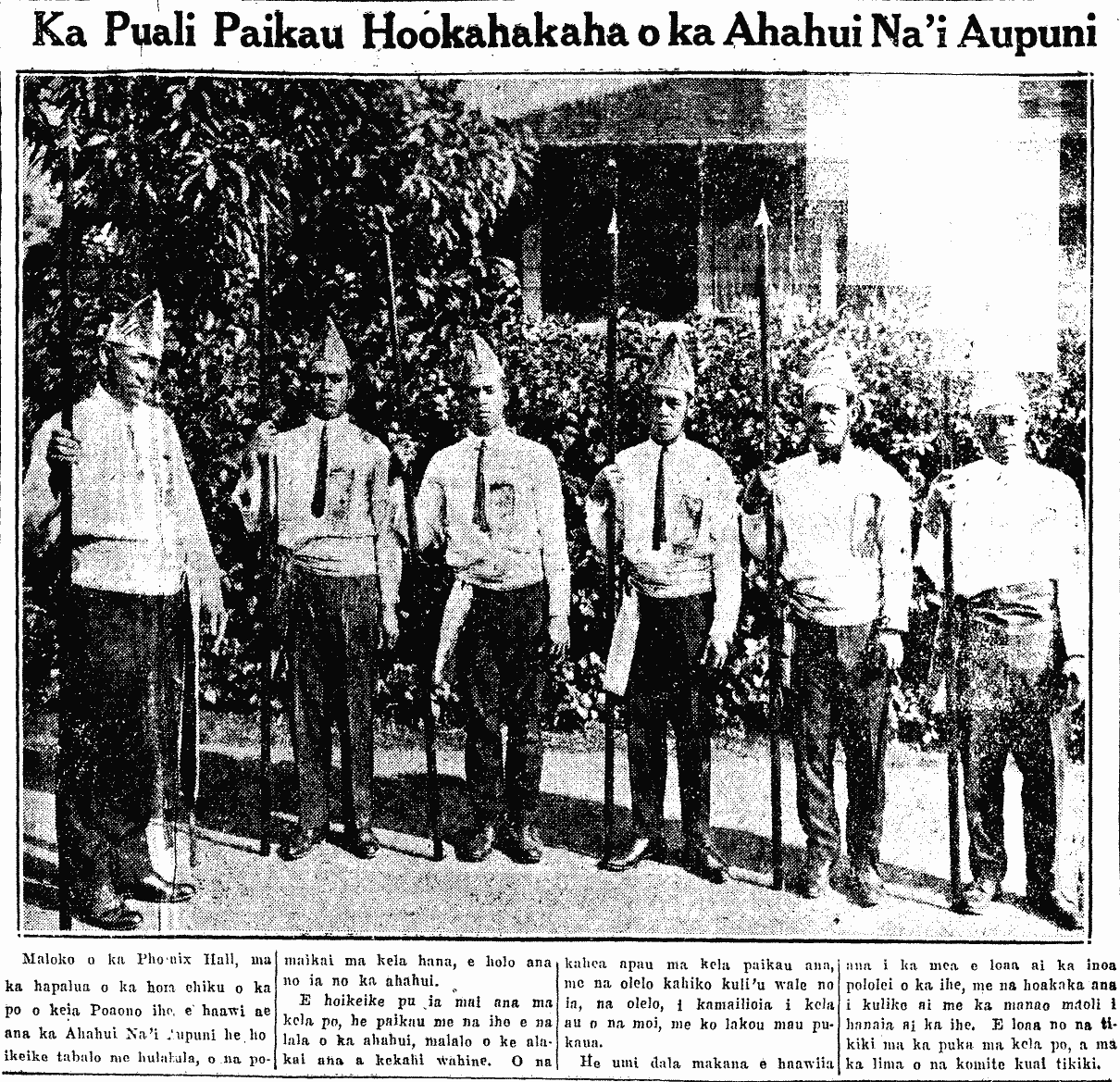
Marching Drill Unit of the Ahahui Na’i Aupuni.

In Phoenix Hall, at half past seven on this Saturday night, the Na’i Aupuni Association will hold a play and dance, and the profits from this endeavor will go to the association.

Also shown on that night will be marching with ihe [spears] by the members of the association under the direction of a woman. The drill commands will all be in the old language—the language spoken during the monarchy, by their war leaders.

A prize of ten dollars will be awarded to the one who knows the correct name of the spear, along with the explanation of the true circumstances under which the spear was made.  Tickets are available at the door on that night, or directly from the members of the ticket selling committee.

(Kuokoa, 4/23/1925, p. 2)

Ka Puali Paikau Hookahakaha o ka Ahahui Na'i Aupuni

Ka Nupepa Kuokoa, Buke LXIV, Helu 17, Aoao 2. Aperila 23, 1925.

Things that just make you go hmmmm… 1924.

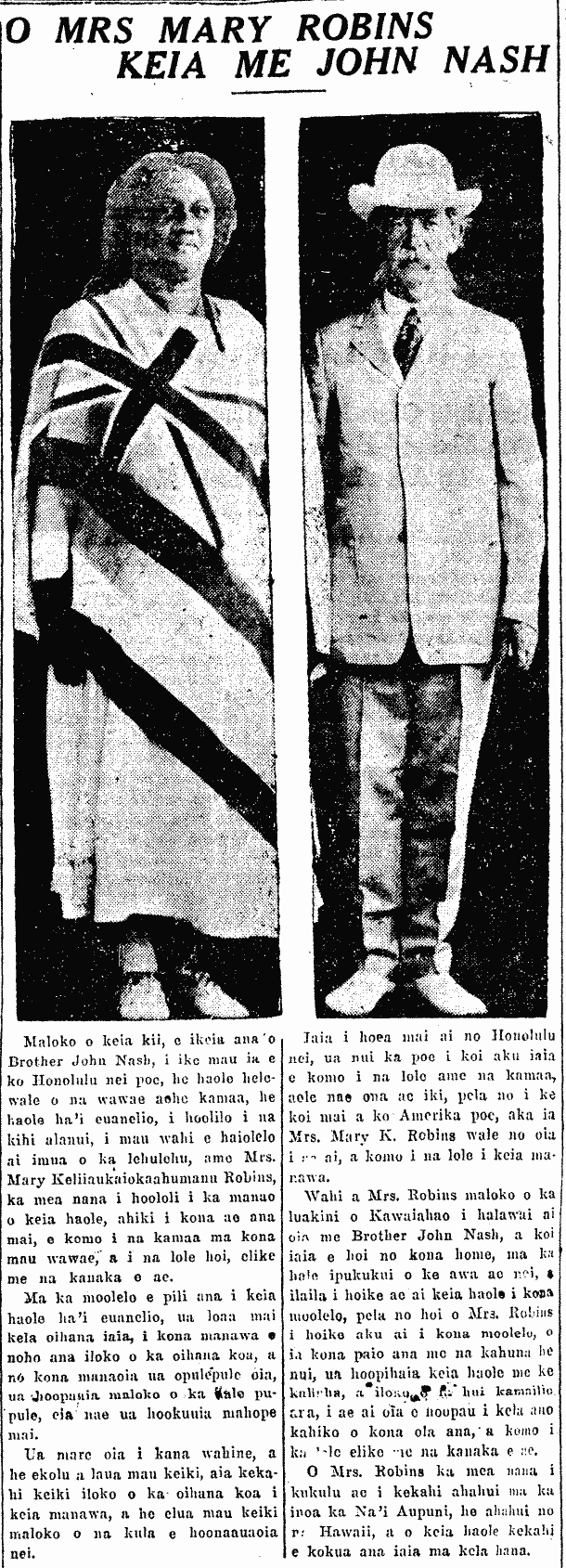
THIS IS MRS. MARY ROBINS AND JOHN NASH

Seen in this picture is Brother John Nash, who is regular to Honolulu’s people; he is a haole who walks around without shoes and is a haole preacher who uses street corners as places to preach in front of the people. And Mrs. Mary Keliiaukaiokaahumanu Robins who convinced this haole to wear shoes on his feet as well as clothes like other men.

As for the story of this haole preacher, he took this calling when he was serving in the military; because he was considered crazy, he was confined to an asylum, but was released soon after.

He married his wife and they had three children: one of them is currently in the service, and the other two are getting their schooling.

When he arrived in Honolulu, there were many who pushed him to wear clothing and shoes, but he did not agree in the least, and so too went the pleas of the Americans; it was only to Mrs. Mary K. Robins that he acquiesced and he now wears clothes.

According to Mrs. Robins, she met Brother John Nash in Kawaiahao Church, and she urged him to go with her to her home in the lighthouse of the harbor there. It was there that this haole told his story, and Mrs. Robins likewise told hers; and after much arguing with this preacher, he was baffled [kahaha?], and while they were talking, he agreed to discard his old ways and to don clothing like other people.

Mrs. Robins is the founder of the Association called Na’i Aupuni, an association for Hawaiians, and that haole assists her in that endeavor.

[Anybody know more about this organization called Ahahui Na’i Aupuni?]

(Kuokoa, 12/11/1924, p. 2)

O MRS MARY ROBINS KEIA ME JOHN NASH

Ka Nupepa Kuokoa, Buke LXIII, Helu 50, Aoao 2. Dekemaba 11, 1924.

Commission carrying the anti-annexation petitions, 1897.

THE APPEARANCES OF THE REPRESENTATIVES ARE FINE.

We have just seen in the newspaper the “Call” of San Francisco, portraits of the Representatives of the Lahui which were published in that newspaper, with appreciation and delight. Looking closely at all four of their portraits, they each appear fine and dignified, as if those are truly them from top to bottom; there is nothing for the eye to criticize. Also, that newspaper reports of their safe arrival, as well as a conversation of some of the Representatives with a reporter of the newspaper about annexation.

On their sides are portraits of Senators R. F. Pettigrew and Dubois, and both of their stories, from their arrival in Honolulu on the way to Japan, all the way to their return to America. Both of them are true friends to the Hawaiian, wherever they went and came in contact with our native people, but it will be the Senate that will confirm the truth of the words they planted in the hearts of the true Hawaiian people; we hope that the true outcome of their efforts for the good of the land, the people, and the Monarchy arises, and may God in His endless patience bolster their endeavors and progress, so that the journey of our Representatives is helped along. Let Hawaii live forever.

[See the issue of the San Francisco Call (11/28/1897, pp. 1 & 2) referred to in this article here.]

(Aloha Aina, 12/11/1897, p. 2)

ULUMAHIEHIE NA HELEHELENA O NA ELELE.

Ke Aloha Aina, Buke III, Helu 50, Aoao 2. Dekemaba 11, 1897.

More on pictures from the Hawaiian-Language Newspapers and why they need to be reshot. 2012.

[After looking at that Kapiolani Park horse racing picture, you might be thinking, “Seen one horse race, seen them all…” But what about this!

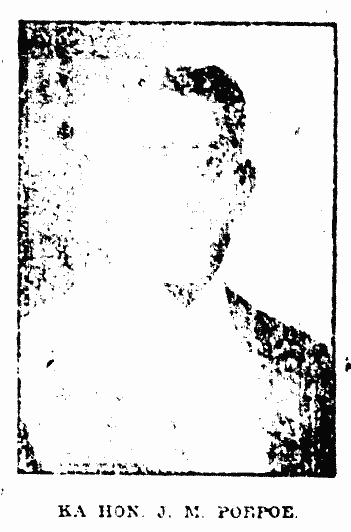
This here is perhaps the only image* known of Joseph Mokuohai Poepoe (patriot/historian/statesman/newspaper editor/lawyer/translator/storyteller…). It comes from his obituary printed in the newspaper Kuokoa.

This is the image you will see from the newspaper online:

KA HON J. M. POEPOE

Ka Nupepa Kuokoa, Buke LI, Helu 15, Aoao 1. Aperila 18, 1913.

Here is a photograph taken by that same amateur from the original newspaper. It isn’t the best of pictures, but at least you get an idea…]

KA HON. J. M. POEPOE.

Ka Nupepa Kuokoa, Buke LI, Helu 15, Aoao 1. Aperila 18, 1913.

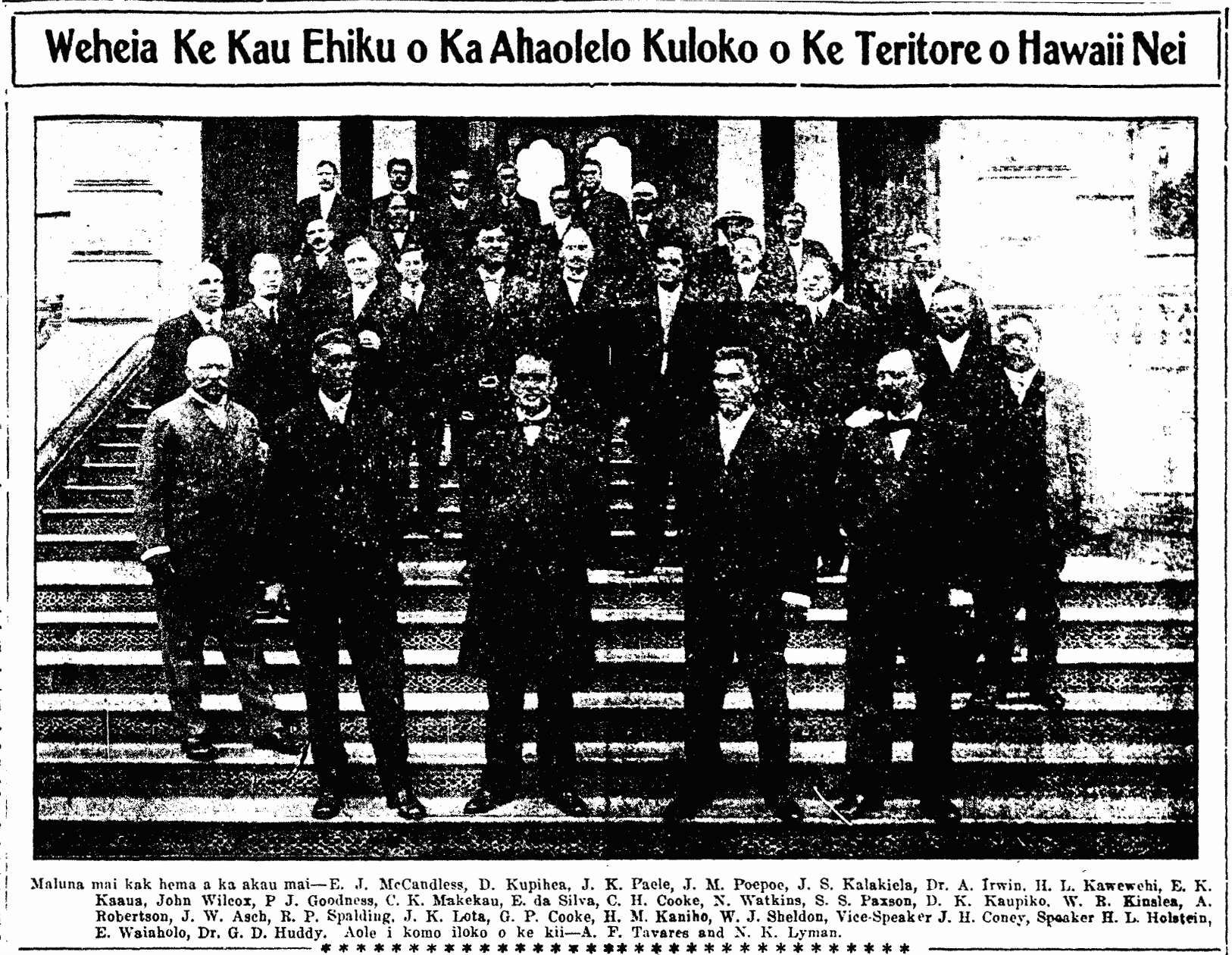
*There is one other image I found, but Poepoe is standing far in the back, and is hardly visible. It was taken at the opening of the Legislature (just a few months before he dies). Poepoe stands in the top row, 4th from the left. (This is the image you will find online.)

Weheia Ke Kau Ehiku o Ka Ahaolelo Kuloko o Ke Teritore o Hawaii Nei

Ka Nupepa Kuokoa, Buke L, Helu 8, Aoao 1. Feberuari 21, 1913.

Just another reason why the Hawaiian-Language Newspapers need to be reshot. 2012.

[Here is what the typical picture looks like from a Hawaiian-Language Newspaper when you see it online. This particular image is of the horse races at Kapiolani Park in 1913.]

Ikeia Na Heihei Like Ole Mawaho o Kapiolani Paka

Ka Nupepa Kuokoa, Buke XLIX, Helu 1, Aoao 1. Ianuari 3, 1913.

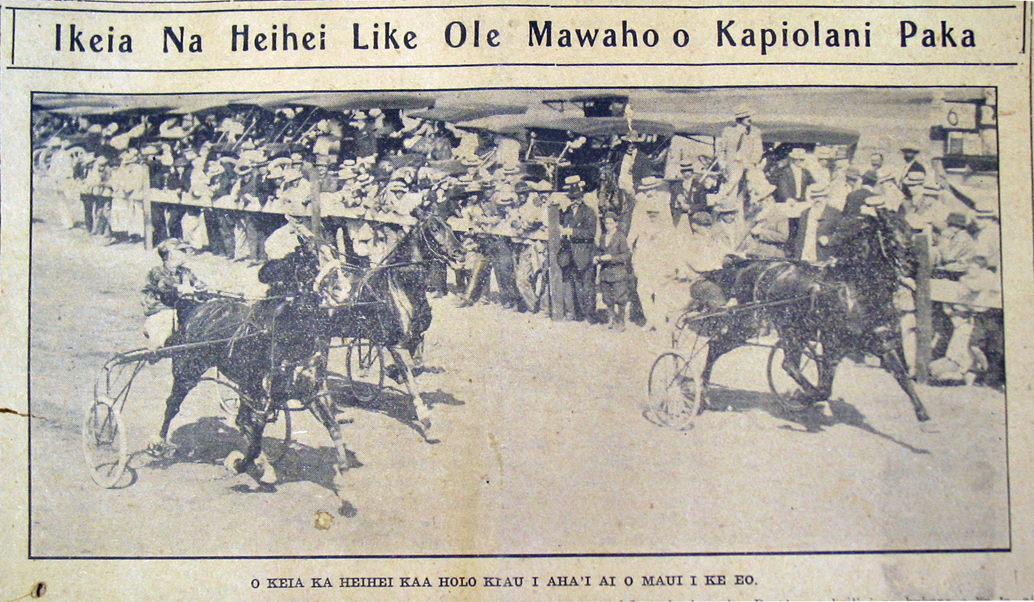
[However, that image taken by a total amateur with an average camera shot directly from the newspaper looks like this.]

Ikeia Na Heihei Like Ole Mawaho o Kapiolani Paka

Ka Nupepa Kuokoa, Buke XLIX, Helu 1, Aoao 1. Ianuari 3, 1913.

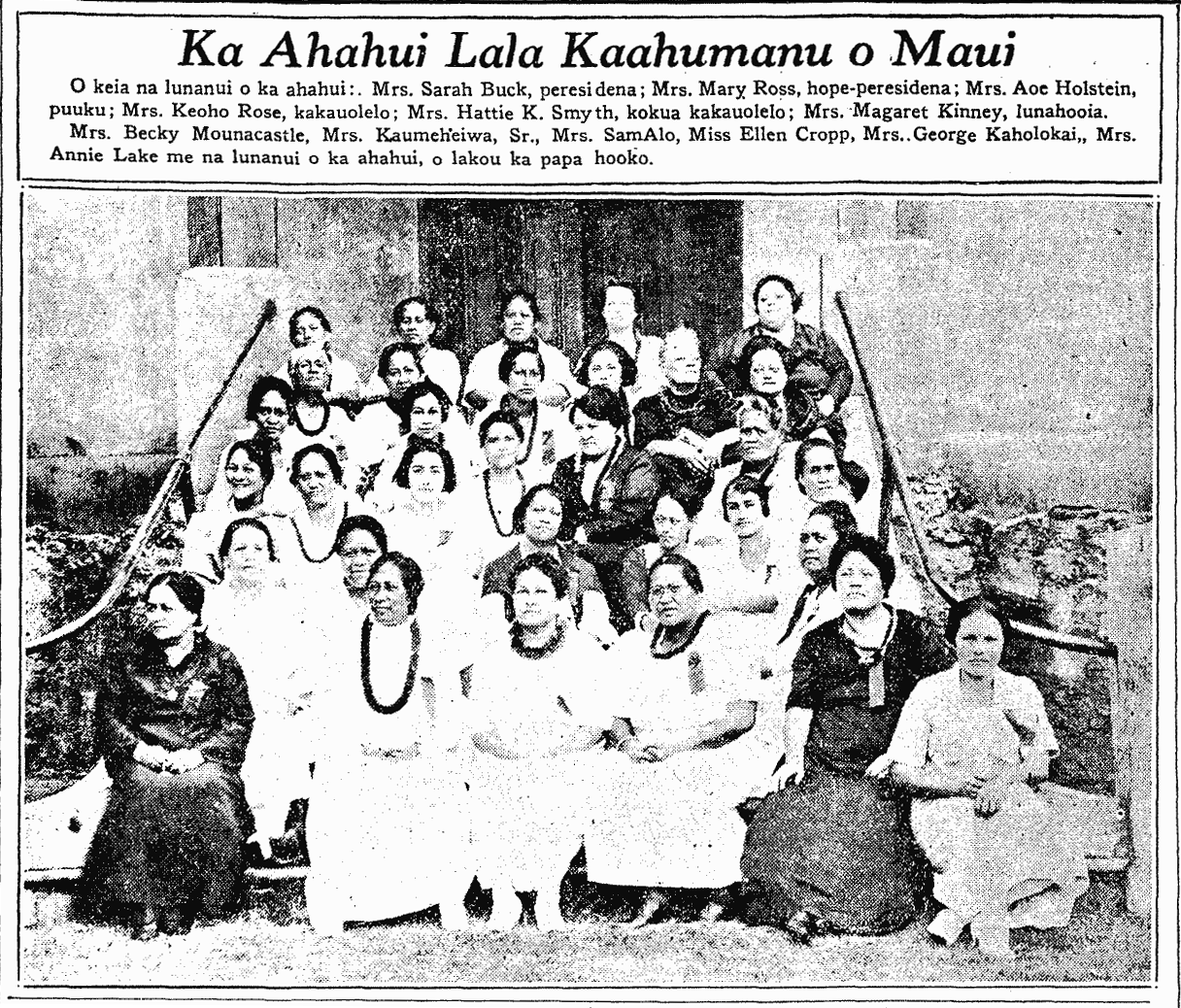
Nice picture of Maui’s Kaahumanu Society officers, 1923.

The Members of the Kaahumanu Society of Maui

These are the officers of the society: Mrs. Sarah Buck, president; Mrs. Mary Ross, vice president; Mrs. Aoe Holstein, treasurer; Mrs. Keoho Rose, secretary; Mrs. Hattie K. Smyth, assistant secretary; Mrs. Magaret [Margaret] Kinney, auditor; Mrs. Becky Mounacastle [Mountcastle], Mrs. Kaumeheiwa, Sr., Mrs. Sam Alo, Miss Ellen Cropp, Mrs. George Kaholokai, Mrs. Annie Lake along the officers of the society, are the executive committee.

(Kuokoa, 7/5/1923, p. 3)

Ka Ahahui Lala Kaahumanu o Maui

Ka Nupepa Kuokoa, Buke LXII, Helu 27, Aoao 3. Iulai 5, 1923.

Images of the return of Kamehameha III’s ahuula, 1927.

This is a picture showing scenes of the Feather cape of Kamehameha. The picture on the top is the return of the ahuula from the archives to within the Palace. The picture below is the ahuula draped upon the throne.

(Kuokoa, 12/1/1927, p. 1)

He kii keia e hoikeike ana...

Ka Nupepa Kuokoa, Buke LXVI, Helu 53, Aoao 1. Dekemaba 1, 1927.

Moanalua, then and now, 1922.

MOANALUA PAST AND MOANALUA PRESENT.

(Written by J. K. Mokumaia)

(Continued)

[This is from a serial column on stories about Moanalua. At the close of the previous installment, Mokumaia is speaking about Waiapuka and evidence of a large population…]

So too a well-built rock platform, it is like a heiau; and so too a huge cave large enough for a hundred people to live; and so too perhaps a small cave enough for a single person to live as a lookout, looking out at Moanalua, where the oncoming enemies would be plain in sight.

In my estimation, its height above sea level is 500 and a half feet, and this valley was an important one to the people, and was called Kamanaiki, and there is the famous hill Puukapu.

It is said that this was a place where the alii and people got together to discuss an important problem, and it will be be clear through your writer, those things integrally related to this hill and why it is famous; being that this hill is very close to where passing travellers were waylaid at night.

Therefore, dear readers of my fond Kilohana (a frequently used appellation for the newspaper Kuokoa, coming from its subtitle “Ke Kilohana Pookela no ka Lahui Hawaii” [The Greatest Prize of the Hawaiian Nation]), I am taking this little entertainment back to the time when Kaleiluhiole was ruling as konohiki, where this story gets its basis.

Kaleiluhiole’s total area of management went all the way to Makua, Waianae and back, when he made his tour, he would start at Moanalua and take a respite at Makua, staying there for some anahulu (a period of 10 days), and then turn back; going along on these tours were his workers as well as those who entertained on the trips so that everyone amongst his travelling companions was filled with the constant promise of merriment.

When the konohiki stayed there, items from the seaside were prepared by the natives, and so too the fruits of the land; being that his word had power, it was necessary to prepare all these things; and the important man during those times as heard by your writer was the one called Kihikihi; this gentleman was lame, but his  mind however was filled with all sorts of ideas that benefited him.

He owned a number of schooners, and from amongst his servants, there is one still alive in Waianae, that being Mr. Hui; they went around with the father of your writer, being that my father was a captain of the vessels belonging to Kihikihi, who was also the grandfather of your writer.

The basis for this discussion was that when the Konohiki stayed in Makua it was a regular thing that entertainment was provided for him; and from amongst these entertainments, was a hula troupe headed by Mahoe; this hula leader was from Kauai,  and when he was joined by the beauty of Makua, that hula performance of his—the hips of that hula leader were pressed by that beauty of Makua; quiet your breathing at the whispering seas of that land, as your eyes will  grow dizzy watching [?].

My father was also one who belonged to this hula troupe, and when the konohiki made his return, until reaching his usual lands, that being Moanalua, it was customary for him, were it extremely long, for everyone to be filled with happiness, and this happiness was what was witnessed when that hula troupe was joined by Moanalua’s, which was headed by Keoni Paakaula, and hula students got together, and thus appeared your writer; from what is known, this travelling was the foundation from which a brought forth its garden and came the year spoken previously of by the writer, when thought first came to him.

Looking at how the konohiki and people lived, it was quite fun; this was a land of people and food aplenty.

(To be continued.)

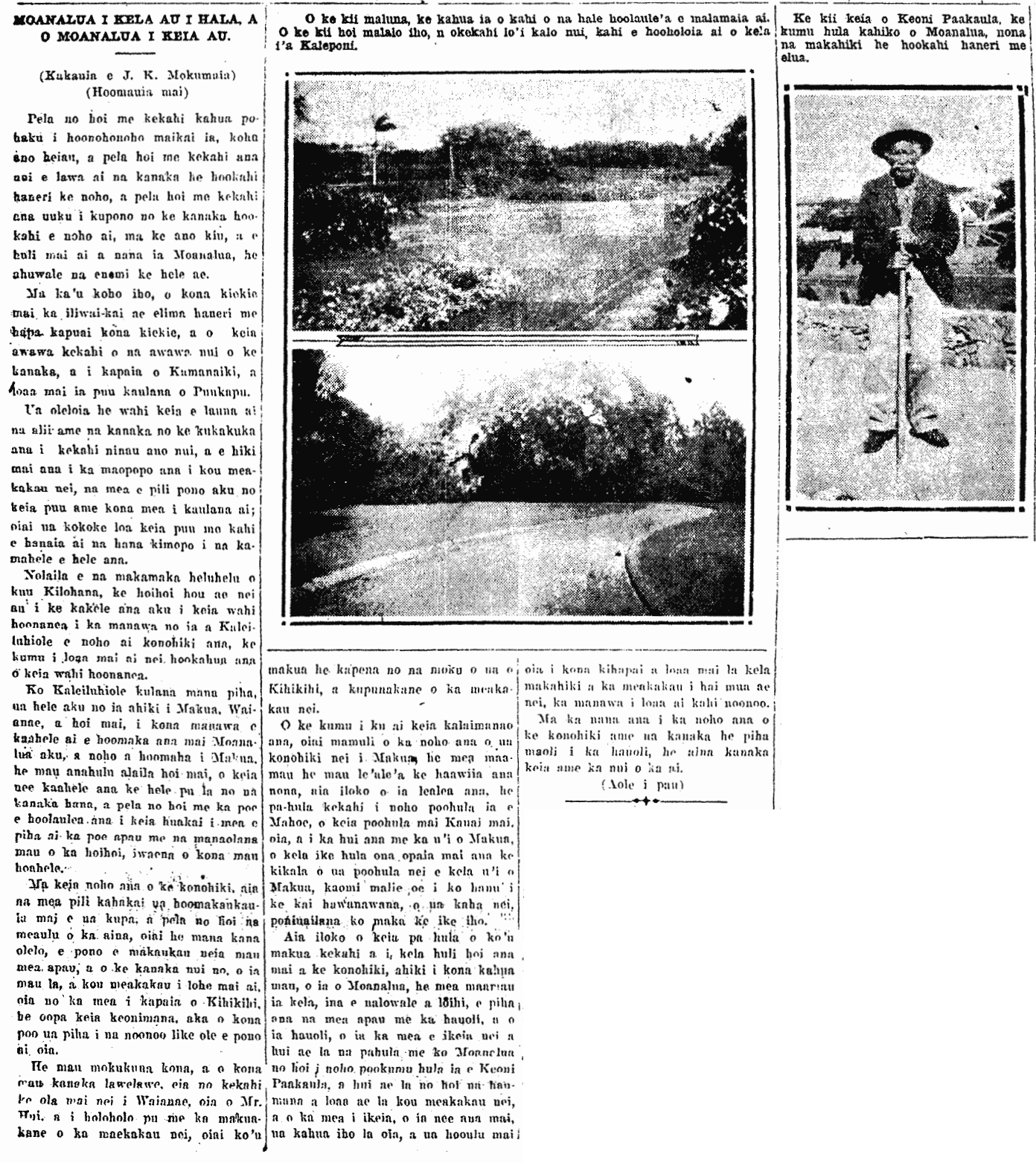
The picture above is the grounds on which was the structure where festivities were held. The picture below is of a great taro patch where the fish from California [i’a Kaleponi?] was set loose.

This is a picture of Keoni Paakaula, the old kumu hula of Moanalua, who is 102 years old.

[This serial by J. K. Mokumaia begins on 2/17/1922 and might end on 8/31/1922 (although there is indication that it is not completed).]

(Kuokoa, 3/10/1922, p. 6)
MOANALUA I KELA AU I HALA, A O MOANALUA I KEIA AU.

Ka Nupepa Kuokoa, Buke LXI, Helu 10, Aoao 6. Maraki 10, 1922.

Now this is friendship, 1912.

TRAVELLED THE OCEAN BECAUSE OF ALOHA FOR HER FRIEND

There was the shocking news spread about on the morning of Tuesday last week about the streetcar accident, and then on the night of the following Monday like a flash of lightning there came sad news of the passing of Malie Kamakaea at Queen’s Hospital due to her injuries.

When the news spread across the width and breadth of the land and arrived before a tiny girl, a beloved friend of Malie Kamakaea, who lives on Kauai, the girl just left her home, her family and and everyone, and she travelled across the sea to see the cold body of her friend who left her and their schoolmates in this world behind.

The name of this tiny girl is Alice Charman, and she is only nine years old. When her older sisters told her of the passing of her beloved friend from this world, she immediately prepared herself to leave her home and went to the place to board the Kinau, and travelled across the sea all by herself for Honolulu.

When the steamship Kinau docked at the harbor, and while the crowd of people watching over the cold body of Malie Kamakaea and the family were relaxing at the funeral home of Mr. Silva, the sea-travelling child, Miss Alice Charman, arrived to see the cold body of her friend who she shared aloha with over the many days they attended school together.

In her hand she held a beautiful lei woven with flowers of the Garden Isle, woven over leaves of ama’u fern, and this became something appreciated by all; the circumstances of it’s fashioning was something they’d remember always.

It was the love of a friend that caused the trip over the wide ocean; distance is of no matter when summoned by tears.

(Kuokoa, 1/26/1912, p. 4)

AU MAI I KE KAI NO KE ALOHA I KE AIKANE

Ka Nupepa Kuokoa, Buke XLVIII, Helu 4, Aoao 4. Ianuari 26, 1912.