WILLIAM H. HEEN.
One of the Names Chosen for the Position of Circuit Judge [Lunakanawai Kaapuni] for Oahu nei.
(Kuokoa, 2/16/1917, p. 1)

Ka Nupepa Kuokoa, Buke LV, Helu 7, Aoao 1. Feberuari 16, 1917.
One of the Names Chosen for the Position of Circuit Judge [Lunakanawai Kaapuni] for Oahu nei.
(Kuokoa, 2/16/1917, p. 1)
Ka Nupepa Kuokoa, Buke LV, Helu 7, Aoao 1. Feberuari 16, 1917.
To Regulate the Hawaiian Board of Health.
Be it enacted by the King and the Legislative Assembly of the Hawaiian Islands in the Legislature of the Kingdom Assembled:
Section 1. His Majesty the King shall appoint five native Hawaiians to be a Hawaiian Board of Health, and His Majesty the King shall appoint one of them to be President of said Board, and all of said Board shall be persons skilled in the practice of native medicine, of good character, and they shall serve during the King’s pleasure.
Section 2. It shall be the duty of said Hawaiian Board of Health to hear all applications made by native Hawaiians who wish to practice native medicine in this Kingdom for the cure of any kind of disease, or for the cure of chronic diseases or hereditary diseases, or for the cure of broken bones.
Section 3. Said Board, or a majority thereof, shall give to each applicant a certificate certifying to the Minister of the Interior the qualification of the applicant to practice native medicine in any kind of disease, or for the treatment of chronic disease or hereditary diseases, of the cure of broken bones, as may be stated in the application.
Section 4. The Minister of the Interior shall grant on the order of the said Board a license to any applicant who has received a certificate of his qualification to practice medicine in any kind of disease, upon receiving twenty dollars.
Section 5. Every person so licensed to practice medicine, as in Section 4 of this Act specified, shall keep records of his practice of medicine, and shall enter correctly in such records all the business done by him. Any person who shall practice hoomanamana, hoopiopio, anaana, or hoounauna, shall have his license cancelled immediately. Continue reading
An Incomprehensible Law—Discrepancy Between the English and Hawaiian Versions.
In the case of an appeal from the Waialua District Court, respecting an alleged kahuna, Judge Preston yesterday rendered a decision in the Intermediary Court substantially as follows: Continue reading
HAWAIIAN BOARD OF HEALTH.—Some one has asked, what is the meaning of the announcement of the establishment of the above entitled body. The law of 1868 provides for the appointment by the King of three “native born Hawaiians,” Continue reading
LET ALL MEN know the thoughts of the Hawaiian Medical Practitioners [Kahuna Lapaau Hawaii], they who number one hundred and fifty. O Ke Au Okoa, speak their thoughts. About how we will bear this immense right of ours impeccably, without deceit. Let them be instructed to put behind these evil thing: evil sorcery [anaana], imitative magic [hoopiopio], sending spirits [hoounauna], and the deification of all evil things; Continue reading
Unlicensed Medical Practitioner.—This past Monday, a man named Kapohaku was brought before the Police Court [Aha Hoomalu] after being charged with practicing medicine without a license. He admitted his guilt, therefore, Continue reading
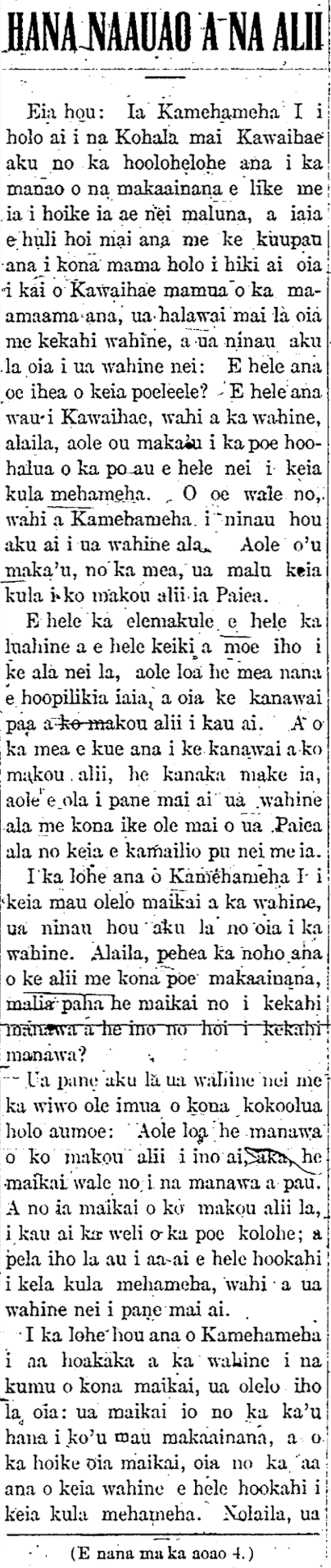
And here is something else: When Kamehameha I went to the Kohala districts from Kawaihae to hear the thoughts of the makaainana like those shown earlier, as he turned back with haste so that he would reach the seaside of Kawaihae before it was light, he came upon an old woman and asked her: “Where are you going in the darkness?” “I am going to Kawaihae,” replied the woman. “Aren’t you afraid of being ambushed at night while you walk this desolate field. Just by yourself?” Kamehameha then asked of the woman. “I have no fear, for this plain is protected because of our alii, Paiea.”
“The old men go, the old women go, and the children go and sleep on these pathways, and there is no one at all who will bother them, for that is a strict law that our alii has placed. And the person who disobeys the law of our alii is a dead man; he will not live,” answered the woman, not knowing that it was Paiea who was talking with her.
When Kamehameha heard these fine words of the woman, he further asked the woman. “So how is the way of life of the alii with his makaainana? Is it good sometimes and bad sometimes?”
The woman answered with no fear before her late night travelling companion, “There has been no time in which our alii has been bad to us, but he has always been good. And it is because of this goodness of our alii that wrongdoers are fearful, and it is thus that I can dare to walk alone across the desolate field,” the woman replied.
When Kamehameha heard once again the woman expounding on why he was good, he said [to himself], “I am indeed beneficent to my people, and the proof of this good is that this woman dares to travel this lonely field alone.” Therefore,…
[To be continued.]
(Hoku o Hawaii, 7/1/1909, p 1)
Ka Hoku o Hawaii, Buke IV, Helu 9, Aoao 1. Iulai 1, 1909.
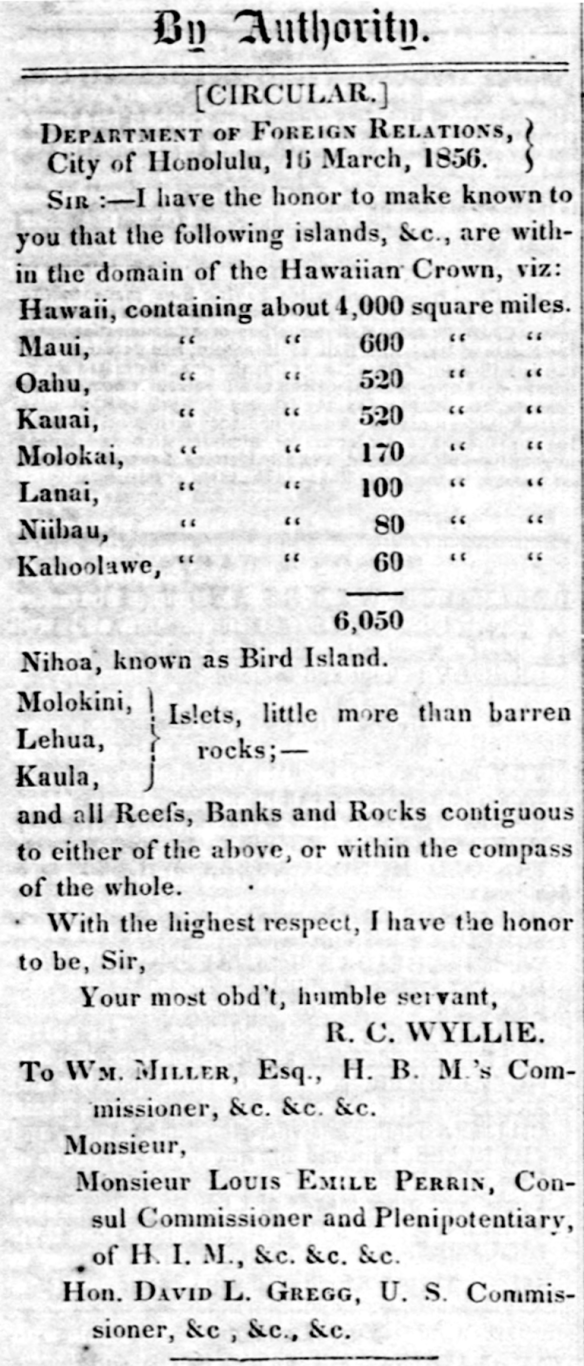
[CIRCULAR.]
Department of Foreign Relations,
City of Honolulu, 16 March, 1856 [1857].
Sir:—I have the honor to make known to you that the following islands, &c., are within the domain of the Hawaiian Crown, viz:
Hawaii, containing about 4,000 square miles.
Maui, ” ” 600 ” “
Oahu, ” ” 520 ” “
Kauai, ” ” 520 ” “
Molokai, ” ” 170 ” “
Lanai, ” ” 100 ” “
Niihau, ” ” 80 ” “
Kahoolawe, ” ” 60 ” “
6,050
Nihoa, known as Bird Island.
Molokini, Lehua, Kaula, Islets, little more than barren rocks;—
and all Reefs, Banks and Rocks contiguous to either of the above, or within the compass of the whole.
With the highest respect, I have the honor to be, Sir,
Your most obd’t, humble servant,
R. C. WYLLIE.
To William Miller, Esq., H. B. M.’s Commissioner, &c. &c. &c.
Monsieur,
Monsieur Louis Emile Perrin, Consul Commissioner and Plenipotentiary, of H. I. M., &c. &c. &c.
Hon. David L. Gregg, U. S. Commissioner, &c., &c., &c.
(Polynesian, 3/28/1857, p. 2)
The Polynesian, Volume XIII, Number 47, Page 2. March 28, 1857.
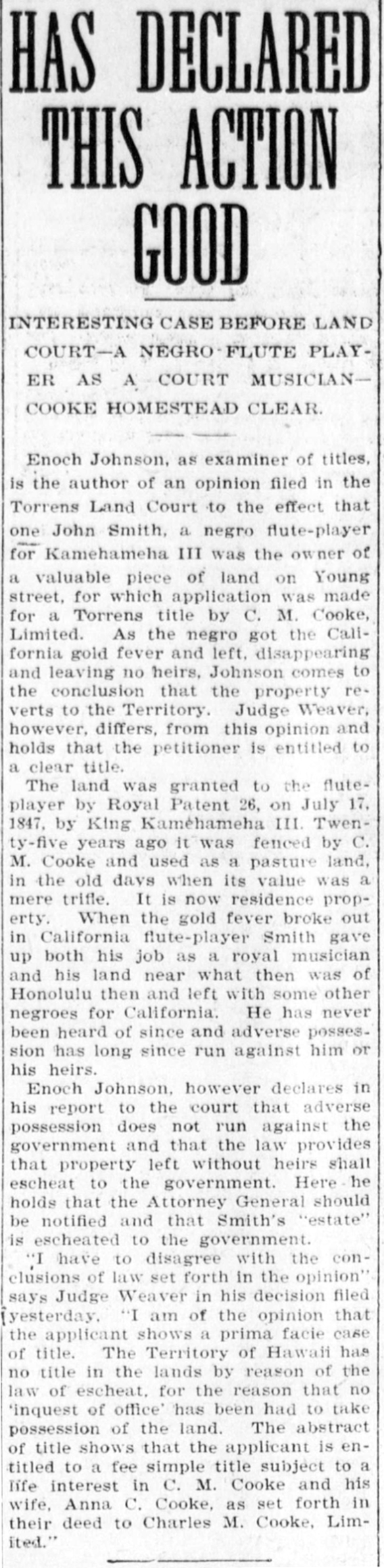
INTERESTING CASE BEFORE LAND COURT—A NEGRO FLUTE PLAYER AS A COURT MUSICAN—COOKE HOMESTEAD CLEAR.
Enoch Johnson, as examiner of titles, is the author of an opinion filed in the Torrens Land Court to the effect that one John Smith, a negro flute-player for Kamehameha III was owner of a valuable piece of land on Young street, for which application was made for a Torrens title by C. M. Cooke, Limited. As the negro got the California gold fever and left, disappearing and leaving no heirs, Johnson comes to the conclusion that the property reverts to the Territory. Judge Weaver, however, differs, from this opinion and holds that the petitioner is entitled to a clear title.
The land was granted to the flute-player by Royal Patent 26, on July 17, 1847, by King Kamehameha III. Twenty-five years ago it was used as a pasture land, in the old days when its value was a mere trifle. It is now residence property. When the gold fever broke out in California flute-player Smith gave up both his job as a royal musician and his land near what then was of Honolulu then and left with some other negroes for California. He has never been heard of since and adverse possession has long since run against him or his heirs.
Enoch Johnson, however declares in his report to the court that adverse possession does not run against the government and that the law provides that property left without heirs shall escheat to the government. Here he holds that the Attorney General should be notified and that Smith’s “estate” is escheated to the government.
“I have to disagree with the conclusions of law set forth in the opinion” says Judge Weaver in his decision filed yesterda. “I am of the opinion that the applicant shows a prima facie case of title. The Territory of Hawaii has no title in the lands by reason of the law of escheat, for the reason that no ‘inquest of office’ has been had to take possession of the land. The abstract of title shows that the applicant is entitled to a fee simple title subject to a life interest in C. M. Cooke and his wife, Anna C. Cooke, as set forth in their deed to Charles M. Cooke, Limited.”
(Hawaiian Star, 6/23/1904, p. 8)
The Hawaiian Star, Volume XII, Number 3824, Page 8. June 23, 1904.
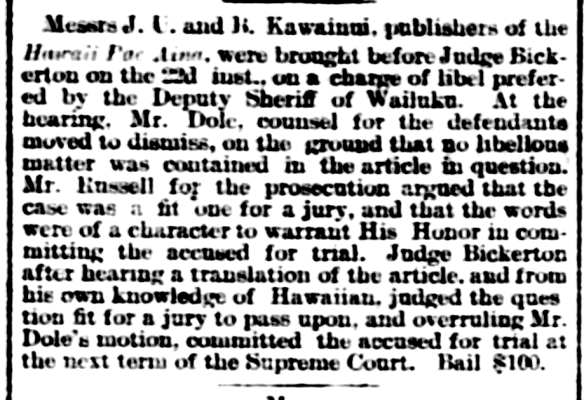
Messrs J. U. and B. Kawainui, publishers of the Hawaii Pae Aina, were brought before Judge Bickerton on the 22d inst., on a charge of libel prefered by the Deputy Sheriff of Wailuku. At the hearing, Mr. Dole, counsel for the defendants moved to dismiss, on the ground that no libellous matter was contained in the article in question. Mr. Russell for the prosecution argued that the case was a fit one for jury, and that the words were of a character to warrant His Honor in committing the accused for trial. Judge Bickerton after hearing a translation of the article, and from his own knowledge of Hawaiian, judged the question fit for a jury to pass upon, and overruling Mr. Dole’s motion, committed the accused for trial at the next term of the Supreme Court. Bail $100.
(Hawaiian Gazette, 4/25/1883, p. 3)
Hawaiian Gazette, Volume XVIII, Number 17, Page 3. April 25, 1883.
 nupepa