Hawaiian medical kahuna and haole doctors, 1871.

Answer to W. P. Waha.

Mr. Editor; Aloha oe:

Perhaps it is well that I explain in your newspaper a thought responding to W. P. Waha of Honomaele Uka, Hana, Maui.

In the newspaper, Kuokoa, Buke 10, Helu 27, of the 8th of this past July, Waha published an opinion pertaining to the Practice of Hawaiian Medicine. From what I saw searching from beginning to end; this is what I mainly got out of it, that “he is jealous, malicious, and a slanderer, ” and so forth. You just chomp your mouth like a wild shark of the sea saying, “All of the Hawaiians are dying because of whom? Yes! They are dying because of you Heads of the Government!” If that is the intent of the questioner, then I ask of you, “Is that indeed true?” Let us all look at the thoughts of this malicious inciter, being that the Heads of our Nation are not looking to kill off the Hawaiian Lahui, and ways to kill them, but it is you, and it is you yourselves who offer yourselves off to die; and you enjoy grumbling to our Heads of Government. Take a short look at this, you fault finder; During the past session of the Legislature, in the year 1870, $4,000 was put to teach Hawaiian youths Medicine, and in the month of November of last year, the government chose the proper person in which they trust, as a teacher for the school, and it is being taught now. There is no other reason for this action except because of the aloha for you, O Hawaiian people.

Take another look; some Hawaiian medical kahuna are licensed, so that they can practice medicine in the country and areas where there are no doctors. The ignorant and uneducated practitioners are being sued. If you look at these actions by our Government Heads, it appears as if they are concerned that our Lahui will perish. Continue reading
Licensed kahuna and non-licensed kahuna, 1875.

[Found under: “Nu Hou Kuloko.”]

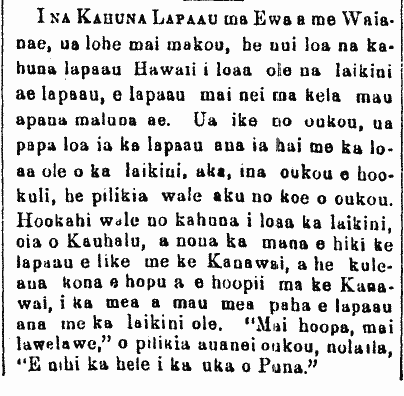
To the Medical Kahuna in Ewa and Waianae, we have heard that there are many Hawaiian medical kahuna without licenses to practice medicine who are treating patients in those districts. You know that the treating of others without a license is prohibited, and if you do not listen, you will be in trouble. There is but one kahuna who is licensed, and that is Kauhalu; and he has the power to arrest and sue under Law the one or ones who doctor people without license. “Don’t touch, don’t undertake this,” or you will face troubles, therefore, “Beware when treading in the uplands of Puna.”¹

¹”E nihi ka hele i ka uka o Puna,” is a famous warning given by Hiiaka to her aikane Wahineomao. It became used as a general warning to be careful of what you are doing.

(Kuokoa, 9/19/1874, p. 2)

I na kahuna lapaau...

Ka Nupepa Kuokoa, Buke XIII, Helu 38, Aoao 2. Sepatemaba 19, 1874.

Kauka Judd opens a clinic for Hawaiians, 1871.

Treatment for Hawaiians.

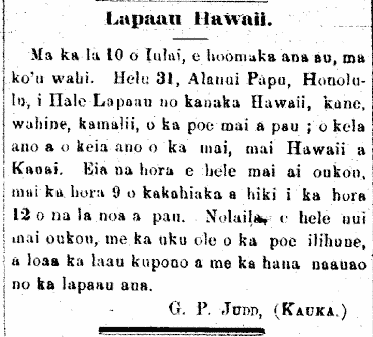
On the 10th of July, I will commence at my place. Number 31, Fort Street, Honolulu, a Clinic for Hawaiian, men, women, children, everyone; with any illness, from Hawaii to Kauai. These are the hours for you all to come by, from 9 o’clock in the morning until 12 on weekdays [la noa]. Therefore, come all; there is no pay for the indigent, and you will get proper medicine with enlightened treatment.

G. P. Judd, (Kauka.)

[Although the title of this advertisement, “Lapaau Hawaii,” can be seen as “Treatment for Hawaiians,” I think the first idea that comes to mind would be “Hawaiian Medicine.” I wonder if that was done on purpose…]

(Au Okoa, 7/20/1871, p. 2)

Lapaau Hawaii.

Ke Au Okoa, Buke VII, Helu 14, Aoao 2. Iulai 20, 1871.

One of the biggest early influences on Hawaiian music in Japan starts here, 1909.

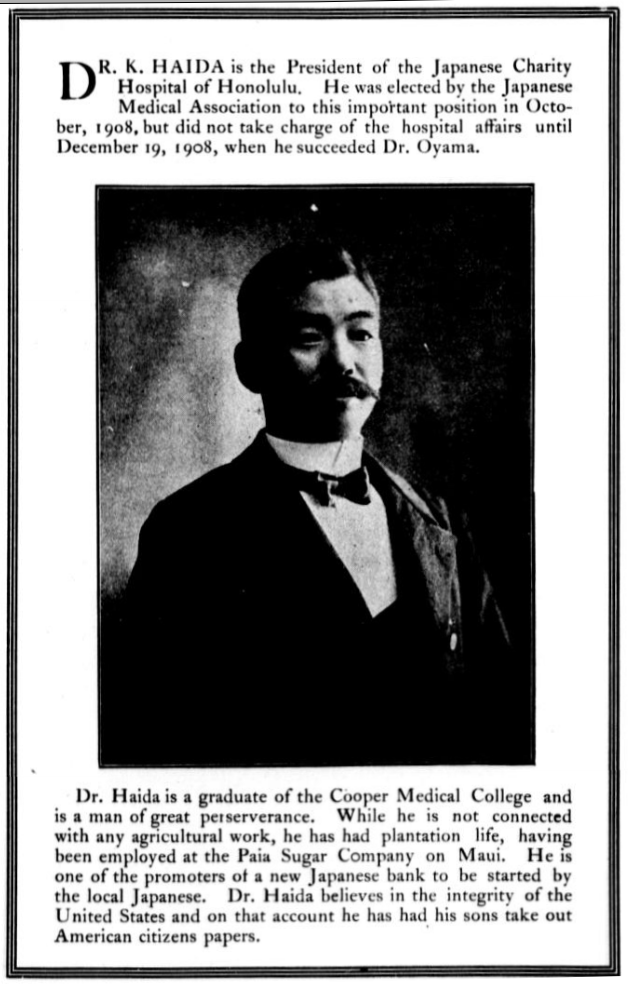
DR. K. HAIDA [Katsugorō Haida] is the President of the Japanese Charity Hospital of Honolulu. He was elected by the Japanese Medical Association to this important position in October, 1908, but did not take charge of the hospital affairs until December 19, 1908, when he succeeded Dr. Oyama.

Dr. Haida is a graduate of the Cooper Medical College and is a man of great perseverance. While he is not connected with any agricultural work, he has had plantation life, having been employed at the Paia Sugar Company on Maui. He is one of the promoters of a new Japanese bank to be started by the local Japanese. Dr. Haida believes in the integrity of the United States and on that account he has had his sons take out American citizen papers.

[See also this article on Yukihiko Haida returning to Hawaii in 1933 from Japan to study Hawaiian music.

And also see this article put up by the Nihon Ukulele Association on Yukihiko (Harry) Haida.]

(Evening Bulletin, 3/25/1909, p. 44)

DR. K. HAIDA...

Evening Bulletin Industrial Edition, 1909, p. 44.

Alsoberry Kaumu Hanchett from “The Story of Hawaii and Its Builders,” 1925.

ALSOBERRY KAUMU HANCHETT

City and County Physician

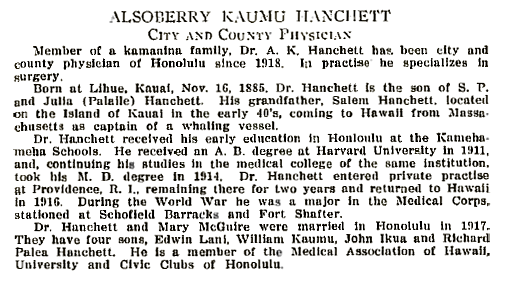
Member of a kamaaina family, Dr. A. K. Hanchett has been city and county physician of Honolulu since 1918. In practice he specializes in surgery.

Born in Lihue, Kauai, Nov. 16, 1885, Dr. Hanchett is the son of S. P. and Julia (Palaile) Hanchett. His grandfather, Salem Hanchett, located on the Island of Kauai in the early 40’s, coming to Hawaii from Massachusetts as captain of a whaling vessel.

Dr. Hanchett received his early education in Honolulu at the Kamehameha Schools. He received and A. B. degree at Harvard University in 1911, and, continuing his studies in the medical college of the same institution, took his M. D. degree in 1914. Dr. Hanchett entered private practise at Providence, R. I., remaining there for two years and returned to Hawaii in 1916. During the World War he was a major in the Medical Corps, stationed at Schofield Barracks and Fort Shafter.

Dr. Hanchett and Mary McGuire were married in Honolulu in 1917. They have four sons, Edwin Lani, William Kaumu, John Ikua and Richard Palea Hanchett. He is a member of the Medical Association of Hawaii, University and Civic Clubs of Honolulu.

[This comes from another awesome resource: The Story of Hawaii and Its Builders, with which is incorporated volume III Men of Hawaii; an historical outline of Hawaii with biographical sketches of its men of note and substantial achievement, past and present, who have contributed to the progress of the Territory, edited by George F. Nellist. Honolulu: Honolulu Star-Bulletin, Ltd., 1925. It is available in text form (minus the many picture portraits) here at the Hawaii USGenWeb Archives.]

(Story of Hawaii and Its Builders, 1925.)

Alsoberry Kaumu Hanchett

The Story of Hawaii and Its Builders, p. 487

Alsoberry Kaumu Hanchett, Kauai boy, becomes a doctor, 1914.

ANOTHER KAUAI BOY MAKES GOOD

A. H. Hanchett who is a Lihue boy, born in a house on the site of the present bowling alley, will graduate from the medical department of Harvard at the end of this month and will, on July 1, enter upon his duties as interne of a great hospital at Providence, R. I. He stood an examination, with 56 others, for that place and came out first best.

Young Hanchett’s father still lives on Kauai, at Waimea; and he is a half brother of W. O. Crowell, of Waimea. Prior to leaving the Islands, he graduated from both Kamehameha school and Oahu College. He next took a four-years course in Harvard, graduating A. B.; after which he took up the medical course, which he is now about to complete.

It is Dr. Hanchett’s hope and present intention to return to the Islands as soon as his two-year term with the Providence hospital is completed.

(Garden Island, 6/9/1914, p. 2)

ANOTHER KAUAI BOY MAKES GOOD

The Garden Island, Volume 10, Number 22, Page 2. June 9, 1914.

A. Kaumu Hanchett studying at Harvard, 1914.

HAWAII IS PROUD OF THIS NATIVE HAWAIIAN

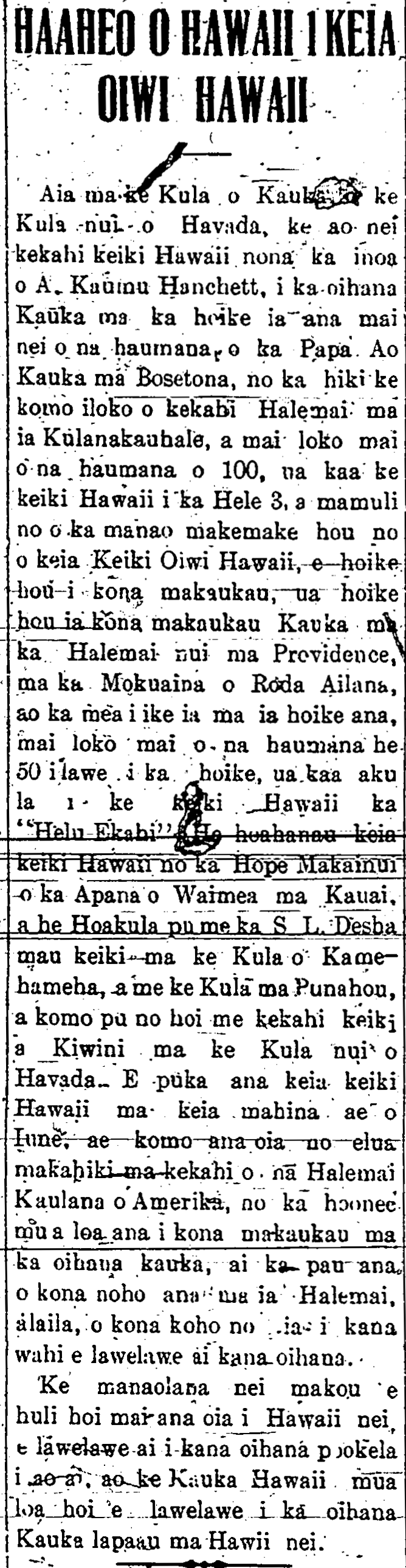
At the Medical School of Harvard University, a Hawaiian named A. Kaumu Hanchett is learning Medicine; in an examination of the medical students in Boston, in order to enter one of the Hospitals of the City, and from amongst a 100 students, the Hawaiian boy ranked 3rd, and because this Hawaiian Boy wanted to once again test his competence, his Medical abilities were tested once again at a big Hospital in Providence in the State of Rhode Island, and what was revealed in that examination was that amongst 50  students who took the test, to the Hawaii boy went “Number One.” He is a brother [hoahanau] of the Deputy Sheriff [Crowell] of the District of Waimea on Kauai, and he was a Classmate of the children of S. L. Desha at Kamehameha School and Punahou School, and he entered Harvard University with a son of Desha’s. This Hawaiian boy will graduate in this coming June, and will intern for two years at one of the Famous Hospitals of America to advance his abilities in the medical field, and at the completion of his stay at the  Hospital, then he will select where he will practice his calling.

We hope that he will come back to Hawaii nei to practice this greatest of occupations in which he trained, and be the first Hawaiian to practice medicine in here in Hawaii.

[On page 295 of the Harvard Alumni Directory for 1910, you will find Alsoberry Kaumu Hanchett [c 1907–10, A.B. 1911(10).] Waimea, Kauai, Hawaii.]

(Hoku o Hawaii, 5/21/1914, p. 2)

HAAHEO O HAWAII I KEIA OIWI HAWAII

Ka Hoku o Hawaii, Buke 8, Helu 50, Aoao 2. Mei 21, 1914.

Translations and vocabulary not found in dictionaries, 1903.

HEAHA LA KA PAIN BALM?

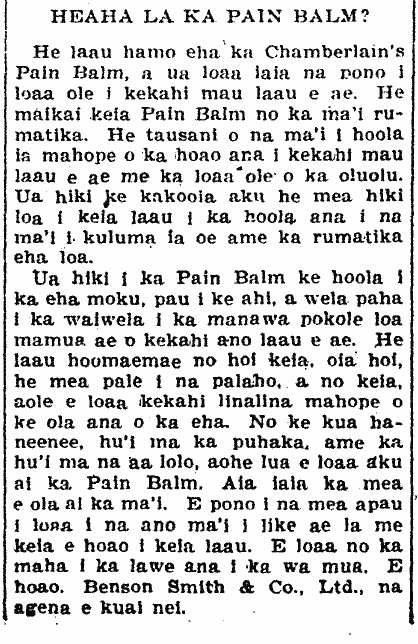
He laau hamo eha ka Chamberlain’s Pain Balm, a ua loaa iaia na pono i loaa ole i kekahi mau laau e ae. He maikai keia Pain Balm no ka ma’i rumatika. He tausani o na ma’i i hoola ia mahope o ka hoao ana i kekahi mau laau e ae me ka loaa ole o ka oluolu. Ua hiki ke kakooia aku he mea hiki loa i keia laau i ka hoola ana i na ma’i i kuluma ia oe ame ka rumatika eha loa.

Ua hiki i ka Pain Balm ke hoola i ka eha moku, pau i ke ahi, a wela paha i ka waiwela i ka manawa pokole loa mamua ae o kekahi ano laau e ae. He laau hoomaemae no hoi keia, oia hoi, he mea pale i na palaho, a no keia, aole e loaa kekahi linalina mahope o ke ola ana o ka eha. No ke kua haneenee, hu’i ma ka puhaka, ame ka hu’i ma na aa lolo, aohe lua e loaa aku ai ka Pain Balm. Aia iaia ka mea e ola ai ka ma’i. E pono i na mea apau i loaa i na ano ma’i i like ae la me keia e hoao i keia laau. E loaa no ka maha i ka lawe ana i ka wa mua. E hoao. Benson Smith & Co., Ltd., na agena e kuai nei.

(Kuokoa, 4/3/1903, p. 5)

HEAHA LA KA PAIN BALM?

Ka Nupepa Kuokoa, Buke XLI, Helu 14, Aoao 5. Aperila 3, 1903.

WHAT IS PAIN BALM?

Chamberlain’s Pain Balm is a liniment and, while adapted to all the ordinary uses of a liniment, has qualities which distinguish it from other remedies of this class. Pain Balm is especially beneficial for rheumatism. Thousands of cases can be cited in which it has effected a cure when the sufferer had previously tried the best medical service without securing relief. Pain Balm is positively guaranteed to give relief  in the most severe cases of chronic or acute rheumatism.

Pain Balm heals bruises, burns and scalds in less time than any other treatment. It is “antiseptic” that is, it prevents putrefaction and by so doing, generally prevents and unsightly scar remaining after the injury is healed. For lame back, lumbago and neuralgia, Pain Balm has no equal. It has the quality of “getting to the right spot.” No sufferer from these distressing affections should defer a trial of this remedy. One application gives relief. Try it. For sale by all dealers. Benson, Smith & Co., general agents.

[Actual translations of almost anything like this advertisement done in the past can shed light on vocabulary, turns of phrase, and so much more!]

(Hawaiian Star, 9/5/1903, p. 3)

WHAT IS PAIN BALM?

The Hawaiian Star, Volume XI, Number 3576, Page 3. September 5, 1903.

Interesting translation, 1908.

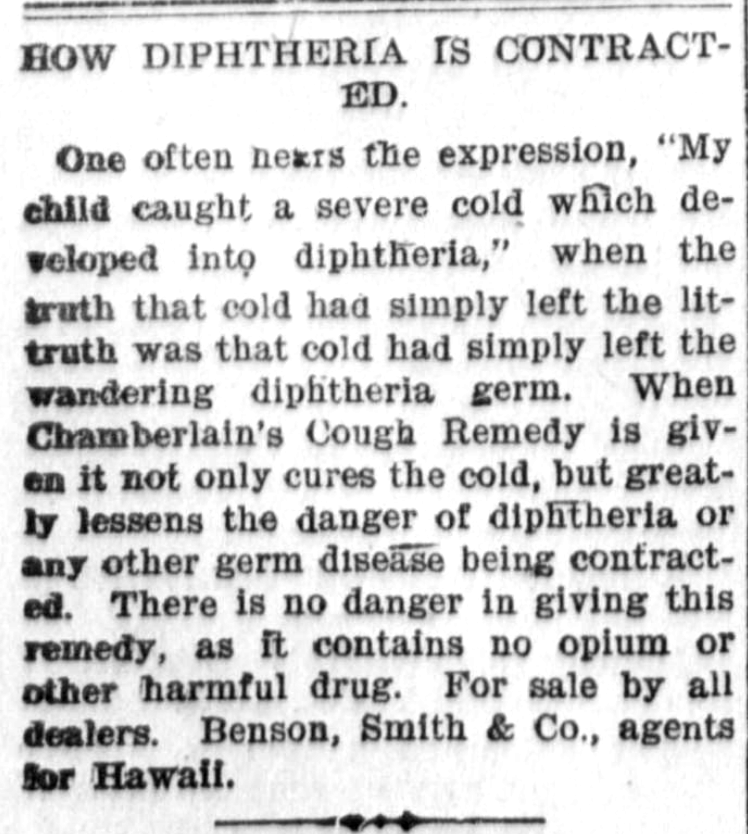
HOW DIPHTHERIA IS CONTRACTED.

One often hears the expression, “My child caught a severe cold which developed into diphtheria,” when the truth that cold had simply left the lit- truth was that cold had simply left the wandering diphtheria germ. When Chamberlain’s Cough Remedy is given it not only cures the cold, but greatly lessens the danger of diphtheria or any other germ disease being contracted. There is no danger in giving this remedy, as it contains no opium or other harmful drug. For sale by all dealers. Benson, Smith & Co., agents for Hawaii.

(Hawaiian Star, 3/13/1908, p. 6)

HOWA DIPHTHERIA IS CONTRACTED.

The Hawaiian Star, Volume XV, Number 4978, Page 6. March 13, 1908.

KE ANO I HOOPAUIA AI O KA MA’I O KA PUU.

Ua lohe pinepineia keia olelo i ke kamailioia, “Ua loaa ka’u keiki i ke anu, a ku a puu maoli ae ma ka a-i,” a o ka mea oiaio no ea, mai ke anu mai i loaa mai ai ka anoano liilii a hiki i ke ku a puu maoli ana o ka a-i. I ka manawa i haawiia aku ai o ka Laau Kumu a Chamberlain, aole wale no o ke anu kana i hoola ai, aka ua hoopauia a hoemiia mai ka ma’i puu o ka a-i, a mau anoano e ae paha o kekahi ano ma’i. Aole loa he pilikia iki o ka haawi ana aku i keia laau oiai aole he opiuma iloko olaila, a laau hoopilikia e ae paha. Eia ke kuaiia nei e Benson, Smith & Co., Ltd., na akena no ka Paeaina Hawaii.

(Kuokoa, 3/13/1908, p. 4)

KE ANO I HOOPAUIA AI O KA MA'I O KA PUU.

Ka Nupepa Kuokoa, Buke XLIII, Helu 11, Aoao 4. Maraki 13, 1908.

Western medical school for Hawaiians, 1870.

Kahunas.

We understand that one of our physicians, who is thoroughly conversant with the native language, has been authorized to form a class of eight or ten Hawaiian young men, (graduates of the highest schools,) for instructions in the principles and practice of medicine.

There has never been made, that we are aware of, any systematic or earnest effort to instruct Hawaiian youth in the medical art. The knowledge that is necessary to be acquired to make a skillful and thoroughly competent practitioner is not to be obtained in this country, which as yet, does not possess medical schools and colleges, and the difficulties in the way of sending Hawaiian pupils abroad to obtain a medical education, are so various and insurmountable, as almost to preclude any hope of being overcome. Continue reading