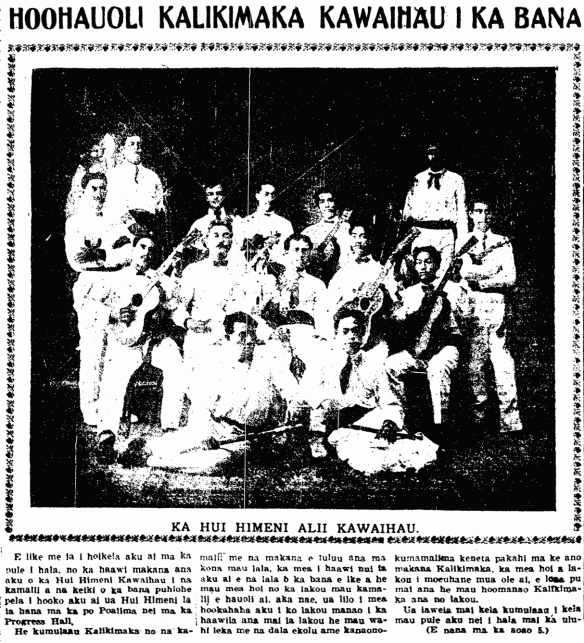
Royal Kawaihau Glee Club honors the Hawaiian Band, 1906.

KAWAIHAU GIVES A MERRY CHRISTMAS TO THE BAND

KA HUI HIMENI ALII KAWAIHAU

Just as was announced last week that the Kawaihau Glee Club would give presents to the children of the band boys, that Glee Club did indeed do so on this past Friday night at Progress Hall.

There was a Christmas tree for the children with presents weighing down on its branches, which were given generously [for] the band members to see, things to give joy to their children; however, they were shocked by being each given envelopes with three dollars and sixty-five cents as a Christmas gift, something they did not bef0re dream of, that they too would receive Christmas presents.

This tree was brought some weeks ago from the…

(Kuokoa, 12/28/1906, p. 1)
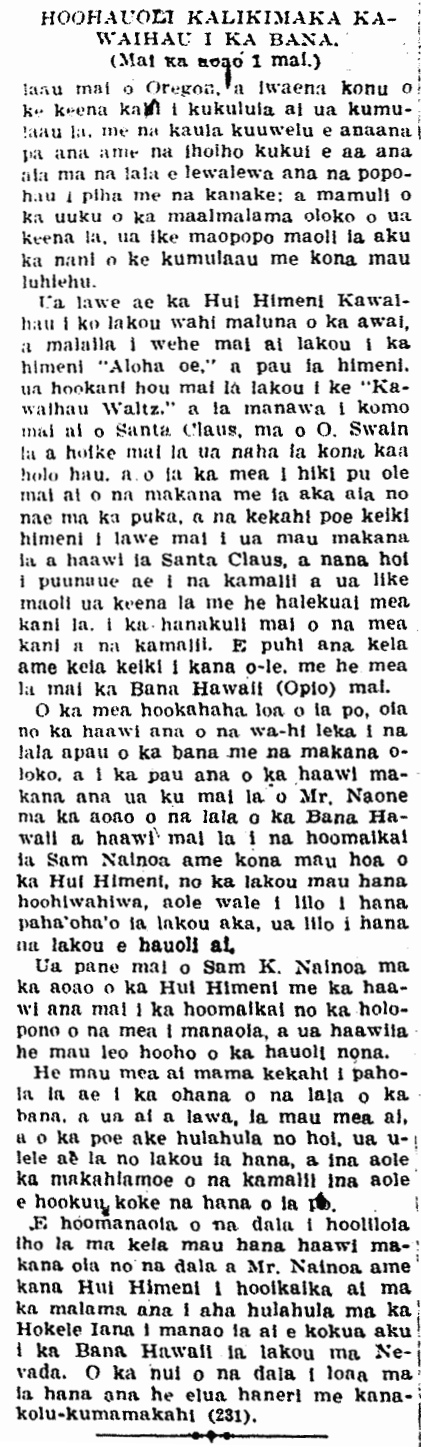
HOOHAUOLI KALIKIMAKA KAWAIHAU I KA BANA

Ka Nupepa Kuokoa, Buke XLV, Helu 52, Aoao 1. Dekemaba 28, 1906.

…forests of Oregon, and it was right in the middle of the room where the tree was stood, with strings of tinsel glistening and candles shining on the branches swaying with snowballs filled with candy; and because of the low light in the room, the beauty of the festooned tree was clearly seen.

The Kawaihau Glee Club took their place atop the stage [awai], and there they opened with the song “Aloha oe,” and after they were done with that song, they played the “Kawaihau Waltz,” and that was when Santa Claus came in, that being O. Swain, and said that his sleigh was broken which was why the presents didn’t comewith him, but they were at the door, and some young singers brought the presents over to Santa Claus and he distributed them to the children and the room was just like a musical instrument shop with all the noise coming from the instruments of the children. Each of the children played trumpets like the Hawaiian Band (of Children).

The most amazing thing that night was the handing over of envelops to each of the band members with a present within, and after the presents were done being handed out, Mr. Naone stood representing the members of the Hawaiian Band [Bana Hawaii] and gave their thanks to Sam Nainoa and his fellow members of the Glee Club for their honoring them; it wasn’t just something surprising for them, but something that gave them joy.

Sam K. Nainoa responded from the Glee Club and was appreciative that what was planned went smoothly, and for him were given cheers of joy.

There was also a light meal set out for the families of the band members, and they ate their fill of that food, and those that desired to dance, they went at it; were it not for the sleepy children the activities of the night would not have let out so quickly.

Let it be recalled that the money used for this gift giving, that being the money that Mr. Nainoa and his Glee Club worked for by holding a dance at the Young Hotel to help the Hawaiian Band who was at Nevada. The profit from that activity was two hundred and thirty-one (231) dollars.

(Kuokoa, 12/28/1906, p. 5)
HOOHAUOLI KALIKIMAKA KAWAIHAU I KA BANA

Ka Nupepa Kuokoa, Buke XLV, Helu 52, Aoao 5. Dekemaba 28, 1906.
Acrostic Mele for the Home of Emma and Joseph Nawahi, Homelani, 1894.

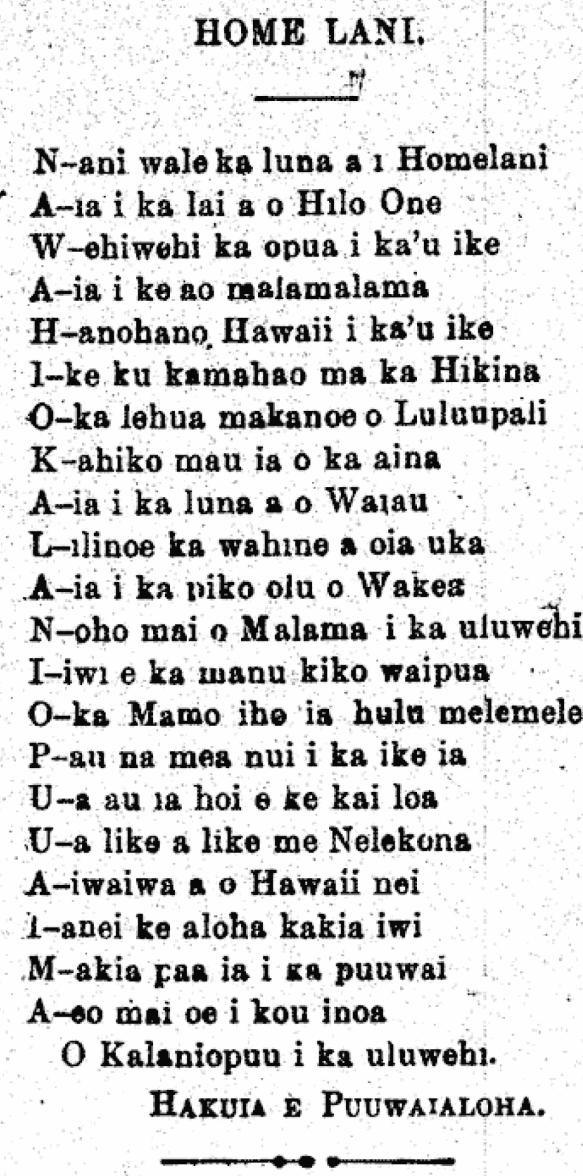
HOME LANI.

N—ani wale ka luna a i Homelani
A—ia i ka lai a o Hilo One
W—ehiwehi ka opua i ka’u ike
A—ia i ke ao malamalama
H—anohano Hawaii i ka’u ike
I—ke ku kamahao ma ka Hikina
O—ka lehua makanoe o Luluupali
K—ahiko mau ia o ka aina
A—ia i ka luna o Waiau
L—ilinoe ka wahine a oia uka
A—ia i ka piko olu o Wakea
N—oho mai o Malama i ka uluwehi
I—iwi e ka manu kiko waipua
O—ka Mamo iho la hulu melemele
P—au na mea nui i ka ike ia
U—a au ia hoi e ke kai loa
U—a like a like me Nelekona
A—iwaiwa a o Hawaii nei
I—anei ke aloha kakia iwi
M—akia paa ia i ka puuwai
A—eo mai oe i kou inoa
O Kalaniopuu i ka uluwehi.

Hakuia e Puuwaialoha.

[E o, e Hilo i ka ua Kanilehua! Does anyone know who Puuwaialoha is? This person was a composer of many a mele.]

(Leo o ka Lahui, 12/18/1894, p. 3)

HOME LANI.

Ka Leo o ka Lahui, Buke II, Helu 1080, Aoao 3. Dekemaba 18, 1894.

Konia’s kanikau for Paki, 1855.

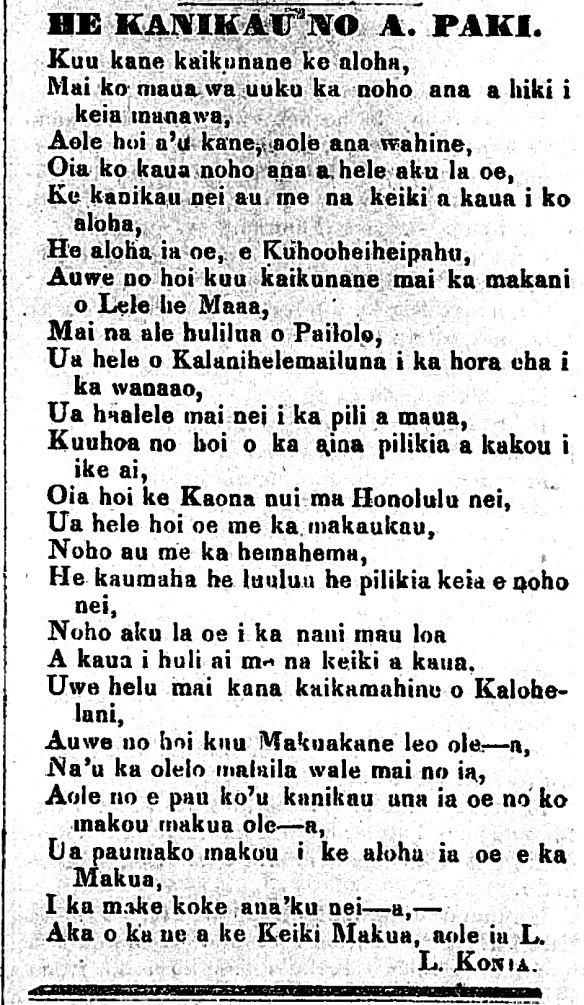
HE KANIKAU NO A. PAKI.

Kuu kane kaikunane ke aloha,
Mai ko maua wa uuku ka noho ana a hiki i keia manawa,
Aole hoi a’u kane, aole ana wahine,
Oia ko kaua noho ana a hele aku la oe,
Ke kanikau nei au me na keiki a kaua i ko aloha,
He aloha ia oe, e Kuhooheiheipahu,
Auwe no hoi kuu kaikunane mai ka makani o Lele he Maaa,
Mai na ale hulilua o Pailolo,
Ua hele o Kalanihelemailuna i ka hora eha i ka wanaao,
Ua haalele mai nei i ka pili a maua,
Kuu hoa no hoi o ka aina pilikia a kakou i ike ai,
Oia hoi ke Kaona nui ma Honolulu nei,
Ua hele hoi oe me ka makaukau,
Noho au me ka hemahema,
He kaumaha he luuluu he pilikia keia e noho nei,
Noho aku la oe i ka nani mau loa,
A kaua i huli ai me na keiki a kaua,
Uwe helu mai kana kaikamahine o Kalohelani,
Auwe no hoi kuu Makuakane leo ole—a,
Na’u ka olelo malaila wale mai no ia,
Aole no e pau ko’u kanikau ana ia oe no ko makou makua ole—a,
Ua paumako makou i ke aloha ia oe e ka Makua,
I ka make koke ana’ku nei—a,—
Aka o ka ne a ke Keiki Makua, aole ia L.

L. Konia.

(Elele E, 6/16/1855, p. 20)

HE KANIKAU NO A. PAKI.

Ka Elele E, Buke 10, Aoao 20. Iune 16, 1855.

On the moving of the Na-ha Stone to Hilo Library 100 years ago, and its history (4 of 6), 1915.

As soon as Ululani heard these words of her children, she exited the house, and soon saw Kamehameha approaching, and that is when Ululani began a wailing call of love [uwe helu] and then she also called out the name song for Kamehameha with these words:

Au—we hoi—e, he mai hoi paha,
O oe ka ia e Kalaninuilanimehameha—a,
E hea aku ana i ka Iwa kiloulou moku la,
E komo e kuu Laninui hoi—a,
Ao i wehewehena ao i waihona—e,
Kona po o ka hoa keia—la,
A’u lei o ka ua haao hoi—e,
E lele ae la mauka o Auaulele—a,
E komo hoi paha i ka hale o Kealohalani—e,
Auau i ke kiowai kapu o Ponahakeone,
Ae inu hoi i ka awa a Kane i kanu ai i Hawaii,
A ola hoi ke kini o ke akua ia oe,
He mai hoi e kuu Laninuimehameha—a.

[Ah indeed, do come,
Might it be you, O Kalaninuilanimehameha?
I call out to the island-hooking Frigate bird,
Come in, my Heavenly Chief,
The day opens, the day closes,
In his night, this is the companion,
My lei of the Haao rains,
Soaring in the uplands of Auaulele,
Entering the home of Kealohalani,
Bathing in the sacred pool of Ponahakeone,
Drinking the awa which Kane planted in Hawaii,
The multitudes of the gods will live through you,
Come, my dear Laninuimehameha.] Continue reading

Name chant for Kamehameha V, 1868.

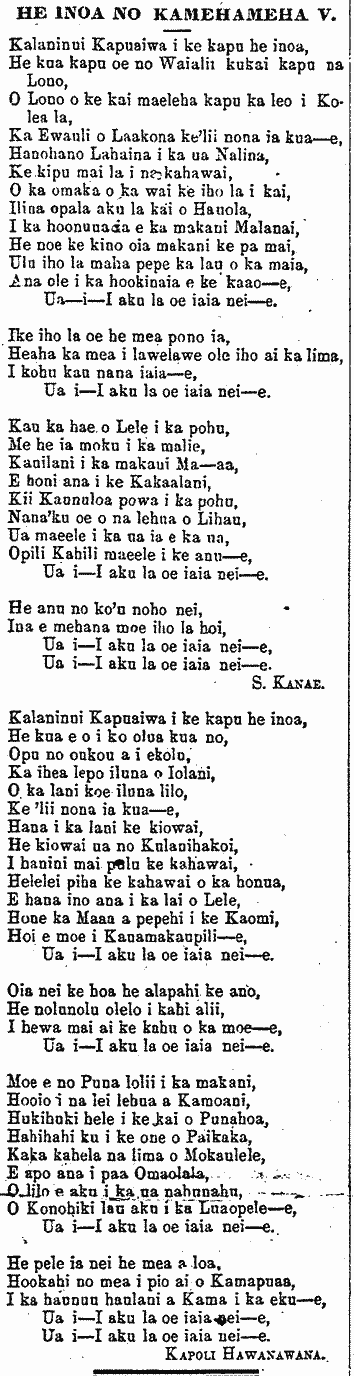
HE INOA NO KAMEHAMEHA V.

Kalaninui Kapuaiwa i ke kapu he inoa,
He kua kapu oe no Waialii kukai kapu na Lono,
O Lono o ke kai maeleha kapu ka leo i Kolea la,
Ka Ewauli o Laakona ke’lii nona ia kua—e,
Hanohano Lahaina i ka ua Nalina,
Ke kipu mai la i na kahawai,
O ka omaka o ka wai ke iho la i kai,
Ilina opala aku la kai o Hauola,
I ka hoonuua ia e ka makani Malanai,
He noe ke kino oia makani ke pa mai,
Ulu iho la maha pepe ka lau o ka maia,
Ana ole i ka hookinaia e ke kaao—e,
Ua—i—I aku la oe iaia nei—e.

Ike iho la oe he mea pono ia,
Heaha ka mea i lawelawe ole iho ai ka lima,
I koho kau nana iaia—e,
Ua i—I aku la oe iaia nei—e.

Kau ka hae o Lele i ka pohu,
Me he ia moku i ka malie,
Kauilani i ka makani Ma—aa,
E honi ana i ke Kakaalani,
Kii Kaunuloa powa i ka pohu,
Nana’ku oe o na lehua o Lihau,
Ua maeele i ka ua ia e ka ua,
Opili Kahili maeele i ke anu—e,
Ua i—I aku la oe iaia nei—e.

He anu no ko’u noho nei,
Ina e mehana moe iho la hoi,
Ua i—I aku la oe iaia nei—e,
Ua i—I aku la oe iaia nei—e.

S. KANAE.

Kalaninui Kapuaiwa i ke kapu he inoa,
Ke kua e o i ko olua kua no,
Opu no oukou a i ekolu,
Ka ihea lepo iluna o Iolani,
O ka lani koe iluna lilo,
Ke ‘lii nona ia kua—e,
Hana i ka lani ke kiowai,
He kiowai ua no Kulanihakoi,
I hanini mai pulu ke kahawai,
Helelei piha ke kahawai o ka honua,
E hana ino ana i ka lai o Lele,
Hone ka Maaa a pepehi i ke Kaomi,
Hoi e moe i Kauamakaupili—e,
Ua i—I aku la oe iaia nei—e.

Oia nei ke hoa he alapahi ke ano,
He nolunolu olelo i kahi alii,
I hewa mai ai ke kahu o ka moe—e,
Ua i—I aku la oe iaia nei—e.

Moe e no Puna lolii i ka makani,
Hooio i na lei lehua a Kamoani,
Hukihuki hele i ke kai o Punahoa,
Hahihahi ku i ke one o Paikaka,
Kaka kahela na lima o Mokaulele,
E apo ana i paa Omaolala,
O lilo e aku i ka ua nahunahu,
O Konohiki lau aku i ka Luaopele—e,
Ua i—I aku la oe iaia nei—e.

He pele ia nei he mea a loa,
Hookahi no mea i pio ai o Kamapuaa,
I ka haunuu haulani a Kama i ka eku—e,
Ua i—I aku la oe iaia nei—e,
Ua i—I aku la oe iaia nei—e.

KAPOLI HAWANAWANA.

[There is one oki of this mele found in the 5/28/1868 issue of Au Okoa by Kekuanaoa, one in the 6/18/1868 issue without an attribution, one in the 7/23/1868 issue by Kamehameha III; three in the 7/30/1868 issue, one by Kalama, one by Kaomi, and the other by Liliha. There are also many issues that are missing for this newspaper, and who knows what treasures might be found once copies of those issues are found!]

(Au Okoa, 9/24/1868, p. 1)

HE INOA NO KAMEHAMEHA V.

Ke Au Okoa, Buke IV, Helu 23, Aoao 1. Sepatemaba 24, 1868.

More from the Deshas, 1944.

Our Day

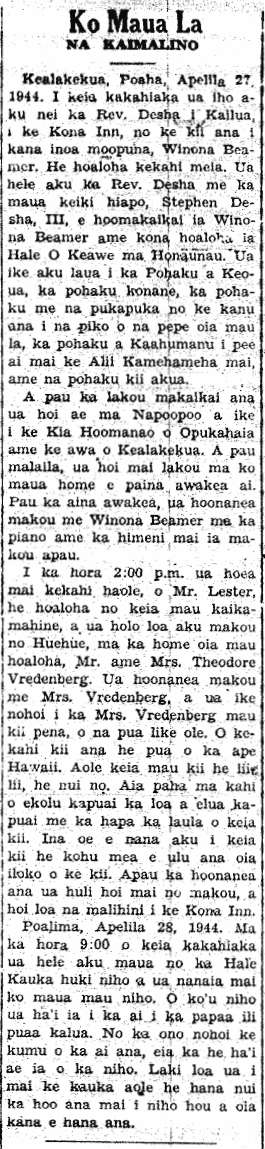
THE CALM SEAS OF KONA

Kealakekua, Thursday, April 27, 1944. This morning the Rev. Desha went down to Kailua, to the Kona Inn, to fetch his namesake grandchild, Winona Beamer. She had a friend with her. The Rev. Desha went with our first child, Stephen Desha III, to take Winona Beamer and her friend to Hale o Keawe at Honaunau. They saw the Stone of Keoua [Pohaku a Keoua], the stone konane board, the stone with holes to bury the umbilical cord of babies of those days, the stone that Kaahumanu used to hide from Kamehameha with, and the stone god figures.

After their tour was over they returned to Napoopoo and saw the Monument to Opukahaia and the bay of Kealakekua. And after that was done, they came back to our home to eat lunch. After lunch, we had an enjoyable time with Winona Beamer with the piano and all of us singing.

At 2:00 p. m., a haole arrived, Mr. Lester, a friend of these girls, and we all went to Huehue, to the home of those friends, Mr. and Mrs. Theodore Vredenberg [Vredenburg]. We spent a pleasant time with Mrs. Vredenberg and saw her drawings of all sorts of flowers. One of her pictures was of the flower of the Hawaiian ape. These drawings were not small, they were big indeed. The length of this drawing is around three feet while the width is about two feet and a half. If you look at this drawing, it looks as if it is growing in the picture. After enjoying our time, we turned back and the visitors returned to the Kona Inn.

Friday, April 28, 1944. At 9:00 this morning, the two of us went to the Dentist [Hale Kauka huki niho] and had a checkup. My tooth was chipped from eating the charred skin from a kalua pig. I ate it because it was tasty, and alas my tooth became chipped. I was so lucky, the doctor said it was not a big thing to insert a new tooth, and that is what he will do.

[This was a fun account, perhaps mostly because I know the awesome daughter of Theodore and Beatrice Vredenburg!]

(Hoku o Hawaii, 5/10/1944, p. 1)

Ko Maua La

Ka Hoku o Hawaii, Volume XXXIX, Number 3, Aoao 1. Mei 10, 1944.

Mele hooipoipo, 1913.

“LEI HULU MAMO.”

Auhea wale oe Lei Hulu Mamo,
O ka lei kohu a o kuu papale,
Hookohu ka opua me ka naulu,
Kau mai la i ka lae a o Mololani,
Aniani he kilohi mau oe no’u,
A ke kehau a i hali mai nei,
O ke ko mai hoi a ke kehau,
I mehana iho au a i ko poli.
O oe a owau ka i ike iho,
I ka eha lima ole a ke aloha.
Ia aloha ia no a o Haiku,
E walea ae nei me Kilohana,
O ka hana paha ia a ke aloha,
Kohu wai mapuna ka puapua’i;
Kaomi iho au he ole ka paa,
Pakela ke koii hana nowelo,
Hoona ae ana i ko aloha,
A i kahi Lei Rose a kaua,
Ua lei no oe lei no au,
Me ka opua hiki o ke ahiahi,
Mahope hoi au ou hookahi,
A lei i ka lei o ka lanakila.
Kilohi ae au ia Hiilaniwai,
Ia wai kaulana o ka aina.
Haina ia mai ana ka puana,
Kuu Lei Hulu Mamo ua hiki mai.

(Kuokoa, 4/4/1913, p. 8)

"LEI HULU MAMO."

Ka Nupepa Kuokoa, Buke LI, Helu 13, Aoao 8. Aperila 4, 1913.

William Luther Moehonua turns back and recalls his life with Lucy Lulea Kaiamoku Muolo Moehonua, 1865.

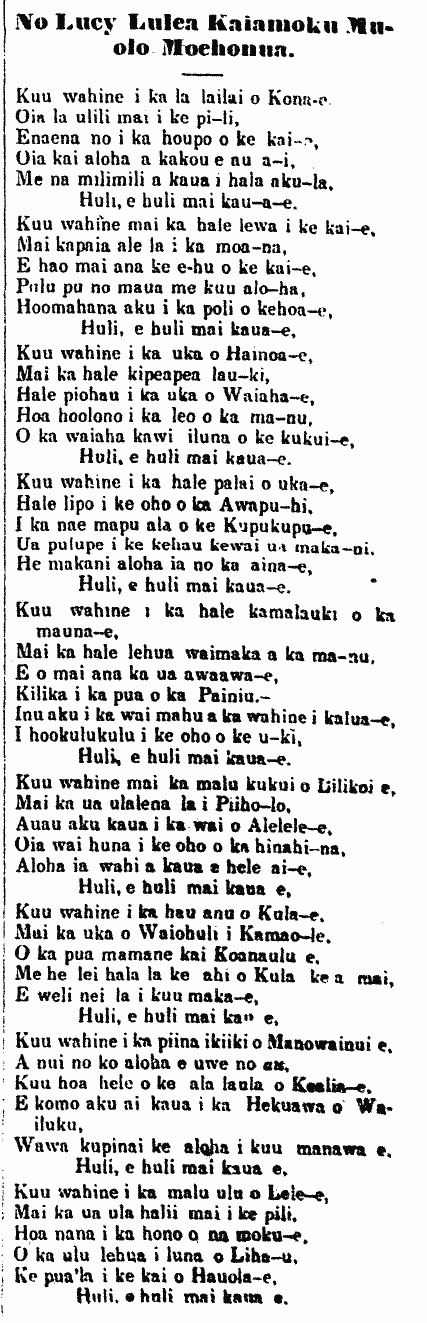
No Lucy Lulea Kaiamoku Muolo Moehonua.

Kuu wahine i ka la lailai o Kona—e,
Oia la ulili mai i ke pi—li,
Enaena no i ka houpo o ke kai—e,
Oia kai aloha a kakou e au a—i,
Me na milimili a kaua i hala aku—la,
Huli, e huli mai kau—a—e.

Kuu wahine mai ka hale lewa i ke kai—e,
Mai kapaia ale la i ka moa—na,
E hao mai ana ke e—hu o ke kai—e,
Pulu pu no maua me kuu alo—ha,
Hoomahana aku i ka poli o kehoa—e,
Huli, e huli mai kaua—e.

Kuu wahine i ka uka o Hainoa—e,
Mai ka hale kipeapea lau—ki,
Hale piohau i ka uka o Waiaha—e,
Hoa hoolono i ka leo o na ma—nu,
O ka waiaha kawi iluna o ke kukui—e,
Huli, e huli mai kaua—e.

Kuu wahine i ka hale palai o uka—e,
Hale lipo i ke oho o ka Awapu—hi,
I ka nae mapu ala o ke Kupukupu—e,
Ua pulupe i ke kehau kewai ua maka—ni,
He makani aloha ia no ka aina—e,
Huli, e huli mai kaua—e.

Kuu wahine i ka hale kamalauki o ka mauna—e,
Mai ka hale lehua waimaka a ka ma—nu,
E o mai ana ka ua awaawa—e,
Kilika i ka pua o ka Painiu—
Inu aku i ka wai mahu a ka wahine i kalua—e,
I hookulukulu i ke oho o ke u—ki,
Huli, e huli mai kaua—e.

Kuu wahine  mai ka malu kukui o Lilikoi—e,
Mai ka ua ulalena la i Piiho—lo,
Auau aku kaua i ka wai o Alelele—e,
Oia wai huna i ke oho o ka hinahi—na,
Aloha ia wahi a kaua e hele ai—e,
Huli, e huli mai kaua e.

Kuu wahine i ka hau anu o Kula—e,
Mai ka uka o Waiohuli i Kamao—le,
O ka pua mamane kai Koanaulu—e,
Me he lei hala la ke ahi o Kula ke a mai,
E weli nei la i kuu maka—e,
Huli, e huli mai kaua e.

Kuu wahine i ka piina ikiiki o Manowainui e,
A nui no ko aloha e uwe no au,
Kuu hoa hele o ke ala laula o Kealia—e,
E komo aku ai kaua i ka Hekuawa o Wailuku,
Wawa kupinai ke aloha i kuu manawa e,
Huli, e huli mai kaua e.

Kuu wahine i ka malu ulu o Lele—e,
Mai ka ua ula halii mai i ke pili,
Hoa nana i ka hono o na moku—e,
O ka ulu lehua i luna o Liha—u,
Ke pua’la i ke kai o Hauola—e,
Huli, e huli mai kaua e.

(Kuokoa, 11/11/1865, p. 1)

No Lucy Lulea Kaiamoku Muolo Moehonua.

Ka Nupepa Kuokoa, Buke IV, Helu 45, Aoao 1. Novemaba 11, 1865.

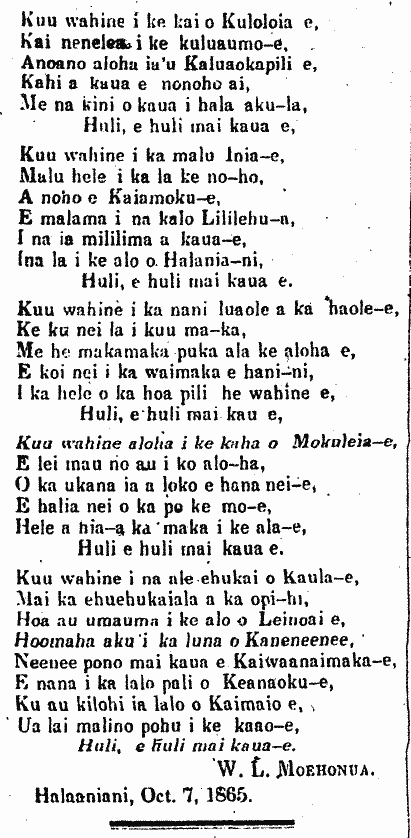
Kuu wahine i ke kai o Kuloloia e,
Kai nenelea i ke kuluaumo—e,
Anoano aloha ia’u Kaluaokapili e,
Kahi a kaua e nonoho ai,
Me na kini o kaua i hala aku—la,
Huli, e huli mai kaua e.

Kuu wahine i ka malu Inia—e,
Malu hele i ka la ke no—ho,
A noho e Kaiamoku—e,
E malama i na kalo Lililehu—a,
I na ia mililima a kaua—e,
Ina la i ke alo o Halania—ni,
Huli, e huli mai kaua e.

Kuu wahine i ka nani luaole a ka haole—e,
Ke ku nei la i kuu ma—ka,
Me he makamaka puka ala ke aloha e,
E koi nei i ka waimaka e hani—ni,
I ka hele o ka hoa piili he wahine e,
Huli, e huli mai kaua e.

Kuu wahine aloha i ke kaha o Mokuleia—e,
E lei mau no au i ko alo—ha,
O ka ukana ia a loko e hana nei—e,
E halia nei o ka po ke mo—e,
Hele a hia—a ka maka i ke ala—e,
Huli, e huli mai kaua e.

Kuu wahine i na ale ehukai o Kaula—e,
Mai ka ehuehukaiala o ka opi—hi,
Hoa au umauma i ke alo o Leinoai e,
Hoomaha aku i ka luna o Kaneneenee,
Neenee pono mai kaua e Kaiwaanaimaka—e,
E nana i ka lalo pali o Keanaoku—e,
Ku au kilohi ia lalo o Kaimaio e,
Ua lai malino pohu i ke kaao—e,
Huli, e huli mai kaua—e.

W. L. Moehonua.

Halaaniani, Oct. 7, 1865.

(Kuokoa, 11/11/1865, p. 2)

Kuu wahine i ke kai o Kuloloia e...

Ka Nupepa Kuokoa, Buke IV, Helu 45, Aoao 2. Novemaba 11, 1865.

A sort of kanikau for Lucy Muolo Moehonua by William Charles Lunalilo? 1865.

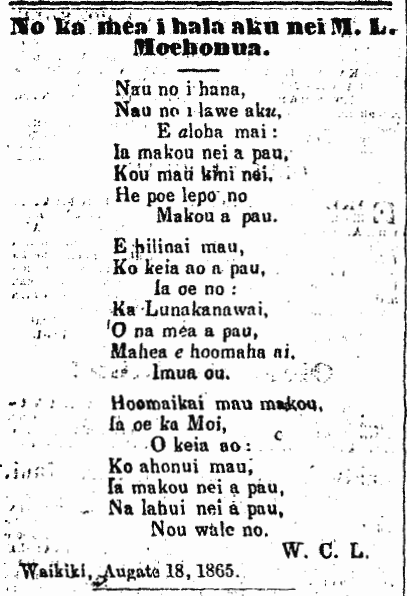
No ka mea i hala aku nei M. L. Moehonua.

Nau no i hana,
Nau no i lawe aku,
E aloha mai:
Ia makou nei a pau,
Kou mau kini nei,
He poe lepo no
Makou a pau.

E hilinai mau,
Ko keia ao a pau,
Ia oe no:
Ka Lunakanawai,
O na mea a pau,
Mahea e hoomaha ai,
Imua ou.

Hoomaikai mau makou,
Ia oe ka Moi,
O keia ao:
Ko ahonui mau,
Ia makou nei a pau,
Na lahui nei a pau,
Nou wale no.

W. C. L.

Waikiki, Augate 18, 1865.

[For the one who passed on, M. L. Moehonua

You created,
You take away,
Give aloha:
To us all,
Your multitudes,
People from the dirt,
Are all of us.

Constantly relying,
Is this whole world,
In you:
The Judge,
Of all things,
Where are we to rest,
Before you.

We always give praise,
To you the King,
Of this world:
Your constant patience,
For all of us,
For all of the nations,
Only for you.

W. C. L.

Waikiki, August 18, 1865.]

(Kuokoa, 8/26/1865, p. 4)

No ka mea i hala aku nei M. L. Moehonua.

Ka Nupepa Kuokoa, Buke IV, Helu 34, Aoao 4. Augate 26, 1865.

A Kauai procreation chant for Princess Kaiulani, 1899.

[Found under: “KANIKAU NO KAIULANI.”]

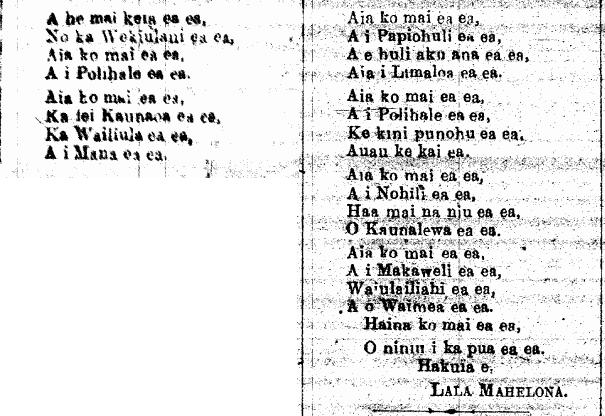
A he mai keia ea ea,
No ka Wekiulani ea ea,
Aia ko mai ea ea,
A i Polihale ea ea.

Aia ko mai ea ea,
Ka lei Kaunaoa ea ea,
Ka Wailiula ea ea,
A i Mana ea ea.

Aia ko mai ea ea,
A i Papiohuli ea ea,
A e huli aku ana ea ea,
Aia i Limaloa ea ea.

Aia ko mai ea ea,
A i Polihale ea ea,
Ke kini punohu ea ea,
Auau ke kai ea [ea].

Aia ko mai ea ea,
A i Nohili ea ea,
Haa mai na niu ea ea,
O Kaunalewa ea ea.

Aia ko mai ea ea,
A i Makaweli ea ea,
Waiulailiahi ea ea,
A o Waimea ea ea.

Haina ko mai ea ea,

O niniu i ka pua ea ea.

Composed by,

Lala Mahelona.

(Aloha Aina, 3/18/1899, p. 6)

A he mai keia ea ea,

Ke Aloha Aina, Buke V, Helu 11, Aoao 6. Maraki 18, 1899.