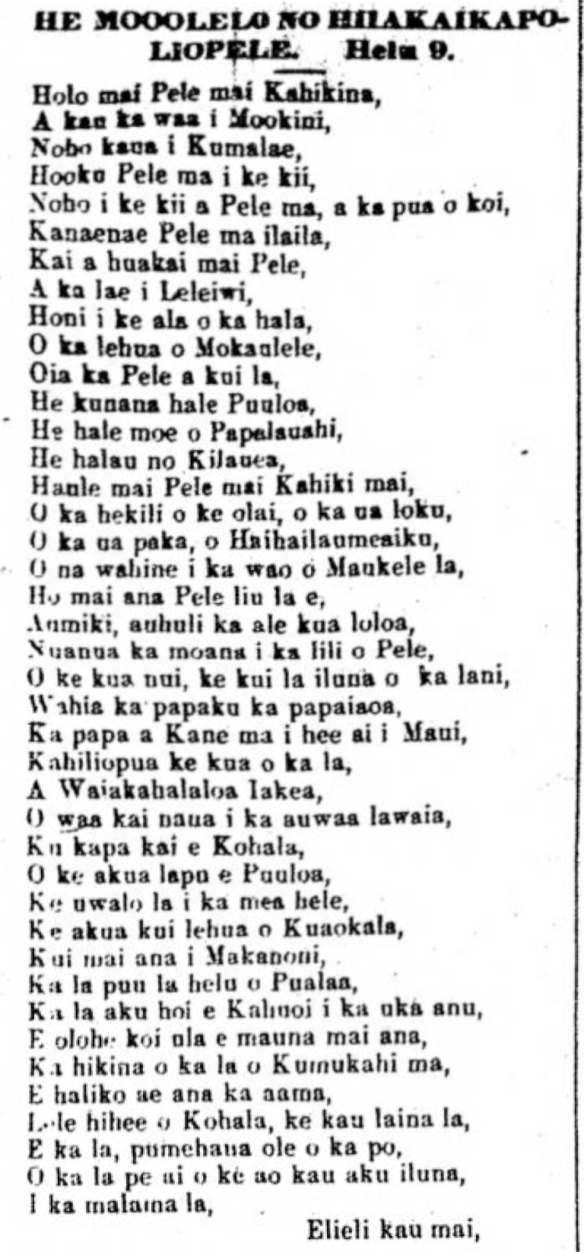
Pele makes lei of lehua from the very beginning, 1862.

[Found under: “HE MOOLELO NO HIIAKAIKAPOLIOPELE. HELU 9.”]

Holo mai Pele mai Kahikina,
A kau ka waa i Mookini,
Noho kaua i Kumalae,
Hooku Pele ma i ke kii,
Noho i ke kii a Pele ma, a ka pua o koi,
Kanaenae Pele ma ilaila,
Kai a huakai mai Pele,
A ka lae i Leleiwi,
Honi i ke ala o ka hala,
O ka lehua o Mokaulele,
Oia ka Pele a kui la,
He kunana hale Puuloa,
He hale moe o Papalauahi,
He halau no Kilauea,
Haule mai Pele mai Kahiki mai,
O ka hekili, o ke olai, o ka ua loku,
O ka ua paka, o Haihailaumeaiku,
O na wahine i ka wao o Maukele la,
Ho mai ana Pele liu la e,
Aumiki, auhuli, ka ale kua loloa,
Nuanua ka moana i ka lili o Pele,
O ke kua nui, ke kui la iluna o ka lani,
Wahia ka papaku, ka papaiaoa,
Ka papa a Kane ma i  hee ai i Maui,
Kahiliopua ke kua o ka la,
A Waiakahalaloa iakea,
O waa kai nana i ka auwaa lawaia,
Ku kapa kai e Kohala,
O ke akua lapu e Puuloa,
Ke uwalo la i ka mea hele,
Ke akua kui lehua o Kuaokala,
Kui mai ana i Makanoni,
Ka la puu la helu o Pualaa,
Ka la aku hoi e Kahuoi i ka uka anu,
E olohe koi ula e mauna mai ana,
Ka hikina o ka la o Kumukahi ma,
E haliko ae ana ka aama,
Lele hihee o Kohala, ke kau laina la,
E ka la pumehana ole o ka po
O ka la pe ai o ke ao kau aku iluna,
I ka malama la,
Elieli kau mai.

[From the time of her arrival to Hawaii, Pele fashions lei of lehua blossoms from Mokaulele in Hilo. May the majestic trees live forever. Until a solution is found to Rapid Ohia Death, wear your lehua in your heart, not in your lei!]

(Hoku o ka Pakipika, 3/6/1862, p. 4)
HokuoHawaii_3_6_1862_4.png

Ka Hoku o ka Pakipika, Buke I, Helu 24, Aoao 4. Maraki 6, 1862.

The story of Umi, by Simeon Keliikaapuni and J. H. Z. Kalunaaina, 1862.

HE MOOLELO NO UMI.

KEKAHI ALII KAULANA O KO HAWAII NEI PAE AINA

HELU 1.

I laweia mai e a’u noloko mai o kekahi Buke Moolelo Hawaii, i paiia ma Lahainaluna, M. H. 1838, a ke manao nei au e paiia kona Moolelo ma ka Nupepa Kuokoa, a me ke ano o kana hana i ka wa kahiko.

O Umi ke keiki a Liloa, aole nae oia ka Liloa keiki mua, aka, o Hakau ka mua a Liloa laua me Piena, ka Liloa wahine hoao maole ia; nolaila, ua kapaia o Hakau he alii nui, no ka mea, ua like pu ko Piena alii me ko Liloa; aka, o Umi, he keiki oia na Liloa me kekahi wahine ana i launa wale aku ai, o Akahiakuleana ka inoa o ua wahine la. Ua manao nuiia oia he wahine alii ole; aka, ma kona kuauhau, he alii no, hookahi o laua kupuna me Liloa. He mau mamo laua na Kanipahu.

[This is the beginning of the story of Umi as told by Simeon Keliikaapuni which he says he based off of the story in “Ka Mooolelo Hawaii.” This ran in the Kuokoa from 1/25/1862 to 2/8/1862. The telling of Umi’s story was then continued by J. H. Z. Kalunaaina from 2/22/1862 and concluded on 4/26/1862. Check out a translation of this serial column by Noʻeau Peralta, on the cool page of the Hamakua community group Hui Mālama i ke Ala ʻŪlili (huiMAU). Take a look also at all the other activities being done by huiMAU shown on their page. Wouldn’t it be awesome if other communities could look to this group as an example!]

 (Kuokoa, 1/25/1862, p. 1)

Kuokoa_1_25_1862_1.png

Ka Nupepa Kuokoa, Buke I, Helu 9, Aoao 1. Ianuari 25, 1862.

Umi, the son of Liloa and Akahiakuleana, 1859.

[Found under: “MOOOLELO HAWAII.—Helu 49.”]

Pertaining to Umi.—Umi was an alii of the people of Hawaii. Here is the history of this alii:

Umi was the son of Liloa, he was not the first son of Liloa, but Hakau was the first son of Liloa with Pinea, who was Liloa’s true “wife” [wahine hoao maoli]; therefore, Hakau was called a high chief, for the rank of Pinea was equal to that of Liloa. Umi however was the child of Liloa with a woman who he just took, her name being Akahiakuleana. It was widely thought that she was not an alii, but according to her genealogy she is indeed an alii; she and Liloa had a common ancestor. They were both descendants of Kanipahu.

Here is the genealogy of that Akahiakuleana from Kanipahu and Liloa’s genealogy from Kanipahu.

Kanipahu dwelt with Alaikauakoke, born was Kalapana, that being Liloa’s ancestor; Kanipahu dwelt with Hualani, born was Kalahumoku, that being Akahiakuleana’s ancestor. Continue reading

Kamakau’s story of Lonoikamakahiki, 1871.

[Found under: “KA MOOLELO HAWAII: NA S. M. KAMAKAU.”]

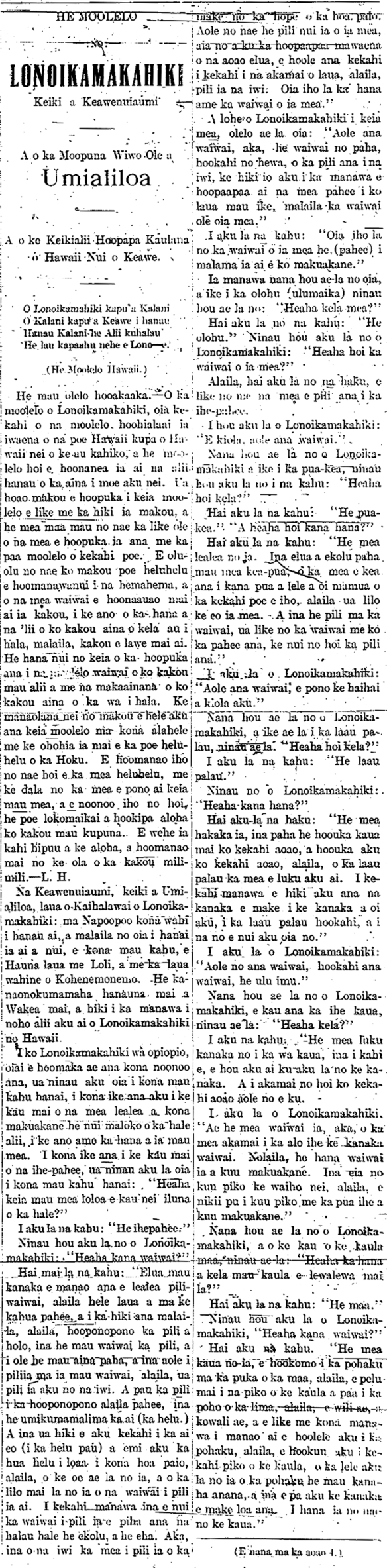
Pertaining to Lonoikamakahiki: Lonoikamakahiki was the child of Keawenuiaumi, the alii of Kau and Puna, and reigned over the entirety of those sections of Hawaii. He married a chiefess, Kaikilanikohepanio, from amongst the granchildren of Laeanuikaumanamana, and from the two of them were born the sons, Keawehanauikawalu and Kaihikapumahana, and the two of them became ancestors of chiefs and commoners. When Lono ruled, he was a chief who did not listen to nor heed the advice of his kahuna and counselors [kakaolelo], so some of his counselors left to find a good master [haku]. And that is why Lanahuimihaku folks left, to find a master who would follow and listen to their advice; they searched for a haku for themselves, and they lived went to live with Kailikapuakuihewa on Oahu, believing that he was a chief who was upright and who listened to everything the kahuna and kakaolelo instructed….

[S. M. Kamakau’s telling of the story of Lonoikamakahiki ran from 1/12/1871 to 2/2/1871 in the newspaper Au Okoa. It can be found in Ruling Chiefs, pp. 47–63.]

(Au Okoa, 1/12/1871, p. 1)

AuOkoa_1_12_1871_1.png

Ke Au Okoa, Buke VI, Helu 39, Aoao 1. Ianuari 12, 1871.

Lonoikamakahiki, unattributed, 1909.

A STORY

OF

LONOIKAMAKAHIKI

Son of Keawenuiaumi

And Fearless Grandson of

Umialiloa

And the Famous Riddling Chief of Great Hawaii of Keawe.

O Lonoikamakahiki kapu a Kalani
O Kalani kapu a Keawe i hanau
Hanau Kalani he Alii kuhalau
He lau kapaahu nehe o Lono—e.

[Lonoikamakahiki, the sacred one of Kalani
Sacred Kalani, born of Keawe
Born was Kalani, a expansive Chief
O Lono, a rustling of a heap of mats.]

(A Hawaiian Story.)

Words of clarification.—The story of Lonoikamakahiki is one of the stories delighted in by the native Hawaiians of Hawaii nei of the olden days, and it is a moolelo that was enjoyed by the alii born in this land who have passed on. We have endeavored to print this story to the greatest of our ability, but it is a common thing for there to be discrepancies from what is published with what is memorized by some people. May our readers please be patient with the mistakes, and take the valuable things that will teach us of the nature of the deeds of the alii of our land of days past. Publishing the valuable stories of our alii and makaainana of our land of the past is of great importance. We hope that this story will travel its path, delighting the readers of the Hoku. But do remember, O Readers, that money is what makes this possible, and consider that our kupuna were generous and welcoming people. Open the purse of aloha, and remember the life of our beloved.— Editor.

[This story of Lonoikamakahiki appears in Hoku o Hawaii from 7/8/1909 to 12/9/1909. Unfortunately, the first 11 buke of the Hoku, from 5/3/1906 to 5/24/1917 are not available yet online.]

(Hoku o Hawaii, 7/5/1909, p. XXX)

HokuoHawaii_7_8_1909_1.png

Ka Hoku o Hawaii, Buke IV, Helu 10, Aoao 1. Iulai 8, 1909.

Z. P. Kalokuokamaile’s Lonoikamakahiki, 1924.

ENJOYMENT TO PASS THE TIME.

THE STORY OF LONOIKAMAKAHIKI, THE EXPERT ALII WHO HAD NO EQUAL AT CONTESTS OF WIT, AND AT WAR.

CHAPTER I.

(Written by Z. P. K. Kawaikaumaiikamakaokaopua)

Lonoikamakahiki was born in the land of Napoopoo, at the base of the cliff of Manuahi, South Kona, Hawaii. Keawenuiaumi was the father, Koihalawai was the mother; and it was in Napoopoo where he was raised until adulthood; his caretakers were Hauna and his younger brother Loli.

These two men had one wife. They did not want two wahine, and they were both very nice; they did not fight or argue and there was no dissension between them over this one woman. When Lonoikamakahiki was young, he began to think.

When Lonoikamakahiki was looking at the many items of entertainment of his father placed in the royal house, and he saw the ihe pahee placed there, he looked for a long time and after a while he asked his caretakers:

“What is that long thing hanging up there in the house?” Continue reading

Story of Lonoikamakahiki as told by Wille Sepe. Kawa Jr., 1887–1888.

A STORY OF

Lonoikamakahiki

THE

High Chiefly Offspring of Kalani.

The Great Alii of Hawaii.

[WRITTEN FOR THE KUOKOA NEWSPAPER.]

(The Author should make clear that although this Lahuikanaka was accustomed to memorizing things, there nonetheless are variations between what this person and that memorized. And it is from what is memorized by this Writer, it is on that path that he will travel until this Moolelo is complete.)

I must clarify the ancestors of the alii who this moolelo is about. So that the new generations of the Hawaiian People know the kupuna and makua and older brothers and younger brothers and the sisters of their alii for whom this famous story rises.

Kiha (m) lived with Kaohikinuiokalani (f), and born between them were the chiefly children, five in total. Here are each of their names:

Liloa (m), after him there were twins, Laeanui (f), Kaumanamana (f), Kalani (m), Pinea (f).

Liloa lived with his own sister, Pinea, and born was Hakau (m), that being Hakaualiloa. It is said that Hakau was a Pi’o Chief. Continue reading

B. L. Koko tells the story of Lonoikamakahiki, 1865.

STORY OF LONOIKAMAKAHIKI

PART 1.

Kalani was the father and Haumea the mother, born was Lonoikamakahiki from Haumea and Kalani; He was taken as hanai by Hauna of Kaikilanialiiwahineopuna [?? Hauna o Kaikilanialiiwahineopuna] until he was grown; the chiefs went to bathe in the ocean, and after they had bathed, the two of them went upland to warm themselves.

While the two of them were warming themselves, Kaiklanialiiwahineopuna said to Lonoikamakahiki, “let’s play konane (the konane played with pebbles).” “Yes,” said Lonoikamakahiki, and they laid out the pebbles upon the board and the two began to play [uhau], and in that first match, he lost to his sister; the two played once again, and he lost once again to his sister; they played for the third time, and that Chief lost once more; after this third loss of Lonoikamakahiki, the Chief grew irritated for just losing…

[This is the opening of one of the stories of Lonoikamakahiki found in the Hawaiian Language Newspapers. It was written by B. L. Koko of Kaualaa, Wailupe, Oahu, and runs in Au Okoa from 9/4/1865. There is criticism of his telling and Koko ends his story on 10/23/1865. He states at his closing that what he wrote is all he knows, but those who know the story well most likely know more things. And if his kupunakane know more, that he will submit it.]

(Au Okoa, 9/4/1865, p. 4)

AuOkoa_9_4_1865_4.png

Ke Au Okoa, Buke I, Helu 20, Aoao 4. Sepatemaba 4, 1865.

Death of the translator of Twenty-Thousand Leagues Beneath the Sea, Oniula, George W. Kanuha, 1876.

A Solemness, an  Expression of Affection for G. W. Kanuha.

[Aia aku la paha oe i ka aina hanau,
Ia Kona kai opua i ka lai,
Opua hinano ua malie
Hiolo na wainaoa a ke kehau,
Aole—eia ka paha i na hono a Piilani,
I ka lai o Hauola,
I ka malu o ka Ulu o Lele
E holoholo kuaua paupili ana.
Auwe! Aloha ino.]

Perhaps you are at the land of your birth,
Kona of the billowing clouds on the sea in the calm,
The clouds white like hinano blossoms,
Where the chilling waters of the Kehau mists fall,
No—maybe you are here amongst the bays of Piilani,
In the calm of Hauola,
In the shade of the Breadfruit of Lele,
Travelling about like the Paupili showers.
Auwe! How sad.

George W. Kanuha was born in 1845 in the town of Kailua, North Kona, Hawaii, of the streaked sea, the peaceful sea at Kalaiaehu, ever moistened by the amazing rains of the land of his birth in the face of the clouds. And he passed on to the other side of the black river, that line before the animals life and plant life which forever moves toward the final Great Revelation in the City of heaven. On the 16th day of this month, G. W. Kanuha travelled one last time in the shade of the ulu trees of Lele [Lahaina] in the sparkling sun and the red dirt of his welcoming home, sinking into the eternal home, the belly of the earth following after papa and mama. Aloha ino.

Ahukinialaa Wahineiki was his father, a student of Lahainaluna College, from the very beginning of the school in 1831, he boarded at that school until he graduated with the fluttering flag upon his Diploma. Mrs. Kealoha Wahineiki was his mother. G. W. Kanuha was an only child. Continue reading

Emma Nakuina tells the story of Hiiaka, 1883.

HIIAKA.

A Hawaiian Legend by a Hawaiian Native. A Legend of the Goddess Pele, Her Lover Lohiau and her Sister Hiiakaikapoliopele.

The crater of Kilauea on Hawaii, is the residence of the Goddess Pele. She had eight sisters, all called Hiiaka, with some distinguishing ending, as Hiiaka-noholae, (Hiiaka living on the headland), Hiiaka-wawahilani, (Hiiaka the heaven breaker,) Hiiakaikapoliopele, (Hiiaka in Pele’s heart) etc. The latter commonly called the Hiiaka is the heroine of this legend. Pele had also several brothers Kamohoalii, Lonomakua, Lonoonolii, etc.

All her brothers and sisters were subordinate to her, but Kamohoalii was her favorite brother and Hiiakaikapoliopele the favorite sister. Tradition is not very explicit as to the source of Kamohoalii’s power, but he has always been regarded as the very sacred royal brother of Pele. The brothers and sisters seem to have had great respect foreach other and never trespassed on one another’s privileges, or interfered with each other ‘s actions. Uwekahuna the high bluff of the crater walls beyond the sulphur banks is supposed to contain a large cave, his dwelling, and the bluff is known as “Ka-pali-kapu-o-Kamohoalii” (the tabu cliffs of Kamohoalii.) Smoke from volcanic fires has never been known to be blown against them. True believers stoutly insist that smoke could never by any possibility bend or be blown against it, as that would be a gross violation of the royal privileges of the sacred brother. Continue reading