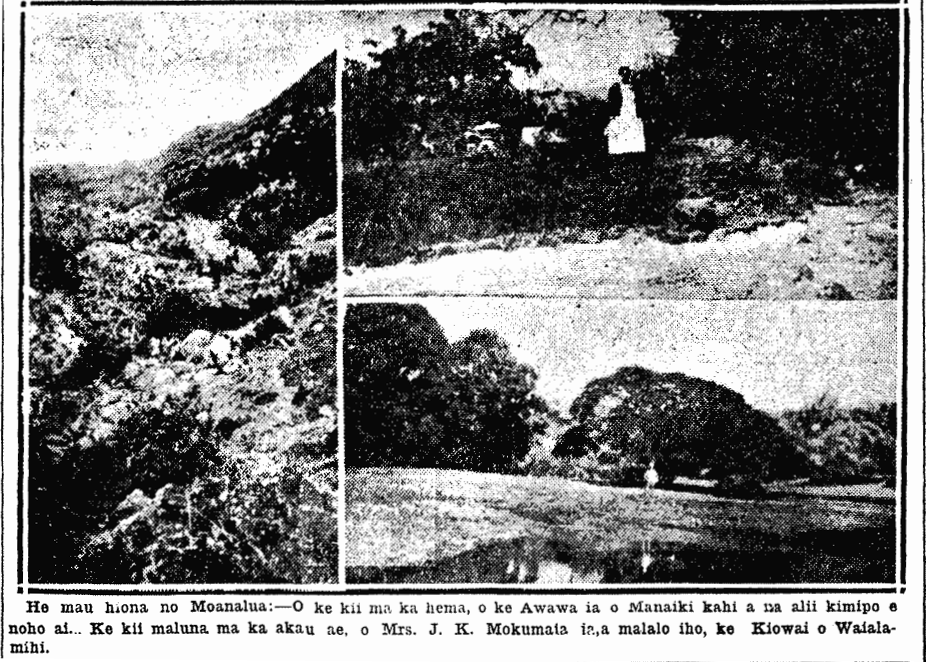
Moanalua: Mele, Moolelo, and Mokumaia, 1922.

[From: “MOANALUA I KELA AU A O MOANALUA I KEIA AU.”]

O Moanalua haki ke au,
I Kahauiki hemo ka umoki
I ke kula loa hoi o Kalihi,
I Kaiwiula kikiipau,
Kapalama lo’i laiki,
I Keoneula malu ke kiawe,
Leleo i ka lokowai,
Haaliliamanu honi kaua,
Kapuukolo i ka Nekina,
Hololio laau me ka huapala,
Kamanuwai moa liilii,
Hauna ke kai eha oe ia’u,
Hainaia mai ana ka puana,
Moanalua au ha’i ke au.

He mau hiona no Moanalua...

Ka Nupepa Kuokoa, Buke LXI, Helu 35, Aoao 3. Augate 31, 1922.

Some scenes of Moanalua:—The picture on the left is the Valley of Manaiki, where the royal assassins lived. The picture on the top on the right is Mrs. J. K. Mokumaia, and below is the Waialamihi Pond.

[This version of “Moanalua” is taken from a long-running column written by J. K. Mokumaia, a long-time resident of the area, on the history of Moanalua, which he called “Moanalua of the past and Moanalua of the Present.” This series which includes many priceless photographs like those above (which will be seen much more clearly when the newspapers are scanned properly) ran in the Kuokoa from 2/17/1922 until 8/31/1922 (although unfinished, it seems to end on this date).]

O Moanalua haki ke au...

O Moanalua haki ke au…

(Kuokoa, 8/31/1922, p. 3)

Another Aladdin translation, 1916.

A MOOLELO KAAO
OF
ALADDIN, THE PEASANT CHILD
AND THE SUPERNATURAL LAMP

Aia maloko o ke kapitala o kekahi o na okana aina waiwai loa a palahalaha hoi o ke aupuni nui o Kina, e noho ana kekahi kanaka humuhumu lole o Masetafa kona inoa, aohe ana hana i kaulana e ae a o keia hana wale no o ka humuhumua tela lole paha, elike me ia e kamaaina nei iwaena o kekahi poe Pake o nei mau la.

MOKUNA I.

He iluhune keia Masetafa, aohe i lawa kana mau wahi loaa e hiki ai e hoolawa kupono iaia iho ame kana wahine ame hookahi keikikane a ke Akua i hoopomaikai mai ai iaia ma keia ola ana, elike me ke kupono nei i makemake ia.

O keia keikikane o Masetafa, nona ka inoa o Aledian, a nona hoi keia moolelo kaao e paneeia aku nei no ka pomaikai o ko ke Kilohana Pookela poe heluhelu moolelo, no ka ilihune no hoi paha o na makua, elike no hoi me na keiki a ka poe ilihune o nei mau la, aole i hoonaauao maikaiia, ua hoopalaleha loaia kona malama a a’oia ana, a ma ia ano ua lilo keia i keiki palaualelo, a e hookuu mauia ana oia e hele a e hana elike me kona makemake, a e hoomaopopoia, o na hana apau ana i hana ai he mau hana hewa loa, no ka mea, aole oia i a’oia i na aoao maikai ame na hana maikai, ame na hua maikai e loaa mai ana mailoko mai o na hana maikai…

[Perhaps this and the translation of the previous post were done from G. S. Beaumont’s “The Arabian Nights’ Entertainments: or, The Thousand and One Nights,” published in 1811. However, the S. K. Kaai version seems a little more simplistic. This later translation seems to follow closely Beaumont’s English and appears in the Nupepa Kuokoa from 11/3/1916 and concludes on 3/9/1917.]

(Kuokoa, 11/3/1916, p. 6)

HE MOOLELO KAAO NO ALEDINA, KE KEIKI LOPA AME KA IPUKUKUI KUPUA

Ka Nupepa Kuokoa, Buke LIV, Helu 44, Aoao 6. Novemaba 3, 1916.

More on Opukahaia, 1865.

The Story of Opukahaia.

Keau was the father, Kamohoula was the mother. From the two was born this child, Opukahaia, along with another younger child (the name of that child is not known). Opukahaia was born soon before the battle between Kamehameha and Namakeha at Kau. And at Kau in Ninole, is where Opukahaia was born. He was named for the slitting of the stomach of a certain alii, and that is why he was called Opukahaia [“the cutting of the stomach”].

When the time of warfare between Kamehameha and Namakeha arrived, the parents of Opukahaia were killed. When his parents were killed, Opukahaia fled Kau, and went to Kohala.

While he lived in Kohala, Opukahaia was found by Pahua, the brother of his mother, and he was returned here to Kona, and lived with Puhua them and Hina them here in Napoopoo, South Kona, Hawaii.

The time when Opukahaia was living here in Napoopoo, when he was brought back from Kohala, he was an adult at the time. While he lived here, to him belonged the occupation of the kahuna of the olden days. Opukahaia was obedient; he was however not a farmer nor a fisherman, for he was not taught much about those things. He really just wanted to be taught kahuna things, and this was something that he was very interested in doing constantly, on sacred nights of Prayer [? Hainapule]. The one who taught him the ways of the kahuna was Pahua. He was a skilled kahuna taught by Hewahewa, the Great Kahuna of the Heiau of Hikiau.

After Opukahaia received the knowledge of the occupation of the kahuna, he constructed his stone Heiau within Helehelekalani, and he built a house atop his heiau, while he worshiped three gods. 1. Lono, 2. Kukaohiakala, 3. Kukailimoku.

He was constantly honing his skills, until he left for America.

When the American trading ship appeared here at Kealakekua, he was prodded by a haole aboard the ship, named Mika Alani, who was an aikane of Hewahewa; and so he went and left the work that he was trained in.

And at this Heiau which he built, he planted three coconuts, and they are growing and fruiting. The cave [? pao] of this boy, Opukahaia, can be seen by those who visit here. His relative still lives here in South Kona, her name is Hina; she is gray-haired and is frail now.

This is a short story of what is heard of Opukahaia. With mahalo.

S. W. Papaula.

Napoopoo, S. Kona, Oct. 10, 1865.

[This seems to be written in response to the translation being published in Kuokoa at the same period. Papaula is adding to the information given in the translation. This ability to quickly add to or correct information published in the newspapers was one of the many advantages newspapers had over books.]

(Kuokoa, 11/4/1865, p. 4)

Moolelo no Opukahaia.

Ka Nupepa Kuokoa, Buke IV, Helu 44, Aoao 4. Novemaba 4, 1865.

Translation of “Memoirs of Henry Obookiah: A Native of Owhyhee, and a Member of the Foreign Mission School…” 1865.

Ka Moolelo o Heneri Opukahaia.

HELU 1.
Kona wahi moolelo mamua o kona hiki ana i Amerika.

He kanaka o Heneri Opukahaia no Hawaii ka mokupuni kaulana a laukanaka hoi o ka Pae Aina Hawaii. Ua hanau ia i ka makahiki 1792. He mau makaainana kona mau makua; aka ua pili nae kona makuahine i ka ohana o na’lii. O kona inoa o Kumuola; a o ka inoa o kona makuakane aole i maopopo. I ka wa i hiki aku ai o ko Opukahaia mau makahiki i ka umi a umikumamalua paha, pepehiia kona mau makua mamua pono o kona mau maka. Elua wale no laua o kona ohana i ola, oia a me kona wahi muli loa nona na malama ekolu. Ua manao lana ia e hoola i kona wahi pokii mai ka popilikia mai i ili iho ai maluna o kona mau makua, nolaila, ua hopu akuu ia i kona wahi pokii a kau ae la ma kona kua, a holo aku la mai ka enemi aku; aka, ua loaa aku no ia i ka poe i alualu aku, a pepehi mainoino ia ua wahi pokii la ona. O ka moolelo o ia wahi ua kakau ia ma kekahi buke e aku mamuli o ka mea i hai waha ia aku e Opukahaia…

[This translation of Edwin Welles Dwight’s “Memoirs of Henry Obookiah, a Native of Owhyhee, and a Member of the Foreign Mission School; Who Died at Cornwall, Conn. Feb. 17, 1818, Aged 26 Years.” begins on 9/9/1865 and is completed on 3/24/1866.]

(Nupepa Kuokoa, 9/9/1865, p. 2)

Ka Moolelo o Heneri Opukahaia.

Ka Nupepa Kuokoa, Buke IV, Helu 36, Aoao 2. Sepatemaba 9, 1865.

More from Dumas: “Three Musketeers,” 1878.

HE MOOLELO
—NO NA—

KIAI EKOLU.

—A ME KE—
Koa Opio Wiwo Ole!
ATAGANANA.

{Translated by a generous pen for the Pride of the Hawaiian Nation.}

CHAPTER 1
NUMBER 1.

To the Newspaper “Ko Hawaii Pae Aina:” My pen is a stranger to your straight borders and your wide columns of news: and at the request of your captain that I write a moolelo or kaao for our Pride, therefore, I have taken my pen nib to translate the story of the “Three Musketeers,” a moolelo that I used to read all the time in days gone by, and a moolelo that I believe will mesmerize those who love kaao, and they will read it over and over so that they can memorize it and tell it by heart. One of my schoolmates.

{O Readers, do be so kind as to forgive me for the names of the people in this moolelo; they are similar with the kaao of The Count of Monte Cristo.}

MA KA Poakahi mua o ka malama o Aperila, M. H. 1675, i au wale ka la, ma kekahi kaona nuku i kapa ia o Muna, ua ike ia aku he mau honene kaua, a ua lohe iho la na kanaka o ua kaona nei e komo hou mai ana ka poe Hugenota e lawe aku i ke kulanakauhale La Rocheller. A ikeia aku na wahine a me na kane e momoku ae ana ma na alanui akea, haalele aku la na wahine i na keiki e uwe alala ana ma na kauhale. O na kane hoi, e kahei ana i na mea kaua, me na maka wiwo ole, a e auamo ana i na pu kaupoohiwi…

[The translation of Alexander Dumas’ “The Three Musketeers” began on 3/2/1878, and the last segment found is on 12/7/1878 (mid-Chapter XVI). I could find no explanation for there only being a quarter of the entire work.]

(Ko Hawaii Pae Aina, 3/2/1878, p. 1)

HE MOOLELO NO NA KIAI EKOLU.

Ko Hawaii Pae Aina, Buke I, Helu 9, Aoao 1. Mei 2, 1878.

Autobiography of Joseph Kawai Opunui, 1929.

THE STORY OF JOSEPH KAWAI OPUNUI AND HIS DESCENDANTS

Joseph Kawai Opunui was born on June 16, 1853 of Hapuku Opunui (m) and Kauhailama Waiwaiole (f) at Kalapana, Puna, Hawaii; and when he grew older, he would go around Kapoho, Puna; and when he was 15, came to Honolulu. Here he entered the English school at Kawaiahao in 1868, on the 3rd day of the month of May; David Malo was the teacher there. He stopped attending that school on July 20, 1870, and entered the Royal School of Kehehuna [Kula Alii o Kahehuna] in 1871. He left that school on April 6, 1872 and went to work for C. P. Ward [Ka Pepee] at Old Plantation as a grass cutter, as a pond worker at the pond of Koula, and as a coconut tree planter of the coconut grove growing there to the present.

He took a wife on October 6, 1873, and had his first child on September 29, 1874. My wife gave birth in Honolulu.

I took care of the jitney cart [kaa kika-ne] for my boss, Mr. Ward, for wages of four dollars a week. That was a lot of money in those days. After that, I went to work for Henry May & Co., food purveyors, weighing coffee, rice, sugar, potatoes, and so forth. They pay was ten dollars per week. I stayed with that employer until they merged with J. T. Waterhouse and McIntyer under the company name of Henry May & Co. It is still in operation today.

From there, I went to work for the government on roads for $1.25 a day, for 15 years. This was under the territory, and then 12 years under the county. I am retired now, but am receiving a pension.

This past 16th of June, I made 76 years old.

We have 1 son and 3 daughters from our loins;

Philamina, Joseph, Christina and Kealohapauole.

Philamina had 17 children. She was married twice. Her first husband was Herman Kaouli, and the second was William Keiki. With him she had six children, and with H. K. Ha’o she had eleven children.

The second child of Joseph Jr. died at the age of three.

One child is living in China. Kealohapauole is childless.

Between Philamina and Herman Kaouli, 2 children are living; with H. K. Ha’o, 2 children are living.

The first child is Margaret; the second child is Victoria. Margaret married J. Kaakua, and they had two children: Mary Laniwahine (deceased) and the second child, Hiram K. Kaakua.

Victoria married Isaac K. Kaawa and they had three children: Thomas K., Margaret Kahalelaulani, and Victoria.

The one living child of William K. Keiki is Clara, and she has five children: Philamina Nohokula, Manuel Kawai, Clara Hiilani, William Weheikekapu, and Frank.

Andrade is the name of Clara’s husband, and he is the father of those children.

I have three generations. With aloha.

Joseph Kawai Opunui

1805 Kalani St., Honolulu.

[I came across this interesting autobiography the other day. Usually, this type of information is submitted by someone else when a person dies, but here, Joseph Kawai Opunui is telling his own story.]

(Alakai o Hawaii, 6/27/1929, p. 4)

HE MOOLELO NO JOSEPH KAWAI OPUNUI AME KANA MAU MAMO

Ke Alakai o Hawaii, Buke 1, Helu 9, Aoao 4. Iune 27, 1929.

More on the reenactment of Kamehameha’s landing, etc. 1913.

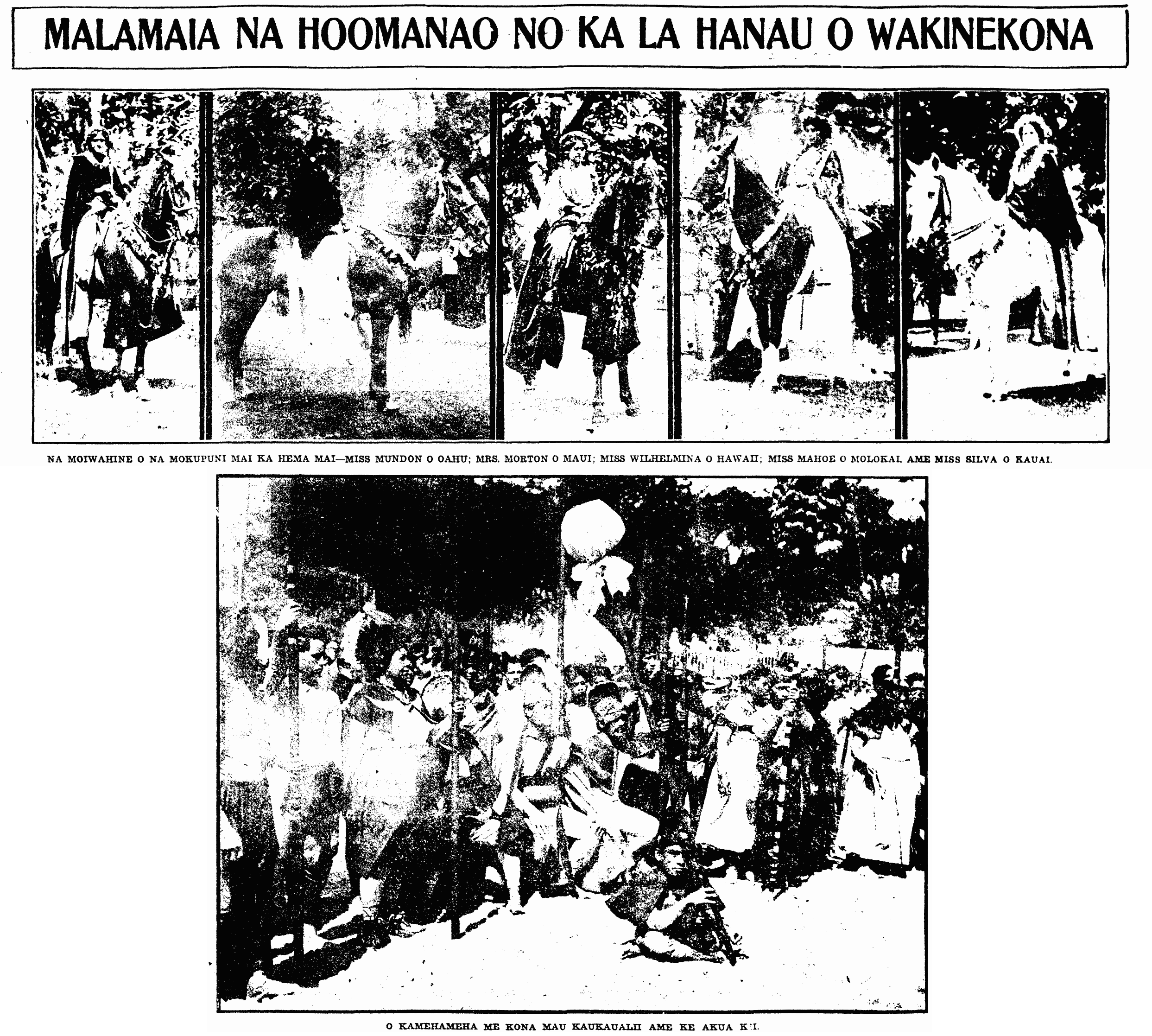
REMEMBERANCES HELD FOR WASHINGTON’S BIRTHDAY

THE QUEENS OF THE ISLANDS FROM THE LEFT—MISS MUNDON OF OAHU; MRS. MORTON OF MAUI; MISS WILHELMINA OF HAWAII; MISS MAHOE OF MOLOKAI; AND MISS SILVA OF KAUAI.

KAMEHAMEHA AND HIS KAUKAUALII AND THE IDOL GOD [AKUA KII].

[Yes, this was all done on George Washington’s birthday: the pāʻū riding and the reenactment of Kamehameha’s landing at Waikiki.]

(Kuokoa, 2/28/1913, p. 1)

MALAMAIA NA HOOMANAO NO KA LA HANAU O WAKINEKONA

Ka Nupepa Kuokoa, Buke LI, Helu 9, Aoao 1. Feberuari 28, 1913.

Reenactment of Kamehameha’s landing on Oahu, 1913.

GREAT PERFORMANCE OF THE LANDING OF KAMEHAMEHA

Some people of Hawaii of these new generations have committed to memory the arrival of Kamehameha the Great to Oahu and his landing in Waikiki, without however having witnessed it; today, at ten in the morning, it will be seen in Waikiki a scene very similar to that arrival of the war canoes of Kamehameha with the greatly distinguished King Kamehameha the Great sitting aboard his double-hulled canoes [waa kaulua] along with his war leaders, the chiefs, and warriors supplied with war implements of all sorts; King Kamehameha is adorned with a feather helmet [mahiole] and feather cloak [ahuula] along with a barbed spear [ihe laumeki] in his hand.

This is the first show of this type done here on Oahu; there was not one from the beginning; therefore, it is something new worth going to.  The preparations for and supervising of this great work is under John Wise, one of the people of this time that has memorized the history of Hawaii and the way of life of the people of old.

From amongst the waa that are being brought to show this day, is one of the huge, old waa; it is said that it belonged to Kamehameha the Great and is being brought from Kailua, Hawaii, from the estate of Prince Kalanianaole. It is said that this a huge and deep canoe, and the depth reaches the waste, and it is something new to see a huge waa of the old times being used these days.

(Kuokoa, 2/21/1913, p. 5)

KA HOIKEIKE NUI NO KA PAE ANA MAI O KAMEHAMEHA

Ka Nupepa Kuokoa, Buke L, Helu 8, Aoao 5. Feberuari 21, 1913.

Abraham Lincoln, 1906–07.

ABE LINCOLN
—°—THE AMERICAN COUNTRY BOY—°—
THE REDEEMER OF THE BLACK SLAVES

CHAPTER I.

HIS FIRST DAY AT SCHOOL.

One fine day, when the hills and vales were covered with the light of the morning, this little child came out of a log cabin. Log cabins were the houses of the poor country people of this area, and this is how they are built….

[This is the opening of one of several biographies of Abraham Lincoln published throughout the years in the Hawaiian-Language Newspapers. This particular one runs in the Kuokoa from 7/27/1906 to 1/18/1907.  Linekona was followed closely through life and death and beyond in the Hawaiian-Language Newspapers. Perhaps of any president of the United States, he is the one most written about and most respected for his stance and for the actions he took to promote these beliefs.

There is an article announcing the beginning of this story appearing in the previous issue of the Kuokoa, 7/20/1906, p. 4: “PERESIDENA LINEKONA, KE KEIKI KUAAINA”.]

(Kuokoa, 7/27/1906, p. 6)

ABE LINEKONA: KE KEIKI KUAAINA AMERIKA

Ka Nupepa Kuokoa, Buke XLV, Helu 30, Aoao 6. Iulai 27, 1906.

The Bernice Pauahi Bishop Museum, and the stone awa bowl, 1919.

SEEING ONCE AGAIN THE MUSEUM AT KAMEHAMEHA SCHOOL.

Twenty years or more has past since I first saw exhibits of the antiquities of Hawaii nei and the tiny islands of Polynesia that are stored in that building, and it is of great value to those who wish to see, and it is true, there are more things stored there from when I first saw it; and there were things which shocked me while other things made me sad.

When I arrived at the museum, it was already filled with foreigners and locals going upstairs and downstairs, and soldiers were the majority, from the military ships docked those days; officers as well as enlisted men returning and going back to the battlefield, they were awestruck; and being that there was only three hours allowed for going around, and while I looked, peeped, and peered here and there, I looked at my watch and more than an hour had past, and here I was on the first floor with so much more of the building to see; therefore, I tried to quicken my pace so that I see things; but if you intended to see everything, you would not be able to do that walking around the whole day because there are so many things that catch your attention and you’d spend some minutes looking at them; and because I wanted to read the explanations and all of the stories, minutes were spent there.

There were all types of fish, birds, and fruits, war implements of all sorts of that time, and they were amazing to see; plus the animals of the land and the sea, it was as if they were living.

On the second floor were the thrones of the beloved monarchs of Hawaii nei who passed, and it was painful in my gut to see this touching sight; and their portraits hung all about, looked as if they were watching you; yes, aloha, aloha for the chiefs of the land.

The time was going quickly, and I was intent on seeing everything, and yet the time was short.

With every step on the third floor, everything was fascinating to see, and looking blow, the winding stairs were just so beautiful and everything was kept so nicely. But amongst everything I saw, there were but two most important things: the first being the thrones and all of their belongings, and the second was a huge stone which weighed more or less a ton; when I entered and met the greeter, I was given a piece of tin stamped with a number, and was asked to leave my hat and coat, and then I stood at the base of the stairs thinking where should I go first; that is when I entered the room on the mauka side of the building, greatly delighted by everything until I reached the place where the great stone stood, and I was astonished at the look and appearance of this stone;  as if it was something I saw before, but when; that is what I thought to myself; and because I was very unclear about it, I looked here and there and I saw a haole sitting at a desk reading a book; I gave my aloha and he looked at me and asked if there was something he could do for me; I said yes, if he could explain to me the story of the stone.

“Yes,” he said, “that stone is the grinding stone of the Hawaiians in the old days; it was upon that stone that adzes were sharpened, and that is the reason for that smooth indentation on the top.”

While I was listening to the explanation of that fine friend, my eyes were set directly upon that stone, and that is when I saw the description printed below it; I immediately left him and I went to read, and I was shocked and for several minutes I stood there, astounded that I met up again with this rock after a span of 55 years gone by.

That label explained that this rock was sent from Kilauea, Kauai, when George R. Ewart was boss of the Kilauea sugar plantation, in 1897, and then I went and joined my friend, and told him the truth about that stone, and its name, and its function; it wasn’t a grindstone like what he believed; and as he heard my story he began to write.

Therefore my news loving friends, so that your confusion over this stone is put to an end, and for when you go to visit this building, you won’t fail to meet up with this rock, and you will have an understanding through this story I am revealing:

The name of this stone is Kanoa, and this was a awa bowl [Kanoa awa] for the alii of that time, and this is the reason why that depression was made right on the top, and there is a place between Kilauea and Pilaa called Kanoa until this day,  named for this stone; and from this spot, the sto0ne was taken away by the boss George R. Ewart when he was the head of that sugar plantation, and this place became the graveyard for the Portuguese, and a Catholic Church [Saint Sylvester Church] stands there until today near the government road.

It was 55 years ago that I first set my eyes on this stone, during those days when the land was forested, and beneath a pandanus tree was where this stone was placed; its height from the ground was perhaps a foot or so, and this Kanoa awa was crafted with great skill and at its side was the cup [apu], which was a smaller stone fashioned like an awa cup.

From what my kupuna told me, this Kanoa belonged to some chiefs and where the Kanoa was left was where a great house one stood, which was a place where the alii of the old times would enjoy themselves. And I was also informed of the alii to whom belonged the Kanoa; Kamoku was the man, and this is a hill that stands to this day in the middle of a field, and should a malihini go and see that Catholic church mentioned earlier, that place is Kanoa, and if you turn to look inland, about two miles away a hill stands like a heap of lava, and below all around it grow all sorts of plants, and from the middle until the top is pilipiliula grass, and today on its peak is a grove of tall pine trees planted after the owner of this land, Mr. C. Bertelman, died and his body was brought and buried some years ago; as for the chiefly woman, she was Kahili, and this is a land immediately seaward of this place, with a huge estuary where fishes of all types swim today.

Should the alii want to have fun, the chiefess went up with poi and fish, and Kamoku went down with the intoxicating awa of the uplands of Kahua-a, bundles of oopu fish, mokihana lei of Kahihikolo, dark shrimps [opae kuauli] of Kaluaokalani, and it was in this house that they would enjoy themselves with their people; that is the whole story dealing with this stone, a awa bowl for the chiefs.

If Mr. George R. Ewart had known of yet another stone that is in Kilauea in Kalihiwai, which rings like a bell, and it is rounded flat, and its sound can be heard for a mile or more if it is struck with a hammer or a rock in other times, and it was something played with by school children; then it would have probably been taken by Mr. Ewart to the museum to be viewed.

I give my appreciation to him being that in that year that this stone was sent, I was working at that sugar plantation, but I had no prior knowledge of this until I saw it once again in this museum.

With the Editor and the metal type setting boys go my valediction.

Me ka mahalo,

Charles K. Nawaiula.

Honolulu, Dec. 2, 1919.

(Kuokoa, 12/12/1919, p. 3)
IKE HOU MA KA HALE HOIKEIKE O NA MEA KAHIKO MA KE KULA O KAMEHAMEHA.

Ka Nupepa Kuokoa, Buke LVII, Helu 50, Aoao 3. Dekemaba 12, 1919.The