[Found under: “Ka Moolelo o Kamehameha I.”]
“He moku Kaula iho a me Niihau,
I kaulua ia Kawaihoa a Kane, Continue reading

“He moku Kaula iho a me Niihau,
I kaulua ia Kawaihoa a Kane, Continue reading
Hawaiian Kaaos and Meles.—In the native papers published in Honolulu, there frequently appear old compositions by the native poets and historians, which would be highly interesting if translated. the late Judge Andrews, the the preface to his “Dictionary of the Hawaiian Language,” says, Continue reading
And then she turned and looked down at the bottom of the pit, and her Hiiaka sisters were sitting there; at which point she chanted:
THE SECOND KAU OF THE STORY OF HIIAKA.
1. A ka luna i Puuonioni Continue reading
O Mr Editor of the Kuokoa Newspaper; Aloha a nui:—Please be kind once more, and if there is a space, let me have it. Because I keep getting asked, that being the heading above. I show the answer and the explanation I got from some very old people. Continue reading
Hawaiian History:—Seen on the first page of our paper this morning is the Hawaiian History written by our writer of history, S. M. Kamakau; Continue reading
THE STORY
— OF —
AAHOAKA THE WARRIOR
— AND —
HIS AMAZING BIRTH
AN OLD STORY FROM KAUAI.
[Brought out for the Kuokoa.]
Kalaleia was born of Kapaopao male and Kahala woman, his land of birth was Anehola. These were alii of here in the Koolau districts. Continue reading
The History
— OF —
Composed by the
Hon. D. Kahaulelio,
The Judge of the Shade of the Breadruit Trees of Lele.
S. P. KALAMA WAIAWAAWA.
This is a story pertaining to the one of this issue:
King Kamehameha III was sailing aboard an American warship for the Kanilehua rains of HIlo, and along with him was G. P. Kauka [G. P. Judd], the father of the Chief Justice A. F. Kauka [A. F. Judd], was with him; he was a favorite and a translator for the alii aboard the ship. The Captain wanted his officers to explain clearly the length in time and the direction, and while the officers were making preparations, S. P. Kalama Waiawaawa asked the King:
What are they doing? Continue reading
DELIGHTING IN THE BEAUTY.
(Written by the Hon. J. Nawahi for the Kuokoa.)
O Kuokoa Newspaper, Aloha oe:—
I give my thanks to you for your kindness in taking my presentation of the things I saw during my travels to San Francisco. But before I begin to tell of the story of this trip, I ask for your kind graciousness in letting me tell of my reason for going to this place, for perhaps some people are mistaken or unclear, according to what I have heard, like what some who seek to deceive have published in a Newspaper while I was in foreign lands. Continue reading
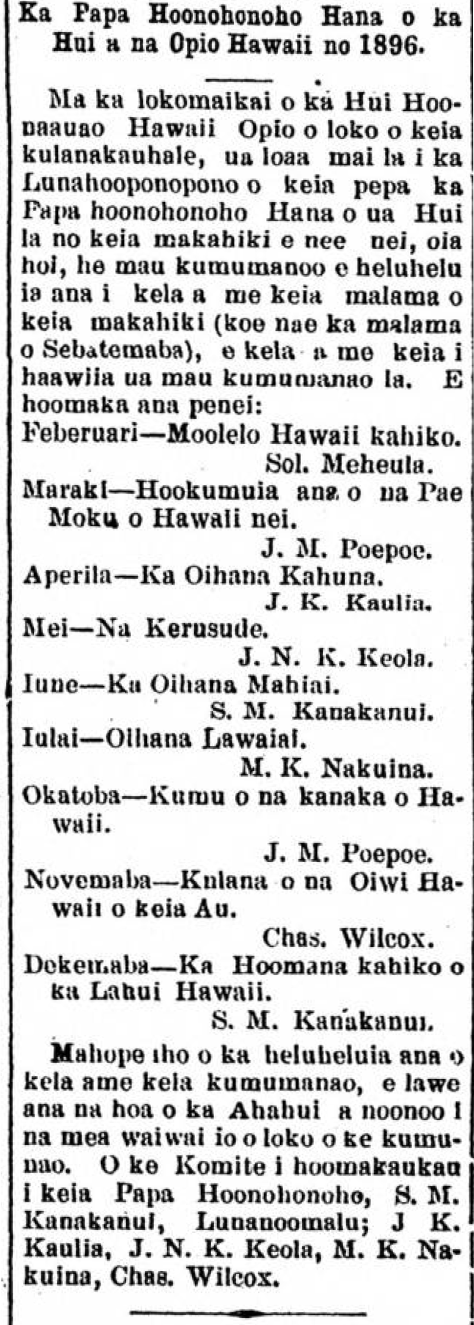
Through the kindness of the Hui Hoonaauao Hawaii Opio of this town, the Editor of this paper has acquired the Agenda of that Institute for this year forth, it being topics being read monthly (except for September) by those who were given the subject. It begins this like this:
February—Old Hawaiian History.
Solomon Meheula.
March—The Origin of the Hawaiian Archipelago.
J. M. Poepoe.
April—The Profession of Kahuna.
J. K. Kaulia.
May—The Crusades.
J. N. K. Keola.
June—The Profession of Farmer.
S. M. Kanakanui.
July—The Profession of Fisherman.
M. K. Nakuina.
October—The Origins of the Hawaiians.
J. M. Poepoe.
November—The State of the Native Hawaiians of Today.
Charles Wilcox.
December—The Old Religion of the Hawaiians.
S. M. Kanakanui.
Following the reading of the topics, the members of the Institute will consider the true value within the topics. The Committee that organized this Agenda is, S. M. Kanakanui, Chairman [Lunahoomalu]; J. K. Kaulia, J. N. K. Keola, M. K. Nakuina, Charles Wilcox.
(Kuokoa, 1/10/1896, p. 3)
Haalilio was born in 1808, at Koolau, Oahu. His parents were of respectable rank, and much esteemed. His father died while he was quite young, and his widowed mother subsequently married the Governor of Molokai, an island dependent on the Governor of Maui. After his death, she retained the authority of the island, and acted as Governess for the period of some fifteen years. Continue reading
 nupepa