Fishing using explosives, 1895.

The Blasting of Fish Prevails.

Mr. Editor:

On the travels of the Circuit Court Judge of Maui, to Kaupo, Kipahulu, Hana, and all the way to the Koolau cliffs of Maui, to ask for money for the building of Wailuku, and we were lucky in what money was collected. I was one who went along on this journey. When we reached Kipahulu, to Hakuole’s place, a policeman, with his son, Kimo Hakuole who is a school teacher; the locals were very hospitable. Continue reading

This letter to the editor of the Nuhou is interesting in so many ways. 1873.

NOT GOOD.

When I saw the newspaper Nuhou Hawaii; I was greatly gladdened to see it. When I took a close look, I was very happy. I talked with my wife, “Hey, this paper, Nuhou Hawaii, it is very good for us to subscribe to this paper.” Please don’t be upset at my bad writing. Gibson, I have much appreciation for you; at your great strength in saying that they should not give Puuloa [Pearl Harbor]. I talk in Chinese; all of Honolulu is appreciative of you. Continue reading

Memorial of Protest from the women of Hilo, 1898.

KUE MEMORIALA.

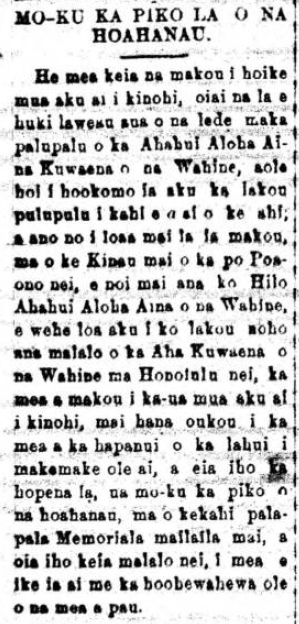
O makou o na Komite o ka Ahahui Aloha Aina o na Wahine i kohoia e ka halawai i noho ma ka la 29 o Sepatemaba 1898, ma Hilo Taona.

Ma keia ke kue loa aku nei i ka Memoriala a ka Ahahui Kuwaena o ka Ahahui Aloha Aina o na Wahine o Honolulu, malalo o na kumu kupono. Continue reading

From the Ahahui Aloha Aina Kuwaena o na Wahine, 1898.

THE UMBILICAL CORD OF THE SIBLINGS ARE CUT.

This is something we made known from the very beginning, during the days when the tender-eyed ladies of the Women’s Central Patriotic League [Ahahui Aloha Aina Kuwaena o na Wahine] were drawing away [huki laweau]; when their kindling was not placed where the flames were burning, and now we received by way of the Kinau on Saturday night, that the Women’s Patriotic League of Hilo requested to dissolve their membership under the Women’s Central Patriotic League here in Honolulu; they, who we restrained from the beginning, not to do what the majority of the nation does not want, and here is the result; the umbilical cords of the siblings are cut, by way of a Memorial from there, and that is what is below, so that it is seen by everyone without fail.

(Aloha Aina, 10/8/1898, p. 3)

AlohaAina_10_8_1898_3

Ke Aloha Aina, Buke IV, Helu 41, Aoao 3. Okatoba 8, 1898.

Mrs. William Hall, 1893.

HAWAII.

Mrs. William Hall Tells of the Arrival of Commissioner Blount.

Disappointment Created by the Taking Down of Old Glory.

How Annexation is Viewed by the People of the Sandwich Islands.

The Daily Rumors Which Alternately Buoy the Annexationists and Royalists.

The following letter from Honolulu was written to Minneapolis friends by Mrs. William Hall, daughter of Mrs. C. O. Van Cleve, the wife of a missionary to the Sandwich islands, and has resided on the islands for the past 30 years. Mrs. Hall’s husband is also a son of a missionary. The story of the courtship and marriage is romantic, for Mr. Hall was visiting Minneapolis when he met Miss Van Cleve, and he fell in love with her at sight. He had only a short time to remain, and as Gen. Van Cleve was then out with a command,the impatient young lover made the journey to the general’s station to tell him he had laid siege to the the daughter’s heart, and that she would surrender if the father gave his consent. Miss Van Cleve afterwards went out to the Sandwich islands, where she was married and began missionary labors with her husband. The letter was written early in April, just after the lowering of the American flag on the islands.

Honolulu, April 5, 1893.

Just as we were in the midst of writing for the mail by the Australia last Wednesday, the telephone announced a United States steamer off Koko Head, supposed to be the revenue cutter Richard Rush, bringing commissioners from Washington to the Hawaiian government. This proved to be correct, and hurrying our letters, we repaired to the water front to see what was to be seen.

The streets were full of people and full of flags. Chicago will hardly fly more bunting to the square yard at the opening of the Columbian Exposition. Everyone hung out a flag of some kind, mostly American, though I noticed “The harp that once through Tara’s halls the soul of music shed,” is hanging “mute” on a green field between two brick buildings on the corner of Fort and Hotel streets, and I think likely, if the trade wind continues as vigorous as at present a few days longer, the cord (chord) will “indignant break.” But to return to our muttons, otherwise streets.

One feature of the display was a procession of native women dressed in white and bearing Hawaiian and American flags, marching down to the wharf to receive and welcome the commissioners.

The Rush entered the harbor and took her place in the naval row. The American minister, the consul, and a committee of three gentlemen boarded her from a steam launch just before she entered the harbor.

It soon became noised abroad that only one commissioner had arrived, and he would not  land for an hour or two. There was some disappointment among the natives when they heard that Admiral Brown had not been sent; others did not quite know whether to be glad or sorry that only one man had been entrusted with this mission.

Soon after the cutter anchored, Maj. Robertson, the ex-queen’s chamberlain, went on board and, presenting the queen’s compliments, offered the commission her carriage in which to ride to the hotel. The offer was declined with thanks, the commissioner had already declined several offers of the kind, preferring to ride in his private carriage. Continue reading

Vote for Hawaiians? 1893.

“STILL HARPING ON MY DAUGHTER.”

The Star is either densely stupid, or deeply dishonest, in its attitude on the question of the suffrage and of the civil and political rights of the Hawaiian, under annexation. In fact, annexation, in view of the prospects of certain early changes in our political conditions can no longer claim a place among the questions of practical politics impending over us. But, aside from that, we would again point out the weakness in the assumption of the annexation organs upon this point of Hawaiian suffrage. The Star says of the Hawaiian,—”Annexation offers him equal citizenship.” It does nothing of the kind. It offers him no citizenship at all, while robbing him of that which he has hitherto enjoyed. We challenge the organs to point to any pledge, on the part of any person, or body of men, authorized to take action in the premises, at all calculated to assure the Hawaiian of any political rights whatever, in case of annexation. Continue reading