Be vigilant. Just because someone claims to represent you, does that necessarily mean it is so? 1893 / timeless.

HOW IS IT POSSIBLE?

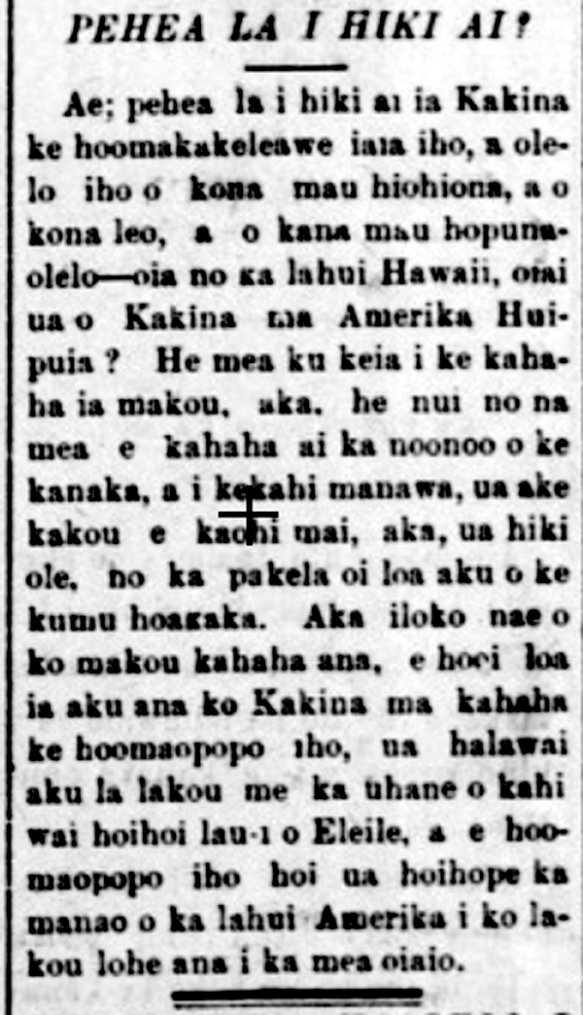
Yes, how can Stevens [John L. Stevens] make himself so brazen and say that his appearance, his voice, and his words—that they represent the Hawaiian people, all the while that that Stevens is in the United States? This is something that is appalling to us, but there are many things that will shock someone, and at times we just want to suppress that feeling, but we cannot, because of how blatant the examples. However, while we may be in shock, the shock of Thurston and his group will greatly surpass this, when they realize that they  met up with the spirit of the waters of Eleile that turn back ti leaves,* and they will realize that the sentiment of the Americans will turn back as well when they hear the truth.

[Many times people don’t pay attention to what is happening outside their own community because they have a job to do, or they have children to care for, or this, or that. Let us be vigilant during these upcoming years. The future generations deserve our attention.]

* See Mary Kawena Pukui’s ʻŌlelo Noʻeau: Hawaiian Proverbs & Poetical Saying, #1649 about the current in the pool of Eleile which turns back stalks of ti leaves thrown into it by visitors.

(Hawaii Holomua, 2/15/1893, p. 2)

HawaiiHolomua_2_15_1893_2.png

Hawaii Holomua, Buke III, Helu 160, Aoao 2. Feberuari 15, 1893.

Mele for the Claudine, the vessel that carried the commission of annexationists to Washington DC, 1893.

KELAUDINA SONG.

Kaulana mai nei Kelaudina
Ahailono o ka poe pakaha
Nau i lawe aku na komisina
O ke aupuni kuloko o Hawaii
Hopuhopualulu e ka hele’na
A na elele o ua aupuni nei
E ake ana e hookoia
Ka iini pakaha aina
Halawai aku nei lakou
Me kahi paele a Kalivilana Continue reading

E nihi ka hele… 1893.

DON’T GET DISCOURAGED.

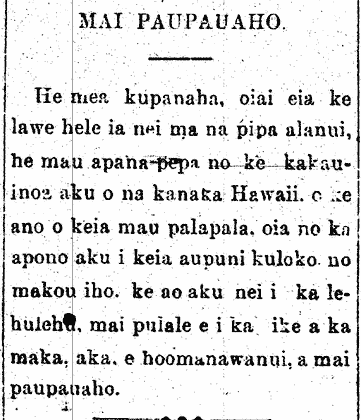
It is outrageous that pieces of paper are being carried on the sides of the streets for Hawaiians to sign; these are documents approving the provisional government [aupuni kuloko] for ourselves; we instruct the public not to let what you see excite you, but be patient and don’t get discouraged.

(Leo o ka Lahui, 1/20/1893, p. 2)

LOKL_1_20_1893_2.png

Ka Leo o ka Lahui, Buke II, Helu 626, Aoao 2. Ianuari 20, 1893.

Keep politics off of the pulpit, 1894.

THE DOORS OF WAINEE CHURCH ARE SHUT.

When the steamer Iwalani arrived on the morning of this past Friday, news of the Paupili rain of Lele [Lahaina] was heard, saying that the doors of Wainee Church were shut by the brethren. The story we heard was this below.

One day on the previous week, in the sermon of the kahu of that Church, A. Pali, he spoke about God, and at the very end of his talk, he revealed this:

“I am a true American, inside and out, from top to bottom;” and other inappropriate words; and the congregation began to fidget, and at the close of his prayer, the brethren told him, you are not good, O Pali, and we tell you that you will not pray in this Church from now forward.” Continue reading

Maintain the peace, 1894.

Announcement of the Hawaiian Patriotic League.

Keep the Peace.

I have been ordered by the Executive Committee [Aha Hooko] of the Central Hawaiian Patriotic League of Honolulu, to instruct all of the Leaders and the members of the Ahahui Aloha Aina across the Archipelago, being that it is known that on the 4th of July, 1894, on that day, the Provisional Government will proclaim a new Constitution, and the Republic of Hawaii, and at that time, or perhaps before that time, perhaps Martial Law [Kanawai Koa] will be proclaimed. Continue reading

On patriotism, 1894.

THE ARRANT COWARDS.

It is refreshing to hear the supporters of the revolutionary Americans accuse the loyal citizens of Hawaii of cowardice. The attitude on the 17th of January of the men, who boast of their patriotism and heroism, was not a proof of the qualities now claimed by them. The p. gs. remind us of the small boy standing behind his big and armed brother—and two policemen as guards—yelling to the lonely boy on the other side with no arms and no police: “Come on, come on you coward and I will fix you.”

The abject cowardice of the government was further illustrated today. A well-known contractor, a man of many years residence, and of unblemished standing in this community desired some cartridges for his revolver. He as many other civilized citizens enjoy during their stay at the Waikiki beach all manly sports, and he fishes, rows, jumps, boxes, and shoots to the target. As a law-abiding citizen he made a formal request to the fir of E. O. Hall & Son, for 100 cartridges and his requisition was returned crossed in red ink “refused by the Marshal.” Continue reading

“The Hawaiian Revolution!” 1894.

THE HAWAIIAN REVOLUTION!

DEDICATED BY SPECIAL PERMISSION

TO THE

Provisional Government

A MOST ELABORATE AND EXTENSIVE HISTORY OF
HAWAII FROM JANUARY, 1893, UNTIL
THE PRESENT!

EXQUISITELY ILLUSTRATED BY THE NEW AND

Beautiful “Crisp Photo” Process.

HAWAII.

The Volume Will Contain Half Tone Portraits of All the Leading People Connected With This Memorable Epoch.

Including an Account of the

INDUSTRIAL ÷  ADVANCE ÷ OF ÷ HONOLULU

In Fact an Historical, Statistical and Descriptive Review of the Material Development and Advancement of the Islands.

WITH AN APENDIX CONTAINING A SERIES OF

Comprehensive ÷ Sketches ÷ of ÷ Representative ÷ Citizens

Mr. Wellesley A. Parker, whose success throughout the world in art matters, is well known has been specially employed to superintend the pictorial department of this work. Of the Crisp process, which is to be used, the following extract from a well known paper speaks well for it.

The Albany, N. Y. Evening Journal says:

New Printing Process.—People unacquainted with the wonderful strides that have been made in Australia in printing, and the general depicting of nature in its most beautiful moods, have little idea of the complimentary and deserving success that Messrs. F. W. Niven and Co. of Ballarat, Australia have attained in their new “Crisp Photo” Process. We have been shown by Mr. Wellesley Parker, who is visiting us, samples of this new firm’s beautiful process. The book that has lately run into three editions, of 5000 each, of “Syracuse Illustrated” is beyond compare the most exquisite series of views ever appearing in the direction of printing. Episodes of the old days, and scenes of the beauties of the gardens of the city, are scattered throughout, interented with pictures of well-known citizens, that for fidelity rival any photograph that is at present produced. Every credit is due to Australia, who has taken the lead in this innovation.

Intersperced through the book will be pages devoted to the estaousnments or leading wholesale and retail merchants. Not only will the exteriors of the buildings be shown, but the interiors will come out with great fidelity, showing every branch of the business in actual working order, thus giving to many a glimpse behind the scenes of the various details involved in producing the articles that they purchase in the showroom or at the counter. The first issue of “The Hawaiian Revolution” is to be 5000.

The principal industries and business establishments will be visited by Mr. Parker, who is now in this city, on behalf of the Publishers, and arrangements made by which the actual details of the various branches of the businesses will be represented pictorially. In addition, it is the desire of the Publishers to add to the completeness of the work by prevailing upon citizens who have handsome residences or grounds, to arrange with Mr. Parker for their appearance in its pages.

PUBLISHED BY THE

HAWAIIAN GAZETTE CO.

[Does anyone know if this book ever got published?]

(Pacific Commercial Advertiser, 4/25/1894, p. 3)
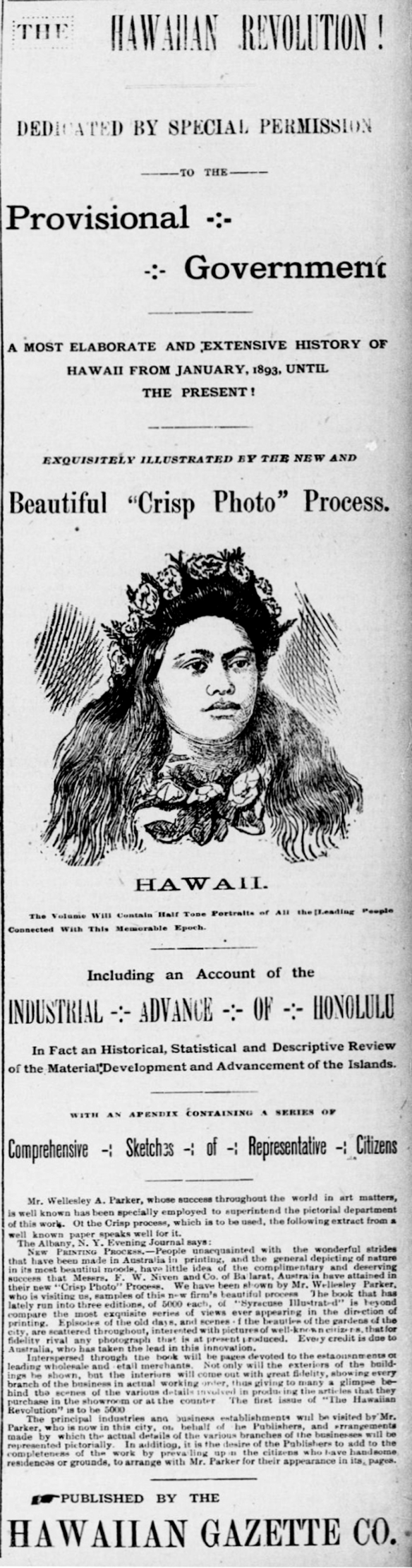
PCA_4_25_1894_3.png

The Pacific Commercial Advertiser, Volume XIX, Number 3671, Page 3. April 25, 1894.
A new scathing “Hawaii Ponoi,” 1894.

TOPICS OF THE DAY.

The Advertiser with its usual ingenuity has finally found the cause for all the opposition among the Hawaiians to the P. G., and to the annexation cause. It is all on account of Hawaii Ponoi, our national anthem, and the morning organette demands, and immediate change in the words of that time-honored song. The new version given by the Advertiser will hardly be adopted, and we therefore take the liberty to substitute some words which we submit to the kind consideration of all loyal Hawaiians who are to be forbidden to sing the anthem of their native land. How is this brother Castle?

HAWAII PONOI HOU.

Pakaha Hawaii,
Kipi i ka lahui,
Na welo mikanele,
Na Pi Gi.

Ino ka ia e,
Ia Kolekaaka,
Pale i ka nani,
Me ka uahoa.

[NEW HAWAII PONOI

They plunder Hawaii
Conspire against the people,
Those missionary descendants,
The P. G.

How vile he is,
That Kole Kaaka,*
Pushing aside beauty,
With his cruelty.]

*”Kole Kaaka” can be found in the dictionary. Look it up. This term with a negative connotation is used often during this period. Might it also be a play on the name Dole? “Wretched Dole”?

(Hawaii Holomua, 1/9/1894, p. 2)

HawaiiHolomua_1_9_1894_2.png

Hawaii Holomua, Volume II, Number 7, Page 2. January 9, 1894.

Denial of “Hawaii Ponoi,” 1894.

HAWAII PONOI.

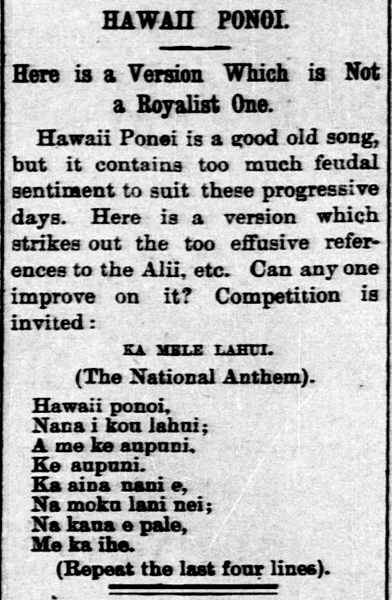
Here is a Version Which is Not a Royalist One.

Hawaii Ponoi is a good old song, but it contains too much feudal sentiment to suit these progressive days. Here is a version which strikes out the too effusive references to the Alii, etc. Can any one improve on it? Competition is invited:

KA MELE LAHUI.

(The National Anthem).

Hawaii ponoi,
Nana i kou lahui;
A me ke aupuni,
Ke aupuni.
Ka aina nani e,
Na moku lani nei;
Na kaua e pale,
Me ka ihe.

(Repeat the last four lines).

(Pacific Commercial Advertiser, 1/8/1894, p. 4)

PCA_1_8_1894_4.png

The Pacific Commercial Advertiser, Volume XIX, Number 3580, Page 4. January 8, 1894.

Hypocrites? 1893.

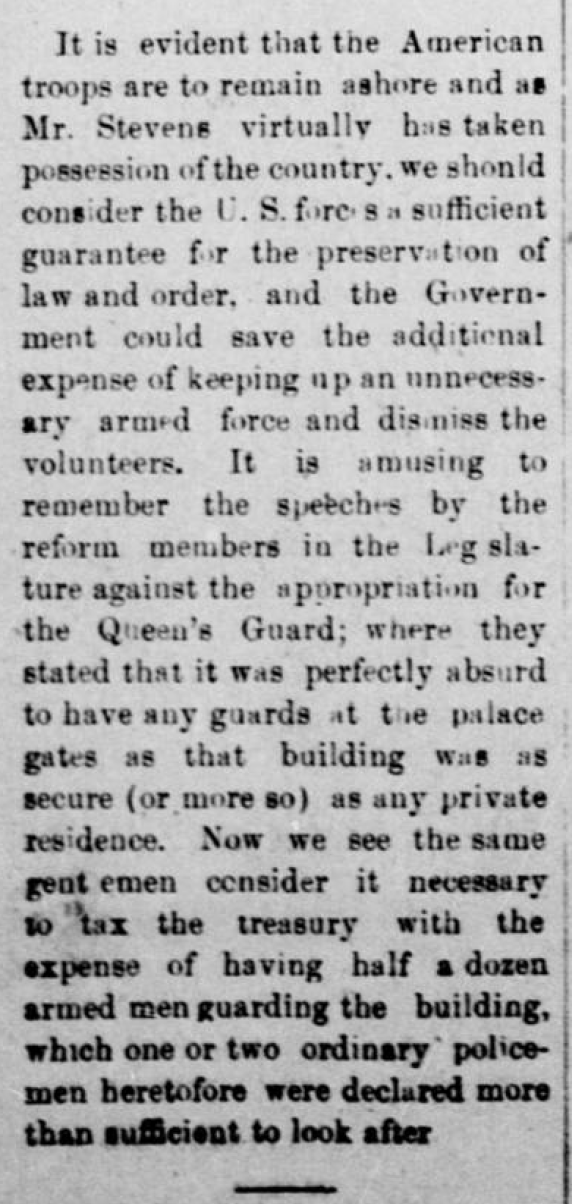
It is evident that the American troops are to remain ashore and as Mr. Stevens virtually has taken possession of the country, we should consider the U. S. forces a sufficient guarantee for the preservation of law and order, and the Government could save the additional expense of keeping up an unnecessary armed force and dismiss the volunteers. It is amusing to remember the speeches by the reform members in the Legislature against the appropriation for the Queen’s Guard; where they stated that it was perfectly absurd to have any guards at the palace gates as that building was as secure (or more so) as any private residence. Now we see the same gentlemen consider it necessary to tax the treasury with the expense of having half a dozen armed men guarding the building, which one or two ordinary policemen heretofore were declared more than sufficient to look after.

(Hawaii Holomua, 1/20/1893, p. 4)

HawaiiHolomua_1_20_1893_4

Hawaii Holomua, Buke III, Helu 143, Aoao 4. Ianuari 20, 1893.