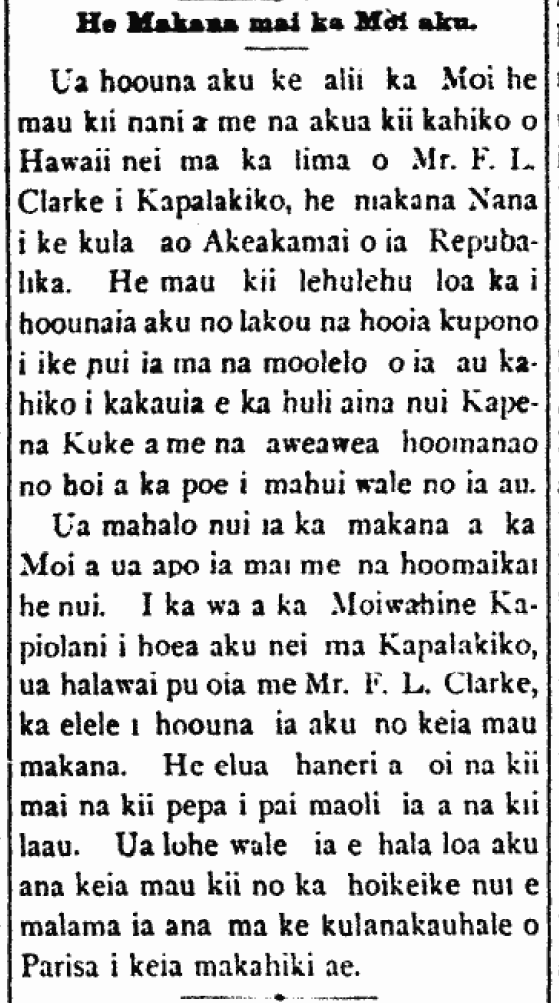
King Kalakaua gifts some 200 kii¹ to the National Academy of Sciences. 1887.

A Gift from the King.

The alii, the King, sent a number of beautiful pictures [kii] and old godly images [akua kii] of Hawaii to the hands of Mr. F. L. Clarke² in San Francisco, a gift from Him to the National Academy of Sciences [? ke kula ao Akeakamai o ia Repubalika]. There were a great many images sent which are well attested to as seen in the old accounts written by the great explorer Captain Cook and the faint recollections of those who have slight knowledge of that era.

The gift of the King was greatly appreciated and it was accepted with much thanks. When Queen Kapiolani arrived in San Francisco, she met with Mr. F. L. Clarke, the representative sent for this gift. There were two hundred or more images, from images that were printed on paper, to wooden idols. It’s been heard that they will go all the way to the city of Paris for the great exposition to be held next year.³

¹”Kii” refers to any image or representation of something, whether it be printed on paper, painted on canvas, carved out of wood, or cast in metal.

²See Clarke’s short history of Hawaii, “Hawaii’s Real Story,” which appeared in The Forum, July 1900, pp. 555–565.

³Exposition Universelle, 1889. See “Catalogue of the Hawaiian Exhibits at the Exposition Universelle, Paris, 1889.” by John A. Hassinger, Department of the Interior.

[Does anyone know of what happens to all of this?]

(Kuokoa, 5/14/1887, p. 2)

He Makana mai ka Moi aku.

Ka Nupepa Kuokoa, Buke XXVI, Helu 20, Aoao 2. Mei 14, 1887.

Anonymous accusations against a Catholic priest in Kalawao, 1874.

The deeds of the Catholic teacher in Kalawao.

We are printing below the deeds of a certain Catholic priest amongst the leprosy patients in Kalawao:

1. Clothes—The clothes donated by the brethren of Honolulu for the needy leprosy patients of Kalawao, that is what the Catholic teacher is using to lure the people of the Evangelical faith [hoomana Euanelio] to join the Catholic religion. While he goes around doing his converting, and when they hear him they convert, but should they be steadfast, the teacher will say, “Should you join the Catholic faith, I will give you the clothing and things that you lack, should you desire.” By this action, some agree to join; there have been many converted over the clothes. This is the cunning way [kumu hinu ?] of the Catholic priest.

2. Wooden staff—The Catholic teacher constantly carries a staff in his hand, and it is with this that he converts people to his faith. This is what he does. For that person or persons who are resolute against being converted over clothes, they are struck by the cane of the Catholic teacher. This is what he does with the cane, and he converts them.

3. The church house—The church in Kalaupapa is of the Catholics.¹ He uses this church to convert some people to his religion. This is basically what he does. When the church was completed in Kalaupapa, the Catholic teacher when to the houses to convert people; the Catholic teacher said, “What is your faith.” “I’m a Calvinist [Kalawina],” that being a Protestant of the Evangelist faith, said the person in response. “That is a faith without any church,” said the Catholic teacher.”We are fine without a church; we hear that our kahu is coming and will hold services at the homes of brethren, and if we are in good health, we will attend the services,” he answered. “That’s no good, for here is our church, you all should come in, and then I’ll give you people clothes, and things you need, should you all desire,” replied the Catholic teacher. With this and everything else said in that conversation, some people converted, and some others remained steadfast behind the truth of the Gospel.

4. The cemetery.—The cemetery of the Catholics recently constructed here in Kalawao is one of the things used by that Catholic teacher and the Catholic disciples to convert people to their side. This Catholic teacher saw that the people were troubled with dead bodies left out, eaten up by pigs; and he was intent on converting the people to his belief, and therefore, he ordered Honolulu to send over several bundles of pine lumber; it arrived recently and is now standing here in Kalawao like a net to catch stupid fish who stray and are caught. So too is this graveyard; there are two faiths who come in, and they are left until the day they rise; who will they be for?

5. Extreme Unction [Ukione].—This act, Extreme Unction, is one of the most heinous acts which the Catholic teacher is doing here in Kalawo, and we all agree that this is akin to thievery. This is what he does. For those who don’t convert over clothes, or the rod, or the church, or the cemetery, he practices Extreme Unction on them. When the Catholic teacher sees or hears of a that a patient has grown weak, one that is from another faith, he goes to them constantly to urge them, and because the patient grows weary, he submits, whereupon the Catholic teacher performs the Extreme Unction; and when the patient recovers, he protests this improper deed of the Catholic teacher; this happens often; some people protest, and other mistakenly submit. From what we’ve seen, the Catholic teacher by these actions is like a yellow-eyed cat spying on its enemy, the mouse. And we believe that these actions of the Catholic teacher are not right in his sacred and faithful position.

Here is another new important thing we are witnessing. On the night of the 22nd of Dec. of the year 1873, at maybe 10 o’clock of that night, Kaiakoili (m) died, he was a brethren of the church of Kawaiahao, and he contracted leprosy and lived here in Kalawao, and was a member of the Siloama Church, and this was his faith until the day he died. However, on the night shown above, during his last hours, he was Baptized [Babetema ia] by Kulia (f), who is a disciple of the Catholic faith, but he was Baptized when he was dead.

Leprosy Patient.

¹St. Philomena Church

(Kuokoa, 1/17/1874, p. 1)

Na hana a ke kumu Pope ma Kalawao.

Ka Nupepa Kuokoa, Buke XIII, Helu 3, Aoao 1. Ianuari 17, 1874.

Catholic clergy arrive, including someone named Damien, 1864.

[Found under: “NEWS OF HAWAII NEI.”]

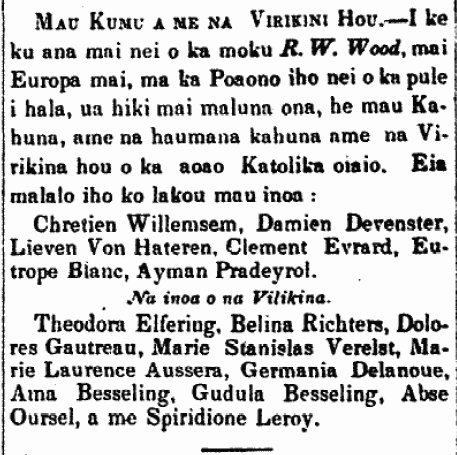
New Teachers and Nuns.—With the docking of the ship R. W. Wood, from Europe, on the Saturday of this past week [March 19, 1864], arrived aboard her was some new Priests and some student priests and Nuns [Virikina] of the Roman Catholics [Katolika oiaio]. Here below are their names:

Chretien Willemsem, Damien Devenster [De Veuster], Lieven Von Hateren, Clement Evrard, Eutrope Bianc, Ayman Pradeyrol.

The names of the Nuns.

Theodora Elfering, Belina Richters, Dolores Gautreau, Marie Stanislas Verelst, Marie Laurence Aussera, Germania Delanoue, Arna Besseling, Gudula Besseling, Abse Oursel, and Spiridione Leroy.

(Kuokoa, 3/26/1864, p. 2)

Mau Kumu a me na Virikini Hou.

Ka Nupepa Kuokoa, Buke III, Helu 13, Aoao 2. Maraki 26, 1864.

Mere Karikimaka, 1901.

CHRISTMAS TREE AT KAWAIAHAO

Nearly 1,200 People Went to See.

Nearly 12 hundred People Went to See.

On Friday night last week, the Sunday School students of Kawaiahao were made happy because of the docking of the ship Alameida [Alameda] that evening with a kind, big old man named “Santa Claus.”

Before the time announced that the old man would be arriving, the great room of that church was packed with the Sunday School children and their parents, and in that crowd, the elders were seen:—Mr. and Mrs. Henry Waterhouse, Mother Castle, Rev. H. H. Parker, Mrs. Haalelea, Rev. S. L. Desha, and our other white friends.

Right before the pulpit, an arch [pio] was erected decorated with pine branches, and amongst these branches the light of electric lights could be seen, in the colors of the American flag: white, red and blue. In the middle of the arch was placed a large star made to be like the Star of Bethlehem which guided the wise men of the East to where the Messiah was born. In the Star was placed a picture of Maria with Christ in her loving bosom. It is truly lovely and beautiful for the heart of man to say.—”It is true, a Messiah was indeed born.”

Under this arch lay a table laden with presents that were made ready to give to the students.

Before the arrival of Santa Claus, hymns were sung and short speeches were given by the girls of the Kawaiahao Boarding School [Kula Hanai o Kawaiahao] and the Youth Class [? Papa Pokii] of Mrs. May Wilcox. Their performance was truly beautiful and sincere, and if the One for whom these celebrations were being held was present in His Actual Body, they would not be without His clapping. The Head of the Sunday School of Kawaiahao, Hon. Henry Waterhouse, gave some praising remarks, as did Pastor Parker [Paleka] and the Pastor of Haili, Rev. S. L. Desha, and the people gathered to hear their voices were joyous.

Being that the one much awaited for was a very kind old man, after the singing of some songs called in English, “Christmas Carols,” there was heard the sound of a conch, at which time was seen Santa Claus entering with his Presents, and he circled about the room giving presents to the children.

Here is some of what he said.—”I am happy to be with all of you. This is one of the most amazing lands for me. Where I live, there are many feet of snow now. When I landed with the steamer Almeida this evening, I was shocked that there was no snow here, so I did not bring my sleigh nor my deer, being that you all have street cars [kaa uwila].

The gifts prepared were handed out. Everyone was thrilled.

(Kuokoa, 12/27/1901, p. 5)

KUMULAAU KARIKIMAKA MA KAWAIAHAO

Ka Nupepa Kuokoa, Buke XXXIX, Helu 26, Aoao 5. Dekemaba 27, 1901.

I wonder what became of these… 1843.

OLD IDOLS OF HAWAII NEI.

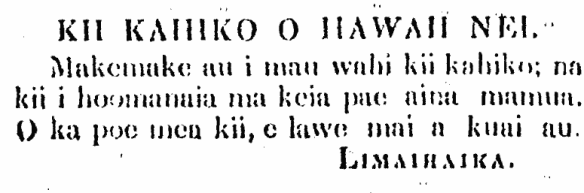
I want some ancient idols [kii]; the idols that were worshiped in these islands before. Those who have the, bring them to me, and I will purchase them.

Armstrong [Limaikaika].

(Nonanona, 11/28/1843, p. 68)

KII KAHIKO O HAWAII NEI.

Ka Nonanona, Buke 3, Pepa 14, Aoao 68. Novemaba 28, 1843.

Kaumakapili Church member, 1910.

Old Member of Kaumakapili.

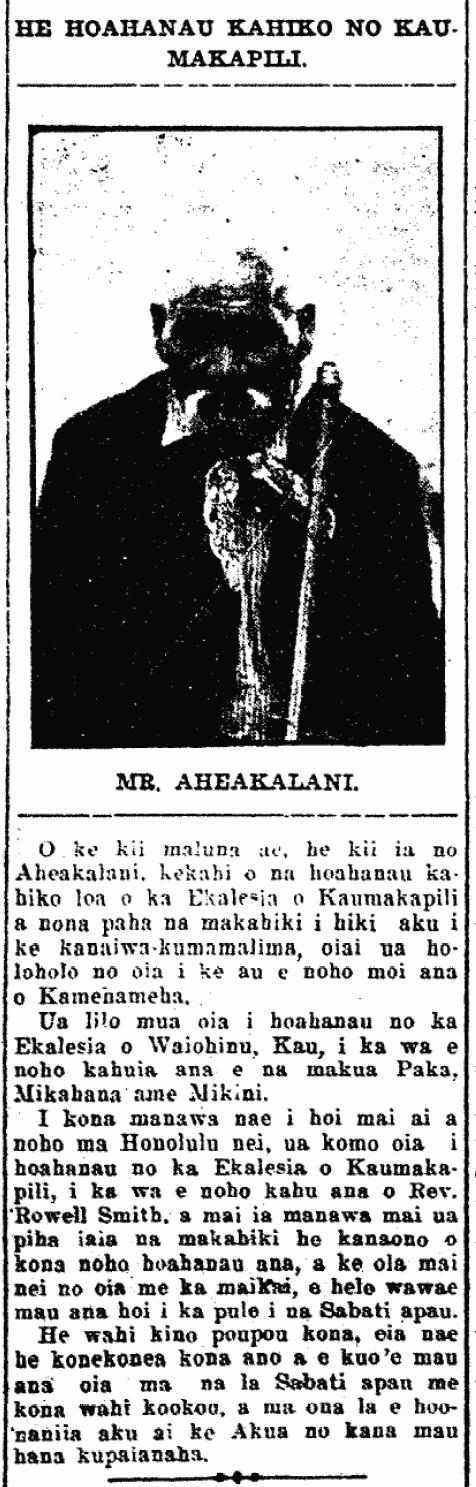
Mr. Aheakalani.

The picture above is one of Aheakalani, one of the very old members of Kaumakapili Church, and he has perhaps reached the age of ninety-five, being that he was going about about during the time Kamehameha was king.
He was first in the congregation of the church of Waiohinu, Kau, when the kahu were Parker, Mikahana and Mikini.

However, when he returned to Honolulu to live, he became a member of Kaumakapili Church, when Rev. Rowell Smith was kahu. And from that time, he has been one of the congregation there for sixty years. He is in good health and walks to prayer ever Sunday.
He is stout, but he is in recovery, and walks every Sunday with his cane, and through him, God is glorified for his amazing works.
(Kuokoa, 5/27/1910, p. 5)
HE HOAHANAU KAHIKO NO KAUMAKAPILI.

Ka Nupepa Kuokoa, Buke XLVII, Helu 21, Aoao 5. Mei 27, 1910.

Maori visit Hawaii, 1920.

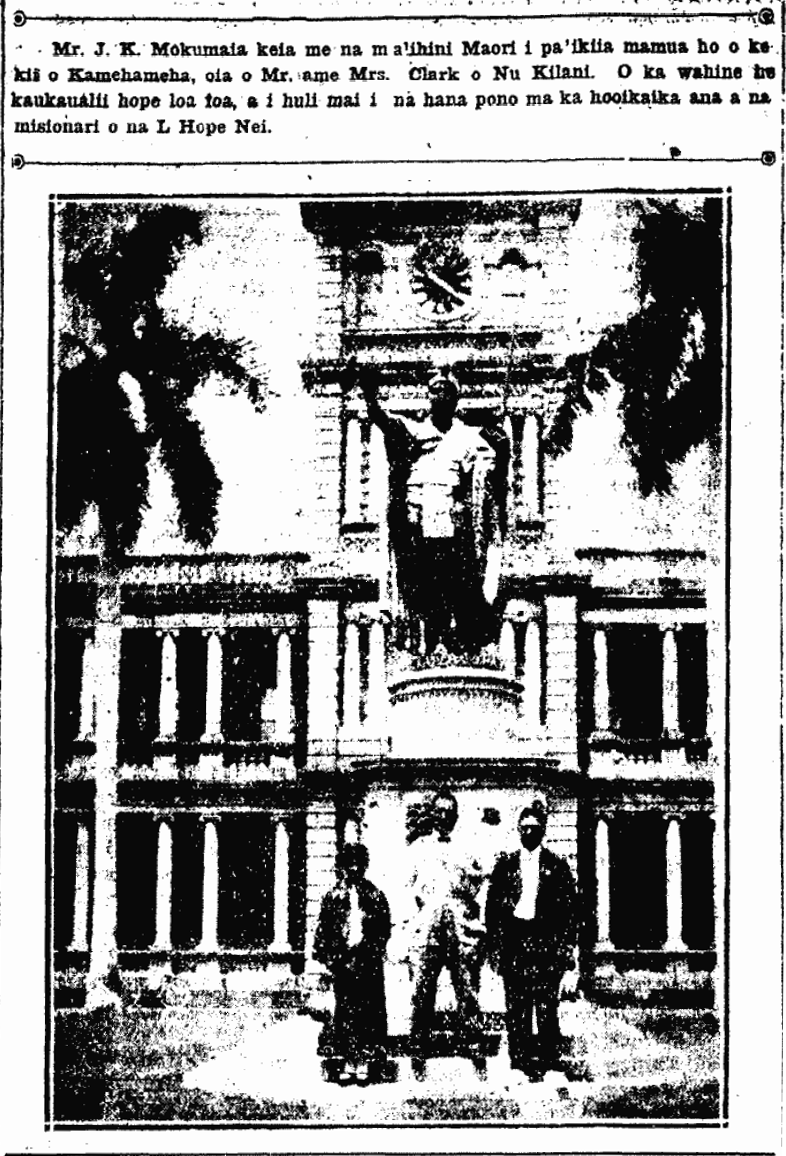
This is Mr. J. K. Mokumaia with the Maori malihini, photographed before the statue of Kamehameha; they are Mr. and Mrs. Clark of New Zealand. The woman is the last kaukau alii [kaukaualii hope loa ??], and they came to do good works by strengthening the missionaries of the Latter Day.

[The text is pretty clear, but during the last decades of the newspapers, you will notice more and more typos, as you can see here.

If the newspapers were reshot clearly, the image would no doubt be much more crisp.]

(Kuokoa, 7/9/1920, p. 3)

Mr. J. K. Mokumaia keia...

Ka Nupepa Kuokoa, Buke LVIII, Helu 28, Aoao 3. Iulai 9, 1920.

Poi made from wheat flour in Kalawao and Kalaupapa, 1879.

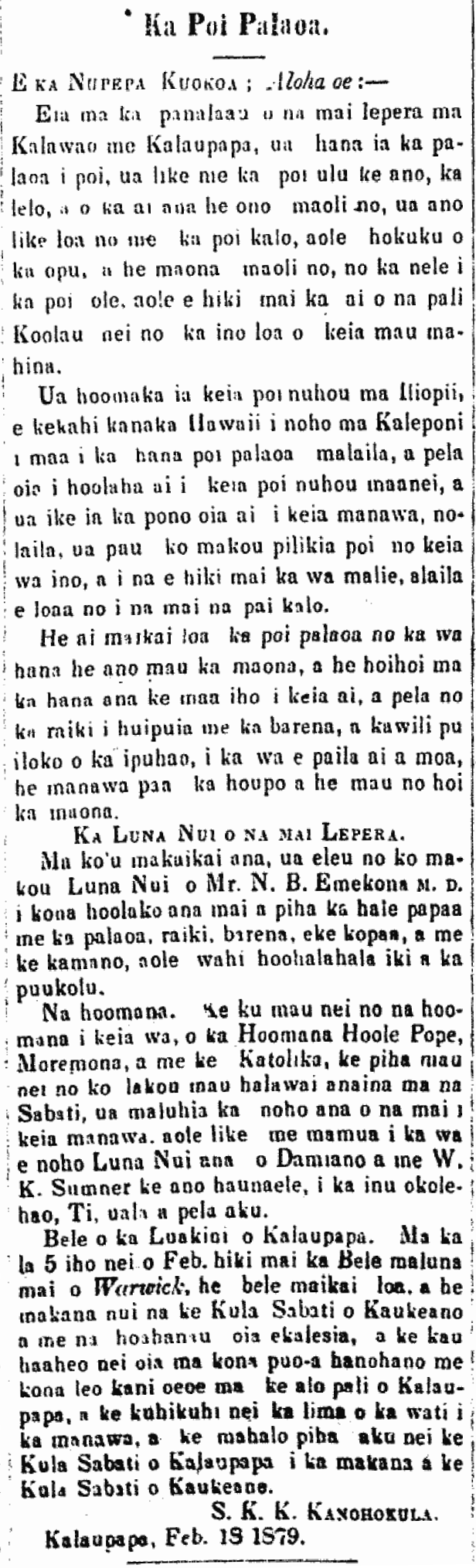
Poi Palaoa.

O Kuokoa Newspaper; Aloha oe:—

Here in the colony of the leprosy patients in Kalawao and Kalaupapa, flour is used to make poi [poi palaoa]; it is similar to poi made of breadfruit [poi ulu] in the yellow color, and it is truly delicious; it is a lot like taro poi [poi kalo]: your stomach doesn’t get sore, and you become full indeed; we have no poi because the taro won’t arrive to these Koolau cliffs because of the terrible weather during these months.

This new poi began at Iliopii, by a Hawaiian who lived in California who was used to making it there, and that is how he spread this new poi here; and the benefits of this poi is now known, and therefore, our poi problems are over during this stormy period, and should calm weather return, the patients will get their paʻi ʻai¹ [pai kalo].

Poi palaoa is very appropriate when working because you stay full, and it is fun to make when you get used to it, and so too with rice mixed with crackers and stirred up in a pot; when it boils and is cooked, it is time for to fill the stomach, and you will be always full.

The Superintendent of the Leprosy Patients.

In my observations, our Superintendent, Mr. N. B. Emerson [Emekona], M. D. is quick with filling the storehouse [hale papaa] with flour [palaoa], rice [raiki], crackers [barena], bags of sugar [eke kopaa], and salmon [kamano]; there is nothing to complain of Kapuukolu.²

Worship. Worship always happens now: Protestants [Hoole Pope], Mormons [Moremona], and Catholics [Katolika]; their meetings on Sundays are always full; life of the patients is peaceful now, not like before when Damien [Damiano] and when W. K. Sumner were Superintendent; there were uprisings from drinking okolehao and other alcoholic drinks made of ti, sweet potato [uala], and so forth.

Bell of the Church of Kalaupapa. On the 5th of Feb., the Bell arrived on the Warwick; a very fine bell which was a gift from the Sunday School of Kaukeano and the brethren of that church; and now it hangs proudly in its honored steeple with its ringing voice in the cliff faces of Kalaupapa, and it points out the movement of the hands of the clock, and the Sunday School of Kalaupapa fully appreciates the gift of the Sunday School of Kaukeano.

S. K. K. Kanohokula.

Kalaupapa, Feb. 18, 1879.

¹Although i tend not to use ʻokina and kahakō, i marked “pai ai” here for added clarity.

²Kapuukolu is a place on Kauai, figuratively used to represent abundance of good food.

(Kuokoa, 3/15/1879, p. 2)

Ka Poi Palaoa.

Ka Nupepa Kuokoa, Buke XVIII, Helu 11, Aoao 2. Maraki 15, 1879.

People from Nuuhiva, 1867.

[Found under: “LOCAL NEWS: OAHU”]

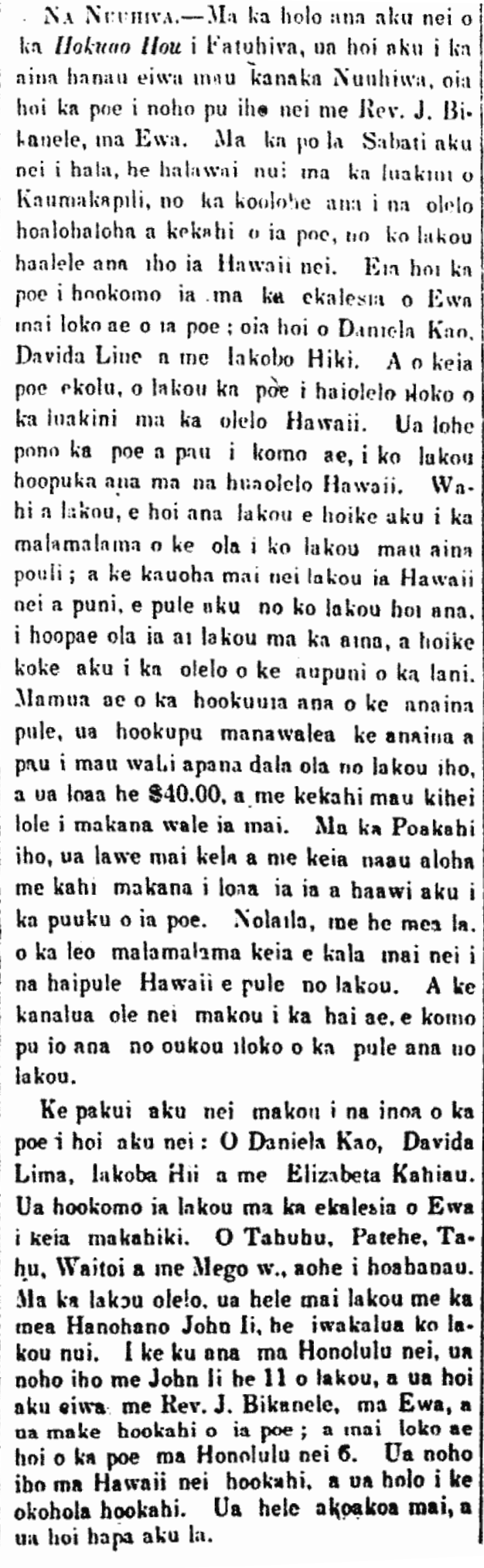
The Nuuhivans.—Upon the sail of the New Hokuao to Fatuhiva, eight Nuuhivans returned to the land of their birth, those were the people who lived with Rev. J. Bicknell [Bikanele] in Ewa. On this past Sunday night, there was a great gathering at Kaumakapili Church, to hear the words of gratitude by some of these people as they leave Hawaii nei. Here are those who were placed in the church of Ewa from amongst these people: Daniela Kao, Davida Line, and Iakobo Hiki. And these three were the ones who gave speeches at the church in Hawaiian. All who entered listened carefully to their speaking of Hawaiian. According to them, they are returning to teach about the light of life in their unenlightened lands; and they bid all of Hawaii to pray on their return, that they may be put on land safely, and soon teach the words of the kingdom of heaven. Before being released, the entire congregation donated money for their daily needs, and $40.00 was collected, along with capes that were gifted. Last Monday, the benevolent brought gifts and gave it to the treasurer of those people. Therefore, it is as if this is the enlightening voice announcing to the devout Hawaiians to pray for them. And we can say without doubt that you will all join in in praying for them.

We are appending the names of the people who returned: Daniela Kao, Davida Lima, Iakoba Hii, and Elizabeth Kahiau. They joined the church of Ewa this year. Tahuhu, Patehe, Tahu, Waitoi, and Mego (female), did not become brethren. According to them, they came along with the Honorable John Ii; there were twenty of them. When they landed in Honolulu, 11 of them lived with John Ii, and nine went with Rev. J. Bicknell to Ewa, and one of those died; those in Honolulu from amongst them are 6. One stayed in Hawaii, and one went on a whaling ship. They came all together, and a portion returned home.

(Kuokoa, 3/30/1867, p. 2)

Na Nuuhiva.

Ka Nupepa Kuokoa, Buke VI, Helu 13, Aoao 2. Maraki 30, 1867.

Alii of Fatu Hiva, 1867.

[Found under: “LOCAL NEWS: OAHU”]

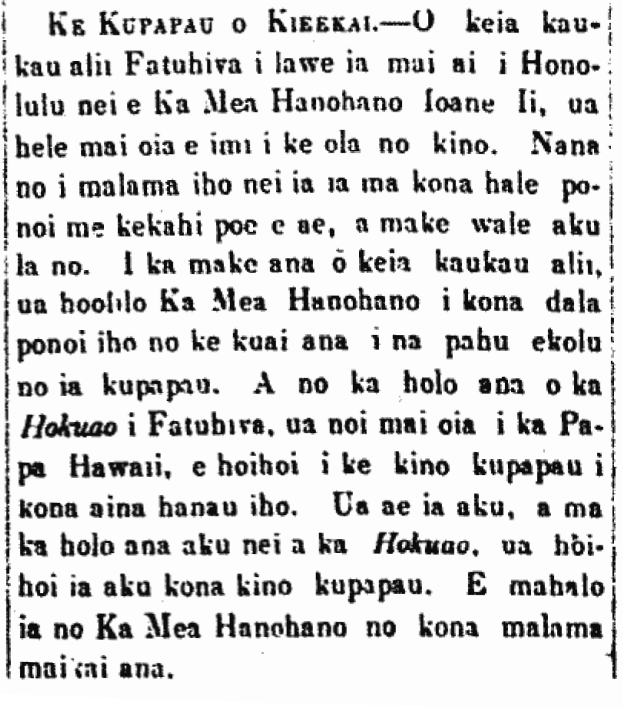
The Body of Kieekai.—This kaukau alii from Fatu Hiva [Fatuhiva] to Honolulu by the Honorable John Papa Ii [Ioane Ii], and he came here in search of health. It was Ii who cared for him at his own home along with some others, and Kieekai died. At the death of this kaukau alii, The Honorable One spent his own money to purchase the three caskets for the body. Being that the Hokuao is on its way to Fatu Hiva, he asked the Hawaiian Board of Missions [Papa Hawaii] to return the body to the land of his birth. It was agreed to, and when the Hokuao left, the body was taken. The Honorable One is appreciated for his fine care.

(Kuokoa, 3/30/1867, p. 2)

Ke Kupapau o Kieekai.

Ka Nupepa Kuokoa, Buke VI, Helu 13, Aoao 2. Maraki 30, 1867.