On Aloha Aina, 1893.

“Breathes there a man with soul so dead,
Who never to himself hath said,
This is my own my native land.”
(Scott.)

Many of those who support honestly the present state of affairs, have done so in the full hope and belief, that thereby the flag of their country—the Stars and Stripes—will float over the land in perpetuity. Not a single Hawaiian, however, even those few whose signatures to annexation petitions (not 200 in number and mostly convicts.) have been bought or forced by necessity from them, desires to see any foreign flag replace his own. Continue reading

Patriotic mele in English, 1893.

As Israel in ancient times sat weeping by the waters of Babylon listening to the plaintive songs which arose from their singers, so sits Hawaii in grief and mourning to-day and to Her our bard sings:

I had a dream, I saw a vision pass before me,
Long ages past arose in swift array,
Adown the stream of time my fleeting fancy bore me
From age to age unto the present day,
Far o’er the southern sea I saw brave ships a-sailing
From isle to isle, till at Hawaii’s shore
They touched, and soon with joy the natives came, them hailing
With pious awe, incarnate Gods of yore,
From all the land they flocked with speed to see the stranger,
Adoring gave their gifts both rich and rare,
But time brought fuller knowledge, knowledge brought its dangers
And Captain Cook’s life paid the forfeit there.
And down the stream still visions came a-floating;
Vancouver came unto this race so brave;
Restored the friendship Cook had lost; while noting
That Britain ne’er would hold them as her slave.
Still swept the vision on with flight so speedy;
One ship alone this time comes into view—
America’s gift unto these islands needy,
Peace, love, goodwill—and Christianity too.
Right lovingly was welcomed each new teacher,
The people flocked to hear good news so true,
That more and more it seemed to every preacher,
The harvest plenteous, but the laborers few.
And time flew by on wings. The isles grew fair, and fairer;
One Briton thought to seize them for his land,
But Britain’s Admiral, our independence bearer,
Restored the flag midst praise from every hand,
The years passed by. Through all the land there rose the steeple—
The preacher controlled all with kindly hand;
Give land and constitution to your people!
(O King! Give heed!) and God will bless your land.
Year followed year. Changed Kings and constitution.
The stranger increased: took mortgages on land:
Kept Hawaii’s daughters, sisters, wives in prostitution:
Spread poverty and vice around on ev’ry hand.
Still years rolled on. With sugar now grown wealthy,
The foreign Christians lifts his eye around,
And says: “For me no doubt the climate is most healthy,
“Tho’ poor and dying Hawaii’s native sons are found.
“Some seventy years ago we gave this land the Bible
“And tried to teach them then its use,
“(To say we’ve showed them poor examples is no libel)
“And fair exchange ‘t will be to cook their goose.
“Their cries for right and justice soon we’ll stifle:
“Take for ourselves this Paradise on earth.
“If they object, we’ll each one tap our rifle,
“And call for help upon our land of birth.
“Unfit to rule with all these years of training—
“(We’ll spread the lie around on every hand,)
“You’ll see they’ll let us do it, uncomplaining,
“For they have got our Bible, and so we’ll take their land.”
At this a noise awoke me, and in wonder
I saw the very instance of my dream.
Hawaii’s Queen and Natives were put under
To bolster up their money-getting scheme
And now forth from them goes across the waters
One last appeal for Justice and for Right.
Preserving peace, Hawaii’s gen’rous sons and daughters,
Before God’s throne on high, in prayer unite:
“Great God! the Judge of All! The records thou art keeping!
“Look down in mercy on our sad estate!
“Be kind unto us! Hear our voice of weeping!
“Till thou restore, grant us in peace to wait.
“And thou, great nation! home of truth and bravery!
“Freedom’s defender! we pray thee us O, hear!
“Restore our Queen and us; now, as in slavery,
“Held by usurper’s armed fear.
“Restore our rights and help us to maintain them!
“O let our prayer be crowned with success!
“Our conduct and your friendship will retain them,
“The God of nations will for ever bless.”

[This mele was probably composed by Kahikina Kelekona, J. G. M. Sheldon.

The image taken from the microfilm is hard to make out at the bottom. Hopefully there will be funding found to have the Hawaiian-Language Newspapers be unbound and rescanned clearly. How can you get to all the pearls stored in the newspapers if you can’t make out the words?]

(Hawaii Holomua, puka pule, 1/28/1893, p. 4)

As Israel in ancient times...

Hawaii Holomua (Puka Pule), Buke III, Helu 5, Aoao 4. Ianuari 28, 1893.
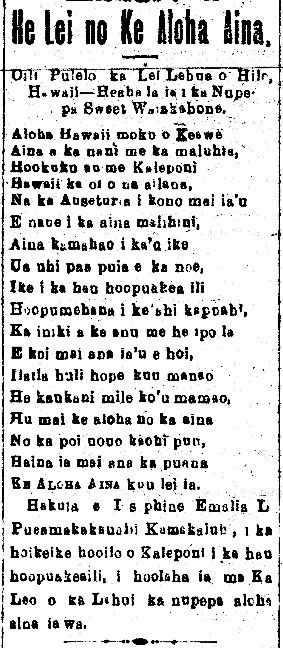
Sweet Emalia and “Moku o Keawe” redux, 1907.

A Lei of Patriotism.

The Lehua Garland of Hilo, Hawaii Rises in Triumph—What is that in the Newspaper, Sweet Waiakahone.

Aloha Hawaii moku o Keawe
Aina a ka nani me ka maluhia,
Hookuku au me Kaleponi
Hawaii ka oi o na ailana,
Na ka Auseturia i kono mai ia’u
E naue i ka aina malihini,
Aina kamahao i ka’u ike
Ua uhi paa puia e ka noe,
Ike i ka hau hoopuakea ili
Hoopumehana i ke ahi kapuahi,
Ka iniki a ke anu me he ipo la
E koi mai ana ia’u e hoi,
Ilaila huli hope kuu manao
He kaukani mile ko’u mamao,
Hu mai ke aloha no ka aina
No ka poi uouo kaohi puu,
Haina ia mai ana ka puana
Ke Aloha Aina kuu lei ia.

Composed by Iosephine Emalia L. Pueamakakaualii Kamakaluhi, at the California winter exhibition in the skin-whitening snow, published in Ka Leo o ka Lahui, the patriotic newspaper of the time.

[Sweet Emalia and her song of aloha aina which is still so famous today!]

(Aloha Aina, 10/26/1907, p. 8)

He Lei no Ke Aloha Aina.

Ke Aloha AIna, Buke XII, Helu 43, Aoao 8. Okatoba 26, 1907.

Queen Liliuokalani birthday celebration, 1911.

Birthday of Liliu.

On this past Saturday, September 2, it was the birthday of Queen Liliuokalani, and a royal audience was held midday of that day between 11 a. m. and 1 p. m. in the afternoon.

At 8 a. m. in the morning of this Saturday, the Royal Hawaiian Band [Bana Hawaii] appeared at Washington Place [Wakinekona Home] and played Hawaiian songs which were composed by the alii during the Monarchy of Hawaii nei, and some of these songs were composed by Queen Liliuokalani. The Royal Hawaiian Band played for an hour in the morning to commemorate the birthday of Liliu at Washington Place, and they played once again from 11 midday to 1 in the afternoon.

At 11, the public was allowed to come and see the alii. The Kalama Society, Kaahumanu Society, and Kauikeaouli Society arrived to see the Queen.

The interior of Washington Place was decorated with kahili, just as during the era when the alii ruled—it was beautiful and awe inspiring to see that morning. The Queen sat upon her cotton chair [noho pulu], with two boys behind her chair, holding long kahili, with ahuula upon their shoulders. The Princess Kawananakoa was on the Queen’s right, and Colonel Iaukea was on her left, and he was the one who introduced the Queen to the malihini and to the townspeople. There also, were the heads of the Territory, County, and Federal government. There were many distinguished people of this town who went to see the alii, and by the looks of it, almost one thousand people came during this royal audience.

What shocked this reporter on that morning, was that two-thirds of the people who went to give their congratulations on the birthday of the Queen were malihini and haole. As for the true Hawaiians, only but a few went to see the alii. Reflecting back in time, and seeing Liliu in her finery, i am lulled into recalling the days when Hawaiians were proud upon the soil of their native land.

(Kuokoa Home Rula, 9/8/1911, p. 4)

ka La Hanau o Liliu.

Kuokoa Home Rula, Buke IX, Helu 36, Aoao 4. Sepatemaba 8, 1911.

Keahu Kealiiaukai, an awesome biography, 1941.

Recalling the Days of Kamehameha V.

KEAHU KEALIIAUKAI

Keahu Kealiiaukai is one of the last Hawaiians left who is not proficient in English. He is a Hawaiian famous for his knowledge of plants, and he is 82 years old. He lives in Lahaina, Maui, the capital of Hawaii in days of yore. Kealiiaukai is now living with his daughter, Mrs. Juliette Pali.

When Kealiiaukai was born in Kaupo, Maui, on the road going to the crater of Haleakala, in the year 1859, this was the fifth year of Kamehameha IV’s reign over Hawaii nei. Kealiiaukai was 4 when that monarch died. He does not recall this.

Remembering the King.

However, Kealiiaukai does in fact remember Kamehameha V, or King Kapuaiwa, his given name; and the last of the Kamehamehas. Kapuaiwa went to Lahaina numerous times, where he was welcomed warmly by his makaainana.

In Kealiiaukai’s eighty and two years of life, he witnessed the passing of the monarchs of his homeland, closing with the overturning of the nation under Queen Liliuokalani’s protection, in 1893. Then the establishing of the provisional government and the Republic of Hawaii, and the joining of the Islands to the United States and the formation of this Territory of America, 40 years ago.

A Religious Man

Kealiiaukai is an important man in Lahaina for the kamaaina there. His wife left this world eight years ago, but she did not however leave behind children. Kealiiaukai is still strong and active. He participates often in works of this Father in Heaven. He spent his life being a member of the Faith of the Latter Day.

Perhaps he is the last medicine man living and practicing from before the times when there was licensing of those in that profession. During his time, it is said that Kealiiaukai practiced healing with plants amongst his own people and healed them due to his expertise in the use of plants growing in the forests of Hawaii, for all types of illnesses.

(Hoku o Hawaii, 3/5/1941, p. 1)

Hoomanao Ina La O Kamehameha V

Hoku o Hawaii, Volume XXXV, Number 45, Page 1. Malaki 5, 1941.

Oamaru, New Zealand graves searchable online, 2013.

Cemetery database makes family searches easier

A new Oamaru cemeteries database has the potential to provide insight into the past, a supporter of the initiative says.

The database is available through the Waitaki District Council website and allows users to search for people buried in the Oamaru Old and Lawn Cemeteries by surname and/or first name, and shows information such as the age of the deceased and what block and plot they are buried in.

North Otago Museum archives curator Eva Garbutt says tracing family history is becoming a popular pastime, with more people than ever wanting to unearth their roots.

“In the past year the demand for putting our cemetery database online has increased as more and more people are getting into doing their family history.

“Now people will be able to search for their ancestors buried in the Oamaru cemeteries thanks to the wonderful

efforts of our volunteers, who have spent many hours putting the information from the original burial registers into a digital and searchable format.”

Waitaki District councillor and historian Helen Stead is a huge supporter of the database and says she is delighted it is up and running.

“I think it places us in the research and genealogical world, because people can look at the database that relates to Oamaru from anywhere in the world.”

Mrs Stead also believes the database could unlock dozens of stories about Oamaru’s past that have been lost with time.

[For the entire article from The Timaru Herald, click the link below:

Cemetery database makes family searches easier]

A hapa haole advertisement, 1912.

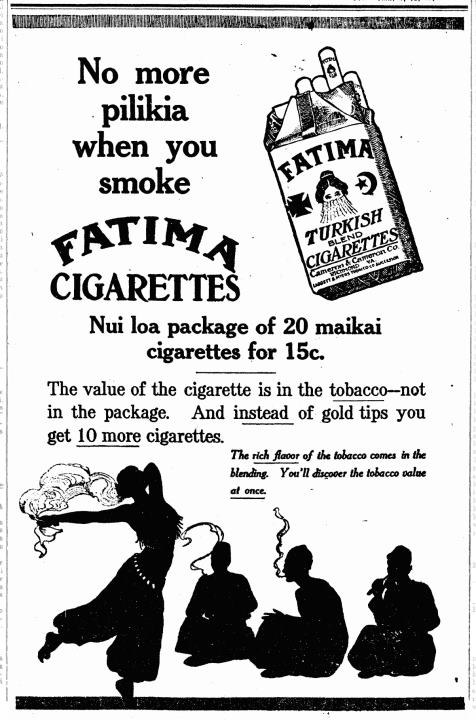
No more
problems
when you
smoke

FATIMA

TURKISH
BLEND
CIGARETTES
Cameron & Cameron Co.
RICHMOND, VA
LIGGETT & MYERS TOBACCO CO., SUCCESSOR.

FATIMA
CIGARETTES

Large package of 20 fine
cigarettes for 15¢

The value of the cigarette is in the tobacco—not in the package. And instead of gold tips you get 10 more cigarettes.

The rich flavor of the tobacco comes in the blending. You’ll discover the tobacco value at once.

[This ad is interesting for so many reasons!]

(Kuokoa 7/5/1912, p. 8)

FATIMA CIGARETTES

Ka Nupepa Kuokoa, Buke XLVIII, Helu 27, Aoao 8. Iulai 5, 1912.

More Hawaiians in the military, 1917.

JOHN A. K. K. MILES

WORKING IN THE SERVICE OF AMERICA

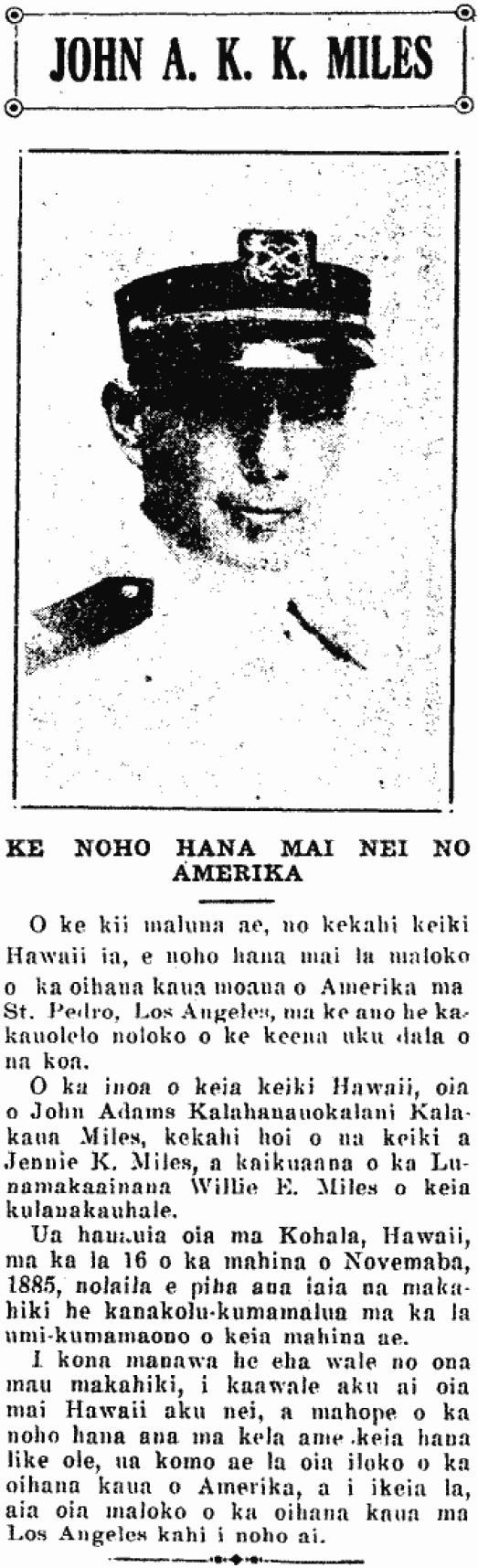
The picture above is of a Hawaiian boy who is working in the navy of America at St. Pedro, Los Angeles, as a secretary in the department of the payroll of the military.

The name of this Hawaiian youth is John Adams Kalahanauokalani Kalakaua¹ Miles, a child of Jennie K. Miles and the older brother of Legislator Willie E. Miles of this city.

He was born in Kohala, Hawaii, on the 16th of November, 1885, and therefore he will make 32 on the 16th of next month.

When he was but four years old, he was taken from Hawaii nei, and after working at various jobs, he joined the military of America. And today, we see that he is in the service in Los Angeles, where he resides.

¹One way names were given traditionally was after important events, whether happy or sad. This is a nice and clear example of a commemorative name. John A. K. K. Miles was born on November 16, 1885, on the birthday of King Kalakaua. He was therefore named literally “The birthday of the royal one Kalakaua”.

(Kuokoa, 10/19/1917, p. 4)

JOHN A. K. K. MILES

Ka Nupepa Kuokoa, Buke LV, Helu 42, Aoao 4. Okatoba 19, 1917.

Hawaiian dies at war, 1917.

ALLY PAMA KUA

HAWAIIAN BOY IS TORPEDOED AND DIES.

The picture [above] is of a Hawaiian sailor, named Ally Pama Kua, who just died at sea when the steamship Kansas was sunk by a torpedo from a German submarine. This, according to a telegraph sent to this town from New York, on the 11th of this month.

The Kansas was torpedoed while it was carrying a full load to France from New York. When the steamship was sunk, A. P. Kua drowned, along with him was a American haole, and two others. As for the captain and the rest of the sailors, they all were all saved.

Because of this sad news received in town, it caused the family of Mr. Kua to be heartbroken. However, there is one thing that made it better, and that was the knowledge that the death of this Hawaiian boy was because he sacrificed his life for his country.

Ally Pama Kua was twenty-seven years old when he met with this tragedy at sea. He is the child of Fritz Wilhelm Kua of the corner of Makiki Street and Beritania Avenue. Aside from his father, he has three sisters and two cousins who are left behind grieving for him.

Ally Pama Kua was employed for a long time as a sailor aboard the steamship Kansas, from when it was sailing Hawaiian waters. And when it became a ship transporting food and other goods for France, he continued working aboard it, all the way until he met with his death on the ocean.

The last word that his family here heard from him was when they received his letter from Philadelphia written last February, and within the letter, he spoke of his marriage to a French woman.

(Kuokoa, 7/20/1917, p. 2)

ALLY PAMA KUA

Ka Nupepa Kuokoa, Buke LV, Helu 29, Aoao 2. Iulai 20, 1917.

Hawaiians away at war, 1917.

Some Hawaiian Boys Aboard the Warship St. Louis

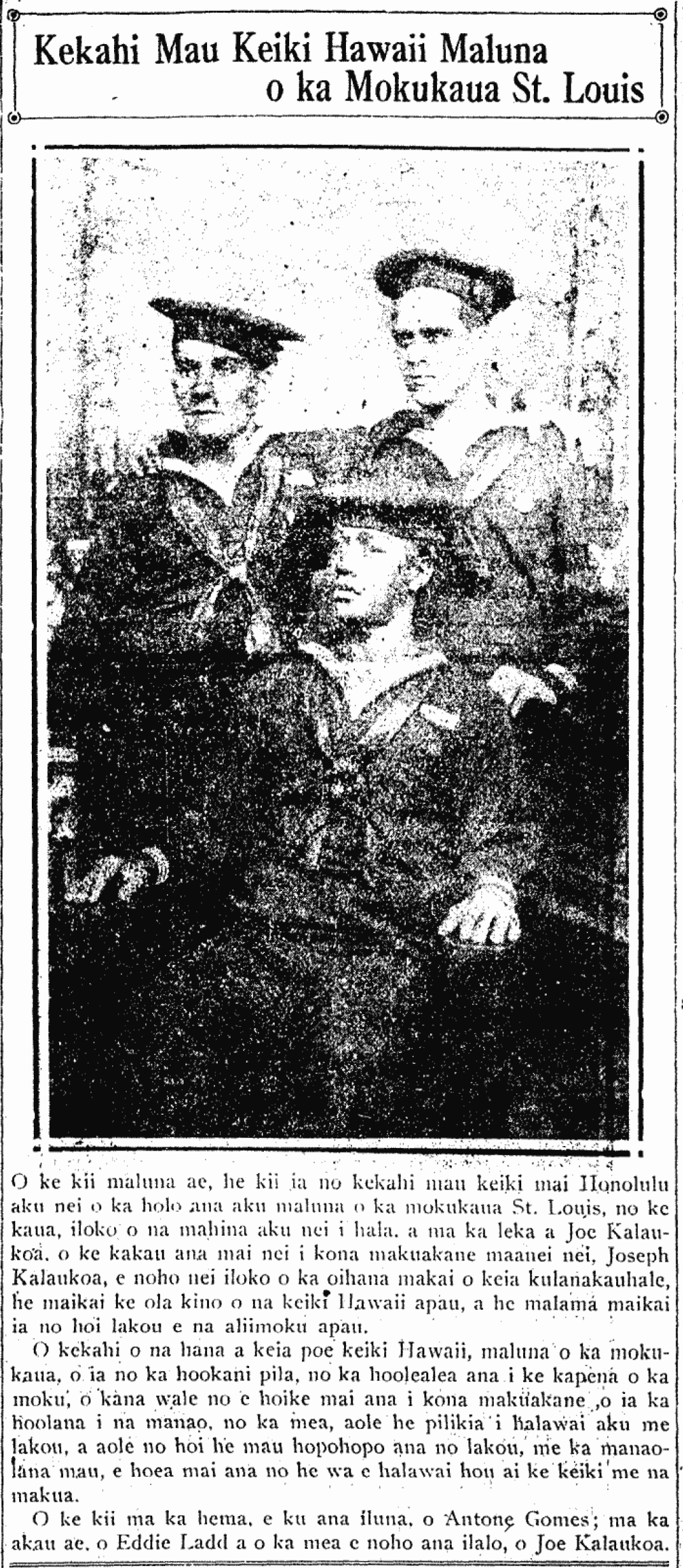
The picture above is of some boys, who left from Honolulu on the warship St. Louis in the past months for the war. And according to the letter written by Joe Kalaukoa to his father Joseph Kalaukoa, who is in the police force of this city, all of the Hawaiian youths are doing well and are all being well taken care of by the officers.

One of the activities of these Hawaiian boys aboard the warship is playing music to entertain the ship’s captain; everything he wrote to his father was uplifting, because there has been no difficulties faced, and he has no fear for them and is forevermore hopeful that there will come a time that the child will again see his parents.

In the picture, standing to the left is Antone Gomes; to the right is Eddie Ladd, and the one seated is Joe Kalaukoa.

(Kuokoa, 7/13/1917, p. 2)

Kekahi Mau Keiki Hawaii Maluna o ka Mokukaua St. Louis

Ka Nupepa Kuokoa, Buke LV, Helu 28, Aoao 2. Iulai 13, 1917.