Selection from Homer’s Iliad, 1868.

WRITING.

Greetings to you [E weli aku ana ia oe] O Maaa wind of my beloved land moistened by the light showers of Winter, and the fragrance-carrying Puulena wind of Mahamoku: O Honele Ihuanu of Albion,¹ aloha to you. It was many years ago when I was overcome by a sudden desire for the poems of the Iliad, the book of Homer of the Greeks, along with the Aeneid of Virgil of the Romans, as I assumed that these mele books were the greatest compositions of the world. I had a great desire to read wisely the lines which brought delight to my mind—however, I was held back by a great cliff from which I was not able to leap and dive to the other side where my mind desired, being that it was written in a superior foreign language reaching the very core of the tongue, which these lips could not mouth; the classical language of those poems. And because I saw these mele in English, translated by someone skilled in those classical languages, that is the reason I thought to bring it into our own language so that you as well may see some of those poems; and perhaps there will be some of you who will hold the past in high regard just as I do. The nature of this mele composed below is a conversation between Hector (a fearless Warrior of Troy) and his wife, Andromache, when they were being warred upon by Greece: The composition of this mele is near factual; and it is truly beautiful. Thus:

“A! e ke alii wiwo ole, i hea la oe e holo aku ai?
A hoopoina loa hoi i kau wahine a me kau keiki.
Aole anei ou manao i ka nui o ko maua pilikia?
Ia’u, he wahine kane ole, a me iala hoi he keiki makua ole? Continue reading
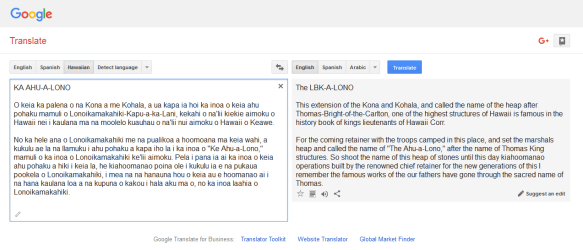

Google Translate, 2016.

I was excited when I read the news this morning in the Honolulu Star Advertiser. I thought I might have been able to give this site up… I guess we all have to start somewhere!

The LBK-A-LONO

This extension of the Kona and Kohala, and called the name of the heap after ThomasBrightoftheCarlton, one of the highest structures of Hawaii is famous in the history book of kings lieutenants of Hawaii Corr.

For the coming retainer with the troops camped in this place, and set the marshals heap and called the name of The Ahua-Lono,” after the name of Thomas King structures. So shoot the name of this heap of stones until this day kiahoomanao operations built by the renowned chief retainer for the new generations of this I remember the famous works of the our fathers have gone through the sacred name of Thomas.

Google_Translate

Ok, that was unrealistic, but:

Google_Translate.png

I am sure there will come a day that it will read better. I applaud Google for this first step!

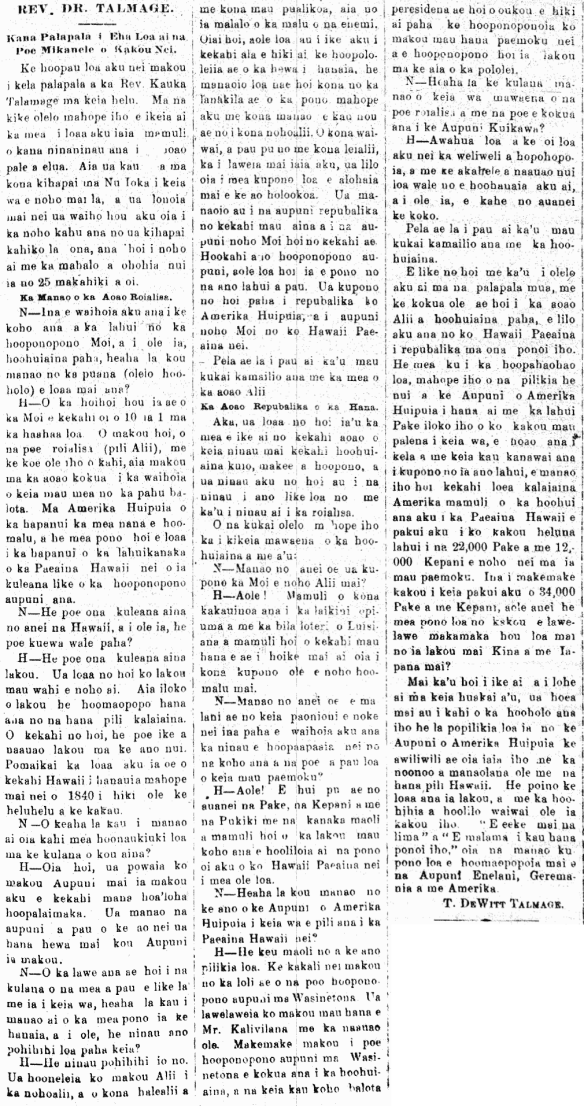
Unheeded words of Talmage to the United States of America, 1894.

REV. DR. TALMAGE.

His Article Which Greatly Hurt the Missionaries Amongst Us.

The article below written by the Rev. Doctor Talmage of New York and published in a newspaper there was translated and published in the newspaper “Aloha Aina;” however,  because of the difference between our understanding of the translation and theirs, we took it and translated it once more and am putting it before our readers. Here is our translation of the said article:

Honolulu, June 18, 1894.

The chamberlain came to invite the two of us to go to the residence of the former Monarch, and had suggested 11 o’clock that morning as the best hour for our visit…

[This is what sent me looking for the article I posted earlier today. Unfortunately, the previous translation is not found online. It must have been printed in the paper, “Nupepa Aloha Aina” which ran from 1/6/1894 to 1/5/1895. The entire run is in the holdings of the Mission Children’s Society Library. This is a paper that is well worth digitizing and OCRing. I am excited to see what the translation differences could be!]

Makaainana_11_12_1894_1.png

Ka Makaainana, Buke II—Ano Hou, Helu 20, Aoao 1. Novemaba 12, 1894.

Makaainana_11_26_1894_1.png

Ka Makaainana, Buke II—Ano Hou, Helu 22, Aoao 1. Novemaba 26, 1894.

Lorenzo Lyons, translator of “The Raven”! 1871.

I posted the awesome translation of Poe’s “The Raven” back in 2013, but back then I did not realize that “Hawaii” was Lorenzo Lyons! Wow.

Ma ke aumoe pouliuli, ia’u i nalu a luluhi
Ma na mea kahiko loa, ane nalo aku no,
Kimo au la, ane moe, hikilele i ka lohe
I ka mea me he kikoni i koni ma ka puka o’u,
He malihini wahi au, i koni ma ka puka o’u,
Oia wale iho no….

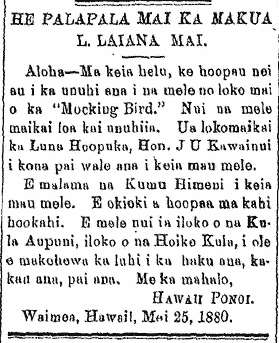
Lorenzo Lyons was also “Hawaii Ponoi”! 1880

A LETTER FROM FATHER L. LAIANA.

Aloha—In this issue, I am concluding my translation of the mele from the “Mocking Bird.” Many very fine songs have been translated. The Publisher [Luna Hoopuka], Hon. J. U. Kawainui, has been kind to print these mele.

The Song Teachers should keep these mele. They should cut them out and assemble them in once place. Sing them widely in the Public Schools, at the School Presentations, so that the work spent composing, writing, and printing these mele will not go to waste. With appreciation,

Hawaii Ponoi.

Waimea, Hawaii, May 25, 1880.

[It is good to know that Lorenzo Lyons went by the pen name “Hawaii Ponoi” as well as “Hawaii”.]

(Ko Hawaii Pae Aina, 6/5/1880, p. 4)

KHPA_6_5_1880_4

Ko Hawaii Pae Aina, Buke III, Helu 23, Aoao 4. Iune 5, 1880.

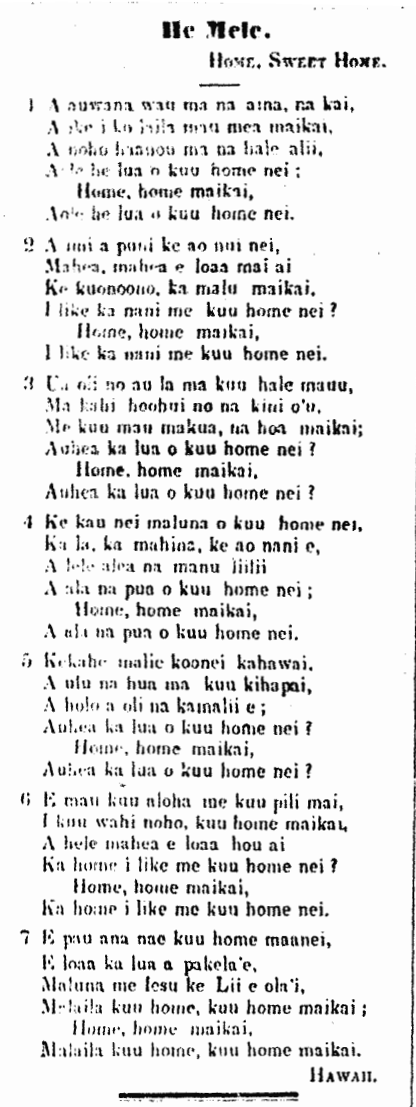
A song by “Hawaii”, 1866.

He Mele.

Home, Sweet Home.

1 A auwana wau ma na aina, na kai,
A ike i ko laila mau mea maikai,
A noho haanou ma na hale alii,
Aole he lua o kuu home nei;
Home, home maikai,
Aohe he lua o kuu home nei.

2 A imi a puni ke ao nui nei,
Mahea, mahea e loaa mai ai,
Ke kuonoono, ka malu maikai,
I like ka nani me kuu home nei?
Home, home maikai,
I like ka nani me kuu home nei.

3 Ua  oli no au la ma kuu hale mauu.
Ma kahi hoohui no na kini o’u,
Me kuu mau makua, na hoa maikai,
Auhea ka lua o kuu home nei?
Home, home maikai,
Auhea ka lua o kuu home nei?

4 Ke kau nei maluna o kuu home nei,
Ka la, ka mahina, ke ao nani e,
A lele alea na manu liilii,
A ala na pua o kuu home nei;
Home, home maikai,
A  ala na pua o kuu home nei.

5 Kekahe malie koonei kahawai,
A ulu na hua ma kuu kihapai,
A holo a oli na kamalii e;
Auhea ka lua o kuu home nei?
Home, home maikai,
Auhea ka lua o kuu home nei?

6 E mau kuu aloha me kuu pili mai,
I kuu wahi noho, kuu home maikai,
A hele mahea e loaa hou ai,
Ka home i like me kuu home nei?
Home, home maikai,
Ka home i like me kuu home nei.

7 E pau ana nae kuu home maanei,
E loaa ka lua a pakela’e,
Maluna me Iesu ke Lii e ola’i,
Malaila kuu home, kuu home maikai,
Home, home maikai,
Malaila kuu home, kuu home maikai.

Hawaii.

[Now that I know that “Hawaii” is Lorenzo Lyons, it makes sense that he was very prolific in the newspapers with his many poetic compositions.]

(Kuokoa, 1/27/1866, p. 4)

Kuokoa_1_27_1866_4

Ka Nupepa Kuokoa, Buke V, Helu 4, Aoao 4. Ianuari 27, 1866.

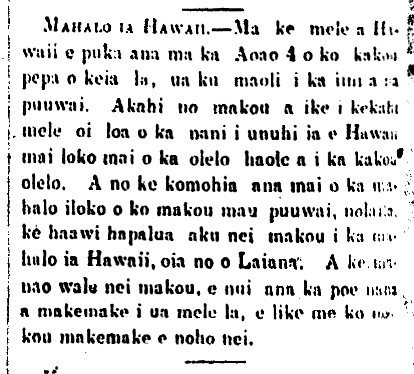
The translator of mele who calls himself “Hawaii” is Lorenzo Lyons! 1866.

[Found under: “HUNAHUNA MEA HOU O HAWAII NEI.”]

Appreciation for Hawaii.—The song published on Page 4 of our paper today, is something truly that our hearts desire. This is the first time that we have seen a song that is exceptionally beautiful translated by Hawaii from English to our language. And being that we feel admiration in our hearts, we give a portion of thanks [??? ke haawi hapalua aku nei makou i ka mahalo] to Hawaii, that is to Lyons [Laiana]. And we believe that there will be many who will see it and like the mele, just as we do.

[I have been searching for the identity of this person Hawaii for many years. Finding the identity of pen names used in Hawaiian newspapers is always an exciting thing.]

(Kuokoa, 1/27/1866, p. 2)

Kuokoa_1_27_1866_2

Ka Nupepa Kuokoa, Buke V, Helu 4, Aoao 2. Ianuari 27, 1866.

Kalakaua’s translation of “Die Wacht am Rhein,” 1872.

Ke Kiai ma ka Rino!

Melody “Watch on the Rhine.”

1. Mehe nei la no ka Iku-wa,
Mehe ale no ke Ki-la,
I ka Rino! No ka he-le,
I paa’i a pake-le,

Mai wiwo e na hoa,
No ke one hanau koa,
E kiai ma ka Rino,
Kupaa a kuo-o!

2. Lohea na leo tausani,
Na maka kai ka lani,
E paa Ieremani-a,
I ka iwi o ka ai-na.

Mai wiwo e na hoa,
No ke one hanau koa,
E kiai ma ka Rino,
Kupaa a ku0-o!

3. E leha ae ilu-na,
I ike mai ka Maku-a,
I paa mau ka Ri-no
Na a-a o ke ki-no.

Mai wiwo e na hoa,
No ke one hanau koa,
E kiai ma ka Ri-no,
Kupaa a kuo-o!

4. I kulu koko hookahi,
I paa i ka pahi,
He pu ma kahi aoao,
Aohe eu nana uwao.

Mai wiwo e na hoa,
O ka one hanau koa,
E kiai ma ka Ri-no
Kupaa a kuo-o!

5. Mehe wai ka leo e kahe nei,
Kawelo a ka hae, ka lei,
Ma ka muliwai o Ri-no
E kiai no na Ri-no.

Mai wiwo e na hoa,
O ka aina hanau koa,
E kiai ma ka Ri-no
Kupaa a kuo-o!

Figgs.

[This is later reprinted in the Kuokoa on 3/29/1907 without attribution.]

(Au Okoa, 2/15/1872, p. 1)

Ke Kiai ma ka Rino!

Ke Au Okoa, Buke VII, Helu 44, Aoao 1. Feberuari 15, 1872.

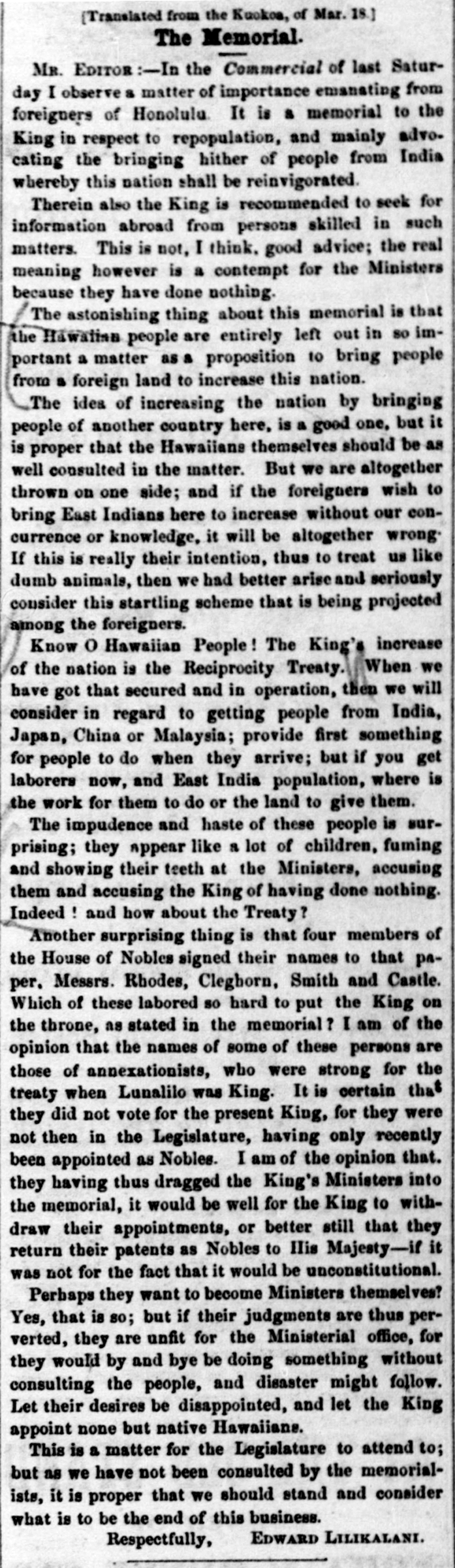
Translation of Edward Lilikalani’s response to the haole Memorial, 1876.

[Translated from the Kuokoa, of Mar. 18.]

The Memorial.

Mr. Editor:—In the Commercial of the last Saturday I observe a matter of importance emanating from foreigners of Honolulu. It is a memorial to the King in respect to repopulation, and mainly advocating the bringing hither of people from India whereby this nation shall be reinvigorated.

 Therein also the King is recommended to seek for information abroad from persons skilled in such matters. This is not, I think, good advice; the real meaning however is a contempt for the Ministers because they have done nothing.

The astonishing thing about this memorial is that the Hawaiian people are entirely left out in so important a matter as a proposition to bring people from a foreign land to increase this nation.

The idea of increasing the nation by bringing people of another country here, is a good one, but it is proper that the Hawaiians themselves should be as well consulted in the matter. But we are altogether thrown on one side; and if the foreigners wish to bring East Indians here to increase without our concurrence or knowledge, it will be altogether wrong. If this is really their intention, thus to treat us like dumb animals, then we had better arise and seriously consider this startling scheme that is being projected among the foreigners.

Know O Hawaiian People! The King’s increase of the nation is the Reciprocity Treaty. When we have got that secured and in operation, then we will consider in regard to getting people from India, Japan, China or Malaysia; provide first something for people to do when they arrive; but if you get laborers now, and East India population, where is the work for them to do or the land to give them.

The impudence and haste of these people is surprising; they appear like a lot of children, fuming and showing their teeth at the Ministers, accusing them and accusing the King of having done nothing. Indeed! and how about the Treaty?

Another surprising thing is that four members of the House of Nobles signed their names to that paper, Messrs. Rhodes, Cleghorn, Smith and Castle. Which of these labored so hard to put the King on the throne, as stated in the memorial? I am of the opinion that the names of some of these persons are those of annexationists, who were strong for the treaty when Lunalilo was King. It is certain that they did not vote for the present King, for they were not then in the Legislature, having only recently been appointed as Nobles. I am of the opinion that they having thus dragged the King’s Ministers into the memorial, it would be well for the King to withdraw their appointments, or better still that they return their patents as Nobles to His Majesty—if it was not for the fact that it would be unconstitutional.

Perhaps they want to become Ministers themselves? Yes, that is so; but if their judgments are thus perverted, they are unfit for the Ministerial office, for they would by and bye be doing something without consulting the people, and disaster might follow. Let their desires be disappointed, and let the King appoint none but native Hawaiians.

This is a matter for the Legislature to attend to; but as we have not been consulted by the memorialists, it is proper that we should stand and consider what is to be the end of this business.

Respectfully,  Edward Lilikalani.

[Here is a translation of Edward Kamakau Lilikalani’s response to the repopulation memorial that was printed in the Kuokoa on 3/18/1876.]

(Pacific Commercial Advertiser, 3/25/1876, p. 3)

The Memorial.

The Pacific Commercial Advertiser, Volume XX, Number 39, Page 3. March 25, 1876.

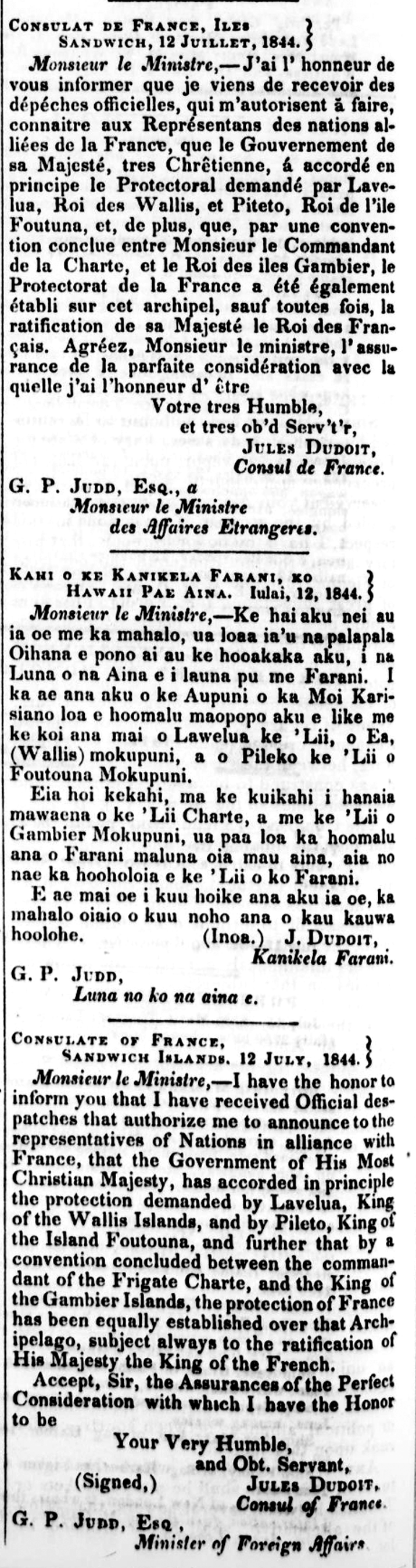
International Hawaii, 1844.

Consulat de France, Iles
Sandwich, 12 Juillet, 1844.

Monsieur le Ministre,—J’ai l’ honneur de vous informer que je viens de recevoir des dépéches officielles, qui m’autorisent ă faire, connaitre aux Représentans des nations alliées de la France, que le Gouvernement de sa Majesté, tres Chrêtienne, á accordé en principe le Protectoral demandé par Lavelua, Roi des Wallis, et Piteto, Roi de l’ile Foutuna, et, de plus, que, par une convention conclue entre Monsieur le Commandant de la Charte, et le Roi des iles Gambier, le Protectorat de la France a été également établi sur cet archipel, sauf toutes fois, la ratification de sa Majesté le Roi des Français. Agréez, Monsieur le ministre l’ assurance de la parfaite considération avec la quelle j’ai l’ honneur d’ être

Votre tres Humble,
et tres ob’d Serv’t’r,
Jules Dudoit,
Consul de France.

G. P. Judd, Esq., a
Monsieur le Minstre
des Affaires Etrangeres.

—————

Kahi o ke Kanikela Farani, Ko
Hawaii Pae Aina. Iulai, 12, 1844.

Monsieur le Ministre,—Ke hai aku nei au ia oe me ka mahalo, ua loaa ia’u na palapala Oihana e pono ai au ke hooakaka aku, i na Luna o na Aina e i launa pu me Farani. I ka ae ana aku o ke Aupuni o ka Moi Karisiano loa e hoomalu maopopo aku e like me ke koi ana mai o Lawelua ke ‘Lii, o Ea, (Wallis) mokupuni, a o Pileko ke ‘Lii o Foutouna Mokupuni.

Eia hoi kekahi, ma ke kuikahi i hanaia mawaena o ke ‘Lii Charte, a me ke ‘Lii o Gambier Mokupuni, ua paa loa ka hoomalu ana o Farani maluna o ia mau aina, aia no nae ka hooholoia e ke ‘Lii o ko Farani.

E ae mai oe i kuu hoike ana ia oe, ka mahalo oiaio o kuu noho ana o kau kauwa hoolohe.

(Inoa.)  J. Dudoit,
Kanikela Farani.

G. P. Judd,
Luna no ko na aina e.

—————

Consulate of France,
Sandwich Islands, 12 July, 1844.

Monsieur le Ministre,—I have the honor to inform you that i have received Official despatches that authorize me to announce to the representatives of Nations in alliance with France, that the Government of His Most Christian Majesty, has accorded in principle the protection demanded by Lavelua, King of the Wallis Islands, and by Pileto, King of the Island Foutouna, and further that by a convention concluded between the commandant of the Frigate Charte, and the King of the Gambier Islands, the protection of France has been equally established over that Archipelago, subject always to the ratification of His Majesty the King of the French.

Accept, Sir, the Assurances of the Perfect Consideration with which I have the Honor to be

Your Very Humble,
and Obt. Servant,
(Signed,) Jules Dudoit,
Consul of France.

G. P. Judd, Esq.
Minister of Foreign Affairs.

(Polynesian, 7/20/1844, p. 2)

Consulat de France, Iles

The Polynesian, New Series, Volume 1, Number 9, Page 2. July 20, 1844.