Kamehameha IV visits Nihoa, 1857.

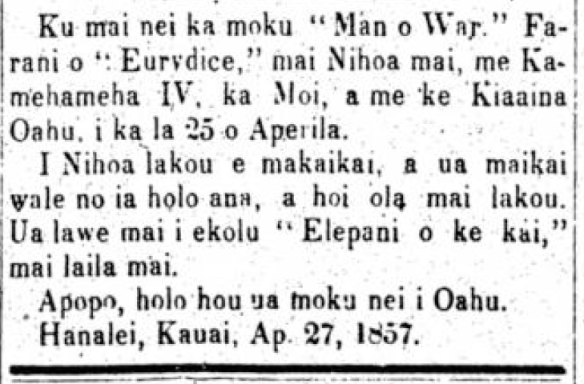
The French man of war “Eurydice” arrived from Nihoa with Kamehameha IV, the King, and the Governor of Oahu [Kekuanaoa], on the 25th of April.

They were on Nihoa touring, and the trip was fine, and they returned in good health. They brought back three “Elephants of the sea,” from there.

Tomorrow, the vessel will return to Oahu.

Hanalei, Kauai, Ap. 27, 1857.

(Hae Hawaii, 5/13/1857, p. 26)

HaeHawaii_5_13_1857_26

Ka Hae Hawaii, Buke 2, Ano Hou.—Helu 7, Aoao 26. Mei 13, 1857.

Annie Freitas composition on trip to see Kapiliula, Maui, 1921.

KAPILIULA SONG

Ikemaka i ka nani o Kapiliula,
Hoohihi ka manao me ka makemake;
Ia wai kaulana o ka aina,
Makaikaiia e ka malihini.

Ua inu ia wai ono hu’ihu’i,
Ia wai kahe mai i ke kumupali;
O ka nee a ka ua me ka makani,
Mea ole nae ia i nei hookele.

Ilaila kamau kiaha bia,
Olu ai ka hele ana o ia kula loa;
Ua lei i ka pua a o ka lehua,
Ua ai i ka hua ohelo papa.

He nui na ono a o ia uka,
O ka lua leko me ka hoio;
Ku au mahalo aku o ka nani,
I ka papa auwai a ke aupuni.

Moani ke ala o ke kiele,
E kono mai ana ia’u e hoi;
Kau aku i ke kaa otomobile,
Olapa ka uwila i Kipahulu.

Aina a ka nani me ka maikai,
Kaulana i ka makani lawe huapala.

Kipa aku i ka hale kamaaina,
Ai i ka opae mahikihiki;
Ilaila hoohihi kahi manao,
I ka hanu aala o pua roselani.

E hoi kakou ua ahiahi,
E ike i ka wai a o Kumaka,
Ilaila makou miki wahi poi,
Ohua o ke kai ka’u i’a ia.

Ua lawa ka iini me ka makemake,
I ka ua Apuakea o Hana;
Hainaia mai ana ka puana,
E hoi ke aloha i Kapiliula.

Haina hou ia mai ka puana,
Malihini kaahele puni o Maui.

Composed by MISS ANNIE FREITAS.
1315 Miller St., Honolulu.

[Annie Freitas sounds like she had a really good time on this huakai!]

(Kuokoa, 6/3/1921, p. 3)

Kuokoa_6_3_1921_3

Ka Nupepa Kuokoa, Buke LIX, Helu 22, Aoao 3. Iune 3, 1921.

Princess Liliuokalani to make circuit of the Islands, 1881.

[Found under: “NOTES.”]

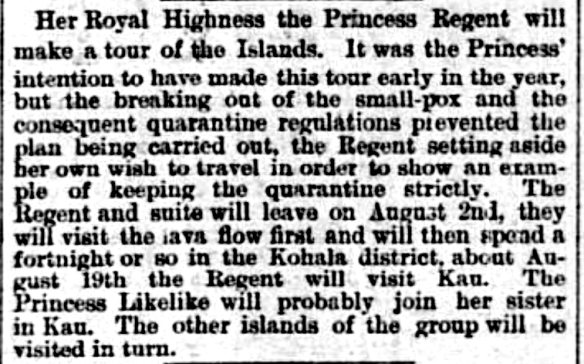
Her Royal Highness the Princess Regent will make a tour of the Islands. It was the Princess’ intention to have made this tour early in this year, but the breaking out of the small-pox and the consequent quarantine regulations prevented the plan being carried out, the Regent setting aside her own wish to travel in order to show an example of keeping the quarantine strictly. The Regent and suite will leave on August 2nd, they will visit the lava flow first and will then spend a fortnight or so in the Kohala district, about August 19th the Regent will visit Kau. The Princess Likelike will probably join her sister in Kau. The other islands of the group will be visited in turn.

(Hawaiian Gazette, 7/27/1881, p. 2)

HawaiianGazette_7_27_1881_2.png

The Hawaiian Gazette, Volume XVII, Number 30, Page 2. July 27, 1881.

Visit to Haleakala, 1876.

ABOUT HALEAKALA.

O Lahui Hawaii; Aloha oe:—

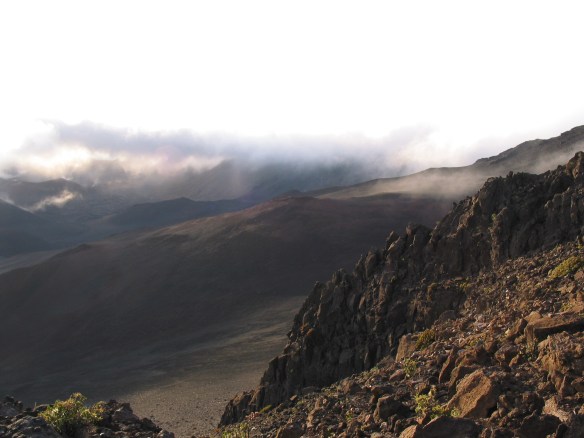
Perhaps there are not that many people who have travelled to the top of that famous mountain Haleakala in East Maui. It was the perfect time, because when I awoke this morning at maybe three o’clock and my eyes were set upon that mountain, I was filled with great admiration. I woke up my kamaaina and we got the horses ready, and at my urging, we left Makawao; and soon I’m writing this letter from the high rocks of this mountain at 9 o’clock in the morning. We are looking at the schooner greatly beloved by the friends of this land, that being the Moi, whose prow was rooting through the lapping sea of Kahului, and the famous pond in the cold, that being Kanaha. The mist is moving down to Iao and blanketing Kapela and her beautiful flowers, and the pili of Kakae disappeared, just leaving the hills in view, and it was as if waters were rushing the dam of Iao. The shady valleys at the edge of Nawaieha are imposing, seeming to duel with the rows of waves of Kahului.

105-0568_IMG

Haleakala 2003. Mau no ka nani hemolele!

Continue reading

Rufus Anderson arrives, 1863.

[Found under: “NA MEA HOU O HAWAII NEI.”]

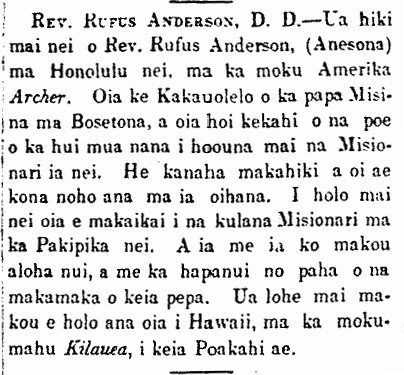
Rev. Rufus Anderson, D. D.—Rev. Rufus Anderson (Anesona) has arrived in Honolulu nei, aboard the American ship, Archer. He is the secretary of the Mission Board in Boston, and he is one of the original members of the board that sent Missionaries here. He served in that occupation for forty years or more. He came to check on the condition of the Missionaries here in the Pacific. With him is our great aloha, along with perhaps the majority of the friends of this paper. We heard that he will be going to Hawaii aboard the steamship Kilauea this coming Monday.

(Kuokoa, 3/7/1863, p. 2)

Rev. Rufus Anderson, D. D.

Ka Nupepa Kuokoa, Buke II, Helu 10, Aoao 2. Maraki 7, 1863.

Rufus Anderson, “Hawaiian Islands: Their Progress and Condition Under Missionary Labors,” 1865.

Anderson’s Writings About Hawaii nei.

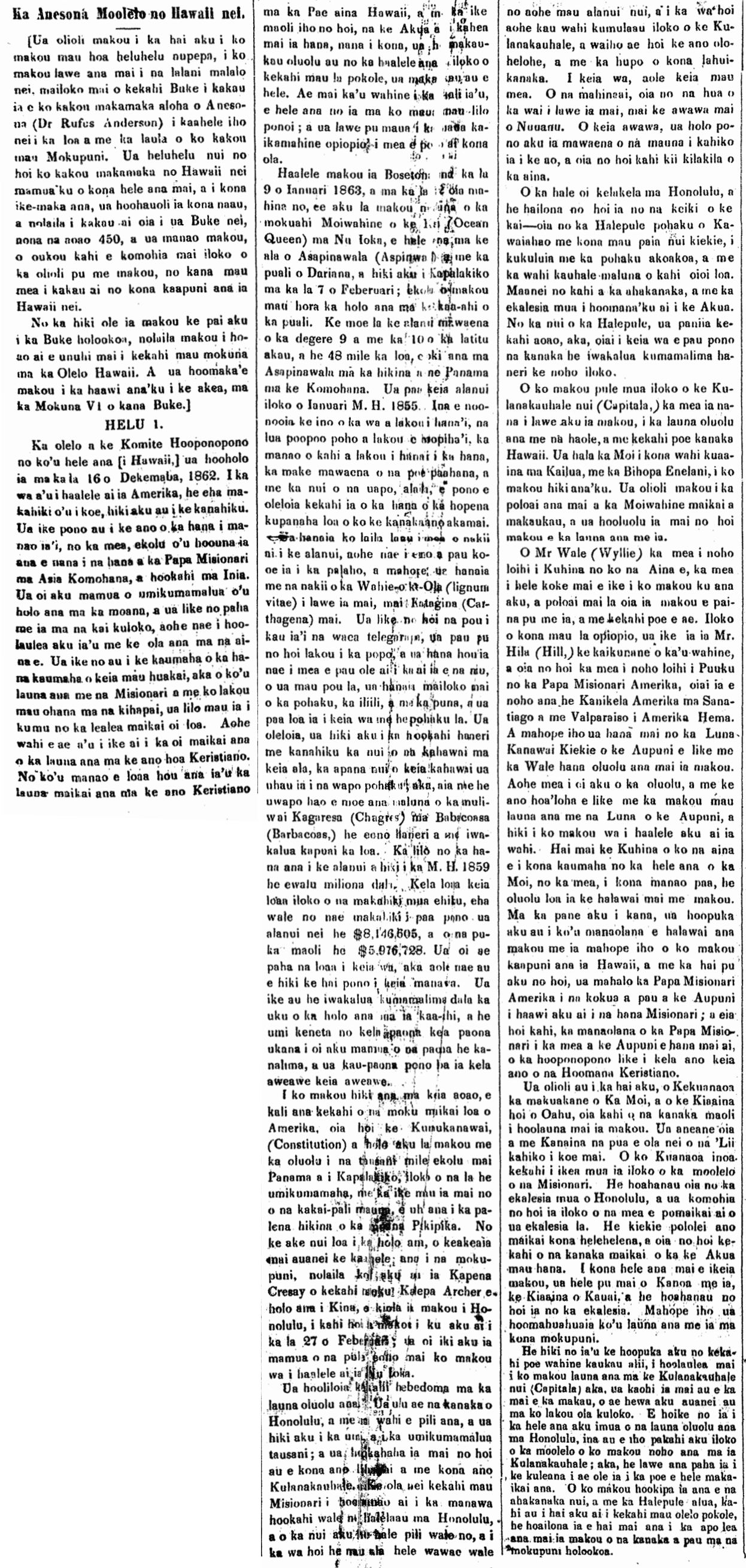
(We are pleased to tell you, our dear readers, that we are taking the lines below from a Book written by our beloved friend, Anesona (Dr. Rufus Anderson) who travelled the width and breadth of our Islands. Our friend read greatly about Hawaii nei before coming here, and when he saw it for his own eyes, his heart was gladdened, and therefore, he wrote this Book of 450 pages, and we believe that you all will also join in the pleasure along with us, for what he wrote about his travels around Hawaii nei.

Because we are unable to print the Book in its entirety, therefore, we tried to translate some chapters into Hawaiian. And we are beginning to provide it for the public from Chapter VI of his Book.)

[This is the introduction to a translation of Rufus Anderson’s “Hawaiian Islands: Their Progress and Condition Under Missionary Labors” which appears as a serial in the Kuokoa from 1/19/1865 to 6/8/1865. The English is available on Google Books here. It is interesting that this serial describing travels through the archipelago is immediately followed by Kamakau’s serial on travels describing famous places, kupua, and ancient alii from Hawaii to Niihau.]

(Kuokoa, 1/19/1865, p. 1)

Ka Anesona Moolelo no Hawaii nei.

Ka Nupepa Kuokoa, Buke IV, Helu 3, Aoao 1. Ianuari 19, 1865.

Lake Waiau atop Mauna Kea is frozen, 1906.

THE FIRST TIME LAKE WAIAU IS SKATED UPON.

When Mr. Eben Low of Waimea, Hawaii, arrived in town, some news about Mauna Kea was heard. According to him, because the ice on the top of Lake Waiau [ka moanawai o Waiau] is frozen solid, it can be walked upon.

The freshwater lake Waiau is a lake atop Mauna Kea, about 15,000 feet above sea level, which is covered with ice, which visitors walked upon. The thickness of the ice was tested by digging, but after digging for two feet, the travellers gave up continuing to dig. Continue reading

Greatest Mariners, 1938 / 2015.

POLYNESIANS AS MARINERS SEEN

Dr. Buck Terms Early Polynesians Greatest Mariners World Has Ever Known

HONOLULU, Nov. 29—Dr. Peter Buck, director of the Bishop Museum, last night termed the early Polynesians the greatest mariners the world has ever known.

Dr. Buck, who will leaves soon for Yale University to lecture on primitive religions, spoke at a dinner in his honor attended by almost 200 persons. He was introduced by Frank Atherton.

He said it was probable that some of the early Polynesians reached the shores of America. He traced the possibility in similarity of certain words, such as that for sweet potato itself was brought into the South Seas from the American continent. Continue reading

Necker claimed for Hawaii, 1894.

THE JOURNEY OF THE IWALANI!

NECKER BECOMES HAWAII’S!

The Islands of the Hawaiian Archipelago!

In the afternoon of May 25, this town was all astir at the news that the steamship Iwalani was headed on a long expedition. At 5:20 of that evening, the Iwalani sailed on its mystifying mission. On board was J. A. King, Minister of the Interior, and the crew was increased by ten more sailors. Ka Leo¹ newspaper was much alarmed thinking that the Provisional Government was looking for a place to keep all of the royalists [anee alii]. The royalists proved this worthless piece of news by Ka Leo printing a letter that they found in some dung, but the people…

THE HAWAIIAN ARCHIPELAGO.

…of proper thinking, they were not anxious. The wonder of the people was highly escalated because the British warship Champion followed half an hour after the Iwalani left. And as is usual in Honolulu nei, news soon spoke of the warship chasing after the Iwalani. These senseless ideas were let go when the Iwalani returned on Tuesday evening, May 29.

From what was said by Captain Freeman of the Iwalani, they passed Nihoa in the evening of Saturday, May 26, and at 11 o’clock on the following morning, May 27, the anchor of the Iwalani was let down on the leeward side of Necker [Neka] Island, 41 hours sailing from Honolulu. The skiff was let down and Captain King, Captain Freeman, engineer Norton, along with seven sailors went on.

NECKER ISLAND.

This island is a heap of rocks, and is 260 feet tall. There is a steep cliff rising from the ground, and it was with great effort that they climbed up until a proper place to where Captain King stood a flagpole and the Hawaiian flag waved in the wind. This island was annexed to the Hawaiian nation, and this is the proclamation that Captain King read: Continue reading

Hawaiians come to Hawaii for the first time, 1940.

Hawaiian Malihini.

The picture above is a picture of a Hawaiian family who came to Hawaii as malihini to this land. They are Hawaiians by skin, but they are newcomers to the land. This is the first time they are seeing in person the land of their parents and kupuna. Arrived by the Aorangi was Mrs. Antone Pai, who was born in San Francisco, and her children who were born in Portland, Oregon. In the front line is Robert, 3; Sylvia, 6, and Antone Jr., 4. In the middle line is Katherine, 9; Antoinette, 8; and Helena, 11. In the back is Mrs. Pai and her brother, Francis Sylvia, who was born in Seattle.

Hawaiians Visiting Hawaii

Question: When is a Hawaiian called a malihini?

Answer: When they have not seen Hawaii before.

These are two generations of Hawaiians that saw Hawaii for the first time when they arrived in Honolulu last week on the Steamer Aorangi from Vancouver. Neither Mrs. Pai nor her children had seen Hawaii before, nor had her brother, Francis Sylvia, 22, who arrived with this family. All of them were born in America to Hawaiian families.

“It is just so beautiful,” according to Mrs. Pai as her voice choked up.

“You see that everything is green,” said one of her children. Continue reading