Wahiawa Reservoir, 1912.

[Found under: “Bits of News”]

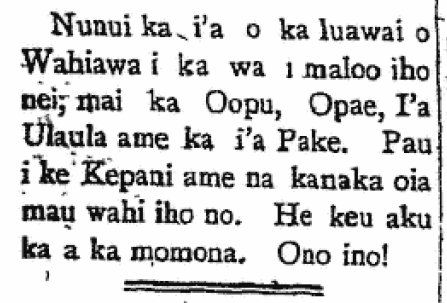
There were a lot of fish in the reservoir of Wahiawa when it recently went dry; from Oopu, to Shrimp [Opae], Red Fish [I’a Ulaula], and Chinese fish [i’a Pake]. They were all taken by the Japanese and those of the area. How sweet tasting. So delicious!

[I might not suggest doing this today…]

(Kuokoa Home Rula, 9/5/1912, p. 4)

Nunui ka i'a o ka luawai o Wahiawa...

Kuokoa Home Rula, Buke X, Helu 36, Aoao 4. Sepatemaba 5, 1912.

Lava destroys the village of Hoopuloa, Kona. 1926.

The Harbor of Hoopuloa is Destroyed by Lava.

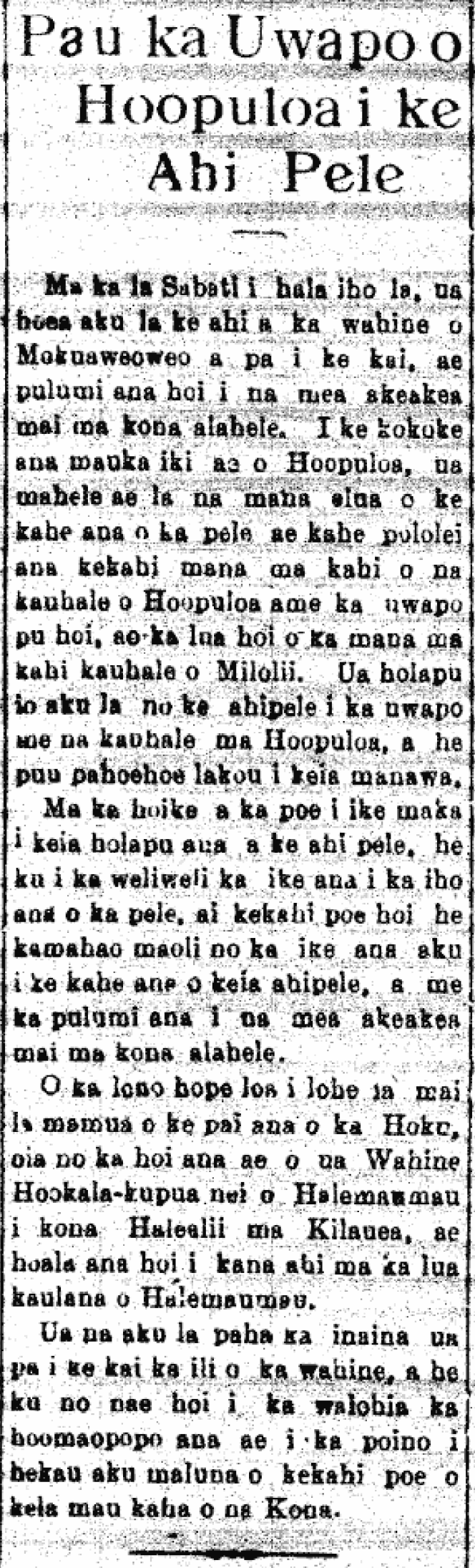
On this past Sunday [4/18/1926], the fire of woman of Mokuaweoweo appeared and reached the sea and it swept aside the things blocking its path. When it got close to the upland of Hoopuloa, the flow of lava separated into two, and one of the flows went straight for the village of Hoopuloa and the harbor, and the second flow went towards the village of Milolii. The fiery lava engulfed the harbor and village of Hoopuloa, and now they are but a heap of pahoehoe lava.

According to eyewitnesses of this engulfing lava, it was frightening seeing the lava coming down, and others say that it was truly awesome watching the flowing lava and its sweeping aside of all obstructions in its path.

The last word heard before the the Hoku went to the press was that this Wondrous Woman of Halemaumau returned to her Palace at Kilauea, and she is bringing to life her fires at the famed crater of Halemaumau.

Perhaps her rage has been quenched as the skin of that woman has touched the sea, but the memory of the tragedy which befell the people of that section of Kona is heartbreaking.

[And check out this awesome picture of the tragic event taken by Tai Sing Loo, put up by the Hawaiian Historical Society!]

(Hoku o Hawaii, 4/20/1926, p. 2)

Pau ka Uwapo o Hoopuloa i ke Ahi Pele

Ka Hoku o Hawaii, Buke XIX, Helu 48, Aoao 2. Aperila 20, 1926.

Bad weather on Kauai. 1862.

Great Flooding in Waimea.

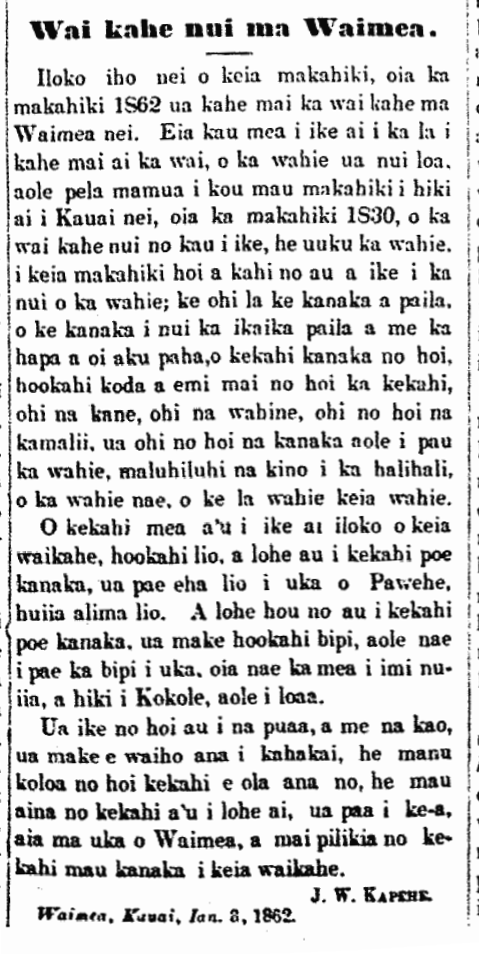
During this year, 1862, there was flooding here in Waimea. This is what I saw on the day of the flood, a lot of kindling; it wasn’t like that before in the years since I arrived here to Kauai, that being 1830; in the floods I’ve witnessed, there was only a little kindling. This year is the first time I’ve seen so much wood for fire; people were gathering it up and making piles. A strong man would have a pile and a half or more, and another would have a cord or less. Men would gather, women, and children too; people gathered it up, but there was no end to it; your body would get tired from carrying the wood, and yet the kindling, it would still be remain here and there.

Another thing I witnessed in the flood was a horse, and I hear from some other people that four horses came ashore at Pawehe; all together that makes five horses. And from some other people I hear that a cow died but did not wash up ashore, but was searched carefully for all the way until Kokole, but was not found.

I’ve seen pigs and goats that were dead, laying on the shore, and there are some ducks still alive; there are places which I’ve heard that are obstructed in the uplands of Waimea, and some people almost got in trouble in this flood.

J. W. Kapehe,

Waimea, Kauai, Jan. 3, 1862.

(Kuokoa, 3/22/1862, p. 2)

Wai kahe nui ma Waimea.

Ka Nupepa Kuokoa, Buke I, helu 17, Aoao 2. Maraki 22, 1862.

More about snow on Molokai, 1912.

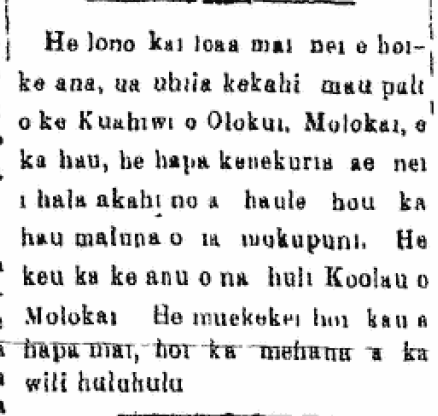
We received word saying that some precipices of the Olokui Mountain, Molokai is covered with snow; it was half a century ago when snow first fell on that island. The Koolau side of Molokai is tremendously cold. [He muekekei hoi a kau hapa mai, hoi ka mehana a ka wili huluhulu. ??]

[Although the previous article says Emma Nakuina thought there never was snow on Molokai before, this here seems to say that snow was recorded on Molokai some time before this!

And does anyone have clarity on the last sentence of the article?]

(Kuokoa Home Rula, 3/15/1912, p. 1)

He lono kai loaa mai nei...

Kuokoa Home Rula, Buke X, Helu 11, Aoao 1. Maraki 15, 1912.

If you think we’ve been having strange weather lately… Snow on Molokai? 1912.

SNOW FELL ON MOLOKAI.

THE FIRST TIME THIS REMARKABLE THING WAS WITNESSED.

On her way home from Molokai, Mrs. Emma Nakuina brought proof of snow [hau sano] falling on Molokai, and you can clearly see the whitening of the mountain tops behind Pukoo with snow. In the history of the inhabitation of Molokai, there has never been seen this amazing thing on that island from the beginning, and this is the first time that snow has been seen falling on Molokai. According to Mrs. Nakuina.

H. D. Bowen stated that snow fell in great quantities on the mountain behind Pukoo, so that you could see clearly the patches of snow in many places on the ridges as well as down in the valleys.

You can see the snow all the way from the harbor of Pukoo and the shore, according to Mr. Bowen. He has some land next to [illegible because of fold] and while he was there, he saw the snow.

I believe this is the first time that man remembers that snow fell on Molokai, said Mrs. Nakuina.

So it is perhaps because of the cold we’ve had these past days that snow fell on Molokai. According to the scientists, the time is coming where the tropic zone will become arctic, and will be covered in snow. Could this be the beginning of this?

[See the article from which this was translated [?] and more in The Hawaiian Star, 3/11/1912, pp. 1 & 5.]

(Aloha Aina, 3/16/1912, p. 1)

HAULE KA HAU SANO MA MOLOKAI.

Ke Aloha Aina, Buke XI, Helu 11, Aoao 1. Maraki 16, 1912.

More news out of Lahainaluna, 1874.

[Found under: “Local News”]

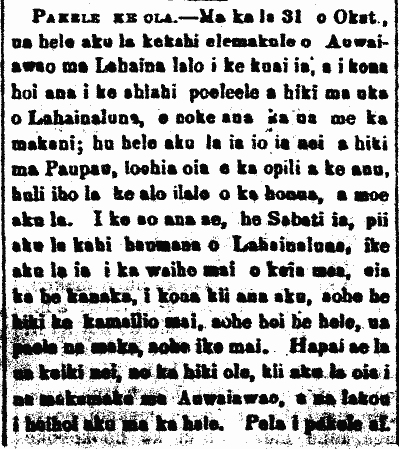
Life is saved.—On the 31st of Oct., an old man from Auwaiawao went to Lahainalalo to go shop, and when he was returning in the evening, it was dark and he reached Lahainaluna; the rain kept falling and the wind kept blowing; the old man wandered here and there until Paupau, and he was numbed with cold and fell face down to the ground and slept. In the morning, it was a Sunday, a student from Lahainaluna was walking up and spotted this thing, come to find out it was a man; when he went to fetch him, the man couldn’t speak, or walk, his eyes were blackened and he couldn’t see. The boy went to carry him, but because he couldn’t, he went to get friends from Auwaiawao, and they carried the man back to his home. That is how he survived.

(Kuokoa, 12/5/1874, p. 2)

Pakele ke ola.

Ka Nupepa Kuokoa, Buke XIII, Helu 49, Aoao 2. Dekemaba 5, 1874.

Tsunami? 1862.

Turbulent Sea.

On Tuesday, the 28th of January, at Waialua, Molokai, exceptionally rough seas were seen, and there was much damage. The fish ponds from Moanui until Puako were smashed by the sea. The road at Honouliwai was dashed, and horses cannot  travel there. On the night of the 29th, there was a great earthquake, and the earth shook for eleven seconds. This is what was written in by M. Timoteo.

(Hoku o ka Pakipika, 2/20/1862, p. 2)

Kaikoo nui.

Ka Hoku o ka Pakipika, Buke I, Helu 22, Aoao 2. Feberuari 20, 1862.

Snow on Hualalai 150 years ago. 1862.

Much Snow, and cold.

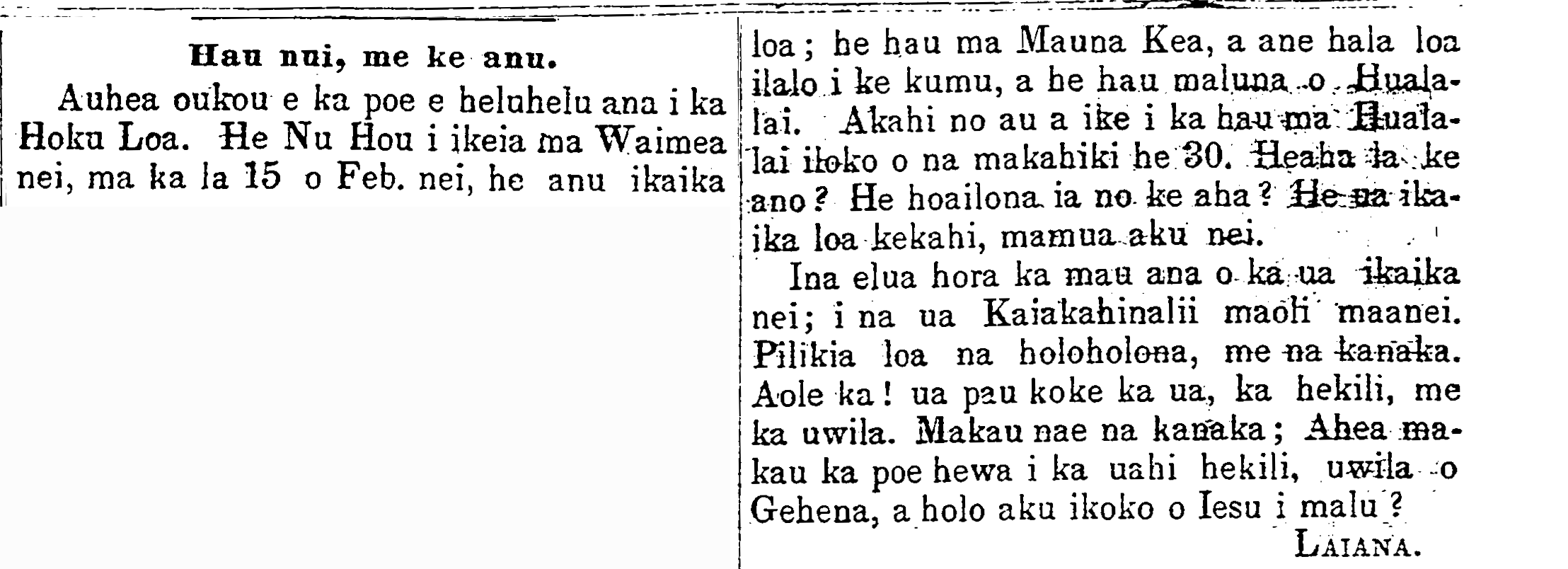
O People reading the Hoku Loa. There is News seen here in Waimea; on the 15th of February, there was extreme cold; there was snow on Mauna Kea, and it almost reached its base, and there was snow atop Hualalai. It was the first time I saw snow on Hualalai in 30 years. What is this? What is it a sign of? There was also heavy rains earlier.

If the heavy rains lasted for a couple of hours, it would have had a massive flood [Kaiakahinalii] here. The livestock and people would have been in trouble. But no! the rain, thunder, and lightning soon stopped. The people were still afraid; When will the people be afraid of the smoke, thunder, and lightning of Gehenna, and go to the protection of Jesus?

LYONS.

(Hoku Loa, 3/1862, p. 34.)

Hau nui, me ke anu.

Ka Hoku Loa, Buke III, Helu 9, Aoao 34. Maraki, 1862.

Kalaupapa a hundred years ago, 1912.

NEWS FROM KALAUPAPA, MOLOKAI.

The S. S. Mikahala arrived yesterday, and turned around full of cargo for this port, and at Kaunakakai it put ashore the pai ai [pa‘i ‘ai], and most of the items will perhaps arrive the following week. The kokua went upside to Kaunakakai with the donkeys to fetch the pai ai yesterday evening, and last night the provision donkeys arrived, and this morning they left again for the remaining pai ai. The reason that that S. S. Mikahala could not land her cargo was because of the rough seas surrounding us; there was no harbor, only ocean, and the waves spreading across shore were towering, but an amazing thing was the request by the Vice Superintendent and Doctor W. J. Goodhue for the children and their skiff of the H. H. K. L. [?] and this request was granted.

Dr. W. J. Goodhue got on, along with the stout boys of the H. H. K. L. and they rowed out to try and get the Mikahala to throw over the pai ai to them; the amazing thing I spoke of was when the skiff came into view and before them was a huge wave, and that was when everyone held their breath, because it was as if the boat and the brave ones aboard would be pulled down, however with the blink of an eye, the skiff arrived triumphantly outside without harm, and Dr. W. J. Goodhue was seen waving his handkerchief to the people on land. And to Mr. Paahao, the helmsman went the people’s appreciation, because it was his steering that they faced the powerful waves and came out like a man-eating shark speeding atop the sparkling [hulala?] billows of the sea; and admiration also went to the boys who rowed, being that it was their strength which helped the helmsman greatly. This is just some news.

I understand that you sent the Calendars and they came, but there they go back again, and maybe we will get them next week.

There is a much Rain and strong Kona winds blowing, from last week until today, and it is this wind that caused the rough seas, and the rough seas are bringing up great rocks [aa?] and depositing them upland.

William Notley
Kalaupapa, Molokai, Feb. 2, 1912.

(Kuokoa Home Rula, 2/9/1912, p. 1)

NA MEA HOU O KALAUPAPA MOLOKAI.

Kuokoa Home Rula, Buke X, Helu 6, Aoao 1. Feberuari 9, 1912.

More drought on Maui, 1912.

[Found under: “Local News”]

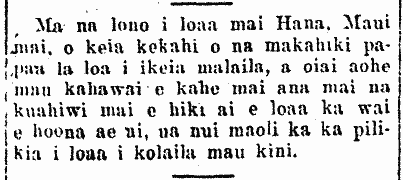
According to the news from Hana, Maui, this is one of those years that great drought is seen there, and being that there are no rivers flowing down from the mountains to bring satiating water, the people there are facing serious trouble.

(Kuokoa, 2/2/1912, p. 8)

Ma na lono i loaa mai Hana...

Ka Nupepa Kuokoa, Buke XLVIII, Helu 5, Aoao 8. Feberuari 2, 1912.