Lonoikamakahiki, unattributed, 1909.

A STORY

OF

LONOIKAMAKAHIKI

Son of Keawenuiaumi

And Fearless Grandson of

Umialiloa

And the Famous Riddling Chief of Great Hawaii of Keawe.

O Lonoikamakahiki kapu a Kalani
O Kalani kapu a Keawe i hanau
Hanau Kalani he Alii kuhalau
He lau kapaahu nehe o Lono—e.

[Lonoikamakahiki, the sacred one of Kalani
Sacred Kalani, born of Keawe
Born was Kalani, a expansive Chief
O Lono, a rustling of a heap of mats.]

(A Hawaiian Story.)

Words of clarification.—The story of Lonoikamakahiki is one of the stories delighted in by the native Hawaiians of Hawaii nei of the olden days, and it is a moolelo that was enjoyed by the alii born in this land who have passed on. We have endeavored to print this story to the greatest of our ability, but it is a common thing for there to be discrepancies from what is published with what is memorized by some people. May our readers please be patient with the mistakes, and take the valuable things that will teach us of the nature of the deeds of the alii of our land of days past. Publishing the valuable stories of our alii and makaainana of our land of the past is of great importance. We hope that this story will travel its path, delighting the readers of the Hoku. But do remember, O Readers, that money is what makes this possible, and consider that our kupuna were generous and welcoming people. Open the purse of aloha, and remember the life of our beloved.— Editor.

[This story of Lonoikamakahiki appears in Hoku o Hawaii from 7/8/1909 to 12/9/1909. Unfortunately, the first 11 buke of the Hoku, from 5/3/1906 to 5/24/1917 are not available yet online.]

(Hoku o Hawaii, 7/5/1909, p. XXX)
HokuoHawaii_7_8_1909_1.png

Ka Hoku o Hawaii, Buke IV, Helu 10, Aoao 1. Iulai 8, 1909.

Z. P. Kalokuokamaile’s Lonoikamakahiki, 1924.

ENJOYMENT TO PASS THE TIME.

THE STORY OF LONOIKAMAKAHIKI, THE EXPERT ALII WHO HAD NO EQUAL AT CONTESTS OF WIT, AND AT WAR.

CHAPTER I.

(Written by Z. P. K. Kawaikaumaiikamakaokaopua)

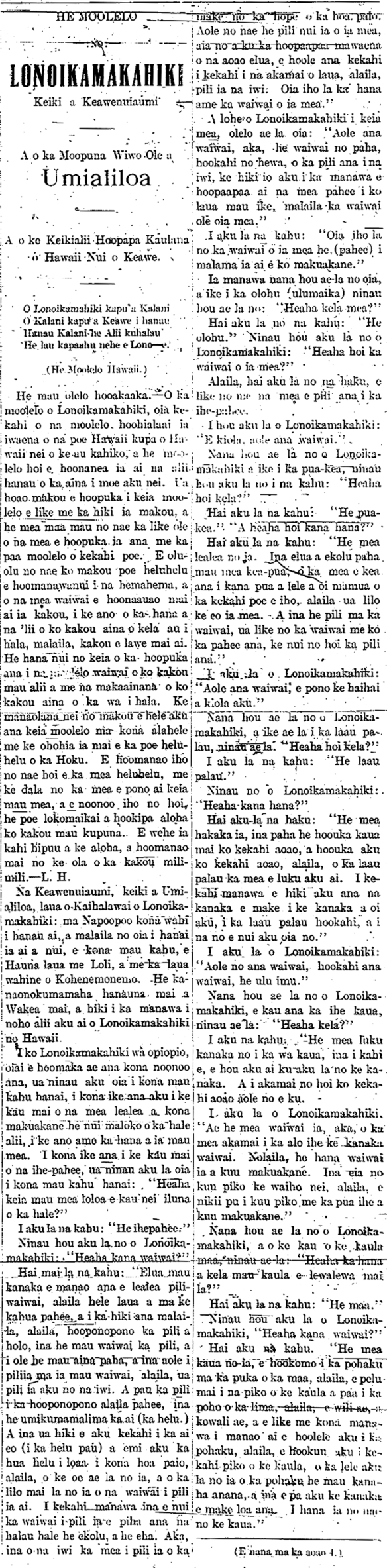
Lonoikamakahiki was born in the land of Napoopoo, at the base of the cliff of Manuahi, South Kona, Hawaii. Keawenuiaumi was the father, Koihalawai was the mother; and it was in Napoopoo where he was raised until adulthood; his caretakers were Hauna and his younger brother Loli.

These two men had one wife. They did not want two wahine, and they were both very nice; they did not fight or argue and there was no dissension between them over this one woman. When Lonoikamakahiki was young, he began to think.

When Lonoikamakahiki was looking at the many items of entertainment of his father placed in the royal house, and he saw the ihe pahee placed there, he looked for a long time and after a while he asked his caretakers:

“What is that long thing hanging up there in the house?” Continue reading

Story of Lonoikamakahiki as told by Wille Sepe. Kawa Jr., 1887–1888.

A STORY OF

Lonoikamakahiki

THE

High Chiefly Offspring of Kalani.

The Great Alii of Hawaii.

[WRITTEN FOR THE KUOKOA NEWSPAPER.]

(The Author should make clear that although this Lahuikanaka was accustomed to memorizing things, there nonetheless are variations between what this person and that memorized. And it is from what is memorized by this Writer, it is on that path that he will travel until this Moolelo is complete.)

I must clarify the ancestors of the alii who this moolelo is about. So that the new generations of the Hawaiian People know the kupuna and makua and older brothers and younger brothers and the sisters of their alii for whom this famous story rises.

Kiha (m) lived with Kaohikinuiokalani (f), and born between them were the chiefly children, five in total. Here are each of their names:

Liloa (m), after him there were twins, Laeanui (f), Kaumanamana (f), Kalani (m), Pinea (f).

Liloa lived with his own sister, Pinea, and born was Hakau (m), that being Hakaualiloa. It is said that Hakau was a Pi’o Chief. Continue reading

B. L. Koko tells the story of Lonoikamakahiki, 1865.

STORY OF LONOIKAMAKAHIKI

PART 1.

Kalani was the father and Haumea the mother, born was Lonoikamakahiki from Haumea and Kalani; He was taken as hanai by Hauna of Kaikilanialiiwahineopuna [?? Hauna o Kaikilanialiiwahineopuna] until he was grown; the chiefs went to bathe in the ocean, and after they had bathed, the two of them went upland to warm themselves.

While the two of them were warming themselves, Kaiklanialiiwahineopuna said to Lonoikamakahiki, “let’s play konane (the konane played with pebbles).” “Yes,” said Lonoikamakahiki, and they laid out the pebbles upon the board and the two began to play [uhau], and in that first match, he lost to his sister; the two played once again, and he lost once again to his sister; they played for the third time, and that Chief lost once more; after this third loss of Lonoikamakahiki, the Chief grew irritated for just losing…

[This is the opening of one of the stories of Lonoikamakahiki found in the Hawaiian Language Newspapers. It was written by B. L. Koko of Kaualaa, Wailupe, Oahu, and runs in Au Okoa from 9/4/1865. There is criticism of his telling and Koko ends his story on 10/23/1865. He states at his closing that what he wrote is all he knows, but those who know the story well most likely know more things. And if his kupunakane know more, that he will submit it.]

(Au Okoa, 9/4/1865, p. 4)

AuOkoa_9_4_1865_4.png

Ke Au Okoa, Buke I, Helu 20, Aoao 4. Sepatemaba 4, 1865.

Queen Liliuokalani attends historical play at Kapiolani Park, 1916.

THE PRESENTATION AT KAPIOLANI PARK ABOUT LONOIKAMAKAHIKI AND KAIKILANI WAS BEAUTIFUL

SOME SCENES THAT WERE SHOWN—(1) Kakuhihewa, King of Oahu. (2) The Alii and Kaukau Alii of King Lonoikamakahiki of Hawaii leaving the throne. (3) King Lonoikamakahiki. (4) The Chiefs and Attendants in the Procession. (5) Queen Liliuokalani, and Her Companions watching the Performance. (6) The Attendants of Queen Kaikilani. (7) The Retainers of Queen Kaikilani. Continue reading

Did Waterhouse make a profit? 1916.

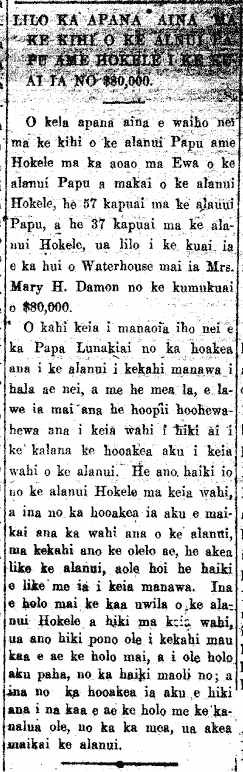
THE PIECE OF LAND AT THE CORNER OF FORT AND HOTEL STREETS SOLD FOR $80,000.

That section of land at the corner of Fort [Papu] and Hotel [Hokele] Streets, on the Ewa side of Fort and makai of Hotel, 57 feet on Fort Street and 37 feet on Hotel Street, was purchased by the Waterhouse Company from Mrs. Mary H. Damon for $80,000.

This is the area proposed by the Board of Supervisors [Papa Lunakiai] for road widening some time ago, and it seems that this place will be taken by eminent domain [hoopii hoohewahewa] so that the county can widen this area of the street. This area of Hotel Street is narrow indeed, and if it is widened, the width will be good, where we will be able to say the street is uniformly wide, and not narrow like it is now. If the electric car on Hotel Street continues on here, other cars would not be able to come or go because of how truly narrow it is; but if it is widened, other cars can travel without any confusion, for the street will be wide enough.

(Aloha Aina, 3/4/1916, p. 1)

AlohaAina_3_4_1916_1.png

Ke Aloha Aina, Buke XXI, Helu 22, Aoao 1. Maraki 4, 1916.

Marriages from a hundred years ago, 1916 / 2016.

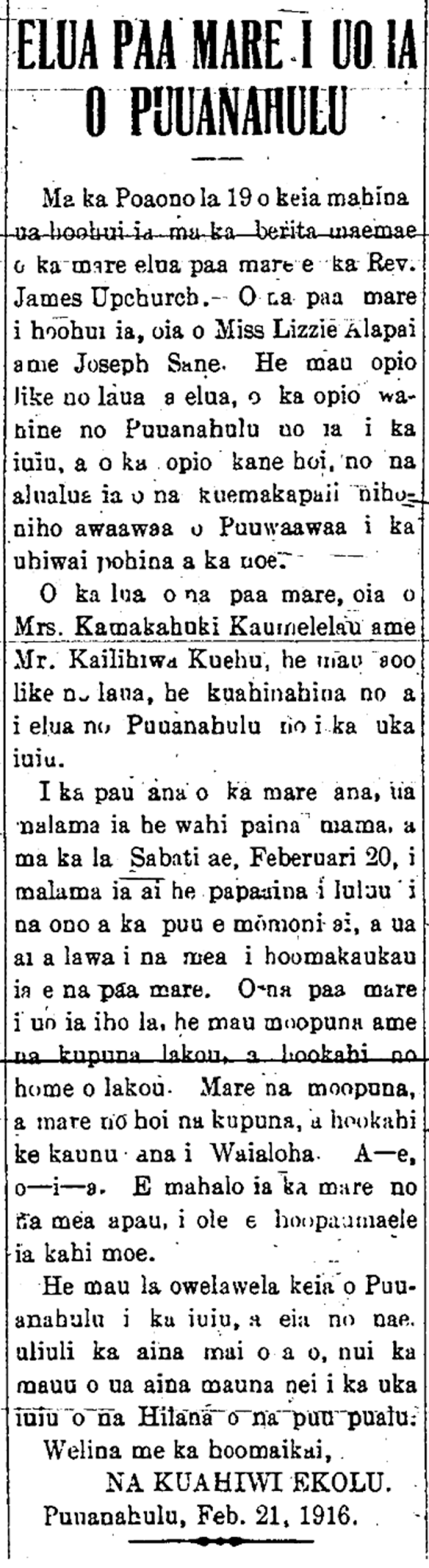
TWO MARRIAGES OF PUUANAHULU BOUND TOGETHER

On Saturday, the 19 of this month, there were two couples joined together in the holy covenant of marriage by the Rev. James Upchurch. The couple joined together was Miss Lizzie Alapai and Joseph Sane.  They are both youths; the young woman is from Puuanahulu in the lofty heights, and the young man is from the furrowed jagged cliff faces of Puuwaawaa in the hazy heavy mists.

The second couple was Mrs. Kamakahuki Kaumelelau and Mr. Kailihiwa Kuehu; both of whom are elderly [aoo], gray-haired ones of Puuanahulu in the lofty heights.

After the ceremony was over, there was held a simple meal, and on the following Sunday, February 20, there was party held with a table laden with the delicacies to be drooled at, and we ate until we were full of the things that were prepared by the couples. The ones who got joined together, were grandchildren and grandparents, and they live in one home. The grandchild got married, and the grandparent got married, the passion in the loving waters of Waialoha is shared. Yes, it is so. Marriage is an admired thing for all, lest one’s bed be sullied.

These have been sweltering days in Puuanahulu in the lofty heights, but the verdure of the land from one side to the other remains; there are much grasses of this mountainous region in the uplands of the Highlands [Hilina] of the assembly of hills.

My affection and appreciation,

NA KUAHIWI EKOLU.

Puuanahulu, Feb. 21, 1916.

[Na Kuawihi Ekolu is Ka Ohu Haaheo i na Kuahiwi Ekolu, which was a pen name for J. W. H. Isaac Kihe.]

(Hoku o Hawaii, 3/9/1916, p. 3)

HokuoHawaii_3_9_1916_3.png

Ka Hoku o Hawaii, Volume Buke 10, Helu 40, Aoao 3. Maraki 9, 1916.

Ahuimanu College exam information, 1871.

Ahuimanu College.

We had the pleasure of attending the public examination of Ahuimanu College last Wednesday, July 5. The location of the College is healthy and romantic, being situated on a plain at the foot of the mountains, and commanding a fine view of the ocean to the north and of the mountain range east and west.

The institution is under the charge of the Rev. Father Lievin, who is distinguished for his affability and kindness as much as for his many scholarly attainments. He has made improvements in the grounds and buildings during the past year: notably, in the students’ dormitory, each one having to himself a latticed apartment opening on a long corridor, all freely ventilated. The students are, even during the night, under his immediate supervision.

We were much pleased with the correct spelling and distinct reading of the primary classes. Young native boys who, a year ago, could not speak a word of English, read fluently and with a very good pronunciation. It occurred to us to ask ourselves how we could read French or German, after only one year’s study.

The examination of the classes in Grammar, Geography, Arithmetic, History, and Elementary Astronomy, was conducted by the President, and after him by the visitors. The questions asked by the latter were not the routine ones of textbooks. They were intended to draw forth the real knowledge of the students. This rather severe examination showed a proficiency in the various branches that is truly commendable. Our expectations were surpassed at the knowledge of English Grammar and Analysis evinced by that class. The study of Music and Oratory seems to be pursued con amore. The spcimens of Penmanship showed a marked improvement—those of the last and present year being side by side. It is only just to mention the Joseph Poepoe, Victor Kapule, Eddy Morgan, John K. Loio, Zachariah Kapule, and John Spencer, were the most distinguished in their several departments.

We learned that the school year commences on the 20th of August, and ends about the 4th of July. The fees for board, lodging and tuition are from $60 to $100 per year; some poor boys are received gratis. These figures are so low that the institution can not be self-sustaining. Bishop Maigret gives $300 a year towards its support. We hope that it will prosper, and continue to extend its usefulness.

(Hawaiian Gazette, 7/12/1871, p. 2)

HawaiianGazette_7_12_1871_2.png

Hawaiian Gazette, Volume VII, Number 26, Page 2. July 12, 1871.

Ahuimanu College Examinations, 1871.

Ahuimanu College.

Ahuimanu College is under the administration of the Roman Catholics; the students had their examinations last week Wednesday. We very much wanted to see firsthand the progress made by this school, but we did not know ahead of time, and its examination date was not advertised. And therefore, we perhaps can take word of their progress from people who were there and who weighed for themselves. This school, many years ago, was under the leadership of Rev. Walsh, and these days, it is being taught and lead by Rev. Father Lievin, the one who is known for his abilities, kindness, and some other good traits for the proper administering in the advancement of the school.

We were informed that the visitors enjoyed the spelling and clear reading of the students of the lower classes. The young students who could not speak English they ear before, could now pronounce clearly what they were reading. This was a testament to the strength and competence of their teaching and their guidance; giving hope that if they continue to progress in that fashion, they will not fail to make advancements in the future. The teaching and making clear to the students about reading clearly is very important in the knowledge of reading that is to be ingrained in our youngsters; whereas studying hurriedly will be worthless in the end; that kind of learning is nothing more than a horse race. Continue reading

Ahuimanu College and St. Louis College, 1882.

ST. LOUIS COLLEGE

Is our leading Roman Catholic educational institution for boys. It is an old institution called by a new name and located in a new place. The same institution long existed and prosecuted its mission at Koolau, on the other side of this island, and was there and then known as Ahuimanu College. Although delightfully situated, and having many advantages in its favor, it was felt to be too far from the centre of population, to answer fully the purpose of its existence. Consequently, it was decided, a short time ago, to remove the institution to the neighborhood of Honolulu.

For this purpose the church authorities purchased a splendid piece of property from Mr. Roth, at the north end of Beretania street, not far from Smith’s bridge, where they have erected suitable buildings, and established the old Ahuimanu College under the new name of St. Louis College.

The College grounds measure about two acres, allowing abundance of space for recreative exercise, and are planted with all kinds of tropical trees, some of which are fruit-producing, while others simply afford shade and ornamentation. It is truly a lovely spot, and being free from noisy surroundings, is peculiarly adapted to the purpose for which it is now used.

The College building is a substantial two storey brick structure, 60×20 feet in the clear. The ground floor is divided into three class rooms of equal size, by wooden partitions. Each of these rooms is nicely furnished with new school furniture of the most approved modern style. They are also well lighted and ventillated, ventillation being greatly assisted by the wooden partitions not extending the whole way to the ceiling, which latter is fourteen feet from the floor. Continue reading