Treasures up for auction, 1873.

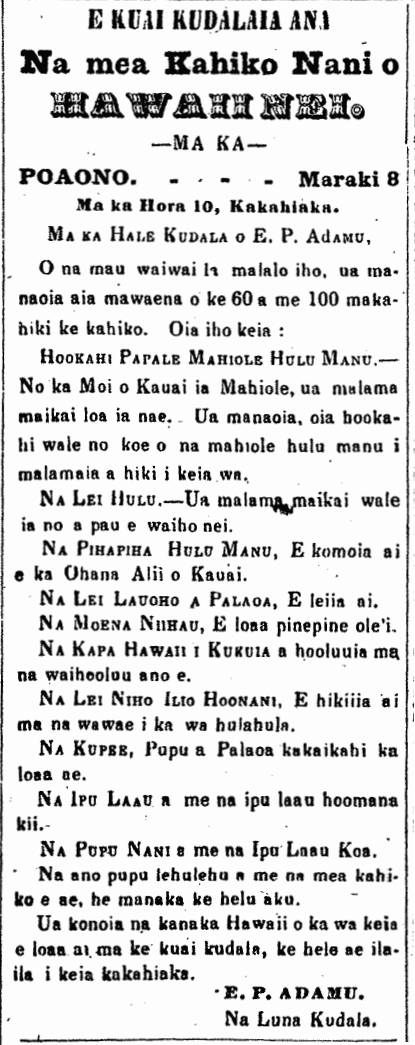
TO BE AUCTIONED OFF

BEAUTIFUL ADORNMENTS of

HAWAII NEI.

—ON—

Saturday, – – – March 8

At 10 o’clock, Morning.

At the Auction House of E. P. Adams [E. P. Adamu]

The items below are thought to be between 60 and a 100 years old. Those being these:

One Mahiole of Bird Feathers.—The Mahiole belonged to the King of Kauai, and was carefully cared for. It is believed to be the only feather mahiole preserved to this day.

Feather Lei.—They are all cared for well.

Bird-Feather Pihapiha, Worn by the Alii Family of Kauai.

Hair and Palaoa Lei, that were worn.

Niihau Mats, Rare.

Hawaiian Kapa that were Pounded and dyed strange colors.

Decorative Dog-Teeth Lei, Bound to the feet when dancing.

Bracelets [Kupee], of Shell and Ivory, Hard to find.

Wooden Bowls and wooden idol bowls [ipu laau hoomana kii]

Beautiful Shells and Koa Bowls.

Various shells and other antiquities, too many to list.

Hawaiians are invited, they will be available for auction if your go there this morning.

E. P. ADAMS.

Auctioneer.

[I wonder how these ended up here, and what became of them…

The English ad can be found in The Hawaiian Gazette of March 3, 1873, p. 5.]

(Kuokoa, 3/8/1873, p. 3)

E KUAI KUDALAIA ANA

Ka Nupepa Kuokoa, Buke XII, Helu 10, Aoao 3. Maraki 8, 1873.

Death of Z. P. K. Kalokuokamaile, 1942.

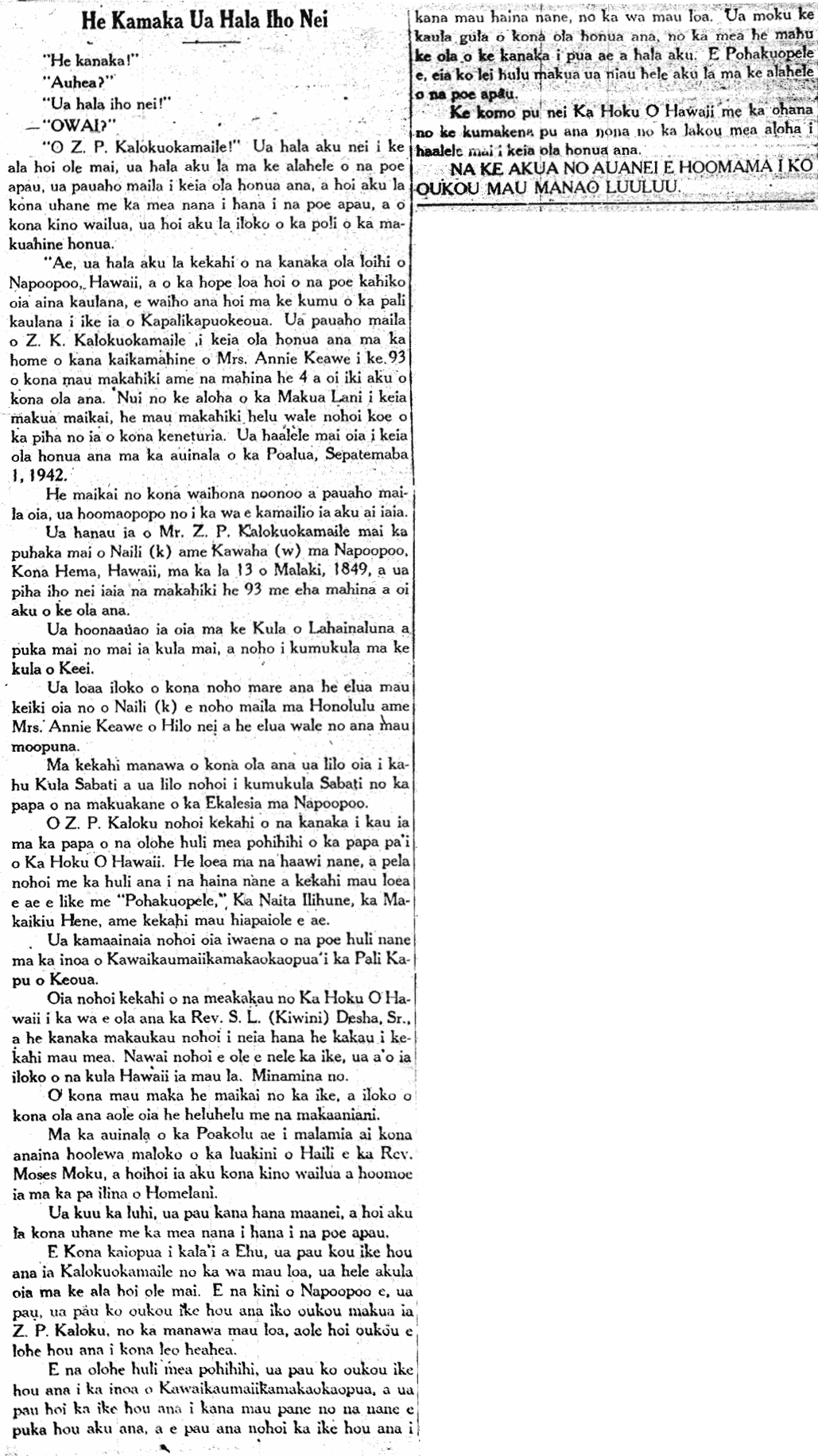
A Man Has Just Passed.

“A man!”

“What?”

“Has just passed!”

“WHO?”

“Z. P. Kalokuokamaile! He has gone on the road of no return; he has taken the path all must ake; he has grown weary of this worldly life; and his spirit has returned to the one who made all people; and his body has returned to the mother earth.

“Yes, one of the long-living men of Napoopoo, Hawaii has passed; and he is the last of the oldsters of that famed land at the base of the acclaimed cliff known as Kapalikapuokeoua. Z. K. Kalokuokamaile grew weary of this world at the home of his daughter, Mrs. Annie Keawe at 93 years and 4 months and a little more in age. The Heavenly Father had much aloha for this good man; he was just a few years away from reaching a century. He left this world in the afternoon of Tuesday, September 1, 1942.

His mind was strong when he grew weary; it was clear when conversing with him.

Mr. Z. P. Kalokuokamaile was born from the loins of Naili (m) and Kawaha (f) at Napoopoo, South Kona, Hawaii, on the 13th of March 1849, and he was 93 years four months and a little more in age.

He was educated at Lahainaluna School and graduated from there and made a living as a teacher at the school of Keei.

From his marriage, he had two children, they being Naili (m) who is living in Honolulu, and Mrs. Annie Keawe of Hilo, and he has just two grandchildren.

At a time in his life, he became a Sunday School principal, and a Sunday School teacher for the father’s class of the Napoopoo Church.

Z. P. Kaloku was a man who was in the class of experts at searching for the obscure information of the press of Ka Hoku o Hawaii. He was an expert at posing riddles [nane] as well as in the solving of nane from other experts such as “Pohakuopele,” Ka Naita Ilihune, Makaikiu Hene, and other highly skilled ones.

He was well known amongst the ones who answered nane by the name of Kawaikaumaiikamakaokaopua i ka Pali Kapu o Keoua.

He was a writer for the Hoku o Hawaii during the life of Rev. S. L. (Kiwini) Desha, Sr., and he was adept as a writer. Who would not be without knowledge who were taught in Hawaii’s schools in those days. How mournful is his passing.

He had good eyesight, and during his life, he didn’t read with glasses.

On the afternoon of the following Wednesday, his funeral was held in Haili Church by the Rev. Moses Moku, and his body was taken to rest in the cemetery of Homelani.

His toiling is over; his work here is over, and his spirit with the one who made all people.

O Kona of the sea of cloud banks in the calm of Ehu, you will not see again Kalokuokamaile for all times; he has gone on the path of no return. O People of Napoopoo, no more, no more will you see again your father, Z. P. Kaloku, for all times; you will no more hear his beckoning voice.

O Expert seekers of things obscure, you will no more see the name Kawaikaumaiikamakaokaopua; you will no more see his answers to newly published riddles; and no more will you see his solutions to riddles for all times. The golden chain of his life has been severed, for man’s life is a vapour that appeareth for a little time, and then vanisheth away. O Pohakuopele, here is your father; he has glided over the path of all men.

Ka Hoku o Hawaii joins in the family in mourning for him, for their loved one who left this earthly life.

MAY GOD LIGHTEN YOUR SORROW.

(Hoku o Hawaii, 9/9/1942, p. 2)

He Kanaka Ua Hala Iho Nei

Ka Hoku o Hawaii, Volume XXXVII, Number 20, Aoao 2. Sepatemaba 9, 1942.

Twenty-one peals of thunder for the People’s King, 1875.

[Found under: “Nu Hou Kuloko.”]

Some people have reported to us that from the beginning of the transportation of the remains of Lunalilo from the Royal Mausoleum at Maemae until entering his crypt at Kawaiahao, there were exactly 21 peals of thunder. Should that be the truth, it is something remarkable.

[The first funeral procession on February 28, 1874 took Lunalilo to the Royal Mausoleum, because his crypt was not yet complete, and then on November 23, 1875, as this article states, his remains were moved to his final resting place at Kawaiahao.

For even more accounts on this amazing occurrence, see https://www.facebook.com/photo.php?fbid=10201289583821168&set=a.10200741355595805.1073741841.1219578864&type=1&theater]

(Kuokoa, 11/27/1875, p. 2)

Ua hai mai kekahi poe...

Ka Nupepa Kuokoa, Buke XIV, Helu 48, Aoao 2. Novemaba 27, 1875.

Let Hawaiian Language be not something just remembered in February, 1920 / 2014.

THE HAWAIIAN LANGUAGE

O Mr. Editor of the Kuokoa Newspaper, Much Aloha to you:—Please allow me a column, for the title placed above.

When I read on page 8, column 2, about the Hawaiian language, I was ecstatic about what was published by the Kuokoa Newspaper on the topic of Mr. Coelho pertaining to the Hawaiian language.

This is seen on the streets, at pleasant gatherings, at meetings, and at the homes; these are just Hawaiians that I am talking about; they just speak English.

Hear me, O My flesh and blood, My beloved people: you are known as a Hawaiian and a lahui by your language; should you lose your mother tongue, you will end up like the Negroes and the Indians; they’ve no lahui and no language.

Pio ka oe ahi,
Pau ka oe hana;
I ikeia mai no oe,
I ka wa moni o ko eke;
Nele ae kahi mea poepoe,
Pau ka pilina ma ka aoao.

You light is extinguished,
Your work has come to an end;
You are acknowledged,
When there is money in your purse;
When the round objects are gone,
You have no place by her side.

Therefore, this writer is calling out to you: do not squander your gold and silver—your mother tongue. Your language is how it is known that you are an educated and superior people, like the great nations of the world. Look at Britain, France, Italy, Germany, Japan and America. Every nation learns their own language; why? For glory, for knowledge; it is known that one is British by the language he knows. The writer of the Psalms says: “That glory may dwell in our land.” How is our nation to have glory?

By abandoning our mother tongue and speaking the language of the malihini, are we knowledgeable, skilled and prepared in that language?

Are you not the foremost, O Tiny Hawaii, by way of the mother tongue of Opukahaia who travelled to America to explain the troubled existence of his lahui, and asked with tears streaming down to send missionary parents for Hawaii nei?

Did he go to America speaking English? No; he went with his own mother tongue. And when the missionaries arrived here in Hawaii, it is through the Hawaiian language that you received education, knowledge, honor, peace, justness, prosperity, righteousness, faith, and aloha.

What nation to the north or south latitudes of the equator is in peace like that of Hawaii? None, there is not a one; it is just Hawaii!

Therefore, this writer calls out: Don’t abandon your mother tongue so that glory may always dwell in Hawaii nei. We must build Hawaiian schools, and teach Hawaiian curriculum. Not just one eye, or one hand and foot. [? Aole i hookahi wale no maka, a i hookahi wale no lima a wawae.] When the legislature meets again the representatives and senators should make a law for teaching the Hawaiian language.

I give my thanks to the Honorable H. M. Kaniho, the first one to submit this bill in his first year there. It did not pass because some of the representatives just watched and did nothing. And I give my thanks to D. M. Kupihea who continually submits this bill.

Honolulu’s people should reelect the Hon. Kupihea so that this bill will once again be submitted; and should it be passed, then both eyes will be gotten: both Hawaiian language and English; and this writer will boast in advance that glory will indeed forever dwell in our land, for all times.

This writer is not saying that we should only teach these languages, but this responsibility is yours to teach knowledge and glory for your life. To be taken up at another time!

To the typesetting boys goes my love, and my unending aloha to the Editor.

[This is probably written in response to the article, “KA OLELO HAWAII.” written by Mrs. Kikilia P. Kealoha of Kaimuki, in Kuokoa on 6/18/1920, p. 8, which in turn was a response to an article of the same title written by W. J. Coelho in the Kuokoa on 5/21/1920, p. 2.

Although we have come a far way from 1920, there is still far to go. There are still those who seem to believe that losing Hawaiian is nothing to be alarmed about.

Z. P. K. Kawaikaumaiikamakaokaopua, is another name for the great historian Z. P. K. Kalokuokamaile (as well as Z. P. K. Lionanohokuahiwi).]

(Kuokoa, 6/18/1920, p. 3)

KA OLELO HAWAII.

Ka Nupepa Kuokoa, Buke LVII, Helu 24, Aoao 3. Iune 18, 1920.
On this, the eighty-seventh birthday of the Royal Hawaiian, a picture from the past, 1927.

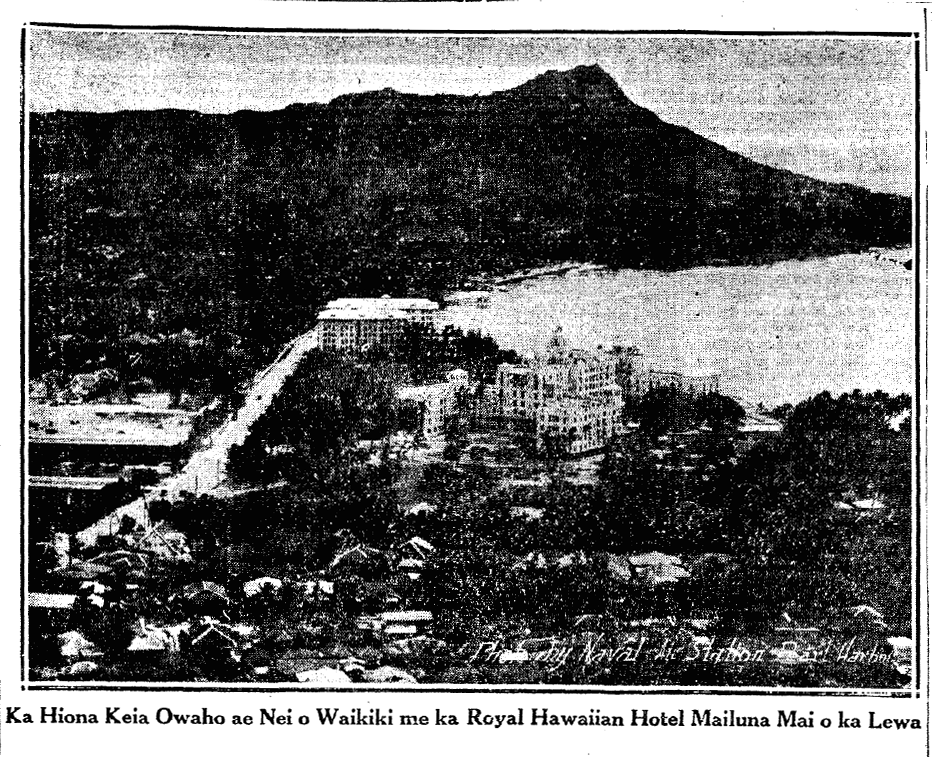
This is a scene from Right Outside Waikiki with the Royal Hawaiian Hotel from Up in the Sky

[The famous pink hotel opened up a few weeks earlier on the 1st of February. You can barely see on the bottom right of the picture, “Photo by Naval Air Station Pearl Harbor”. If the newspapers were rescanned carefully, pictures like these would be so much more vivid!]

(Nupepa Kuokoa, 2/24/1927, p. 5)

Ka Hiona Keia Owaho ae Nei...

Ka Nupepa Kuokoa, Buke LXVI, Helu 8, Aoao 5. Feberuari 24, 1927.

More on Lunalilo’s birthday, 1874.

Birthday of the King.

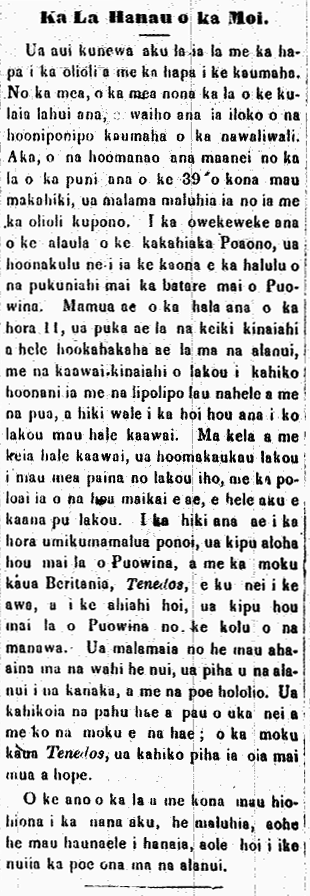
The day passed partially in happiness and partially in sadness. Being that the one whose day this holiday of the lahui is for is there languishing in weakness. The celebration here for his 39th birthday was held peacefully with proper cheer. With the break of dawn of the morning of Saturday, the town was rattled by the boom of the cannons from the battery of Puowina.¹ Before the passing of 11 o’clock, out came the firemen as they paraded on the streets with their fire trucks decorated with the verdure of the forest and flowers, until they returned once again to their station. At each fire station, they had prepared a banquet for themselves while their fine friends were invited to share in this with them. When 11 o’clock arrived exactly, cannons were shot off again from Puowina, along with the warship, Tenedos, which was docked in the harbor; and in the evening as well, cannons were shot off a third time from Puowina. Parties were held at many places, and the streets were teeming with people and those on horseback. All of the flagpoles on land and those on the ships were decorated with flags; the warship Tenedos was adorned from bow to stern.

The nature of the day and its sights were peaceful; there were no commotions aroused, nor were there many drunken people seen on the streets.

¹Puowina is one of the many variants for what we see mostly as Puowaina today [Punchbowl].

(Ko Hawaii Ponoi, 2/4/1874, p. 2)

Ka La Hanau o ka Moi.

Ko Hawaii Ponoi, Buke I, Helu 34, Aoao 2. Feberuari 4, 1874.

King Lunalilo’s second birthday and last as King of the Hawaiian Archipelago, 1874.

The King’s Birthday.

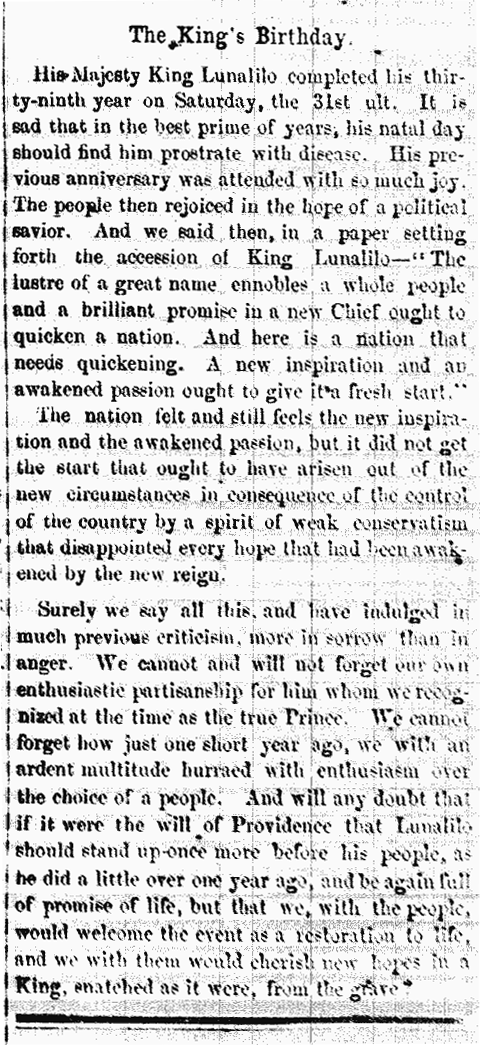
His Majesty King Lunalilo completed his thirty-ninth year on Saturday, the 31st ult. It is sad that in the best prime of years, his natal day should find him prostrate with disease. His previous anniversary was attended with so much joy. The people then rejoiced in the hope of a political savior. And we said then, in a paper setting forth the accession of King Lunalilo—”The lustre of a great name ennobles a whole people and a brilliant promise in a new Chief ought to quicken a nation. And here is a nation that need quickening. A new inspiration an awakened passion ought to give it a fresh start.”

The nation felt and still feels the new inspiration and the awakened passion, but it did not get the start that ought to have arisen out of the new circumstances in consequence of the control of the country by a spirit of weak conservatism that disappointed every hope that had been awakened by the new reign.

Surely we say all this, and have indulged in much previous criticism, more in a sorrow than in anger. We cannot and will not forget our own enthusiastic partisanship for him whom we recognized at the time as the true Prince. We cannot forget how just one short year ago, we with an ardent multitude hurraed with enthusiasm over a choice of a people. And will any doubt that if it were the will of Providence that Lunalilo should stand up once more before his people, as he did a little over one year ago, and be again full of life, but that we, with the people, would welcome the even as a restoration to life, and we with them would cherish new hopes in a King, snatched as it were, from the grave.

(Nuhou, 2/3/1874, p. 6)

The King's Birthday.

Ka Nuhou Hawaii, Buke I, Helu 14, Aoao 6. Feberuari 3, 1874.

Ti ka char sow san nin fat choi? 1866.

Aloha La Konohi!

Is there anyone that knows what dialect the Chinese lines are from in the previous mele post?

Also, might there be someone that might offer an interpretation or translation for the Chinese lines?

1 La hauoli a pomaikai,
No ka lahui o Kina,
Ti ka char sow san nin fat choi
No ka makahiki hou,
Hape Nuia. Hape Nuia &co
E na makamaka nei.

2 Ke hui mai nei na kalepa
O ko Kina poe gentlemen,
Me ka lakou mau ladies no
A hauoli hoomaikai,
Ti ka kon hi. Ti ka kon hi, &co
And san nin Tat-i.

3 Na makua o keia hui
Me na keiki a lakou,
A pomaikai na mea a pau
Keia makahiki hou,
Choi tan qui sow. Choi tan qui sow
Hooili ia lakou.

4 Na ke Akua ma ka lani
Nana e hoomaikai mai
O keia hui ko Kina poe
E noho ma Hawaii nei,
Haleluia. Haleluia
No ka Haku ola mau.

5 Na Keonimana me na Lady
E aloha kakou a pau,
No ko kakou olioli,
Ka la nu Lahui o Kina,
Huro kakou! Huro kakou!!
A hauoli pu.

Chinese New Year song in Lahaina, 1866.

[Found under: “Ka Happy New Year o na Pake”]

Iolidane:—Tahiti Tune.

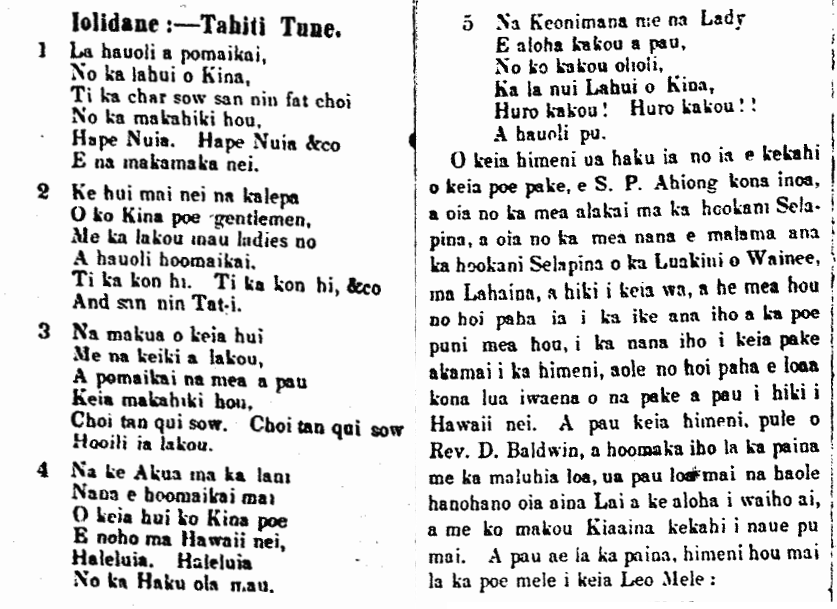
1 La hauoli a pomaikai,
No ka lahui o Kina,
Ti ka char sow san nin fat choi
No ka makahiki hou,
Hape Nuia. Hape Nuia &co
E na makamaka nei.

2 Ke hui mai nei na kalepa
O ko Kina poe gentlemen,
Me ka lakou mau ladies no
A hauoli hoomaikai,
Ti ka kon hi. Ti ka kon hi, &co
And san nin Tat-i.

3 Na makua o keia hui
Me na keiki a lakou,
A pomaikai na mea a pau
Keia makahiki hou,
Choi tan qui sow. Choi tan qui sow
Hooili ia lakou.

4 Na ke Akua ma ka lani
Nana e hoomaikai mai
O keia hui ko Kina poe
E noho ma Hawaii nei,
Haleluia. Haleluia
No ka Haku ola mau.

5 Na Keonimana me na Lady
E aloha kakou a pau,
No ko kakou olioli,
Ka la nu Lahui o Kina,
Huro kakou! Huro kakou!!
A hauoli pu.

[Jordan [?]:—Tahiti Tune.
1 Joyous and blessed day,
For the Chinese people,
Ti ka char sow san nin fat choi
For the new year,
Happy New Year. Happy New Year &co
O Friends here.
2 The merchants have gathered
Of China’s gentlemen,
Along with their ladies
And blessed happiness
Ti ka kon hi. Ti ka kon hi, &co
And sun nin Tat-i.
3 The elders of this group
Along with their children,
Blessed is everyone
This new year,
Choi tan qui sow. Choi tan qui sow.
Onto them.
4 It is God in heaven
Who will bless them
This group of China’s people
Living in Hawaii nei,
Hallelujah, Hallelujah
For the eternal Lord.
5 The Gentlemen and Ladies
Aloha amongst all of us,
For our joy,
The holiday of the Chinese people,
Hurrah to us! Hurrah to us!!
And happiness too.]

This song was composed by one of these Chinese; S. P. Ahiong is his name, and he is the director in the playing of the Seraphim [Selapina], and he holds Seraphim concerts in the Wainee Church in Lahaina until today, and it may be something novel to see for those who are into new things; seeing this skilled Chinese singer, he probably has no match amongst all the Chinese who have come to Hawaii nei. After this song, Rev. D. Baldwin gave a prayer and the banquet started with much calm; all of the respected haole of that Calm land which aloha has put forth, along with our Governor [Paulo Nahaolelua] who came by….

[This is just a portion of a much larger article describing the new year celebration in Lahaina. There are more mele!]

(Kuokoa, 3/3/1866, p. 4)

Iolidane

Ka Nupepa Kuokoa, Buke V, Helu 9, Aoao 4. Maraki 3, 1866.

On koa haole and uses, 1881.

[Found under: “NA HOOHIALAAI O KA MALU ULU O LELE.”]

Pertaining to the Koa [Haole] Tree—The “fruit” of this tree is a fruit that is not of interest, however the seeds are much desired. They are used to make lei for ladies, and the seed pod is thrown away; however, because of the keen investigation of the Hawaiian women, this fruit is woven into baskets, and now it is sewn into hats, which are truly fine looking; and the women are like flocks of birds as they all reach up with their hands picking the pods. The problem perhaps with these kinds of hats is that ones hair might fall out from ones head, because I remember horses; if the horses eat too much koa, their tails and manes fall out and all that is left is the kano! Perhaps however, it may be that only horses shed, and not people; Malakua folks don’t even own koa¹ hats, but they look like they are starting on the top.

¹The original reads “kou”, but it would make more sense here to be “koa”. Thank you to BK for helping me think out of the box.

[This is part of a column on news from Lahaina, written by its representative in the legislature, Samuel K. Kaihumua.

The Bernice Pauahi Bishop Museum has in their collection one of these haole koa hats. See here for further information. Thank you to MB for help with this information!]

(Ko Hawaii Pae Aina, 10/8/1881, p. 1)

No ka Laau Koa

Ko Hawaii Pae Aina, Buke IV, Helu 41, Aoao 1. Okatoba 8, 1881.