Congratulations Waikiki Aquarium, 110 years old! 1904 / 2014.

HOME OF THE FISHES IS OPENED

A Place to Learn and Enjoy for the Visitors.

AN EFFORT BY HONOLULU’S WEALTHY FOR THE BENEFIT OF EVERYONE.

On the Saturday of this past week, the Aquarium of Hawaii, which stands in Waikiki, makai of Kapiolani Park opened for viewing. This opening was not an opening for the general public, but it was for just those who were invited to come see. This Sunday is when it will be open to the public.

Earlier, it was reported in the columns of the Kilohana¹ that a home will be built where Hawaii’s fishes will be kept, and in the end, the report has come true as the building was entered by the invited guests and will be entered by Honolulu’s people on Sunday.

Many years ago, there was a thought to build an aquarium in Honolulu nei, and Dr. Dorn was the one to come up with the idea; however, because the Government held back some of the resources, this idea by the doctor was dropped and it slept quietly until it was revived by the Rapid Transit Company [Hui Kaauwila]. This idea was considered seriously by this group, when Mr. James Castle [Kimo Kakela] and Mr. and Mrs. C. M. Cooke stepped in and encouraged the effort.

Mr. James Castle gave a portion of the land of Kapiolani Park, which he held in lease, as a place to build this home. When Mr. C. M. Cooke and his wife joined in this effort, that is when the Rapid Transit Company realized that their dream that they were dreaming would come true, and Mr. and Mrs. C. M. Cooke graciously gave the money for the construction. Therefore, the Rapid Transit Company was left to collect Hawaii’s fishes for the aquarium, and that is how the aquarium here on Oahu came to be.

This is seen in the great lands all over the world, and its importance is recognized. One of the benefits is that knowledge is gained by those studying the life of fish, and this is taught at universities. And some thousands of people graduate, being educated in where various ocean fishes live, like whales, sharks, the fishes of the ocean floor, and outside of those, the small fishes of the sea shore.

At the aquarium of Hawaii mentioned above are the many fishes of Hawaii; the ocean fishes are separated from the fresh-water fishes, and according to the visitors who went to see this new place and who have seen the displays of the Foreign Lands, …

¹From the subtitle of the Kuokoa Newspaper: “Ke Kilohana Pookela no ka Lahui Hawaii” [The Greatest Prize of the Hawaiian Nation]

[Go check out the Waikiki Aquarium today, Saturday, 3/22/2014! The 110th anniversary celebration continues with fun for the entire family! $1.10 admission to the Waikiki Aquarium all day! Activities include: the Great Marine Chalk Art Draw and Kids Doodle Zone, entertainment by the UH Rainbow Marching Band, Rainbow Dancers, and other guests groups, a special performance of the musical “Honu by the Sea,” free giveaways (while supplies last), LEGO build area, samples from Pepsi, educational and entertaining activities and much more!]

(Kuokoa, 3/25/1904, p. 1) Continue reading

Kamehameha Schools Song Contest, yesterday and today, 1944 / 2014.

[Found under: “News From Boys, Girls Kamehameha School”]

By HARRIETTE HURLEY

People who enjoy Hawaiian music have expressed the desire to know the meanings of the Hawaiian songs. Translations of the two prize songs to be used in the Kamehameha School for Girls’ song contest to be held on February 13, appear below.

Mrs Mary Kawena Pukui, translator at the Bishop Museum and director of Hawaiian activities at the Kamehameha Preparatory School, has translated the songs.

The junior division prize song is Pa’au’au Waltz. Selected for the senior division prize song is Lei Awapuhi.

Translation of Lei Awapuhi

I hear the voice of a loved one say
Let me pluck and wear the flower
To string a lei for my leaf bud to wear
My love was strongly attracted
To the choicest flower that ever bloomed
Let me, darling, string it into a lei,
O let your ginger lei be mine. Continue reading

John Kaina, Kamehameha senior classman, 1941.

KAMEHAMEHA SCHOOLS NEWS

(Written by Louis Agard)

JOHN KAINA

The Bishop Museum [hale hoahu o na mea kahiko o Bihopa] published picture postcards [pepa kii haleleka] showing Hawaiian pictures. Amongst the cards printed is a picture of John Kaina, a senior classman at Kamehameha. John Kaina’s picture is printed in this group of postcards. The first group is made up of twelve eleven cards. Continue reading

Beginnings of the Bishop Museum, 1888.

[Found under: “This and That.”]

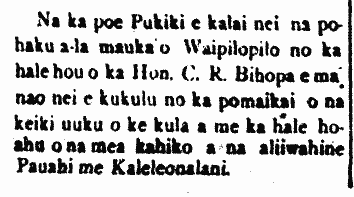
The Portuguese are hewing a-la stone in the uplands of Waipilopilo for the new structure that the Hon. C. R. Bishop is considering building for the benefit of the young children of the school and a place to house the antiques of the royal women Pauahi and Kaleleonalani.

(Kuokoa, 6/2/1888, p. 3)

Na ka poe Pukiki...

Ka Nupepa Kuokoa, Buke XXVII, Helu 22, Aoao 3. Iune 2, 1888.

Another stone kanoa, 1900.

AN AMAZING AWA BOWL.

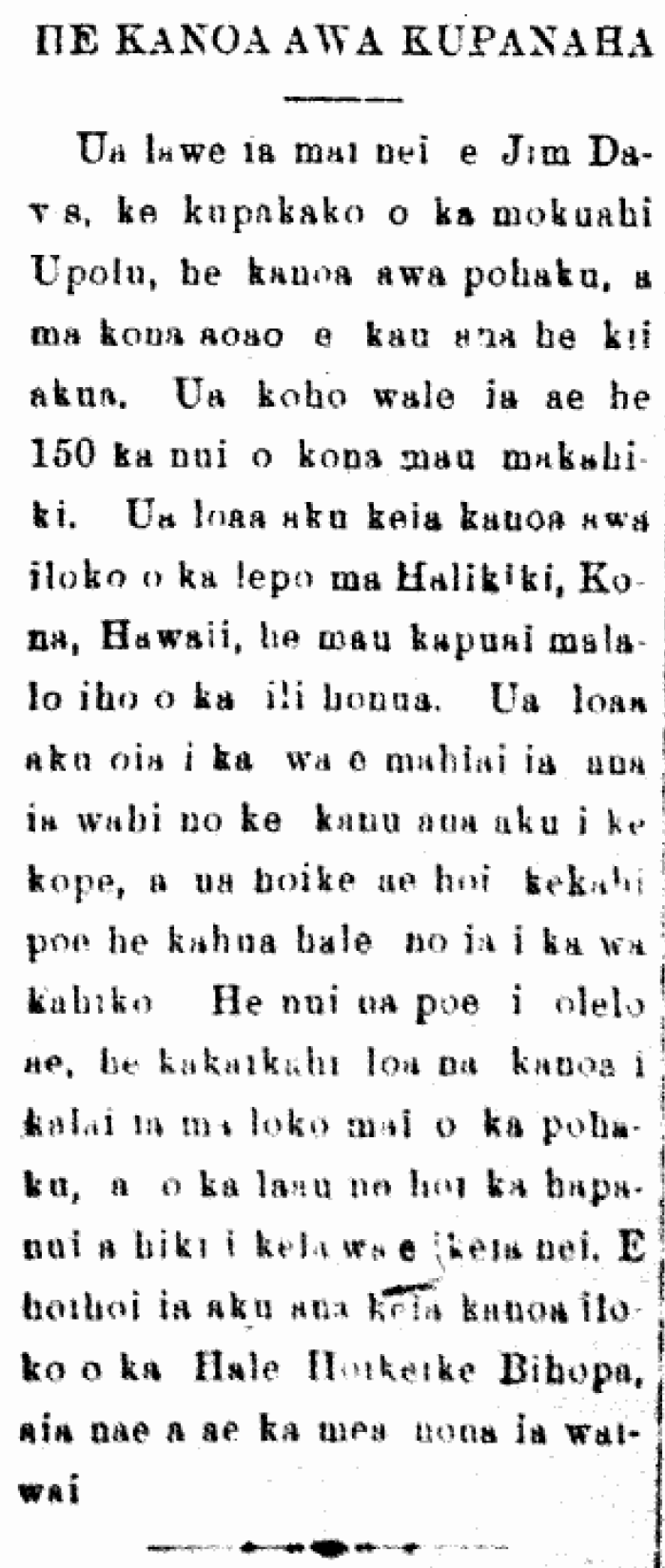
Brought over by Jim Davis, the supercargo [kupakako] of the steamer Upolu, was a stone awa bowl that has a god image [kii akua] on its side. It is estimated to be 150 years old. This kanoa was found in the earth of Halikiki, Kona, Hawaii, a few feet underground. It was found when the land was being worked to plant coffee, and some people said there was a house foundation there in the olden days. There are many who say that a kanoa carved out of stone is very rare, and that most seen to this day are made from wood. This kanoa will be taken to the Bishop Museum after the one who it belongs to gives his consent.

[There was also this story on a stone kanoa at the Museum. And this did not i hear make its way to the Bishop Museum…]

(Aloha Aina, 6/9/1900, p. 6)

HE KANOA AWA KUPANAHA

Ke Aloha Aina, Buke VI, Helu 23, Aoao 6. Iune 9, 1900.

Olelo Noeau, 1922.

PROVERBS.

In order for us to hold on to all of the olelo noeau and all of the ingenious deeds of the Hawaiian people, we very much want everyone to assist the Bishop Museum in their collecting and explaining of wise and witty sayings known amongst this race.

So that this endeavor will move forward, whenever an ancient olelo noeau comes to mind, or perhaps a riddle, do write it down and send it to the museum; and if not to there, send it directly to the Kuokoa with clarification of its hidden meaning or deep wit.

Here are some olelo noeau sent from the museum to this newspaper:

He ala iki ko kahuna.

Aohe pau o ka ike i kau halau.

Aohe hookahi halau i a’oia ai.

He maia ke kanaka, a ka la e hua mai ai, hua.

O-u i ka maka o ka wauke o i opiopio.

Aohe ipukai pau i ka iole.

Aohe malama pau i ka iole.

Aole e nalo na iwi o ke alii kolohe. E nalo na iwi o ke alii maikai. Oluna, olalo, okai, ouka, o ka hao pae, ko ke alii.

Ua mau ke ea o ka aina i ka pono.

E hele ka elemakule, ka luahine, ame ke keiki a moe i ke ala.

Ola na iwi o kaua.

Hiamoe loa ke kane, nana wale ka wahine.

Mai noho a hele kikaha aku.

Ua hala i Kauai, i Kalalau.

Aohe pilo uku.

I ke alo iho la no ka ulu a o ka hala no ia.

He ohu ke aloha, aohe kuahiwi kau ole.

Ono kahi ao luau me ke aloha pu kekahi.

Pa mai, pa mai ka makani o Hilo: waiho ka ipu iki, homai ka ipu nui.

Ka i ke pohuehue, ha’i ka nalu.

Monia, monia, alealea i ke kumu pihapiha: Lawea mai!

O kau ola ia, e Ku ame Hina; O ko’u ola ho’i ia. I ka olua pulapula i keia ao. Amana, ua noa.

Pua ka neneleau momona ka wana.

Pala ka hala, momona ka uhu.

[And presumably from the responses came the publication we all know today as “‘Ōlelo No‘eau: Hawaiian Proverbs and Poetical Sayings”. Some of the examples above are included with different phrasing, while others appear not to have been included. If you don’t have a copy of this publication, it is a must have!]

(Kuokoa, 9/14/1922, p. 5)

NA OLELO NIEAU.

Ka Nupepa Kuokoa, Buke LXI, Helu 37, Aoao 5. Sepatemaba 14, 1922.

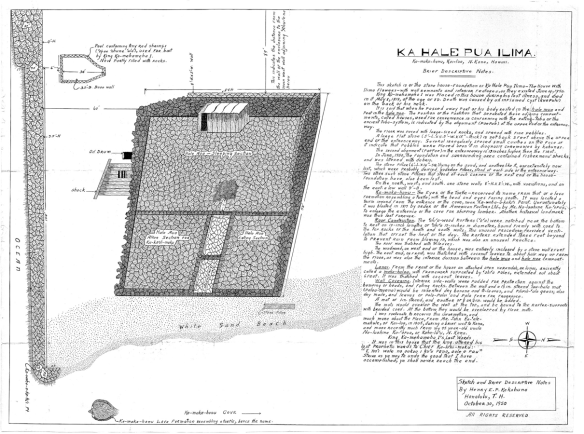
More maps! Check out the awesome detailed work of Henry E. P. Kekahuna, 1900s.

Henry Enoka Palenapa Kekahuna, 1881-1969

Bernice Pauahi Bishop Museum

Henry Kekahuna

Henry E.P. Kekahuna was a valued contributor to Bishop Museum’s records of traditional Hawaiian culture over the many years he assisted anthropologist Kenneth P. Emory. He made detailed records of numerous archaeological sites on Hawai‘i Island for the Museum and the National Park Service, and helped gather local lore from older Hawaiians. (Read on…)

Niihau folks visiting Kauai and a mele for the famed Niihau shell lei , 1940.

[Found under: “Bits of News from Kauai”]

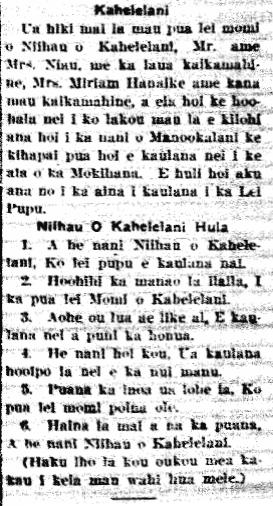
Kahelelani

Those lei blossoms, the momi of Niihau of Kahelelani, Mr. and Mrs. Niau, and their daughter Mrs. Miriam Hanaike and her daughters, have arrived, and they are spending their days gazing at the beauty of Manookalani [Kauai], the flower garden famous for the fragrance of Mokihana. They will return to the land famous for the Shell Lei [Lei Pupu].

Niihau O Kahelelani Hula

1. A he nani Niihau o Kahelelani, Ko lei pupu e kaulana nei.

2. Hoohihi ka manao la ilaila, I ka pua lei Momi o Kahelelani.

3. Aohe ou lua ae like ai, E kaulana nei a puni ka honua.

4. He nani hoi kou, Ua kaulana hooipo ia nei e ka nui manu.

5. Puana ka inoa ua lohe ia, Ko pua lei momi poina ole.

6. Haina ia mai a na ka puana, A he nani Niihau o Kahelelani.

(Your writer has composed these lines of poetry.)

[Abbie P. Palea had a regular column in Hoku o Hawaii, writing about various happenings on Kauai. She often wrote in with poetic compositions by her own hand. Here is just one of them. Although you will find credit given to Joseph Kelly (Keʻale), at the Bishop Museum’s Niihau Shell Lei Exhibit going on now (see it while you can!), i would suggest that because there seems to be no counter claims in later newspapers to Palea’s statement, that “Niihau o Kahelelani Hula” was indeed written by her.

There is so much to be learned from the old Hawaiian-Language Newspapers!]

(Hoku o Hawaii, 8/28/1940, p. 1)

Hoku o Hawaii, Volume XXXV, Number 18, Page 1. Aukake 28, 1940.

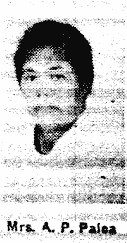
Mrs. A. P. Palea

Kahelelani

Ka Hoku o Hawaii, Volume XXXV, Number 18, Page 1. Aukake 28, 1940.