English and education, 1903.

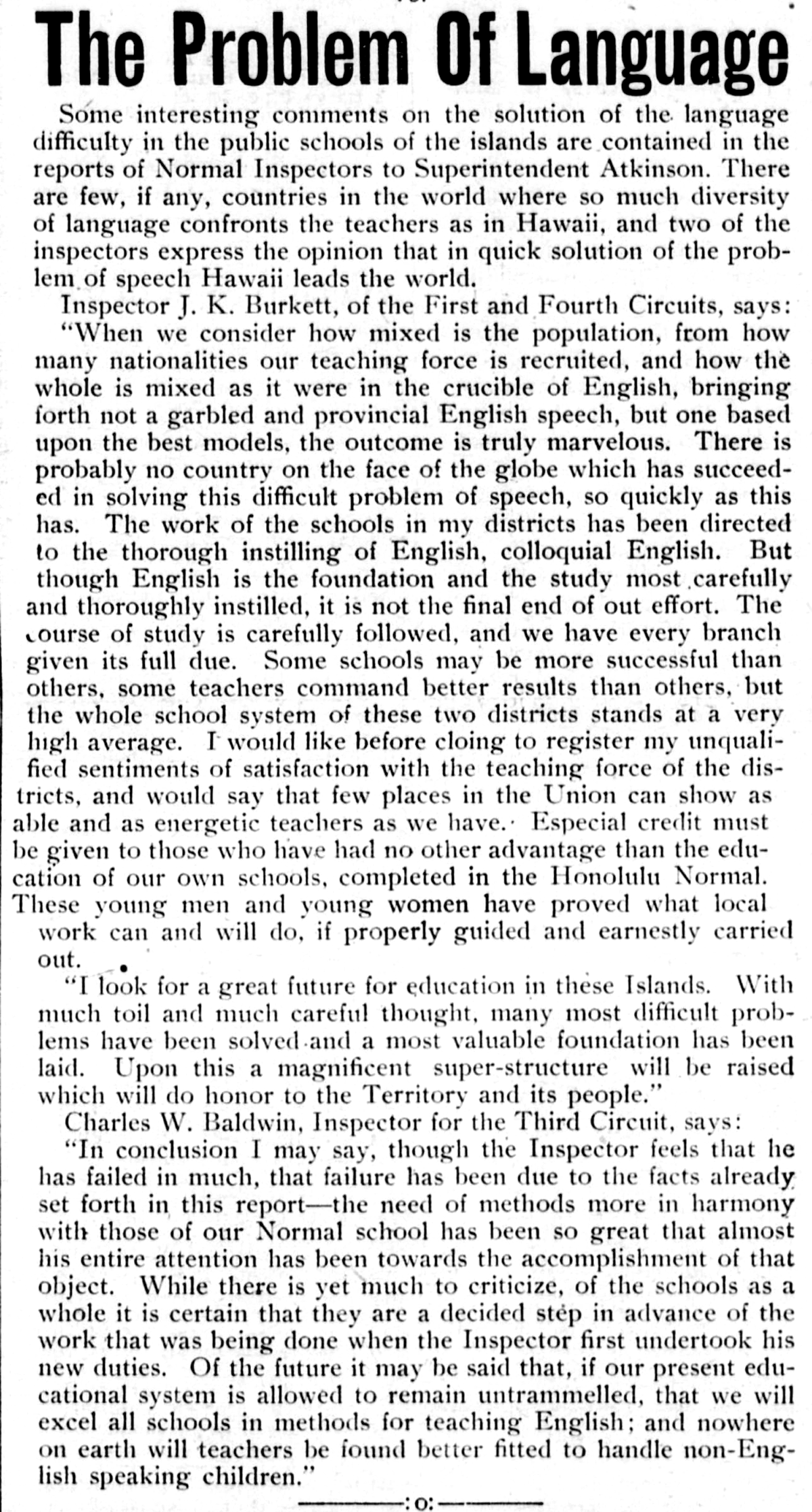
The Problem Of Language

Some interesting comments of the solution of the language difficulty in the public schools of the islands are contained in the reports of Normal Inspectors to Superintendent Atkinson. There are few, if any, countries in the world where so much diversity of language confronts the teachers as in Hawaii, and two of the inspectors express the opinion that in quick solution of the problem of speech Hawaii leads the world.

Inspector J. K. Burkett, of the First and Fourth Circuits, says:

“When we  consider how mixed is the population, from how many nationalities our teaching force is recruited, and how the whole is mixed as it were in the crucible of English, bringing forth not a garbled and provincial English speech, but one based upon  the best models, the outcome is truly marvelous. There is probably no country on the face of the globe which has succeeded in solving this difficult problem of speech, so quickly as this has. The work of the schools in my districts has been directed to the thorough instilling of English, colloquial English. But though English is the foundation and the study most carefully and thoroughly instilled, it is not the final end of our effort. The course of study is carefully followed, and we have every branch given its full due. Some schools may be more successful than others, some teachers command better results than others, but the whole school system of these two districts stands at a very high average. I would like before closing to register my unqualified sentiments of satisfaction with the teaching force of the districts, and would say that few places in the Union can show as able and as energetic teachers as we have. Especial credit must be given to those who have had no other advantage than the education of our own schools, completed in the Honolulu Normal. These young men and young women have proved what local work can and will do, if properly guided and earnestly carried out.

“I look for a great future for education in these Islands. With much toil and much careful thought, many most difficult problems have been solved and a most valuable foundation has been laid. Upon this a magnificent super-structure will be raised which will do honor to the Territory and its people.”

Charles W. Baldwin, Inspector for the Third Circuit says:

“In conclusion I may say, though the Inspector feels that he has failed in much, that failure has been due to the facts already set forth in this report—the need of methods more in harmony with those of our Normal school has been so great that almost his entire attention has been towards the accomplishment of that object. While there is yet much to criticize, of the schools as a whole it is certain that they are a decided step in advance of the work that was being done when the Inspector first undertook his new duties. Of the future it may be said that, if our present educational system is allowed to remain untrammelled, that we will excel all schools in methods for teaching English; and nowhere on earth will teachers be found better fitted to handle non-English speaking children.”

(Hawaiian Star, 3/5/1903, p. 7)

The Problem Of Language

The Hawaiian Star, Volume X, Number 3419, Page 7. March 5, 1903.

The death of Prince Albert Kunuiakea, 1903.

PRINCE ALBERT KUNUIAKEA’S BODY BORNE IN STATE TO THE CAPITOL

Kamehameha III.  Prince Albert.  Queen Kalama.

PRINCE ALBERT AS AN INFANT.

From a picture hanging on the walls of the home of the late Prince Albert Kunuiakea. Made about 1853.

The Program of the Ceremonies Today.

In the old throne room of the Capitol Building, where royalty once held sway, the remains of Prince Albert Kunuiakea were laid in state yesterday afternoon. At 6 o’clock to the accompaniment of muffled drums and the solemn tread of soldiery the casket containing the body of the last heir presumptive of the Kamehamehas was brought from his late residence in Palama to the old royal estate where the Prince as a boy had been raised in the family of Kamehameha III. The procession from the residence was headed by a drum corps followed by four companies of the First Regiment of the National Guard of Hawaii. Behind the troops came the hearse bearing the royal casket, flanked by young Hawaiian chiefs bearing large and small feather kahilis. These were novel in the startling array of beautiful colored feathers and in the adaptation of ancient funeral customs. Behind the hearse came the mourners, the chiefs and chiefesses according to rank as recognized among the Hawaiians. When the military filed into the Capitol grounds they divided on each side of the driveway allowing the hearse to pass between serried lines of soldiers standing at present arms. Col. Soper and Capt. Hawes of the Governor’s staff, in full uniform, met the remains at the front entrance of the Capitol.

The casket was carried into the throne room and deposited upon a bier overspread with a beautiful pall of heavy black velvet faced with yellow silk. At the head was a magnificent feather kahili of black and yellow and candelabra authorized by the Roman Catholic church. Four huge kahilis, the tabu marks of the royal presence, designated the sacred enclosure and within this, six chiefs, three on each side of the bier, were placed upon watch, waving small kahilis in unison over the casket. From the old throne of the Kalakauas the crown flag of Hawaii was suspended and over the entrances the Hawaiian colors were draped. A beautiful array of palms upon the dais, together with the picturesque old throne room chairs, formed a pleasing picture. When the beautiful crystal candelabra were illuminated the scene beneath was spectacular.

The main staircase from the hallway was lined with palms. The waving of the kahilis, and the chanting of the genealogy of the Prince were continued through the night and will be a part of the weird ceremony until the casket is borne from the palace.

The committee on decorations was as follows: Mrs. Carrie Robinson, Mrs. Helen Holt, Mrs. Mary Beckley, Mrs. Ena, Mrs. A. P. Taylor, Mrs. Emmeline Magoon, Mrs. Alice Hutchinson, Miss Hilda Burgess, Miss May Low, Harry Davison, J. McGuire.

From 11 a. m. to 1 p. m. today the body will lie in state in the old throne room of the Capitol. From 1 to 1:20 p. m. the Roman Catholic service will be said, Pro Vicar Libert officiating. A detail of the National Guard was assigned as a guard of honor yesterday afternoon and will remain under arms until the procession moves this afternoon.

The order of procession today appears elsewhere in a By Authority notice.

[Might anyone know where this portrait is today?]

(Pacific Commercial Advertiser, 3/15/1903, p. 1)

PRINCE ALBERT KUNUIAKEA'S BODY BORNE IN STATE TO THE CAPITOL

Sunday Advertiser, Volume I, Number 11, Page 1. March 15, 1903.

Edgar Henriques weds Lucy Kalanikiekie Davis, 1898.

[Found under: “LOCAL BREVITIES.”]

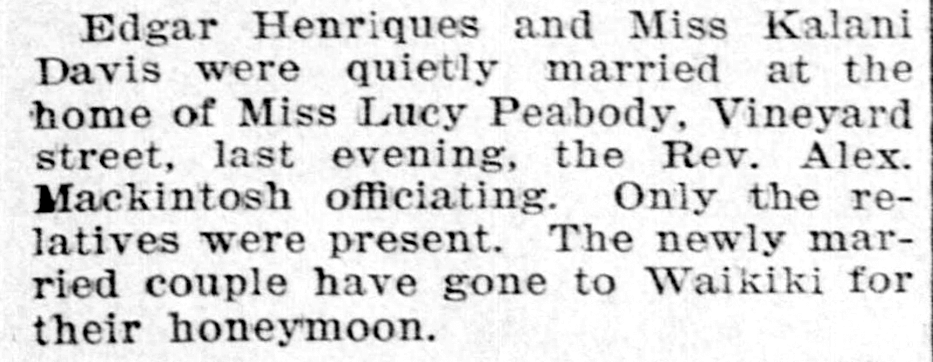
Edgar Henriques and Miss Kalani Davis were quietly married at the home of Miss Lucy Peabody, Vineyard street, last evening [June 10, 1898], the Rev. Alex. Mackintosh officiating. Only the relatives were present. The newly married couple have gone to Waikiki for their honeymoon.

(Pacific Commercial Advertiser, 6/24/1898, p. 7)

Edgar Henriques...

The Pacific Commercial Advertiser, Volume XXVII, Number 4954, Page 7. June 24, 1898.

What may have seemed a good idea at the time…, 1883.

[Found under: “NEWS OF THE WEEK.”]

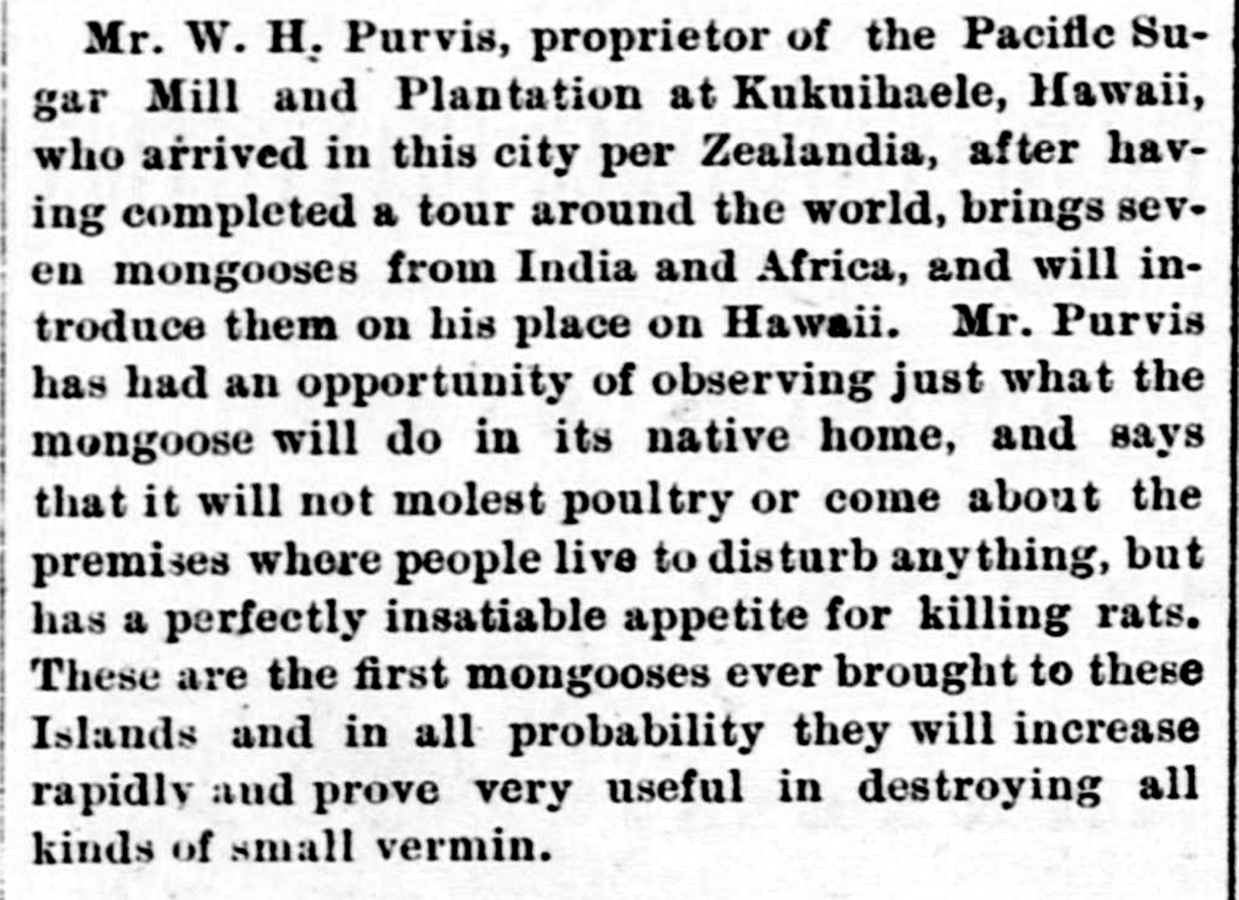
Mr. W. H. Purvis, proprietor of the Pacific Sugar Mill and Plantation at Kukuihaele, Hawaii, who arrived in this city per Zealandia, after having completed a tour around the world, brings seven mongooses from India and Africa, and will introduce them on his place on Hawaii. Mr. Purvis has had an opportunity of observing just what the mongoose will do in its native home, and says that it will not molest poultry or come about the premises where people live to disturb anything, but has a perfectly insatiable appetite for killing rats. These are the first mongooses ever brought to these Islands and in all probability they will increase rapidly and prove very useful in destroying all kinds of small vermin.

[One thing is true, they sure did increase rapidly.]

(Pacific Commercial Advertiser, 9/29/1883, p. 5)

Mr. W. H. Purvis...

The Pacific Commercial Advertiser, Volume XXVIII, Number 14, Page 5. September 28, 1883.

Hawaii related publications, 1844.

CATALOGUE OF WORKS

WHICH RELATE TO, OR TREAT OF,

THE HAWAIIAN ISLANDS.

This catalogue will be found incomplete—especially in works published on the continent of Europe—but it is the best to be derived from the sources at our disposal.

HISTORICAL.

History of the Sandwich Island Mission.—By Rev. Sheldon Dibble. 12mo. New York, 1839.

History of the American Board of Foreign Missions.—8vo. Worcester, 1840. Rev. S. Tracy.

History of the Hawaiian or Sandwich Islands.—By James J. Jarves. 8vo. Boston.—Tappan & Dennet—with plates and maps—1843.

English Edition of same work.—London—Edward Moxon—1843.

History of the North West Coast of America.—By Robert Greenhow. 8vo. Wiley & Putnam—New York. 1840.

Ka Mooolelo, Hawaii, Lahainaluna, 1838.

History of Polynesia.—By Right Rev. M. Russel. 1vol., 12mo. Edinburgh—J. Harper and Brothers—New York, 1843.

History of the Sandwich Islands.—By Sheldon Dibble, Lahainaluna; Pres. of the Mission Seminary, 1843.

The Sandwich Islands.—Progress of Events since their discovery by Capt. Cook; Their Occupation by Lord George Paulet; Their Value and importance by Alexander Simpson, Esq,. 8vo—pamphlet. London, Smith, Elder & Co. 1843.

———

VOYAGES.

Anson’s Voyage around the World.—London, 1748.

Third Voyage of Capt. James Cook, 3 vols. 4to—plates. Admiralty edition. London, 1785.

Portlock’s and Dixon’s Voyage, 1785 to 1788—1 vol. quarto; London, 1789.

Vancouver’s Voyage of Discovery to the North Pacific Ocean, and round the World—1790—1795—3vols.—4to—London, 1798.

Broughton’s Voyage of Discovery in the Dædalus—1795—1798. London—4to—1804.

Capt. John Meare’s Voyages—1787—1788 8vo. London, 1790.

Manuscript Journal of the Voyage of the Brig Hope of Boston, commanded by Joseph Ingraham—from 1790 to 1793; preserved in the Library of the Department of State, at Washington.

Account of a Voyage in the Pacific, made in 1793, and 1794, by Capt. James Colnett, London,—4to.

Voyage de La Perouse au tour du Monde,…

(Polynesian, 7/13/1844, p. 30)

CATALOGUE OF WORKS...

The Polynesian, New Series, Volume 1, Number 8, Page 30. July 13, 1844.

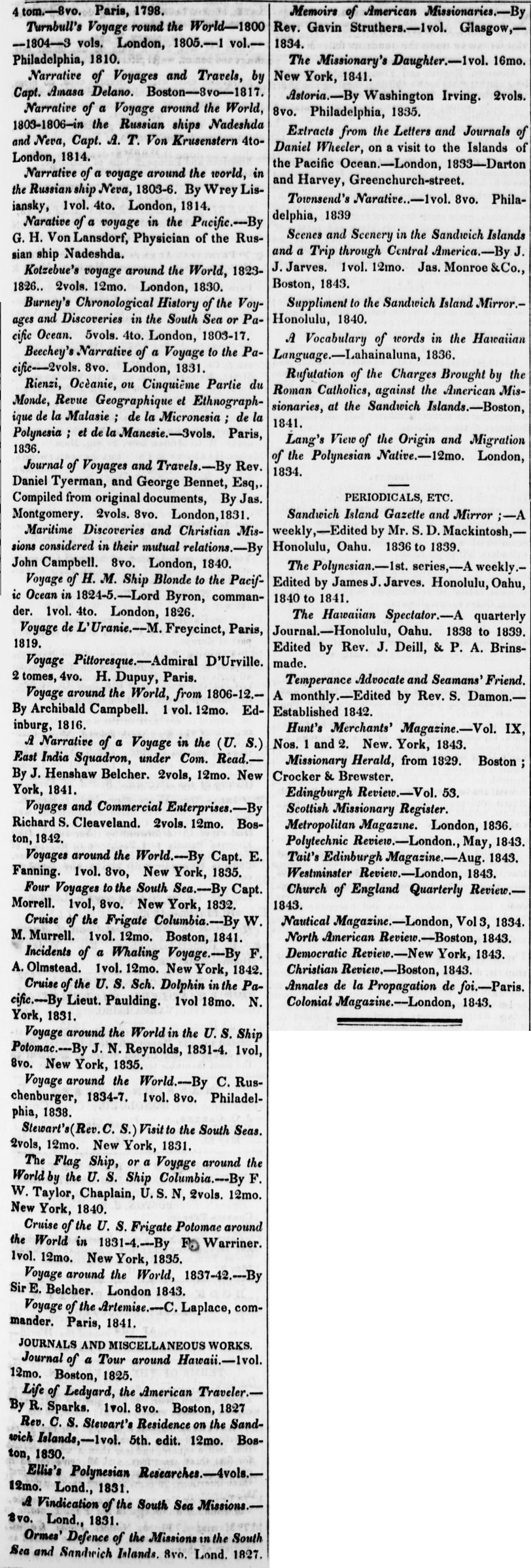
…4 tom.—8vo. Paris, 1798.

Turnbull’s Voyage round the World—1800—1804—3 vols. London, 1805.—1 vol.—Philadelphia, 1810.

Narrative of Voyages and Travels, by Capt. Amasa Delano. Boston—8vo—1817.

Narrative of a Voyage around the World, 1803—1806—in the Russian ships Nadeshda and Neva, Capt. A. T. Von Krusenstern 4to—London, 1814.

Narrative of a voyage around the world, in the Russian ship Neva, 1803—6. By Wrey Lisiansky, 1vol. 4to. London, 1814.

Narrative of a voyage in the Pacific.—By G. H. Von Lansdorf, Physician of the Russian ship Nadeshda.

Kotzebue’s voyage around the World, 1823—1826., 2vols. 12mo. London, 1830.

Burney’s Chronological History of the Voyages and Discoveries in the South Sea or Pacific Ocean. 5vols. 4to. London, 1803—17.

Beechey’s Narrative of a Voyage to the Pacific—2vols. 8vo. London, 1831.

Rienzi, Ocèanie, ou Cinquième Partie du Monde, Revue Geographique et Ethnographique de la Malasie; de la Micronesia; de la Polynesia; et de la Manesie.—3vols. Paris, 1836.

Journal of Voyages and Travels.—By Rev. Daniel Tyerman, and George Bennet, Esq,. Compiled from original documents, By Jas. Montgomery. 2vols. 8vo. London, 1831.

Maritime Discoveries and Christian Missions considered in their mutual relations.—By John Campbell. 8vo. London, 1840.

Voyage of H. M. Ship Blonde to the Pacific Ocean in 1824—5.—Lord Byron, commander. 1vol. 4to. London, 1826.

Voyage de L’Uranie.—M. Freycinct, Paris, 1819.

Voyage Pittoresque.—Admiral D’Urville. 2 tomes, 4vo. H. Dupuy, Paris.

Voyage around the World, from 1806—12.—By Archibald Campbell. 1 vol. 12mo. Edinburg, 1816.

A Narrative of a Voyage in the (U. S.) East India Squadron, under Com. Read.—By J. Henshaw Belcher. 2vols, 12mo. New York, 1841.

Voyages and Commercial Enterprises.—By Richard S. Cleaveland. 2vols. 12mo. Boston, 1842.

Voyages around the World.—By Capt. E. Fanning. 1vol. 8vo, New York, 1835.

Four Voyages to the South Sea.—By Capt. Morrell. 1vol, 8vo. New York, 1832.

Cruise of the Frigate Columbia.—By W. M. Murrell. 1vol. 12mo. Boston, 1841.

Incidents of a Whaling Voyage.—By F. A. Olmstead. 1vol. 12mo. New York, 1842.

Cruise of the U. S. Sch. Dolphin in the Pacific.—By Lieut. Paulding. 1vol 18mo. N. York, 1831.

Voyage around the World in the U. S. Ship Potomac.—By J. N. Reynolds, 1831—4. 1vol, 8vo. New York, 1835.

Voyage around the World.— By C. Ruschenburger, 1834—7. 1vol. 8vo. Philadelphia, 1838.

Stewart’s (Rev. C. S.) Visit to the South Seas. 2vols, 12mo. New York, 1831.

The Flag Ship, or a Voyage around the World by the U. S. Ship Columbia.—By F. W. Taylor, Chaplain, U. S. N, 2vols. 12mo. New York, 1840.

Cruise of the U. S. Frigate Potomac around the World in 1831—4.—By F. Warriner. 1vol. 12mo. New York, 1835.

Voyage around the World, 1837—42.—By Sir E. Belcher. London 1843.

Voyage of the Artemise.—C. Laplace, commander. Paris, 1841.

———

JOURNALS AND MISCELLANEOUS WORKS.

Journal of a Tour around Hawaii.—1vol. 12mo. Boston, 1825.

Life of Ledyard, the American Traveler.—By R. Sparks. 1vol. 8vo. Boston, 1827

Rev. C. S. Stewart’s Residence on the Sandwich Islands,—1vol. 5th. edit. 12mo. Boston, 1830.

Ellis’s Polynesian Researches.—4vols.—12mo. Lond., 1831.

A Vindication of the South Sea Missions.—3vo. Lond., 1831.

Ormes’ Defence of the Missions in the South Sea and Sandwich Islands. 8vo. Lond. 1827.

 Memoirs of American Missionaries.—By Rev. Gavin Struthers.—1vol. Glasgow,—1834.

The Missionary’s Daughter.—1vol. 16mo. New York, 1841.

Astoria.—By Washington Irving. 2vols. 8vo. Philadelphia, 1835.

Extracts from the Letters and Journals of Daniel Wheeler, on a visit to the Islands of the Pacific Ocean.—London, 1833—Darton and Harvey, Greenchurch-street.

Townsend’s Narrative.,—1vol. 8vo. Philadephia, 1839

Scenes and Scenery in the Sandwich Islands and a Trip through Central America.—By J. J. Jarves. 1vol. 12mo. Jas. Monroe & Co., Boston, 1843.

Suppliment to the Sandwich Island Mirror.—Honolulu, 1840.

A Vocabulary of words in the Hawaiian Language.—Lahainaluna, 1836.

Refutation of the Charges Brought by the Roman Catholics, against the American Missionaries, at the Sandwich Islands.—Boston, 1841.

Lang’s View of the Origin and Migration of the Polynesian Native.—12mo. London, 1834.

———

PERIODICALS, ETC.

Sandwich Island Gazette and Mirror;—A weekly,—Edited by Mr. S. D. Mackintosh,—Honolulu, Oahu. 1836 to 1839.

The Polynesian.—1st. series,—A weekly.—Edited by James J. Jarves. Honolulu, Oahu, 1840 to 1841.

The Hawaiian Spectator.—A quarterly Jounal.—Honolulu, Oahu. 1838 to 1839. Edited by Rev. J. Deill, & P. A. Brinsmade.

Temperance Advocate and Seamans’ Friend. A monthly.—Edited by Rev. S. Damon.—Established 1842.

Hunt’s Merchants’ Magazine.—Vol. IX, Nos. 1 and 2. New. York, 1843.

Missionary Herald, from 1829. Boston; Crocker & Brewster.

Edingburgh Review.—Vol. 53.

Scottish Missionary Register.

Metropolitan Magazine. London, 1836.

Polytechnic Review.—London., May, 1843.

Tait’s Edinburgh Magazine.—Aug. 1843.

Westminster Review.—London, 1843.

Church of England Quarterly Review.—1843.

Nautical Magazine.—London, Vol 3, 1834.

North American Review.—Boston, 1843.

Democratic Review.—New York, 1843.

Christian Review.—Boston, 1843.

Annales de la Propagation de foi.—Paris.

Colonial Magazine.—London, 1843.

(Polynesian, 7/13/1844, p. 31)

4 tom...

The Polynesian, New Series, Volume 1, Number 8, Page 31. July 13, 1844.
The “Kearny Cloak” at Tiffany & Co., 1893.

THE WAR CLOAK OF KAMEHAMEHA I.

AN INTERESTING HAWAIIAN RELIC TO BE SEEN IN THIS CITY.

The recent proposed annexation of the Sandwich Islands has revived much forgotten lore concerning the people of Hawaii and their history, and nothing perhaps is more interesting than specimens of the handiwork of this semi-barbarous people who possessed certain arts for ingenuity and patient labor that cannot be equalled by the boasted civilization of the nineteenth century. In Tiffany & Co.’s window, in Union Square, there is on exhibition for a few days a feather war cloak or namo, once the property of Hawaii’s giant King, Kamehameha I (The Lonely One), which tradition says cost the labor of several generations of skilled workers. The body consists of a fine network of homespun cord, make from the native hemp or olona, the meshes of which vary from an eight to a thirty-second of an inch; over this is laid the feather-work in small bunches of three or four feathers each, tied with a minute thread highly twisted, made from the same fibre. The cloak is almost semicircular in shape, and cut to fit in at the neck. The meshwork being made in sections of various shapes, allows it, when placed on a tall man’s shoulders, to fall in graceful lines about his body. Continue reading

Isaac Testa dies, 1909.

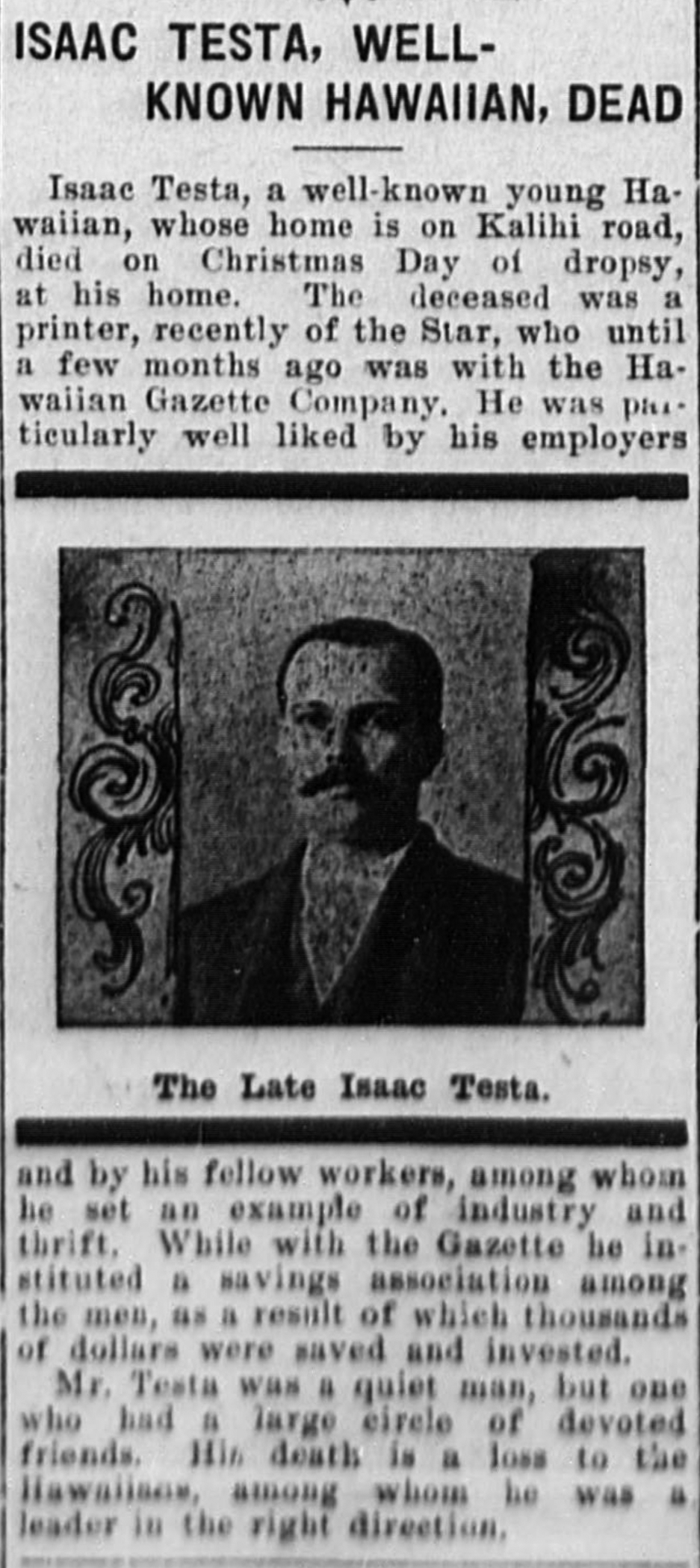
ISAAC TESTA, WELL-KNOWN HAWAIIAN, DEAD

Isaac Testa, a well-known young Hawaiian, whose home is on Kalihi road, died on Christmas Day of dropsy, at his home. The deceased was a printer, recently of the Star, who until a few months ago was with the Hawaiian Gazette Company. He was particularly well liked by his employers…

The Late Isaac Testa.

…and by his fellow workers, among whom he set an example of industry and thrift. While with the Gazette he instituted a savings association among the men, as a result of which thousands of dollars were saved and invested.

Mr. Testa was a quiet man, but one who had a large circle of devoted friends. His death is a loss to the Hawaiians, among whom he was a leader in the right direction.

[It seems that this is the son of the sister of Hoke (Francisco Jose Testa).]

(Hawaiian Gazette, 12/28/1909, p. 3)

ISAAC TESTA, WELL-KNOWN HAWAIIAN, DEAD

Hawaiian Gazette, Volume LII, Number 104, Page 3. December 28, 1909.

Kalai’s fame spreads to far away Pennsylvania, 1874.

[Found under: “Varieties.”]

King Kalakaua, of the Sandwich Islands, has requested an old woman named Kalai, who sent him a mat into which she had woven a petition praying for the removal of taxes on animals, to weave two mats, one with the American and the other with the English coat-of-arms, to be exhibited at our Centennial Exhibition as specimens of Hawaiian handiwork.

[There is mention of this also in the National Republican (Washington, DC) on 6/19/1874.]

(Juniata Sentinel and Republican, 6/24/1874, p. 1)

King Kalakaua...

Juniata Sentinel and Republican, Volume XXVIII, Number 25, Page 1. June 24, 1874.

The famous Niihau protest mat on display at the Bishop Museum, 1874 / 2015.

[Found under: “NOTES OF THE WEEK.”]

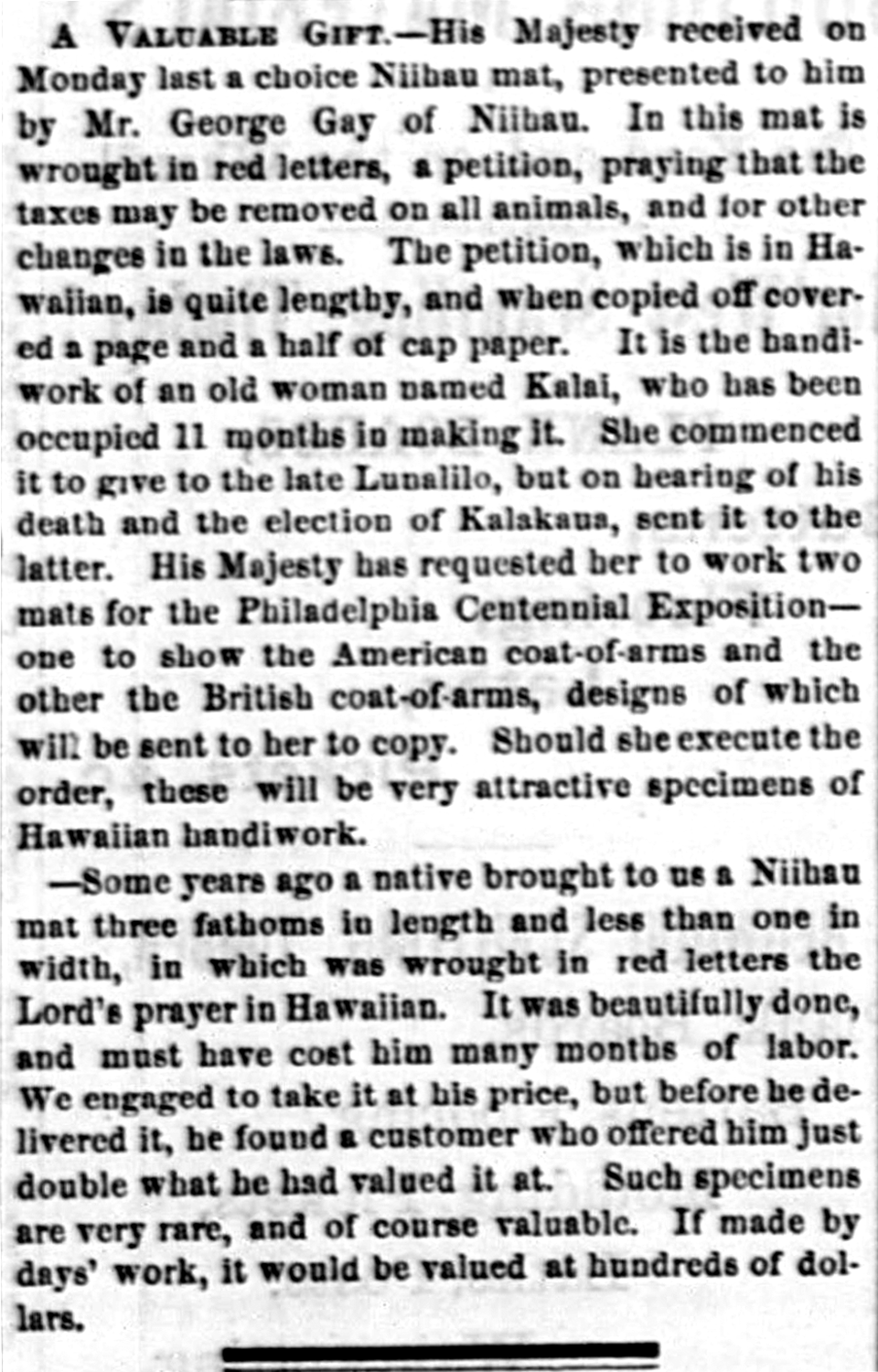
A Valuable Gift.—His Majesty received on Monday last a choice Niihau mat, presented to him by Mr. George Gay of Niihau. In this mat is wrought in red letters, a petition, praying that the taxes may be removed on all animals, and for other changes in the laws. The petition, which is in Hawaiian, is quite lengthy, and when copied off covered a page and a half of cap paper. It is the handiwork of an old woman named Kalai, who has been occupied 11 months in making it. She commenced it to give to the late Lunalilo, but on hearing of his death and the election of Kalakaua, sent it to the latter. His Majesty has requested her to work tow mats for the Philadelphia Centennial Exposition—one to show the American coat-of-arms and the other the British coat-of-arms, designs of which will be sent to her to copy. Should she execute the order, these will be very attractive specimens of Hawaiian handiwork.

—Some years ago a native brought to us a Niihau mat three fathoms in length and less than one in width, in which was wrought in red letters the Lord’s prayer in Hawaiian. It was beautifully done, and must have cost him many months of labor. We engaged to take it at his price, but before he delivered it, he found a customer who offered him just double what he had valued it at. Such specimens are very rare, and of course valuable. If made by days’ work, it would be valued at hundreds of dollars.

[This mat was put on display at the Bishop Museum just yesterday. Go check it out if you are on Oahu nei.]

(Hawaiian Gazette, 4/29/1874, p. 3)

A Valuable Gift.

Hawaiian Gazette, Volume X, Number 17, Page 3. Aprila 29, 1874.

Observations from an Englishman, 1893.

From a Travelling Englishman.

From the time I arrived in Honolulu until today, I’ve heard often of matters pertaining to those referred to as the circle of missionaries, and the dimness of their ideas; I’ve observed their actions very carefully.

I saw today in the Advertiser [Avalataisa] about the party being given for Captain Wiltse, and how they will sit at this party for two hours and a half with just wine to drink and nothing to eat.

Giving a banquet for a high ranking Captain without serving Glasses of Champaigne [Kamapeni] during all that time is like acting out Hamlet without the ghost.

This will not become something that is greatly ridiculed, but this goes back to the way of life of the old Missionaries, with  their humbling station of evil thoughts.

On the day after this party, I saw that Queen Liliuokalani was sent an invitation under the name Mrs. J. O. Dominis, and this is something quite vile by the Committee who did it; Should the Committee think that are considered adults, then it was improper of them to have sent such an invitation to the Queen.

The first thing taught to schoolchildren in Britain is not to kick a man when he falls down. But this is a woman they are kicking, and that woman is Queen Liliuokalani. This is action that can be called despicable of the meanest form, and should this Committee want to be freed of these words, then they must explain it from their side, or this contemptible act will be carried upon their backs.

Charles G. Nottage.

Hawaiian Hotel [Hotele Hawaii], Feb. 28, 1893.

[Perhaps this was meant to say that there was no wine, and only sparkling water? The article he seems to be talking about is found here on the Chronicling America site. PCA 2/28/1893, p. 2.

There is also reference to a separate party that he was invited to. The Queen is mentioned as “Mrs. J. O. Dominis”. This can be found also at Chronicling America, PCA 2/25/1893, p. 4.]

(Leo o ka Lahui, 3/3/1893, p. 3)

Mai Kekahi Haole Pelekane Kaahele Mai.

Ka Leo o ka Lahui, Buke II, Helu 654, Aoao 3. Maraki 3, 1893.