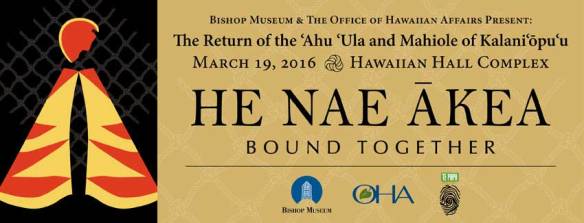
Kalaniopuu’s ahuula and mahiole that he placed on Cook, 1779 / 2016.

I just put up the short excerpt the other day describing Kalaniopuu giving James Cook his ahuula and kahili. And now there is this exciting announcement from the Bernice Pauahi Bishop Museum!

he-nae-akea

[It should be perhaps made clear however that the ahuula at least has made its way back to Hawaii nei two times since 1779, courtesy of the Dominion Museum, the predecessor of Te Papa Tongarewa]. The first time was in 1960:

DOMINION MUSEUM FEATHER CLOAK

Each year the Museum attempts to bring back for the Aloha Week exhibit a fine example of Hawaiian featherwork from abroad. This year the Dominion Museum of Wellington, New Zealand, has generously loaned a large Hawaiian feather cloak, which to the best of our knowledge, was presented to Captain Cook’s expedition in 1779. Aloha Week marks the first return of this cloak to Hawaii.

(Conch Shell: News of the Bishop Museum, October 1960)

The second time was for the “Artificial Curiosities” exhibit at the Bishop Museum which ran from January 18 to August 31, 1978.

Also, check out this previous post on an amazing story about other featherwork given to Cook by Kalaniopuu!

George Vancouver arrives once more on February 14, 1793.

[Found under: “He Moolelo Hawaii”]

Vancouver Returns

In the month of February, the 14 day, 1793, Vancouver [Vanekouwa] returned to Hawaii nei, from the northwest of America, and landed at Kawaihae.

The men pleaded for guns and powder from him. Vancouver refused and would not sell those sort things to them. There was great desire of Hawaiians for those things during those days, because it was a time of war, and Kamehameha was conquering the nation then; Oahu and Kauai remained.

And from there, Vancouver landed at Kealakekua, on the 22nd of that month and met with Kamehameha.

At that time, he gifted Kamehameha with two cattle, a bull and a cow. The cattle that Vancouver brought were from Monterey, a land in America.

These animals were greatly appreciated by Hawaiians because they were unusual, and they were called puaa pipi. It is from those pipi that the cattle which roam these days at Waimea and Maunakea and the other forests of Hawaii proliferated.

Kamehameha treated Vancouver kindly; Vancouver was facing hardship without water and took his water barrels into the uplands, and Kamehameha commanded his men to carry the barrels and to fill them with water. Continue reading

Recalling the death of James Cook, 1896.

[Found under: “He Moolelo no ka HOOKUMUIA ANA O HAWAII”]

PERTAINING TO THE DEATH OF LONO.

On the 24th of January 1779, Kalaniopuu returned from Maui; Lono was at Kealakekua in Kona, and Kalaniopuu met with Lono, and Kalaniopuu the chief treated Lono kindly and donned a ahu ula upon Lono, with kahili, and Kalaniopuu did a great many good things for Lono.

And on the 4th of February 1779, Lono leaves Kealakekua and his ship sails directly outside of Kawaihae and Kohala; it is noticed that one of the masts of his ship is rotten, so he returns to Kealakekua to build a new mast for his ship. Continue reading

Acrostic Mele for the Home of Emma and Joseph Nawahi, Homelani, 1894.

HOME LANI.

N—ani wale ka luna a i Homelani
A—ia i ka lai a o Hilo One
W—ehiwehi ka opua i ka’u ike
A—ia i ke ao malamalama
H—anohano Hawaii i ka’u ike
I—ke ku kamahao ma ka Hikina
O—ka lehua makanoe o Luluupali
K—ahiko mau ia o ka aina
A—ia i ka luna o Waiau
L—ilinoe ka wahine a oia uka
A—ia i ka piko olu o Wakea
N—oho mai o Malama i ka uluwehi
I—iwi e ka manu kiko waipua
O—ka Mamo iho la hulu melemele
P—au na mea nui i ka ike ia
U—a au ia hoi e ke kai loa
U—a like a like me Nelekona
A—iwaiwa a o Hawaii nei
I—anei ke aloha kakia iwi
M—akia paa ia i ka puuwai
A—eo mai oe i kou inoa
O Kalaniopuu i ka uluwehi.

Hakuia e Puuwaialoha.

[E o, e Hilo i ka ua Kanilehua! Does anyone know who Puuwaialoha is? This person was a composer of many a mele.]

(Leo o ka Lahui, 12/18/1894, p. 3)

HOME LANI.

Ka Leo o ka Lahui, Buke II, Helu 1080, Aoao 3. Dekemaba 18, 1894.

Death of Laura Kanaholo Konia, 1857.

On this past 2nd, L. Konia, the widow of A. Paki, died at 50 years of age. She was an alii nui, and was a child of Kaoleioku, and Kalaniopuu was the father of Kaoleioku, an actual cousin of the father of Kamehameha I. Konia was a loving chiefess, and her friends and all the people of this archipelago are very saddened for there is no high chiefess in this land remaining; they have all gone. Her friends weep with greatly pained hearts.

(Hae Hawaii, 7/15/1857, p. 62)

I ka la 2 iho nei...

Ka Hae Hawaii, Buke 2, Ano Hou—-Helu 16, Aoao 62. Iulai 15, 1857.

On the moving of the Na-ha Stone to Hilo Library 100 years ago, and its history (3 of 6), 1915.

THE STORY OF THE NA-HA STONE

(Continued)

“Hear me, O Alii; he has but one opponent to fight where the strength of this hanai of mine will be challenged, that is Keaweokahikona, and this is his one opponent that will thwart his strength, and who will also thwart the strength of his young experts in spear throwing, making it into nothing. I say before you all, O high Chiefs of the land, he must go see this relative of his, for he [Keaweokahikona] is his own blood relative [piko], and should he [Keaweokahikona] decide to follow him, then there will be no more difficulties and they will live as leader and follower from here forth. But he must go quickly and not put it off until the time they should meet has past.

When the alii living in the court of Kalaniopuu heard this, they all approved of this idea of this Prophet Chiefess Kalaniwahine. The days were soon spent preparing for the journey of Kamehameha Paiea to see his cousin Keaweokahikona, and to visit the Naha Stone in the front of Pinao Heiau. The canoes of the young chief Kamehameha were set forth, and they were escorted by a number of high chiefs, they being Naihe and Kalaninuimakolukolu, and these travels of the young chief was accompanied by grace with the seas being calm and the three mountains of Great Hawaii of Keawe were clear.

When the canoes landed at Hilo Hanakahi, they first came ashore at Nukuokamanu [Kanukuokamanu], and as soon as the prow of the canoe rumbled against the sand of Hilo Hanakahi, Naihe folks disembarked first and headed straight for the house of the High Chiefess Ululani; the news had reached the Chiefess Ululani in advance and she called out to Naihe with these words:

“Ha! Hey, my relatives have arrived. What is the reason for your taking this trip across the wide sea?”

At this time her children responded: “Your child is arriving, that is Kalaninuilanimehamehaikamakaohaloa. This is a voyage of that Heavenly Chief to seek a mother, and that is why I appear before you.”

(Hoku o Hawaii, 12/16/1915, p. 2)

KA MOOLELO O NA-HA POHAKU

Ka Hoku o Hawaii, Buke 10, Helu 28, Aoao 2. Dekemaba 16, 1915.

On the moving of the Na-ha Stone to Hilo Library 100 years ago, and its history (2 of 6), 1915.

…the bitter words of Keawemauhili for his charge, Naeole gathered the young leaves of the bitter gourd [ipu awaawa] and broiled them until cooked, and fed them to Kamehameha as if it were young taro leaves,  and it is said that Naeole did this so that the biting and bitter words of Keawemauhili for his charge were neutralized, and those words spoken were those famous words of Hawaii nei of the olden days. “Nip the bud of the wauke while still young.” [“E o-u ka maka o ka wauke oi opiopio.”]

When Kamehameha grew older, and his own father, Keouanui, died, believed to have “been fed a cup of koheoheo by Alapainui here in Hilo,” [“hanai apu koheoheo ia e Alapainui ma Hilo nei,”] that is given poison in his food; Kalaniopuu, Keoua’s elder brother, was in the district of Kau, but moved forth to war with Alapainui, and war was fought where Kalaniopuu retreated. Afterwards war was waged upon the Son of Alapainui, and he died near Kawaihae, and all of Hawaii Island became ruled by Kalaniopuu. Continue reading

On the moving of the Na-ha Stone to Hilo Library 100 years ago, and its history (1 of 6), 1915.

THE STORY OF THE NA-HA STONE

These passing days, the Board of Trade of Hilo [Papa o ka Hui Kalepa o Hilo] is considering moving the Naha Stone [Na-ha Pohaku] from where it now is placed and putting it by the Library of the Hilo Town, and the Editor of the Hoku o Hawaii [S. L. Desha] was asked to tell of some things pertaining to this Royal Stone, and which were contained in the old history of this land, and that will become something for the Natives of this land to understand things about the history of this Birth Stone of the Alii of the Naha Class.

The Naha Stone spoken of in this story is the great Pohaku that is lies in Piihonua in Hilo Town on the Hilo side of Waianuenue Avenue, and is in front of the first house foundation of Governor Kipi of Hilo, and that place is named after an old Heiau called “Pinao.”

In the history of this Royal Stone, it is said that the Pohaku was brought from the Wailua River on Kauai, and it was brought upon double-hulled canoes, and it was brought by a high Chief of long ago named MAKALIINUIKUAKAWALE (m), and this pohaku was brought as a sign of chiefly births and this Pohaku Alii was placed before the Pinao Heiau. Continue reading

Miriam Kekupuohi dies, 1836.

[Found under: “MAKE.”]

Kailua, Hawaii, Feb. 9, 1836.

Died here in Kailua was the chiefess named Miriama Kekupuohi, on the 8th of February. She belonged to the church for eight years, and she was one of the first converts of Kailua nei. She was not known to have any entanglements.

She was very old, perhaps 80 years old. She was a wife of Kalaiopuu,* the chief when Lono [Captain Cook] came, in the first ship to arrive in Kaawaloa.

O Brethren, very true are the words of James 4:14. “Whereas ye know not what shall be on the morrow. For what is your life? It is even a vapour, that appeareth for a little time, and then vanisheth away.”  By DANIELA.

*Kalaiopuu was also known as Kaleiopuu and today is more commonly known as Kalaniopuu.

(Kumu Hawaii, 3/16/1836, p. 24)

Kailua, Hawaii...

Ke Kumu Hawaii, Buke 2, Pepa 6, Aoao 24. Maraki 16, 1836.

Amazing story about the capes given by Kalaniopuu to Cook, 1908.

The Ahuula Garments of Kalaniopuu!

Given by the Chief to Captain Cook!

It is understood in Hawaii’s ancient history, before Captain Cook [Kapena Kuke] left Hawaii, on the 3rd of February, 1779, King Kalaniopuu gave a gift to Captain Cook some Ahuula and Ahu Mamo and feather mahiole headgear of Hawaii. After the ships of Captain Cook left Hawaii Island shortly after the death of that British Captain, the ships went and landed at Kamchatka, on the eastern shores of Siberia.
Continue reading