Ninia Haihailauahiku Kanae dies, 1926.

THAT OLD MOTHER OF WAIKIKI, MRS. N. H. KANAE, PASSES ON.

At 4 o’clock in the morning of Saturday of last week, Mrs. Ninia Haihailauahiku Kanae grew weary of this worldly life at the home of her granddaughter, Mrs. Eva Laupoli Perkins, on Liholiho Street in Makiki, at ninety or more years of elderly age, and with her passing to the other side, it would seem that no more are the old-time locals who accompanied the sea spray of Waikiki. Continue reading

Sarai Hiwauli, 1856.

BIOGRAPHY OF S. HIWAULI II.

Sarai Hiwauli was born in Kahaluu, Koolaupoko, after the great plague here on Oahu during the time of Kamehameha I, and she was taken to Hilo, Hawaii to be raised, along with her parents and her kupuna; from Hopuola and Kalimahauna came Hiwauli, from Kahili and Napolo came Hopuola, from Kahiko and Kuanuuanu came Kahili, from Keaweikekino and Iliholo came Kahiko, from Hoou and Kamaiki came Keaweikekino, from Mahiopupelea and Kapaiki came Hoau, from Kanaloauoo and Kapulaiolaa came Kapaihi, from Kahoanokapuokuihewa and Kapahimaiakea came Kapuleiolaa, from Loheakauakeiki and Kalaniheliikauhilonohonua came Kahoanokapuokuihewa, from Kauhealuikawaokalani and LonowahineikahaleIkiopapa came Kalaniheliikauhilonohonua, from Kaholipioku and Moihala came LonowahineikahaleIkiopapa, from Lonoapii and Piilaniwahine came Moihala, and so on. Continue reading

The birth of the future Kamehameha IV, 1839.

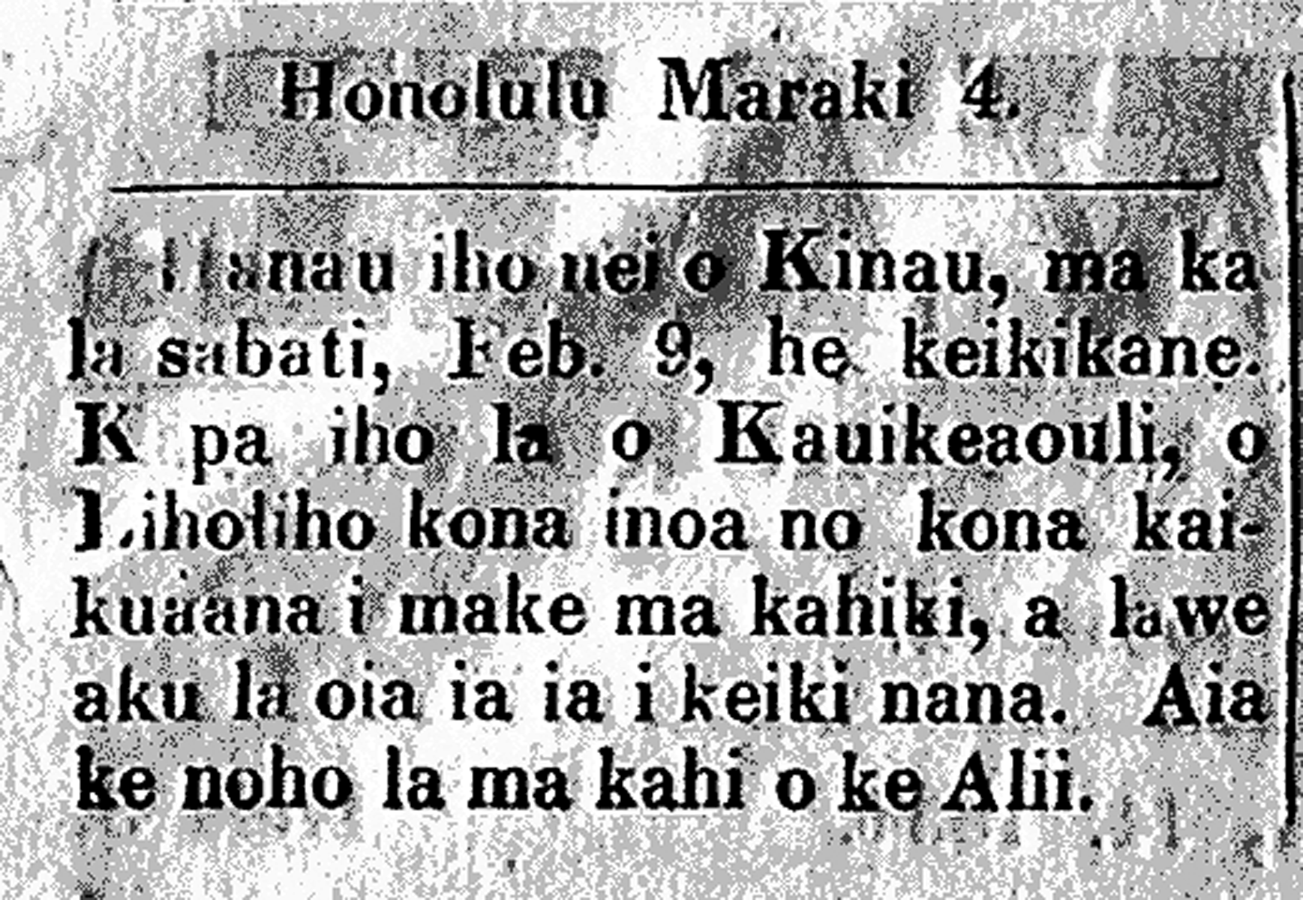
Honolulu March 4.

Kinau just gave birth, on the sabbath, Feb. 9, to a son. Kauikeaouli named him, Liholiho, for his older brother who died in foreign lands; and he took him as a child. He is living in the court of the King.

(Lama Hawaii, 3/14/1834, p. 2)

Honolulu Maraki 4.

Ka Lama Hawaii, Makahiki 1, Helu 5, Aoao 2. Maraki 14, 1834.

Restoration Day celebration, day number 3! 1844.

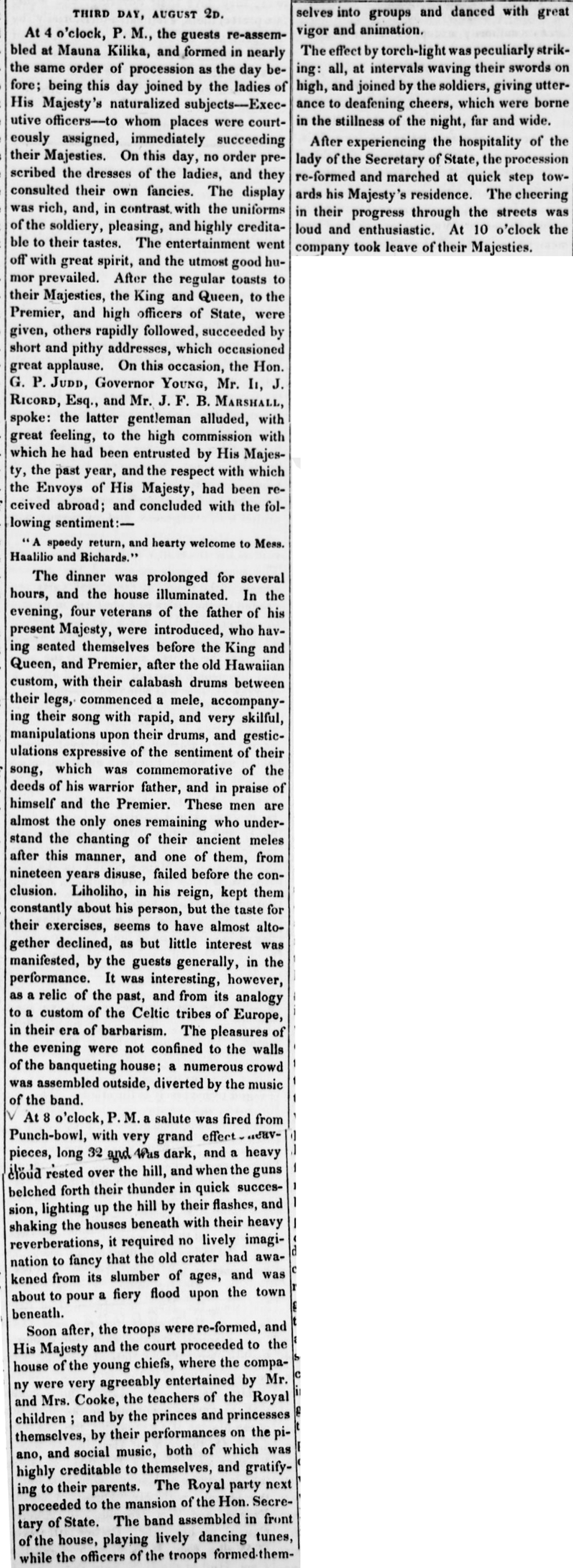
THIRD DAY, AUGUST 2D.

At 4 o’clock, P. M., the guests re-assembled at Mauna Kilika, and formed in nearly the same order of procession as the day before; being this day joined by the ladies of His Majesty’s naturalized subjects—Executive officers—to whom places were courteously assigned, immediately succeeding their Majesties. On this day, no order prescribed the dresses of the ladies, and they consulted their own fanices. The display was rich, and, in contrast with the uniforms of the soldiery, pleasing and highly creditable to their tastes. The entertainment went off with great spirit, and the utmost good humor prevailed. After the regular toasts to their Majesties, the King and Queen, to the Premier, and high officers of State, were given, others rapidly followed, succeeded by short and pithy addresses, which occasioned great applause. On this occasion, the Hon. G. P. Judd, Governor Young, Mr. Ii, J. Ricord, Esq., and Mr. J. F. B. Marshall, spoke: the latter gentleman alluded, with great feeling, to the high commission with which he had been entrusted by His Majesty, the past year, and the respect with which the Envoys of His Majesty, had been received abroad; and concluded with the following sentiment:—

“A speedy return, and hearty welcome to Mess. Haalilio and Richards.”

The dinner was prolonged for several hours, and the house illuminated. In the evening, four veterans of the father of his present Majesty, were introduced, who having seated themselves before the King and Queen, and Premier, after the old Hawaiian custom, with their calabash drums between their legs, commenced a mele, accompanying their song with rapid, and very skillful, manipulations upon their drums, and gesticulations expressive of the sentiment of their song, which was commemorative of the deeds of his warrior father, and in praise of himself and the Premier. These men are almost the only ones remaining who understand the chanting of their ancient meles after this manner, and one of them, from nineteen years disuse, failed before the conclusion. Liholiho, in his reign, kept them constantly about his person, but the taste for their exercises, seems to have almost altogether declined, as but little interest was manifested, by the guests generally, in the performance. It was interesting, however, as a relic of the past, and from its analogy to a custom of the Celtic tribes of Europe, in their era of barbarism. The pleasures of the evening were not confined to the walls of the banqueting house; a numerous crowd was assembled outside, diverted by the music of the band.

At 8 o’clock, P. M. a salute was fired from Punch-bowl, with very grand effect [not legible because of fold in paper] cloud rested over the hill, and when the guns belched forth their thunder in quick succession, lighting up the hill by their flashes, and shaking the houses beneath with their heavy reverberations, it required no lively imagination to fancy that the old crater had awakened from its slumber of ages, and was about to pour a fiery flood upon the town beneath.

Soon after, the troops were re-formed, and His Majesty and the court proceeded to the house of the young chiefs, where the company were very agreeably entertained by Mr. and Mrs. Cooke, the teachers of the Royal children; and by the princes and princesses themselves, by their performances on the piano, and social music, both of which was highly creditable to themselves, and gratifying to their parents. The Royal party next proceeded to the mansion of the Hon. Secretary of State. The band assembled in front of the house, playing lively dancing tunes, while the officers of the troops formed themselves into groups and danced with great vigor and animation.

The effect by torch-light was peculiarly striking: all, at intervals waving their swords on high, and joined by the soldiers, giving utterance to deafening cheers, which were borne in the stillness of the night, far and wide.

After experiencing the hospitality of the lady of the Secretary of State, the procession re-formed and marched at quick step towards his Majesty’s residence. The cheering in their progress through the streets was loud and enthusiastic. At 10 o’clock the company took leave of their Majesties.

(Polynesian, 8/10/1844, p. 47)

THIRD DAY, AUGUST 2D.

The Polynesian, New Series, Volume 1,—Number 12, Page 47. August 10, 1844.

Joseph Emerson interrupts meeting at the Kapuukolo Church, 1893.

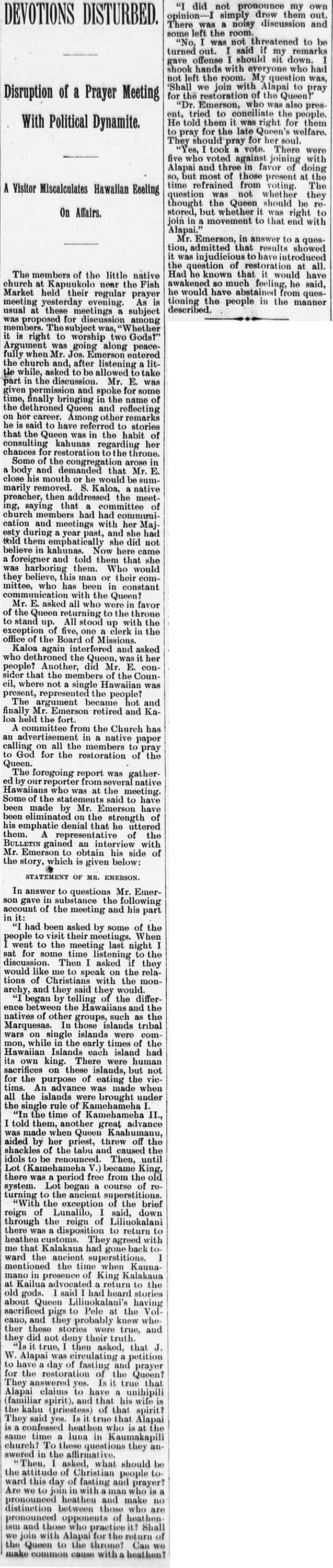
DEVOTIONS DISTURBED.

Disruption of a Prayer Meeting With Political Dynamite.

A Visitor Miscalculates Hawaiian Feeling On Affairs.

The members of the little native church at Kapuukolo near the Fish Market held their regular prayer meeting yesterday evening. As is usual at these meetings a subject was proposed for discussion among members. The subject was, “Whether it is right to worship two Gods?” Argument was going along peacefully when Mr. Jos. Emerson entered the church and, after listening a little while, asked to be allowed to take part in the discussion. Mr. E. was given permission and spoke for some time, finally bringing in the name of the dethroned Queen and reflecting on her career. Among other remarks he is said to have referred to stories that the Queen was in the habit of consulting kahunas regarding her chances for restoration to the throne.

 Some of the congregation arose in a body and demanded that Mr. E. close his mouth or he would be summarily removed. S. Kaloa, a native preacher, then addressed the meeting, saying that a committee of church members had had communication and meetings with her Majesty during a year past, and she had told them emphatically she did not believe in kahunas. Now here came a foreigner and told them that she was harboring them. Who would they believe, this man or their committee, who has been in constant communication with the Queen?

Mr. E. asked all who were in favor of the Queen returning to the throne to stand up. All stood up with the exception of five, one a clerk in the office of the Board of Missions.

Kaloa again interfered and asked who dethroned the Queen, was it her people? Another, did Mr. E. consider that the members of the Council, where not a single Hawaiian was present, represented the people?

The argument became hot and finally Mr. Emerson retired and Kaloa held the fort.

A committee from the Church has an advertisement in a native paper calling on all the members to pray to God for the restoration of the Queen.

The foregoing report was gathered by our reporter from several native Hawaiians who was at the meeting. Some of the statements said to have been made by Mr. Emerson have been eliminated on the strength of his emphatic denial that he uttered them. A representative of the Bulletin gained an interview with Mr. Emerson to obtain his side of the story, which is given below:

STATEMENT OF MR. EMERSON.

In answer to questions Mr. Emerson gave in substance the following account of the meeting and his part in it:

 “I had been asked by some of the people to visit their meetings. When I went to the meeting last night I sat for some time listening to the discussion. Then I asked if they would like me to speak on the relations of Christianity with the monarchy, and they said they would.

“I began by telling of the difference between the Hawaiians and the natives of other groups, such as the Marquesas. In those islands tribal wars on single islands were common, while in the early times of the Hawaiian Islands each island had its own king. There were human sacrifices on these islands, but not for the purpose of eating the victims. An advance was made when all the islands were brought under the single rule of Kamehameha I.

“In the time of Kamehameha II., I told them, another great advance was made when Queen Kaahumanu, aided by her priest, threw off the shackles of the tabu and caused the idols to be renounced. Then, until Lot (Kamehameha V.) became King, there was a period free from the old system. Lot began a course of returning to the ancient superstitions.

“With the exception of the brief reign of Lunalilo, I said, down through the reign of Liliuokalani there was a disposition to return to heathen customs. They agreed with me that Kalakaua had gone back toward the ancient superstitions. I mentioned the time when Kaunamano in the presence of King Kalakaua at Kailua advocated a return to the old gods. I said I had heard stories about Queen Liliuokalani’s having sacrificed pigs to Pele at the Volcano, and they probably knew whether these stories were true, and they did not deny their truth.

“Is it true, I then asked, that J. W. Alapai was circulating a petition to have a day of fasting and prayer for the restoration of the Queen? They answered yes. Is it true that Alapai claims to have a unihipili (familiar spirit), and that his wife is the kahu (priestess) of that spirit? They said yes. Is it tre that Alapai is a confessed heathen who is at the same time a luna in Kaumakapili church? To these questions they answered in the affirmative.

“Then, I asked, what should be the attitude of Christian people toward this day of fasting and prayer? Are we to join in with a man who is a pronounced heathen and make no distinction between those who are pronounced opponents of heathenism and those who practice it? Shall we join with Alapai for the return of the Queen to the throne? Can we make common cause with a heathen?

“I did not pronounce my own opinion—I simply drew them out. There was a noisy discussion and some left the room.

“No, I was not threatened to be turned out. I said if my remarks gave offense I should sit down. I shook hands with everyone who had not left the room. My question was, ‘Shall we join with Alapai to pray for the restoration of the Queen?’

“Dr. Emerson, who was also present, tried to conciliate the people. He told them it was right for them to pray for the late Queen’s welfare. They should pray for her soul.

“Yes, I took a vote. There were five who voted against joining with Alapai and three in favor of doing so, but most of those present at the time refrained from voting. The question was not whether they thought the Queen should be restored, but whether it was right to join in a movement to that end with Alapai.”

Mr. Emerson, in answer to a question, admitted that results showed it was injudicious to have introduced the question of restoration at all. Had he known that it would have awakened so much feeling, he said, he would have abstained from questioning the people in the manner described.

[This article was translated in Leo o ka Lahui, 2/9/1893, p. 2. It is interesting that there is a note appended to the end of the translated article that they did not have time to translate Emerson’s response.]

(Daily Bulletin, 2/7/1893, p. 3)

DEVOTIONS DISTURBED.

The Daily Bulletin, Volume V, Number 644, Page 3. February 7, 1893.

“King of the Cannibal Islands,” 1830 / 1872.

By 1830 at least, there was a mocking ballad called “King of the Cannibal Islands” that was popular in the United Kingdom (as seen in newspaper advertisements for various concerts). Click here for lyrics printed on a broadside in 1858. By many accounts this was written in response to Kamehameha II going to England in 1824.

As a result of another famous trip taken by a Hawaiian monarch in 1874, the lyrics are adapted in America (the original song popular there much earlier).

THE KING OF THE CANNIBAL ISLANDS.

[From the N. Y. Graphic.]

Tam? Tam! Kalakaua the great
Is booming through the Golden Gate;
The Polynesian potentate,
The King of the Cannibal Islands.

Chorus—Hunki-dori-doodle-dum,
Ministers all upon a bum;
Honolulu! How they come
With the King of the Cannibal Islands.

From sugar-coated Hawaii
He comes strange countries for to see;
And ‘Frisco greets him: “How are ye?
O King of the Cannibal Islands.
Hunki-dori, etc. Continue reading

On Kaumualii and Kaahumanu, 1880.

[From: “Ka Moolelo o Kaahumanu”]

Kaahumanu was one of them who made a circuit of Maui, Oahu, and Kauai with Liholiho. When Kaahumanu arrived on Kauai, she took Kaumualii, the alii of Kauai, as a kane [husband] for herself. When Liholiho returned to Oahu, it was with Haakulou, the woman of Kaumualii; because Liholiho took Haakulou as a wahine [wife] for himself, along with his other wahine.

Kaahumanu lived on Kauai along with Kaumualii in the year 1822. Perhaps in the month of August.

Kaahumanu wanted to seek out Nihoa. It was the very first time that Nihoa was found, that tiny island to the North-West of Niihau. Continue reading

Hole Waimea i ka ihe a ka makani, 1927.

A NAME SONG FOR LIHOLIHO.

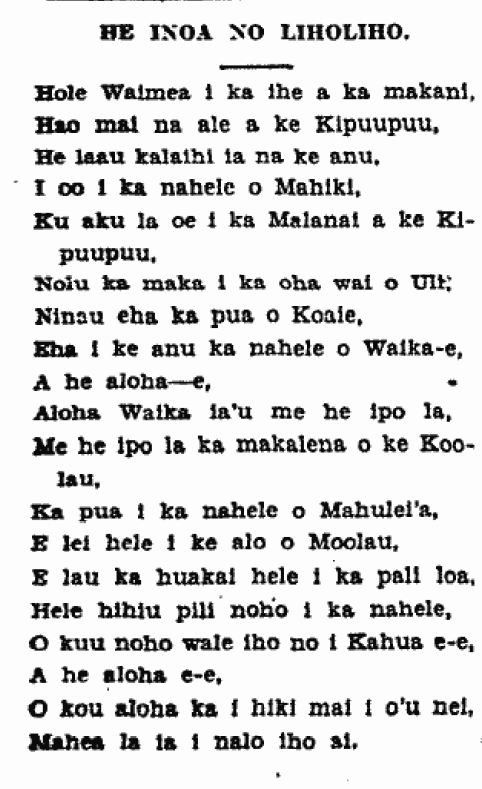
HE INOA NO LIHOLIHO.

Hole Waimea i ka ihe a ka makani,
Hao mai na ale a ke Kipuupuu,
He laau kalaihi ia na ke anu,
I oo i ka nahele o Mahiki,
Ku aku la oe i ka Malanai a ke Kipuupuu,
Nolu ka maka i ka oha wai o Uli,
Ninau eha ka pua o Koaie,
Eha i ke anu ka nahele o Waika-e,
A he aloha—e,
Aloha Waika ia’u me he ipo la,
Me he ipo la ka makalena o ke Koolau,
Ka pua i ka nahele o Mahulei’a,
E lei hele i ke alo o Moolau,
E lau ka huakai hele i ka pali loa,
Hele hihiu pili noho i ka nahele,
O kuu noho wale iho no i Kahua e-e,
A he aloha e-e,
O kou aloha ka i hiki mai i o’u nei,
Mahea la ia i nalo iho ai.

(Kuokoa, 7/14/1927, p. 6)

HE INOA NO LIHOLIHO.

Ka Nupepa Kuokoa, Buke LXVI, Helu 28, Aoao 6. Iulai 14, 1927.

G. S. Kelii passes away, 1924.

OUR BELOVED FATHER HAS GONE.

Much aloha to the Kuokoa Newspaper, the lamp of the parlor; give welcome to my aloha within your columns so that the intimates and friends who live in all the corners of the land may see.

In the month of January 26, 1924, my beloved father, G. S Kelii, grew weary of this life and returned to the home beyond where our beloved Lord called to us. O Weary and Dejected, come to Me and I will give you comfort.

My beloved father was born in Kau, Hawaii, during the time of Kamehameha II, when the people were taxed… Continue reading

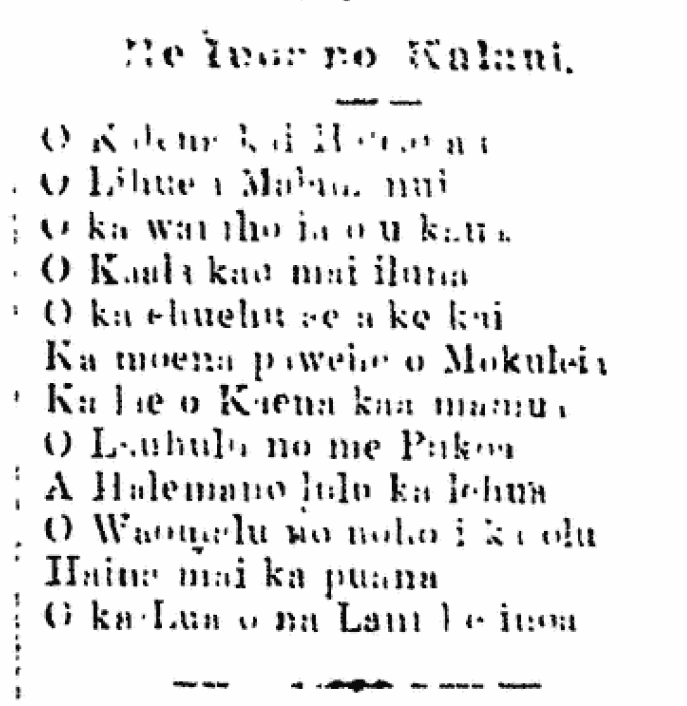
More hidden mele: a name song for Kamehameha II, 1893.

He Inoa no Kalani.

O Kalena kai Haleauau
O Lihue i Malamanui
O ka wai iho ia olu kaua
O Kaala kau mai iluna
O ka ehuehu ae a ke kai
Ka moena pawehe o Mokuleia
Ka lae o Kaena kaa mamua
O Lauhulu no me Pukoa
A Halemano lulu ka lehua
O Waomalu no noho i ka olu
Haina mai ka puana
O ka Lua o na Lani he inoa

[This mele, a name song for Kamehameha II, is still popular today, and is more commonly known as “Kalena Kai.” It was not “hidden” within a separate moolelo, but the reason that it was and is hard to find is that the digital images of this newspaper, Lei Momi, are terrible. I hope one day soon this and all the other Hawaiian-Language Newspapers will be rescanned as clearly as possible before they disintigrate…]

(Lei Momi, 7/8/1893, p. 4)

He Inoa no Kalani.

Ka Lei Momi, Buke 1, Helu 14, Aoao 4. Iulai 8, 1893.